
TL;DR
In the NIST AI RMF vs ISO 42001 decision, NIST helps your teams do AI risk work well, while ISO/IEC 42001 lets an auditor certify that the work runs. The NIST AI RMF is a free, voluntary framework, and NIST does not certify anyone against it. ISO/IEC 42001 is a management-system standard, and third-party certification bodies issue its certificates. Pick NIST when the goal is managing AI risk internally, and pick ISO when customers or partners want third-party proof. Many organizations need both, so they run one control register and tag each control to the NIST subcategory and ISO clause it meets. Neither one equals EU AI Act compliance, although both help you build the evidence the Act asks for.
Key Takeaways
- The NIST AI RMF is a voluntary risk framework built on four functions (Govern, Map, Measure, Manage), and no NIST certificate exists for it.
- ISO/IEC 42001 sets requirements for an AI management system, and third-party certification bodies audit and certify it.
- The two overlap most on risk and impact assessment, while ISO alone requires internal audit, management review and corrective action.
- Choose by the question your buyer or regulator asks, because a certificate proves conformity and a NIST assessment explains how you manage AI risk.
- Running both costs far less when one control register carries a tag for each framework instead of two separate programs.
- Neither framework makes you EU AI Act compliant, and NIST has published no AI RMF 2.0, so work from version 1.0 as of November 2026.
The Questionnaire Line That Forces a Choice
Picture the last week of a promising enterprise deal. The buyer’s procurement team sends its AI questionnaire, and one line asks for a copy of your ISO/IEC 42001 certificate.
Meanwhile, your AI team has spent a year on the NIST AI RMF. It has an inventory, impact assessments and a risk register to show for it.
None of that is a certificate, though. So the head of risk has a few days to choose.
Should the reply lean on the NIST work, start an ISO program, or commit to both? The scene is illustrative, but plenty of AI vendors and enterprise risk teams face the same call in 2026.
The choice gets easier once you see what each document is for. One helps you do the risk work well, and the other lets an outsider check that the work keeps running.
NIST AI RMF vs ISO 42001 at a Glance
The fastest way to compare the two is side by side. The table sets out what each one is, who publishes it, how it is built and what you can claim at the end.
| Dimension | NIST AI RMF | ISO/IEC 42001 |
|---|---|---|
| What it is | A voluntary framework of outcomes for managing AI risk | A standard with requirements for an AI management system (AIMS) |
| Publisher and date | NIST, version 1.0 released 26 January 2023 | ISO/IEC JTC 1/SC 42, published 18 December 2023 |
| Revision status | NIST says 1.0 is being revised under the White House AI Action Plan | First edition; supporting standards 42005 and 42006 followed in 2025 |
| Structure | Four functions, 19 categories, 72 subcategories | Clauses 4 to 10 in the shared management-system structure, plus Annex A reference controls and Annex B guidance |
| Main output | Risk decisions and evidence for each AI system | An operating, audited management system for a defined scope |
| Certification | None from NIST | Certificate from a third-party certification body |
| Who checks it | Your own teams, or an assessor you hire | A certification body, through Stage 1 and Stage 2 audits and yearly surveillance |
| Companion guidance | Generative AI Profile (NIST AI 600-1, July 2024) | Impact assessment guidance in ISO/IEC 42005 (May 2025) |
| Cost to access | Free download | Paid standard |
Two Columns, Two Different Jobs
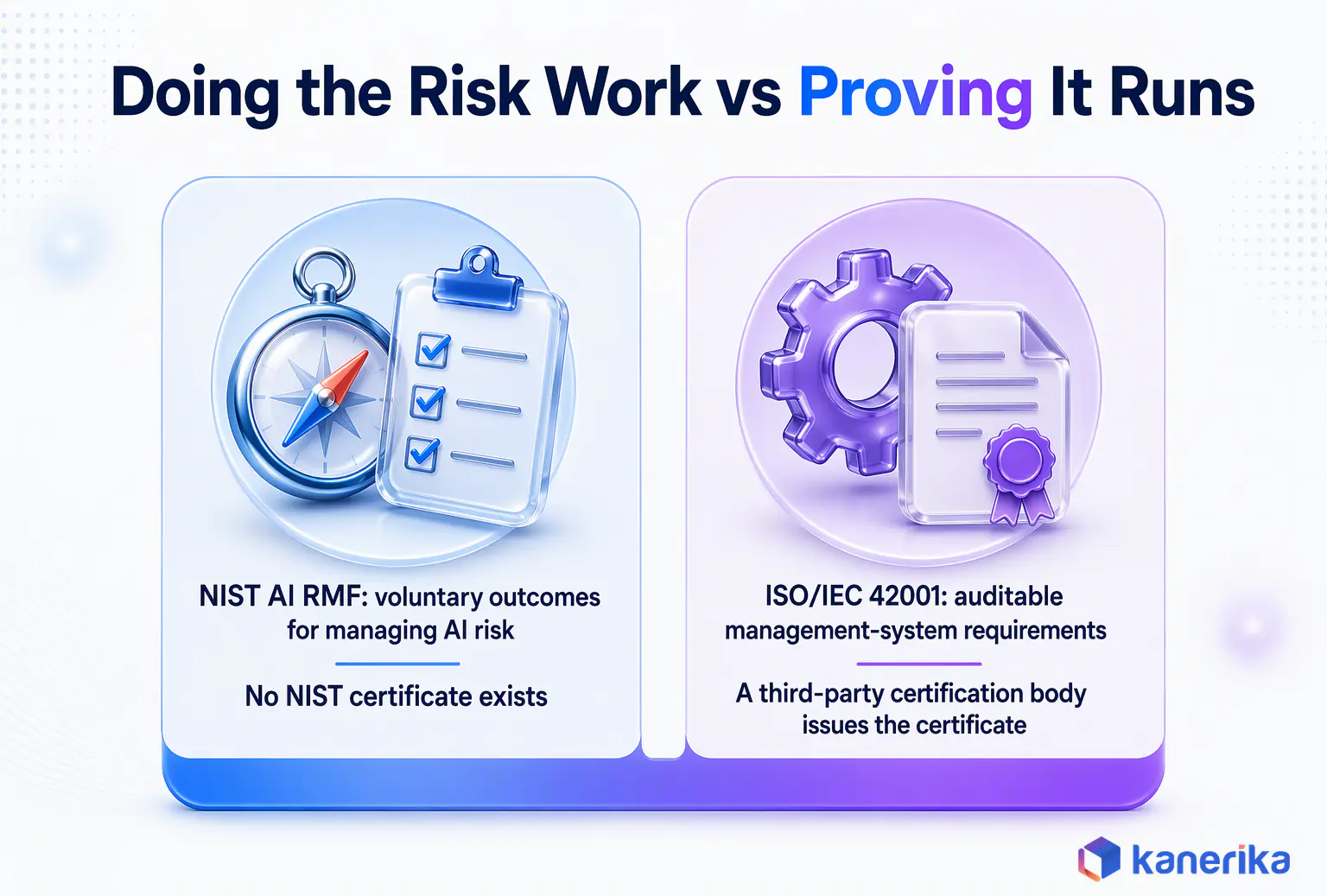
Read the left column as a way of working. The NIST framework describes the outcomes a mature AI risk program reaches. The NIST AI RMF Playbook guide shows how teams turn those outcomes into actions. NIST still describes version 1.0 as a framework intended for voluntary use.
Read the right column, by contrast, as a system someone else can audit. ISO/IEC 42001 tells you what an AI management system must contain, and the ISO 42001 certification walkthrough covers the audit itself.
If you are still weighing frameworks in general, the AI governance framework overview compares the wider field. Both are voluntary to adopt, but only ISO ends in a certificate.
The Real Difference: Doing the Risk Work vs Proving the System Runs
Both documents care about the same AI risks, so the overlap is large. They differ in what they ask you to produce, who looks at it, and what a good result lets you say in public.
Outcomes You Aim for vs Requirements an Auditor Tests
NIST writes its framework as outcomes. The AI RMF 1.0 text says its actions “do not constitute a checklist, nor are they necessarily an ordered set of steps.”
As a result, a bank and a retail startup can apply the same subcategory in different ways. That is deliberate, because NIST meant the framework to fit any sector and use case.
ISO/IEC 42001 works the other way round. It states requirements, and an auditor samples evidence against each one.
Internal audit (clause 9.2), management review (9.3) and corrective action (10.2) are mandatory there. So a team that skips them fails the audit, even when its models behave well.
AI Systems in View vs a Scoped Management System
NIST keeps its eye on AI systems and their context. MAP 1.1, for example, asks you to document each system’s intended purpose and setting.
The unit of work is therefore usually one model or one use case. That focus suits the everyday goals of responsible AI, such as fair outcomes and safe behavior in a specific setting.
ISO certifies a management system inside a boundary you draw under clause 4.3. Within that scope, the standard lets you apply its requirements with a risk-based approach to each AI use case, product or service. A narrow scope makes a first audit easier, but it also limits what the certificate covers.
What an ISO 42001 Certificate Does and Does Not Prove
A certificate shows that a scoped AI management system was operating when the auditor sampled it. That is a strong signal for a buyer, because an independent body checked the system against a public standard.
A certificate does not prove that every model is accurate, fair or safe. It also says nothing about AI systems outside the scope statement, and it does not amount to EU AI Act conformity. So buyers who treat it as a blanket guarantee read more into it than the auditor wrote.
How the Four NIST Functions Map to ISO 42001 Clauses
Much of the work for one framework produces evidence the other can use, so mapping the two early saves a second round of documentation later.
An Evidence-Level Crosswalk
Treat the table below as an interpretive aid rather than an official equivalence. NIST’s AI Resource Center lists published mappings, including a NIST AI RMF to ISO/IEC 42001 crosswalk from Microsoft. Check your own mapping against them before an auditor sees it.
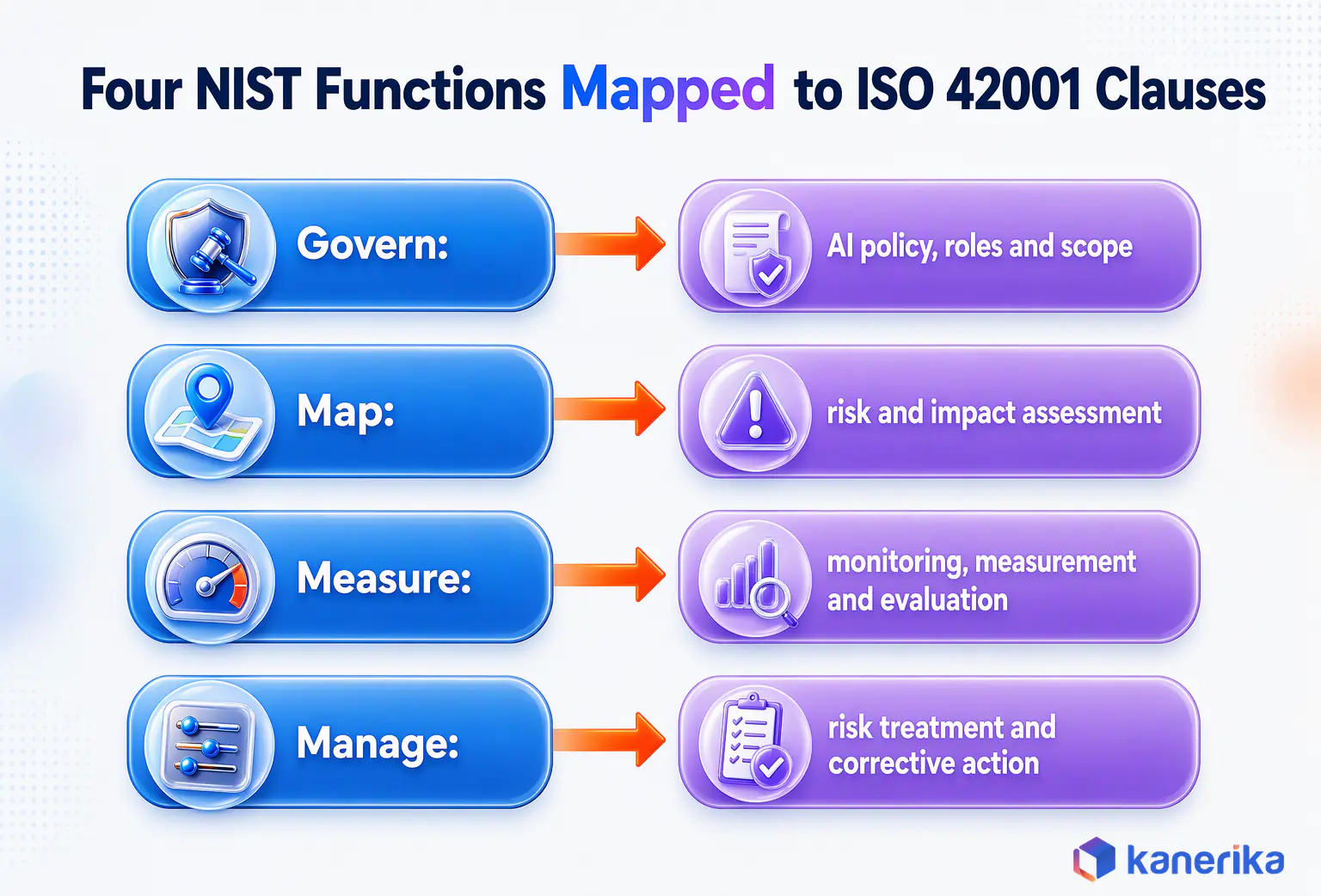
| NIST function | Example subcategories | ISO/IEC 42001 clauses | Shared evidence | What ISO adds |
|---|---|---|---|---|
| GOVERN | 1.6 inventory of AI systems; 2.1 documented roles and lines of communication; 6.1 policies for third-party AI risk | 4.3 scope; 5.2 AI policy; 5.3 roles; 7.2 competence; 7.5 documented information | AI policy, RACI chart and AI system inventory | Document control and inputs to management review |
| MAP | 1.1 intended purpose and context; 5.1 likelihood and magnitude of each impact | 4.1 and 4.2 context and interested parties; 6.1.2 risk assessment; 6.1.4 and 8.4 AI system impact assessment | Use-case intake record and impact assessment | Assessments repeated at planned intervals as an operating requirement |
| MEASURE | 1.1 metrics for the most significant risks first; 2.1 test sets, metrics and testing tools documented; 3.1 tracking of emergent risks | 9.1 monitoring, measurement, analysis and evaluation; 8.2 operational risk assessment | Evaluation report and monitoring dashboard export | Results feed the internal audit in 9.2 |
| MANAGE | 1.3 responses (mitigate, transfer, avoid, accept); 3.1 third-party risk monitoring; 4.1 post-deployment monitoring; 4.3 incident tracking | 6.1.3 and 8.3 risk treatment; 10.1 continual improvement; 10.2 nonconformity and corrective action | Risk register with treatment decisions, plus an incident log | Corrective-action records and an improvement trail |
The mapping is many-to-many. GOVERN cuts across the whole NIST framework, so its outcomes touch almost every ISO clause.
Similarly, a single clause such as 6.1.2 draws on several MAP and MEASURE subcategories. Annex A then lists reference control objectives and controls, and your risk treatment decides which of them apply.
Where the Two Do Not Overlap
First, NIST goes deeper on measurement. It names seven trustworthiness characteristics, from valid and reliable to explainable and interpretable to fair with harmful bias managed. It also expects documented test, evaluation, verification and validation (TEVV) work, which is where practices such as AI red teaming fit.
ISO asks you to monitor and evaluate, too, but it leaves the depth of testing to your own risk assessment. Where ISO goes further is the machinery of a management system.
Internal audit, management review, control of documented information and corrective action are all mandatory. A team that starts with NIST should therefore expect these four pieces to be its main gap before an ISO audit.
Certification and Assurance: What Each Lets You Claim
NIST does not certify organizations against the AI RMF. When its AI RMF FAQ asks whether anyone must use the framework, the answer is a plain “No.”
NIST also publishes no certification scheme. So any “NIST AI RMF certified” badge comes from a third party running its own assessment.
ISO does not certify anyone either. ISO’s certification page says external certification bodies do that work, and it adds that accreditation of those bodies is not compulsory. Since July 2025, ISO/IEC 42006 has set extra requirements, on top of ISO/IEC 17021-1, for bodies that audit and certify an AI management system.
The ISO path runs in a fixed rhythm. Year one brings a Stage 1 and a Stage 2 audit.
After a pass, the certificate lasts three years, with surveillance audits in years two and three, according to Schellman’s ISO 42001 FAQ. Because the claims people make are not always that precise, it pays to know what to ask for.
| Claim you see | What it means | What to ask for |
|---|---|---|
| “ISO/IEC 42001 certificate” | A certification body audited a scoped AI management system | The certificate, scope statement, issuing body, accreditation, validity dates and exclusions |
| “Follows the NIST AI RMF” | The organization uses NIST outcomes to manage AI risk, and nobody certified it | Assessment method, AI systems covered, evidence samples and open gaps |
| “NIST AI RMF certified” | A third party’s own label, since NIST certifies no one | Who assessed, against which criteria, and whether the label means more than a self-attestation |
The same three questions belong in your own supplier reviews. The guide to AI vendor risk assessment turns them into a scored questionnaire. An AI auditing framework then shows how an assessor tests the answers you get back.
Checklist
AI Governance Checklist
A practical checklist of the policies, owners, reviews and evidence an AI governance program needs before a NIST assessment or an ISO 42001 audit.
Get the Checklist →Cost and Timeline: Where the Effort Actually Goes
Neither framework has a price tag on its own. Instead, the spend sits in the work both require, plus a layer of audit and documentation that only ISO adds.
| Cost component | NIST AI RMF | ISO/IEC 42001 |
|---|---|---|
| Access to the text | Free PDF from NIST | Paid standard from ISO, IEC or a national body |
| AI inventory, risk and impact assessment | Needed | Needed |
| Evaluation and monitoring | Needed, often in more depth | Needed, with depth set by your risk assessment |
| Documentation | Light, set by your own needs | Required, with document control |
| Internal audit and management review | Optional | Required |
| Certification-body fees | None | Stage 1 and Stage 2 audits, then yearly surveillance |
| Ongoing cycle | Set by your own review cadence | Three-year certificate with surveillance in years two and three |
Only one line in that table has a published market figure, though. Schellman, a certification body, says year-one Stage 1 and Stage 2 audit fees typically run from the $20,000s up to the $40,000s.
Surveillance then costs $13,000 to $20,000 or more a year. Those are one provider’s audit fees, so staff time and any outside help sit on top.
For the full three-year budget, line by line, see the ISO 42001 certification cost breakdown.
Timelines depend on four things no price list shows: the AI systems in scope, an existing ISO 27001 system, documentation maturity and evidence history. A company with an ISO 27001 program already runs audits, reviews and document control, so it starts well ahead.
AI Assessment
See How Ready Your AI Program Is for an Audit
Score your organization’s AI maturity across data, governance and security to see how much groundwork stands between you and a NIST assessment or an ISO 42001 audit.
Start Your AI Assessment →Who Recognizes What: US Buyers, Regulators and the EU AI Act
Recognition often decides which framework pays off first, because a certificate only helps when someone you sell to or answer to values it.
In the US
Congress directed NIST to develop the AI RMF as a voluntary framework, and it remains voluntary as of November 2026. State law has started to name it too.
Texas HB 149 took effect on January 1, 2026. Among the ways a defendant can avoid liability, it lists substantial compliance with the NIST Generative AI Profile or another recognized AI risk framework.
Enterprise procurement follows its own questionnaire. A certificate answers “are you certified?”
By contrast, a NIST-based assessment answers “how do you manage AI risk?” So the cheapest move is to ask the buyer which one they need before you build anything. The wider rules behind those questionnaires appear in the guide to AI regulation and the overview of AI compliance.
In the EU
Neither framework adds up to EU AI Act compliance. Article 40 of the Act grants a presumption of conformity only for harmonised standards whose references appear in the Official Journal.
Even then, it covers only the requirements those standards address. Article 17 also requires providers of high-risk AI systems to run a quality management system. An AIMS gives that work a head start, but it does not replace the Act’s conformity assessment.
The timing has also moved. Regulation (EU) 2026/1744 pushes high-risk obligations to 2 December 2027 for Annex III systems and 2 August 2028 for Annex I systems.
Generative systems already on the market before 2 August 2026 must meet the Article 50(2) marking duty by 2 December 2026. The EU AI Act compliance guide maps those obligations in detail. For banks, insurers and payments firms, the guide to AI governance in financial services sorts out which rules apply to which firm.
Which Should You Start With? A Decision Matrix
“It depends” is true but unhelpful. The matrix gives a starting point and a first 90-day move for six common situations, so you can find your row and act on it.
| Your situation | Start with | Why | First 90-day move |
|---|---|---|---|
| SaaS or AI vendor whose enterprise customers ask for ISO 42001 | ISO/IEC 42001 | Customers want third-party proof | Scope the AIMS to one product line and book a certification body |
| US enterprise using AI internally, with no outside request | NIST AI RMF | The job is managing risk, and nobody has asked for proof | Build the AI inventory and assess the five highest-risk use cases |
| Company already certified to ISO 27001 | ISO/IEC 42001, with NIST for measurement depth | Audit, review and document control already run | Extend the existing management system to AI and add NIST-style testing |
| Heavy generative AI or agent use | NIST AI RMF plus the Generative AI Profile, then ISO | GenAI risks need detailed measurement first | Map GenAI use cases against NIST AI 600-1 and set evaluation metrics |
| EU provider or deployer of high-risk AI | Both, mapped to AI Act obligations | The Act asks for risk management and a quality management system | Tag controls to Articles 9 and 17 and get legal review of the mapping |
| Bank or insurer with a model risk function | NIST AI RMF inside model risk management | Model validation already exists to build on | Fold AI systems into the model inventory and validation cycle, then add ISO when a customer or group policy asks |
Generative AI, Agents and Model Risk Teams
Two rows deserve a closer look. Teams with heavy GenAI use can pair the NIST profile with generative AI governance and agentic AI governance practices.
That matters because autonomous tools add permission and oversight risks a chatbot never had. Banks, meanwhile, can fold the NIST functions into the validation habits described in machine learning governance.
When Neither Framework Should Come First
Sometimes neither framework should come first. If you have no AI inventory, no named owner for AI risk, or a live incident on your hands, fix that before picking a standard. An AI governance assessment finds those gaps fastest, and the AI governance maturity model shows how far each fix moves you.
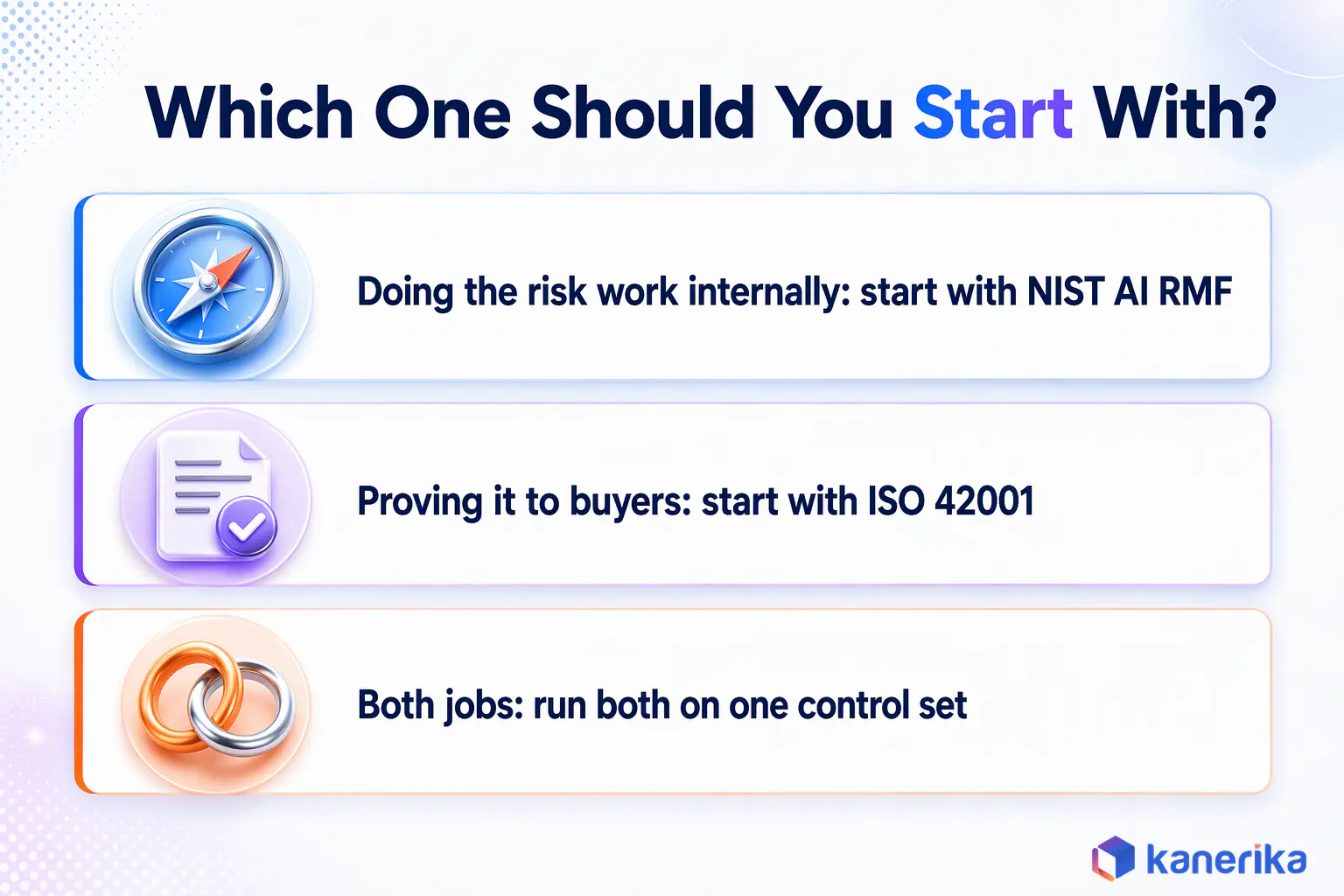
The rule underneath the matrix is short. Use NIST when the job is doing the risk work and ISO when the job is proving it to outsiders. When you have both jobs, use both.
Kanerika Service
AI Governance Consulting Services
Kanerika’s AI governance services include a governance assessment that surfaces gaps before they become audit findings, risk tiering with defined accountability, and model impact assessments before deployment.
Explore AI Governance ServicesHow to Run Both on One Control Set
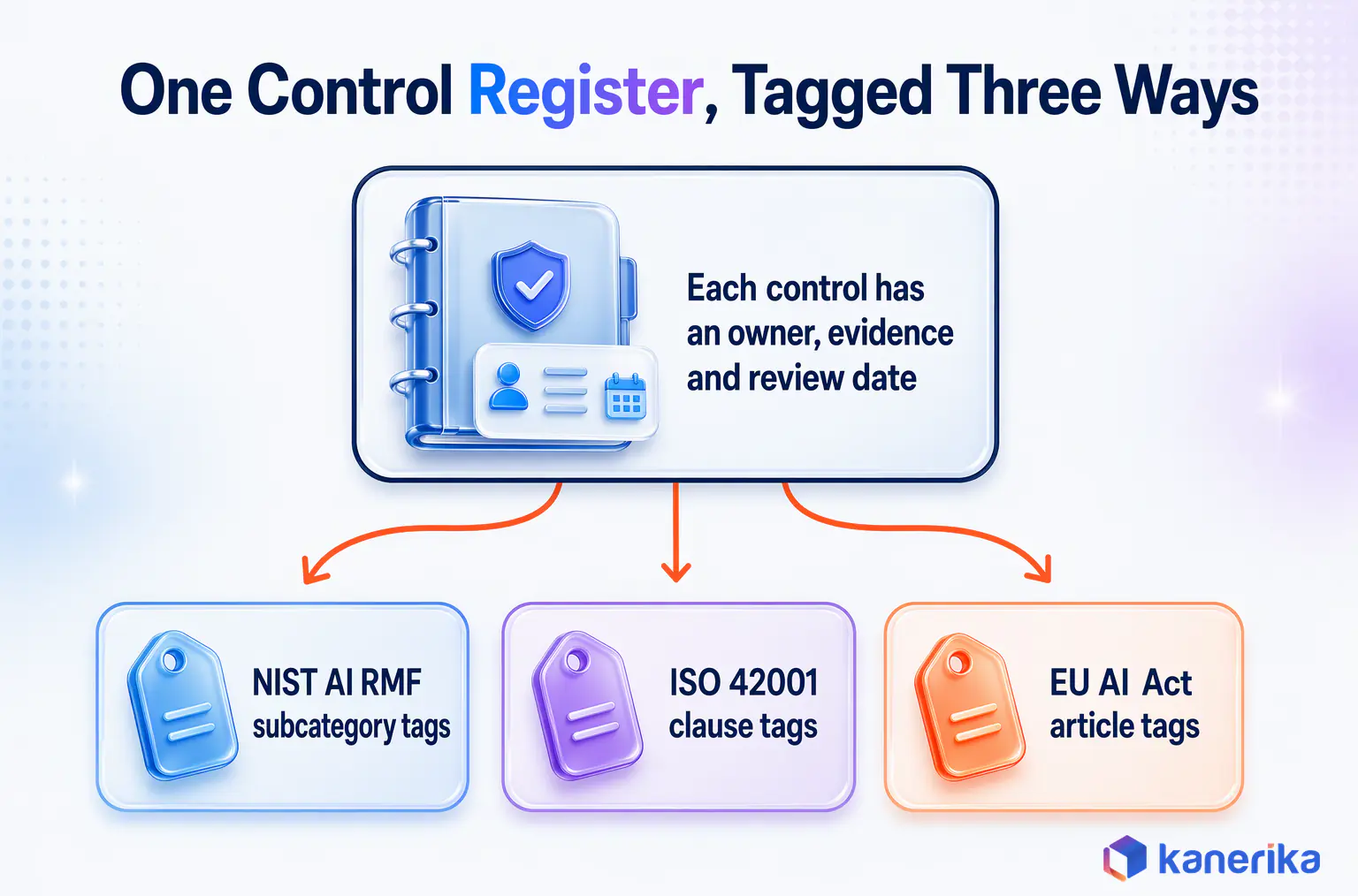
Two programs side by side double the paperwork and split ownership. One control register, with each control tagged to every framework it meets, gives you two views of the same work.
Each row in that register holds the control, its owner and the AI systems in scope. It also records the risk the control treats, where the evidence lives and how often someone reviews it.
Finally, each row carries tags for a NIST subcategory, an ISO clause and, where it applies, an EU AI Act article. When a buyer asks for ISO evidence, you filter by clause. When the board asks how you manage AI risk, you filter by NIST function.
What to Build Once
- An AI system inventory, which answers GOVERN 1.6 and also sets the boundary for the ISO scope.
- A use-case risk and impact assessment, built on an AI risk assessment template, with ISO/IEC 42005 guiding the impact side.
- A risk register that records each treatment decision (mitigate, transfer, avoid or accept).
- Evaluation and monitoring evidence, pulled from pipelines your teams already run, with the tooling covered in the LLMOps observability guide.
- Supplier reviews, an incident log and the AI policies themselves.
Data lineage belongs on that list too, because both frameworks ask where training and inference data came from. Teams that already run data lineage tracking for analytics can extend it to models. The split between the two disciplines is set out in AI governance vs data governance.
What ISO Still Asks for on Top
Even so, four pieces stay ISO-only. You need an internal audit program, management reviews with recorded decisions, control of documented information, and corrective-action records that close each nonconformity. Plan them from the start, because an auditor wants evidence that they have already run at least once.
A five-step order keeps the build manageable for most teams.
- Inventory every AI system and pick the ISO scope from that list.
- Tag existing controls to NIST subcategories and ISO clauses, then mark the gaps.
- Adopt one assessment template for every new use case.
- Collect evidence from existing pipelines, with a named owner for each control.
- Run a full internal audit and management review before the Stage 1 audit.
Software helps when the register outgrows a spreadsheet. The AI governance tools roundup compares platforms that keep controls, evidence and framework tags in one place. For the NIST side, the NIST Playbook guide suggests actions for each subcategory you tag.
Common Mistakes in the NIST AI RMF vs ISO 42001 Decision
Five errors come up again and again when teams weigh one framework against the other or try to run both at once.
- Calling a NIST assessment a certification. NIST certifies no one, so a sales deck that says “NIST certified” invites hard questions from any informed buyer.
- Scoping the first ISO audit to every AI system. A narrow first scope gets you certified sooner, and you can widen it in later cycles.
- Keeping two evidence libraries. Two risk registers drift apart, and the mismatch tends to surface during an audit.
- Treating the certificate as AI Act compliance. A 42001 certificate covers a management system, so the Act’s own conformity duties still apply.
- Waiting for an AI RMF 2.0. NIST says version 1.0 is under revision as part of the White House AI Action Plan, but it has published no 2.0, so build on 1.0 and the Generative AI Profile for 2026 work.
Some of the 2.0 talk traces back to April 2026. That month NIST released a concept note for a profile on trustworthy AI in critical infrastructure, which is a profile under the existing framework.
How Kanerika Helps Enterprises Map to Both
Kanerika is not a certification body. It does not hold an ISO/IEC 42001 certificate or a NIST AI RMF attestation, and it does not claim either.
Its own credentials include ISO 27001, ISO 27701:2019 and SOC 2 Type II. The work it does is getting a client’s AI systems, controls and evidence ready for whichever framework the client chooses.
Kanerika’s AI governance services page describes an assessment that “surfaces governance gaps before they become audit findings and tests controls on your highest-risk systems first.” The page frames this work through its IMPACT framework (Identify, Map, Prove, Analyze, Create, Transform). In that framework, Identify surfaces governance gaps, while Prove tests governance controls on the highest-risk systems first.
The build work listed on that page lines up with the crosswalk above. It covers risk tiering with defined accountability, model impact assessments before deployment and a model registry with a full audit trail.
Data lineage from source to model output is on the list too. It also includes bias and fairness auditing, plus LLMOps controls such as prompt-injection protection and hallucination monitoring with audit logging.
The same “define once, reuse everywhere” design shows up in Kanerika’s data work. For a global pharmaceutical enterprise, Kanerika built one governed ontology on Microsoft Fabric that standardized 85+ KPIs.
That work cut manual investigation and reconciliation time by 70%. Power BI and Copilot then used the same trusted definitions, which is the principle a tagged control register follows, with one definition and many views.
Case Study
One Governed Ontology on Microsoft Fabric
A global pharmaceutical enterprise standardized 85+ KPIs in one governed ontology on Fabric, cut manual investigation and reconciliation time by 70%, and reused the same definitions in Power BI and Copilot.
Read the Case Study →Wrapping Up
The NIST AI RMF vs ISO 42001 choice comes down to which job you need done. Use the NIST AI RMF to do the risk work and ISO/IEC 42001 to prove it to outsiders. If you have both jobs, run both.
Start by asking your buyers and regulators what they require, then draw the scope and list the controls you already run. The AI governance hub covers the wider program around either framework. Whichever you pick first, run it on one control set, so the second framework costs far less than the first.
Frequently Asked Questions
Is the NIST AI RMF mandatory?
No. NIST built the AI RMF as a voluntary framework, and its own FAQ says neither private nor public sector organizations are required to use it. It can still become an obligation in practice when a customer contract, a government buyer or a group policy asks suppliers to follow it.
Can a company get NIST AI RMF certified?
No official NIST certification exists. NIST does not certify organizations against the AI RMF, so any NIST AI RMF certified badge comes from a third party using its own method. Ask who performed the assessment, which AI systems it covered, what evidence it sampled and which gaps remain open.
Is ISO 42001 the same as the NIST AI RMF?
No. The NIST AI RMF is a voluntary set of outcomes for managing AI risk, organized into Govern, Map, Measure and Manage. ISO/IEC 42001 is a management-system standard with requirements a certification body can audit. They cover similar risks, but only ISO 42001 leads to a certificate.
Can you use NIST AI RMF and ISO 42001 together?
Yes, and they work well together. The practical method is one control register where each control carries a NIST subcategory tag and an ISO clause tag. Shared evidence such as the AI inventory, impact assessments and the risk register then serves both, and ISO adds internal audit and management review on top.
Should you implement NIST AI RMF before ISO 42001?
Start with NIST when the goal is managing AI risk internally and nobody has asked for proof. Start with ISO 42001 when customers or partners want a certificate, or when you already run an ISO 27001 management system. Either way, map controls to both so the second framework reuses the first one’s work.
How much does ISO 42001 certification cost compared with the NIST AI RMF?
The NIST AI RMF is free to download and has no audit fee. For ISO 42001, Schellman says year-one Stage 1 and Stage 2 audit fees typically run from the $20,000s to the $40,000s, with surveillance at $13,000 to $20,000 or more a year. Internal staff time comes on top.
Does ISO 42001 certification make you EU AI Act compliant?
No. An ISO 42001 certificate covers an AI management system, and it is not the conformity assessment the EU AI Act requires. The Act gives a presumption of conformity only for harmonised standards published in the Official Journal, so high-risk providers still need to meet each obligation directly.
Is there a NIST AI RMF 2.0?
No. NIST says AI RMF 1.0 is being revised as part of the White House AI Action Plan, but it has not published a version 2.0. The April 2026 release was a concept note for a critical infrastructure profile. Organizations should keep working from version 1.0 and the Generative AI Profile.
How long does an ISO 42001 certificate last?
According to Schellman, an organization that passes its Stage 2 audit is certified for three years. Surveillance audits follow in years two and three to confirm the AI management system is still operating, and the scope statement on the certificate defines which AI systems and activities it covers.