AI Recruitment Agent for Resume Screening and Candidate Shortlisting
Screen every application, shortlist with evidence, and keep recruiters in charge of every hiring decision.
Screened against the job brief
Shortlist with reasons shown
Recruiter makes every hire call
Type II certified delivery
Certified security practices
Technology certifications
Screen every application, shortlist with evidence, and keep recruiters in charge of every hiring decision.
Recruiting teams lose days to manual resume review while the strongest candidates accept offers elsewhere. Kanerika builds and runs an AI recruitment agent on your own cloud that reads every application, scores it against the role profile, and hands recruiters a ranked shortlist with the reasoning attached. People make the hiring calls. The agent clears the screening queue, so recruitment workflow automation starts at the step that slows hiring down.
How the AI Recruitment Agent Works Inside Your Hiring Stack
Deployed on Your Infrastructure
Kanerika deploys the recruitment agent on your Azure, AWS, GCP, or on-premises environment. No third-party SaaS ever holds your candidate pipeline.
Governed and Secure by Design
Kanerika is SOC 2 Type II, ISO 27001, and ISO 9001 certified. The agent inherits your access controls and logs every screening action for audit.
Works Where Recruiters Already Work
Shortlists, screening summaries, and alerts arrive in Microsoft Teams, Slack, or email. Recruiters act on them without learning another tool.
Candidate Data Stays in Your Tenant
Resumes, assessments, and notes never leave your environment and are never used to train external models.
Recruiters Stay in the Loop
Every shortlist is a recommendation that a recruiter reviews and approves before any candidate advances or receives a message.
Every Score Is Source-Traced
Each ranking cites the resume evidence and role criteria behind it, so hiring managers see exactly why a candidate placed where they did.
Automating HR Knowledge Search
See how Kanerika’s KlarityIQ document agent answers HR questions from your own policies and records, the same grounded approach the recruitment agent uses on resumes.
Recruitment Process Automation Across the Hiring Funnel
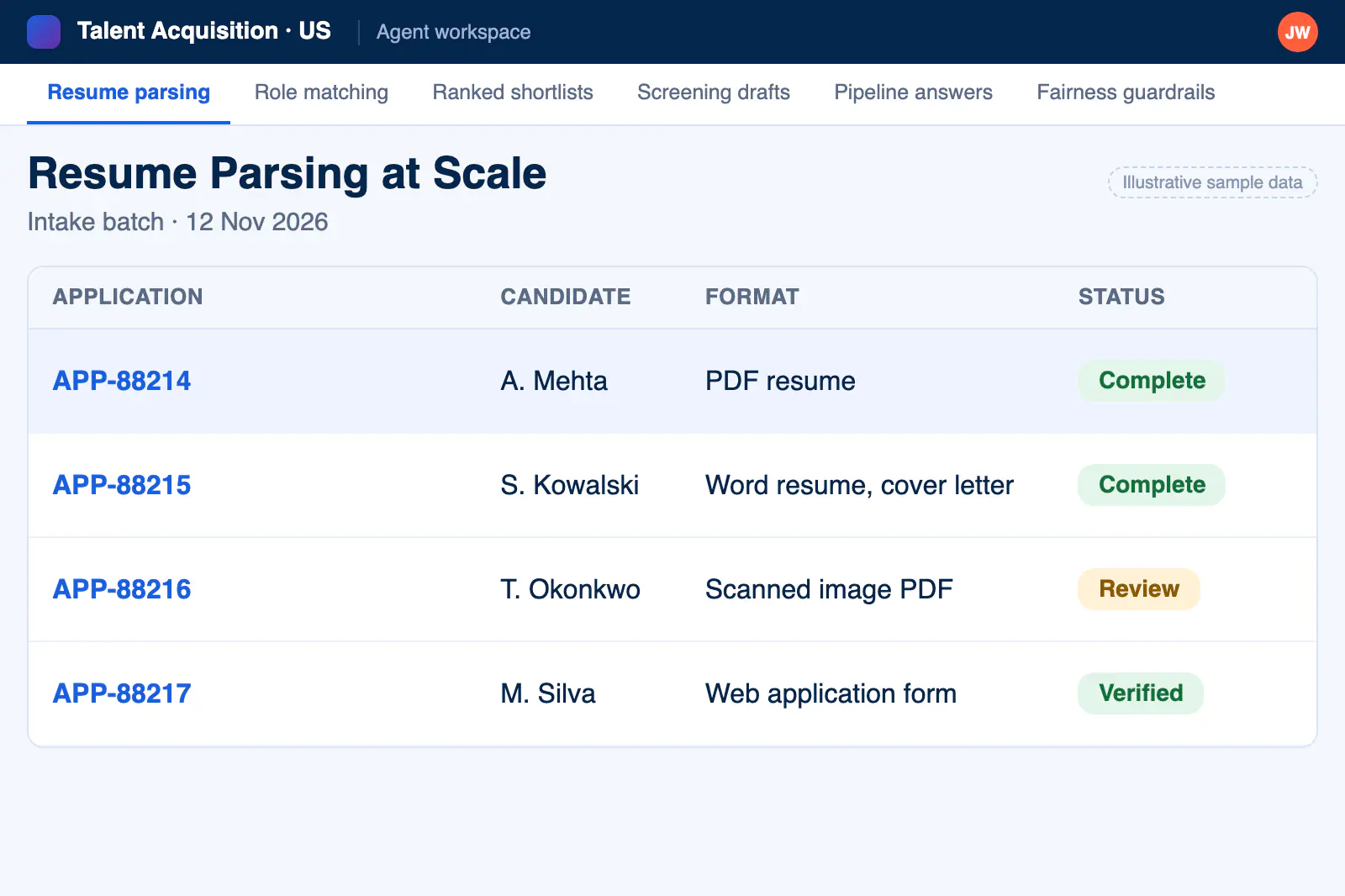
Resume Parsing at Scale
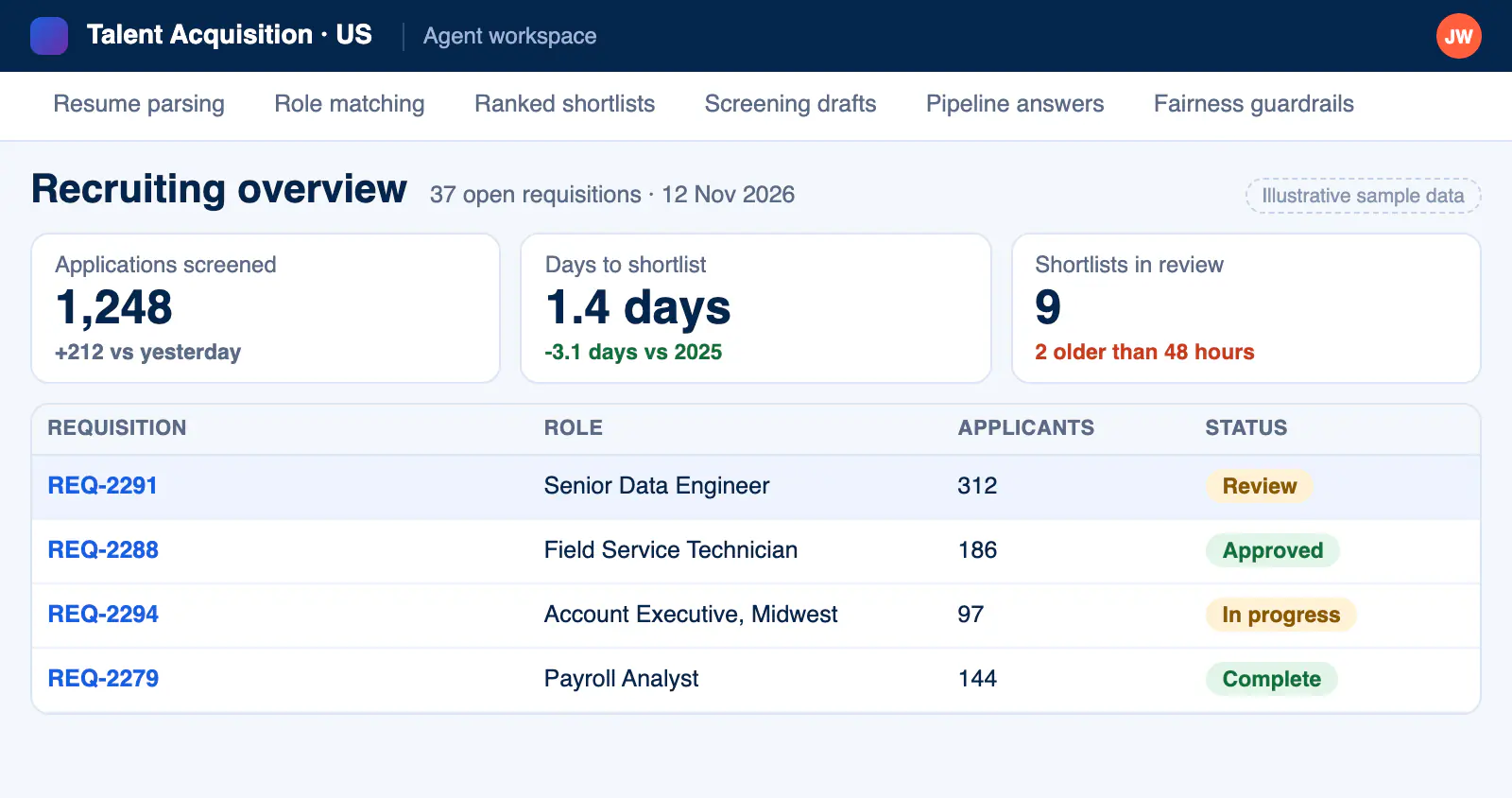
The agent reads resumes, cover letters, and application forms in common formats and extracts skills, experience, and qualifications into structured candidate profiles.
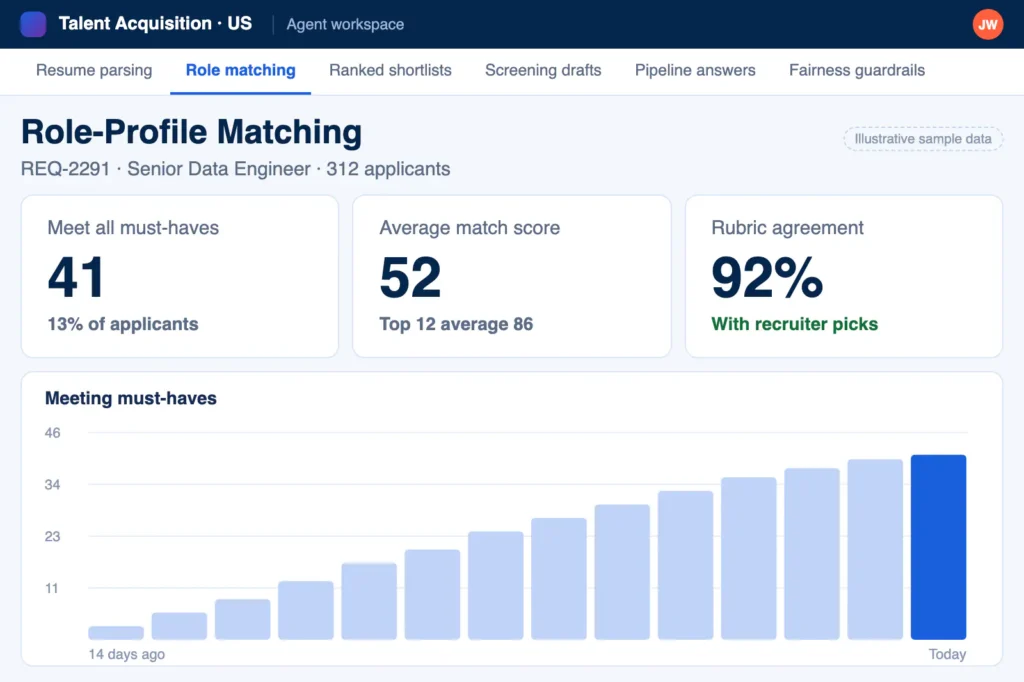
Role-Profile Matching
Candidates are scored against must-have and preferred criteria you define with your hiring managers, not against generic keyword lists.
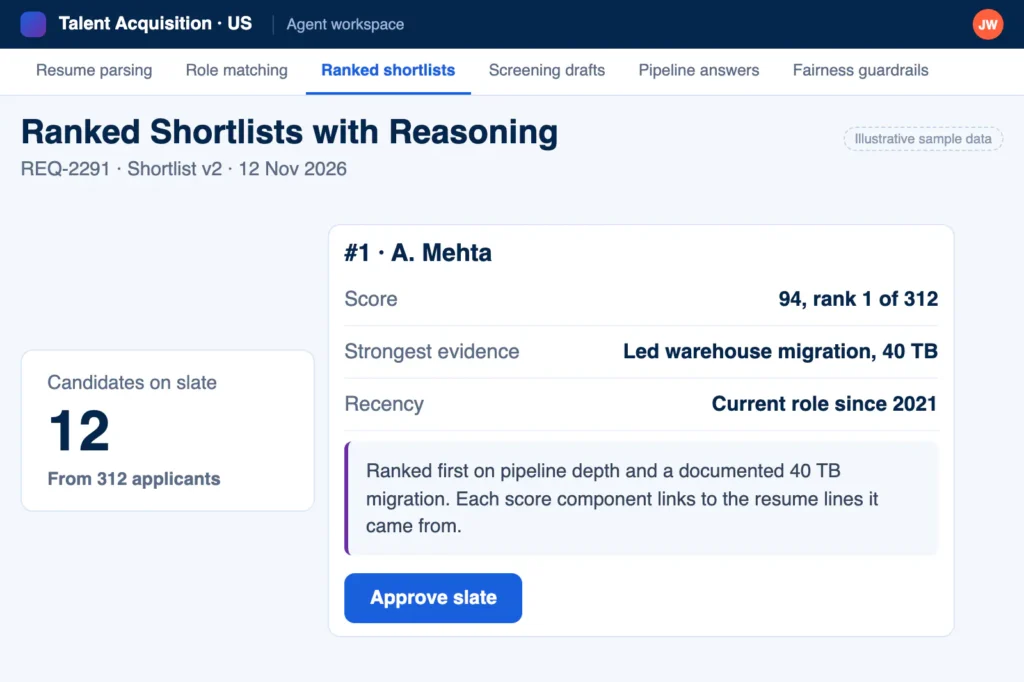
Ranked Shortlists with Reasoning
Recruiters receive a ranked slate for each requisition, with the evidence behind every placement one click away.
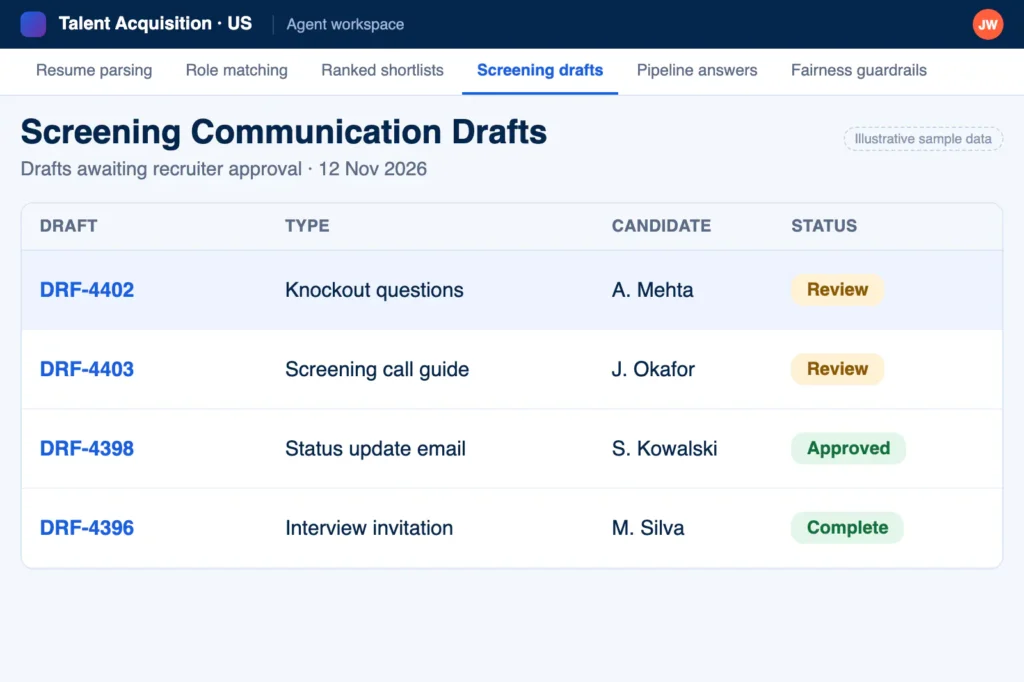
Screening Communication Drafts
The agent drafts knockout questions, screening call guides, and candidate update emails for recruiter approval before anything goes out.
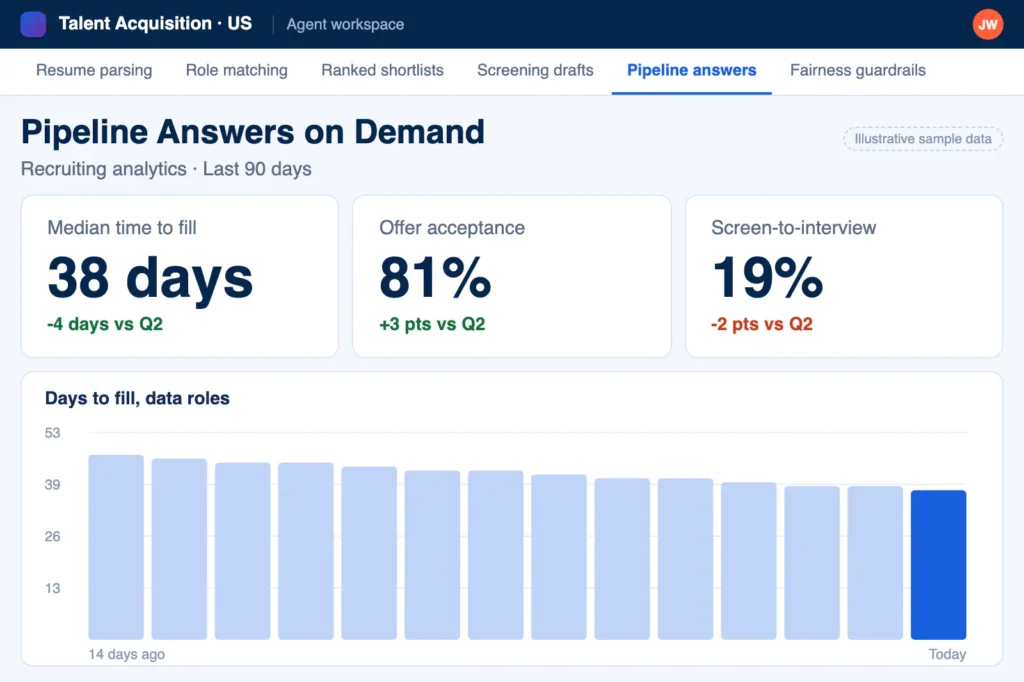
Pipeline Answers on Demand
Ask plain-language questions about time-to-fill, source quality, and funnel drop-off. For deeper workforce analytics, Kanerika pairs the agent with Karl, our data analytics AI agent .
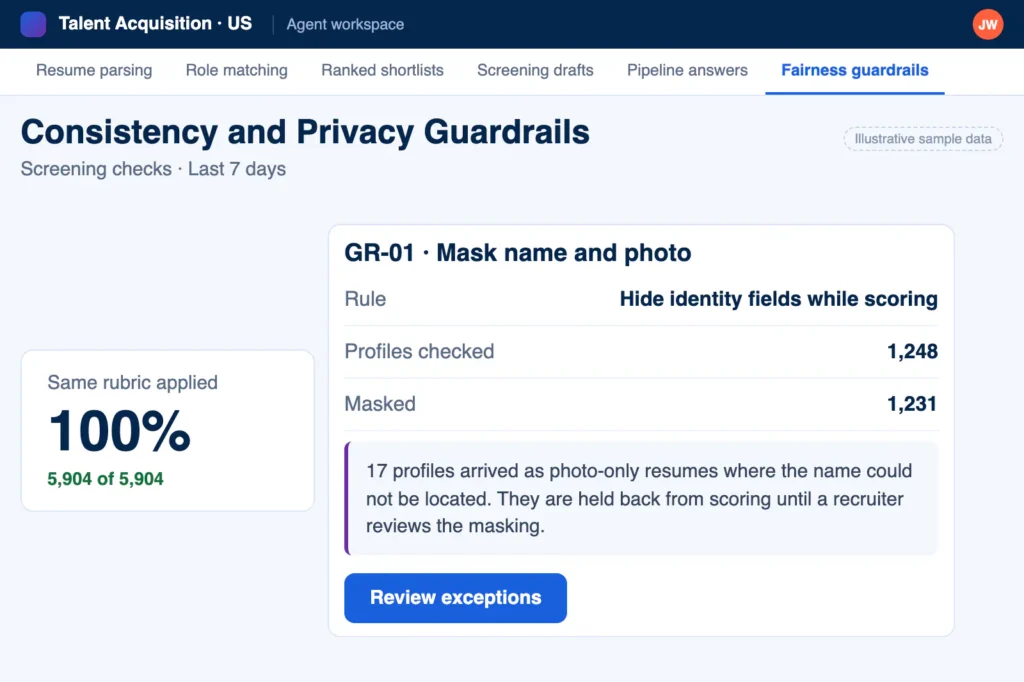
Consistency and Privacy Guardrails
The same criteria apply to every applicant, and sensitive personal fields can be masked during screening. Kanerika's Susan agent handles PII redaction where regulations demand it.
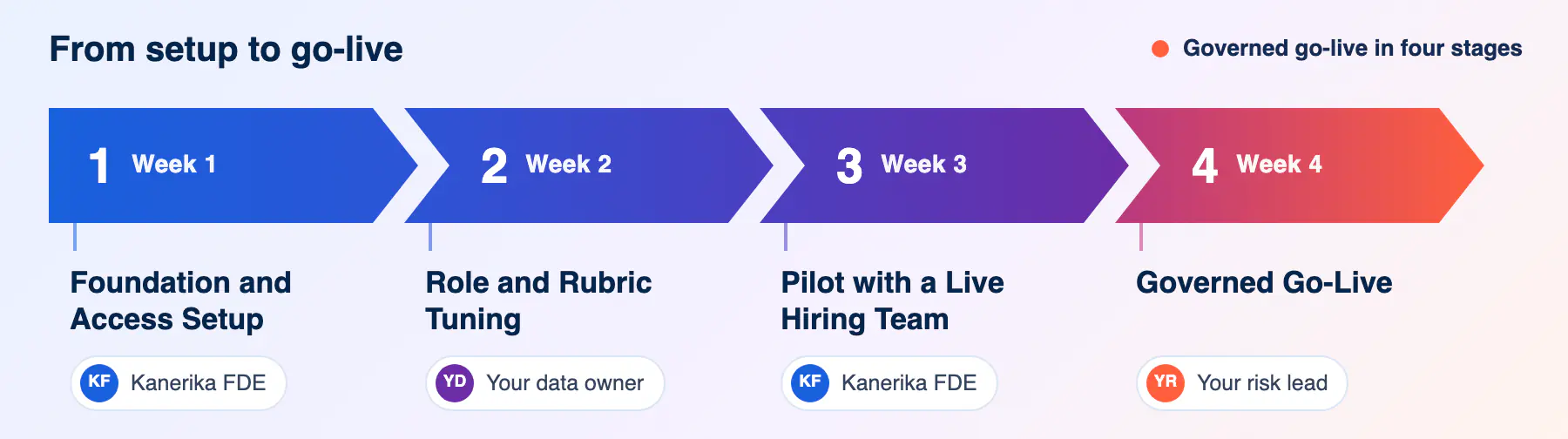
Deploy Your AI Recruitment Agent in Weeks
Foundation and Access Setup
Kanerika connects the agent to your applicant tracking system, HRIS, and collaboration tools, then configures access policies and audit logging.
Role and Rubric Tuning
The agent learns your role families, scoring rubrics, and terminology, shaped in working sessions with recruiters and hiring managers.
Pilot with a Live Hiring Team
One team runs real requisitions through the agent. Recruiters correct rankings, and the agent refines from that feedback.
Governed Go-Live
The agent rolls out across your talent function with human review gates, access controls, and audit trails in place from day one.
Recruitment Automation Solutions for Every Hiring Team
High-Volume Requisition Screening
Clear thousands of applications for frontline, support, and shared-services roles with consistent criteria and same-day shortlists.
Technical Role Shortlisting
Match engineering and data candidates on demonstrated skills and project evidence rather than job-title keywords.
Campus and Early-Career Intake
Process seasonal application spikes without temporary screening staff, and give every graduate application a full read.
Internal Mobility Matching
Surface current employees who fit open roles before the search goes external, using the same evidence-based scoring.
Staffing and RPO Throughput
Agencies and recruitment process outsourcing teams screen more requisitions per recruiter without quality drift across accounts.
Reviving Past Applicant Pools
Re-score silver-medal candidates from earlier searches against new openings instead of paying to source the same people twice.
Industries Where AI Resume Screening Pays Off Fastest
Healthcare
Credential-heavy clinical hiring with license and certification checks built into the screen. See Kanerika in healthcare .
Retail and FMCG
Seasonal and store-level hiring at volume, where speed to shortlist decides who staffs the floor. See retail and FMCG .
Manufacturing
Skilled trade and plant roles screened on certifications, safety records, and shift availability. See manufacturing .
Banking and Financial Services
Regulated-role hiring with documented, auditable screening decisions. See banking and financial services .
Logistics and Supply Chain
Driver, warehouse, and operations hiring where open roles directly cap capacity. See logistics and supply chain .
Technology and Software
Competitive technical talent markets where a 48-hour shortlist beats a two-week one.
Why Teams Choose Kanerika for Recruitment AI
Built by Kanerika's 300+ engineers, who have delivered for 100+ enterprise clients. Live in weeks, on your own data.
It reads every resume in whatever format and turns it into a clean candidate profile.
I get a ranked shortlist and can see the reasons behind every name in one click.
I can ask how long roles take to fill and where candidates drop off, in plain English.
Proof Points from Kanerika's HR Automation Work
80% Fewer Mismatch Tickets with Context-Aware AI
Impact:
- 22% Bandwidth Savings
- 40% Increase in Mapping Accuracy
- 80% Decrease in Mismatch Tickets
50% Faster Onboarding with RPA for HR Operations
Impact:
- 50% Faster onboarding process
- 84% Improvement in SLA adherence
- 100% Improvement in SLA adherence
15% Lower HR Admin Overhead with Power BI Analytics
Impact:
- 15% Reduction in admin overheads
- 26% Increase in resource efficiency
- 30% Improvement in insight optimization
FAQs
An AI recruitment agent reads every incoming application, extracts skills and experience, scores candidates against the role profile, and produces a ranked shortlist with the evidence attached. Recruiters review the shortlist, adjust it, and decide who advances. The agent removes the manual screening backlog while people keep full control of hiring decisions.
No. The agent takes on the repetitive reading and ranking work that consumes recruiter days. Recruiters still own sourcing strategy, candidate relationships, interviews, offers, and every final decision. Teams that deploy screening agents typically redirect recruiter hours toward candidate experience and hard-to-fill searches, which is where human judgment changes outcomes most.
The agent applies the same role criteria to every single application, which removes the inconsistency that creeps into manual review at volume. Scoring rules are visible and auditable, sensitive personal fields can be masked before screening, and recruiters review every shortlist. Kanerika configures these guardrails with your HR and compliance teams during setup.
The agent is built on your stack and works next to the enterprise recruitment software you already run, so integration follows your environment rather than a fixed connector list. During setup Kanerika connects your applicant tracking system, HRIS, and email or collaboration tools, then configures how shortlists and alerts flow into them. Most teams act on results directly inside Teams, Slack, or email.
Candidate data stays inside your own tenant on Azure, AWS, GCP, or on-premises infrastructure. Nothing is sent to train external models, and the agent inherits your existing access controls and retention policies. Kanerika is SOC 2 Type II, ISO 27001, and ISO 9001 certified and operates as a GDPR compliant organization.
Deployment runs in weeks rather than quarters and follows four phases. Kanerika connects your systems and configures access, tunes the agent to your roles and screening rubrics, pilots it with one hiring team on live requisitions, then expands with governance in place. Timelines vary with your stack and number of role families.
Each shortlist ranks candidates for a specific requisition and shows the reasoning behind every placement. You see matched skills, experience evidence pulled from the resume, flags on missing must-have criteria, and suggested screening questions. Hiring managers get a defensible, documented view of why each candidate advanced instead of a bare numeric score.
Yes. Volume is the core problem the agent solves. It screens every application in a high-volume intake with the same criteria and the same attention, whether a requisition draws fifty applicants or five thousand. Recruiters then work a ranked queue instead of an unread pile, and strong candidates hear back before losing interest.
Keyword filters match strings, so they reject strong candidates who used different wording and pass weak ones who gamed the terms. The agent reads context, weighs experience against your actual role profile, and explains every ranking. It also drafts communications and answers pipeline questions, which no static filter inside an ATS does.
Look for screening that reads context instead of matching keywords, rankings that show the resume evidence behind each placement, and recruiter approval before any candidate advances or receives a message. Check where candidate data lives and whether it trains outside models. Kanerika’s AI recruitment agent is built around those points: it runs in your own tenant, applies the same criteria to every applicant, and connects to your applicant tracking system and HRIS.
It pays off when application volume outruns recruiter capacity: high-volume requisitions, seasonal or campus intake, and staffing or RPO teams screening across many accounts. In those settings an AI agent for recruitment reads every application against the same role criteria and returns a ranked shortlist with the reasoning attached. Recruiters still own sourcing strategy, interviews, offers and every final decision, with more of their time free for that work.
Let’s Transform Your Business