Home Industries AI Retail
AI Built for Faster, More Profitable Retail
From demand forecasting to dynamic pricing, AI built for retail turns raw signals into faster, more profitable decisions across every channel.
Improvement in stock availability
Faster assortment planning
Increase in margin realization
Quicker product pricing updates
Get Started with AI Retail Solutions












Operational Gaps AI Closes for Retailers
Retailers lose revenue to stockouts, poor demand forecasting, and decisions made on stale data. AI fixes this by turning fragmented signals across your POS, eCommerce, and supply chain into actions that actually move the needle.
Retail Inventory Imbalances
Excess stock in some locations and empty shelves in others.
Inaccurate Demand Signals
Forecasts that fail to reflect promotions, trends, and local demand shifts.
Delayed Pricing Decisions
Margins impacted when competitor pricing and demand change quickly.
Limited Customer Visibility
Inability to understand and analyze buying customer behavior across channels.
Outdated Reporting Tools
Teams depend on reporting tools that are outdated or inefficient.
Legacy Retail Data Systems
Data systems that cannot scale with modern omnichannel complexity.
AI Solutions Purpose-Built for Retail Performance
We configure, integrate, and deploy AI around your existing retail data infrastructure. Each solution targets a specific operational or commercial challenge in retail environments.
Retail Demand Forecaster
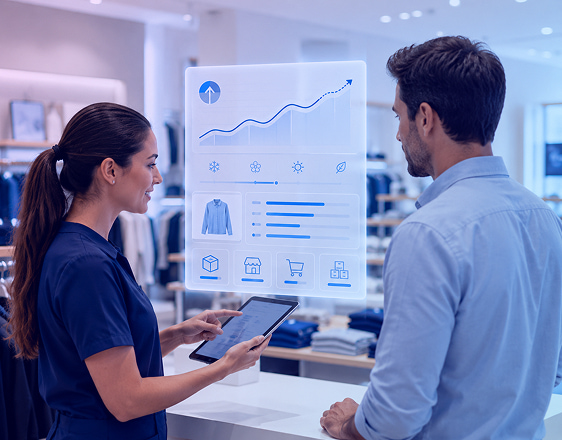
Predicts demand at SKU, store, and channel level using sales history, seasonal trends, and promo signals to keep replenishment and allocation ahead of shopper demand.
Inventory Optimizer
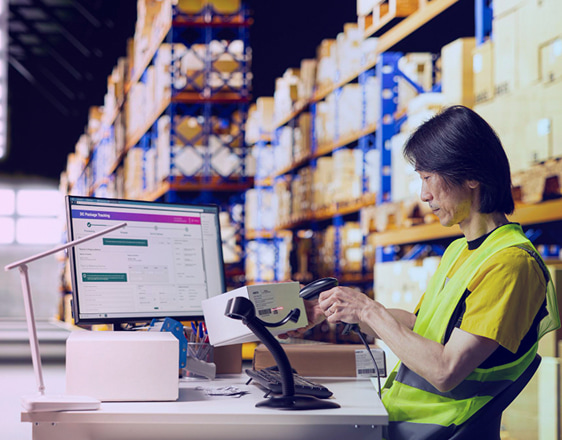
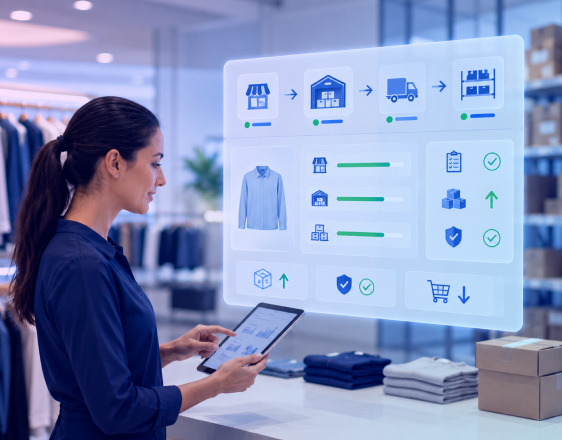
Tracks stock across stores, warehouses, and DCs. Recommends reorder points, safety stock, and allocation priorities to cut holding costs and prevent stockouts before they hit revenue.

Smart Pricing Assistant
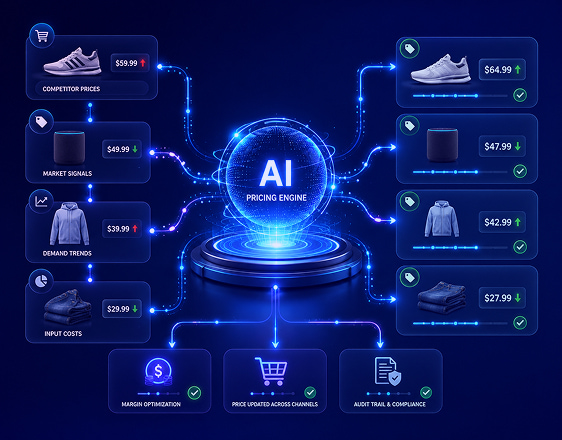
Monitors competitor prices, input costs, and demand shifts to recommend catalog-wide price changes automatically, with a full audit trail for commercial and finance alignment.
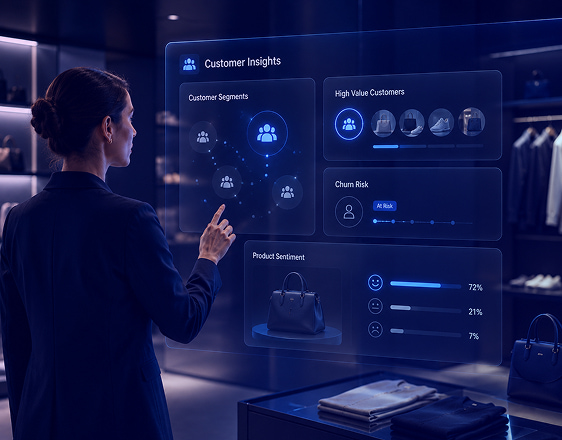
Customer Insights Copilot
Segments customers by behavior, lifetime value, and churn risk. Surfaces product sentiment trends through an interactive dashboard built for commercial and merchandising decisions.
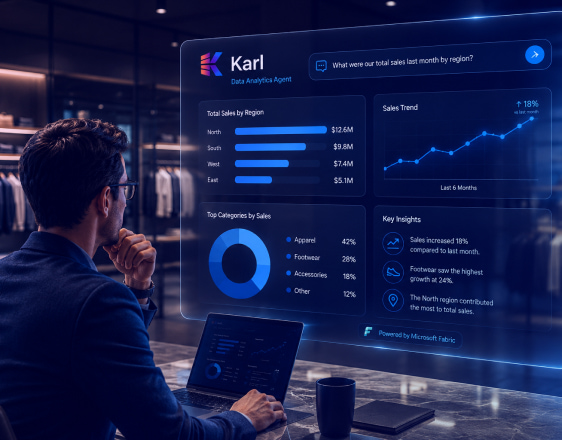
Karl - Data Analytics Agent
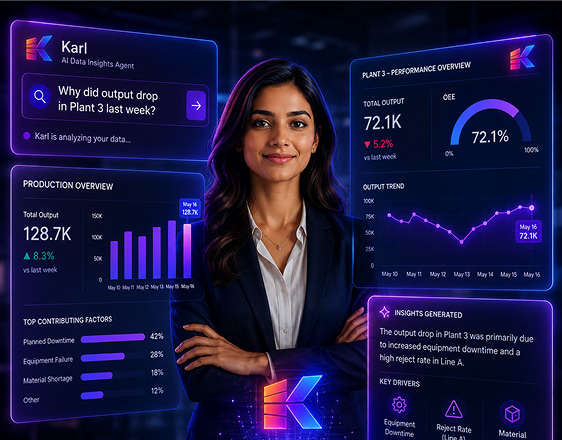
Queries your retail data in plain English and returns instant answers with visuals. No analyst needed. Gives sales, planning, and ops teams direct access to performance data inside Microsoft Fabric.

AI Services Tailored for Retail Transformation
Most retail AI never leaves the pilot. Kanerika takes it from strategy to model build, deployment, and live production operations.
AI Strategy and Advisory
Define where AI fits across your stores, supply chain, and commercial workflows with a tailored roadmap.
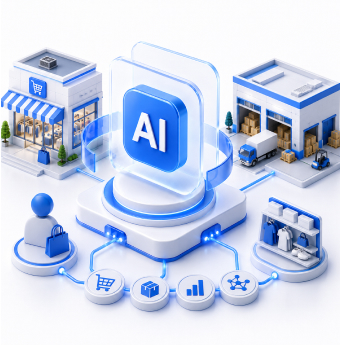
Generative AI Solutions
Automate product descriptions, promotional copy, and internal knowledge retrieval across retail operations.
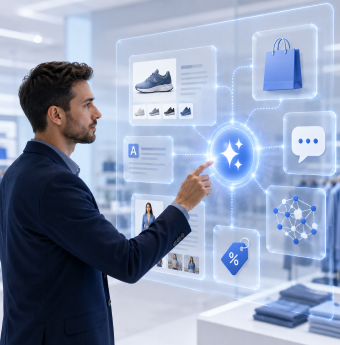
AI Model Development
Demand forecasting, inventory optimization, and customer propensity models built on your behavioral data.
AI/ML Ops
Keep retail AI models accurate as assortment, seasonal patterns, and market conditions evolve over time.
AI Governance
Build and deploy retail AI within your data privacy, audit, and regulatory requirements without adding friction to your operations.

AI/ML Consulting
Custom models for demand prediction, churn analysis, and product performance across therapeutic areas.
Why Retailers Choose Kanerika for AI Deployments
Retail-Trained AI Models
Built on POS, loyalty, and seasonal demand data, not generic business intelligence.
Agentic AI Expertise
Deploy agents that act on demand shifts, pricing signals, and inventory gaps without manual intervention.
AI Implementation Experience
From demand forecasting models to autonomous retail agents, we deployed AI across complex omnichannel environments.
Responsible AI Development
Audit trails, explainability, and data privacy built into every engagement. ISO 9001, 27001, SOC 2, and CMMI Level 3.
What Retail Leaders Say About Our AI
Spreadsheet forecasts were outdated before buyers could act on them. The Demand Forecaster changed that. Planning cycles are shorter and our forecast accuracy is the best it has ever been.
Head of Supply Chain
Specialty Retail Group
VP Commercial
Consumer Electronics Retailer
Stockouts during peak periods kept hurting our sales and NPS. The Inventory Optimizer gave our team visibility they never had before. In-stock rates improved in the first cycle.
Director of Operations
FMCG Retail Brand
Category managers were spending half their time pulling reports. Karl gave them direct access to performance data and freed them up to actually make decisions.
Head of Retail Analytics
Fashion Retailer
Frequently Asked Questions (FAQs)
01What is AI in retail and how does it work for store and supply chain operations?
AI in retail applies machine learning, natural language processing, and intelligent automation to improve demand forecasting, inventory management, pricing decisions, customer segmentation, and supply chain planning. Retail AI solutions connect to your existing systems, including POS, OMS, ERP, and WMS, and apply trained models to generate predictions and recommendations your teams can act on. Each solution is configured for your specific retail environment and trading cycle, not a generic cross-industry template.
02How does AI-powered demand forecasting help retailers reduce overstock and stockouts?
Retail demand forecasting AI analyzes historical sales data, promotional calendars, seasonal patterns, and external demand signals to predict order volumes at the SKU, store, and channel level. Unlike spreadsheet models, it accounts for multiple demand variables simultaneously and adjusts as conditions change. For retailers managing large assortments across multiple locations, accurate SKU-level forecasts directly improve replenishment timing, reduce overstock write-offs, and prevent the lost sales that come from repeated stockouts during peak periods.
03How does AI inventory optimization reduce holding costs in retail?
AI inventory optimization for retail analyzes consumption patterns, supplier lead times, current stock positions, and demand forecasts to recommend dynamic reorder points and safety stock quantities. Rather than applying fixed min-max rules set months in advance, the model adjusts recommendations as demand and supply conditions shift. For retailers managing thousands of SKUs across multiple fulfillment nodes, this prevents capital from accumulating in slow-moving stock while keeping fast-moving products available when shoppers need them.
04What does an AI smart pricing tool do for retail margin management?
A retail AI pricing solution monitors input costs, competitor pricing signals, and real-time demand patterns to recommend price adjustments across large product catalogs without requiring manual review of every SKU. For retailers in commodity-sensitive or highly competitive categories, manual pricing cycles cannot keep pace with market movements. AI-driven pricing protects margins during cost increases, supports promotional planning with data-backed recommendations, and reduces the time between a market signal and a pricing response.
05How does AI customer segmentation improve retail marketing and merchandising outcomes?
AI customer segmentation for retail analyzes purchase history, browsing behavior, loyalty data, and churn signals to group customers by behavior, lifetime value, and purchase intent. Rather than applying broad demographic segments, AI models surface the granular patterns that drive repurchase and response rates. Merchandising teams use segmentation insights to shape assortment decisions. Marketing teams use them to improve targeting, personalization, and retention campaign performance across channels.
06What is sentiment analysis for retail and how does it help product teams?
Retail sentiment analysis uses natural language processing to extract structured insight from customer reviews, returns notes, and service transcripts at both the overall product level and at the level of specific product attributes. Rather than reading reviews manually or relying on aggregate star ratings, product and commercial teams receive a continuous signal about which features drive purchase satisfaction and which generate repeat complaints. This supports faster range decisions, more targeted product development, and better response to emerging quality issues.
07How does Karl help retail operations and buying teams without requiring technical skills?
Karl lets store operations managers, buyers, and category teams query trading data in plain English. It translates natural language questions into SQL, runs the query, generates a visual, and explains the result without requiring any technical knowledge. Retail teams use it to access sell-through rates, category performance trends, store-level comparisons, and replenishment status during trading reviews without waiting for analyst support. Karl deploys as a Microsoft Fabric workload within the platform many retailers already use.
08How long does it take to deploy AI solutions in a retail environment?
Agent deployments including Karl and DokGPT typically go live within a few weeks once data sources are connected and access is configured. Forecasting and inventory optimization model builds generally take four to eight weeks, depending on data quality and the number of variables involved. Pre-built agents and FLIP accelerators reduce implementation timelines significantly compared to custom builds. Most clients see measurable outcomes within the first production deployment cycle rather than months after go-live.