call/text us now

+1 (855) 6-KANERI

AI Security Alert Triage Agent for SOC Teams

Turn thousands of raw alerts into a short, ranked list your analysts can actually work.

24/7

Alert triage without a queue

Enriched

Context added before analysts look

Human

Analysts own every response

Hire the AI Security Alert Triage Agent for 30 Days
SOC 2

Type II certified delivery

ISO 27001

Certified security practices

250+

Technology certifications

Turn thousands of raw alerts into a short, ranked list your analysts can actually work.

Alert triage challenges in security operations centers start with volume. Alerts arrive duplicated, low-context, and mostly benign, while the one that matters waits in the pile. An AI security alert triage agent enriches each alert, clusters the noise, scores what remains against your environment, and hands analysts a ranked queue with evidence attached. Kanerika builds and runs it inside your environment, and analysts keep every response decision.

AI-powered security alert triage interface from Kanerika showing alert enrichment at ingest

How the Security Alert Triage Agent Works Inside Your SOC

deployed code icon

Deployed in Your Environment

Kanerika deploys the agent on Azure, AWS, GCP, or on-premises infrastructure. Alert data and telemetry never leave your perimeter for a vendor cloud.

verified user icon

Built Under a Certified Security Program

Kanerika holds SOC 2 Type II, ISO 27001, and ISO 27701 certifications, so your security review starts from documented controls rather than promises.

forum icon

Works Where Analysts Work

Verdicts, case summaries, and escalations land in Microsoft Teams, Slack, or your ticketing queue, alongside the consoles your team already runs.

lock icon

Data Stays in Your Tenant

Logs, alerts, and identity data remain in your environment and are never used to train external models.

assignment turned in icon

Analysts Keep Response Authority

The agent recommends and documents. Containment and remediation actions wait for a human decision unless you explicitly configure exceptions.

find in page icon

Source-Traced Verdicts

Every triage verdict cites the events, threat intelligence, and prior cases behind it, so an analyst can check the reasoning in seconds.

Automating Security Alert Triage to Cut Alert Fatigue

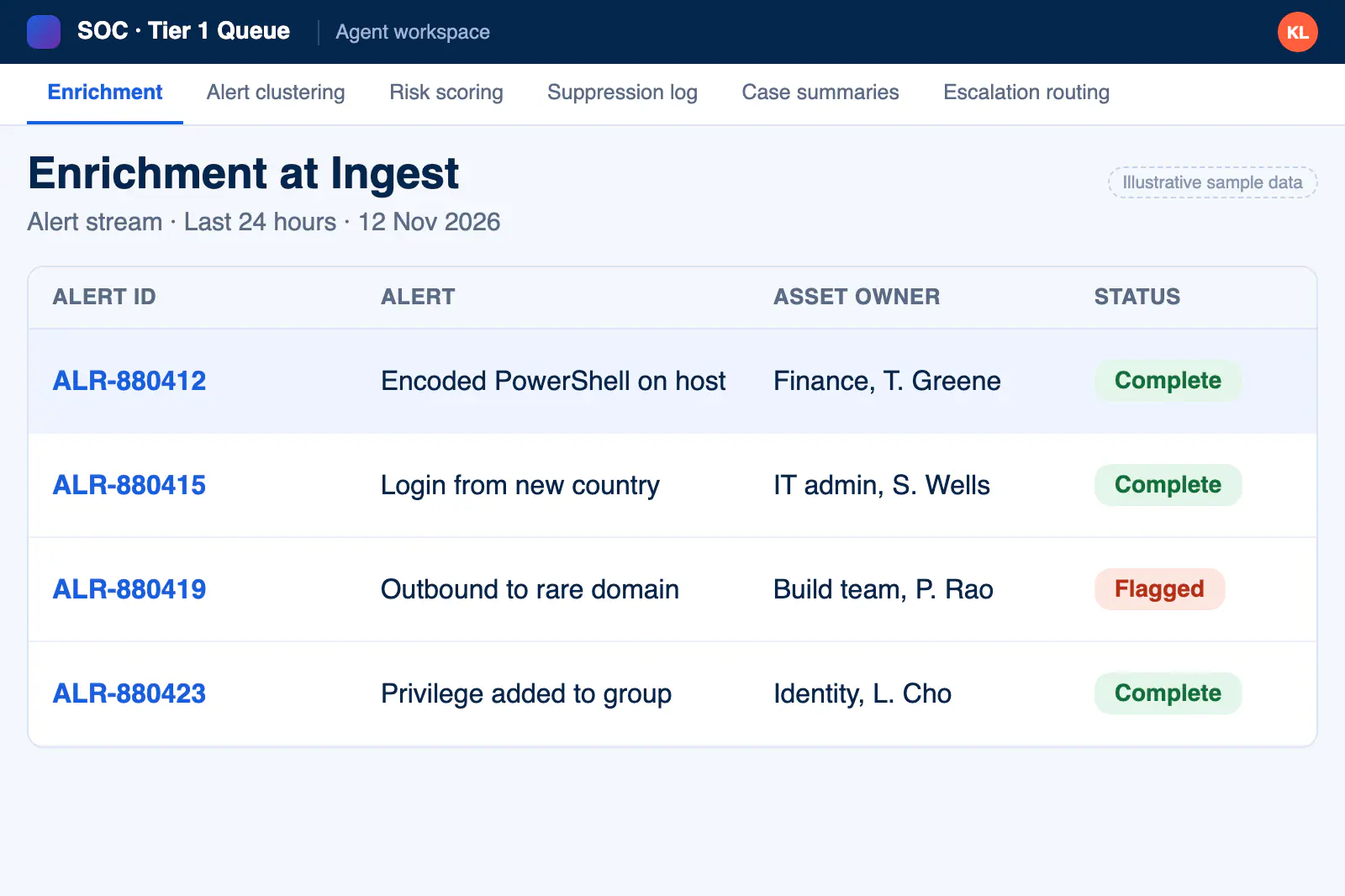
Enrichment at Ingest

Asset owner, user history, threat intelligence, and related events attach to each alert before an analyst ever opens it.

Security Alert Triage Agent screen for enrichment at ingest

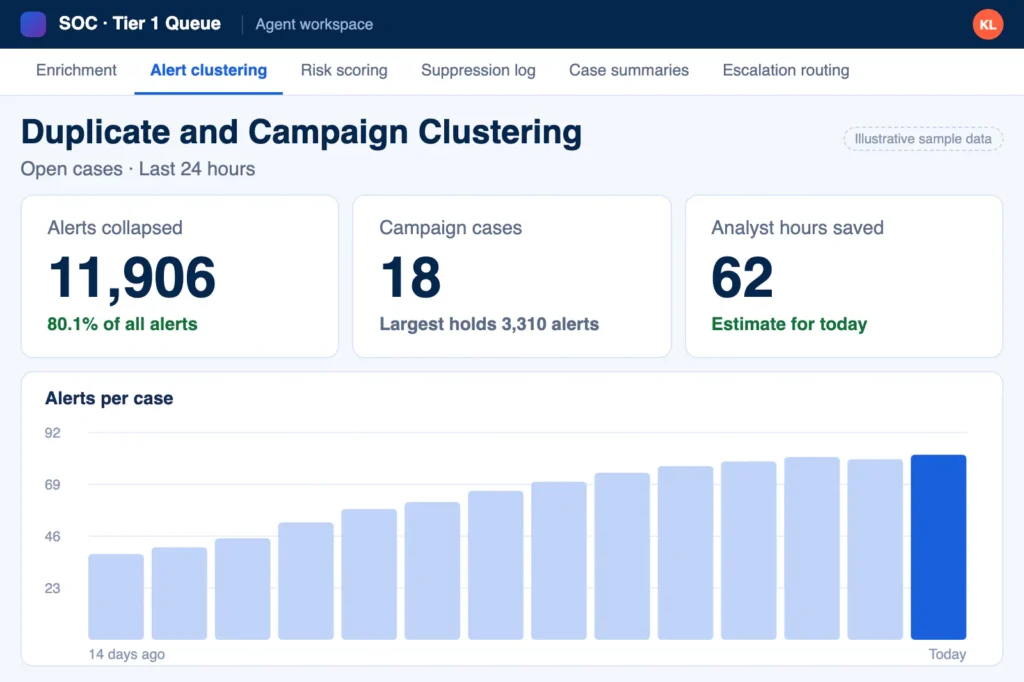
Duplicate and Campaign Clustering

Hundreds of related alerts collapse into one case, so a phishing wave reads as a single campaign instead of a wall of tickets.

Security Alert Triage Agent screen for duplicate and campaign clustering

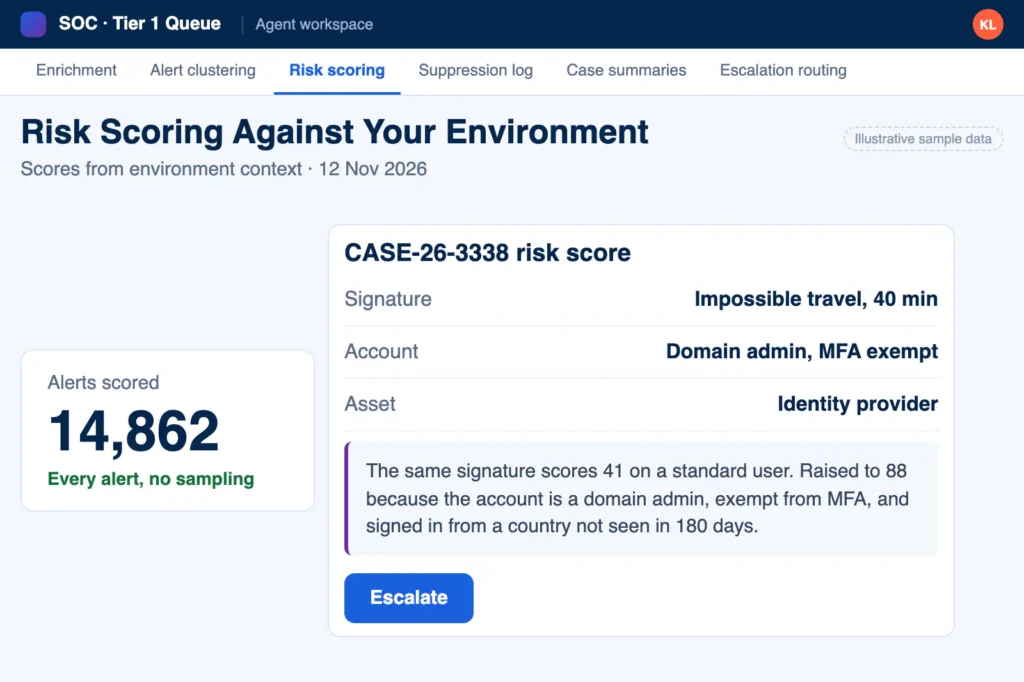
Risk Scoring Against Your Environment

Alerts touching crown-jewel assets, privileged accounts, or exposed services score higher than the same signature elsewhere.

Security Alert Triage Agent screen for risk scoring against your environment

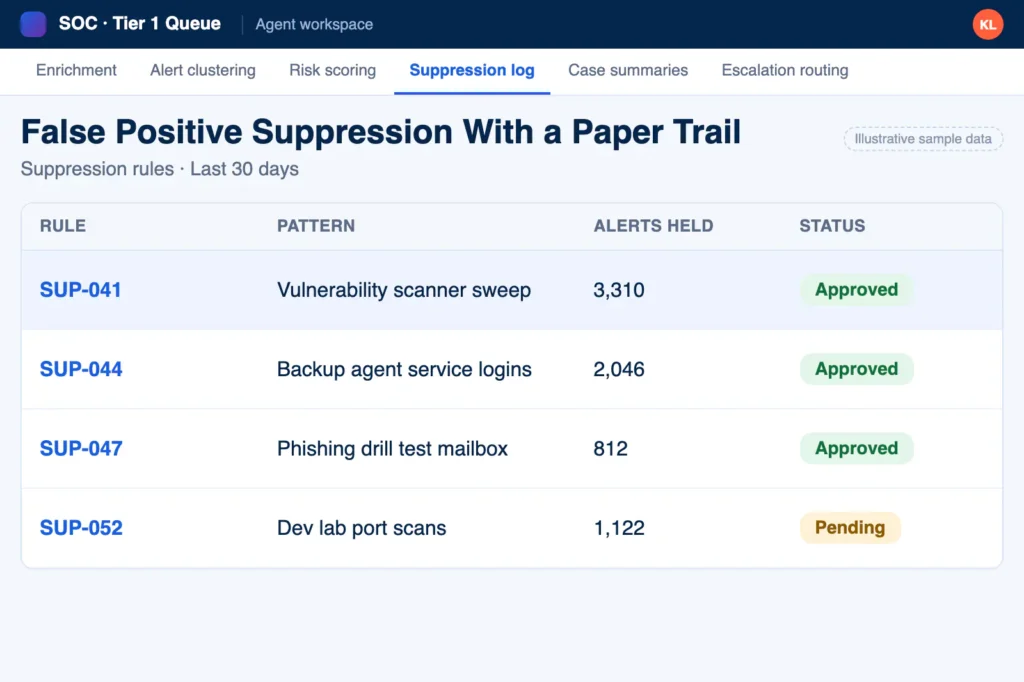
False Positive Suppression With a Paper Trail

Recurring benign patterns get suppressed under rules your team approves, and every suppression is logged and reversible.

Security Alert Triage Agent screen for false positive suppression with a paper trail

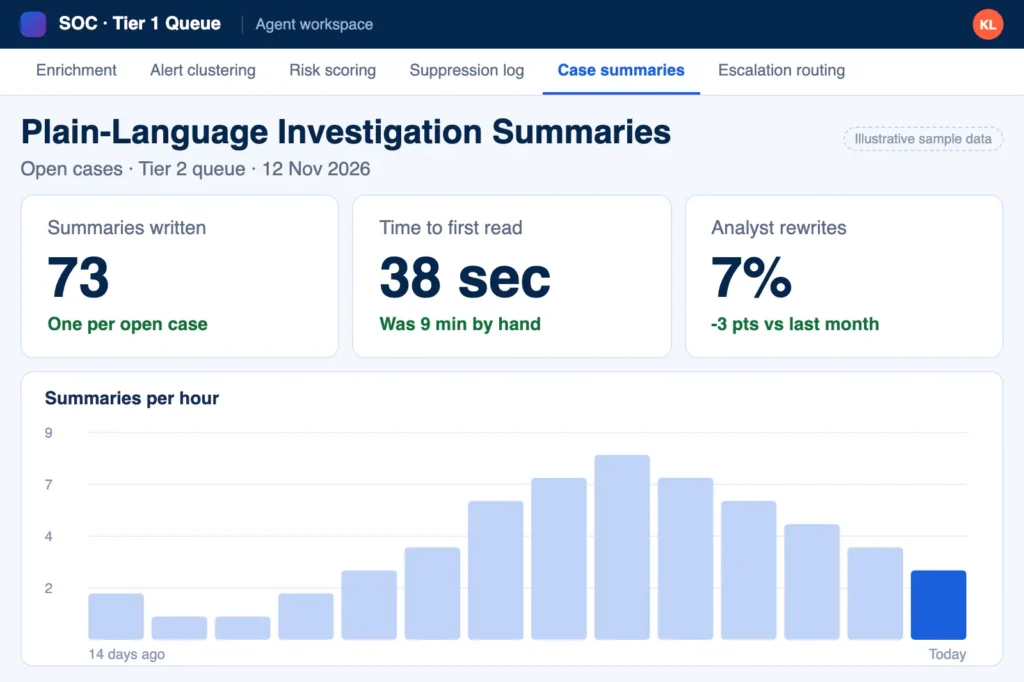
Plain-Language Investigation Summaries

Each case opens with what happened, what was touched, and what to check next, written for the analyst picking it up.

Security Alert Triage Agent screen for plain-language investigation summaries

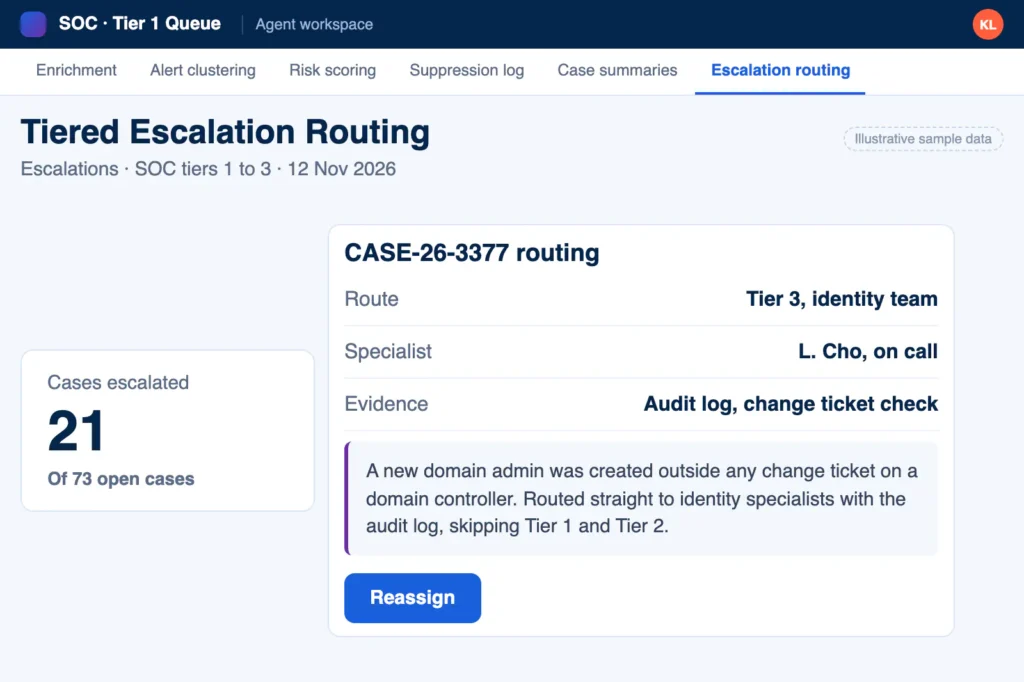
Tiered Escalation Routing

Cases route to the right tier and the right specialist with evidence attached, instead of bouncing between queues.

Security Alert Triage Agent screen for tiered escalation routing

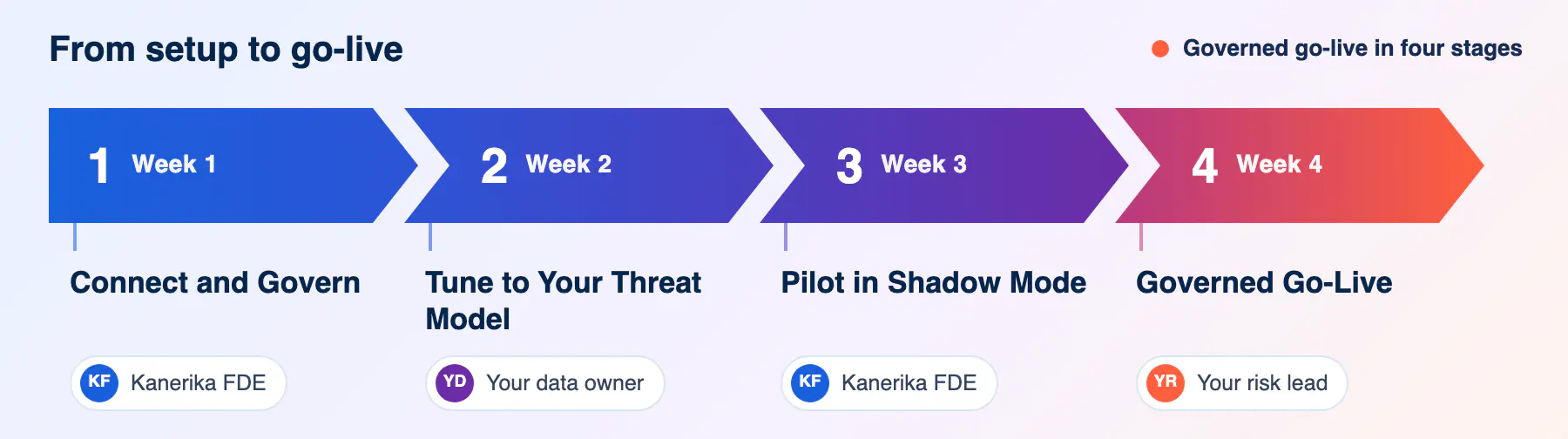
Deploy Your Security Alert Triage Agent in Weeks

Security Alert Triage Agent rollout plan from setup to governed go-live
data_table.svg

Connect and Govern

Kanerika connects the agent to your SIEM, EDR, identity provider, and asset inventory with read-only access and full audit logging.

help_center.svg

Tune to Your Threat Model

Crown-jewel assets, privileged accounts, and known-benign patterns are encoded with your security engineers.

batch_prediction.svg

Pilot in Shadow Mode

The agent triages alongside your analysts without touching the live queue. Verdicts are compared and thresholds adjusted on real alerts.

export_notes.svg

Governed Go-Live

Live triage begins with audit trails, reversible suppression, and escalation paths agreed before the switch.

Where Alert Triage in Security Operations Breaks Down

phishing icon

Phishing Alert Floods

Reported emails and gateway alerts cluster by campaign, with affected users and clicked links listed in one case.

security icon

Endpoint Alert Noise

Repetitive EDR detections from known-good software get suppressed with evidence, while novel behavior rises to the top.

badge icon

Identity and Impossible-Travel Alerts

Sign-in anomalies are checked against travel records, VPN usage, and device history before anyone gets paged.

cloud icon

Cloud Misconfiguration Alerts

Posture findings rank by exposure and data sensitivity, so the public bucket with real data outranks the empty one.

bedtime icon

After-Hours Coverage

Overnight alerts arrive triaged, clustered, and summarized, so the morning shift starts with a worked queue instead of a backlog.

history edu icon

Audit and Review Evidence

Every triage decision is documented with its sources, giving assessors and insurers a clean record of how alerts were handled.

Industries Where Alert Triage Matters Most

account balance icon

Banking and Financial Services

High alert volumes meet regulatory expectations for documented response, and the agent keeps both under control.

shield with heart icon

Insurance

Customer data concentration raises the stakes on identity and exfiltration alerts, which score accordingly.

local hospital icon

Healthcare

Clinical system availability shapes risk scoring, and patient data boundaries stay enforced during investigation.

factory icon

Manufacturing

Alerts touching plant networks and industrial systems rank above office noise, protecting uptime where it costs most.

shopping cart icon

Retail

Payment infrastructure and seasonal traffic spikes get weighted scoring, so fraud-adjacent alerts surface first.

local shipping icon

Logistics

Distributed sites and partner integrations widen the attack surface, and clustering keeps multi-site patterns visible.

Why SOC Leaders Choose Kanerika for Alert Triage

Proof Points From Adjacent Kanerika Deployments

Detecting Rental Transaction Risk Early with AI-Powered Risk Intelligence

Impact:

  • ~500 Risk findings surfaced 
  • ~1.2M Financial exposure identified
  • 6 Risk categories used to classify findings

60% Less Manual Compliance Work with AI

Impact:

  • 40% Faster Regulatory Response
  • 60% Less Manual Compliance Work
  • 5X Better Audit Traceability

3x Faster Expert Vetting with an AI Compliance Agent

Impact:

  • 3X Faster expert vetting
  • 70% Decrease in backlog cases
  • 40% Reduction in event delays

FAQs

It is a deployable AI agent for automating security alert triage. It ingests alerts from your SIEM and EDR, enriches them with asset and identity context, clusters duplicates into cases, scores risk against your environment, and routes ranked cases to analysts with evidence attached. Kanerika builds and runs it entirely inside your own infrastructure, under your governance.

No. The agent sits between your detection stack and your analysts, reading alerts through the APIs of the SIEM, EDR, and ticketing tools you already run. Detections keep firing where they fire today. What changes is that analysts receive clustered, enriched, ranked cases instead of a raw, unranked alert stream.

Not unless you configure it to. The default posture is recommend and document, with every containment or remediation action waiting on an analyst decision. Some teams later choose to allow narrow automated actions, such as quarantining a confirmed phishing message, and each one runs under an approved, logged, reversible rule.

Nowhere outside your environment. The agent runs on your Azure, AWS, GCP, or on-premises infrastructure, reads telemetry in place, and never sends logs to a vendor cloud or external model training. Kanerika holds SOC 2 Type II, ISO 27001, and ISO 27701 certifications and works through your own security review process.
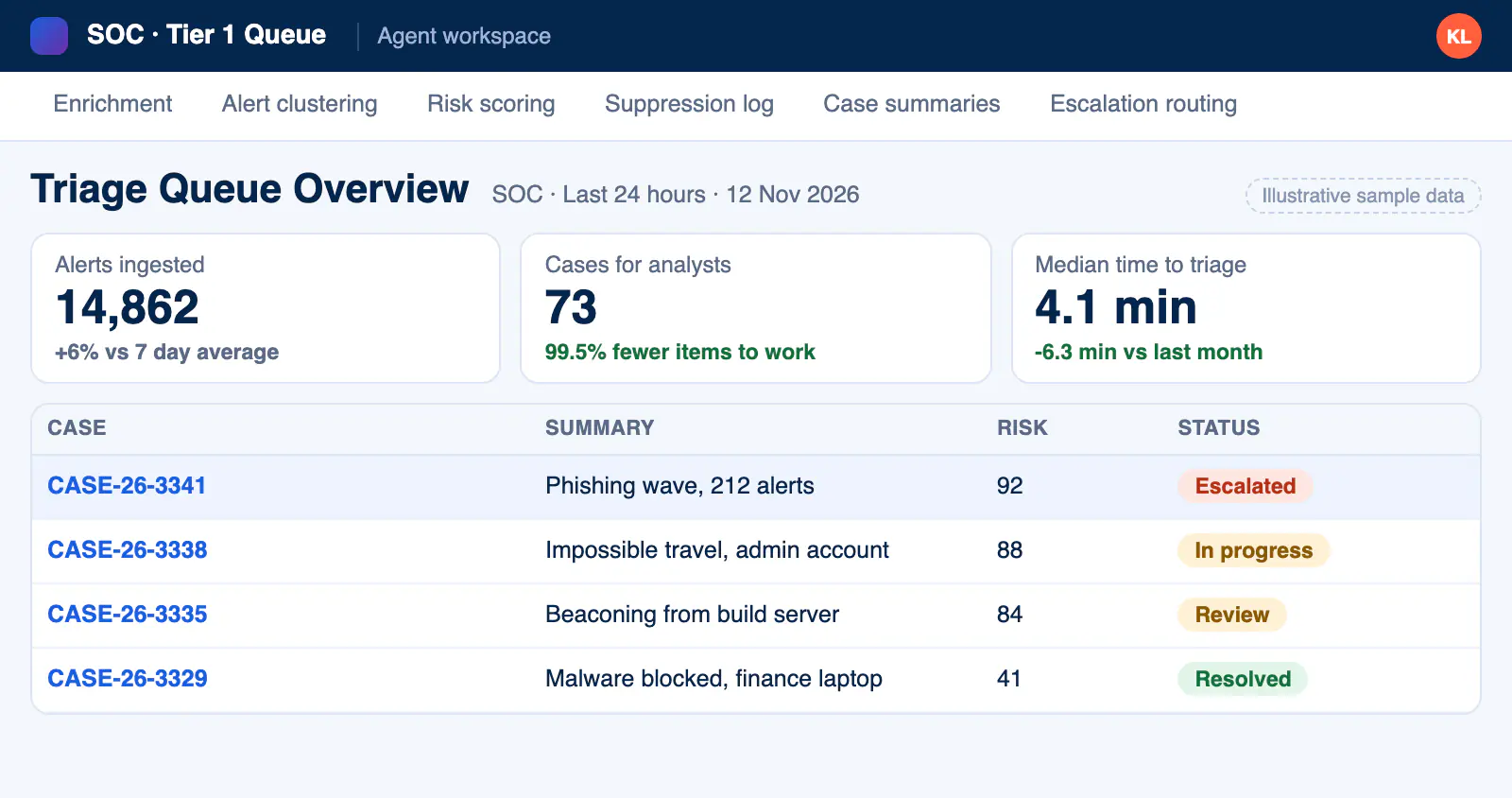
Suppression only happens under rules your team approves, each one scoped, logged, and reversible. Suppressed alerts are stored, not deleted, and the agent re-surfaces a pattern when its behavior changes. Analysts can audit every suppression decision, and shadow mode during the pilot shows you precision numbers before anything goes live.

The agent is built against your stack rather than shipped as a fixed integration list. Typical connections cover your SIEM, EDR, identity provider, asset inventory, threat intelligence feeds, and ticketing system through their own APIs, with read-only access as the default and write access only where your team grants it.

Weeks, with shadow mode doing the convincing. Kanerika connects your detection sources, encodes your threat model, and runs the agent alongside analysts on live alerts without touching the queue. Once its verdicts track your best analysts’ judgment at thresholds you set, live triage begins with full audit trails in place.

Kanerika has not yet published a SOC-specific case study, and this page says so plainly. The adjacent deployments linked above show the same pattern in production, early anomaly detection on transaction streams and a real-time compliance agent that made expert vetting three times faster. A shadow-mode pilot produces your own numbers.

You keep your SOC, your analysts, and your tools. Kanerika builds, delivers, and tunes an agent that runs inside your environment under your governance, rather than taking the monitoring function offsite. Your team gains capacity and context, and nothing about your detection or response authority moves to a third party.

Look for enrichment that attaches asset owner, user history and threat intelligence before an analyst opens the alert, clustering that turns a phishing wave into one case, and risk scoring tuned to your crown-jewel assets. Every verdict should cite its sources, and every suppression should be approved, logged and reversible. Kanerika’s agent also leaves containment decisions with your analysts unless you configure exceptions.

Start in shadow mode. The agent triages alongside your analysts on live alerts without touching the queue, and its verdicts are compared with theirs while thresholds are adjusted. Live triage begins only once verdicts track your best analysts’ judgment, with audit trails, reversible suppression and escalation paths agreed before the switch. That sequence is how to automate security alert triage without giving up response authority.

Let’s Transform Your Business

get started today

Your Free Resource is Just a Click Away!