call/text us now

+1 (855) 6-KANERI

AI Claims Denials Management Agent for Healthcare Providers

Turn denied claims into recovered revenue with appeals drafted, prioritized, and tracked by an AI agent your billing team controls.

Root cause

Tagged on every denied claim

Appeals

Drafted with payer evidence

Human

Billers approve every appeal

Hire the AI Claims Denials Management Agent for 30 Days
SOC 2

Type II certified delivery

ISO 27001

Certified security practices

250+

Technology certifications

Turn denied claims into recovered revenue with appeals drafted, prioritized, and tracked by an AI agent your billing team controls.

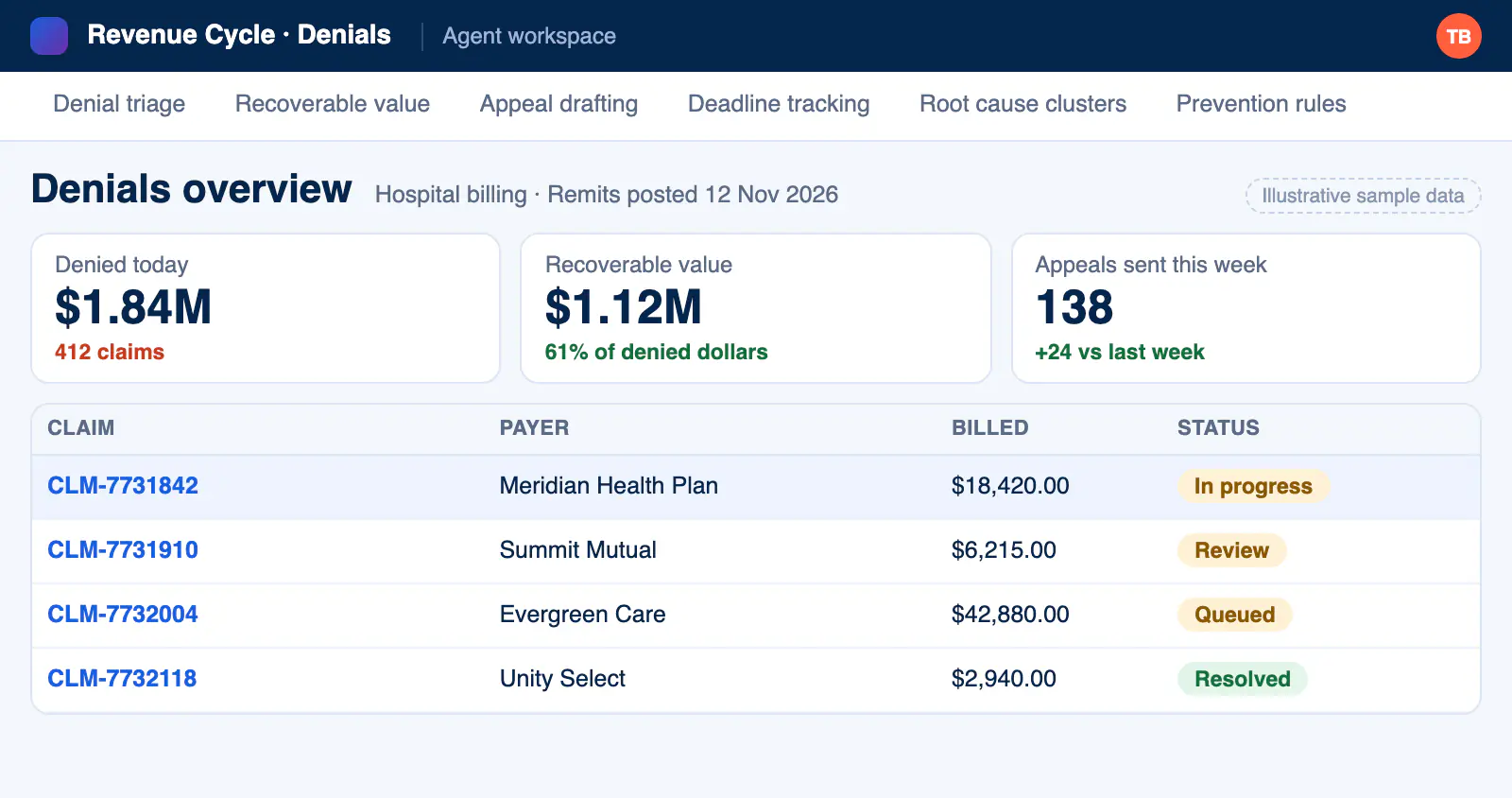
Every denied claim starts a race against a payer deadline, and most billing teams can only work the biggest balances before time runs out. The rest become write-offs. An AI claims denials management agent triages every denial the day it lands, drafts the appeal with supporting evidence attached, and feeds the root cause upstream so the same denial stops repeating. Kanerika builds and runs this denial management software on your infrastructure, inside your revenue cycle, under your rules.

Denial management software interface from the AI claims denials management agent showing triage by remittance codes

How the Claims Denials Agent Handles Denial Management in RCM

deployed code icon

Deployed on Your Stack

Kanerika deploys the agent on your Azure, AWS, GCP, or on-premise environment, connected to your billing system, clearinghouse remittances, and EHR.

verified user icon

Governed on a Secure Foundation

Kanerika holds SOC 2 Type II, ISO 27001, ISO 27701, and ISO 9001 credentials. The agent inherits your role-based access and audit logging.

forum icon

Answers Where Teams Work

Denial queues, appeal drafts, and deadline alerts reach billing staff inside Teams, Slack, or email, not in yet another portal.

lock icon

PHI Stays in Your Tenant

Claims data and clinical records never leave your environment and are never used to train external models.

assignment turned in icon

Human Review on Every Appeal

The agent drafts and assembles. A biller or coder approves every appeal before it goes to the payer, with full visibility into the evidence.

find in page icon

Source-Traced Workpapers

Every appeal cites the remittance codes, payer policy, contract clause, and chart evidence behind it, so escalations and audits stand on documentation.

The Denial Management Process After a Claim Is Rejected

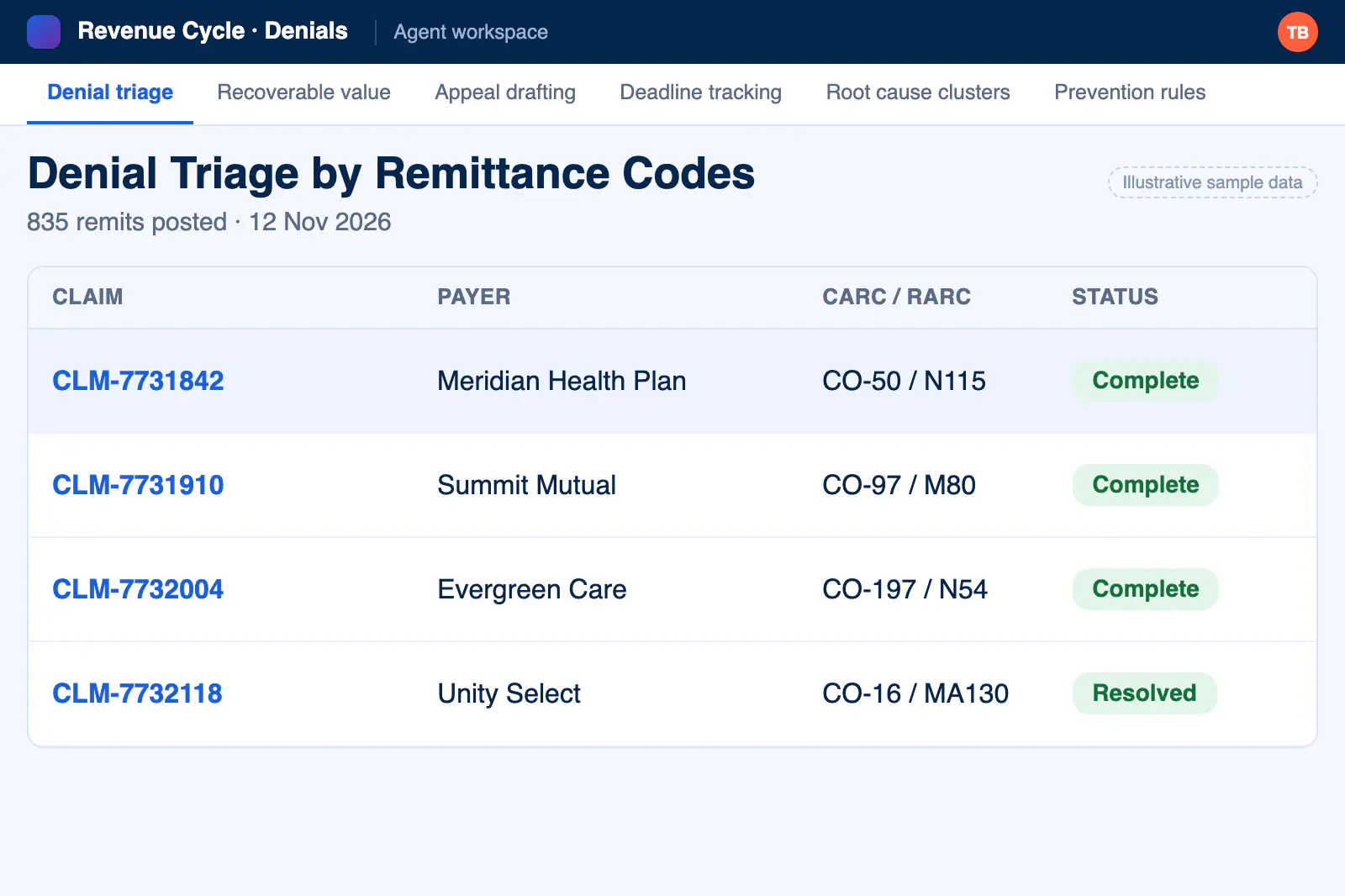
Denial Triage by Remittance Codes

Incoming denials are classified by CARC and RARC codes, payer, and service line the day the remittance posts, not when someone opens the queue.

Denials Management AI Agent screen for denial triage by remittance codes

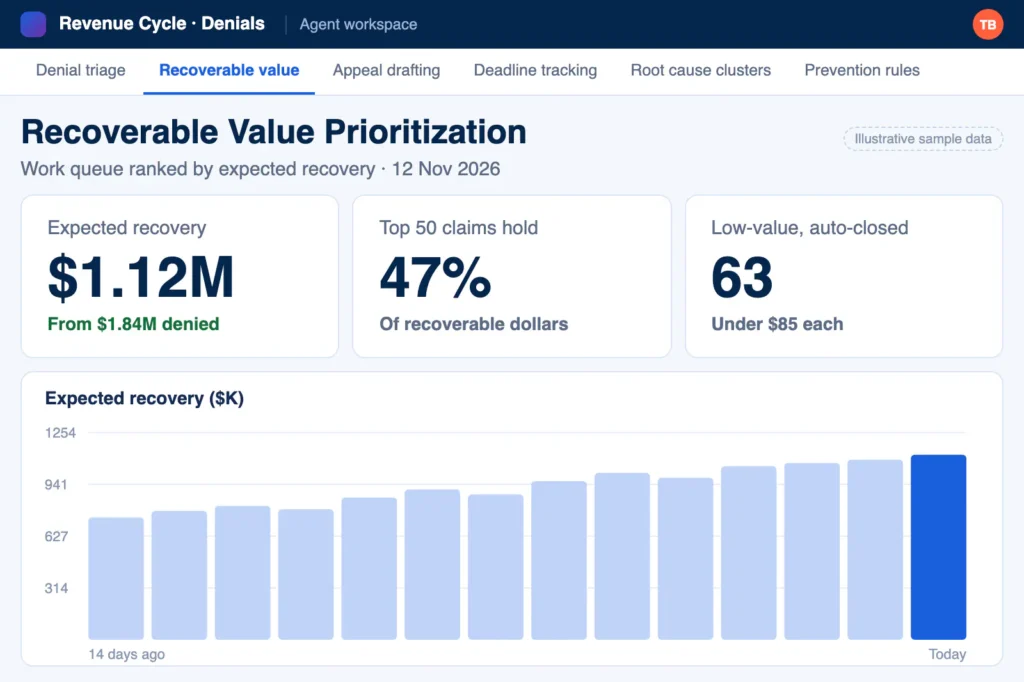
Recoverable Value Prioritization

Each denial is scored on balance, appeal deadline, and historical overturn likelihood, so staff work the dollars that can actually come back.

Denials Management AI Agent screen for recoverable value prioritization

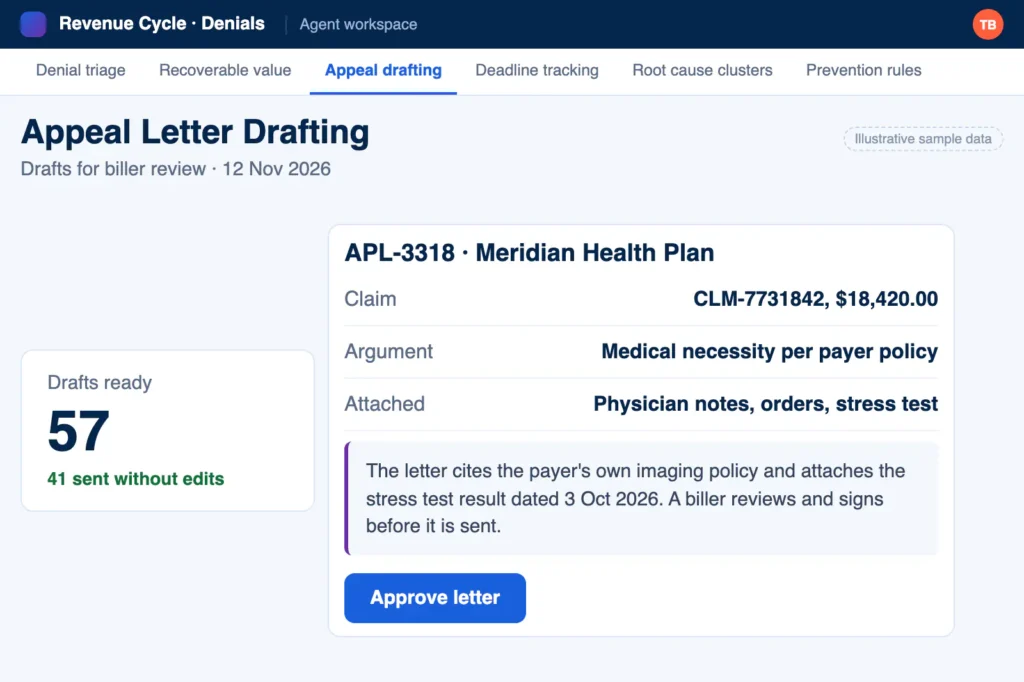
Appeal Letter Drafting

The agent drafts payer-specific appeal letters and pulls the clinical notes, orders, and authorization records that support medical necessity.

Denials Management AI Agent screen for appeal letter drafting

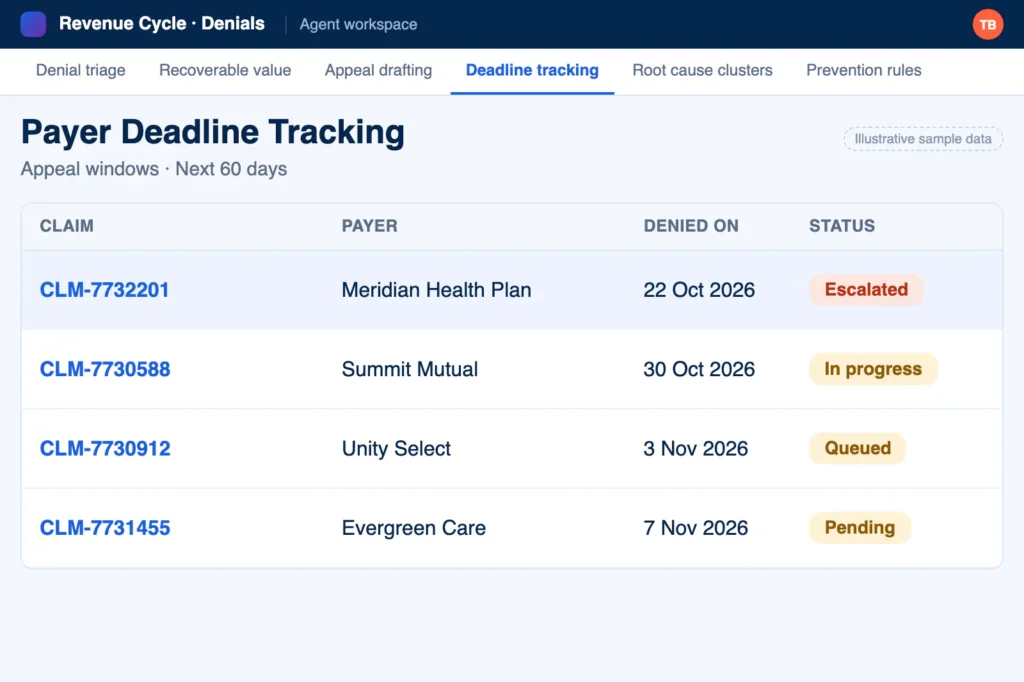
Payer Deadline Tracking

Every appeal window is tracked from the denial date, with escalation before timely filing limits close the door on recoverable revenue.

Denials Management AI Agent screen for payer deadline tracking

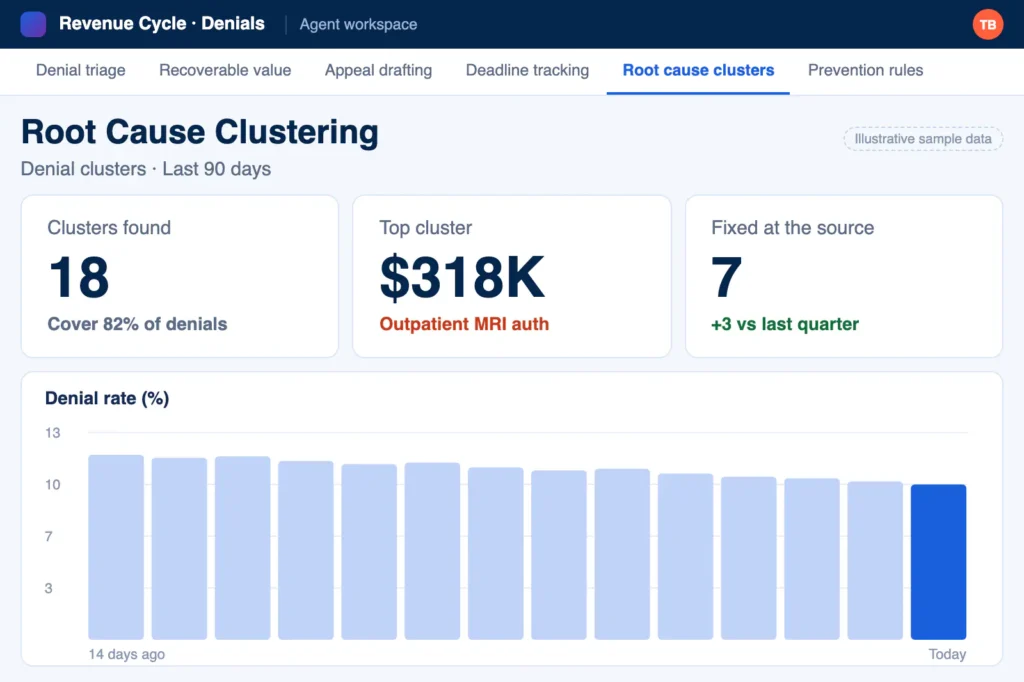
Root Cause Clustering

Denials are grouped by cause, a payer policy change, a registration gap, a coding pattern, so fixes target the source instead of the symptom.

Denials Management AI Agent screen for root cause clustering

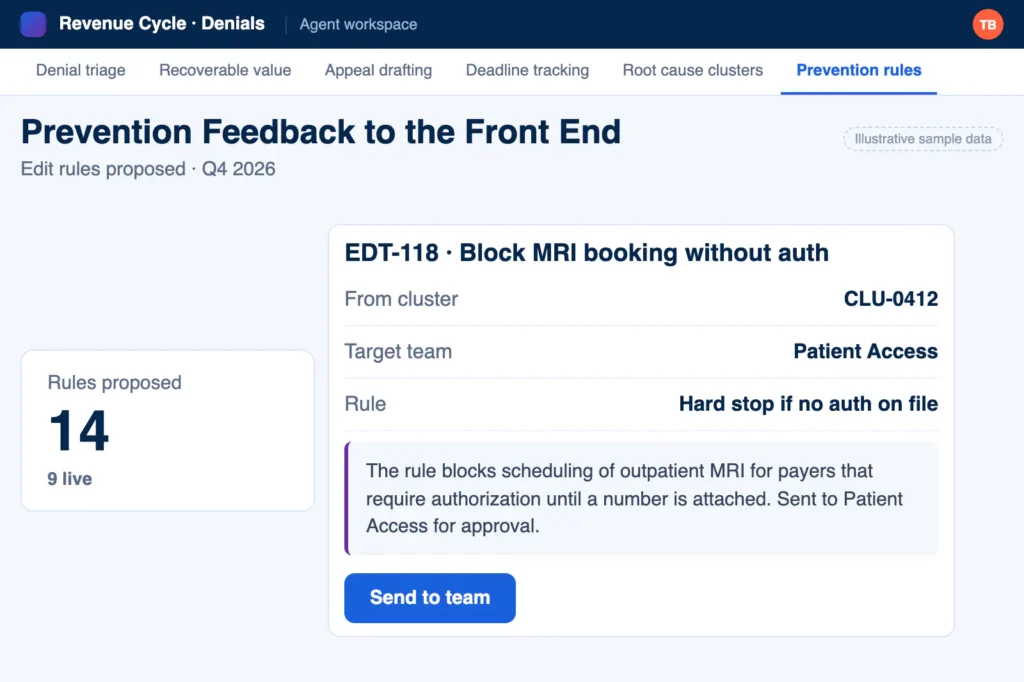
Prevention Feedback to the Front End

Findings flow back to registration, authorization, and coding teams as specific edit rules, shrinking the denial rate quarter over quarter.

Denials Management AI Agent screen for prevention feedback to the front end

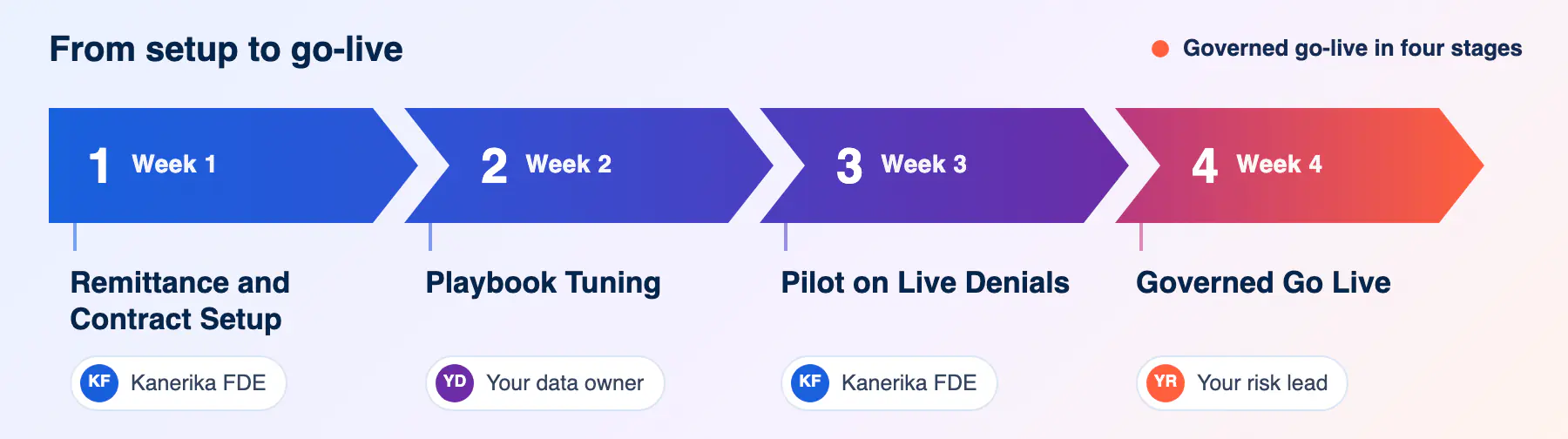
Deploy a Denials Management AI Agent in Weeks

Denials Management AI Agent rollout plan from setup to governed go-live
data_table.svg

Remittance and Contract Setup

Kanerika connects your 835 remittance feeds, payer contracts, and billing system, and loads your historical denial data.

help_center.svg

Playbook Tuning

Appeal templates, routing rules, and overturn models are tuned to your payer mix and specialty using past denial outcomes.

batch_prediction.svg

Pilot on Live Denials

One payer or denial category runs through the agent while your billing team reviews every draft and calibrates thresholds.

export_notes.svg

Governed Go Live

The agent works the full denial stream with approval gates, deadline safeguards, and audit trails your compliance team signed off.

Where Denial Management Solutions Recover Revenue

medical services icon

Medical Necessity Denials

The agent assembles clinical evidence against the payer's own published policy, the strongest ground for an overturn.

find in page icon

Missing Documentation Denials

Requested records are located, packaged, and resubmitted in days, closing the easiest recoverable category first.

timer icon

Timely Filing Races

Deadline-ranked queues keep appeals moving before filing limits expire, the write-off category that discipline alone rarely fixes.

code icon

Coding-Related Denials

Bundling, modifier, and specificity denials are routed to coders with the claim history and payer edit logic already summarized.

money off icon

Underpayments Against Contract

Paid-but-short claims are compared against contracted rates, surfacing systematic underpayment patterns worth escalating.

compare arrows icon

Coordination of Benefits Denials

COB and secondary payer rejections trigger eligibility rechecks and corrected resubmissions without a biller rebuilding the file.

Built for Provider Revenue Cycle Teams

local hospital icon

Hospitals and Health Systems

High denial volumes across dozens of payers get full-queue coverage instead of top-balance triage.

stethoscope icon

Physician Groups

Multi-specialty groups appeal more denials per biller without growing the back office.

receipt long icon

RCM and Billing Companies

Outsourced revenue cycle firms raise overturn rates across client portfolios and show clients the evidence behind every recovery.

surgical icon

Ambulatory Surgery Centers

Implant, authorization, and bundling denials are worked with procedure-level documentation attached.

radiology icon

Labs and Imaging Centers

High-volume, low-balance denials become economical to appeal because drafting costs minutes, not hours.

wheelchair pickup icon

DME and Home Health Providers

Documentation-heavy denials move with the attestations and delivery records payers demand. Explore Kanerika's wider AI in healthcare practice.

Why Revenue Cycle Leaders Choose Kanerika for Denial Management Services

Proof Points from Adjacent Claims and Healthcare Deployments

Insurance Reporting Modernization with Power BI

Impact:

  • Real-Time Report Availability
  • Elimination of Manual Reporting Tasks
  • Improved Accuracy and Data Consistency

36% Cost Savings with AI/ML-Powered RPA in Insurance

Impact:

  • 20% Reduction in claim processing time
  • 25% Improvement in operational efficiency
  • 36% Increased cost savings

61% Faster Reporting with Power BI for Healthcare

Impact:

  • 25% Increase in data-driven decisions
  • 40% Decrease in response time
  • 61% Reduction in time to information

FAQs

It is an AI agent that works denied claims on the provider side of the revenue cycle. It triages every denial by remittance code, prioritizes by recoverable value and deadline, drafts appeals with clinical evidence attached, and clusters root causes for prevention. Kanerika builds and runs it on your infrastructure, with billers approving every appeal.

Prior authorization happens before care is delivered, securing payer approval for a planned service. Denials management happens after a submitted claim is rejected, recovering revenue for care already provided. They are different workflows with different teams, though denial root-cause data often points back to authorization gaps your front end can fix.

The agent covers medical necessity, missing documentation, coding, timely filing, underpayment, and coordination of benefits denials. The fastest wins usually come from documentation and eligibility categories, where the fix is procedural. Medical necessity appeals gain the most from automated evidence assembly, since the agent matches chart records to the payer’s own published policy.

No. The agent drafts the appeal letter, attaches the remittance detail and clinical evidence, and queues it for review. A biller or coder approves every submission before it reaches the payer. Your team sets the review rules, and the full draft-to-decision trail is logged for compliance audits and later payer escalations.

Each denial is scored on outstanding balance, days remaining in the appeal window, and the historical overturn rate for that payer and denial code. The queue reorders continuously as deadlines approach. That means staff effort lands on recoverable dollars first, instead of whatever happens to sit at the top of the worklist.

Yes, prevention is where the compounding value sits. The agent clusters denials by root cause and turns patterns into specific guidance for registration, authorization, and coding teams. Providers that act on those feedback loops shrink the denial rate itself, which beats winning appeals one at a time at the same cost forever.

Yes. The agent runs inside your tenant, inherits your access controls, and never sends PHI or claims data to external model training. Kanerika holds SOC 2 Type II, ISO 27001, ISO 27701, and ISO 9001 credentials, is CMMI Level 3 appraised, and follows GDPR-compliant delivery practices agreed with your compliance team.

Kanerika has published adjacent proof rather than a named denials case study so far. That includes Power BI healthcare analytics that leadership teams rely on and AI, ML, and RPA fraud detection running on insurance claims data at scale. Both case studies are linked on this page, with their outcomes described in each write-up.

No. The agent multiplies the capacity of the team you have, whether in-house or outsourced. Billers stop rebuilding appeal files by hand and spend their time on approvals, payer escalations, and judgment calls. RCM firms and other denial management services providers deploy the same agent across their client portfolios to raise overturn rates without adding delivery headcount.

Look for software that classifies every denial by CARC and RARC codes the day the remittance posts, then ranks the queue by balance, appeal deadline, and overturn likelihood. It should draft payer-specific appeals with the clinical evidence attached, track timely filing limits, and cluster root causes so registration and coding teams can fix the source. Kanerika’s agent does each of these inside your tenant, with a biller or coder approving every appeal.

It covers everything that happens after a payer rejects a submitted claim. Billers identify the denial reason, decide whether it is worth appealing, gather the supporting records, and submit the appeal before the filing window closes. The work then loops back to prevention, so the same denial stops recurring. The agent takes on triage, prioritization, appeal drafting, and root cause clustering, while your team keeps every approval.
Let’s Transform Your Business

get started today

Your Free Resource is Just a Click Away!