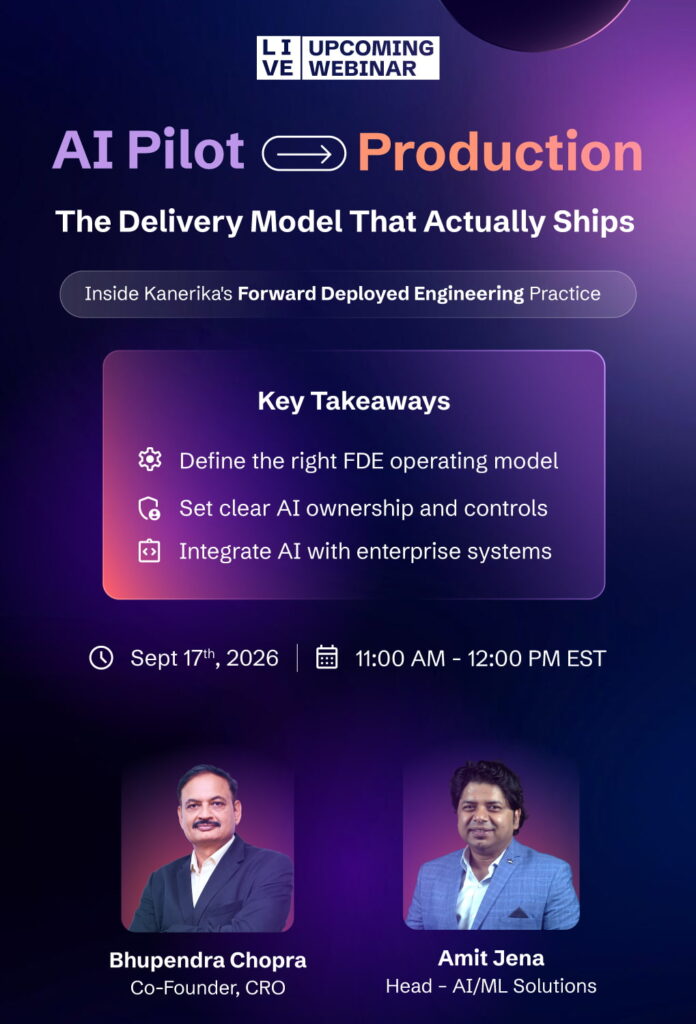
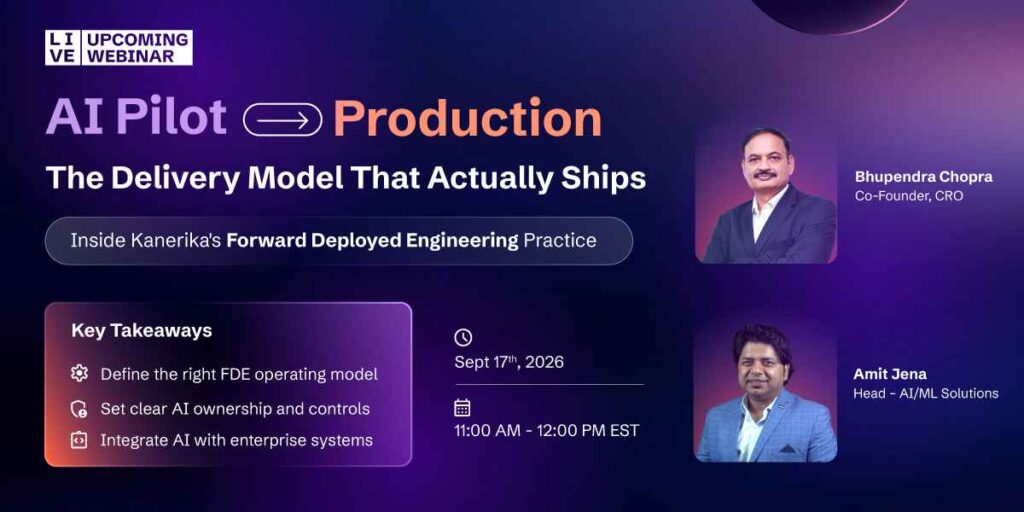
Hire AI Developers for Enterprise AI, Gen AI, and Agentic AI Projects
AI Solutions Delivered
Production-Ready AI Agents
Pilot-to-Production Rate
Get Started with Hire AI Developers Solutions












What Our AI Professionals Can Build
Add AI specialists to design, develop, and manage enterprise AI systems. Kanerika’s professionals work across data, models, applications, and AI operations to move projects from planning to production.

Generative AI Development
- Build secure enterprise GenAI applications
- Develop RAG-based knowledge systems
- Connect LLMs with business data

AI Agent Development
- Create task-focused enterprise AI agents
- Build multi-agent workflow systems
- Add human approval checkpoints
Machine Learning Engineering
- Develop predictive machine learning models
- Improve model accuracy and performance
- Deploy models into production systems

AI Data Engineering
- Prepare trusted data for AI
- Build scalable AI data pipelines
- Improve data quality and lineage

MLOps and Model Management
- Automate model training and deployment
- Track model performance and drift
- Manage versioning, testing, and monitoring
AI Governance and Security
- Apply responsible AI governance controls
- Protect enterprise data and access
- Support compliance, audits, and reporting
Business Benefits of Hiring AI Developers
Add experienced AI developers to improve execution, reduce hiring delays, and move AI work into production with less strain on internal teams.
Faster AI Project Delivery
- Reduce delays across development stages
- Move pilots into production faster
- Meet critical AI delivery timelines
Lower Hiring & Training Costs
- Avoid long recruitment cycles
- Reduce onboarding and training effort
- Pay only for required capacity
Stronger Technical Execution
- Add proven AI development experience
- Improve model quality and reliability
- Build secure production-ready systems
How Our AI Developers Solve Real Business Problems
See how Kanerika’s AI teams turn complex enterprise needs into working AI systems with clear gains in speed, accuracy, and operating cost.
70% Less Investigation Time with One Governed Ontology on Fabric
Impact:
- 70% Less investigation and reconciliation time
- 85+ Governed KPIs standardized across Power BI
- 40+ Entities and relationships modeled across key domains
60% Less Reporting Effort Across 3 SAP Systems on Fabric
Impact:
- 60% Reduction in time spent per reporting cycle
- 35+ Source tables connected across the order lifecycle
- 50+ Governed KPIs standardizing lead-time reporting
80% Less Manual Work in Travel Invoice Processing
Impact:
- 80% Less manual invoice work
- 100% Invoice lifecycle traceability
- 4x More volume, same cost
INNOVATE
Hire AI Developers with Industry-Specific Expertise








Why Hire Kanerika’s AI Developers?
Work with AI professionals who combine strong technical skills, enterprise delivery experience, and practical knowledge of production AI systems.
Build with developers experienced in generative AI, machine learning, LLM applications and RAG systems.

Support projects across document intelligence, predictive analytics, process automation, and customer operations.

Apply access controls, testing, monitoring, audit support, and responsible AI practices from development through deployment.

Empowering Alliances
Our Strategic Partnerships
The pivotal partnerships with technology leaders that amplify our capabilities, ensuring you benefit from the most advanced and reliable solutions.





Frequently Asked Questions (FAQs)
01What does an AI developer do?
An AI developer designs, builds, tests, and deploys software that uses machine learning, generative AI, computer vision, natural language processing, or predictive models. Their work may include preparing data, creating RAG pipelines, integrating LLM APIs, training models, building AI agents, and setting up monitoring. Enterprises hire AI developers to turn defined business requirements into secure, reliable, production-ready AI applications
02What skills should you look for when hiring AI developers?
Look for strong Python, SQL, machine learning, API integration, cloud, data engineering, and software development skills. For generative AI projects, assess experience with LLMs, prompt design, embeddings, vector databases, RAG, model evaluation, and agent frameworks. Strong AI engineers should also understand security, data governance, MLOps, testing, cost control, system integration, and the needs of enterprise applications.
03How much does it cost to hire an AI developer?
The cost to hire an AI developer depends on seniority, location, engagement model, project scope, and technical specialization. Generative AI developers, MLOps engineers, and agentic AI specialists often cost more than general software developers because the available talent pool is smaller. Total cost should also include cloud infrastructure, model usage, data preparation, security reviews, testing, monitoring, integration, and ongoing model maintenance.
04How long does it take to hire AI developers?
Direct hiring can take several weeks or months because experienced AI engineers remain difficult to assess and recruit. AI staff augmentation can shorten the process by providing pre-vetted professionals who join an existing team for a defined period. The actual start date depends on role complexity, required platform knowledge, security checks, interview stages, and whether you need one specialist or a dedicated AI development team.
05Should you hire an AI developer or an AI development company?
Hire an individual AI developer when your internal team already has clear architecture, product ownership, data access, and technical leadership. Choose an AI development company when the project needs several roles, such as machine learning engineers, data engineers, LLM developers, MLOps specialists, and AI governance support. A company is usually better for complex enterprise AI solutions that require delivery accountability across multiple workstreams.
06What is the difference between an AI developer and a machine learning engineer?
An AI developer usually focuses on building applications that use AI models, APIs, agents, and enterprise data. A machine learning engineer focuses more deeply on model training, feature engineering, experimentation, deployment, and model performance. The roles often overlap. For generative AI development, companies may need both application-focused LLM developers and machine learning engineers who manage evaluation, fine-tuning, observability, and production reliability.
07Can AI developers work with an existing engineering team?
Yes. Dedicated AI developers can join existing product, data, cloud, or software teams and follow their tools, coding standards, security controls, and delivery process. This AI staff augmentation model keeps architecture and project priorities under internal control while adding specialist capacity. It works well when a company needs help with RAG development, AI agents, machine learning pipelines, model integration, testing, or MLOps.
08How do you evaluate an AI developer before hiring?
Use a practical assessment based on the work the developer will perform. Ask candidates to design a small RAG system, explain model selection, review failure cases, estimate inference cost, and describe security controls. Strong AI developers should explain trade-offs clearly, test outputs, handle poor data, and discuss monitoring. Avoid hiring based only on certificates, framework names, or a basic chatbot demonstration.
09When should a company hire generative AI developers?
Hire generative AI developers when the business has a defined use case, available data, executive ownership, and a clear path from pilot to production. Common needs include document intelligence, enterprise search, customer service automation, knowledge assistants, code support, and AI agents. Hiring too early, before data access, governance, and success measures are defined, often creates expensive prototypes that cannot move into daily operations.
10Why hire AI developers through staff augmentation?
AI staff augmentation gives companies access to specialized talent without waiting through a full recruitment cycle or committing to permanent headcount. Businesses can add LLM developers, machine learning engineers, MLOps experts, or AI data engineers for specific delivery stages. This model suits enterprises that want direct control over priorities, architecture, intellectual property, and team management while adjusting AI development capacity as project needs change.