AI Governance Agent for Policy, Risk and Audit Evidence
Govern every model and agent your company runs, with evidence an auditor can follow.
Less investigation time, governed ontology
Inventory, owner and risk tier
Evidence trail per decision
Type II certified delivery
Certified security practices
Technology certifications
Govern every model and agent your company runs, with evidence an auditor can follow.
AI is spreading through enterprises faster than anyone can document it, and regulators are starting to ask who approved what. Kanerika builds and runs an AI governance agent on your own cloud that keeps a live inventory of models and agents, maps each one to policy, and collects audit evidence as a side effect of normal work. AI agent governance stops being a spreadsheet nobody trusts.
How the AI Governance Agent Works
Deployed on Your Stack
Kanerika deploys the agent on your Azure, AWS, GCP or on-premises environment, so governance runs where your AI systems already live.
Built on a Governed, Secure Foundation
Kanerika holds SOC 2 Type II, ISO 27001, ISO 27701 and ISO 9001 credentials and is GDPR compliant. The agent inherits your access controls and classification.
Works Where Your Teams Already Are
Intake requests, approvals and policy questions flow through Teams, Slack or email. Governance meets people in their daily tools, so it gets used.
Data and Prompts Stay in Your Tenant
Inventory records, assessments and usage logs never leave your environment and are never used to train external models.
Human Sign-Off on Every Policy Decision
The agent prepares assessments, maps controls and drafts findings. Risk owners and committees make the calls, and every decision is recorded with its reasoning.
Evidence Traced to Its Source
Every control status links to the artifact behind it, whether a test result, an access review or an approval, so auditors can verify rather than take your word.
AI Guardrails Explained for Enterprise Agents
The four types of AI guardrails and five building blocks that a governance agent enforces in practice.
The AI Audit Framework: EU AI Act, NIST and ISO 42001
A six-step audit blueprint that maps directly to the policy and evidence work this agent automates.
What the AI Governance Software Keeps in Order
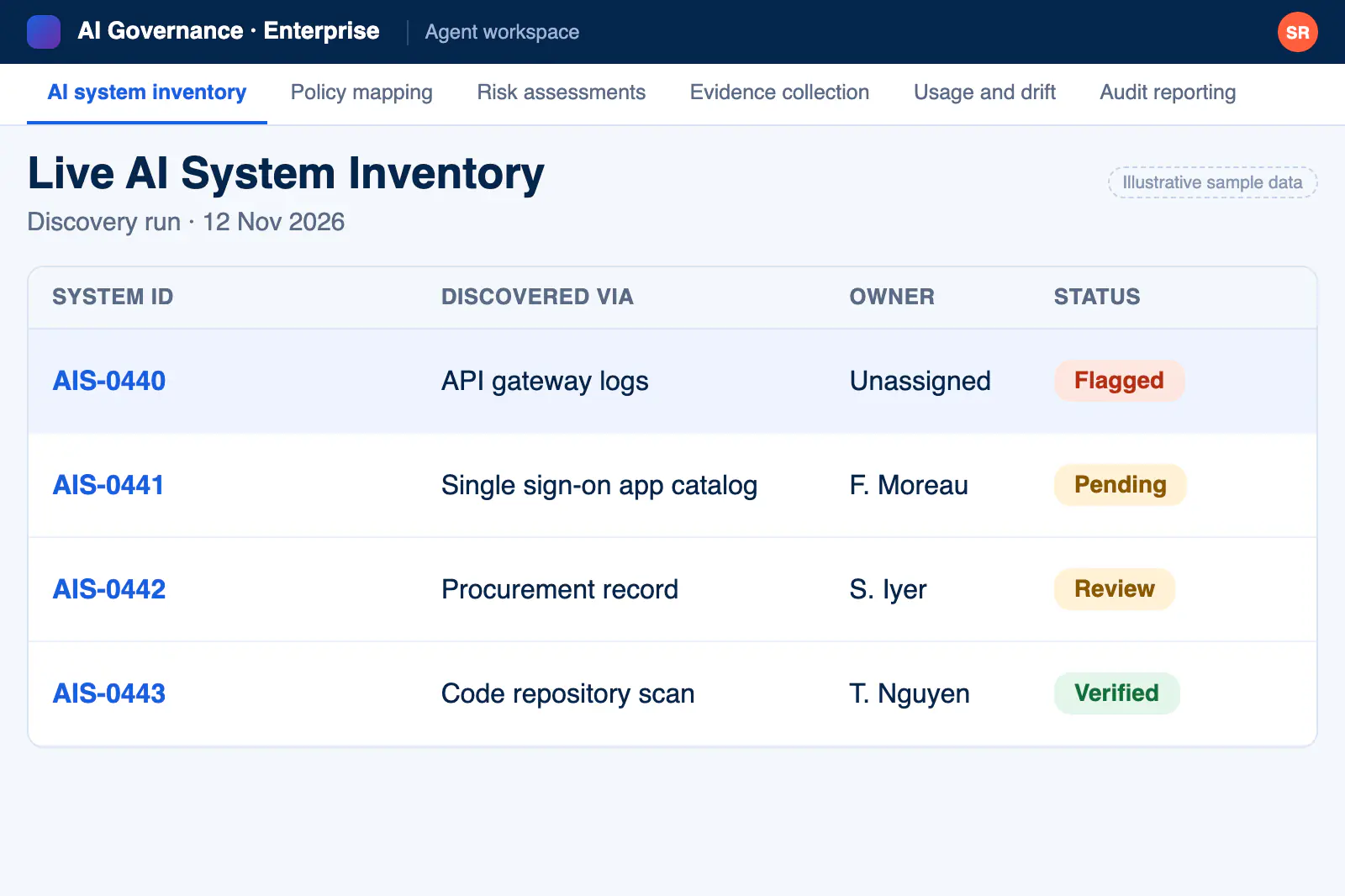
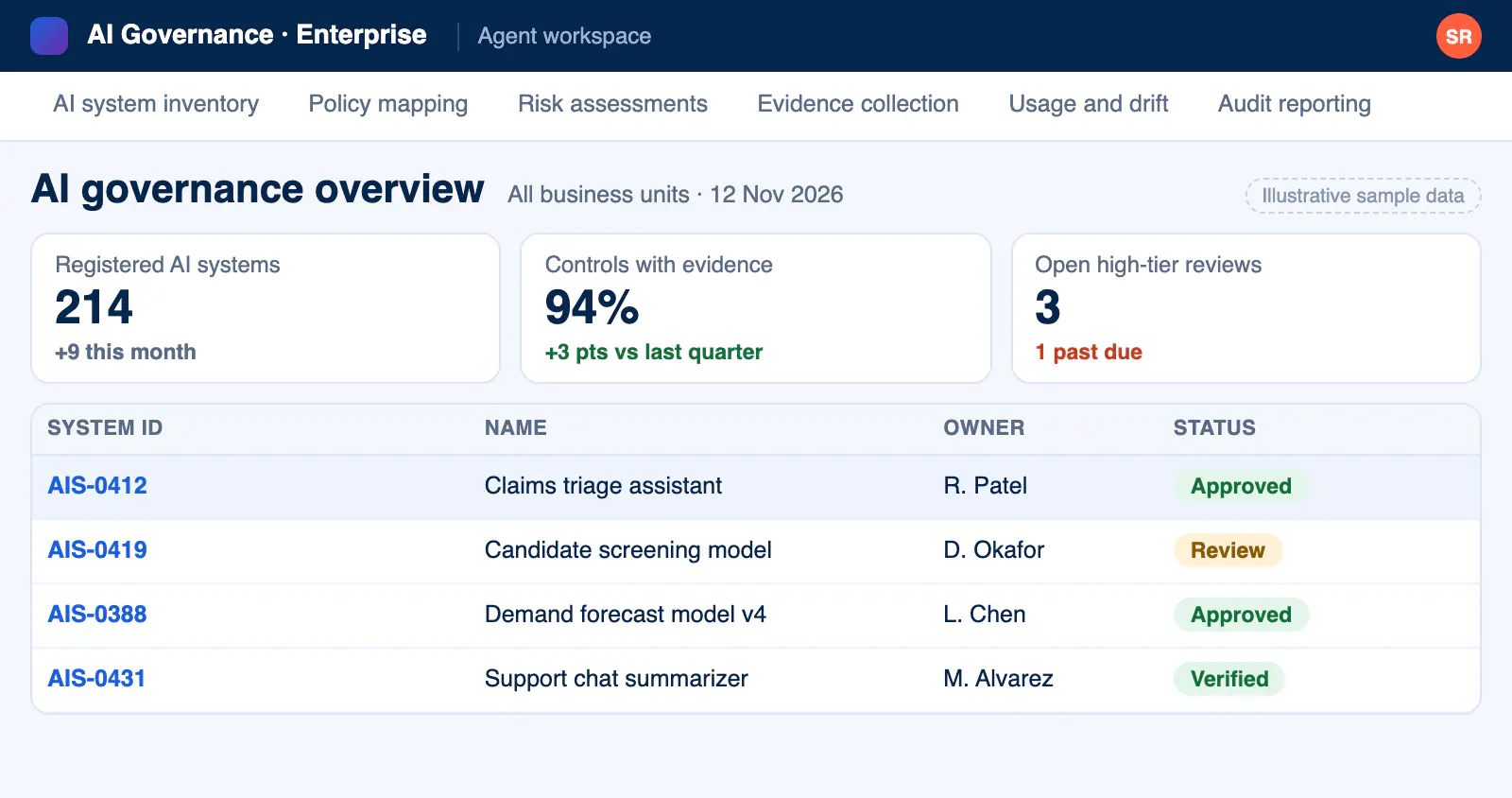
Live AI System Inventory
The agent discovers and registers models, agents and AI-enabled tools across the business, each with an owner, purpose and risk tier. Shadow AI shows up instead of hiding.
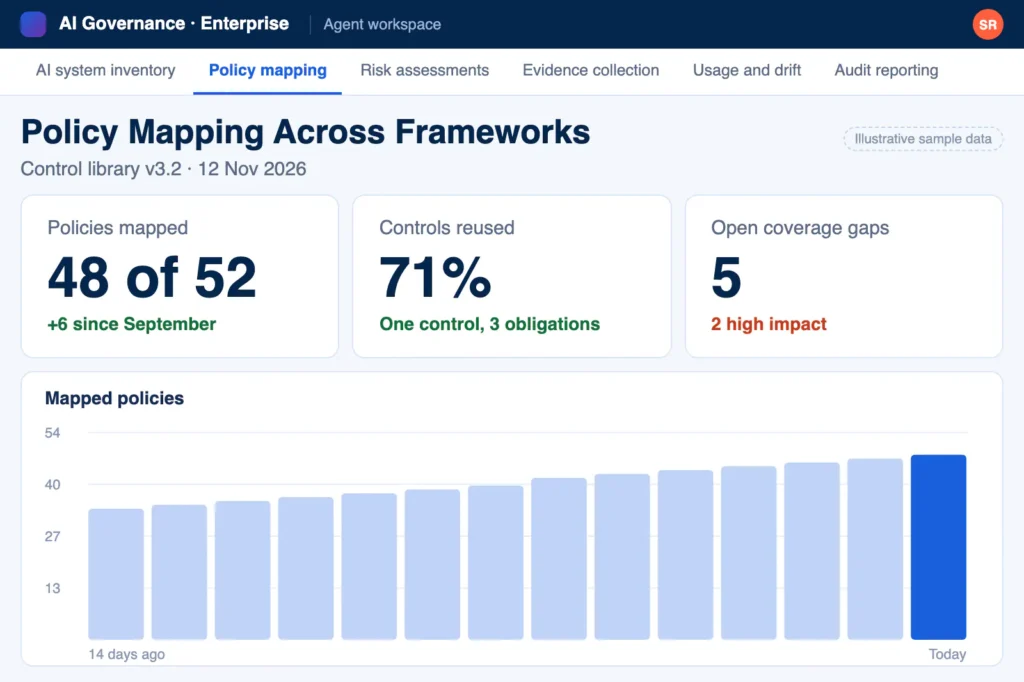
Policy Mapping Across Frameworks
Internal policies are mapped to external frameworks such as NIST AI RMF, ISO/IEC 42001 and the EU AI Act, so one well-run control answers several obligations at once.
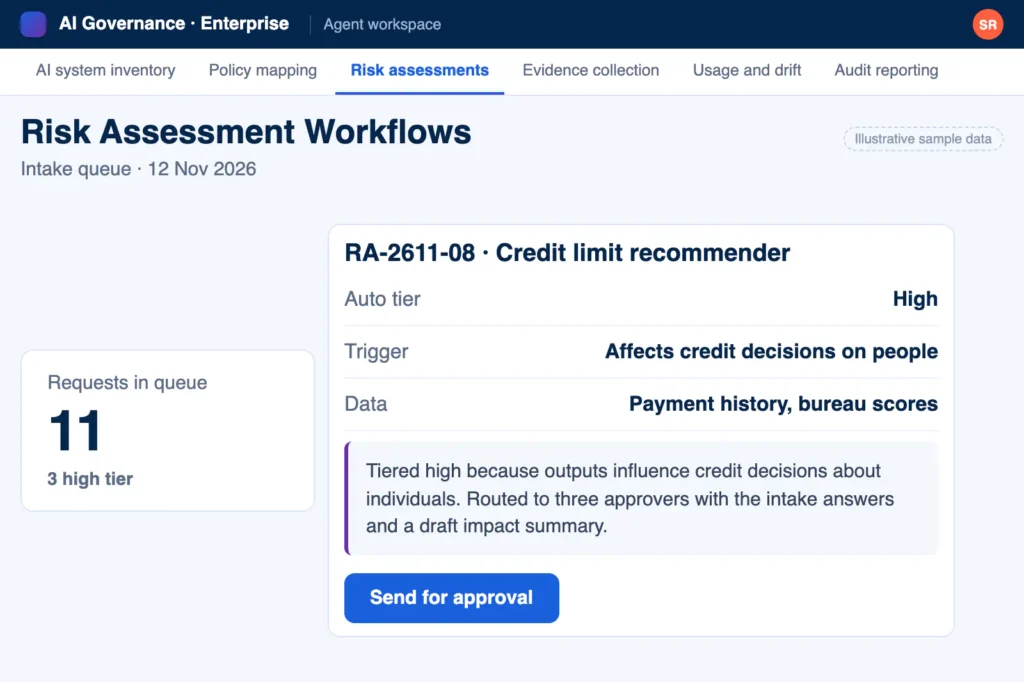
Risk Assessment Workflows
New AI use cases enter through a structured intake, get risk-tiered automatically and route to the right approvers with the context needed to decide.
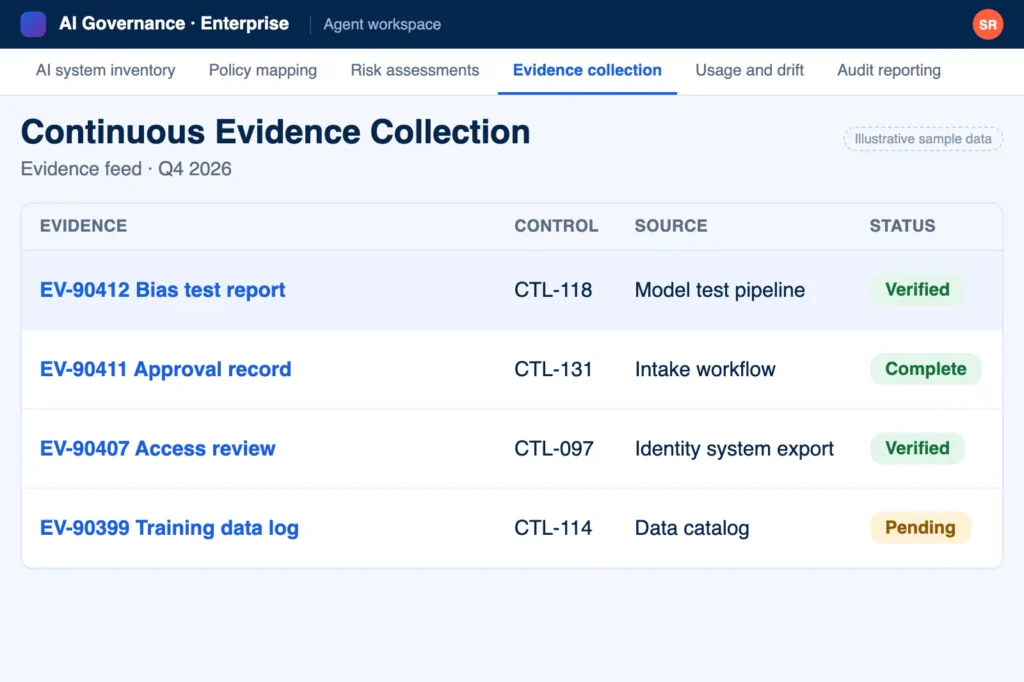
Continuous Evidence Collection
Approvals, test results, bias checks and access reviews are captured as they happen and filed against the controls they satisfy.
Usage and Drift Monitoring
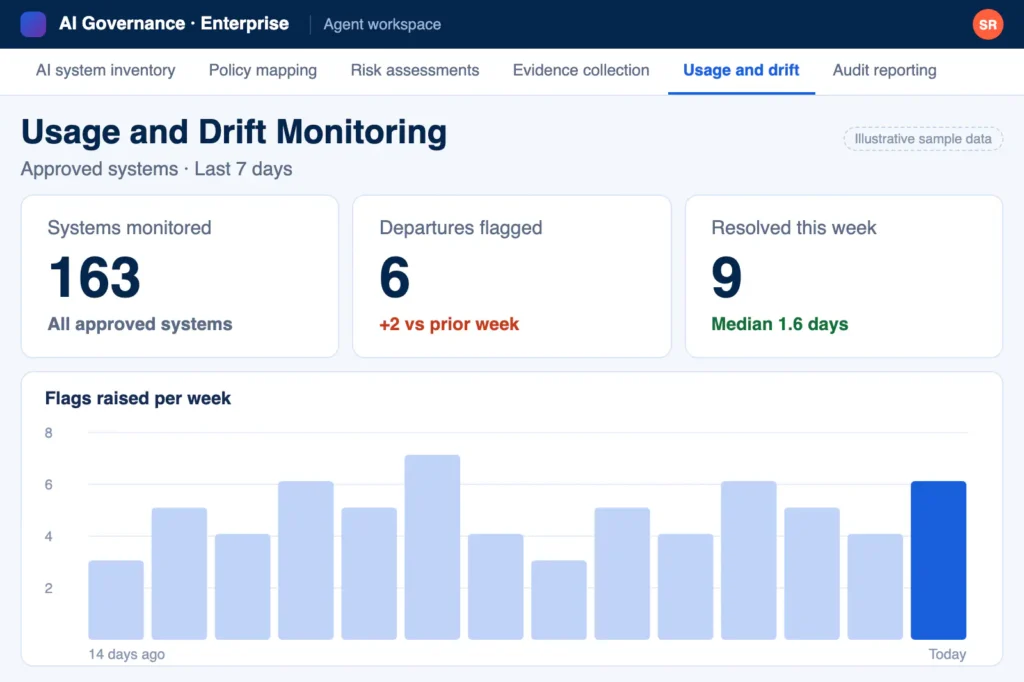
The agent watches how approved systems are actually used and flags departures from the approved purpose, data scope or user group.
Audit and Regulator Reporting
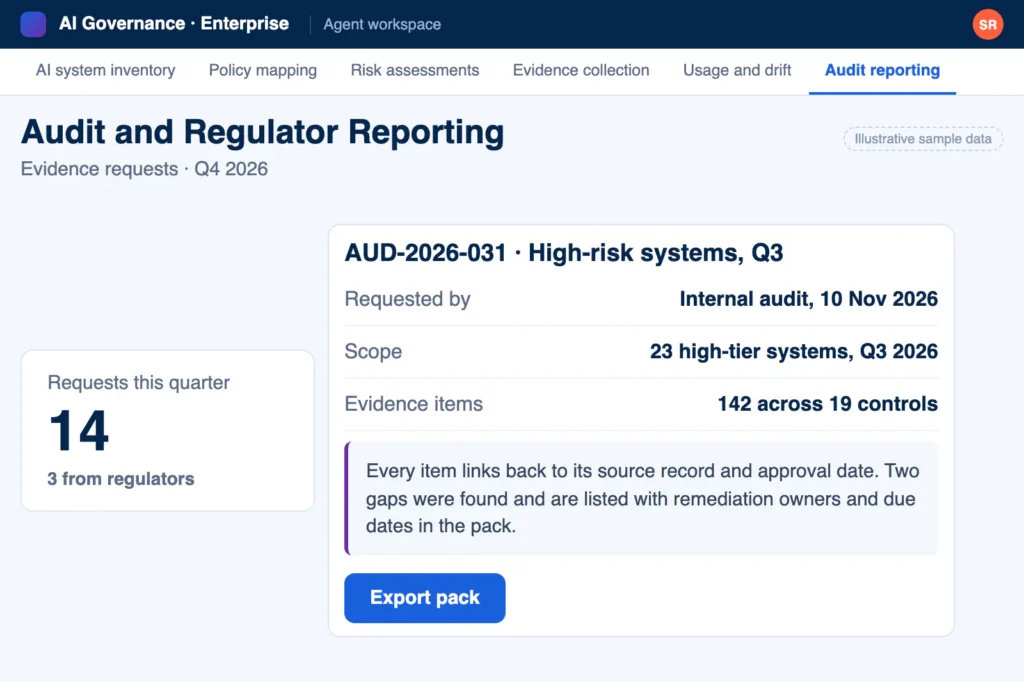
When an auditor or regulator asks, the agent assembles the evidence for the requested scope in hours, with every item traceable to its source.
Deploy Your AI Governance Agent in Weeks
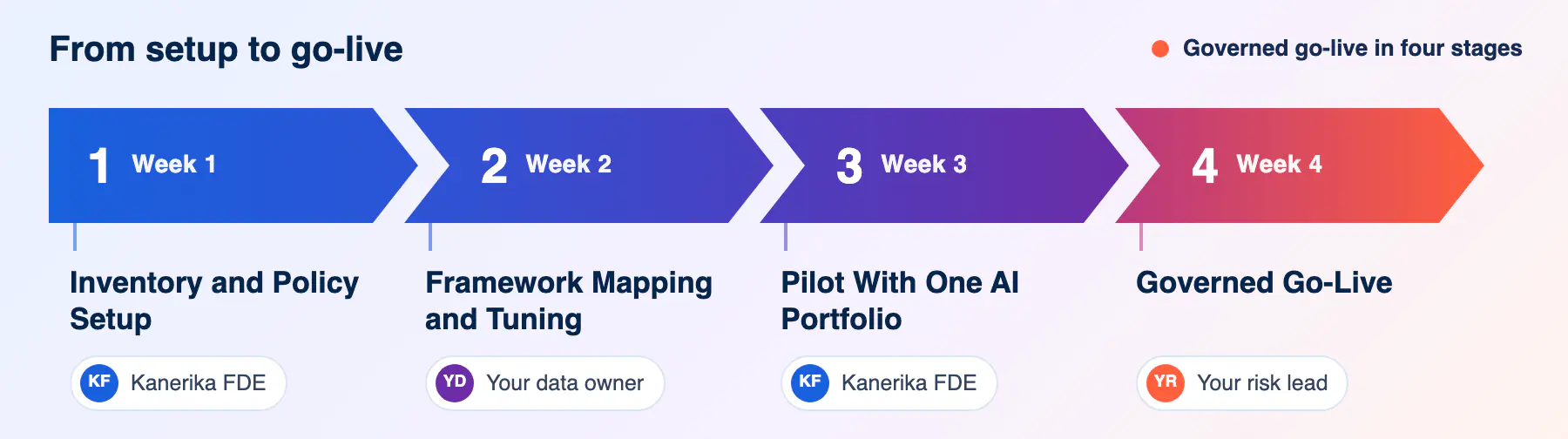
Inventory and Policy Setup
Kanerika connects the agent to your environment, builds the initial AI system inventory and loads your policies, standards and control library.
Framework Mapping and Tuning
Controls are mapped to the frameworks you answer to, and risk-tiering rules are tuned with your risk and legal teams.
Pilot With One AI Portfolio
One business unit or AI portfolio runs intake, assessment and evidence collection live. The process is refined on real requests.
Governed Go-Live
The agent rolls out across the enterprise with role-based access, escalation paths and audit logging in place from the first day.
Where AI Governance Tools Earn Their Keep
New AI Use-Case Intake
A product team proposes an AI feature, the agent tiers the risk, routes approvals and records the decision inside Teams.
Audit Evidence on Demand
An internal audit request that once took weeks of document chasing is answered from evidence the agent filed as work happened.
Policy Rollout and Attestation
Updated AI policies reach the affected owners with plain-language summaries, and the agent tracks attestations and exceptions to closure.
Third-Party AI Assessment
Vendors embedding AI into their products are assessed against your policy before contracts renew, with findings filed to the vendor record.
Model Change Review
Material changes to a model or agent trigger re-assessment automatically, so yesterday's approval does not cover today's system.
Incident and Exception Handling
AI incidents and policy exceptions are logged, classified and routed with evidence attached, building the record regulators expect to see.
Where Regulated Industries Use AI Governance Agents
Banking and Financial Services
Model risk management discipline extended to generative AI and agents. See Kanerika's banking and financial services work.
Insurance
Underwriting and claims models governed with the fairness evidence state regulators request. More on insurance .
Healthcare
Clinical and operational AI tracked with the documentation healthcare compliance teams need.
Pharma
AI used in regulated processes documented to quality standards for pharma organizations.
Manufacturing
AI on the shop floor and in the supply chain inventoried and governed for manufacturing leaders.
Logistics and Supply Chain
Optimization and forecasting models governed across partners in logistics and supply chain operations.
Why Teams Choose Kanerika for AI Agent Governance
Built by Kanerika's 300+ engineers, who have delivered for 100+ enterprise clients. Live in weeks, on your own data.
We finally see every AI tool in use, with an owner and a risk level next to each one.
New AI ideas come in through one intake and reach the right approvers with the context they need.
It tells us when a system is being used for something it was never approved for.
Governance Results from Kanerika Deployments
70% Less Investigation Time with One Governed Ontology on Fabric
Impact:
- 70% Less investigation and reconciliation time
- 85+ Governed KPIs standardized across Power BI
- 40+ Entities and relationships modeled across key domains
3x Faster Expert Vetting with an AI Compliance Agent
Impact:
- 3X Faster expert vetting
- 70% Decrease in backlog cases
- 40% Reduction in event delays
Zero Breaches, 100% Compliance for a Bank with Purview
Impact:
- 0% Data Breaches
- 100% Adherence to Compliance Regulations
- 15% Increase in Loyal Customers
FAQs
An AI governance agent is a deployed AI system that inventories the models and agents a company runs, maps them to internal policy and external frameworks, routes risk assessments and collects audit evidence continuously. Where many AI governance tools stop at a register, the agent also covers AI workflow automation governance, moving intake, approvals and evidence through the process without manual chasing. Kanerika builds and operates these agents on the client’s own cloud, with human owners making every approval decision.
No tool makes an organization certified, and any vendor claiming that deserves suspicion. Certification requires an accredited external assessment of your management system. What the agent does is map your controls to ISO/IEC 42001 and NIST AI RMF and keep the evidence organized, so the assessment you pursue moves much faster.
Data governance answers where data lives, who touches it and how it is classified. AI governance answers which models exist, what they are approved to do and whether their behavior still matches that approval. The two connect, and Kanerika delivers both, but an AI inventory and assessment trail is its own discipline.
The agent runs in your own Azure, AWS, GCP or on-premises environment, and all inventory, assessment and evidence records stay in your tenant. Access follows your role-based controls, nothing is used to train external models, and Kanerika operates under SOC 2 Type II, ISO 27001, ISO 27701 and ISO 9001 credentials.
Weeks, following four phases. Kanerika builds the initial inventory and loads your policies, maps controls to the frameworks you answer to, then pilots intake and evidence collection with one portfolio or business unit. Enterprise go-live follows once the process has proven itself on real requests, with governed access from day one.
The agent discovers AI usage across the environment and compares it to the approved register, so unregistered tools and models surface quickly. Each discovery is routed to an owner for a decision rather than silently blocked, which keeps teams cooperative. Over time the register converges on reality instead of on what people remembered to report.
kanSuite is Kanerika’s modular governance services program, covering kanGovern for data governance strategy, kanComply for regulatory compliance frameworks and kanGuard for data security, all delivered on Microsoft Purview. The AI governance agent is a natural companion, extending the same discipline to the models and agents that consume all of that governed data.
Two published case studies anchor this page. A single governed ontology on Microsoft Fabric cut investigation time by 70% for one client, and a Microsoft Purview implementation gave a leading bank classified, policy-enforced control of its regulated data. Both case studies are linked above with full architecture and outcome detail for each engagement.
Start with a live inventory that gives every model and agent an owner, a purpose and a risk tier, so shadow AI surfaces instead of hiding. Then check that policies map to NIST AI RMF, ISO/IEC 42001 and the EU AI Act, that new use cases enter through structured intake, and that evidence is captured as work happens and traced to its source. Kanerika’s agent covers each of these inside your own tenant, with people signing off every decision.
Register every agent before it goes live, tier its risk at intake and route approval to the right owner. Re-assess automatically when a model or agent changes materially, because yesterday’s approval does not cover today’s system. Watch actual usage against the approved purpose, data scope and user group, and file approvals, test results and access reviews against the controls they satisfy. The governance agent applies these practices as part of normal work.
Let’s Transform Your Business