

Alteryx to Microsoft Fabric Migration, Automated with FLIP
Migrating from Alteryx to Microsoft Fabric eliminates per-seat licensing, unifies your analytics and AI stack on one platform, and removes the infrastructure overhead. Kanerika's FLIP Migration Accelerator automates the heavy lifting, converting Alteryx workflows into Fabric-native data pipelines.
Get Started with Alteryx to Microsoft Fabric Migration
The Alteryx Modernization Gap
What Staying on Alteryx Costs Your Enterprise

80%
IT budgets are spent on legacy system maintenance.

44%
CIOs see legacy systems as growth barriers

50%
Developer productivity is lost due to outdated tools.

70%
Digital transformation efforts fail due to legacy systems.
Migrate from

with Our Accelerator
Use Your Azure Committed Spend (MACC)

Watch FLIP Convert Alteryx Workflows to Fabric
See how FLIP connects to your Alteryx environment, converts workflows into Fabric-native data pipelines, and preserves transformation logic, data connections, and scheduling throughout.
Migration ROI Calculator
Kanerika’s IP-led accelerator, FLIP, automates your migration with major resource savings, ensuring a faster, lower-risk move to your target platform.
FLIP is Kanerika's proprietary migration accelerator. Here's exactly where the savings come from:
The Alteryx to Microsoft Fabric Advantage
What Enterprises Unlock by Moving from Alteryx to Fabric

One Platform for Analytics and AI
- Consolidate analytics, data engineering, and AI on one platform
- Eliminate tool sprawl with OneLake as shared storage
- Share data across teams without duplication

Cloud Native, Higher Scalability
- Run Spark-native compute across batch, streaming workloads
- Build real-time Fabric pipelines without separate infrastructure
- Reduce latency across your analytics and data integration stack

Built-In Governance and Reporting
- Run ML models directly on OneLake, no data movement needed
- Get Power BI dashboards live and reporting from day one
- Govern all Fabric workloads centrally via Microsoft Purview

Lower Total Cost of Ownership
- Pay for what you consume, not per-seat Alteryx licensing
- Cut complexity by consolidating analytics into one Fabric platform
- Apply MACC credits toward migration costs from day one
The Migration Process
Our Alteryx Migration Consulting and Automation Approach
Workflow Discovery and Architecture Assessment
FLIP connects to your Alteryx environment, catalogues all workflows, data connections, and macros, and packages selected assets with full dependencies for conversion.


Automated Alteryx to Fabric Pipeline Conversion
FLIP ingests exported Alteryx assets, analyzes transformation logic, and converts each workflow into a Fabric-native data pipeline, preserving business rules, source-target connections, and scheduling automatically.

Validation Against Original Alteryx Outputs
Converted Fabric pipelines are validated against original Alteryx workflow configurations, confirming functional parity across transformation logic, trigger behavior, and data output before deployment.

Deployment, Optimization and Fabric Readiness
FLIP flags conversion edge cases, decommissions redundant workflows, and connects your Fabric environment to OneLake, Microsoft Purview governance, and Power BI reporting from day one.

ROI YOU CAN EXPECT
What Automated Alteryx to Fabric Migration Saves You
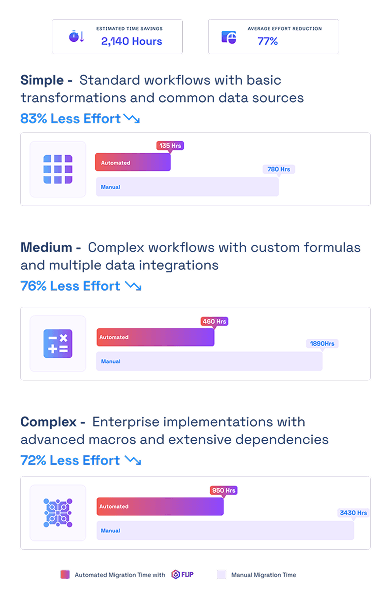
Alteryx to Fabric migration services with FLIP reduce effort at every complexity level. FLIP handles conversion so your team focuses on validation rather than manual rebuilding.

ESTIMATED TIME SAVINGS

Average effort reduction
Simple - Standard workflows with basic transformations and common data sources
Less Effort

Medium - Complex workflows with custom formulas and multiple data integrations
Less Effort
Complex - Enterprise implementations with advanced macros and extensive dependencies
Less Effort

Case studies
Migration Outcomes FLIP Delivers Across Industries
We delivered data platform migrations across manufacturing, retail, financial services, and logistics using FLIP as the conversion engine for Alteryx, Informatica, and other ETL workloads.
Migration
60% Faster Migration: Crystal Reports to Power BI
Impact:
- 60% Faster Migration
- 10x Data Scale
- 99.5% Refresh Success Rate
Migration
60% Faster Analytics with Informatica to Alteryx
Impact:
- 45% Faster Reporting Cycles
- 38% Reduction in Maintenance Costs
- 60% Improved Analytics Turnaround
Migration
74% Faster Retail Reporting with Microsoft Fabric
Impact:
- 74% Faster Reporting Cycles
- 65% Increase in Reporting Stability
- 72% Faster Access to Current Metrics
Frequently Asked Questions (FAQs)
01How long does an Alteryx to Microsoft Fabric migration take?
Timeline depends on workflow volume and complexity. Simple Alteryx migrations take around 120 hours with FLIP versus 720 hours manually. Mid-scale projects with custom macros run approximately 480 hours automated. Complex enterprise environments take around 940 hours with FLIP compared to 3,365 hours by hand. Kanerika runs a full workflow audit before work begins, so you get a precise scope and timeline before any commitment is made.
02What do Alteryx to Fabric migration services include?
Kanerika’s Alteryx to Fabric migration services cover four stages: workflow discovery, automated conversion with FLIP, validation against original Alteryx outputs, and deployment with post-migration optimization. FLIP handles the first two automatically for most workflow types. Your team reviews converted pipelines, validates against source outputs, and signs off before any Alteryx workflow is decommissioned. Manual work is limited to edge cases FLIP flags during discovery.
03What is the recommended approach to migrate Alteryx workflows to Fabric?
The most efficient way to migrate Alteryx workflows to Fabric is automated conversion with FLIP. Rather than rebuilding each workflow manually, FLIP exports your Alteryx environment, converts workflows into Fabric-native data pipelines, and validates outputs against originals. Kanerika runs migrations in parallel with your existing Alteryx environment so nothing is decommissioned until Fabric pipelines are fully validated. This approach avoids production disruption and gives your team time to verify outputs before the final cutover.
04Is Microsoft Fabric a practical alternative to Alteryx for enterprise data teams?
For organizations already in the Microsoft ecosystem, Fabric is the strongest Alteryx alternative available today. Unlike Alteryx’s standalone data prep model, Microsoft Fabric unifies data integration, warehousing, real-time analytics, and AI on one platform with OneLake as shared storage. It connects natively to Power BI and Azure services, scales with Spark compute, and includes Microsoft Purview for built-in governance. Teams that switch from Alteryx to Microsoft Fabric typically see lower licensing costs and a platform ready for AI workloads without additional tooling.
05Can enterprises fully replace Alteryx with Microsoft Fabric?
Yes. Microsoft Fabric covers every core Alteryx use case, including data prep, blending, ETL, and workflow automation, while adding cloud-native compute, real-time analytics, and built-in governance. Kanerika maps each Alteryx workflow to its Fabric equivalent before migration begins and confirms parity post-conversion. FLIP automates the conversion while Kanerika engineers handle edge cases. Organizations that replace Alteryx with Fabric typically reduce per-seat licensing costs and eliminate the need for separate, siloed analytics infrastructure.
06What happens to Alteryx data pipelines during migration to Fabric?
During Alteryx to Fabric data pipeline migration, FLIP analyzes each workflow and converts it into an equivalent Fabric-native data pipeline. Alteryx data connections become Fabric connectors, transformation steps map to Fabric data flow components, and scheduling logic translates to Fabric pipeline triggers. Business rules, parameters, and output configurations are preserved throughout. Each converted pipeline is validated for functional parity before the original Alteryx workflow is retired. FLIP flags any items requiring manual review so your team knows exactly what needs attention.
07What does Alteryx migration consulting with Kanerika cover?
Alteryx migration consulting with Kanerika covers three phases: assessment, execution, and enablement. Assessment maps your full Alteryx workflow inventory, identifies complexity tiers, and produces a migration plan with effort estimates. Execution uses FLIP to automate conversion, with Kanerika engineers handling edge cases and validation. Enablement covers governance setup with Microsoft Purview, Power BI integration, and team training on Fabric. Kanerika holds Microsoft’s Data Warehouse Migration to Azure Specialization as a certified Microsoft Solutions Partner for Data and AI.
08How does Kanerika handle Alteryx decommissioning during cloud migration?
Decommissioning starts only after each Fabric workflow group passes parity validation and formal sign-off. Kanerika then retires the matching Alteryx workflows in waves, archives workflow definitions and historical outputs for audit purposes, disables Alteryx Server schedules, and repoints downstream consumers such as Power BI reports to the new Fabric pipelines. Seat and server licenses are reduced in line with each wave, so licensing costs fall progressively rather than only at the final cutover.
09Can we run Alteryx and Microsoft Fabric in parallel during migration?
Yes, and Kanerika recommends it. All Alteryx to Microsoft Fabric migrations run in parallel with the existing Alteryx environment. Fabric pipelines are built and validated while Alteryx continues handling production workloads. Different business units or workflow groups can move at different speeds. Alteryx is decommissioned only after your team formally signs off on the Fabric environment. There is no forced cutover, and you retain full control over the pace throughout the migration.
10Is Kanerika's Alteryx to Fabric migration tool available on Azure Marketplace?
Yes. Kanerika’s FLIP Migration Accelerator is listed on the Azure Marketplace and can be purchased using Azure Committed Spend (MACC). If your organization has committed Azure spend, you can apply it toward your Alteryx to Fabric migration services, reducing or eliminating out-of-pocket tooling costs. Kanerika holds Microsoft’s Data Warehouse Migration to Azure Specialization and is a certified Microsoft Solutions Partner for Data and AI. FLIP has passed Microsoft’s technical and compliance requirements. Kanerika also holds ISO 27001, SOC 2, ISO 9001, and CMMI Level 3 certifications.