Home Industries AI Pharma
AI Advantage We Bring to Pharma Manufacturers
Kanerika’s AI solutions give pharmaceutical manufacturers real-time control over demand, pricing, inventory, and compliance across every product and market.
Fewer stockouts
Forecast accuracy
Higher pricing margins
Get Started with AI Pharma Solutions












What Running Pharma Without AI Actually Costs You
Fragmented data, slow pricing cycles, and manual compliance workflows compound across every function until margins shrink and launch timelines slip.
Manual Invoice Workflows
Finance teams routing invoices by hand with no audit trail, creating delays and compliance gaps.
Limited Commercial Visibility
No unified view of customer behavior, churn signals, or product sentiment across channels and regions.
Demand Signals Lost in Silos
Disconnected sales and production, makes accurate SKU-level forecasting nearly impossible.
Slow Product Pricing Response
Manual price review cycles fall behind market shifts, tender deadlines, and competitor moves.
Compliance and Audit Drag
Teams spend weeks retrieving SOPs and regulatory documentation that AI can surface in seconds.
Inaccurate Inventory Positioning
Overstock on slow-moving SKUs and shortages on high-demand products drain working capital and revenue.
AI Suite Your Pharma Operations Need
From demand forecasting to audit prep, these AI tools are built for the specific data, compliance, and commercial challenges pharma operations run into daily.
Pharma Demand Forecaster
Predict demand at SKU, region, and channel level using sales history, trends, and market signals to keep production and supply ahead.

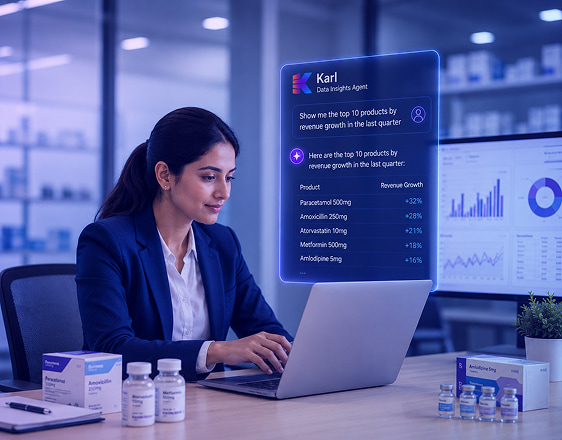
Karl - AI Data Insights Agent
Query commercial performance, inventory levels, and operational metrics in plain English. No SQL, no dashboards. Just ask and get answers.
Smart Product Pricing
Monitor competitor pricing, tender cycles, and input cost shifts to recommend timely price adjustments across your product catalog with a full audit trail.

Customer Insights Copilot
Segment customers by behavior, affinity, and churn risk. Surfaces sentiment trends from field data so teams act on real signals.

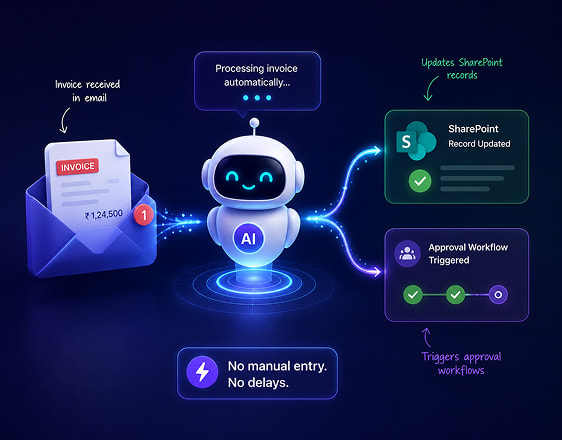
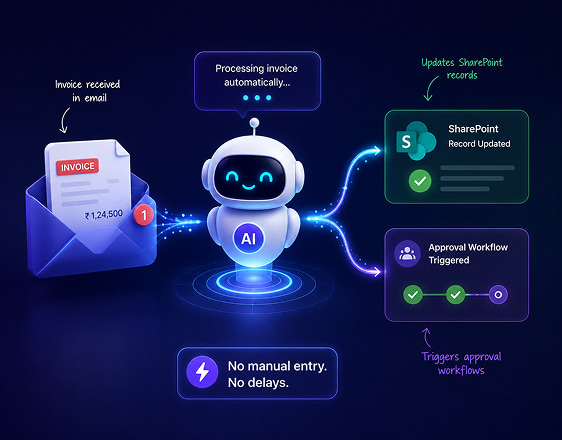
Invoice Automation Agent
Pulls invoice data from email, updates SharePoint records, and triggers approval workflows automatically. No manual entry, no delays.

Pharma AI Services for Accelerating Outcomes
End-to-end AI services built around pharma’s specific constraints: regulatory compliance, complex supply chains, and commercial teams that need answers fast.
AI Strategy and Advisory
A prioritized AI roadmap tied to your commercial, supply chain, and compliance goals.

Generative AI Solutions
Automate regulatory submissions, medical affairs content, and internal knowledge retrieval at scale.

AI Model Development
Demand, pricing, and patient propensity models built on your historical sales and operational data.
AI/ML Ops
Keep pharma AI models accurate as market conditions, product mixes, and regulatory requirements evolve.
AI Governance
Deploy AI within your GMP, FDA, and data privacy requirements without adding friction to your operations.

AI/ML Consulting
Custom models for demand prediction, churn analysis, and product performance across therapeutic areas.

Why Pharma Companies Choose Kanerika for AI
Pharma-Trained AI Models
Built on production, commercial, and regulatory data, not generic life sciences templates.
Agentic AI Expertise
Deploy agents that act on demand shifts, pricing signals, and compliance triggers without manual intervention.
Compliance-First by Design
deployment includes audit trails, access controls, and explainability to meet GMP, FDA, and regulatory requirements.
Proven Business Outcomes
Real improvements in forecast accuracy, pricing margin, and audit response times, not proof-of-concept pilots.
What Pharma Leaders Say About Our AI
“Demand planning used to lag our actual market by weeks. The Forecaster changed that. We stopped writing off overstock and started planning with confidence.
Head of Supply Chain
Pharmaceutical Manufacturer
“Tender pricing was reactive and inconsistent. Smart Product Pricing gave our commercial team a model they trust and timelines they can actually meet.”
VP Commercial
Generic Drug Company
“Regulatory audits used to consume our compliance team for weeks. DokGPT cut that to two days. It retrieved exactly what the inspector needed with full citations.”
Compliance Director
Pharma Manufacturing Group
“We didn’t have a visibility problem. We had an access problem. Karl gave our ops team answers without waiting on anyone.”
Chief Operating Officer
Pharma Distributor
Frequently Asked Questions (FAQs)
01What is AI in pharmaceutical manufacturing and how does it improve operations?
AI in pharmaceutical manufacturing applies machine learning, predictive analytics, and intelligent automation to demand forecasting, pricing optimization, regulatory compliance, and commercial operations. Unlike manual workflows, AI models analyze historical sales data, production records, and market signals to surface actionable recommendations in real time. Pharma manufacturers using AI in operations report measurable improvements in forecast accuracy, inventory positioning, pricing margin realization, and audit response times across commercial and supply chain teams.
02How does AI demand forecasting work for pharmaceutical manufacturers?
AI demand forecasting for pharma analyzes historical sales data, seasonal patterns, product lifecycle stages, and market signals to predict SKU-level demand across regions, channels, and therapeutic areas. Unlike spreadsheet models, AI accounts for tender cycles, generic entry, and supply variability simultaneously. Pharmaceutical manufacturers using AI-powered demand planning report significant reductions in overstock write-offs, fewer production misalignments, and faster replenishment cycles, particularly for high-volume generic portfolios and specialty drug products with complex distribution requirements.
03How does AI improve pharmaceutical pricing and tender management?
AI pharmaceutical pricing tools monitor competitor pricing, tender deadlines, input cost shifts, and reimbursement changes to recommend timely price adjustments across large product catalogs without manual SKU-by-SKU review. For generic and specialty pharma companies operating in tender-driven markets, manual pricing cycles cannot keep pace with market movements. AI-driven pricing protects margins during cost increases, supports tender responses with data-backed recommendations, and reduces the lag between a market signal and a commercial pricing decision.
04Can AI help pharmaceutical companies with regulatory compliance and audit preparation?
Yes. AI document intelligence tools retrieve cited answers from SOPs, batch records, regulatory filings, and compliance policies in seconds. Instead of manually searching across multiple systems for weeks, compliance and quality teams get accurate, sourced responses in minutes. Pharmaceutical organizations using AI for regulatory document retrieval report audit preparation time dropping from weeks to days. The same tools support inspection readiness, GMP compliance documentation, and internal audit workflows without requiring additional headcount or system replacement.
05What is a pharma demand forecaster and how is it different from standard forecasting tools?
A pharma demand forecaster is an AI model trained specifically on pharmaceutical sales patterns, product lifecycle data, tender cycles, and supply chain variables. Unlike standard business forecasting tools, it accounts for regulatory-driven demand shifts, generic substitution effects, and reimbursement changes that affect pharmaceutical demand differently from other industries. Pharma-specific forecasting models deliver SKU-level accuracy across therapeutic areas, geographies, and distribution channels, reducing both overstock write-offs and stockout events on high-demand products.
06How does AI improve inventory management for pharmaceutical manufacturers?
AI inventory optimization for pharma analyzes consumption patterns, production lead times, shelf-life constraints, and demand forecasts to recommend dynamic safety stock levels and reorder points. Rather than applying static min-max rules that fail during demand spikes or supply disruptions, AI adjusts recommendations continuously as conditions change. Pharmaceutical manufacturers using AI inventory tools report significant reductions in working capital tied up in slow-moving stock, fewer write-offs from expired inventory, and better availability on high-demand SKUs across distribution networks.