
TL;DR
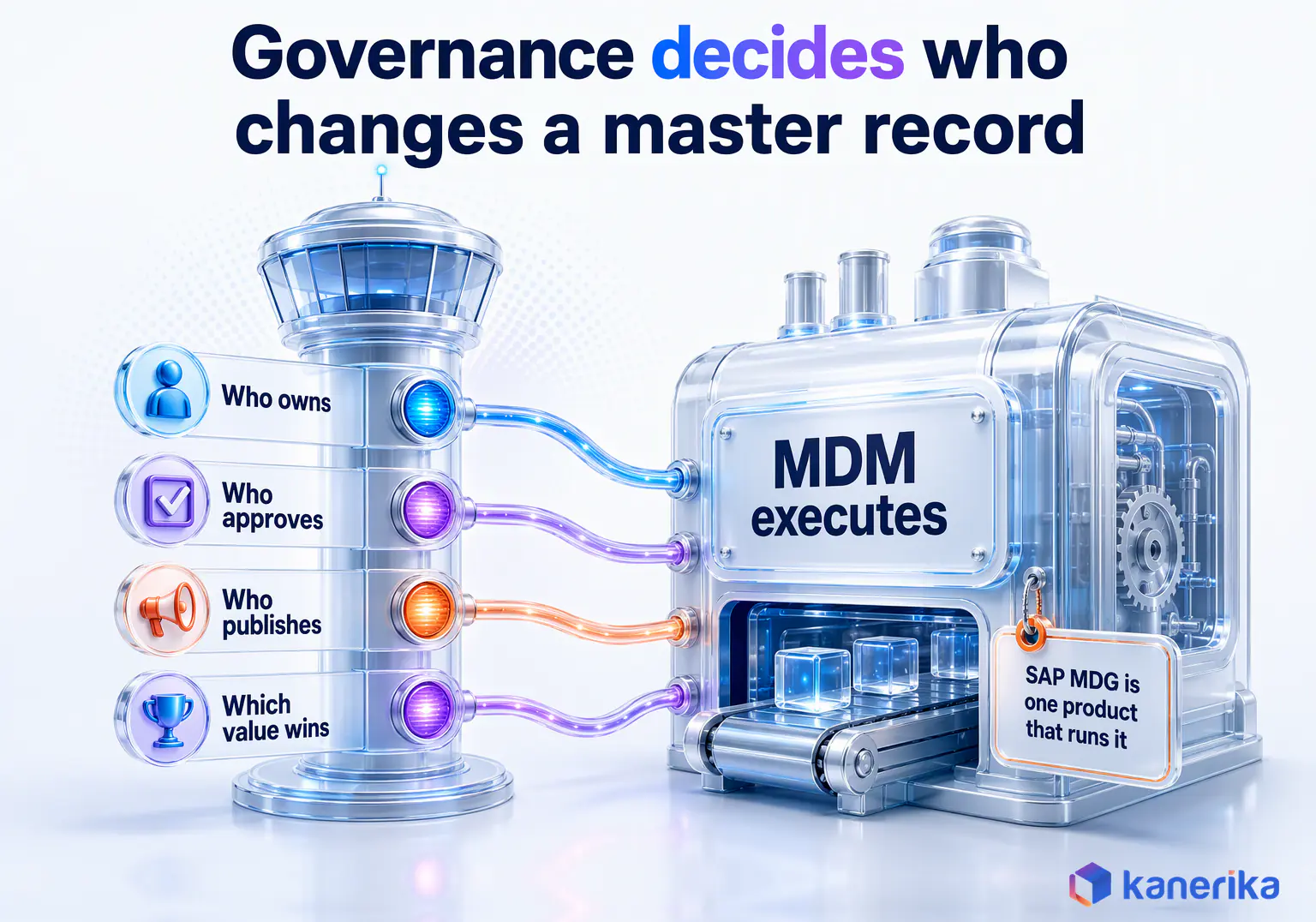
Master data governance is the set of rules, roles and controls that decides who can create, change, merge and publish core business records such as customers, suppliers and products. The business owns those decisions, data stewards work the exception queues, and the MDM platform only carries out the rules. It is a discipline, and SAP Master Data Governance is one product that can run it. The golden record is the hard part, because match, merge and survivorship are three separate decisions. Ownership often sits at the attribute level, so finance can own bank details while procurement owns supplier classification. Start with one domain that has a visible problem, then measure false merges, exception age and business outcomes before you expand.
Key Takeaways
- Master data governance decides who may create, change, merge and publish shared records, and MDM software executes those decisions.
- A golden record is a governed version of an entity, not always one physical record or one source for every field.
- Match, merge and survivorship need separate rules, separate owners and separate tests.
- Attribute-level ownership settles most disputes, for example finance approving every bank detail change.
- Stewards need funded time, risk-based queues and a clear escalation path, or the roles exist only on paper.
- Prove one domain against exit criteria, then expand, and judge success by business outcomes rather than activity.
What an Ungoverned Supplier Record Costs Every Month
Take one supplier held three ways (an illustrative case). Procurement lists Northline Components, the ERP holds Northline Components Inc., and accounts payable keeps an older record with different bank details.
Nothing breaks on day one. Yet every month the records stay split, the cleanup bill grows. Invoices post against the wrong entry, a buyer creates a fourth copy, and an auditor asks who approved the bank change.
An MDM platform cannot settle any of this on its own. It cannot decide who owns the supplier, whether two records may merge, or whose bank details win. Those are governance decisions, and each quarter without them adds duplicates, rework and audit questions that someone eventually has to unwind.
What Is Master Data Governance?
Master data governance is the set of rules, roles and controls that decides who can create, change, merge and publish core business records. These are the shared entities every process depends on, such as customers, suppliers, products, locations and the chart of accounts. Governance also covers each entity’s critical attributes, relationships and lifecycle states.
Its output is a set of written, enforced decisions. For example, who may create a supplier? Which fields must be filled before a record can be used? Who approves a merge, and who can override a value?
Master Data vs Transaction Data
Master data describes the things a business deals with, while transaction data records what happened to them. A supplier with its legal name, tax ID and payment terms is master data, while the invoice that supplier sends is a transaction.
The difference matters because errors travel differently. A wrong invoice affects one payment. But a wrong supplier record affects every invoice, order and report that points at it, so it earns its own governance.
Master Data Governance vs MDM vs Data Governance
Master data governance sets the decisions, while master data management (MDM) is the process and technology that carries them out. So is master data management part of data governance? Broadly yes, because enterprise data governance is the parent discipline that sets policy for all data.
Within it, master data governance is the slice that handles shared entities and their golden records. Kanerika’s guide to building a data governance framework covers the wider structure, and the table below shows where each layer stops.
| Discipline | Scope | Decisions it makes | Accountable roles | Typical outputs |
|---|---|---|---|---|
| Data governance | All enterprise data | Policy, classification, access, quality standards | Governance council, chief data officer | Policies, standards, business glossary |
| Master data governance | Shared entities such as customer, supplier and product | Who creates, changes, merges and publishes; which value wins | Domain owners, attribute owners, stewards | Decision rights, match and survivorship rules, approval workflows |
| Master data management | The hub and processes that hold master records | How the rules run at scale | MDM team, technical custodians | Golden records, match engine, workflows, publishing |
A simple test sorts most questions. When a question starts with “who decides”, it belongs to governance. When it starts with “how does the system do it”, it belongs to MDM instead.
Master Data Governance vs SAP MDG
The name causes real confusion, because SAP sells a product called SAP Master Data Governance. SAP also now positions it inside SAP Business Data Cloud. Its product page lists golden records per domain, matching and merging, pre-built change-request workflows and a complete audit trail of changes.
SAP MDG is one way to run the discipline, especially in SAP-centric estates. It still leaves the ownership model to you. Everything in this guide applies whether the rules run in SAP MDG, another MDM hub or a set of governed workflows.
Why Master Data Governance Matters
Shared records sit underneath decisions that cost money when they go wrong. Paying the right supplier, for one, depends on one approved set of bank details. Crediting the right customer also depends on knowing that two records are the same company, while classifying a product once depends on one agreed hierarchy.
What Disconnected Master Records Cost
The cost usually shows up as slow, manual reconciliation long before anyone calls it a master data problem. At FoodPharma, plant managers, finance and analysts worked across six disconnected systems. The Microsoft customer story on FoodPharma names Kanerika as the delivery partner.
Over a 7-week implementation, Kanerika built a foundation layer on Microsoft Fabric that consolidated more than 50 tables and 1 TB of history. Cross-functional reporting dropped from two business days to 90 minutes, and the BI team got back roughly 15 hours a week. It was a reporting foundation rather than an MDM hub. Still, it puts a weekly price on scattered records.
The price is visible at enterprise scale too. Gartner’s often-cited estimate, from research published in 2020, was that poor data quality costs organizations at least $12.9 million a year on average. The figure also appears in Kanerika’s State of Enterprise AI & Data Modernization 2026 report. Kanerika’s breakdown of the real costs of bad data quality shows where that money leaks.
Why AI Raises the Stakes
AI makes the problem harder to ignore, because Gartner predicts that through 2026, organizations will abandon 60% of AI projects unsupported by AI-ready data. The same release draws on a Gartner survey of 1,203 data management leaders. Of their organizations, 63% either lack or are unsure whether they have the right data management practices for AI.
When an assistant sees three versions of one supplier, it gives three different answers. Governed master data gives it one entity to reason about, which is why governance work now shows up on AI roadmaps.
The Core Components of a Master Data Governance Framework
A working framework has six parts. Skip one and the others stop holding. After all, a policy with no owner is only a suggestion, and a workflow with no rule is just a queue.
These parts also work best when teams set them up together. A top North American healthcare organization, for instance, worked with Kanerika on Microsoft Purview. Together they built a framework that set data classifications, steward roles and usage policies at the same time. Training and a feedback loop then kept it current. The healthcare Purview case study records 57% less data discovery time and 35% higher data accuracy.
Case Study
57% Less Data Discovery Time with Microsoft Purview
A top North American healthcare organization set data classifications, steward roles and usage policies together on Microsoft Purview, cutting data discovery time by 57% and raising data accuracy by 35%.
Read the Case Study →1. Scope: Domains, Critical Attributes and Lifecycle States
Start by naming the domains you govern. Then, for each domain, list the business process it serves, its critical attributes, source systems, consumers and the accountable owner.
Lifecycle states such as active, blocked and retired belong in scope too, since a blocked supplier that still receives purchase orders is a governance failure. Supplier and product domains also carry extra operational weight, as Kanerika’s guide to supply chain master data management explains.
2. Policies and Standards
Policies define what a valid record looks like: agreed definitions, validation rules, naming standards and reference data. Each rule should be testable. “An LEI has exactly 20 alphanumeric characters” can be checked; “identifiers must be accurate” cannot.
3. Processes to Create, Change, Approve, Publish and Retire
Every record moves through the same lifecycle. Creation needs a duplicate check, while changes to controlled fields need approval. Retirement then needs a dependency review before anyone switches a record off.
4. Roles and Decision Rights
Roles say who is accountable for which entity and attribute. Decision rights say what each role may approve alone and when it must escalate. The next section covers both.
5. Technology: MDM Hub vs Data Catalog
Tools carry out the rules rather than set them. A typical stack pairs an MDM hub for matching with a catalog for definitions and lineage, plus quality checks and an approval engine. SAP MDG’s pre-built change-request workflows are one example of that approval layer. In short, the hub decides which value is trusted, and the catalog explains what each field means and where it came from.
6. Metrics and Review
Metrics show whether the rules work in practice. A quarterly review then uses them to adjust rules, thresholds and steward staffing, and the measurement section below lists which ones to track.
Who Owns the Golden Record? Roles and Decision Rights
A golden record is the trusted, governed version of an entity that downstream systems should rely on. Owning it therefore means owning the decisions that shape it. That is why the question of who should own master data has more than one answer.
What Golden Means in Each Domain
Golden can mean three different things. It might be a consolidated profile for analytics or an approved operational record that systems transact against. It can also be a set of authoritative values drawn field by field from several sources.
Decide which one each domain needs before anyone argues about owners. Downstream systems can still keep their own versions, so the ERP may hold a local vendor number while the hub holds the golden identity. Someone still has to govern the link between them.
Entity-Level vs Attribute-Level Ownership
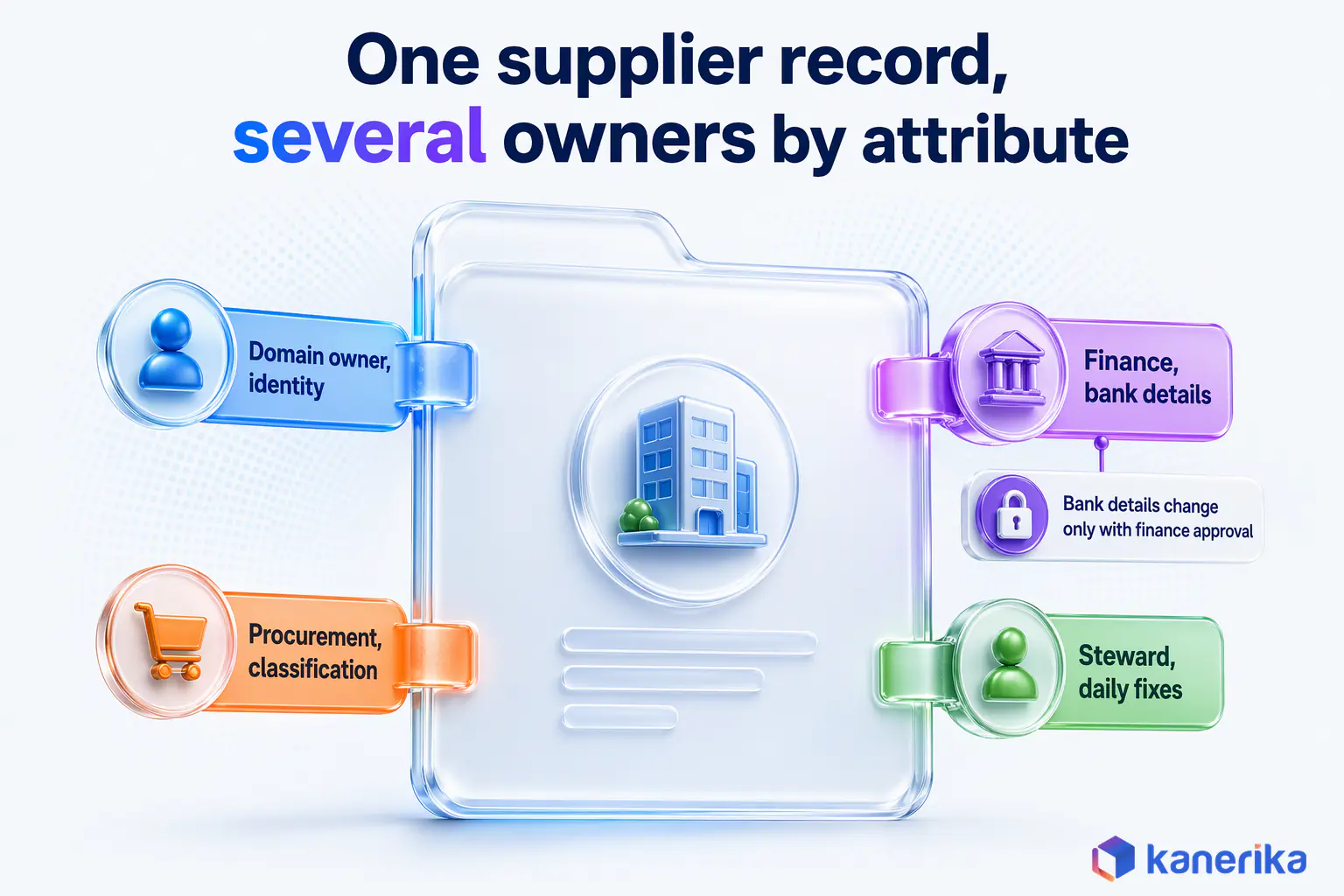
Ownership rarely sits with one person per entity. For example, a supplier domain owner can be accountable for the supplier as a whole, while finance controls payment attributes and procurement controls commercial classification. Customer records also split the same way, with legal entity data, credit terms and marketing preferences often owned by different teams.
Writing ownership down at the attribute level therefore settles the most common dispute before it starts. When bank details change, everyone already knows that finance approves it.
Council, Domain Owners, Stewards and Technical Custodians
Five roles cover most master data programs, and the table shows what each one is accountable for and where it usually sits.
| Role | Accountable for | Typical decisions | Usually sits in |
|---|---|---|---|
| Governance council | Cross-domain policy and conflicts | Approve the operating model, settle disputes between domains | Senior business and data leaders |
| Domain owner | One master data domain | Approve entity definitions and match and merge policy | The business function that relies most on the domain |
| Attribute owner | Specific controlled fields | Approve changes and overrides to those fields | Finance, procurement, sales operations |
| Data steward | Daily record quality | Resolve routine duplicates and exceptions within policy | Business operations teams |
| Technical custodian | Platform and integrations | Configure rules, run releases, keep the hub available | IT or the MDM engineering team |
A short charter keeps the council useful. It should name the domains in scope, the decisions reserved for the council, the meeting cadence and how a deadlock gets broken. Without one, the council either approves everything by default or becomes the bottleneck for routine changes. Review the charter when a new domain joins, since each one brings its own owners and disputes.
Kanerika’s guide to data stewardship covers steward models in more depth. For master data, though, the point is narrower, since stewards act only within the rights that owners have granted them.
An Illustrative Decision-Rights Matrix
The matrix below is illustrative, because enterprise roles vary. It does show the level of detail that keeps decisions from stalling in a shared inbox, though.
Kanerika Service
Data Governance Consulting Services
Kanerika designs ownership models, steward roles and decision rights for master data, then builds the training and change management that keep those roles active after go-live.
Explore Data Governance Services| Decision | Accountable role | Who executes | Escalation trigger |
|---|---|---|---|
| Approve an entity definition | Domain owner | Domain design team | When another domain disputes it |
| Approve match and merge policy | Domain owner | MDM team | When the change affects high-risk identities |
| Resolve a routine duplicate | Authorized domain steward | Steward | When the evidence is not enough to decide |
| Override a controlled attribute | Attribute owner | Authorized steward | When the field is restricted or the change is material |
| Change a production rule | Designated rule owner | MDM engineering | When the impact is material or conflicts with policy |
Roles on paper are not enough, though. Kanerika’s State of Enterprise AI & Data Modernization 2026 report names adoption neglect as a common failure mode. In that pattern, teams treat go-live as the finish line, so the new tool goes unused. Its fix is to fund change management, and steward roles need the same treatment, with protected time, training and a queue they actually work.
How to Govern Match, Merge and Survivorship Rules
Match, merge and survivorship are three separate decisions. When teams treat them as one tool setting, they end up with false merges they cannot easily undo. Each decision needs its own rule and its own owner, because each one fails differently.
Match Rules Decide Whether Two Records Are the Same Entity
Matching starts with normalization, such as standard casing, address formats and legal suffixes. Deterministic rules then compare exact identifiers such as a tax ID, while probabilistic rules score fuzzy similarity across names and addresses.
For legal entities, the Legal Entity Identifier is the strongest deterministic key available. GLEIF describes the LEI as a unique 20-character alphanumeric code for one legal entity. If both records carry an LEI and the codes differ, block the automatic merge and route the pair to a steward.
A shared address alone does not prove identity, because two subsidiaries can share a headquarters. Likewise, one shared services center can sit at the same address as dozens of suppliers. So test rules on a labelled set of known matches and known non-matches before trusting them.
Bringing records into one place first also makes this work easier. For customer domains, that is the job of customer data integration, which feeds the match engine with cleaner, comparable inputs.
Merge Rules Decide Whether Combining Is Allowed
A suspected duplicate is not an approved consolidation. Merge rules therefore say which combinations can happen automatically, which need a steward and which are never allowed. For example, a parent company and its subsidiary may match on name yet must stay separate entities.
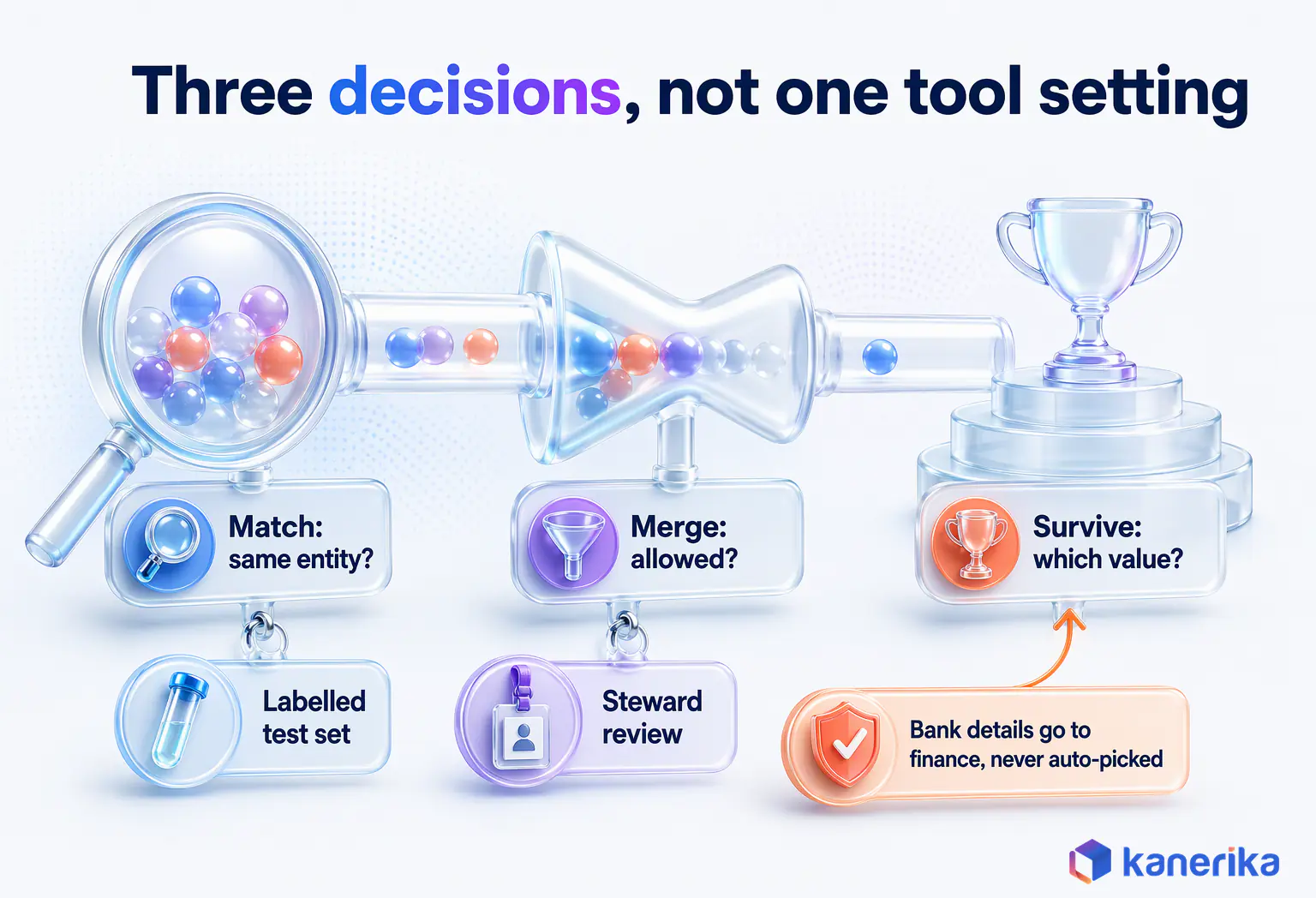
Survivorship Rules Decide Which Value Wins
Once records merge, each attribute needs a rule for which value survives. Global rules such as “newest wins” or “ERP wins” fail because they ignore which source is authoritative for which field. A newer address typed in by a call center agent, for instance, should not overwrite a validated legal address from a registry feed.
| Survivorship rule | How it works | Good fit | Watch out for |
|---|---|---|---|
| Source authority | A named system wins for a named attribute | Legal name from a registry, payment terms from ERP | When a source is authoritative only in some regions |
| Validated status | A verified value beats an unverified one | Bank details confirmed by callback | When validation expires and needs renewal |
| Effective date | The most recent valid value wins | Addresses and contact details | When recent edits were never validated |
| Completeness | The fuller value wins when identity is settled | Product descriptions, optional fields | When a longer value is simply wrong |
| Approved override | A steward’s approved value wins, with a reason | Disputed attributes | When overrides have no expiry or review date |
The same table answers a common question about pricing master data across ERP and CRM. A common split makes price lists and payment terms ERP-authoritative and lets CRM own sales-facing contact fields, with every override logged against its approver. Where a CPQ tool sets prices, name it the source for price fields instead.
Worked Example: Two Supplier Records With Conflicting Bank Details
Here is an illustrative case. Two supplier records share a tax ID and a legal name, so the match rule flags them as the same entity. The merge rule then allows consolidation because both sit under the same legal entity.
The bank details differ, however, and survivorship does not pick one automatically. Bank details are finance-owned and fraud-sensitive, so the case goes to a finance steward. That steward confirms the account through an independent callback before approving, and both source values stay in the record’s history with the approval attached.
Before a rule like this goes live, it has to prove itself on labelled data. In an illustrative test, a team labels 400 known matches and 400 known non-matches from its supplier file. Say the rule catches 380 of the true matches and wrongly pairs 6 of the non-matches. That works out to a 5% missed-match rate and a 1.5% false-match rate, and the owner decides whether both are acceptable.
Linking One Order Record Across Three SAP Systems
Here is a reporting-side example of linking records across systems. A global thermal management manufacturer ran its order journey across three disconnected SAP systems (Cloud for Customer, CPQ and S/4HANA). As a result, nothing connected quotes, approvals and deliveries into one record.
Kanerika built one governed pipeline on Microsoft Fabric from about 35 source tables, then linked Opportunities, Quotes and Orders through a dedicated bridge. As the order lifecycle case study shows, the lead-to-delivery journey now reads as one continuous record, and time spent per reporting cycle fell by 60%. The same model standardized 50+ KPIs and enforced row-level security at four levels, from region down to Sales Group.
Approve, Version and Test Rule Changes
A changed threshold or source precedence can rewrite thousands of existing records in one run. That is why rule changes need a release process of their own.
- Propose the change with its business reason and the attributes it touches.
- Assess the impact on existing golden records.
- Test against the labelled set, including known hard cases.
- Get approval from the domain or attribute owner.
- Deploy in a controlled window and keep the previous version.
- Monitor merge and exception rates after release.
- Roll back if results drift from what the test showed.
Illustrative threshold design: on the 800-pair labelled set above, auto-merge only at a score of 0.95 or above. Even then, merge automatically only where a deterministic key also agrees. Send scores from 0.80 to 0.95 to a steward, and treat anything below 0.80 as no match.
If the steward band holds 12% of pairs (96 of 800) and one steward clears 40 a day, each load needs 2.4 steward days. That figure sets staffing. These thresholds are examples, so set yours from your own labelled data.
Avoid borrowing match-score thresholds from a vendor deck, since the right threshold depends on your own data. Only your labelled set can show where it sits.
Case Study
60% Less Time per Reporting Cycle Across Three SAP Systems
A global thermal management manufacturer linked Opportunities, Quotes and Orders from SAP Cloud for Customer, CPQ and S/4HANA into one continuous record on a governed Microsoft Fabric pipeline.
Read the Case Study →Stewardship Workflows Across the Master Data Lifecycle
Rules only work when someone applies them every day. Stewardship workflows turn those rules into queues, approvals and handoffs that real people can run.
Create and Change Records
The cheapest duplicate is the one never created. That is why a pre-creation search checks for an existing match before a new record is allowed. Mandatory attributes also stop incomplete records from going live.
Controlled fields then route to the right approver. Checks such as automated data validation also catch format errors before a steward ever sees them.
Route Exceptions by Risk
Exceptions do not all deserve the same attention. A missing phone number can wait, while a bank detail change on an active supplier cannot. Each queue item should therefore carry enough context for a steward to act without hunting for it.
A useful queue item carries six things.
- The exception type and the rule that raised it
- Evidence, such as source values and match scores
- A priority based on business risk
- The responsible steward and the actions that steward may take
- An escalation path for cases beyond those rights
- A resolution target agreed with the domain owner
Queues built this way also make staffing visible. When the backlog grows, the domain owner can see which exception types are driving it.
Publish to Downstream Systems
Approved in MDM is not the same as propagated. A change only counts once the ERP, CRM and analytics layers have received and accepted it, so track acknowledgments and failed deliveries. SAP Master Data Governance, for example, ships pre-built change request workflows with automated routing and notifications. That gives each change a tracked request before anything is published. Kanerika’s guide to enterprise data integration covers the pipelines behind this step.
Retire, Split and Unmerge Safely
False merges happen, so plan the way back before you need it. An unmerge needs source-record lineage to rebuild the original entities, plus a review of everything that pointed at the merged record.
Unmerging also does not reverse transactions already executed against the merged record. As a result, finance may need compensating entries, and downstream reports may need a restatement.
Illustrative: a false merge of two customers is found three weeks later, and 140 invoices have posted against the merged ID. The unmerge rebuilds both source records from lineage. Finance then reviews those 140 postings for compensating entries.
Choose a Governance Operating Model
An operating model decides where decision authority sits across business units and regions. Company size is a weak guide here. Instead, the real drivers are how consistent each domain must be and how different the business units are.
Centralized, Federated and Hybrid Models
| Model | How decisions flow | Fits when | Main risk |
|---|---|---|---|
| Centralized | One central team owns policy and approves changes | When domains must match everywhere and units are similar | Bottlenecks and slow approvals |
| Federated | Domain or regional teams decide within shared standards | When business units differ or regional rules apply | Drift between regions |
| Hybrid | A central team sets policy, and domains or regions own local attributes | When one global identity must sit alongside local needs | Unclear boundaries unless they are written down |
Federated setups echo the thinking behind a data mesh, where domains own their data within common standards. Hybrid, by comparison, suits enterprises that need one global supplier or customer identity but local ownership of regional attributes.
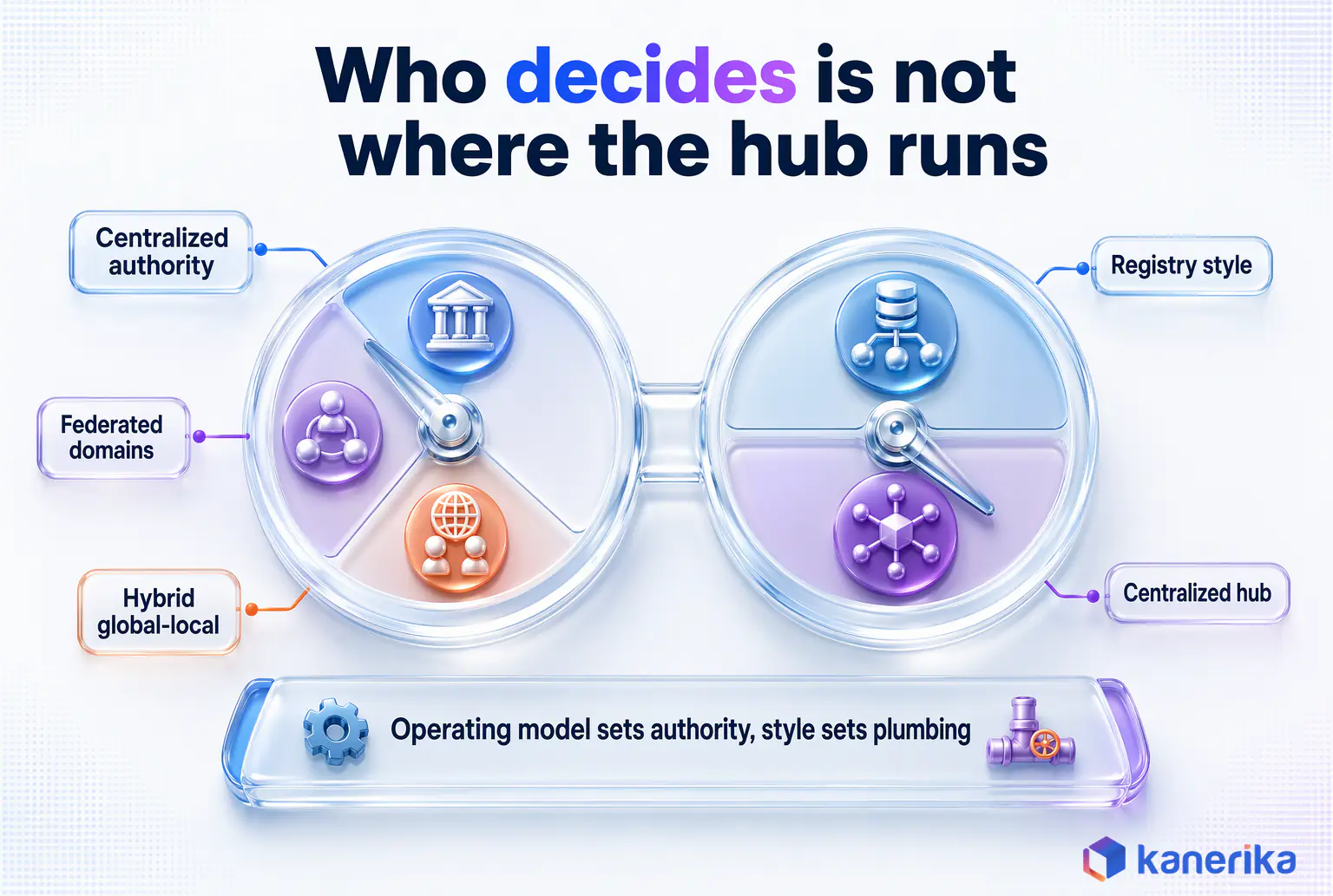
Keep the Operating Model Separate From the MDM Implementation Style
Who decides is a different question from where the hub runs. Profisee describes four MDM implementation styles. Each one changes where records are stored and updated, not who holds the authority to approve them.
- Registry: source systems stay the system of record, which is easy to start but gives little control.
- Consolidation: a hub holds consolidated data for analytics without syncing it back to sources.
- Coexistence: the hub becomes the system of record while data entry stays flexible.
- Centralized: the hub is the system of record and the only place that accepts updates.
A centralized style can still run under a federated operating model. The style decides the plumbing, and the operating model decides the authority.
When a Global Policy Is Mandatory
Some rules must hold everywhere. Identity rules, bank detail approval and sensitive data handling, in particular, usually need one global policy.
Regional address formats, local tax fields and language variants can take a documented local exception instead. Each exception still needs a written reason and a named owner, so that the next audit can follow it.
Controls for Auditability, Privacy and Access
Master data changes carry financial and legal weight, so every change needs a trail. For any golden value, controls should therefore answer three questions. Where did it come from, who approved it, and who is allowed to see it?
Provenance and Rule History
Each golden attribute should trace back to its source value, the rule that selected it, the approval behind it and its effective date. Kanerika’s guide to data lineage explains how that trace is built and kept current as systems change.
Least Privilege and Segregation of Duties
Steward edits are not all equal, so identity changes and sensitive attributes such as bank details need tighter rights. The person who requests a change should also never be the one who approves it.
Sensitive Data and Permitted Use
Merging two identities does not merge their consent. If one record allowed marketing and the other did not, the golden record keeps the stricter permission until legal review says otherwise. Retention and deletion rules also have to follow the merged entity.
Deadlines make that lineage practical rather than theoretical. Under Article 12(3) of the GDPR, a controller has one month to report the action taken on an access, rectification or erasure request. Complex or numerous requests can stretch that by two further months. So the golden record has to list every system a correction must reach, or a merged entity misses the deadline.
Scale also makes these controls harder to run by hand. Take a global bank with nearly 9,000 branches and 22,000 ATMs, which held data across SAP, Dynamics 365, CRM, Oracle and Netezza systems. For that bank, Kanerika set up Microsoft Purview discovery and classification, Purview policies for PII, PCI and PHI handling, and automated lineage into the lakehouse.
The bank’s Purview case study reports that data classification accuracy improved by 72%. For master data, that accuracy matters because it decides which fields get the tighter access rules.
Audit Evidence for Overrides and Rule Changes
Keep five pieces of evidence for every override and every rule change.
- Who requested the change, and why
- Who approved it
- The values before and after
- The records it affected
- How to roll it back
Auditors ask for exactly this set, so having it ready turns a week of digging into a short export.
Master Data Governance Tools and Technology
A tool enforces the decisions your owners make. So judge each option by how well it runs governance work, then check how it fits the systems you already have.
What Master Data Governance Solutions Must Do
At minimum, the platform should run approval workflows and match and merge records. It should also apply survivorship per attribute, keep a full audit trail, enforce quality rules and publish changes downstream.
Best Master Data Governance Tools and Software by Need
| Need | Options to evaluate | What to check |
|---|---|---|
| SAP-centric estate on S/4HANA | SAP Master Data Governance | Change-request workflows and domain coverage, as well as SAP roadmap fit |
| Multidomain MDM hub | Informatica, Profisee, Reltio, Stibo Systems | Match and survivorship controls, steward screens, integration options |
| Catalog, lineage and quality on Microsoft | Microsoft Fabric OneLake catalog, with Microsoft Purview for classification and protection | Which catalog, lineage and quality jobs OneLake covers today, since Purview data governance support ends November 12, 2027 |
| Validation and cleanup | Data quality and cleansing tools | Profiling depth, rule reuse, monitoring |
For SAP buyers asking which master data governance tool suits S/4HANA, SAP MDG is the native option. The choice usually turns on how much of your master data lives outside SAP.
On the Microsoft side, plan around a platform change. Microsoft is retiring Purview’s data governance features, including Unified Catalog and its data quality scoring. New accounts can no longer be created, and support ends on November 12, 2027.
Governance moves to the Microsoft Fabric OneLake catalog, while Purview keeps classification, sensitivity labels and data loss prevention. Microsoft’s own transition guide says Fabric’s Governance Health is not a rules, profiling and scoring engine. So validate each data quality job before assuming a replacement. A master data program on Microsoft still needs its own rules and scoring layer.
Kanerika’s roundup of data quality tools and its guide to metadata management cover the layers next to the hub. The wider market of data governance tools also has its own comparison.
Kanerika Service
Microsoft Purview Implementation Services
Kanerika delivers kanGovern, kanGuard and kanComply on Microsoft Purview, including Information Protection and Data Loss Prevention for the sensitive fields in governed master data.
Explore Microsoft Purview ServicesSAP Master Data Governance Alternatives
You don’t have to leave SAP to govern non-SAP records, since SAP’s own page says MDG can govern master data for SAP and third-party applications. Alternatives earn a look when most of your master data lives outside SAP, or when one hub has to serve several ERPs. In that case, the multidomain hubs in the table above (Informatica, Profisee, Reltio and Stibo Systems) are the usual shortlist.
So compare them in a pilot on your own hard records. Check survivorship control per attribute, steward screens your business teams will actually use, and the implementation styles each one supports. That last point matters, because a registry style is the easiest to start but gives the least control, while a centralized hub gives the most.
Tools Do Not Set Decision Rights
No product decides who owns bank details. That is why Kanerika delivers governance as services through kanSuite. It includes kanGovern for strategy and enforcement, kanGuard for access security and kanComply for regulatory compliance.
Kanerika’s data governance services page describes them as powered by Microsoft Purview, Databricks Unity Catalog and Concentric AI. They are services rather than licensed products, so the work centers on owners, rules and controls instead of a new license.
How to Implement Master Data Governance: A 7-Step Roadmap
Timing matters more than tooling. Kanerika’s State of Enterprise Data Platform Migrations 2026 report makes the point plainly. Governance built in at the assessment phase, not at project end, is the single strongest predictor of post-go-live outcomes. In contrast, leaving it to the final phase forces architectural rework and late compliance delays.
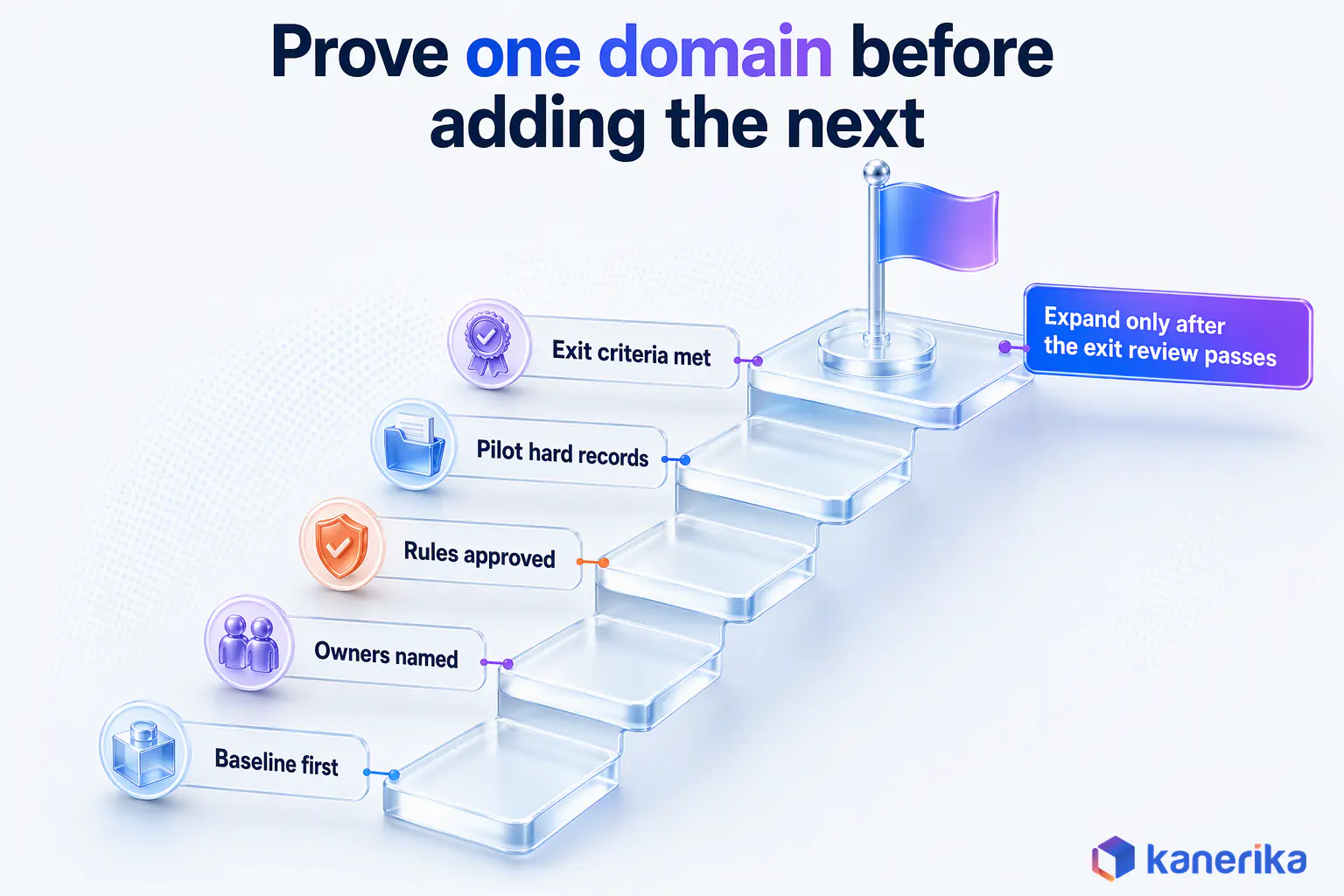
1. Pick One Domain With a Visible Business Problem
Start where the pain is visible and the boundaries are manageable. Supplier data with duplicate payments, or customer data with broken account views, makes a better first domain than a vague enterprise-wide goal.
2. Baseline the Domain
Inventory the systems, record counts, current owners and the costliest exceptions, then measure duplicate and error rates. If 1,200 of 40,000 supplier records are suspected duplicates, the baseline is 3%, and every later target is set against it.
3. Name Owners and Decision Rights
Assign domain and attribute owners, then fill in the decision-rights matrix. Then have the governance council approve it, so that disputes have somewhere to go.
4. Write the Minimum Rule Set
Cover the critical attributes, the match, merge and survivorship rules, and the exception paths. Resist writing a rule for every field, because the pilot will change many anyway.
5. Pilot on Representative and Difficult Records
Test ordinary records alongside the hard ones, such as subsidiaries, shared addresses, stale values and conflicting identifiers. Also include stewards and downstream process owners, since they tend to find the gaps first.
6. Roll Out With Exit Criteria
Leave the pilot only when it meets criteria the owners agreed in advance.
- Rules approved by the domain and attribute owners
- Labelled test results within the agreed tolerance
- Exception queues staffed and working
- Audit evidence complete for every override
- Downstream systems receiving changes correctly
Writing these down before the pilot starts keeps the exit decision honest, because nobody can move the goalposts after seeing the results.
7. Review and Expand Domain by Domain
Review the metrics after each release, then add the next domain. Kanerika’s list of data governance best practices covers the program habits that support this rhythm.
How to Measure Master Data Governance
Measure outcomes rather than activity. Kanerika’s State of Enterprise AI & Data Modernization 2026 report tracked 414 measured outcomes across 161 engagements and found a median improvement of 47%. Across those engagements, 76% improved at least one metric by 50% or more.
The same report lists counting demos and dashboards as a failure mode, measuring output instead of outcomes. For master data, the same trap is reporting rules written and records touched. Track time-to-value, cost and trust instead, which the metrics below map onto.
Entity-Resolution Quality
Track the false-merge rate and the missed-match rate on a labelled evaluation set. Then report confirmed duplicates separately from suspected ones, since mixing them hides real risk.
Operational Health
Watch exception age, review volume, manual override rate, unmerge incidents and propagation success. If stewards override 30 of 500 automated merges in a month, a 6% override rate usually means a rule no longer fits the data.
Business Outcomes
Tie the program to process results such as supplier onboarding time, customer account reconciliation or product launch readiness. But avoid claiming causation unless the baseline and timing support it.
Define Each Metric Before Setting Targets
| Metric | Definition | Data source | Owner | Review cadence |
|---|---|---|---|---|
| False-merge rate | Merges later reversed, divided by total merges | MDM hub audit log | Domain owner | Monthly |
| Missed-match rate | Known duplicates not flagged on the labelled set | Labelled evaluation set | MDM team | Each rule release |
| Exception age | Median days an exception stays open | Steward queue | Steward lead | Weekly |
| Override rate | Manual overrides divided by survivorship decisions | MDM hub audit log | Attribute owner | Monthly |
| Propagation success | Changes accepted downstream, divided by changes published | Integration logs | Technical custodian | Weekly |
Vendor guides sometimes publish target values. Informatica’s MDG framework guide, for one, lists completeness of 95%+, accuracy of 98%+ and a duplicate rate under 2%. Treat those as examples instead, and set your own targets from the baseline you measured in step two.
Common Master Data Governance Challenges and How to Avoid Them
The expensive mistakes are predictable, and one of the most common is treating governance as an afterthought. Kanerika’s State of Enterprise AI & Data Modernization 2026 report describes it as bolting controls on after a compliance scare. Its remedy is lineage and role-based access built into the platform from day one. For master data, that means owners and decision rights are approved before the hub goes live, as the last row of the table below shows.
| Failure | Warning sign | Corrective control |
|---|---|---|
| Unowned golden records | Disputes stay open for weeks because nobody owns the value | Name attribute owners, then an escalation path |
| Global “newest wins” survivorship | Validated values vanish when recent edits arrive | Set survivorship per attribute rather than globally |
| Over-aggressive automatic merges | Unmerge requests keep rising, especially after new loads | Tighten merge rules, then test on labelled sets |
| Queues without capacity | The exception backlog still grows every week | Fund steward time, then route by risk |
| Approved records that never reach consumers | Downstream systems still show old values | Track propagation as well as failed deliveries |
| Rule changes without impact tests | Merges or exceptions jump soon after a release | Test every change before release |
| Platform before decision rights | The tool goes live before anyone agrees on owners | Approve the decision-rights matrix before configuration |
Best Practices That Hold Up
- Secure an executive sponsor who can settle cross-domain disputes.
- Start with one domain and expand only after the exit criteria are met.
- Embed governance steps in daily work, such as supplier onboarding forms.
- Automate enforcement where rules are stable, and keep people on high-risk decisions.
- Review rules every quarter with the owners who approved them.
Know when not to start. Take a domain with one system of entry, a few thousand records and no downstream consumers. A validation rule at the source fixes it more cheaply. A program also stalls when the sponsor cannot settle cross-domain disputes, or when no one has funded steward time.
None of these practices needs a new tool. Instead, they need owners with the time and the authority to use them.
Checklist
Enterprise Data Governance Checklist
Check ownership, stewardship, policies and processes against one practical list, so gaps surface before you configure a hub or add a second domain.
Get the Checklist →Master Data Governance for AI and Agents
Is master data management still relevant with AI in the picture? It matters more, because assistants and agents act on whatever entity they are handed. Governed identities then give them one customer or supplier to reason about instead of three.
Match Controls to the AI Use Case
| AI use case | Access | Lineage | Freshness | Approval |
|---|---|---|---|---|
| Retrieval assistant | Filtered by the user’s own rights | Source cited with each answer | Set by how fast the domain changes | None needed to read |
| Feature pipeline | Service account with least privilege | Full trace for model audits | Matches the training schedule | Owner sign-off on feature changes |
| Operational agent | Narrow, action-specific rights | Every action logged | Near real time | Human approval for high-risk changes |
AI Can Propose Matches, and Policy Approves Them
AI is good at proposing likely matches and summarizing evidence for a steward. However, high-risk merges and changes to controlled attributes still go through policy and human approval. The wider question of governing the data AI systems consume belongs to AI data governance.
Case Study
70% Less Reconciliation Time with One Governed Ontology
A global pharmaceutical enterprise replaced dashboard-level KPI logic with a governed ontology on Microsoft Fabric, standardizing 85+ KPIs and extending them to Fabric AI and Copilot.
Read the Case Study →Consistent definitions matter as much as consistent records. A global pharmaceutical enterprise, for example, kept its KPI logic inside individual Power BI dashboards. As a result, the same metric returned different numbers for different users.
Kanerika built a governed business ontology on Microsoft Fabric with 85+ governed KPIs and 40+ entities and relationships. It then extended that ontology to Fabric AI and Copilot. The governed ontology case study reports 70% less investigation and reconciliation time.
How Kanerika Helps Enterprises Govern Master Data
If you’d rather not run this alone, Kanerika, your trusted partner for master data governance, can carry part of the load. Our data governance consulting team applies its IMPACT methodology, aiming for measurable outcomes at each phase, from assessment to deployment. For master data, that’s the onboarding time or reconciliation effort you baselined, not the count of rules written.
In practice, the work is the same whoever runs it. You baseline sources, agree owners and decision rights, and write match, merge and survivorship policy, then set up workflows, publishing and stewards. That’s general practice, and the 7-step roadmap above gives one order for it.
The kanSuite services carry this work, as the healthcare and banking Purview cases above show. For a structured start, try the enterprise data governance checklist. The Data Governance Whitepaper for Enterprises sets out how to architect governance across the enterprise.
What Our Teams Watch For
Three pitfalls keep coming up. Match rules get configured before owners agree on them, steward roles get named but never funded, and approved changes stop at the hub. The good news? Each is cheaper to prevent during assessment than to fix after go-live.
Governance is rarely a project’s headline, even though trust in its data depends on it. In Kanerika’s State of Enterprise AI & Data Modernization 2026 report, data governance and compliance was the primary solution in only 6% of 161 engagements. But “governance as an afterthought” is one of the 5 failure modes the same report names. For master data, that gap tends to surface as disputed records nobody owns.
Talk to Kanerika
Plan Your Master Data Governance Rollout
Bring one domain and its most expensive record problem. Kanerika will map owners, match and survivorship rules and a pilot plan with exit criteria in a short working session.
Book a Working Session →Make Master Data Governance Stick, One Domain at a Time
You probably have a supplier or customer file that nobody fully trusts right now, and maybe a tool that was meant to fix it. Here’s the thing: that record starts to hold when someone owns each decision about it, not when the software gets smarter. So your first move is a name, not a platform, next to merge approvals, bank details and the rule that picks which value wins.
If that sounds familiar, name the owners before you write match rules. A hub that goes live with rules but no owners collects disputes nobody can settle. But starting small works: one domain, a few named owners and a pilot with exit criteria give everyone a result they can see.
That’s where Kanerika’s data governance services come in, backed by its status as a Microsoft Solutions Partner for Data and AI. Kanerika linked one order record across three SAP systems for a manufacturer, and time per reporting cycle fell 60%. So bring one disputed record, like a supplier with clashing bank details, and we’ll map its owners and pilot plan in a working session.
If you’d rather read the evidence first, Kanerika’s State of Enterprise AI & Data Modernization 2026 report is a good next step. Either way, we’d like to hear which record is giving you trouble.
Frequently Asked Questions
What is master data governance?
Master data governance is the set of rules, roles and controls that decides who can create, change, merge and publish core business records such as customers, suppliers and products. It assigns owners to entities and attributes, sets match and survivorship rules, and keeps an audit trail, so every system relies on the same trusted version of each record.
What is the difference between master data governance and master data management?
Master data governance decides who owns each record, which rules apply and who approves changes. Master data management is the process and technology that executes those decisions, including the hub, the match engine, workflows and publishing. Governance without MDM struggles to scale, and MDM without governance produces fast, automated mistakes that nobody owns or can explain.
Is master data management part of data governance?
Broadly, yes. Enterprise data governance is the parent discipline that sets policy for all data, including classification, access and quality standards. Master data governance is the part that handles shared entities and golden records, while master data management is the machinery that applies those rules. A single governance council can oversee both, so the policy and its execution stay connected.
Is master data governance the same as SAP MDG?
No. Master data governance is a vendor-neutral discipline, while SAP Master Data Governance is an SAP product that can run it. SAP describes golden records per domain, matching and merging, change-request workflows and an audit trail. The product supports the discipline, but your organization still has to decide owners, decision rights and survivorship rules.
Who should own master data in an organization?
The business should own master data, with ownership set at the entity and attribute level. A domain owner is accountable for the supplier or customer as a whole, while finance may own bank details and procurement may own classification. Data stewards resolve daily exceptions within those rights, and IT acts as the technical custodian of the platform.
What is a golden record in master data management?
A golden record is the trusted, governed version of an entity that downstream systems should rely on. It can be a consolidated profile for analytics, an approved operational record, or a set of authoritative values chosen field by field. It is built from approved sources and rules, and its history shows where every value came from.
What are match, merge and survivorship rules?
Match rules decide whether two records describe the same entity, using exact identifiers and fuzzy similarity. Merge rules decide whether combining them is allowed, automatically or only after steward review. Survivorship rules decide which value wins for each attribute, based on source authority, validation, recency, completeness or an approved override recorded with its approver.
How do you implement master data governance?
Start with one domain that has a visible business problem and baseline its systems, owners and costly exceptions. Name domain and attribute owners, write the minimum match, merge and survivorship rules, then pilot on difficult records. Roll out only when agreed exit criteria are met, and expand domain by domain while reviewing metrics after each release.
How do you measure master data governance success?
Measure entity-resolution quality through false-merge and missed-match rates on a labelled test set. Track operational health through exception age, override rate, unmerge incidents and propagation success. Then tie the program to business outcomes such as supplier onboarding time or account reconciliation, using your own baseline rather than borrowed industry targets for every metric.
Which master data governance tool is best for SAP S/4HANA?
SAP Master Data Governance is the native choice for S/4HANA estates. It brings pre-built change-request workflows, matching and merging, and a complete audit trail of changes, and it can also govern master data for third-party applications. Choose a multidomain hub instead when most of your master data lives outside SAP or spans several ERPs.
What are the best alternatives to SAP Master Data Governance?
The usual shortlist is the multidomain MDM hubs: Informatica, Profisee, Reltio and Stibo Systems. Test each one in a pilot on your own hard records, and compare per-attribute survivorship, steward screens and the implementation styles it supports. Whichever you pick, name owners and decision rights first, because the tool only enforces them.
What is the difference between master data management and a data catalog?
An MDM hub matches, merges and publishes the trusted version of shared records such as customers and suppliers. A data catalog describes data instead: definitions, owners, lineage and classification. Most programs need both, with the catalog explaining what a field means and the hub deciding which value is the one every system should use.