
Data Migration Consulting Services for Enterprise Modernization
Kanerika is a specialist data platform migration & modernization consultancy. Our IP-led FLIP accelerators handle ETL migration, BI platform transitions, and RPA modernization, cutting manual efforts, licensing costs, and go-live risk across every platform migration path.
Reduction in Migration Costs
Reduction in Migration Time
Fewer Resources Required
Get Started with Migration Solutions












Migration ROI Calculator
Kanerika’s IP-led accelerator, FLIP, automates your data platform migration, delivering major resource savings and ensuring a faster, lower-risk move to your target platform.
FLIP is Kanerika's proprietary migration accelerator. Here's exactly where the savings come from:
Data Migration Solutions for Accelerated Business Growth
Our data platform migration services cover the full journey from assessment to go-live. We manage every step of BI, ETL, and automation platform transitions, with FLIP accelerators ensuring speed, accuracy, and zero data loss. On ETL paths such as Informatica to Microsoft Fabric, our ETL migration consultants review and redesign the 20-30% of logic that FLIP cannot automate.
ETL and Data Platform Migrations
Move from Informatica to Talend, Alteryx, Databricks, or Microsoft Fabric using our ETL migration accelerators engineered for accuracy and minimal disruption.
Highlights:
- Preserve data accuracy and integrity at every migration stage.
- Cut migration timelines with automated conversion tools.
- Unlock faster data processing on modern cloud platforms.
BI and Reporting Platform Migration
Migrate from Tableau, SSRS, Crystal Reports, or Cognos to Power BI with connectors that preserve dashboards, datasets, and business logic intact.
Highlights:
- Retain existing dashboards, reports, and user permissions.
- Gain advanced visualization on modern BI platforms.
- Complete transition of reports, datasets, and data connections.
RPA Platform Modernization
Transition from UiPath to Microsoft Power Automate with FLIP’s automated conversion. Workflow logic, exception handling, and business rules carry over.
Highlights:
- Maintain business process continuity during transition.
- Leverage native M365 and Azure integration post-migration.
- Minimize downtime while maximizing automation efficiency.

AI-Powered Migration Accelerators
FLIP is Kanerika's proprietary Intelligent Workflow Automation Platform with accelerators for data migration, ETL migration services, and RPA transitions. Each accelerator automates discovery, conversion, and validation across 12 supported migration paths.

















Real Results from Our Data Migration Services
See how enterprises across industries cut costs, reduced timelines, and modernized platforms with Kanerika’s data migration solutions, with documented outcomes from every engagement.
Migration
60% Faster Migration: Crystal Reports to Power BI
Impact:
- 60% Faster Migration
- 10x Data Scale
- 99.5% Refresh Success Rate
Migration
60% Faster Analytics with Informatica to Alteryx
Impact:
- 45% Faster Reporting Cycles
- 38% Reduction in Maintenance Costs
- 60% Improved Analytics Turnaround
Migration
74% Faster Retail Reporting with Microsoft Fabric
Impact:
- 74% Faster Reporting Cycles
- 65% Increase in Reporting Stability
- 72% Faster Access to Current Metrics
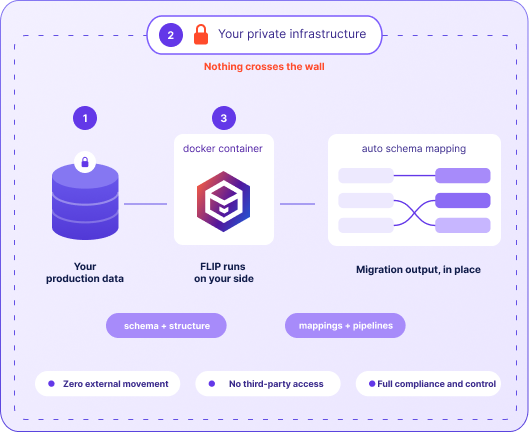
Your Data, Your Walls, Our Intelligence
FLIP brings high-speed migration directly into your private infrastructure via Docker. We move your project forward without ever moving your data.
Metadata-Only Processing
We only analyze schema and structure; your actual production data remains untouched and invisible.
Total Isolation
Deployed entirely within your network with zero external movement or third-party access.
On-Prem Automation:
Get high-speed schema mapping and pipeline generation while maintaining full compliance and control.
Our IMPACT Framework for Structured, Risk-Free Migration
At Kanerika, we leverage the IMPACT methodology to drive successful migration projects, focusing on delivering tangible outcomes.
OUR PROCESS
How Our Data Migration Consulting Process Works
Every engagement starts with a full assessment of your source environment. Our data migration consultants then design the migration architecture, configure FLIP for your specific path, execute automated conversion with built-in validation, and stay on post-launch for performance monitoring and source system decommission. For database moves, each database migration consultant on the team applies schema reconciliation and parallel-run testing before cutover.

Step 1
Understand Business Goals

Step 2
Analyze Data & Workflows

Step 3
Design Sound Solutions

Step 4
Develop & Deploy Solutions

Step 5
Ongoing Support
01
Step 1
Understand Business Goals
02
Step 2
Analyze Data & Workflows
03
Step 3
Design Sound
Solutions
04
Step 4
Develop & Deploy Solutions
05
Step 5
Ongoing
Support


Tools and Technologies We Work With
As a specialist data migration services company, Kanerika works across a broad technology stack, from Informatica, Tableau, and Cognos on the source side to Microsoft Fabric, Databricks, Power BI, and Talend on the target.










INNOVATE
Enterprise Data Migration Across Key Industries






Automotive
Migrates supply chain and production data to modern platforms for faster operational reporting.


WHY Kanerika
Why Kanerika is Your Go-To Data Migration Company?
Kanerika’s data migration consultants have delivered many platform transitions across ETL, BI, and RPA domains, backed by a team of certified engineers

Our IMPACT delivery framework and FLIP accelerators reduce migration timelines by up to 60%, with automated validation built into every stage to minimize go-live risk.

Our dedicated team provides continuous assistance before, during, and after the migration, ensuring a smooth transition and ongoing optimization.

Empowering Alliances
Our Strategic Partnerships
The pivotal partnerships with technology leaders that amplify our capabilities, ensuring you benefit from the most advanced and reliable solutions.






Frequently Asked Questions (FAQs)
01What are the biggest risks in an enterprise data migration project?
The five most common risks in enterprise data migration are data loss from schema mismatches, business logic gaps in ETL pipelines, migration-related downtime, scope creep from poor pre-migration discovery, and security exposure during data transfer. Most failures trace back to insufficient upfront assessment and manual conversion approaches. Kanerika’s data migration services use automated validation, schema reconciliation, and parallel-run testing to catch issues during migration, not after go-live.
02How long does a data platform migration typically take?
Timeline depends on scope, platform complexity, and whether migration is automated or manual. Simple BI platform migrations take 4-8 weeks with tooling. Mid-complexity ETL migration paths like Informatica to Microsoft Fabric typically run 8-16 weeks automated versus 6-12 months manually. Enterprise data migration projects involving full stack transitions can take 3-9 months. Automated migration consistently delivers 40-60% faster timelines than manual approaches, with significantly lower risk of overrun.
03What is the difference between data migration, platform modernization, and cloud migration?
Data migration moves data between storage systems or databases, focusing on accuracy and continuity. Platform modernization is broader. It replaces the underlying data infrastructure, ETL workflows, and analytics tools, converting business logic for the new environment. Cloud migration specifically moves workloads from on-premises to cloud platforms. Most enterprise data migration projects involve all three simultaneously, which is where underplanning creates the most risk and timeline overruns.
04How do you migrate from Informatica PowerCenter to Microsoft Fabric without losing business logic?
Preserving business logic in Informatica-to-Fabric ETL migration requires automated deep extraction from the Informatica repository, full dependency mapping of transformations and workflow chains, and intelligent conversion into Fabric Data Pipelines and Dataflows Gen2. Parallel validation then compares source and target outputs before cutover. Kanerika’s FLIP platform automates 70-80% of this process through the FIRE connector, which extracts complete workflow packages and converts them into Fabric-ready pipelines with transformation rules intact.
05What ROI can enterprises expect from migrating off legacy ETL platforms?
Enterprises migrating from Informatica to Microsoft Fabric or Databricks typically see 40-70% reduction in annual licensing costs. Developer productivity improves 30-50% on modern platforms with native automation and low-code data flows. Data processing speeds improve 20-40% with cloud-native distributed compute. Strategic value comes from AI-ready architectures that legacy ETL platforms cannot support. Most organizations reach positive ROI from data migration solutions within 12-18 months of go-live.
06How do you ensure data quality and integrity during a large-scale migration?
Data quality requires controls at three stages. Pre-migration profiling identifies duplicates, nulls, and referential integrity gaps in source systems. During migration, row-count reconciliation and hash-based checksums verify accuracy at each transformation stage. Post-migration, parallel-run periods compare source and target outputs before decommissioning. Poor data quality affects 84% of migrations. FLIP’s built-in validation layer runs automated reconciliation continuously throughout the data migration process, flagging failures in real time rather than post-cutover.
07What is involved in migrating from UiPath to Power Automate?
UiPath-to-Power-Automate migration involves workflow inventory and complexity classification, extraction of business rules and exception handling from XAML files, and conversion to Power Automate flows. Not all UiPath workflows have direct Power Automate equivalents, so some require architectural redesign rather than conversion. Kanerika’s FLIP RPA Migration Accelerator automates this translation, preserving all workflow logic and exception handling. Published results include 90-day migrations of 2-year UiPath codebases with 75% reduction in post-migration licensing costs.
08What should enterprises look for when evaluating data migration consulting firms?
Key criteria when evaluating a data migration consultancy include platform-specific expertise for your exact migration path, purpose-built automation tooling rather than manual scripting, a documented methodology for preserving undocumented business logic, and a validation framework that runs during migration. Technology certifications like Microsoft Solutions Partner and Databricks Consulting Partner reflect validated platform depth. Security certifications including ISO 27001 and SOC 2 are non-negotiable when sensitive enterprise data is moving between platforms. Apply the same checklist to any data migration solution partner, and ask for documented outcomes on your exact migration path.
09 What is FLIP and how does it accelerate data and RPA platform migrations?
FLIP is Kanerika’s proprietary AI-enabled low-code migration platform. It automates the most time-intensive phases of data migration: discovery, asset extraction, logic mapping, format conversion, and validation. Where traditional ETL migration services rely on developers manually rewriting source configurations, FLIP automates 70-80% of that work. The result is 60-70% reduction in labor cost, faster delivery timelines, and higher accuracy. Post-migration, organizations receive full asset logs, migration reports, and source documentation for all converted assets.
10 What migration paths does FLIP support?
FLIP supports twelve migration paths across data platform, BI, and RPA categories. Data platform paths include Informatica PowerCenter to Microsoft Fabric, Databricks, Alteryx, and Talend; Azure Data Factory to Fabric; and SQL Server and SSIS to Fabric. BI migrations cover Tableau, IBM Cognos, Crystal Reports, and SSRS to Power BI. RPA migration supports UiPath to Microsoft Power Automate. Each accelerator is purpose-built for its specific path, not a generic script applied across platforms.
11What measurable outcomes have Kanerika's migration projects delivered?
Kanerika’s data migration services have delivered 30% improvement in data processing speeds, 40% reduction in operational costs, 80% faster insight delivery, and 95% reduction in reporting time. BI migrations achieve up to 80% automation in report conversion with zero data loss. RPA migrations deliver 90-day turnaround on 2-year UiPath codebases and 75% reduction in licensing costs. Organizations using FLIP save an average of 2,485 developer hours compared to manual migration approaches.
12 How does Kanerika handle undocumented business logic in legacy ETL systems?
FLIP addresses undocumented business logic through three mechanisms. Metadata-level extraction from source repositories captures all mappings, parameters, and dependencies that surface-level workflow review would miss. Dependency graph analysis maps circular references and shared transformation logic before conversion begins. Parallel execution validation compares source and target outputs row by row before cutover. The 20-30% of logic that cannot be automated is reviewed and redesigned directly by Kanerika’s data migration consulting team.
13What does Kanerika's IMPACT methodology look like for a migration project?
IMPACT structures every data migration engagement across six phases. Initiate covers full source environment inventory and risk assessment. Map defines target architecture and migration waves. Plan configures FLIP and documents edge-case logic. Activate executes automated migration with parallel running for critical workflows. Check runs output reconciliation and business user acceptance testing. Track manages production cutover, rollback triggers, and post-migration monitoring. Skipping the Initiate phase is the leading cause of timeline overruns and post-cutover logic gaps.
14Which industries does Kanerika serve with data migration services?
Kanerika delivers enterprise data migration programs across banking, insurance, healthcare, pharma, logistics, manufacturing, retail, and automotive. Each industry has distinct priorities: HIPAA compliance in healthcare, FDA 21 CFR Part 11 in pharma, regulatory reporting pipelines in banking, and real-time operational analytics in manufacturing. As a specialist data migration services company, Kanerika builds migration architectures around each sector’s compliance requirements, data volumes, and platform targets rather than applying a generic methodology across industries.
15How is Kanerika's migration approach different from a general systems integrator?
General systems integrators approach data migration as a staffing and project management exercise, where cost and timeline scale linearly with asset volume because the work is manual. Kanerika differs in three ways. FLIP automates 70-80% of conversion work per migration path. Microsoft Solutions Partner and Databricks Consulting Partner status reflects platform-validated depth, not self-claimed expertise. And post-migration governance through the KAN suite activates immediately in the new environment, rather than requiring a separate engagement.