FLIP vs Impetus LeapLogic Migration automation and capabilities compared
FLIP vs Impetus LeapLogic: compare automation claims, platform coverage, validation, deployment and licensing, and see how FLIP automates up to 80% of a migration with proof built in.
See FLIP Convert an ETL Workload
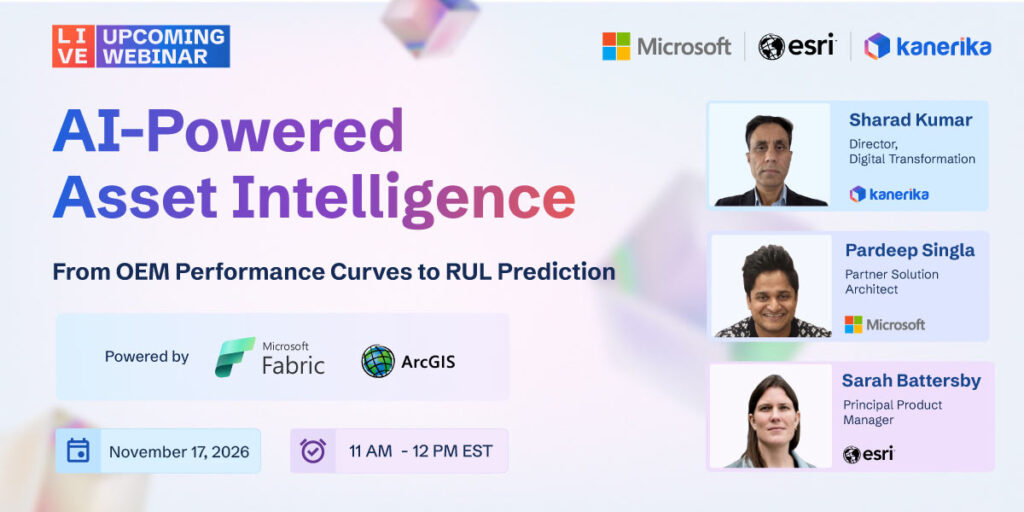
A FLIP demo from Kanerika’s YouTube channel shows ETL assets converted into a target platform.
What Reviewers Say About FLIP
Reviews quoted as published on G2, Capterra and Gartner Peer Insights.

★4.9/531 reviews on G2
Moved Our Entire SSIS Environment to Fabric Without Losing a Single Record
“The 99.9% data integrity during migration was the number that mattered most to us. We also saw a 30% improvement in processing speeds after going live.”
Conor L.Founder, Manufacturing · May 2026

★5.0/5FLIP · 5 reviews on Capterra
Real Time Dashboards with great value and support
“Since we started using Flip, our managers save hours every week on reporting and we make faster decisions on real-time data we trust.”
Ryan A. M.Owner, Computer Software · Sep 2025

★4.7/53 reviews on Gartner
Business logic well validated, with strong communication and clear documentation
“The Kanerika team was very responsive and motivated. We are preparing to move into a second phase with them to operationalize the solution.”
Director of Data and AnalyticsReal Estate, 50M-1B USD · Sep 2026
Two Platforms. Two Migration Approaches.
LeapLogic leads with a wide catalog of sources and targets. FLIP leads with automation backed by reconciliation.
Kanerika FLIP
Published paths with reconciliation built in
FLIP automates up to 80% of migration work across ETL, BI and RPA paths, and checks converted output against the original. It runs in Docker inside your infrastructure and processes metadata only.
Choose FLIP when
- You want published migration paths with client results behind each one.
- Conversion must stay inside your network, on metadata only.
- You need reconciliation and parallel runs before any production cutover.
Impetus LeapLogic
A broad catalog of sources and targets
LeapLogic describes automating migration from any legacy source to any cloud platform, covering ETL, warehouse, analytics, BI, mainframe and Hadoop sources and targets such as Azure, AWS, Databricks and Snowflake.
Choose LeapLogic when
- Your estate spans many legacy sources, including mainframe and Hadoop systems.
- You want a 14-day free web trial before talking to a sales team.
- Licensing by features, source-target pairs and conversion quotas suits you.
FLIP and Impetus LeapLogic at a Glance
Published capabilities and claims, side by side.
| Consideration | FLIP | Impetus LeapLogic |
|---|---|---|
| Migration scope | ETL, BI and RPA migration paths, with reconciliation, orchestration and data quality after cutover. | Sources across ETL, warehouse, analytics, BI, mainframe, orchestration and Hadoop, with BI sources converting to Power BI. |
| Automation | Up to 80% of a data platform migration automated; Kanerika engineers handle the remaining 20 to 30%. | States 70 to 95%, 80 to 95% and up to 95% automation in different materials. |
| Stated gains | Client results are published per migration, such as 70% less manual effort and 80% faster data refresh. | 4x faster transformation, 1.5x faster validation, 2x lower cost and 50% less manual effort versus traditional approaches. |
| Where conversion runs | Runs in Docker inside your own network and processes metadata only, with Kanerika engineers supporting. | On-premises or cloud, single or multi-node. Self-hosting needs a Linux server with 16 cores and 64 to 128 GB RAM. |
| Validation | Row-count reconciliation, hash-based checksums and parallel runs compare migrated output with the original. | Row and cell-level query validation, with parallel run execution enablement and production deployment support. |
| Licensing and start | Migration ROI calculator, a demo, or FLIP plans on Microsoft Marketplace, which is MACC-eligible. | LeapLogic offers a 14-day free web trial, then licences by features, source-target combinations and conversion quotas. |
| Data security | Lists ISO 27001, ISO 27701, SOC 2 Type II and CMMI Level 3 for Kanerika. | States data is secured at rest and in motion, encrypted and masked with format-preserving encryption. |
Why FLIP Wins on Automation and Proof
Where FLIP stands apart on migration automation and platform capabilities.
Certified and marketplace-ready
Buy FLIP direct or through Microsoft Marketplace as a MACC-eligible offer, backed by ISO 27001, SOC 2 Type II and CMMI Level 3 credentials.
Conversion runs inside your network
FLIP is deployed through Docker in your own infrastructure and processes metadata only, which keeps security approvals simple and your logic under your control.
Reconciliation built into the platform
Row-count reconciliation, hash-based checksums and parallel runs prove that converted output matches the original data before any production cutover is approved by your teams.
Published paths, not just a catalog
FLIP publishes migration paths for ETL platforms, six BI tools moving to Power BI, and UiPath moving to Power Automate, each with client evidence.
A baseline that is your own estate
Up to 80% of migration work is automated, and the assessment shows what stays manual, so your plan rests on your own assets.
One platform after the migration ends
Reconciliation, orchestration, data quality checks, document automation, AI agents and governance run, with lineage included, on the same platform that completed the migration.
Ask Every Vendor for Proof on Your Workloads.
Bring the ETL, BI or RPA assets that matter most. We will assess them, show what converts and what stays manual, and run the work inside your network.
Key Considerations Before You Choose a Platform
LeapLogic and FLIP compared on the criteria that decide a migration.
How much of the migration is automated?
LeapLogicLeapLogic cites 70 to 95%, 80 to 95% and up to 95% automatic conversion of legacy code in different materials.
FLIPUp to 80% of migration work is automated, and the assessment shows the manual remainder before you commit.
What are the gains measured against?
LeapLogicIts 4x transformation, 1.5x validation, 2x cost and 50% effort gains are each stated against what it calls traditional approaches.
FLIPAssessment comes first, so gains are modelled on your own estate with the migration ROI calculator, not on a generic baseline.
Where does the conversion run?
LeapLogicLeapLogic runs on-premises or in the cloud, and self-hosting needs a 16-core Linux server with 64 to 128 GB RAM.
FLIPFLIP runs in Docker inside your own network and processes metadata only, with Kanerika engineers supporting the work.
How is the platform licensed?
LeapLogicLeapLogic offers a 14-day free web trial, then licences by features, source-target combinations and conversion quotas.
FLIPUse the migration ROI calculator, book a demo or review FLIP plans published on Microsoft Marketplace, which is MACC-eligible.
LeapLogic Claims Worth Validating
Public statements to confirm in writing before you decide.
Three automation ranges
LeapLogic states 70 to 95% automatic conversion in one place, 80 to 95% in another and up to 95% in a third.
How FLIP approaches itFLIP states up to 80% and shows your own automated share in the assessment before work begins.
Gains against traditional approaches
LeapLogic cites 4x faster transformation, 1.5x faster validation, 2x lower cost and 50% less manual effort versus traditional approaches.
How FLIP approaches itModel your own scope with the FLIP migration ROI calculator, then confirm it in an assessment.
Any source, any target
LeapLogic describes migration from any legacy source to any cloud platform, covering ETL, warehouse, analytics, BI, mainframe and Hadoop sources.
How FLIP approaches itFLIP publishes specific ETL, BI and RPA paths, each backed by client results and a validation method.
Self-hosting requirements
LeapLogic’s single-node install needs 16 cores, 64 to 128 GB of RAM and 500 GB of disk, plus a machine-bound licence.
How FLIP approaches itFLIP runs in Docker inside your existing infrastructure and processes metadata only, with Kanerika engineers supporting.
How FLIP Automates a Migration, Start to Cutover
FLIP links every stage, and Kanerika engineers handle exceptions, approvals and production readiness.
Assess your estate before you commit
FLIP scans legacy repositories, inventories every asset, maps dependencies and flags conversion gaps, so scope and migration waves are planned from facts, not estimates.
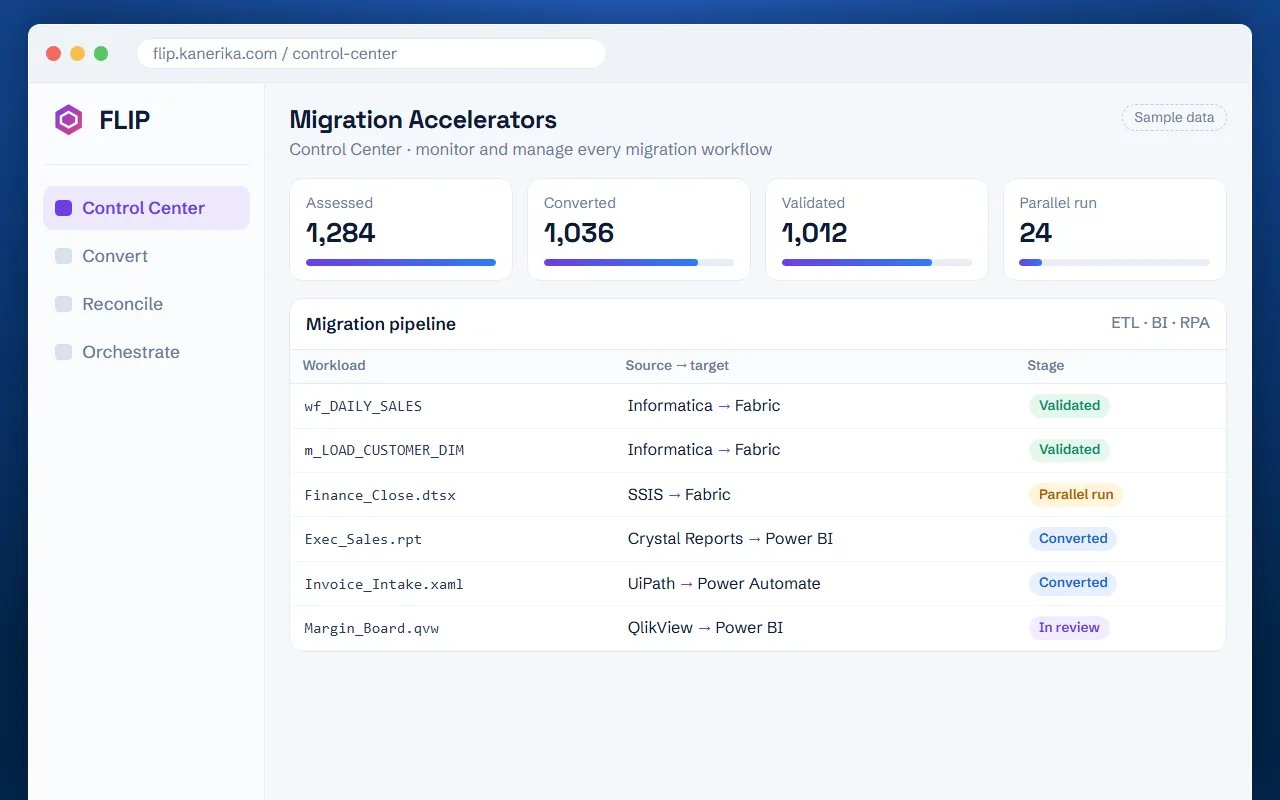
Convert workloads automatically
Supported workloads are converted into target-platform assets automatically, while complex logic and unsupported patterns are routed to Kanerika engineers for review and redesign.
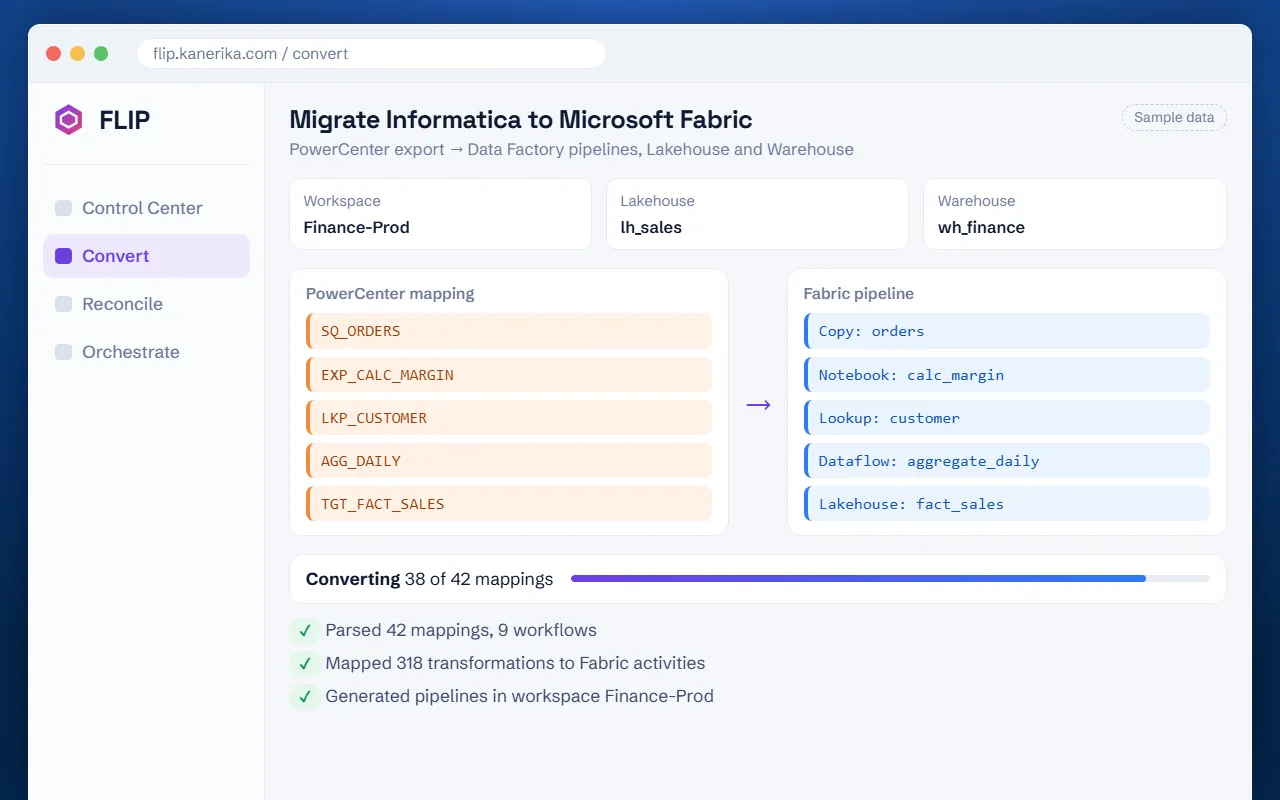
Validate against the source
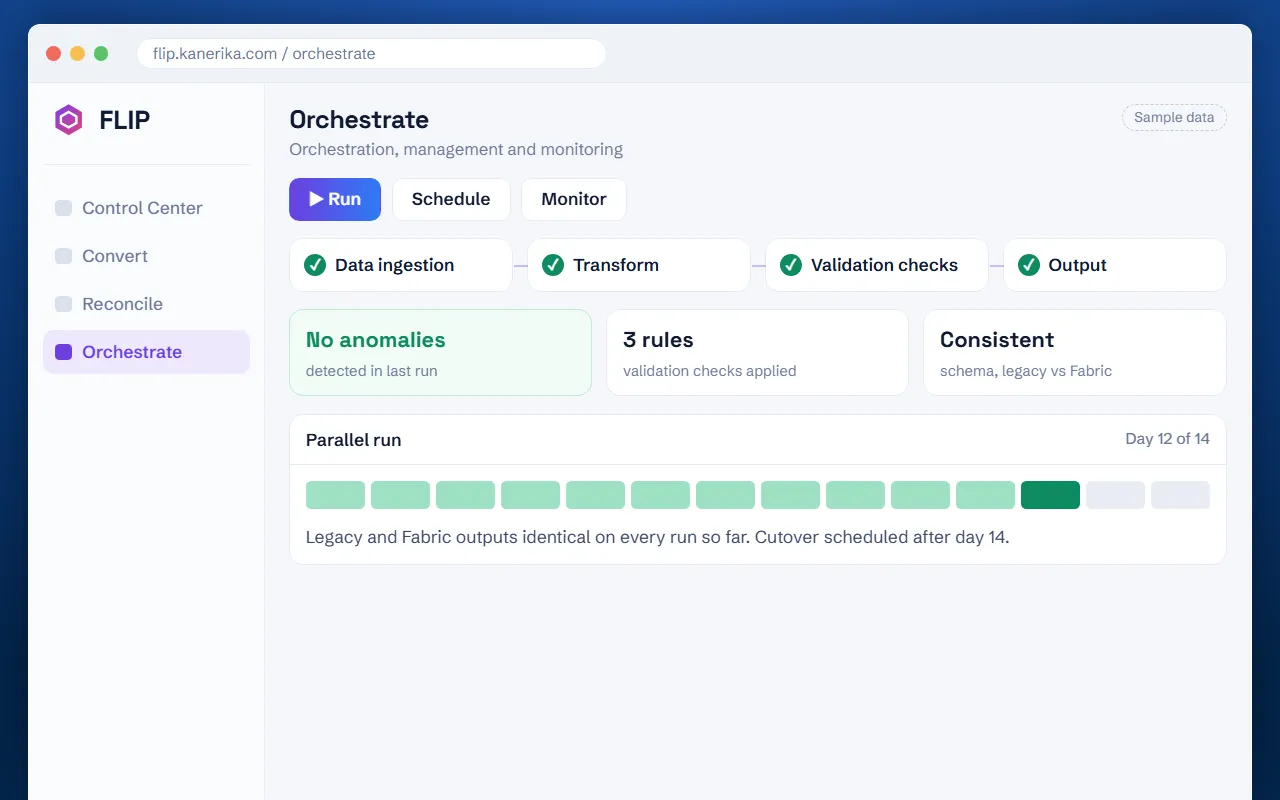
Row-count and checksum reconciliation compares migrated data with source outputs, and parallel runs surface any differences long before the production cutover is scheduled.
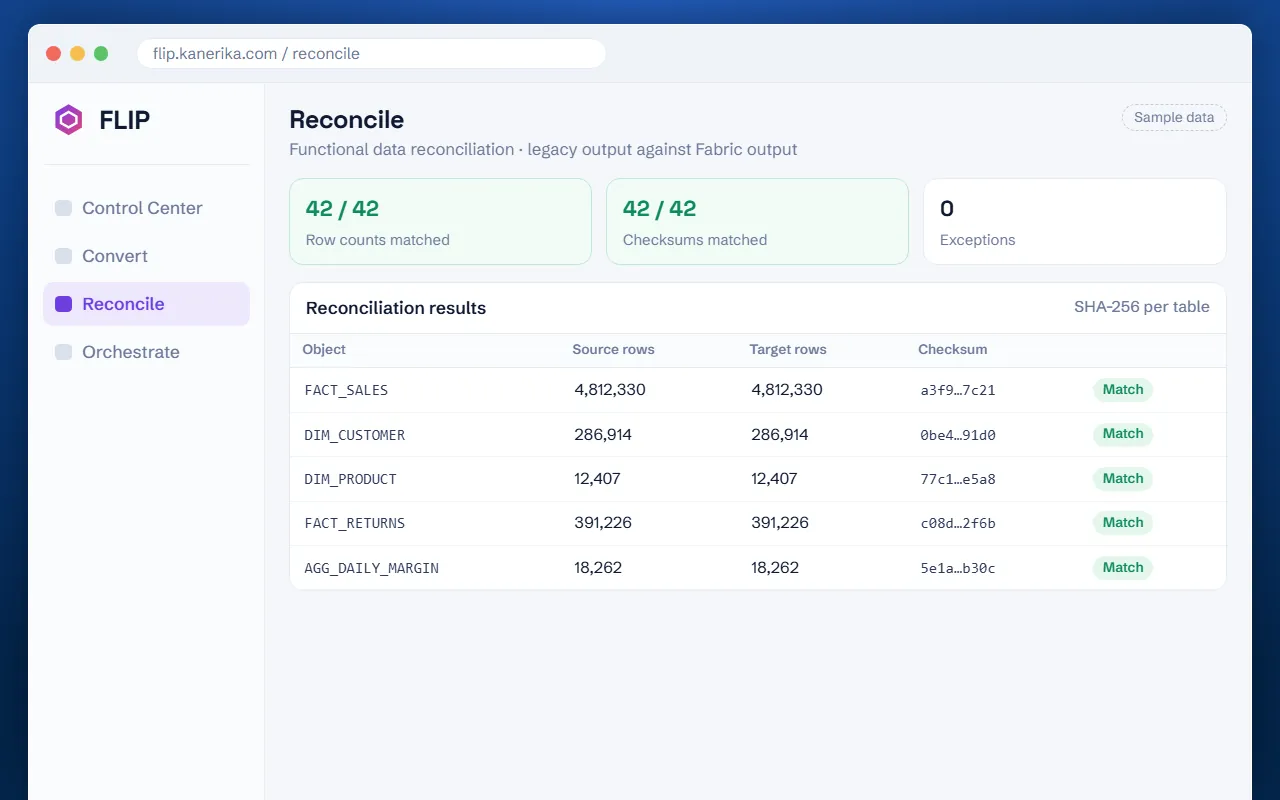
Deploy with a rollback plan
Deployment support, user acceptance testing, rollback planning and post-migration monitoring close out the program, with one accountable team from the first scan to go-live.
FLIP Results Across ETL, BI and RPA
Published Kanerika case studies where FLIP did the conversion.
ETL migration
70%
less manual migration effort
- 60% faster time-to-delivery
- 45% lower total migration cost
Global building-materials manufacturer
ETL migration
45%
faster reporting cycles
- 38% lower maintenance costs
- 60% faster analytics turnaround
Global fintech firm
BI migration
80%
faster data refresh and reporting
- 70% less reporting maintenance
- 40% lower infrastructure and licensing costs
Global interconnect-solutions maker
RPA migration
90 days
to move a codebase built over two years
- 75% lower annual licensing costs
- 50% less effort with automated migration
Trax
Test FLIP on Workloads You Can Inspect
Review your workloads with Kanerika to define migration scope, automation coverage and validation needs before you commit to a tool.
FLIP vs Impetus LeapLogic: Frequently Asked Questions
What is the difference between FLIP and LeapLogic?
LeapLogic describes migration from any legacy source to any cloud platform, licensed by features, source-target pairs and quotas. FLIP automates up to 80% of migration work with published ETL, BI and RPA paths and built-in reconciliation.
Which automates more of the migration, FLIP or LeapLogic?
Kanerika states up to 80% automation for FLIP. LeapLogic states 70 to 95%, 80 to 95% and up to 95% in different materials. Neither is a guarantee for your estate, so run a pilot on your own workloads.
Where does LeapLogic run the conversion?
LeapLogic supports on-premises and cloud deployments, on a single node or several. Self-hosting needs a Linux server with 16 cores and 64 to 128 GB of RAM. FLIP runs in Docker inside your network and processes metadata only.
How much does LeapLogic cost?
LeapLogic is licensed by features, source-target combinations and conversion quotas, and offers a 14-day free web trial, so pricing depends on scope. FLIP can be sized with the migration ROI calculator and a demo.
How does LeapLogic handle validation?
LeapLogic describes row and cell-level query validation and parallel run enablement. FLIP reconciles migrated output by row count and hash-based checksums, and runs parallel periods before cutover.
Can I try LeapLogic before talking to sales?
LeapLogic offers a 14-day free web trial, and its desktop version supports offline assessment. Kanerika offers a FLIP demo, a migration ROI calculator and an assessment-first start on your own workloads.
Is FLIP secure enough to run on sensitive code and data?
Yes. FLIP runs in Docker inside your infrastructure and processes metadata only, so source code and business data stay in your network. Kanerika holds ISO 27001, SOC 2 Type II and CMMI Level 3. The platform applies lineage, audit trails and role-based access.
What results has Kanerika reported from FLIP migrations?
Kanerika publishes four FLIP case studies. An ETL migration for a building-materials manufacturer cut manual effort by 70%, delivered 60% faster and lowered total cost by 45%. A BI migration for an interconnect-solutions maker gave 80% faster data refresh and 40% lower infrastructure and licensing costs. An RPA migration for Trax moved a two-year codebase in 90 days and cut annual licensing costs by 75%.
What are the best alternatives to LeapLogic?
Kanerika FLIP is an alternative when you want published migration paths with client results, conversion inside your network, and reconciliation built in. Compare both on a pilot of representative workloads.
Which is better, FLIP or LeapLogic?
Choose FLIP for automation backed by reconciliation, in-network processing and coverage of ETL, BI and RPA. Choose LeapLogic when your estate spans many legacy sources, such as mainframe and Hadoop. Settle it with a pilot.
Sources and disclaimer
Impetus LeapLogic
- LeapLogic home
- LeapLogic: find your migration
- LeapLogic: get started (FAQ)
- LeapLogic: self-service free trial
- LeapLogic docs: deployment architecture and prerequisites
- LeapLogic docs: key concepts and architecture
- LeapLogic docs: set up data sources for AI
- Impetus: Microsoft Fabric Community Conference (FABCON) 2026
- Impetus: success with AWS
Kanerika
- Migration services and supported FLIP paths
- FLIP product page
- Case study: Informatica to Talend migration
- Case study: Informatica to Alteryx migration
- Case study: QlikView to Power BI
- Case study: UiPath to Power Automate for Trax
- Case study: Informatica to Microsoft Fabric (also lists certifications)
- YouTube: IBM DataStage to Databricks Migration with FLIP (Demo)
Disclaimer: This comparison is based on publicly available information from the linked sources, accessed November 10, 2026. It was prepared by Kanerika, the provider of FLIP, and is not an independent benchmark or an exhaustive product review. Product features, availability, pricing and terms may change. Selection guidance reflects Kanerika’s assessment of the cited information. Vendor statements and client results have not been independently tested; case-study results reflect individual engagements, not head-to-head benchmarks, and no performance, cost or migration outcome is guaranteed. Reviews are quoted as published on third-party platforms and may be out of date. All product names and trademarks belong to their respective owners. References to Impetus or LeapLogic do not imply affiliation, sponsorship or endorsement. If anything here is inaccurate or out of date, tell us and we will correct it.