
TL;DR
AI governance in financial services means the controls and records a firm keeps over its AI, with rules set by firm type, place and use. In the EU, high-risk AI Act duties for finance cover only individual credit scoring and life and health insurance pricing, from 2 December 2027. DORA already binds EU banks, insurers, investment firms and payment firms on ICT and vendor risk, and GDPR limits solely automated decisions. US rules split by sector, with SR 26-2 guidance for banks, the NAIC bulletin for insurers and existing SEC and FINRA rules for brokers. The UK relies on existing FCA rules and named senior managers, while Singapore’s MAS Guidelines take effect from 7 October 2027. One shared core of inventory, risk tiers, owners, testing, oversight, vendor control and records covers most of it, with sector overlays on top.
Key Takeaways
- The legal entity, its supervisor and the use case decide which AI rules apply, so one group can face four rulebooks at once.
- Only two financial uses are named high-risk in the EU AI Act, credit scoring of individuals and life and health insurance pricing.
- The AI Act counts existing EU financial governance rules toward its own duties and hands enforcement to the financial supervisor.
- In the US, insurers face the most AI-specific text, through the NAIC bulletin, New York’s Circular Letter 7 and Colorado rules.
- Accountability for a vendor’s model stays with each regulated entity that uses it, whatever the contract says.
- A dated calendar from 2 December 2026 to 7 October 2028 shows which duties land first and on whom.
Six Dates That Rewrote the Rulebook for Financial AI
17 January 2025. DORA starts to apply, and EU banks, insurers, investment firms and payment institutions answer for every ICT provider they use, AI vendors included.
2 February 2025. The EU AI Act’s prohibitions and its AI literacy duty take effect.
17 April 2026. The Federal Reserve, OCC and FDIC retire SR 11-7 and issue SR 26-2 in its place.
14 May 2026. Colorado repeals its first AI statute and re-enacts it as SB26-189.
7 October 2026. The Monetary Authority of Singapore publishes AI risk guidelines for every financial institution it supervises.
2 December 2027. EU high-risk duties start to apply to credit scoring and to life and health insurance pricing.
Now read that list the way a diversified financial group reads it. The bank, the insurer, the asset manager and the payments arm each sit under a different supervisor, because each holds its own licence.
Each date therefore lands on some of them and misses the others. The hard part, then, is knowing which.
What AI Governance in Financial Services Has to Answer
AI governance in financial services is the accountability, controls and evidence a firm keeps over the AI it builds or buys. The general idea is the same as in any sector, so Kanerika’s guide to the basics of AI governance covers it.
What changes in finance, though, is the question behind it. Which regulator supervises which legal entity, for which use?
That question matters because AI in finance touches decisions regulators already police. A credit model decides who borrows, a pricing model sets what a family pays for cover, and a surveillance model picks which trades compliance reviews.
Supervisors therefore arrive with decades of conduct and model risk rules, and they apply them to AI before any AI law does.
Three more features also set the sector apart. First, model risk management is old practice in banking, so supervisors expect inventories and validation as a matter of habit.
Second, many firms rely on the same few cloud and model vendors, which is why third-party concentration worries resilience regulators. Third, a single group often holds a bank licence, an insurance licence and an investment licence, each with its own supervisor.
Law, Guidance or Voluntary
The rules themselves also differ in weight, and this post labels each one. Binding law includes the EU AI Act, DORA, GDPR, Colorado SB26-189 and state insurance regulations.
Supervisory guidance includes SR 26-2, the NAIC model bulletin as each state adopts it and New York’s Circular Letter 7. It also covers FINRA Regulatory Notice 24-09, the ESMA statement on MiFID II and the MAS Guidelines. Voluntary frameworks include the NIST AI RMF and the Treasury’s Financial Services AI Risk Management Framework, released on 19 February 2026.
Checklist
AI Governance Checklist
A practical checklist for setting up AI governance, with the ownership, review and oversight steps supervisors in every financial sector expect to see.
Get the Checklist →Guidance is not law, but it still shapes what an examiner expects to see. Voluntary frameworks, however, carry no penalty at all.
Even so, the NAIC bulletin lets insurers rely on the NIST AI RMF, so a voluntary framework can become the shape of a supervised programme. Kanerika’s AI governance framework guide shows how such frameworks fit together, and the NIST AI RMF playbook walks through the US reference model.
The Regulator Map: Which Rules Reach Which AI, by Sector
The two tables below map the main regimes against four types of financial firm. They reflect the position as of 6 November 2026, and each row also carries its legal status. A dash means the regime does not target that firm type, although a group entity in that sector may still be caught.
Two regimes apply the same way to all four columns, so they sit outside the tables. GDPR Article 22 is binding law and limits solely automated decisions about people when those decisions have legal or similar effects.
The NIST AI RMF and the Treasury framework, by contrast, are voluntary reference control sets. Duties that apply outside finance sit in Kanerika’s broader AI compliance guide.
EU, UK and Singapore Rules by Firm Type
| Regime | Status (6 Nov 2026) | Banks and lenders | Insurers | Asset managers and broker-dealers | Payments and fintech |
|---|---|---|---|---|---|
| EU AI Act, Annex III and Art 27 | Law; high-risk duties from 2 Dec 2027 | Credit scoring of individuals is high-risk; fraud detection carved out | Life and health risk assessment and pricing is high-risk; impact assessment before use | No named high-risk use; classify each system | Fraud models carved out; credit checks can be high-risk |
| DORA | Law; applies since 17 Jan 2025 | Credit institutions in scope | Insurers, reinsurers and intermediaries in scope | Investment firms, AIF managers and management companies in scope | Payment, e-money and account information firms in scope |
| ESMA MiFID II statement | Guidance (30 May 2024) | Where the bank gives retail investment services | – | Organisational, conduct and best-interest duties for retail AI use | – |
| FCA Consumer Duty and SM&CR; PRA SS1/23 | Existing rules; SS1/23 is a PRA supervisory statement; no AI-specific FCA rules planned | SS1/23 for banks with internal model approval | Consumer Duty and a named senior manager | Senior manager accountability under SM&CR | Consumer Duty where the firm is in scope |
| MAS AI Guidelines | Guidelines; issued 7 Oct 2026, effective from 7 Oct 2027 | All AI, including GenAI and agents | Same scope as banks | Covered like every financial institution | Covered as well |
US Rules by Firm Type
| Regime | Status (6 Nov 2026) | Banks and lenders | Insurers | Asset managers and broker-dealers | Payments and fintech |
|---|---|---|---|---|---|
| SR 26-2 (Fed, OCC, FDIC) | Guidance, not enforceable; since 17 Apr 2026 | Model risk guidance, mainly for banks over $30B; GenAI and agents out of scope | – | – | – |
| NAIC model bulletin | Guidance; adopted in 29 jurisdictions as of 3 Nov 2026 | – | Written AIS Program, proportionate to use, covering third-party AI | – | – |
| NYDFS Circular Letter 7; Colorado 3 CCR 702-10 | NY guidance (11 Jul 2024); Colorado regulation | – | Discrimination testing before production and at least yearly; board owns outcomes | – | – |
| Colorado SB26-189 | Law; duties from 1 Jan 2027 | Lending decisions; check your exemption | Insurance decisions; check your exemption | Financial service decisions, if consequential | Lending and financial service decisions |
| SEC rules and FINRA RN 24-09 | Existing law; SEC AI proposal withdrawn Jun 2025; FINRA notice is guidance | – | – | Existing conduct and Rule 3110 supervision apply to AI | – |
How to Read the Map
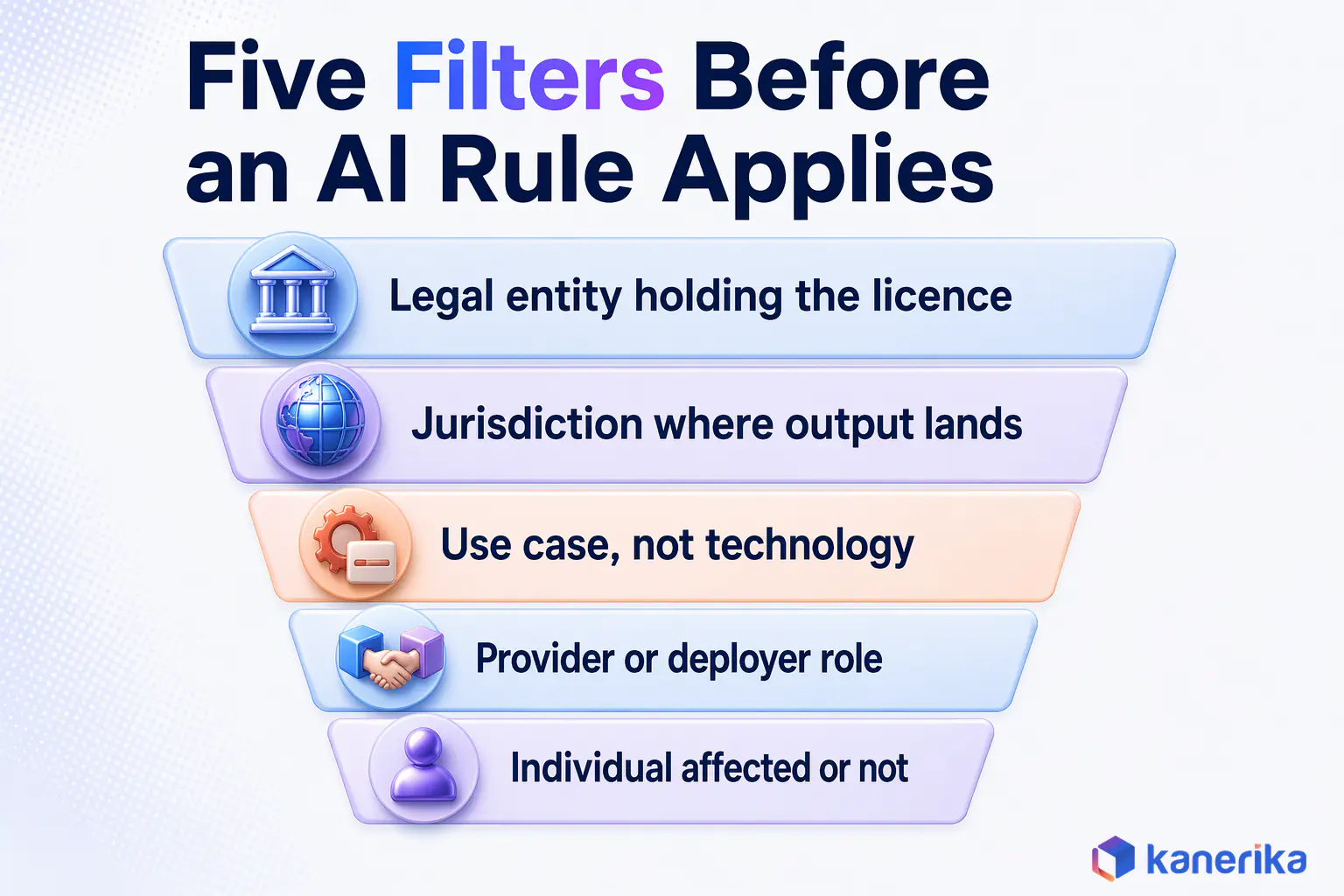
A row applies only after a few filters. Start with the legal entity, because a regime binds the licensed company rather than the group brand.
Then check the jurisdiction where the entity operates and where the output lands. After that comes the use case, since the EU high-risk list names uses rather than technologies.
Two more filters then decide the duty itself. The first is role, because the AI Act treats a provider that builds a system differently from a deployer that uses it.
The second is the affected person, since many duties apply only when the decision concerns an individual. Finally, look for exemptions, such as the fraud carve-out in the EU or entity exemptions in Colorado.
One Group, Several Tags per Model
Take an EU life insurer’s pricing model, for example. It is high-risk under Annex III 5(c), and the insurer must run a fundamental rights impact assessment before deploying it.
Its cloud host also belongs in the DORA register of ICT providers. Because it prices cover for individuals, GDPR Article 22 also applies to any solely automated decision.
That one model therefore carries four tags. A bank in the same group might run a fraud model with only two tags, DORA and GDPR.
That is because fraud detection sits outside the high-risk list. So an inventory that stores a single “compliant” field cannot show that difference. Tags per regime can, and they also tell each supervisor which records to expect.
Sector by Sector: What Each Type of Firm Must Govern
The same governance core runs through every sector, yet the supervisor’s first question differs. A bank examiner starts with model risk.
An insurance regulator, however, starts with unfair discrimination. A securities regulator starts with conflicts and supervision, while a payments supervisor starts with resilience. Each section below starts from that first question.
Banks and Lenders
In the US, SR 26-2 replaced SR 11-7 and SR 21-8 on 17 April 2026 and mainly targets banks over $30 billion. It is not enforceable, and it leaves generative and agentic AI to each bank. Credit decisions still carry fair lending duties, and in the EU the credit scoring of individuals falls under Annex III 5(b).
Kanerika’s guide to what bank supervisors now expect from AI programmes covers the bank-only detail. The breakdown of what SR 26-2 changed for model risk covers validation.
Insurers
Insurers face more AI-specific text than any other US financial sector. The NAIC adopted its model bulletin on the use of AI systems by insurers on 4 December 2023.
It asks each insurer to keep a written AI Systems (AIS) Program for AI that makes or supports regulated insurance decisions. That programme should be proportionate to how the insurer uses AI, and it should cover AI systems and data bought from third parties.
Kanerika Service
AI for Banking
Kanerika builds AI systems for fraud, credit and reporting with audit trails, access controls and governance built in, so supervisors can review the controls.
Explore AI for BankingA bulletin is not a statute, though. Each state adopts it on its own terms, and the NAIC adoption map listed 29 jurisdictions as of 3 November 2026.
That count covers 27 states plus the District of Columbia and Puerto Rico. The NAIC itself notes that the map does not confirm whether each adoption carries every model element.
State Rules Beyond the NAIC Bulletin
Some states go further, though. New York’s Insurance Circular Letter No. 7, issued on 11 July 2024, covers AI and external consumer data in underwriting and pricing.
It expects discrimination testing before a system goes into production and again at least once a year. Senior management and the board answer for the outcomes, and an insurer “may not rely solely on a third-party’s claim of non-discrimination.”
Colorado has its own insurance AI regulation, 3 CCR 702-10, and its new SB26-189 adds duties for insurance decisions from 1 January 2027. California and Texas have also issued insurance AI bulletins. So a multi-state carrier needs a state-by-state register rather than one national answer.
In the EU, risk assessment and pricing for life and health insurance is high-risk under Annex III 5(c). Deployers of those systems must complete a fundamental rights impact assessment before first use.
DORA also covers insurers, reinsurers and insurance intermediaries. EIOPA also published an Opinion on AI governance and risk management on 6 August 2025 to guide national supervisors.
Across both regions, the uses that draw attention are underwriting, pricing, claims handling and fraud. Kanerika’s insurance industry work spans those same claims, underwriting and fraud workflows. Since regulators look there first, claims and pricing models usually head an insurer’s inventory.
Kanerika Service
Data and AI for Insurance
See how Kanerika supports insurers across underwriting, pricing, claims and fraud workflows, the same systems state regulators and the EU AI Act now examine.
Explore Insurance SolutionsAsset Managers and Broker-Dealers
As of 6 November 2026, no AI-specific SEC rule binds US asset managers or broker-dealers. The SEC proposed rules in 2023 on conflicts of interest from predictive data analytics.
Two years later, the SEC withdrew that proposal on 12 June 2025, effective 17 June, and said it does not intend to finalise it. Existing obligations still apply in full.
FINRA also says the same thing in plainer terms. Its Regulatory Notice 24-09 calls FINRA rules “technology neutral” and reminds members that they apply to AI, including generative AI.
Under Rule 3110 a firm needs a reasonably designed supervisory system. A firm that uses generative AI in supervision should also have policies on model risk management, data integrity and accuracy.
In the EU, ESMA’s statement of 30 May 2024 covers AI in retail investment services. It expects firms using AI to meet MiFID II organisational, conduct and best-interest duties.
DORA also covers investment firms, alternative investment fund managers and management companies. In the UK, meanwhile, the Consumer Duty and the Senior Managers and Certification Regime apply. The uses that matter most are advice tools, portfolio construction, trade surveillance and client communications.
Payments and Fintech
Payments firms get the most relief from the EU AI Act. Annex III 5(b) excludes AI used to detect financial fraud, so the core transaction-monitoring model is usually not high-risk.
However, a pay-later or lending feature that scores an individual’s creditworthiness can be. DORA also covers payment institutions, e-money institutions and account information service providers, including exempted payment institutions.
In the US, no AI-specific federal rule targets non-bank payments firms. Instead, existing licensing, consumer protection and anti-money laundering duties apply to AI-driven decisions as they apply to any other.
Colorado SB26-189, however, is the exception to watch. From 1 January 2027 it covers automated decisions that materially influence consequential decisions about financial or lending services.
Under that law, deployers must give notice at the point of interaction. After an adverse decision they must describe the technology’s role in plain language within 30 days, and consumers can ask for correction and human review.
Records then stay for three years. Some entities are exempt where they comply with other legal duties, so check whether your licence type qualifies.
How the EU AI Act, DORA and GDPR Stack for a Financial Group
Three EU laws reach financial AI, and each governs a different layer. First, the AI Act governs the system and its use.
Second, DORA governs the ICT supply chain and resilience. Finally, GDPR governs personal data and automated decisions about people. Kanerika’s EU AI Act compliance guide walks through the full Act, so this section stays on the parts that matter to a financial group.
Only Two Financial Uses Are Named High-Risk
Annex III of the EU AI Act names two financial uses as high-risk. Point 5(b) covers credit scoring and creditworthiness checks on individuals, with fraud detection excepted.
Point 5(c) covers risk assessment and pricing for individuals in life and health insurance. Every other financial use needs its own classification under Article 6, rather than a blanket high-risk label.
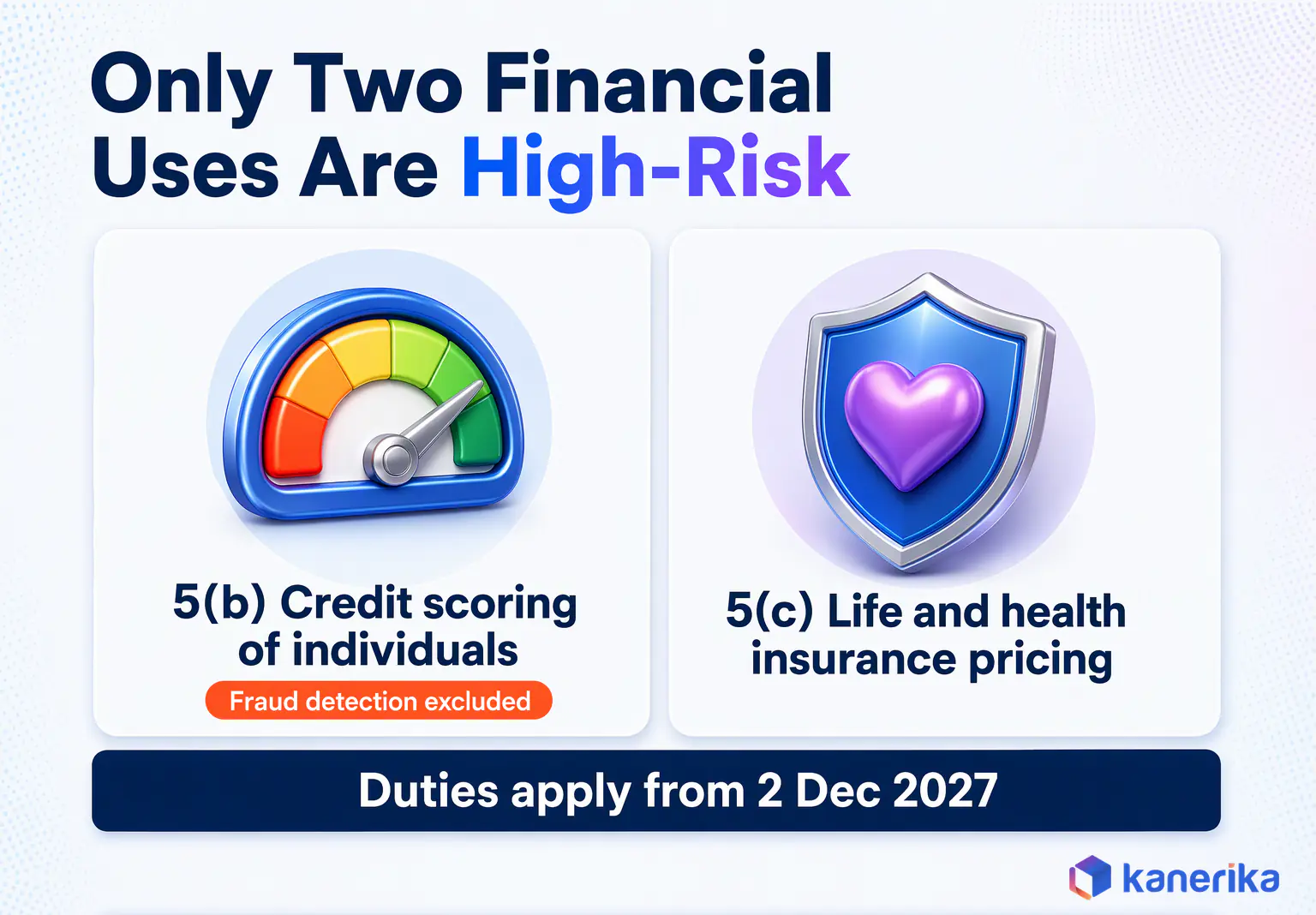
The dates also moved in 2026. Under Regulation (EU) 2026/1744, high-risk duties for Annex III systems apply from 2 December 2027 and for Annex I systems from 2 August 2028.
The original prohibitions and the AI literacy duty have applied since 2 February 2025. Generative systems already on the market before 2 August 2026 must meet the Article 50(2) marking duty by 2 December 2026.
Your Existing Governance Rules Count Toward the AI Act
Three articles make a shared operating model possible. Under Article 17(4), a provider that is a regulated financial institution meets most of the quality management duty by following its existing internal governance rules.
Similarly, under Article 26(5), a deployer meets the monitoring duty the same way. Article 74(6) then makes the national financial supervisor the market surveillance authority for that use.
In practice, a financial group should extend the governance it already runs under EU financial services law instead of building a parallel AI bureaucracy. The Article 27 impact assessment for 5(b) and 5(c) systems still has to be done, though.
Nor is a firm outside the EU automatically safe. Article 2(1)(c) reaches providers and deployers abroad when the system’s output is used in the Union.
DORA Governs the Plumbing, Not the Model’s Fairness
DORA has applied since 17 January 2025. It sets rules for ICT risk management, incident reporting, testing and the register of ICT third-party providers.
It also creates an EU oversight framework for critical ICT providers, including cloud. An AI vendor is an ICT third party, but it is not a designated critical provider by default.
Meanwhile, GDPR Article 22 gives people the right not to face a solely automated decision with legal or similarly significant effects. Recital 71 gives the automatic refusal of an online credit application as an example.
The UK and Singapore: Principles Today, Dated Expectations Next
London and Singapore take different paths to the same destination. The UK leans on rules that already exist, while Singapore published AI-specific guidelines with dates attached on 7 October 2026.
UK: Existing Rules, Named Owners
The FCA’s published approach to AI is principles-based and outcomes-focused. “We do not plan to introduce extra regulations for AI,” it says, and it relies on existing frameworks instead.
So the Consumer Duty covers customer outcomes. Likewise, the Senior Managers and Certification Regime means a named senior manager answers for how AI is used in their area.
For banks, building societies and PRA-designated investment firms with internal model approval, the PRA’s SS1/23 sets model risk principles. It took effect on 17 May 2024, and an amended version applies from 23 April 2026.
AI use is already wide. In the Bank of England and FCA survey of November 2024, 75% of responding firms already used AI. Another 10% planned to within three years. Those figures describe the firms that responded, not the whole market.
AI Assessment
See Where Your AI Program Stands
Score your organization’s readiness across AI and ML foundations, generative AI and AI agents, and see which systems need governance attention first.
Start Your AI Assessment →Singapore: AI Risk Guidelines That Cover Every Financial Institution
The MAS published its Guidelines on Artificial Intelligence Risk Management on 7 October 2026, after a consultation in November 2025. They apply to all financial institutions and to all forms of AI, including generative AI and agents.
Boards and senior management oversee AI risk, and existing governance structures can do the job. So MAS does not require a dedicated AI committee.
The guidelines expect an AI inventory, a risk materiality assessment for each use and proportionate lifecycle controls. Those controls span data governance, testing, human oversight, cybersecurity, monitoring and change management.
Firms stay accountable for third-party AI and should limit, suspend or replace it when its risk exceeds appetite. Where impact is immaterial, basic policies suffice.
Timing, however, is staged. Sections 3 and 4 take effect from 7 October 2027, and Sections 5 and 6 apply by 7 October 2028. MAS also plans to consult in 2027 on further guidance for agentic AI.
The Common Core: One Operating Model, Sector Overlays
The map looks crowded, yet AI governance in financial services comes down to a short list of the same things. Seven controls appear again and again, under different names.
Build them once at group level, then add a thin overlay for each sector. Kanerika’s guide to AI governance, risk and compliance covers how those controls sit inside a wider GRC structure.
Seven Controls Every Regime Asks For
| Common control | Regimes that ask for it | Evidence to keep |
|---|---|---|
| AI inventory | MAS Guidelines, NAIC AIS Program, SR 26-2 model inventory, AI Act high-risk registration | One record per system with entity, use and owner |
| Risk tiering | MAS risk materiality, NAIC proportionality, AI Act classification | Tier and the reason for it, per regime |
| Accountable owner | SM&CR, MAS board and senior management, NYDFS board and senior management | Named owner per legal entity |
| Testing before use, including bias | NYDFS before production and yearly, AI Act high-risk duties | Test plans, results and sign-off |
| Human oversight | MAS lifecycle controls, Colorado human review, GDPR Art 22 | Review route and override logs |
| Monitoring and change control | MAS lifecycle controls, AI Act Art 26(5) via existing governance | Drift reports and change approvals |
| Third-party assurance | DORA, MAS, NYDFS, NAIC, SR 26-2 | Vendor register, contracts, assurance reports |
Records also sit under every row. Colorado asks deployers to keep them for three years, and the AI Act expects logs for high-risk systems. So the inventory, the test results and the decision logs should share one retention policy rather than seven.
Bias testing, though, deserves a note of its own. Each regime wants proof that a model does not treat protected groups unfairly, so the test method should be documented once and reused. Explainable AI methods then turn a model’s output into reasons a reviewer or customer can follow.
What Stays Local to Each Sector
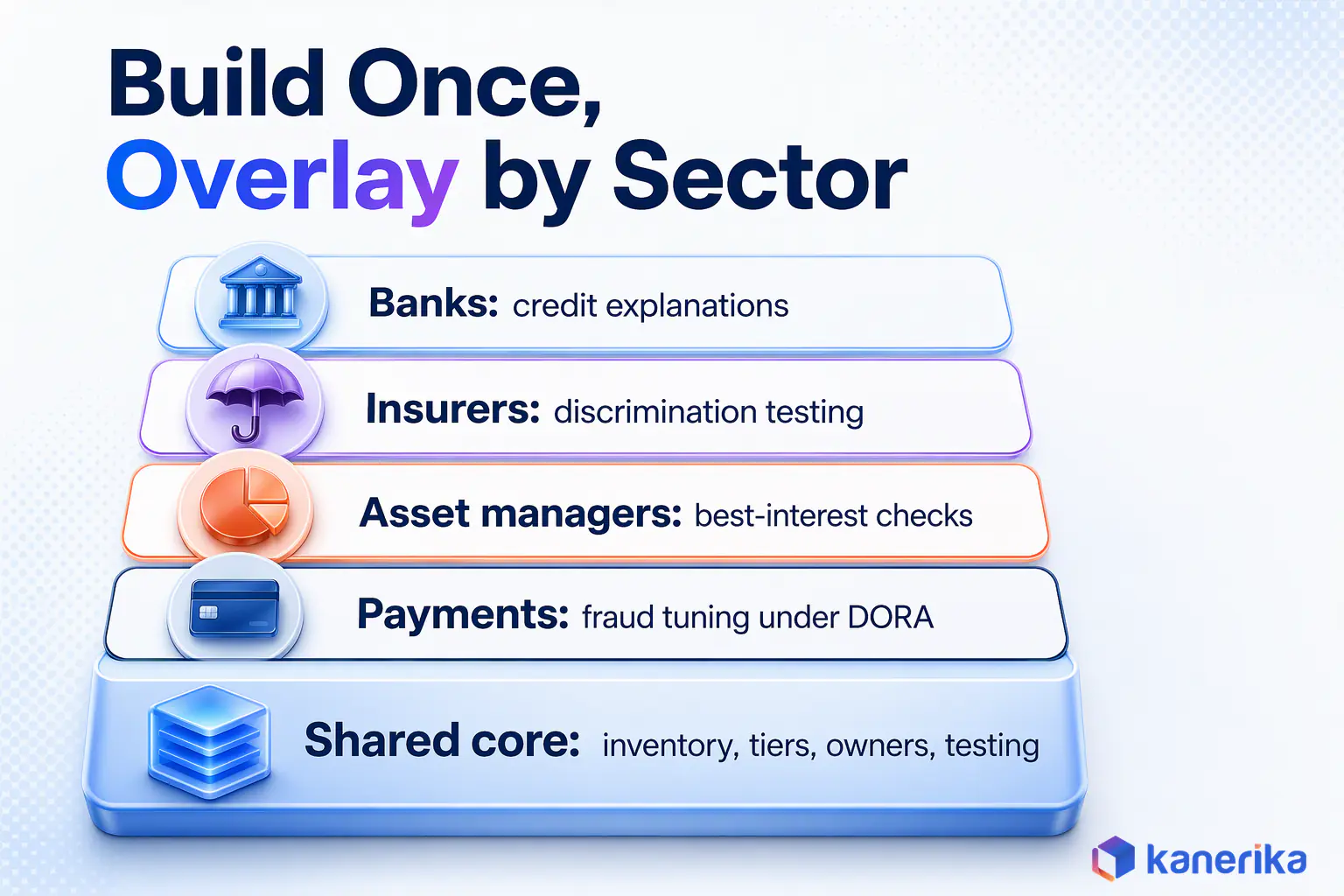
The overlays are where sector rules really differ. Banks and lenders add credit decision explanations and fair lending checks, often on top of mature data governance programmes in banking.
Insurers instead add unfair discrimination testing on pricing and underwriting, state by state. Asset managers and broker-dealers add best-interest and supervision checks on advice and surveillance tools. Payments firms add fraud model tuning inside DORA’s resilience rules, because a false decline is also an outage for the customer.
Still, keep each overlay thin. If an overlay starts to repeat the core, move that control back into the core so every entity gets it. A maturity model for AI governance helps a group judge which entities need the overlay first.
Who Decides in a Multi-Entity Group
Group-level committees can set policy and pick the shared tooling. However, accountability stays with each regulated entity’s board and senior managers, because the licence sits there.
MAS says existing structures can carry AI oversight without a dedicated AI committee. Similarly, the UK’s SM&CR names the person who answers for an AI outcome in each firm.
A workable split gives the group the inventory, the tiering method and the control library. Each entity then owns its use cases, its sign-offs and its conversation with its own supervisor. That split also keeps a group committee from approving a model that only one entity’s regulator can judge.
One AI Vendor, Different Duties for Each Regulated Entity
Picture one model provider serving four entities in the same group. The bank, the EU insurer, the asset manager and the payments subsidiary all use the same language model and the same fraud scoring service.
So the vendor signs one master contract. Each entity still owes its own regulator a different set of duties.
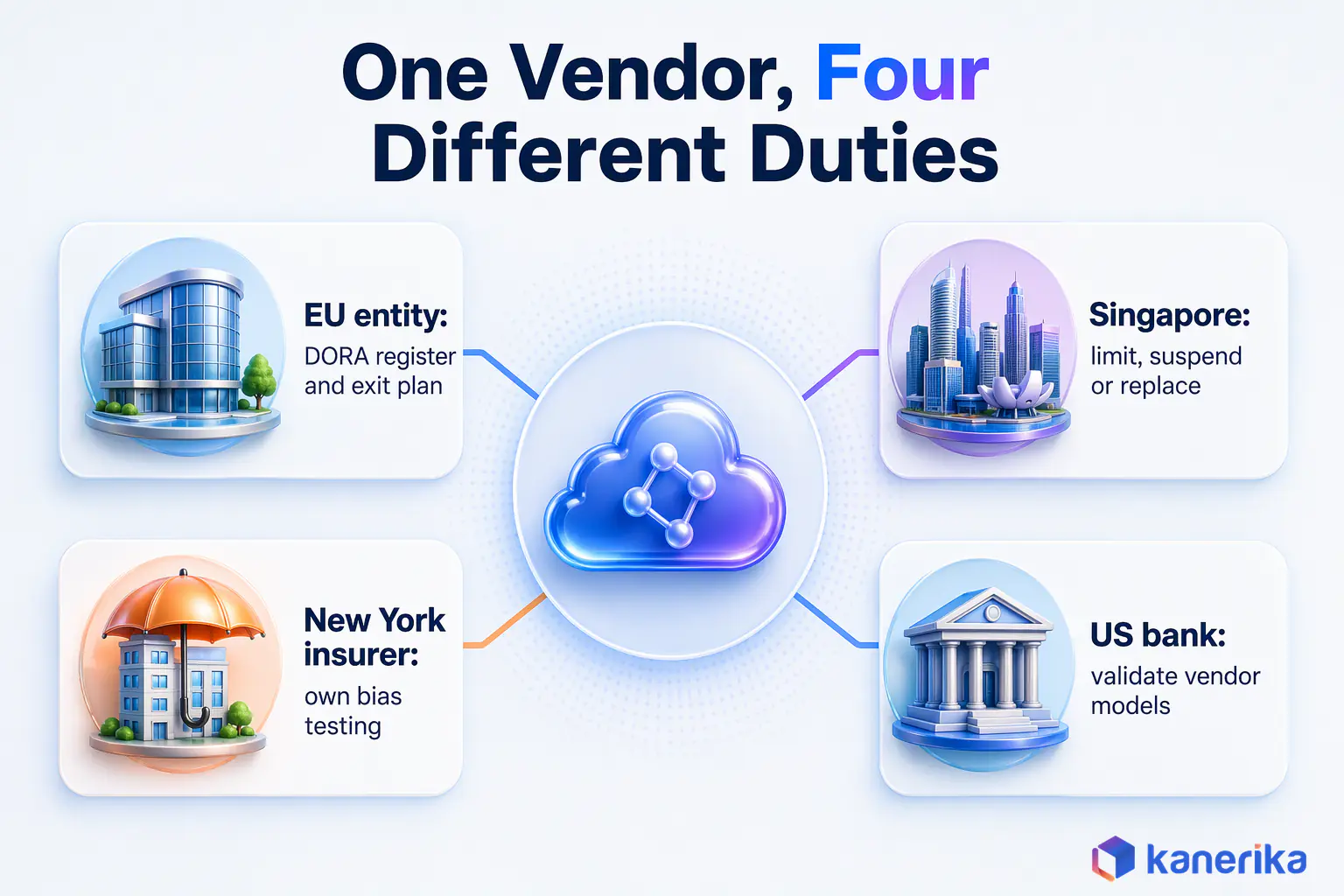
The EU entities must record the vendor in their DORA register, set contract terms and keep an exit plan. Under the MAS Guidelines, a Singapore entity stays accountable and should limit, suspend or replace the vendor if its risk exceeds appetite.
A New York insurer, though, may not rely only on the vendor’s claim that its model does not discriminate. The NAIC bulletin also expects insurers to govern AI systems and data from third parties.
Two more duties apply in the US. Under Colorado SB26-189, the developer must hand technical documentation to the deployer from 1 January 2027. And a bank must still validate vendor models under SR 26-2, even though it cannot see every line of code.
Accountability never moves to the vendor, whatever the contract says. Kanerika’s guide to running an AI vendor risk assessment lists the due diligence questions, so this section stops at who owes what.
Generative and Agentic AI: Where the Rules Lag the Technology
Generative AI and AI agents are where coverage is most uneven. SR 26-2 puts generative and agentic models outside its scope, so US banks write their own standards for them.
MAS instead covers all AI, agents included, and plans a 2027 consultation on agentic AI. FINRA applies its existing rules to generative AI, and the FCA relies on its existing frameworks.
The EU also adds one near-term duty. Providers of generative systems already on the market must meet the Article 50(2) marking duty by 2 December 2026, so outputs carry a machine-readable label. Kanerika’s guide to generative AI governance covers the wider control set for these systems.
Agents raise the stakes because they act rather than advise. An agent that can move money, change a limit or file a claim needs the same controls a new employee would get, and then some.
First, set approval limits and transaction caps. Then grant tool permissions one by one, and require human sign-off for consequential actions. Log every action the agent takes, keep a kill switch, and give each agent its own inventory entry.
These controls work under every regime on the map, which matters while the rules catch up. For adoption patterns and use cases, see Kanerika’s guide to agentic AI in financial services. The model risk guide for AI and LLM validation covers how to test them.
Checklist
Enterprise Agentic AI Checklist
A checklist for putting AI agents into production with the permissions, approvals, logging and oversight controls a regulated firm needs before an agent acts.
Get the Checklist →The Evidence Layer: Tag Once, Answer Every Supervisor
Each supervisor asks for evidence in its own format. The way to stay sane is to tag every inventory item once, with enough metadata to answer any of them.
For example, a workable minimum covers the legal entity, jurisdiction, sector, use case and affected population. Add the provider or deployer role, model version, data sources and lineage, vendor, owner and last test date.
Then record the classification rationale per regime. That field explains why a fraud model is not high-risk under the AI Act, or why a pricing model is. It also saves the same argument from being rebuilt for every exam.
From there, an illustrative flow runs from inventory to obligation mapping, then to control execution, an evidence store and supervisory reporting. Then automate the collection and routing of evidence. Keep applicability calls and residual risk sign-off with qualified people, because those judgements carry legal weight.
Most of this plumbing already exists in a well-run data platform. Lineage, catalogues, access control and data quality rules are the same tools that prove where a model’s inputs came from.
Kanerika’s guide to how AI governance differs from data governance explains where the two programmes meet. Kanerika’s data governance services build that layer.
The Deadline Calendar From Now to 2028
Several duties, though, are already live. DORA has applied since 17 January 2025, and the AI Act’s original prohibitions since 2 February 2025.
SR 26-2 has applied since 17 April 2026, while NAIC adoptions and New York’s Circular Letter 7 are in place where adopted. The dates below are still ahead, as of 6 November 2026.
| Date | What applies | Who it reaches |
|---|---|---|
| 2 Dec 2026 | AI Act Art 50(2) marking for generative systems already on the market | Providers of generative AI used in the EU |
| 1 Jan 2027 | Colorado SB26-189 duties for automated decisions | Lenders, insurers and financial service firms deciding for Colorado consumers |
| 7 Oct 2027 | MAS Guidelines Sections 3 and 4 | All MAS-supervised financial institutions |
| 2 Dec 2027 | AI Act Annex III high-risk duties, including the impact assessment | Credit scoring of individuals; life and health insurance pricing |
| 2 Aug 2028 | AI Act Annex I high-risk duties | AI in products under EU product safety law |
| 7 Oct 2028 | MAS Guidelines Sections 5 and 6 | All MAS-supervised financial institutions |
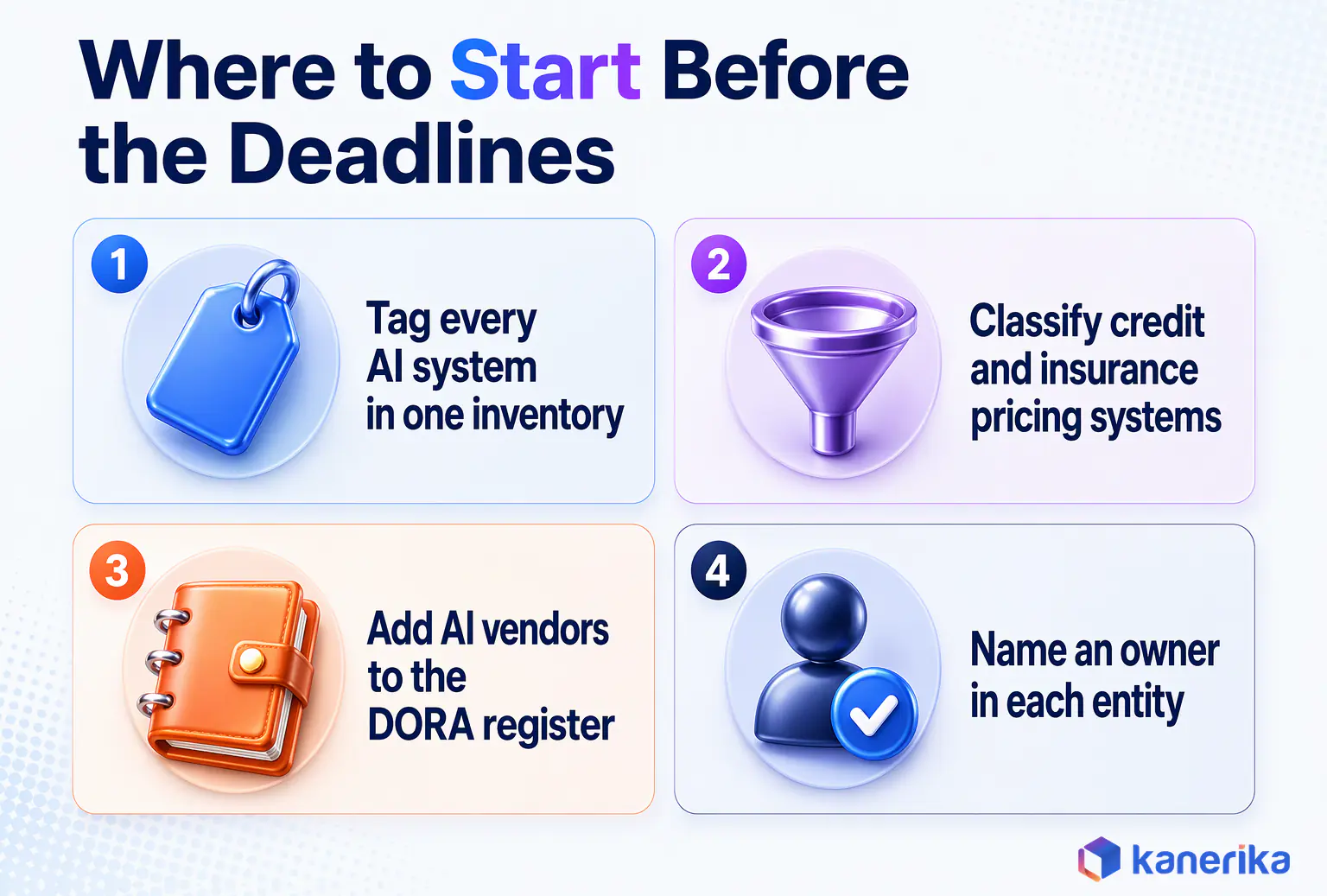
For AI governance in financial services, the calendar suggests a starting order. First, build the tagged inventory, because every later duty depends on it.
Second, classify any 5(b) or 5(c) systems and plan their impact assessments before December 2027. Third, bring every AI vendor into the DORA register and the vendor review cycle. Finally, name an owner in each regulated entity before the MAS and Colorado dates arrive.
How Kanerika Supports AI Governance in Financial Services
Kanerika’s AI governance services follow the IMPACT approach the service page describes, which stands for Identify, Map, Prove, Analyze, Create and Transform. In the page’s own words, “Identify surfaces governance gaps before they become audit findings.”
“Prove tests governance controls on highest-risk systems first,” and “Analyze quantifies the cost of governance failures against the cost of prevention.” Finally, “Transform embeds governance into ongoing AI operations.” For EU AI Act scope, the page says Kanerika maps systems against the Act’s classification framework and builds compliance programs for those in scope.
What the Work Covers for Banks and Insurers
The capabilities also map closely to the common core above. They include data lineage tracking from source to model output, model impact assessments before deployment and a model registry with a full audit trail.
They also cover explainability reports, risk tiering with defined accountability and pre-deployment validation for regulated AI systems. GDPR compliance for automated decision-making and pre-deployment bias testing across protected attributes complete the set.
The service page also explains why independence matters in this sector. Independent validation “matters in banking and insurance where model risk management frameworks require independent validation before a model enters production.” For model release and monitoring, Kanerika’s MLOps consulting supports the change control side.
The service page lists three jobs in banking and finance: governing credit models for Basel compliance, ensuring fair lending decisions and automating regulatory audit trails. Insurers get tracking of predictive model drift in production and audit-ready AI documentation. Validation continues after launch, through post-change audits after model updates and independent validation of inherited legacy AI systems.
A Financial Services Delivery Example
The evidence layer is where Kanerika’s financial services work shows. For a leading financial services provider, Kanerika rebuilt the data platform behind fraud, risk and settlement reporting.
Pipeline logic replaced expert-run Excel transformations, and row-level security, automated data quality rules and business glossary mappings check the data at source. Data lag fell by 90%, and reporting latency fell by 96% from a three-day cycle.
Case Study
Core Platform Data Modernization for Faster Risk and Fraud Reporting
For a leading financial services provider, Kanerika rebuilt fraud, risk and settlement reporting with row-level security and automated data quality rules, cutting data lag by 90% and reporting latency by 96%.
Read the Case Study →That project was a data modernisation engagement rather than an AI governance one. Even so, it built the controlled, traceable data a governance programme relies on.
Kanerika’s banking and financial services practice works under ISO 27001, ISO 27701:2019 and SOC 2 Type II certifications.
Start With the Map, Not the Model
So which rules apply to which firm? The legal entity, its supervisor and the use case decide.
An EU insurer pricing life cover faces the AI Act’s high-risk duties, DORA and GDPR. A US broker-dealer faces existing SEC and FINRA rules. A Singapore bank faces the MAS Guidelines from October 2027, and a Colorado lender faces SB26-189 from January 2027.
Most of the work is shared, though. An inventory tagged by regime, risk tiers, named owners, testing, oversight, vendor control and records satisfy the bulk of every rulebook.
The sector overlays and the deadlines are what differ. Draw the map first, and the operating model follows from it.
Talk to Kanerika
Map Your Firm’s AI Governance Duties With Kanerika
Bring your entity list and AI inventory. Kanerika’s team will walk through which regimes reach each model and where a shared governance core can cover them.
Book a Meeting →Frequently Asked Questions
What is AI governance in financial services?
It is the set of owners, controls and records a bank, insurer, asset manager or payments firm keeps over the AI it builds or buys. Which rules apply depends on the legal entity, its supervisor, the jurisdiction and the use case, so one financial group can face several different rulebooks for the same model at the same time.
Is there one AI regulation that applies to all financial services firms?
No. Each sector answers to its own supervisor and rules. The EU AI Act, DORA and GDPR are binding law in Europe, US rules split between bank guidance, state insurance bulletins and securities rules, and Singapore’s MAS Guidelines cover every financial institution there. A shared control core with sector overlays is the practical answer to that split.
Does the EU AI Act classify every financial AI system as high-risk?
No. Annex III names only two financial uses as high-risk. These are credit scoring or creditworthiness checks on individuals, with fraud detection excluded, and risk assessment and pricing for individuals in life and health insurance. Every other financial use needs its own classification, and those high-risk duties apply from 2 December 2027 under Regulation (EU) 2026/1744.
Does DORA apply to AI vendors used by banks, insurers and payment firms?
DORA treats an AI vendor as an ICT third-party provider, so EU banks, insurers, investment firms and payment institutions must record it in their register and manage it through contracts and exit plans. DORA has applied since 17 January 2025. A vendor is not a designated critical provider by default, and DORA does not judge model fairness.
Is the NAIC AI model bulletin binding in every US state?
No. The NAIC model bulletin is guidance that each state chooses whether to adopt, and wording can vary between adoptions. As of 3 November 2026 the NAIC map listed 29 jurisdictions, made up of 27 states plus the District of Columbia and Puerto Rico. New York, Colorado, California and Texas also have their own insurance AI texts.
Can a US financial firm be subject to the EU AI Act?
It can. Article 2(1)(c) of the AI Act reaches providers and deployers located outside the EU when the output of their AI system is used in the Union. That does not catch every US firm automatically. A firm should check where each system’s output lands, whether the use is listed as high-risk, and whether it acts as provider or deployer.
Does using a third-party AI model transfer compliance responsibility to the vendor?
No. Every major regime keeps accountability with the regulated firm. The MAS Guidelines say financial institutions stay accountable for third-party AI, New York’s Circular Letter 7 says an insurer cannot rely solely on a vendor’s non-discrimination claim, and DORA requires EU firms to govern ICT providers through registers, contract terms, oversight and exit plans.
How do you govern AI agents in financial services?
Treat each agent like a new employee with limited authority. Give it an inventory entry and an owner, set approval limits and transaction caps, grant tool permissions one by one and require human sign-off for consequential actions. Log every action and keep a kill switch, because SR 26-2 leaves agents to each bank’s own framework.
Who owns AI governance in a financial services firm?
The board and senior managers of each regulated legal entity own it, because the licence sits with that entity. A group committee can set policy, standards and shared tooling, but it cannot carry the entity’s accountability. The UK names a senior manager under SM&CR, and MAS lets firms use existing governance structures without a dedicated AI committee.
When do the next AI deadlines hit financial firms?
The next dates are 2 December 2026 for EU generative AI marking, 1 January 2027 for Colorado SB26-189 and 7 October 2027 for MAS Guidelines Sections 3 and 4. EU high-risk duties for credit scoring and life and health pricing follow on 2 December 2027, with the remaining MAS sections due by 7 October 2028.