
TL;DR
An AI vendor risk assessment checks whether a supplier that runs AI on your data can prove it handles that risk safely. Standard security questionnaires miss most of it, because they were written for software that behaves the same way every day. So ask ten AI-specific questions about training on your data, model changes, hidden model providers, evaluation evidence, incidents, output ownership and EU AI Act roles. Demand documents rather than promises, and score each answer on the strength of its evidence. Set hard gates that stop a purchase whatever the total score says. Then write the answers into the contract and re-assess whenever the vendor changes its model, its sub-processors or its terms.
Key Takeaways
- An AI vendor risk assessment judges the supplier’s practices, evidence and contract terms rather than the risk of your own use case.
- SOC 2 and ISO 27001 reports cover a security program, so they rarely say anything about training on your data or model behavior.
- The biggest blind spots include model changes and nested model providers, as well as training on customer data and IP cover for outputs.
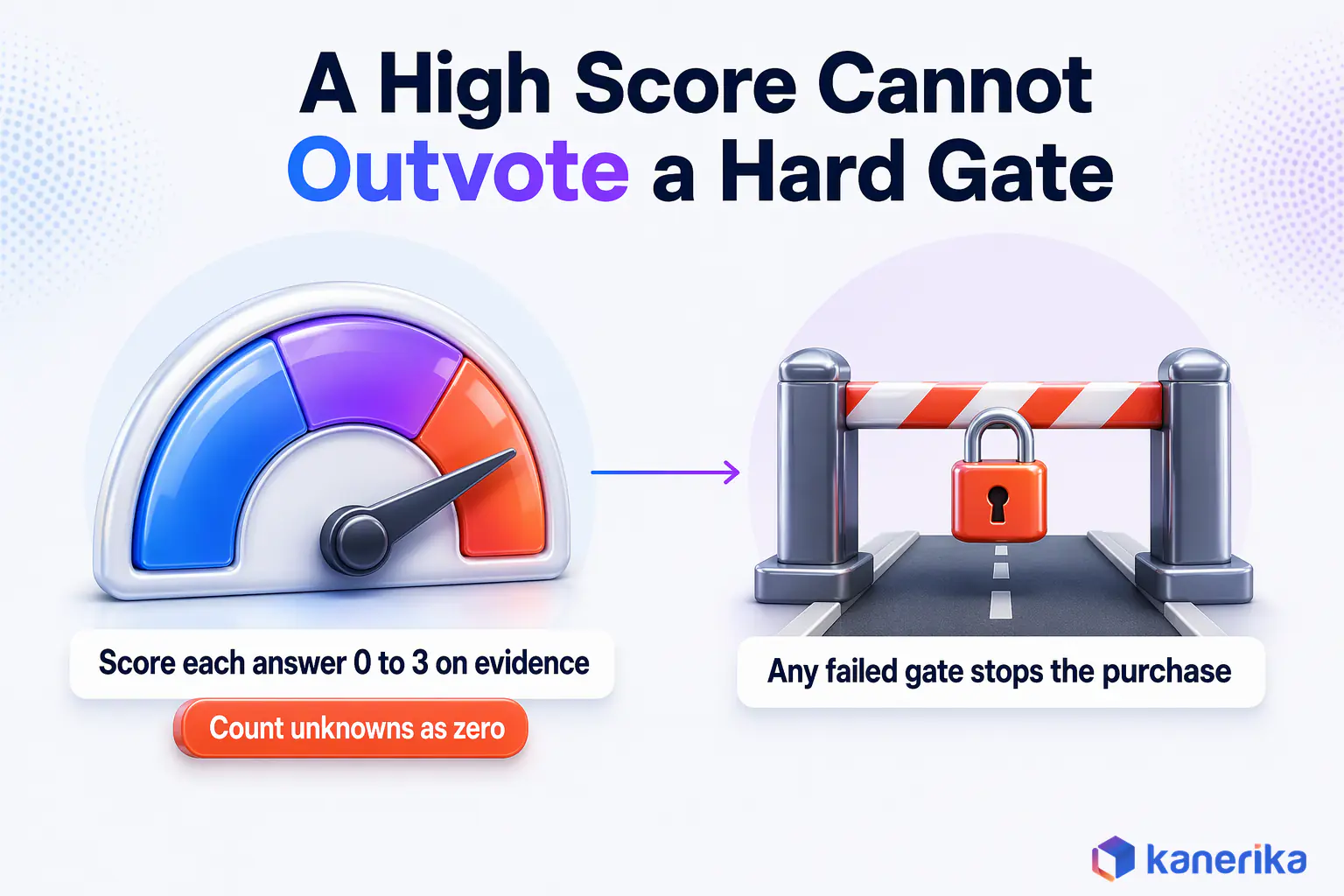
- Score every answer on evidence, count unknowns as zero and then let hard gates override a high total.
- A vendor’s answers only protect you once they appear as clauses on notice, deletion, sub-processors, incidents and indemnity.
- Re-assess on events such as a model swap or a newly enabled AI feature, not only on the annual calendar.
Ten Questions Your Security Questionnaire Never Asks
Will you train a model on our support tickets? Which foundation model sits behind your product, and who signed that contract? What happens to our workflow when that model changes next Tuesday? Those three, and seven more like them, rarely appear in the questionnaire a procurement team sends out.
Picture the help desk tool you approved two years ago. Last year it shipped an AI assistant, switched on by default, so ticket text flows to a model provider nobody on your side reviewed. The SOC 2 report in the vendor file was accurate when it arrived, but it says nothing about any of this.
That gap is what an AI vendor risk assessment closes. It comes down to asking questions written for AI, accepting evidence instead of assurances and letting a few deal-breakers outrank a good total score.
What Is an AI Vendor Risk Assessment?
An AI vendor risk assessment is due diligence on an outside supplier whose product uses AI on your data or inside your workflows. It tests the vendor’s practices and the evidence behind them, as well as the commitments it will sign. So the subject is the supplier, while the risk of your own use case is a separate question.
In other words, this guide covers assessing vendors who supply AI. It is not about AI tools that automate vendor reviews, because that is a different purchase with its own risks.
Three neighboring jobs sit close to this one. For example, scoring the inherent risk of a use case belongs in an AI risk assessment template. The vendor review then inherits that tier rather than scoring it again. Validating models you build or tune yourself is AI model risk management, while checking model files, packages and agent tools is AI supply chain security. All three feed a wider program, and Kanerika’s guide to AI governance notes that a central AI inventory must include third-party and embedded models too.
How It Differs From a Classic Third-Party Review
The table below shows where the two reviews overlap and where the AI review goes further.
| Dimension | Classic third-party security review | AI vendor risk assessment |
|---|---|---|
| What is assessed | Security program, access control, availability | All of that, plus data use for training, model behavior and output rights |
| Typical evidence | SOC 2 report, ISO 27001 certificate, pen test summary | Those, plus model or system cards, dated evaluation results and a model provider list |
| How fast the product changes | Versioned releases on a known schedule | Models, prompts and routing can change with no release note |
| Who sits in the chain | Vendor plus named sub-processors | Vendor, sub-processors and foundation model providers you never contracted with |
| How it fails | Breach, outage, lost data | Also wrong or harmful output at scale, leaked prompts and unauthorized agent actions |
Read the right-hand column as additions rather than replacements. A vendor still needs a sound security program, and the AI questions sit on top of it.
Checklist
Generative AI Checklist
A practical checklist for secure generative AI adoption and governance, covering data access, vendor review and monitoring for the AI services you bring in.
Get the Checklist →Why Your Existing Vendor Questionnaire Misses AI Risk
Security questionnaires such as SIG-style and CAIQ-style templates grew up around a stable product. You assess it once, then it ships updates on a schedule and behaves the same way tomorrow. But AI products break that assumption in five ways.
Five Gaps a Classic Review Leaves Open
To begin with, the model can change without anything you would call a release. For instance, a vendor may swap the model, edit a system prompt or route traffic to a cheaper model. As a result, the feature you approved now behaves differently, and last year’s questionnaire cannot see it.
Your inputs may also become someone’s training data. Prompts and uploaded files can feed model improvement, and so can feedback buttons and the embeddings built from your documents. Classic questionnaires ask where data is stored, but they seldom ask whether it is learned from.
Many AI products are also wrappers. The company you contract with often calls a foundation model provider underneath. That provider then becomes a fourth party holding your data under terms you never read. So the vendor’s promises are only as strong as its upstream terms.
Then there is output, which is probabilistic rather than fixed. For example, a penetration test can show that the login page is safe. Even so, it cannot show that the summaries are accurate or that the assistant refuses a malicious instruction. That proof needs evaluation evidence instead.
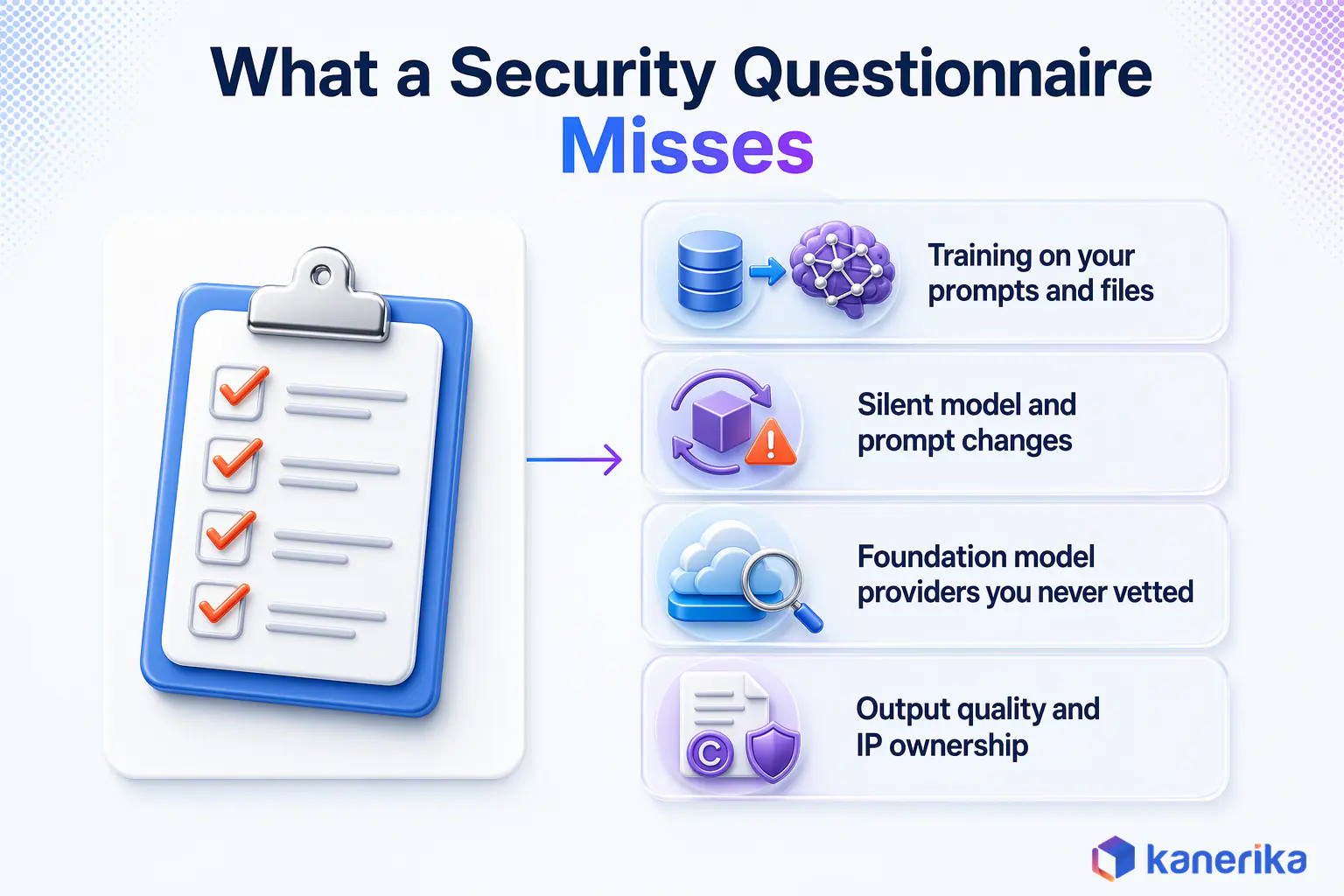
Finally, AI arrives inside tools you already own. A vendor you assessed for file storage switches on an AI feature mid-contract, and the assessment on file never covered it. This is the same blind spot that drives shadow AI, except that the purchase was approved.
What Certifications Do and Do Not Cover
Certifications do not close these gaps on their own, even though buyers often treat them that way. A SOC 2 Type II report or an ISO 27001 certificate tells you the vendor runs a controlled security program. But neither one says whether your data trains a model or whether the outputs suit your use.
ISO/IEC 42001 gets closer, since it certifies an AI management system. According to the ISO/IEC 42001 preview, its introduction covers managing suppliers and third parties that provide or develop AI systems. Still, a certificate has a scope statement, so it is not a warranty for the product you are buying. This guide to ISO 42001 certification explains what an audit does and does not test.
OWASP treats the AI supply chain as its own risk class. Its LLM03:2025 supply chain entry warns that third-party pre-trained models and data can be tampered with or poisoned. So a vendor’s model choices are part of your attack surface, whether or not the questionnaire asks about them.
Which Vendors Need an AI Assessment, and How Deep to Go
Not every supplier needs the full treatment, because a review that is too heavy for small purchases soon gets skipped. So start by finding the AI suppliers you already have. Then match review depth to what each one can touch.
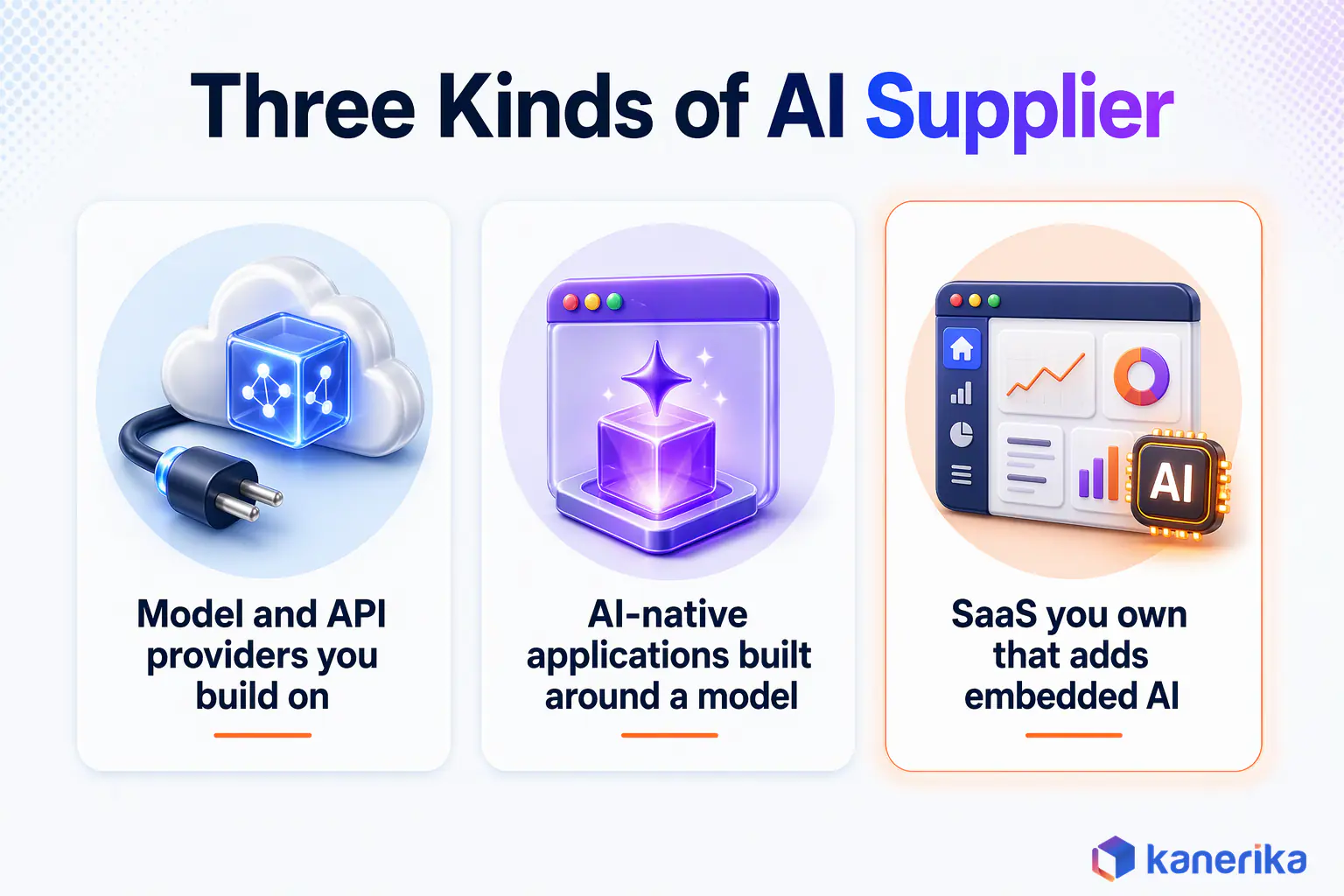
Three Kinds of AI Supplier
Model and API providers sell direct access to a model, so your own teams build on it. AI-native applications are products built around a model, such as a contract review tool or a coding assistant. The third kind is easy to miss, because it is the SaaS you already own adding embedded AI to an existing product.
That third group is where inventories fall short. The original assessment covered storage or workflow, and nobody re-opened it when an assistant appeared in the toolbar.
Finding these suppliers takes several sources at once. Check procurement records and SaaS release notes, as well as admin consoles, integration configs, API keys and expense data for small AI subscriptions. Once the list exists, a governance tool can help keep it current.
Follow the data past the prompt while you map each supplier. Retrieved documents, embeddings, conversation history and logs all carry your information, and so does the vendor’s support access. A data lineage view makes that flow visible, and you cannot judge the answers that come back without it.
Tier the Review Before You Send a Questionnaire
Review depth should follow four factors. The first two are data sensitivity and whether the AI only advises or can also act. Then come how much its output affects people and how much regulation applies.
If your organization already scored the use case, inherit that tier here instead of scoring it twice. The tiers below are an example policy rather than a standard.
| Tier (example policy) | Typical profile | Review depth |
|---|---|---|
| Light | Public or internal data, advisory output, a person reviews everything | Short AI addendum, terms check, training and retention questions only |
| Standard | Confidential data, output used in decisions, limited integrations | All ten questions, documents for each answer, contract clauses |
| Deep | Personal or regulated data, agents that take actions, decisions about people | All ten questions, evidence tested in a trial with your data, legal review, named owner for monitoring |
Financial services already works this way. The FS-ISAC Generative AI Vendor Risk Assessment Guide from February 2024 starts with a risk analysis across five domains. Its domains cover use case, business integration, confidential data, business resiliency and potential for exposure. Together, they then set a Level 1, 2 or 3 due diligence plan.
The guide is also designed to supplement an existing third-party risk program rather than replace it. That is the right posture for most enterprises, since the AI review adds a layer on top of the security review you already trust.
AI Assessment
See Where Your AI Program Stands
Score your organization’s AI maturity across data, governance and security to see which AI vendors and embedded AI features need a deeper review first.
Start Your AI Assessment →The 10 AI Vendor Risk Assessment Questions That Matter Most
Each question below explains why a classic questionnaire misses it, what a good answer looks like and which evidence to request before you score it. Send them as an AI addendum to your existing questionnaire, so the vendor answers the security basics once and the AI questions separately.
1. Will You Use Our Data to Train or Improve Any Model?
“Data” has to mean more than stored records. Ask about prompts, outputs, uploaded files, retrieved context, feedback ratings, embeddings and usage telemetry, because each one can feed model improvement. Also ask whether training is on or off by default, and whether that changes by plan tier.
A good answer is a contractual no-training commitment that covers every one of those inputs and also flows down to the model provider. The red flag is a promise found only in a blog post or a settings page, since the vendor can change both. Request the product terms, the DPA and the upstream provider’s data-use terms, then compare them with your own AI privacy requirements.
2. Where Is Our Data Processed, How Long Is It Kept, and How Is It Deleted?
Classic reviews cover storage regions and backups, but not much else. AI adds derived artifacts that outlive the source file, such as embeddings in a vector store, cached completions and evaluation sets. Find out how long each one lives and whether deletion reaches all of them.
In practice, good answers come with a data-flow diagram, a retention schedule per artifact and a deletion certificate on request. Watch for “we delete your data on termination” when nothing is said about backups, caches or the model provider’s own retention. Then tie the answer to your data classification, because a Restricted label should rule out some processing regions entirely.
Datasheet
Elevate Data Governance, Compliance & Security
How Kanerika sets up data discovery, classification, access policies and compliance controls, the foundation you need before you can say which data a vendor may touch.
Download the Datasheet →3. Which Model Providers and Sub-Processors Touch Our Data?
This is the fourth-party question, and wrappers dislike it most because it exposes their upstream terms. Ask for a current list of every model provider and sub-processor. Then ask what each one does, where it processes data and which terms bind it.
The law already sets a floor here. Under GDPR Article 28, a processor needs the controller’s prior written authorization before engaging another processor. Under a general authorization, it must also announce intended additions or replacements so that the controller can object.
Article 28(4) then requires the same data protection obligations to flow down by contract. So a vendor that answers “we use leading models” without naming them has failed this question.
4. How Will You Tell Us Before the Model or Its Behavior Changes?
Nothing in a standard questionnaire covers this, even though it causes many production surprises. Your questions should cover model swaps, version upgrades, system prompt edits, retrieval changes and routing between models.
A good answer offers advance notice of material changes, version pinning for a defined period and regression results before the new version goes live. Some vendors also offer a rollback path, while others let you pin a version through an LLM gateway. “We continuously improve our models” is the answer to push back on, because it describes the risk rather than a control.
5. What Evaluation Evidence Backs the Capability We Are Buying?
Sales decks quote public benchmark scores, but those say little about your documents or your users. Instead, ask for dated evaluation results tied to the product version you will run, with test conditions, known limits and failure categories.
Still, the strongest evidence is a trial on your own data, scored against your own acceptance criteria. Kanerika’s LLM evaluation framework explains how to design those tests. Results for a different model, version or language are a red flag, even when the numbers look good.
6. How Do You Isolate Tenants and Stop Prompt Injection and Unauthorized Tool Actions?
AI adds attack paths that a web application review never tests. For example, a malicious document can carry hidden instructions. A shared index can also leak one customer’s content to another, and an agent can call a tool it should never reach.
Ask how the vendor enforces tenant isolation in retrieval, filters outputs and limits tool permissions. Also request summaries of AI-specific testing, ideally including AI red teaming against the OWASP Top 10 for LLM applications. When the product runs agents, compare its controls with Kanerika’s review of AI agent security tools.
The vendor’s controls are only half of the picture, because your own configuration matters as well. An AI security assessment covers that side.
On-Demand Webinar
The Real Cost of LLM Security Risks and How to Reduce Them
An on-demand Kanerika webinar on the LLM security risks that cost enterprises the most, from prompt injection to data leakage, and the controls that reduce them.
Watch the Webinar →7. What Logs, Admin Controls and Human Overrides Do We Get?
You cannot govern what you cannot see, nor what you cannot switch off. Check which prompts, outputs and tool calls are logged and whether you can export those logs. Then ask whether an admin can disable AI features across the whole tenant.
Regulation also makes this practical. The high-risk rules apply from 2 December 2027 for Annex III systems. From then, EU AI Act Article 26 requires deployers of high-risk systems to keep the logs under their control for a period suited to the system’s purpose. That period must be at least six months, unless other EU or national law sets a different one. They must also assign human oversight to competent people, which is hard when the vendor holds the only copy of the logs. Also ask whether risky actions can require a person’s approval, the pattern behind human-in-the-loop AI agents.
8. What Counts as an AI Incident, and How Fast Will You Tell Us?
A security incident clause usually means a breach. But AI incidents also include data leaking through outputs, harmful output at scale and unauthorized agent actions. A material behavior change after an update belongs on the list too. Get the vendor to define AI incidents in writing and commit to a notice clock.
The clock you agree is a negotiation choice. For context, Article 73 of the EU AI Act gives providers of high-risk systems 15 days to report a serious incident to authorities. That then shrinks to 2 days for a widespread infringement and 10 days in the event of a death. Because Article 26(5) expects deployers to inform the provider first, your vendor clause should leave you time to meet your own duties.
9. Who Owns the Outputs, and What Does Your IP Indemnity Actually Cover?
Generated text, code and images raise questions that a software license never had to answer. Pin down who owns outputs, what rights the vendor keeps over your inputs and which infringement claims its indemnity covers.
The NIST AI RMF Core names this risk, since GOVERN 6.1 covers third-party risks such as infringement of intellectual property. Read the exclusions closely, because many indemnities exclude modified outputs or anything the upstream model provider will not cover. Also, an indemnity capped below the realistic cost of a claim is weaker than it looks.
10. What Is Your Role Under the EU AI Act, and What Does That Leave With Us?
The AI Act sorts parties into roles, and each role carries different duties. A provider develops an AI system or general-purpose AI model and places it on the market under its own name. A deployer uses an AI system under its own authority, which describes most buyers when they purchase a tool.
That role can shift, though. Under Article 25(1), a deployer becomes the provider of a high-risk system when it puts its own name on it or makes a substantial modification. Repurposing a system so that it becomes high-risk has the same effect.
Article 25(4), as amended by Regulation (EU) 2026/1744, also requires a written agreement between a high-risk provider and its AI suppliers. That agreement must set out the information, capabilities and technical access the provider needs so that it can comply.
Timing matters as well, because the dates have moved. The same amendment moved the high-risk requirements to 2 December 2027 for Annex III systems and 2 August 2028 for Annex I systems. Meanwhile, general-purpose AI model duties have applied since 2 August 2025, including documentation for companies that integrate those models. The EU AI Act compliance guide covers the roles in more depth, but counsel should confirm how they apply to you.
The Ten Questions on One Page
Use this matrix as the AI addendum itself. Each row gives the reviewer a target answer and a reason to stop, as well as the document that settles it.
| Question | Good answer | Red flag | Evidence |
|---|---|---|---|
| 1. Training on our data | Contractual no-training for all inputs, flowed down | Promise only in marketing copy | Terms, DPA, upstream terms |
| 2. Location, retention, deletion | Retention per artifact, deletion reaches caches and embeddings | “Deleted on termination” only | Data-flow diagram, retention schedule |
| 3. Model providers and sub-processors | Named list with notice and objection rights | “Leading models,” no names | Sub-processor list, flow-down terms |
| 4. Model changes | Advance notice, pinning, regression results | “We continuously improve” | Change policy, release history |
| 5. Evaluation evidence | Dated results for the version you buy | Public benchmarks only | Eval report, your own trial |
| 6. Isolation and injection | Tested tenant isolation and tool limits | “Covered by our pen test” | AI security test summary |
| 7. Logs and overrides | Exportable logs, tenant-wide off switch | Vendor-only logs | Admin guide, log schema |
| 8. AI incidents | Written definition and a notice clock | “As soon as practicable” | Incident policy, contract draft |
| 9. Outputs and IP | Clear ownership, indemnity covering outputs | Outputs excluded from indemnity | License terms, indemnity clause |
| 10. EU AI Act role | Stated role and the documents it supplies | Refuses to state a role | Role analysis, model documentation |
Evidence to Request, and What Each Document Proves
Every answer is worth what its evidence is worth. A useful ranking runs from an assertion, to a document and finally to a document tested against your own environment. So ask for the strongest form that each tier can justify.
| Artifact | What it proves | What it does not prove |
|---|---|---|
| SOC 2 Type II report | Security controls operated over a period | Anything outside its scope, so check that the AI feature is in it |
| ISO 27001 certificate and Statement of Applicability | A certified security management system | Data use for training or output quality |
| ISO/IEC 42001 certificate | A certified AI management system, including supplier processes | That a given product suits your use, so read the scope |
| Model or system card | Intended use, known limits, model lineage | Performance on your data |
| Evaluation report | Measured quality for a stated version and test set | Behavior after the next model change |
| AI red-team or pen-test summary | Specific attacks were tried and fixed | Coverage of attacks not in the plan |
| Sub-processor list and DPA | Who handles your data, under which terms | That upstream terms match the vendor’s promises |
Frameworks That Organize the Request
Two frameworks help organize the request. In the voluntary NIST AI RMF 1.0 (under revision as of November 2026), GOVERN 6 covers third-party software, data and supply chain issues. MAP 4 maps third-party components. MANAGE 3 then expects third-party resources and pre-trained models to be monitored, and Kanerika’s NIST AI RMF playbook walks through applying it. The FS-ISAC guide adds seven questionnaire categories, from data privacy and model training to Nth-party risk and legal compliance. Neither framework replaces judgment, but both make it harder to skip a whole category by accident.
Checklist
AI Governance Checklist
A step-by-step checklist for AI governance, from inventory and risk tiering to oversight and monitoring, so third-party AI gets the same scrutiny as your own systems.
Get the Checklist →How to Score AI Vendor Answers Without Hiding a Deal-Breaker
A score turns forty pages of answers into something a committee can compare. It also creates a risk, because a strong total can bury the one answer that should have stopped the deal. So use a simple evidence scale, weights you can defend and hard gates that sit outside the arithmetic.
The Scoring Sheet
Score each question from 0 to 3 on evidence rather than on how confident the answer sounds. A 0 means no answer or an unacceptable one, while a 1 means an assertion with nothing behind it. A 2 means a document supports the answer, and a 3 means it was verified and will be kept current.
Count an unknown as 0 rather than skipping it. Mark a question N/A only with a written reason, such as “no agent or tool actions in this product.” Otherwise vendors learn that a blank answer costs nothing.
The weights in the worked-example table below are an example policy rather than a standard. Shift them toward the risks that matter in your sector, then keep them fixed for a year so that scores stay comparable.
To total the sheet, each area contributes its weight multiplied by the score divided by 3. In this example policy, 75 or more means approve and 60 to 74 means approve with contract conditions. Anything lower means reject, and a failed gate overrides all three bands.
Worked Example: Two Vendors, One Shortlist
Two fictional vendors bid for a contract-summary tool that will read confidential agreements. Vendor A has polished documents for almost everything, such as model cards and fresh evaluation reports. Vendor B is smaller and its evidence is thinner, but it gave straight answers.
| Area (question) | Example weight | Hard gate | Vendor A (0-3) | Vendor B (0-3) |
|---|---|---|---|---|
| Training on your data (1) | 15 | Trains by default, no contractual opt-out | 0, gate failed | 3 |
| Location, retention, deletion (2) | 10 | No deletion commitment | 3 | 2 |
| Model providers and sub-processors (3) | 10 | Cannot name its model providers | 3 | 2 |
| Model change notice (4) | 10 | No change notice at all | 3 | 1, email promise only |
| Evaluation evidence (5) | 10 | No gate | 3 | 2 |
| Isolation, injection, tool limits (6) | 15 | No gate | 3 | 2 |
| Logs, admin controls, overrides (7) | 10 | No gate | 3 | 2 |
| AI incident response (8) | 10 | No gate | 3 | 1, no notice clock |
| Outputs and IP (9) | 5 | No gate | 3 | 2 |
| EU AI Act role (10) | 5 | No gate | 2 | 2 |
| Weighted total | 100 | Any failed gate stops the purchase | 83, but fails a gate | 65, passes every gate |
Vendor A wins on points and still loses the deal. Because its contract lets it train on customer data by default, no amount of good documentation offsets that for confidential agreements.
Vendor B lands in the conditional band instead. It gets approval with two contract asks, a notice clause for model changes and a defined AI incident clock. Once both are signed, its scores on questions 4 and 8 rise to 2 at the next review.
Red Flags That Should Pause the Purchase
Some answers deserve a stop before anyone opens the scoring sheet. The red-flag column in the matrix above lists the usual ones. One more belongs beside them: a SOC 2 scope that excludes the AI feature or the infrastructure behind it.
Not every flag is fatal. A refusal to name model providers or to put no-training in the contract usually is. But vague incident language or a missing log export is often fixable in negotiation. So treat those as asks with a deadline rather than a rejection.
Contract Clauses That Turn Answers Into Obligations
A questionnaire answer describes current practice, and practice can change next quarter. A clause, by contrast, binds the vendor for the term of the deal. So every answer you relied on during scoring should reappear in the contract.
| Clause | What it says | Question it closes |
|---|---|---|
| Data use and no training | Your inputs, outputs and derived data are used only to serve you, never to train, with the same terms flowed down | 1 |
| Retention and deletion | Retention limits per artifact and a deletion certificate when you ask or exit | 2 |
| Sub-processor notice | Notice of new or replaced model providers and sub-processors, plus a right to object | 3 |
| Material AI change | Advance notice before model or behavior changes, plus version pinning and a right to terminate | 4 |
| Evidence and audit rights | Refreshed evaluation results and SOC 2 bridge letters on a schedule | 5, 6 |
| Logs and controls | Log export in a usable format and a tenant-wide off switch | 7 |
| AI incident | A written definition of AI incidents, a notice clock and cooperation duties | 8 |
| Outputs and IP indemnity | Output ownership and an indemnity that covers outputs, with realistic caps | 9 |
| AI Act cooperation | The information, documentation and technical access you need for your obligations | 10 |
| Exit | Data export, deletion and transition help when the contract ends | 2, 3 |
The numbers inside these clauses, such as notice days or incident hours, are negotiation choices rather than legal requirements. GDPR Article 28 sets the floor for sub-processor terms, while the AI Act sets duties by role. Beyond that, the terms depend on bargaining power and risk, so have counsel review the final wording.
Keeping Signed Clauses Checked
Signing the clauses is half the work, while keeping them checked across dozens of vendors is the other half. Kanerika’s post on AI contract policy compliance covers that side, where AI agents check contracts against a governance playbook.
Contract volume is also where AI can help the reviewers themselves. In one Kanerika project, for example, a real estate developer moved vendor agreement processing onto an LLM system that reads unstructured PDFs. It added a chat interface for finding vendors against detailed criteria, and the client cut manual processing time by 82%.
Case Study
90% Faster Vendor Selection with LLM Agreement Processing
Kanerika built LLM-based vendor agreement processing over unstructured PDFs for a real estate developer, with an 82% reduction in manual processing time and a 90% boost in vendor selection.
Read the Case Study →Re-Assess on Events, Not Just on the Calendar
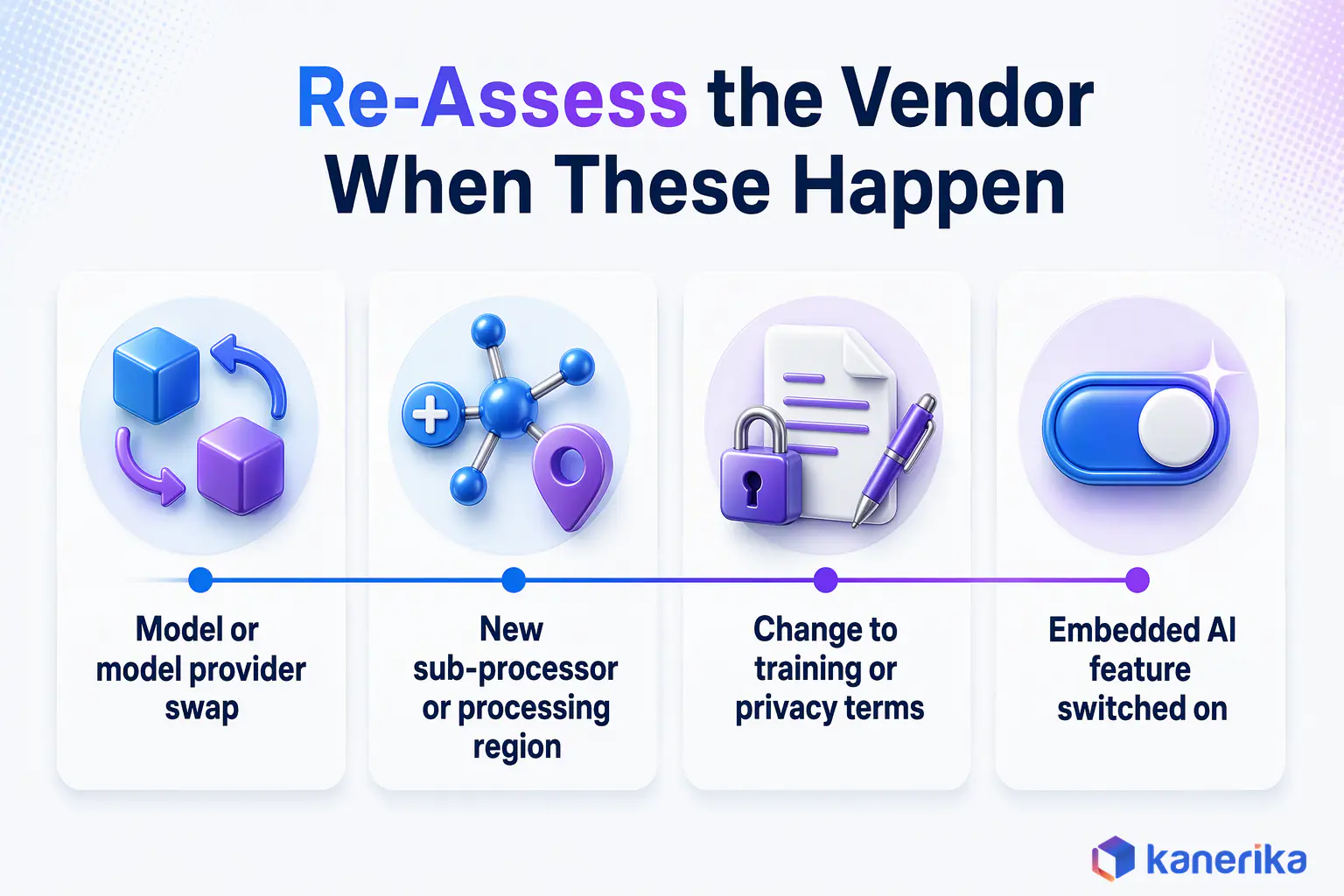
An annual review assumes the vendor stands still between reviews. AI vendors rarely do, so pair a baseline cadence with event triggers. As an example policy, review Deep-tier vendors every year, Standard-tier every two years and Light-tier at renewal.
Events matter more than dates, though. Each trigger below has someone who notices it first, as well as a specific part of the assessment to reopen.
| Trigger | Who usually notices | What to re-check |
|---|---|---|
| Model or model provider swap | Vendor notice, release notes | Questions 3, 4 and 5 |
| New sub-processor or region | Sub-processor notice, privacy team | Questions 2 and 3 |
| Terms or privacy policy change on training | Legal, procurement | Question 1 |
| Embedded AI feature switched on | Admin console, business owner | The full assessment at the right tier |
| New data source or tool permission connected | IT, data team | Questions 2, 6 and 7 |
| AI incident or published vulnerability | Security, vendor notice | Questions 6 and 8 |
| Vendor acquired | News, account team | Questions 1, 3 and 10 |
| SOC 2 or certificate expires | Vendor management | Evidence for every area |
Standards point the same way. For instance, NIST AI RMF MANAGE 3.1 expects risks from third-party resources to be monitored regularly. Similarly, the June 2023 interagency guidance on third-party risk from US banking agencies treats ongoing monitoring and termination as life-cycle stages.
Monitoring also works better when the vendor’s behavior shows up in your own telemetry. The tools in Kanerika’s roundup of AI observability tools can track quality drift and cost after a model change. That way, a silent swap shows up on a dashboard instead of in a complaint.
Who Owns the AI Vendor Assessment
No single team can answer all ten questions. The assessment works when each function owns its part and one person owns the decision.
Procurement or vendor management runs intake, tiering, renewal gates and the contract file. Security owns questions 6 and 7, the security evidence and the AI incident terms. Privacy and legal take questions 1, 2, 3, 9 and 10, which covers the DPA, the indemnity and the AI Act role.
Data and IT teams map data flows and integrations, and they also check log export and the tenant-wide off switch. The business owner states the intended use, sets user rules and usually spots new AI features first. Finally, a risk acceptance authority signs off exceptions, conditional approvals and any gate override.
These roles slot into your existing AI governance framework rather than forming a new committee.
Write down who can accept a failed gate, and also keep that list short. If the answer is “anyone who wants the tool,” then the gates are decoration. An AI governance assessment can check whether these roles work across the wider program.
Kanerika Service
AI Governance Consulting Services
Kanerika’s AI governance services cover risk tiering with defined accountability, pre-deployment validation, post-change audits after model updates and independent validation of inherited AI systems.
Explore AI Governance ServicesHow Kanerika Helps You Assess and Govern Third-Party AI
Kanerika sits on both sides of this table. As a supplier, it answers customer security questionnaires itself, backed by ISO 27001, ISO 27701:2019, SOC 2 Type II and CMMI Level 3. As an advisor, its AI governance services include an assessment that tests controls on the highest-risk systems first. They also cover risk tiering with defined accountability and pre-deployment validation for regulated AI systems. Two more items match the re-assessment triggers above: post-change audits after AI model updates and independent validation for inherited legacy AI systems. The page frames this work through its IMPACT framework (Identify, Map, Prove, Analyze, Create, Transform).
An Independent Review in Practice
The review style shows in Kanerika’s work for Forest River. This was a data platform, not an AI vendor, and a third-party integrator had built the Microsoft Fabric solution. Leadership wanted an independent view before a Dynamics 365 go-live. Kanerika ran a six-week, read-only review, logged evidence for each finding and changed no system.
The result was a RAG-rated scorecard across five lenses and 18 dimensions, plus about 136 findings with owners, effort and sequence. The verdict was a conditional go-live with about 30 days of pre-cutover work. Strengths such as the copy pattern and Key Vault usage stayed in place. An AI vendor review should end the same way, with a defensible decision and clear conditions rather than a list of complaints.
Case Study
Independent Fabric Architecture Review Before Go-Live
Kanerika’s six-week, read-only review of a Fabric data platform built by a third-party integrator for Forest River logged about 136 findings and led to a conditional go-live.
Read the Case Study →Wrapping Up
An AI vendor risk assessment answers one question, which is whether you can trust this supplier with AI on your data. Ask the ten questions a normal security questionnaire misses, and accept documents rather than assurances. After that, score the evidence with hard gates that no total can outvote. Then write every answer you relied on into the contract, and re-assess whenever the model, the sub-processors or the terms change.
Frequently Asked Questions
What is an AI vendor risk assessment?
An AI vendor risk assessment is due diligence on a supplier whose product uses AI on your data or in your workflows. It checks the vendor’s practices on training, data retention, model providers, model changes, evaluation, security, incidents and output rights. It also asks for evidence behind each answer and turns the important answers into contract terms.
How is an AI vendor assessment different from a standard third-party risk review?
A standard review checks the vendor’s security program, access controls and availability. An AI vendor assessment keeps those checks and adds questions classic templates skip. These cover training on your data, silent model changes, foundation model providers behind the product, evaluation evidence, AI-specific incidents, output ownership and the vendor’s role under the EU AI Act.
What questions should I ask an AI vendor?
Ask whether your data trains any model and how data is kept and deleted. Ask which model providers touch it and how model changes are announced. Request evaluation evidence and security testing for prompt injection and tool actions. Then ask about logs and overrides, AI incident notice, output ownership with IP indemnity, and the vendor’s EU AI Act role.
Does a vendor's SOC 2 report cover its AI features?
Only if the AI feature and its infrastructure sit inside the report’s scope, so read the scope section first. Even then, SOC 2 tests whether security controls operated over a period. It does not say whether your data trains a model, whether outputs are accurate, or how the vendor handles a model swap, so ask those questions separately.
Do we need to assess an existing SaaS vendor that switches on an AI feature?
Yes. The original assessment covered the product as it was, and the new feature may send your data to a model provider you never reviewed. Treat the switch-on as a re-assessment trigger, run the AI questions at the right tier, and keep the feature disabled across the tenant until the review and contract changes are complete.
How often should AI vendors be re-assessed?
Use a baseline cadence by tier, such as yearly for high-risk vendors and at renewal for low-risk ones, as an example policy. Then add event triggers. A model or provider swap, a new sub-processor, a change to training terms, a newly enabled AI feature, an incident or an acquisition should each reopen the relevant questions.
Does buying an AI tool make us a provider under the EU AI Act?
Usually not, because most buyers are deployers that use a system under their own authority. Under Article 25, though, you become the provider of a high-risk system if you put your name on it or modify it substantially. Repurposing a system into a high-risk use has the same effect, so confirm the analysis with counsel.
Who should own AI vendor risk assessments?
Ownership is shared, with one accountable decision maker. Procurement runs intake, tiering and renewals, while security owns isolation, logging and incident terms. Privacy and legal own data use, sub-processors, IP and the AI Act role, and data and IT map integrations. A named risk acceptance authority approves exceptions and any override of a failed hard gate.
What are the biggest red flags in an AI vendor's answers?
Watch for a no-training promise that appears only in marketing copy, a refusal to name model providers and evaluation results from a different model version. Other warning signs are a SOC 2 scope that excludes the AI feature, no log export or off switch, vague incident notice and an IP indemnity that excludes outputs.