AI Expense and Travel Audit Agent for Finance Teams
Audit every expense line before reimbursement goes out, not a sample after it.
Audited, not sampled
Receipts matched to your rules
Auditors decide on every flag
Type II certified delivery
Certified security practices
Technology certifications
Audit every expense line before reimbursement goes out, not a sample after it.
Sampling catches a fraction of policy violations and almost none of the clever ones. An AI expense audit agent runs a travel and expense audit on every receipt, checks every line against your policy, and routes only genuine exceptions to your auditors. Kanerika builds and runs it on your infrastructure, and your finance team keeps the final say on every denial.
How the Expense Audit Software Works on Your Infrastructure
Deployed on Your Stack
Kanerika deploys the agent on Azure, AWS, GCP, or on-premises systems you already operate. Expense data never routes through a third-party SaaS.
Governed and Certified Delivery
Kanerika holds SOC 2 Type II, ISO 27001, and ISO 27701 certifications, so the agent arrives with controls your auditors and security team can verify.
Works Where Finance Works
Flags, questions, and approvals arrive in Microsoft Teams, Slack, or email. Auditors clear exceptions without opening another tool.
Data Stays in Your Tenant
Receipts, card feeds, and employee records remain in your environment and are never used to train external models.
Auditors Keep the Final Say
The agent flags and explains. A person approves every denial, clawback, or policy exception, with the reasoning recorded.
Evidence-Traced Findings
Every flag cites the exact receipt line and the policy rule it breaks, so reviews take seconds instead of email threads.
AP Copilot: Invoice Processing Automation
Kanerika’s finance automation agent working invoices, the adjacent AP workflow behind the expense audit agent.
Expense Report Audit Coverage Sampling Cannot Match
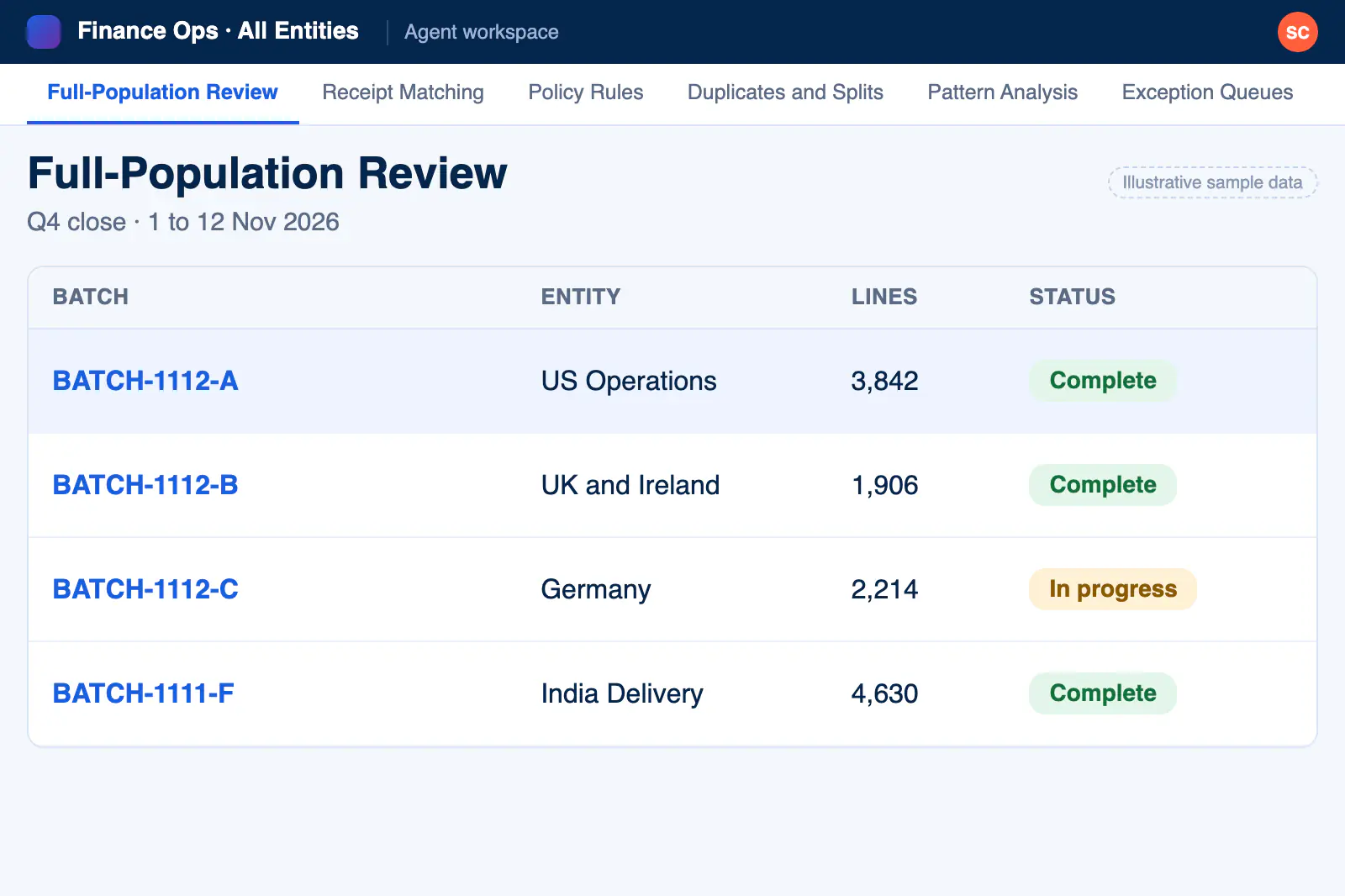
Full-Population Review
The agent audits every report, every line, every month. No more choosing between coverage and headcount.
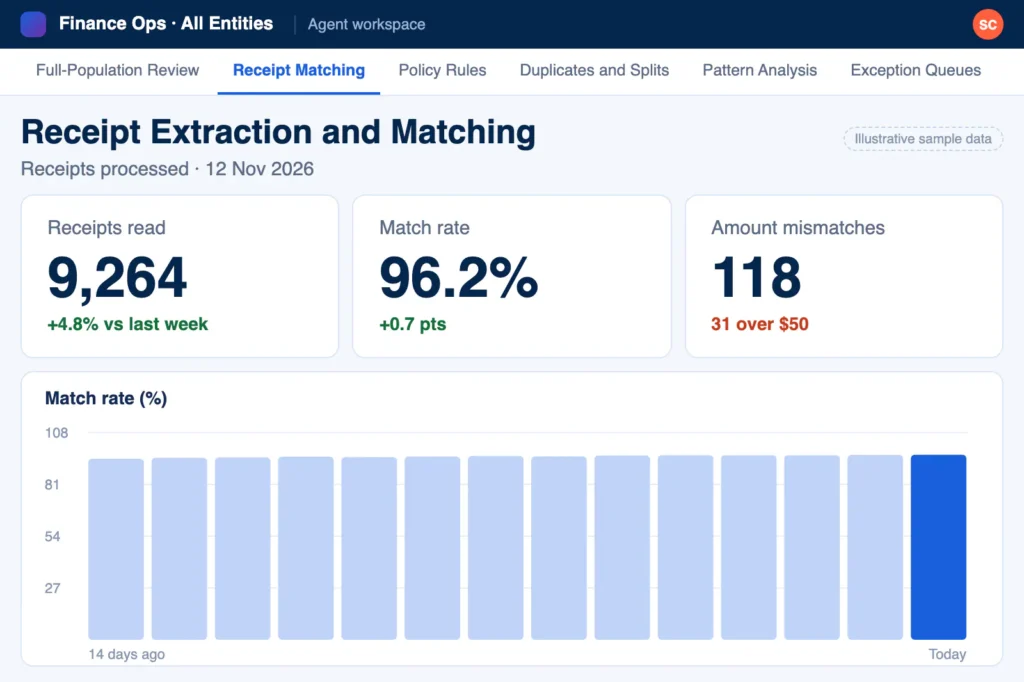
Receipt Extraction and Matching
Merchant, date, amount, currency, and tax details are read from each receipt and matched against the claimed line.
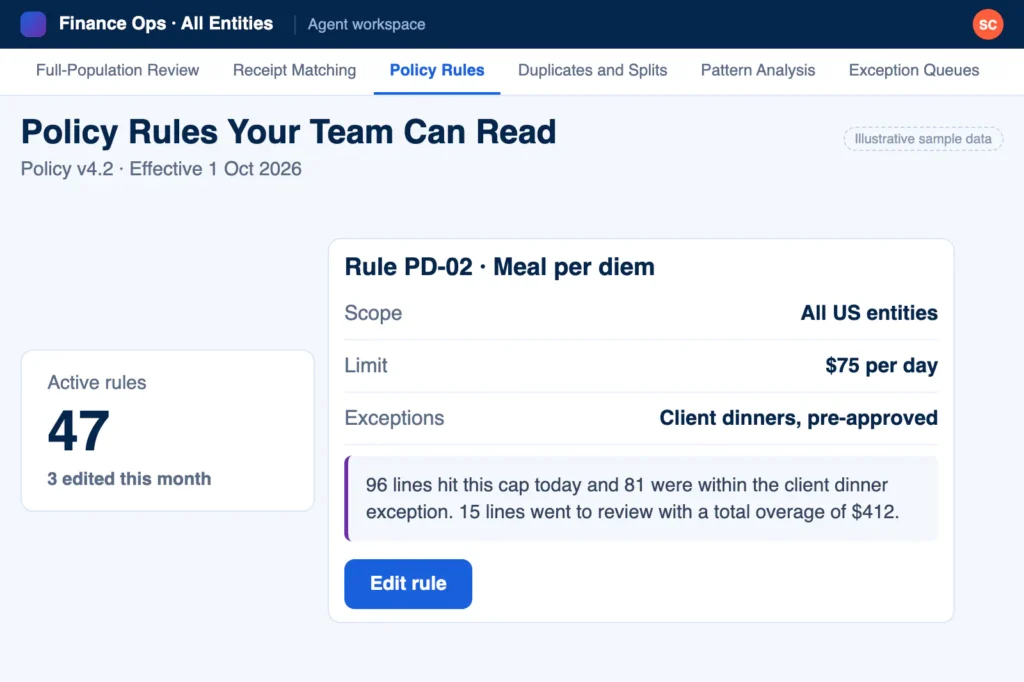
Policy Rules Your Team Can Read
Per-diem caps, travel class rules, merchant restrictions, and spend thresholds are encoded as rules finance can review and edit.
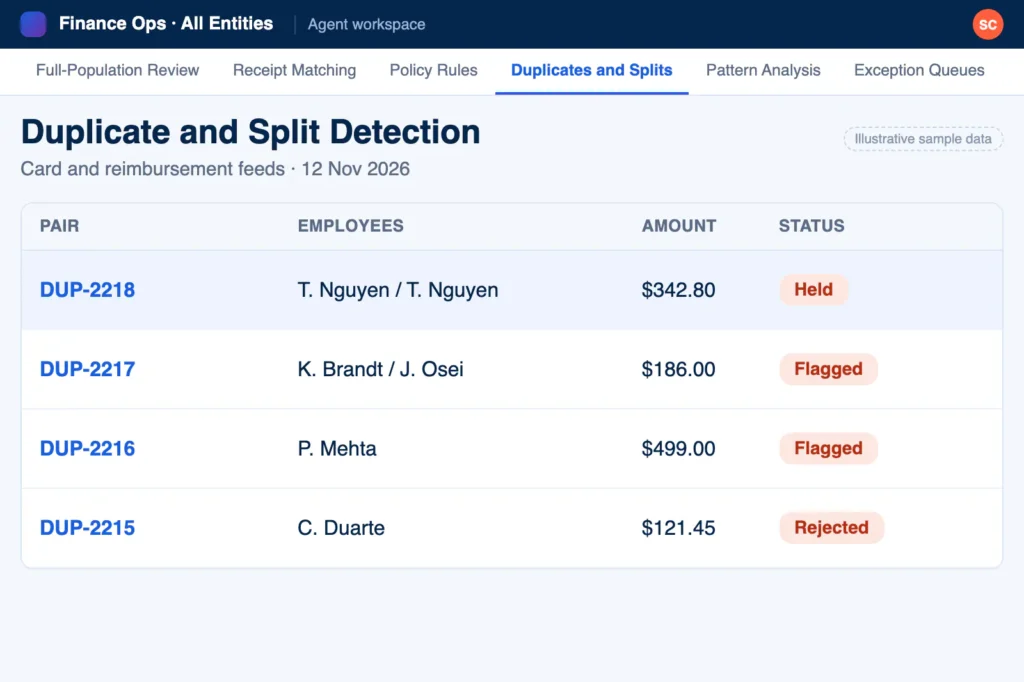
Duplicate and Split Detection
The same receipt claimed twice, shared across colleagues, or a purchase split to dodge an approval threshold gets flagged automatically.
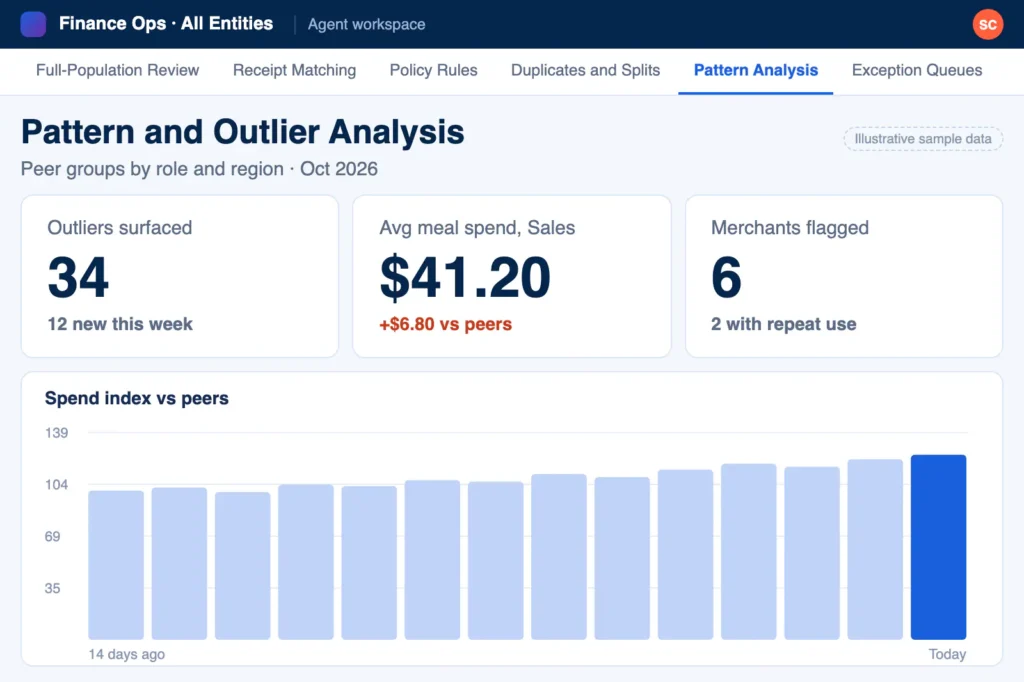
Pattern and Outlier Analysis
Spend patterns by employee, merchant, and route surface outliers against peer groups, the signals a line-by-line check misses.
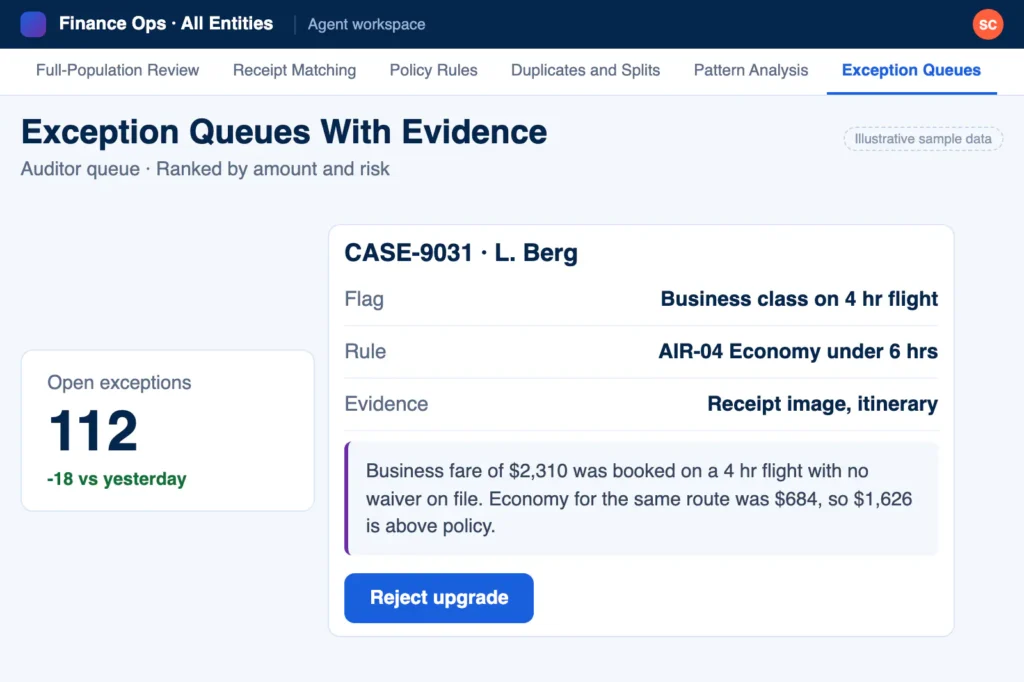
Exception Queues With Evidence
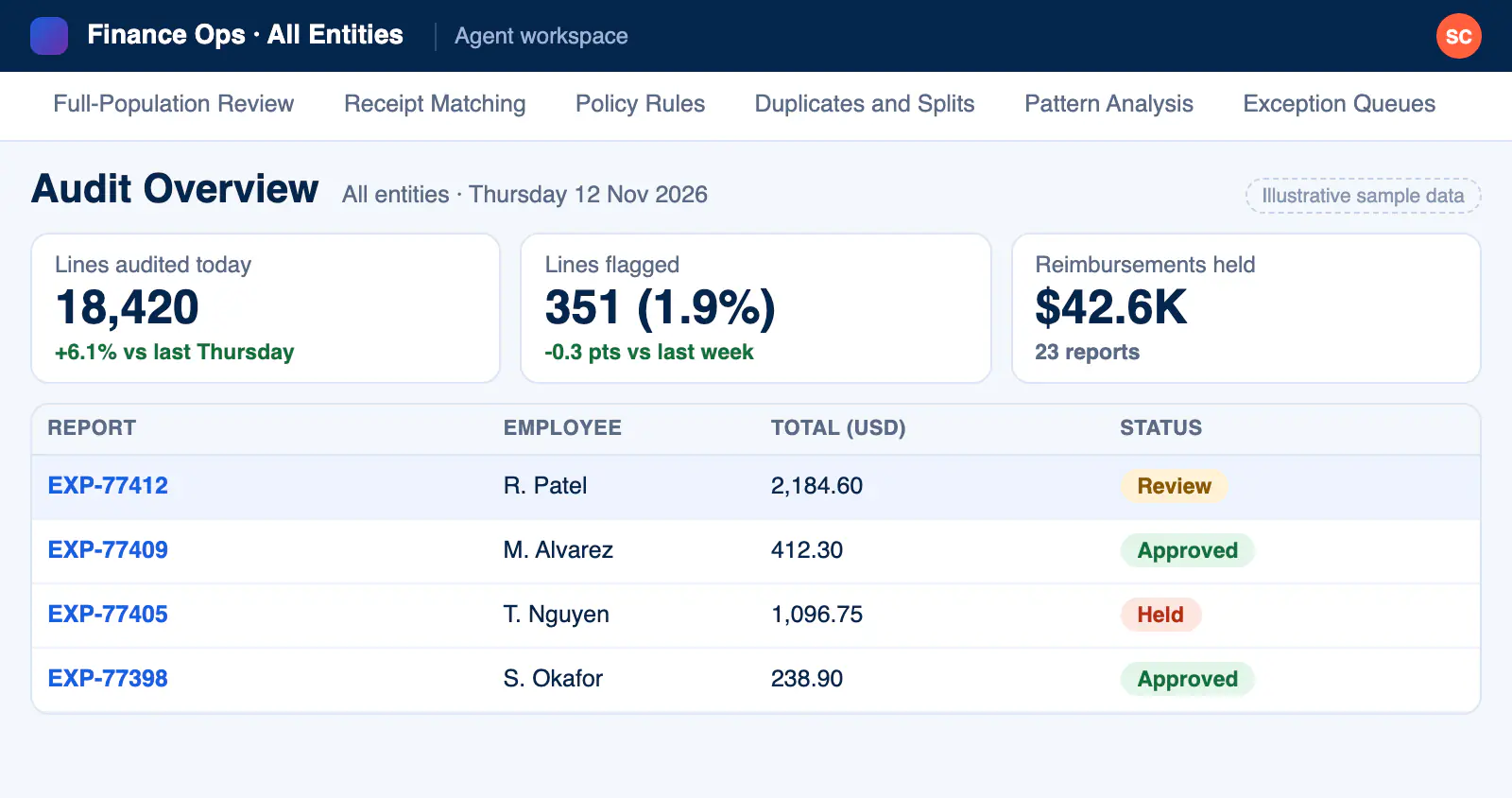
Auditors see the flag, the receipt image, the rule, and a suggested action in one view, ranked by amount and risk.
Deploy Your Expense Audit AI Agent in Weeks
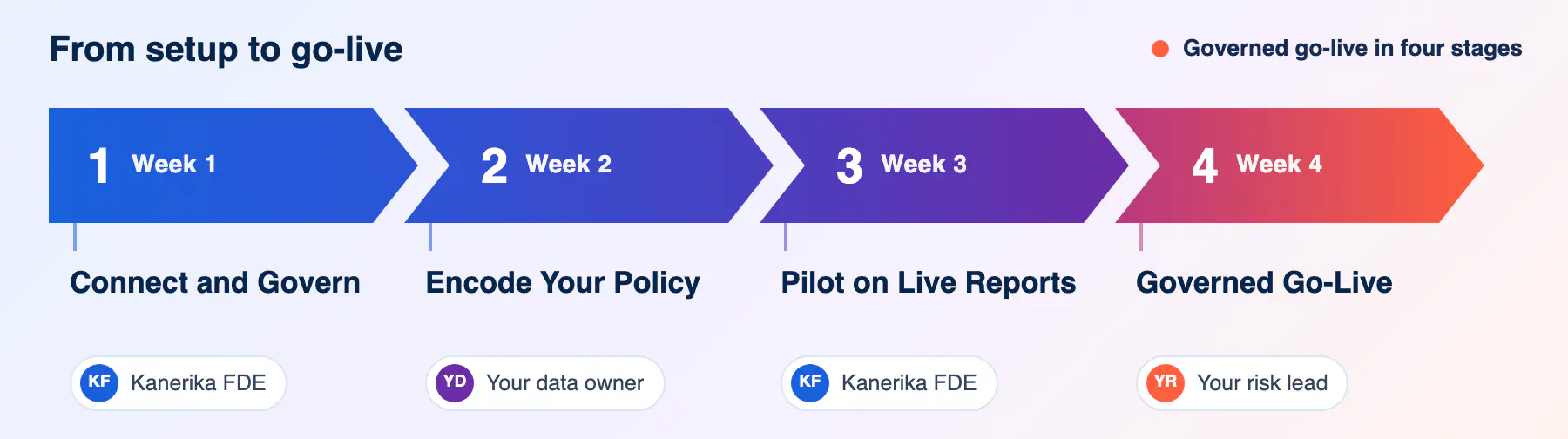
Connect and Govern
Kanerika connects the agent to your expense platform, card feeds, and HR data, then sets access policies and audit logging.
Encode Your Policy
Your travel and expense policy becomes machine-checkable rules, reviewed and signed off by your finance team.
Pilot on Live Reports
One entity or region goes first. Auditors score the agent's flags, and thresholds get tuned on real results.
Governed Go-Live
Coverage extends to the full population with dashboards, exception queues, and audit trails in place.
What the Agent Catches Before Money Leaves
Duplicate Claims
The same hotel invoice in two reports, or claimed by two colleagues from the same trip, is caught across months and entities.
Travel Class Violations
Business-class fares booked against an economy policy get flagged with the fare detail and the applicable rule.
Per-Diem and Cap Overruns
Meal and lodging claims above the local limit surface with the overage amount already calculated.
Personal Spend on Corporate Cards
Weekend transactions, restricted merchant categories, and non-travel purchases during travel dates stand out immediately.
Mileage and Route Inflation
Claimed distances are checked against plausible routes, and repeat inflation patterns by claimant get flagged for review.
Missing or Unreadable Receipts
Claims without usable evidence are returned to the employee automatically, before an auditor spends time on them.
Industries Where Expense Audit Automation Pays Off First
Pharma and Life Sciences
Spend tied to healthcare professional interactions carries regulatory exposure, so full coverage beats sampling.
Banking and Financial Services
Travel and entertainment spend sits under regulatory scrutiny, and the agent keeps evidence ready for examiners.
Manufacturing
Field service and plant visit travel generates high claim volumes that sampling programs rarely cover.
Logistics
Driver and depot expenses across many sites get consistent policy treatment without a central audit bottleneck.
Healthcare
Conference, locum, and multi-site travel claims are checked against policy without slowing reimbursement for clean reports.
Retail
District manager and buying team travel is audited in full, with seasonal spikes absorbed without extra headcount.
Why Finance Teams Choose Kanerika for Expense Auditing
Built by Kanerika's 300+ engineers, who have delivered for 100+ enterprise clients. Live in weeks, on your own data.
It reviews every expense line, every month, instead of a small sample.
Policy rules are written in plain language, so finance can read and change them.
It flags unusual spend against peers, the things a line-by-line check misses.
Results From Kanerika Finance Automation Deployments
90% Faster Vendor Selection with LLM Agreement Processing
Impact:
- 82% Reduction in manual processing time
- 75% Increase in cloud integration efficiency
- 90% Boost in vendor selection
99% Faster Invoice Processing with Automation
Impact:
- 45% Decrease in maintenance costs
- 95% Savings in developmental efforts
- 99% Reduction in processing time
90% Less Manual Work in AP with UiPath Automation
Impact:
- 90% Reduction in manual intervention
- 400+ Man-hours saved per month
- 30% Faster invoice processing
FAQs
It is a deployable AI agent that reads every expense report, matches receipts to claimed lines, checks each line against your travel policy, and routes exceptions to auditors with evidence attached. Kanerika builds and runs it on your infrastructure, and your team keeps the final decision on every flagged claim.
No. The agent works on top of SAP Concur, Expensify, or whichever platform you run, reading reports and their receipts through that platform’s own APIs. Submission, approval chains, and reimbursement stay where they are. What changes is that every expense report audit happens before payment instead of on a small sample weeks afterward.
Yes, and that is the whole point. The agent reviews reports between submission and payment, so violations are corrected before money leaves rather than clawed back afterward. Clean reports pass through without delay, flagged ones route straight to an auditor, and you choose which categories can hold payment pending review.
In your environment. Receipts, card feeds, and employee records stay on your Azure, AWS, GCP, or on-premises infrastructure and are never used to train external models. Kanerika holds SOC 2 Type II, ISO 27001, and ISO 27701 certifications, and the agent inherits your existing access controls and data retention policies.
Your policy lives as rules the finance team can read and edit. When a per-diem limit or travel class rule changes, an authorized user updates the rule and it applies from the next report onward. Every rule change is versioned and logged, so auditors can reconstruct which policy applied when.
Less, for most of them. Clean reports stop waiting on a human audit queue and reimburse faster, and employees with a missing receipt hear about it on the same day instead of weeks later. The friction concentrates where it belongs, on the small share of claims that actually break policy.
FLIP’s AP automation processes supplier invoices, and Mike proofreads numbers inside documents for internal consistency. This agent audits employee travel and expense claims against policy. All three share the same Kanerika deployment and governance model, so finance teams often run them together, but each one works a different document queue.
Weeks, not quarters. Kanerika connects your expense platform and corporate card feeds, encodes your policy as reviewable rules, and pilots the agent on one entity or region with auditors scoring every flag. Once precision meets the bar your team sets, coverage extends to the full population with dashboards and audit trails.
Published work linked on this page includes an AP automation deployment that cut manual intervention by 90 percent and saved over 400 man-hours monthly, automated invoice processing with rule-based cost allocations, and FLIP running travel and expense management for KBR. Expense audit pilots produce your own measured numbers within weeks.
Full-population review comes first, so every report and line is checked rather than a sample. After that, look for receipt extraction matched against the claimed line, policy rules finance can read and edit, duplicate and split detection, and outlier analysis against peer groups. Exception queues should show the flag, receipt image, rule and suggested action together, with a person approving every denial.
Start with when it audits. A tool that reviews reports between submission and payment stops violations before money leaves, instead of clawing it back later. Then check that it works on top of your existing expense platform, keeps receipts and card data in your own environment, and leaves auditors with the final say. Kanerika’s agent is built that way and pilots on one entity or region first.
Let’s Transform Your Business