LLM Development Services for Smarter Enterprise Workflows
Faster query response
Improved knowledge access
Faster time-to-production
Get Started with LLM Development Solutions












LLM Development Services Enterprises Actually Trust
Most LLM development services stop at delivering a model. Kanerika builds the full system, from fine-tuning on your data to integration and compliance governance.

Custom LLM Development
- Architect models from the ground up
- Train on proprietary enterprise data
- Deployed on your own infrastructure

LLM Fine-Tuning
- Reduce hallucinations on domain tasks
- Improve accuracy on niche workflows
- Cut inference costs over time

RAG Development
- Retrieve from live enterprise sources
- Source-linked, auditable outputs
- Handles all data formats

LLM Integration & API Layer
- Plug into existing enterprise stack
- Secure, versioned API endpoints
- Minimal disruption to current workflows
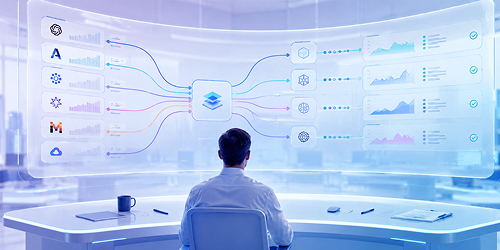
Multi-Model Orchestration
- Coordinate across multiple LLMs
- Optimize for cost, speed, or accuracy
- Single control layer, multiple providers

LLM Security & Guardrails
- Block off-policy responses at runtime
- Prevent prompt injection attacks
- Enforce output boundaries consistently
LLM Development Services Customized to Your Business Problems
Not every LLM project starts at the same place. Kanerika scopes every engagement to where your AI readiness actually is today.
LLM Strategy & Scoping
- Audit data and AI readiness
- Define model architecture and approach
- Deliver a prioritized build roadmap
Build, Fine-Tune & Deploy
- Develop and fine-tune on your data
- Integrate with your existing stack
- Hand off production-ready models
Ongoing Support
- Monitor output quality continuously
- Retrain as your data evolves
- Keep performance reliable at scale
Real World Outcomes from Our LLM Development Services
See how Kanerika’s LLM development practice has cut manual work, improved decision accuracy, and delivered measurable ROI.
AI/ML & Gen AI
43% Faster Data Retrieval for a Global Investment Bank
Impact:
- 43% Faster information retrieval
- 100% Role-based compliance achieved
- 35% Higher workforce efficiency
AI/ML & Gen AI
90% Faster Vendor Selection with LLM Agreement Processing
Impact:
- 82% Reduction in manual processing time
- 75% Increase in cloud integration efficiency
- 90% Boost in vendor selection
AI/ML & Gen AI
80% Ticket Auto-Resolution with LLM-Driven AI
Impact:
- 80% Auto-response of tickets
- 70% Reduced cost of staffing
- 50% Decrease in ticket resolution time
IMPACT Methodology for Reliable LLM Development
Kanerika's IMPACT methodology takes every LLM project from initial scoping through to live deployment, with defined checkpoints at every stage.
INNOVATE
LLM Development Across Every Major Enterprise Vertical



Healthcare
Run LLMs that optimize routing, automate documentation, and surface supply chain insights from fragmented operational data.





Why Choose Kanerika for LLM Development Services
Proven LLM delivery experience, enterprise-grade governance, and the Microsoft credentials that regulated industries require.
98% client retention across 100+ enterprise clients reflects consistent delivery on complex, regulated AI projects over 10 years.

Every LLM we build includes role-based access controls, audit trails, and source-grounded retrieval so outputs are traceable and compliant by design.

Our team handles everything from data preparation and model training to integration, governance, and post-deployment support.

Empowering Alliances
Our Strategic Partnerships
The pivotal partnerships with technology leaders that amplify our capabilities, ensuring you benefit from the most advanced and reliable solutions.




Frequently Asked Questions (FAQs)
What are LLM development services?
LLM development services cover the end-to-end process of building, fine-tuning, and deploying large language models for enterprise use. This includes custom model architecture, domain-specific training, retrieval-augmented generation, API integration, and ongoing governance. Enterprises use these services to automate document-heavy workflows, support internal knowledge retrieval, and build AI applications that operate reliably on proprietary data.
What is the difference between LLM fine-tuning and custom LLM development?
Fine-tuning adapts an existing foundation model on your domain data to improve accuracy on specific tasks. Custom LLM development builds a model architecture from the ground up, typically for regulated industries where data cannot leave your infrastructure or where proprietary model weights are a compliance requirement. Fine-tuning is faster and more cost-effective. Custom builds offer full control over architecture, data residency, and model behavior.
How long does an enterprise LLM development project take?
Timelines vary by scope. A focused RAG implementation or API integration typically runs 6 to 12 weeks. A domain-specific fine-tuning project runs 8 to 16 weeks depending on data readiness. Full custom model development for regulated environments can extend several months. Data preparation is consistently the most underestimated phase and the one most likely to extend timelines.
What industries benefit most from LLM development services?
Industries with document-intensive workflows, complex decision-making, and strict compliance requirements see the strongest results. Financial services, healthcare, insurance, manufacturing, pharma, and logistics use enterprise LLMs for contract analysis, clinical documentation, fraud detection, regulatory reporting, and supply chain intelligence. Regulated industries benefit most when auditability and controlled data access are built into the model architecture from the start.
How do you ensure LLM outputs are accurate and hallucination-free?
Accuracy depends on architecture choices, not just model selection. Retrieval-augmented generation grounds responses in verified enterprise sources, reducing hallucinations significantly. Fine-tuning on domain-specific data improves output consistency on niche tasks. Adding evaluation pipelines, output guardrails, and human-in-the-loop review layers for high-stakes decisions are standard practices in production-grade LLM applications built for regulated environments.
What does governed LLM development mean for regulated enterprises?
Governed LLM development means every model output is traceable, access-controlled, and auditable. It includes role-based access controls scoped to user permissions, full decision-path logging, source attribution on every response, and compliance mapping to frameworks like HIPAA, SOC 2, or ISO 27001. For regulated enterprises, governance is not a post-deployment layer. It needs to be built into the LLM architecture from day one.
Should enterprises build their own LLM or use a third-party model?
Most enterprises do not need to build from scratch. Fine-tuning an open-source foundation model on proprietary data delivers strong domain performance at a fraction of the cost. Custom builds make sense when data sovereignty requirements prevent using third-party APIs, when proprietary model weights provide competitive advantage, or when the use case cannot be served by existing models. A qualified LLM development partner can assess which approach fits your requirements.
How do multi-model orchestration and RAG work together in enterprise LLMs?
Multi-model orchestration routes tasks to the most appropriate model based on cost, speed, or accuracy requirements. RAG layers verified enterprise knowledge retrieval on top of model inference, ensuring responses are grounded in current, source-linked data. Together, they give enterprises a flexible, cost-efficient LLM architecture that handles diverse workloads without depending on a single model provider or hallucinating on domain-specific queries.
How much does LLM development cost?
Cost depends on scope. The main factors are whether you fine-tune an existing model or build a custom one, the volume and quality of your training data, the evaluation and governance requirements, and the infrastructure needed for secure deployment.
Kanerika starts with a short discovery phase to confirm the use case, data readiness and model approach, then provides a fixed scope and estimate for model selection, fine-tuning, evaluation and deployment. Contact us for a quote based on your use case.
Ready to Move Your AI Pilots Into Production?
Get a free assessment from our team covering strategy, engineering, and production monitoring end to end.