AI Prior Authorization Agent for Healthcare
Submit complete, payer-ready prior authorization requests in hours instead of days, before care gets delayed.
Matched to each request
Evidence pulled from the chart
Staff submit every request
Type II certified delivery
Certified security practices
Technology certifications
Submit complete, payer-ready prior authorization requests in hours instead of days, before care gets delayed.
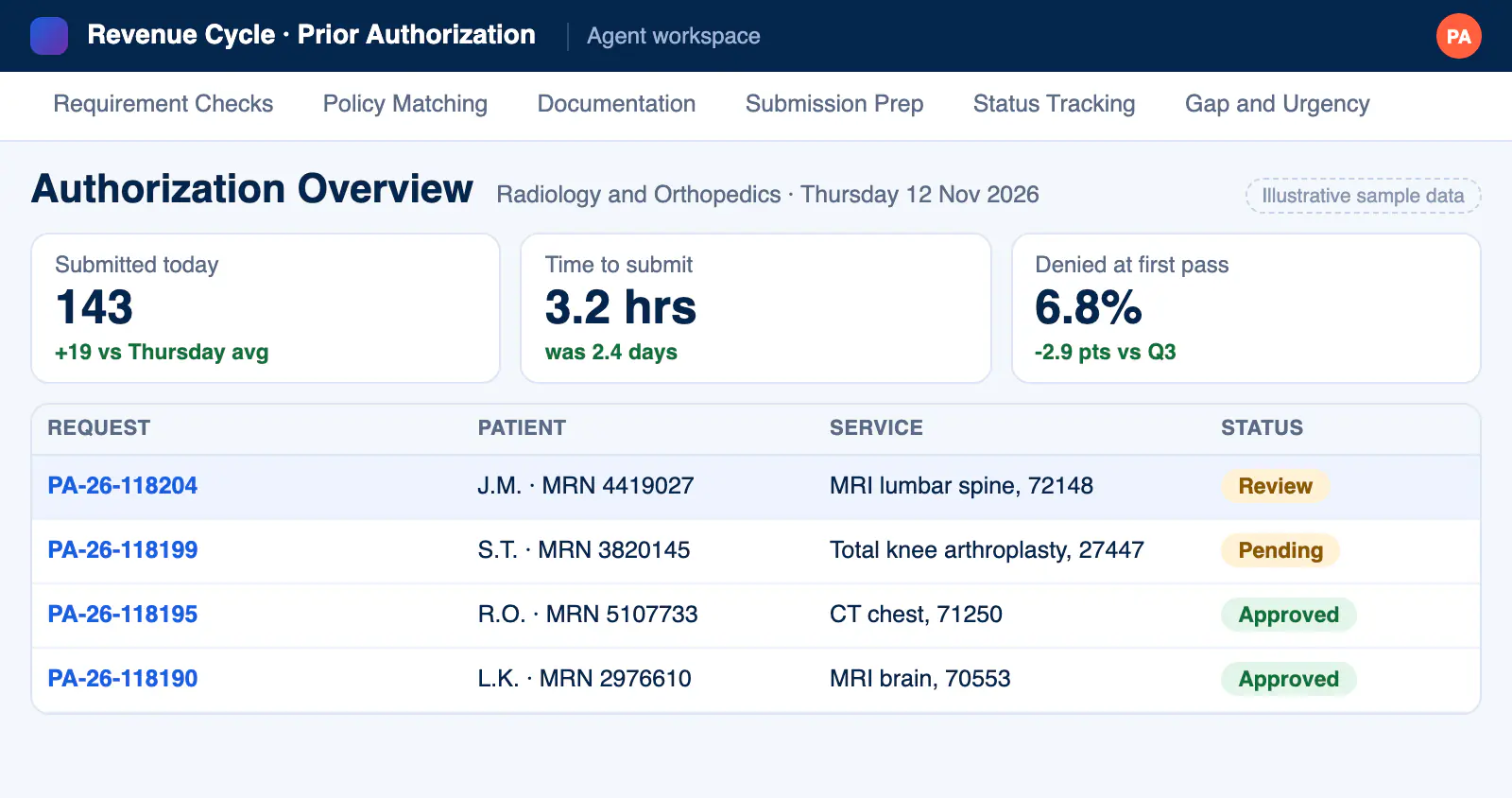
Prior authorization sits between a physician's order and the care itself, and every day it drags, a patient waits. Staff dig through payer rules, assemble clinical documents, and sit on hold while schedules slip. An AI prior authorization agent checks whether approval is required, assembles the clinical evidence payers ask for, prepares the submission, and tracks it to a decision. Kanerika builds and runs the agent on your own infrastructure, with clinicians keeping the final
How the AI Prior Authorization Agent Works in Your Patient Access Workflow
Deployed on Your Stack
Kanerika deploys the agent on your Azure, AWS, GCP, or on-premise environment and connects it to your EHR, practice management, and payer channels.
Governed on a Secure Foundation
Kanerika holds SOC 2 Type II, ISO 27001, ISO 27701, and ISO 9001 credentials. Access to patient data follows your existing role-based controls.
Answers Where Teams Work
Patient access and authorization staff get status updates, missing-document alerts, and work queues inside Teams, Slack, or email.
PHI Stays in Your Tenant
Protected health information never leaves your environment and is never used to train external models. For masking needs, Kanerika also builds Susan, a PII redaction agent .
Clinicians Keep the Final Say
The agent prepares and tracks requests. Clinical judgments, peer-to-peer calls, and any override decisions stay with your physicians and nurses.
Source-Traced Submissions
Every request records which payer policy was applied, which clinical documents were attached, and why, so audits and appeals start from a clean trail.
Fueling Growth with AI in Healthcare
Kanerika’s overview of AI in healthcare, the provider and payer setting this agent works in.
Automated Prior Authorization Software for Every Step Before Care
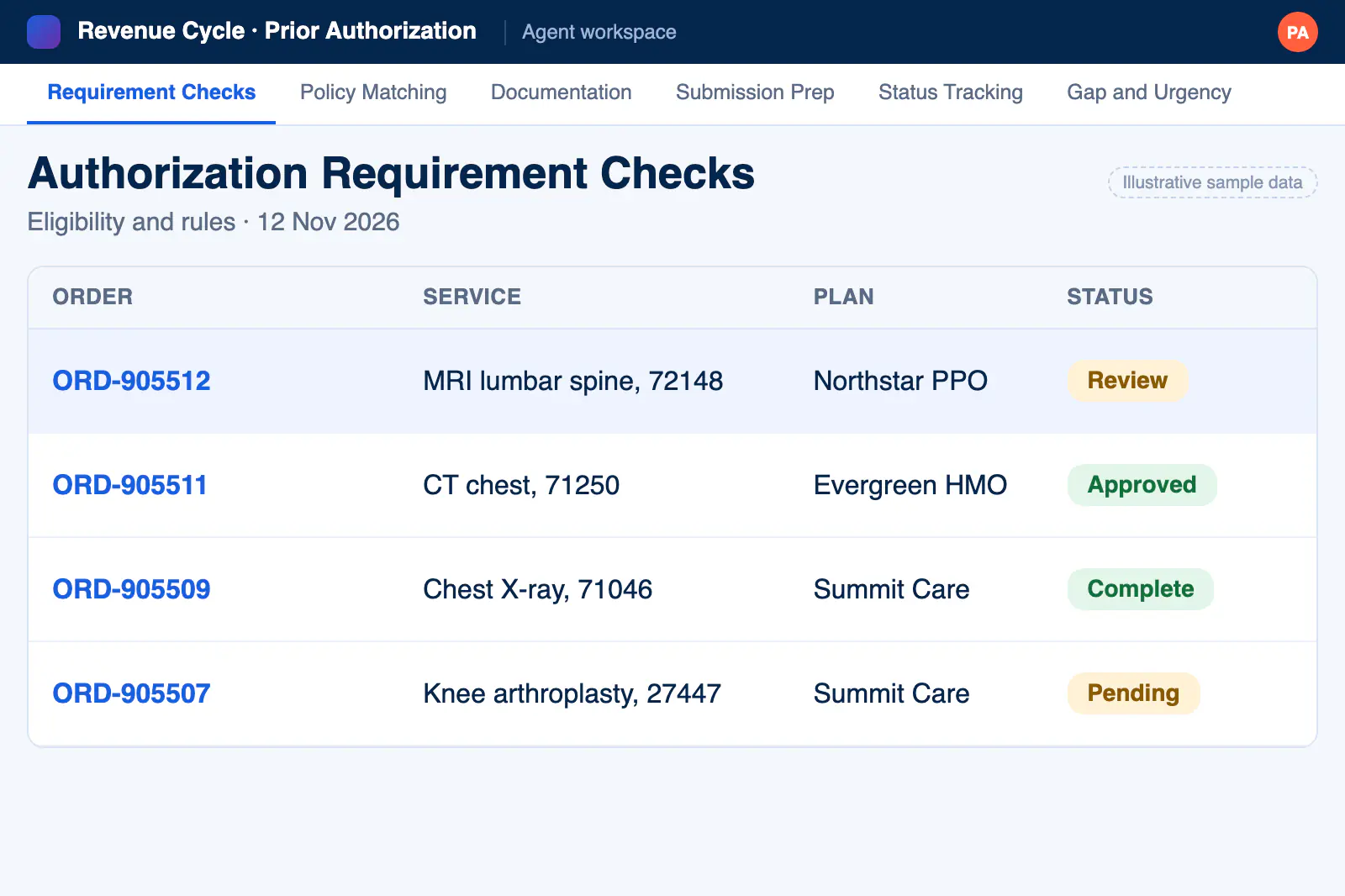
Authorization Requirement Checks
For each ordered service, the agent determines whether the patient's plan requires prior authorization, using current payer rules rather than last year's spreadsheet.
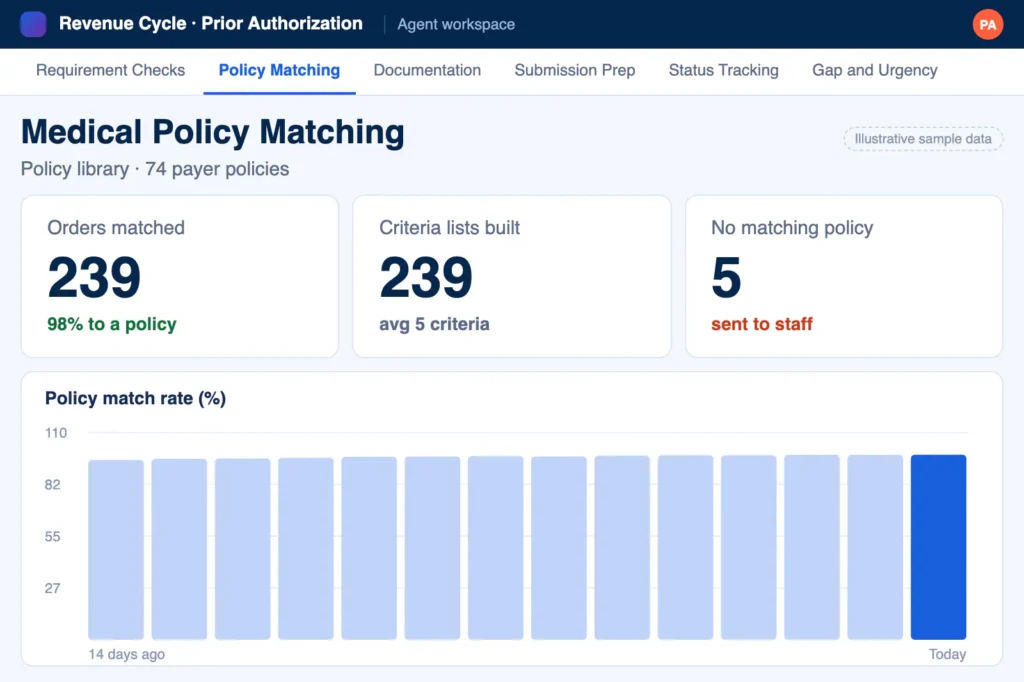
Medical Policy Matching
Payer medical policies are matched to the order, so staff know up front which clinical criteria the request must satisfy.
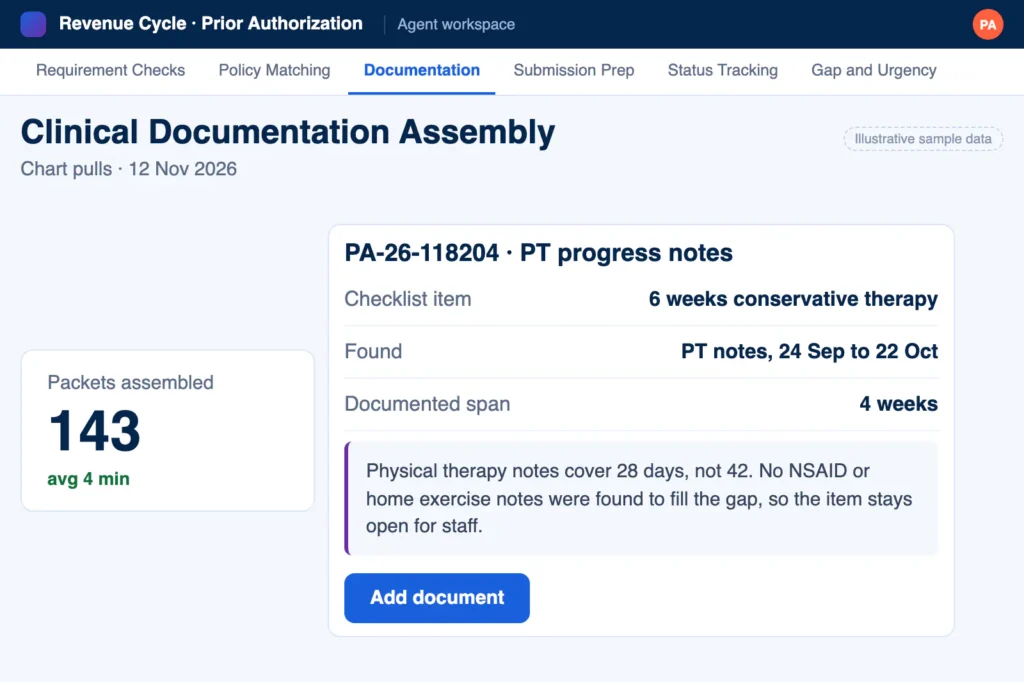
Clinical Documentation Assembly
The agent pulls relevant notes, labs, and imaging reports from the EHR and maps them to the payer's documentation checklist.
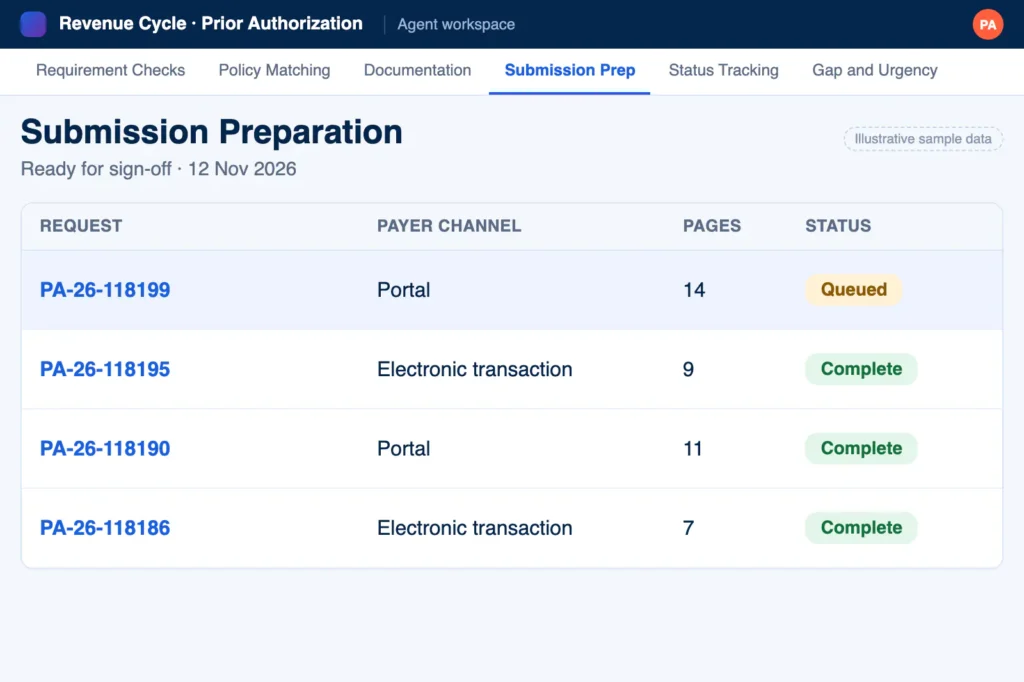
Submission Preparation
Requests are prepared for the payer's channel of record, whether portal, fax, or electronic prior authorization transaction, with human sign-off before anything is sent.
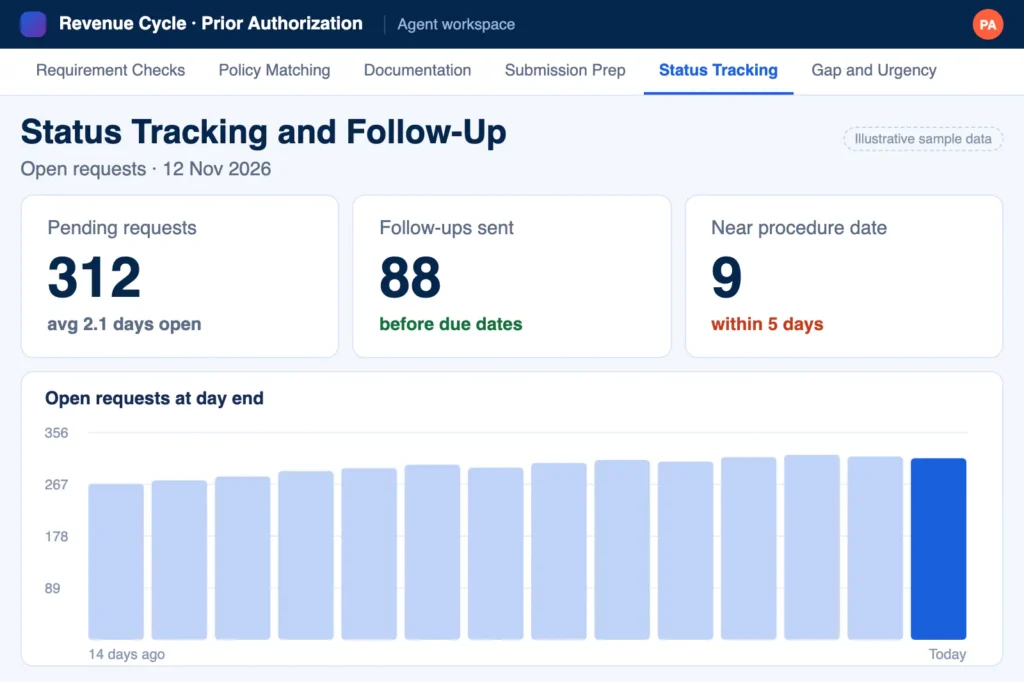
Status Tracking and Follow-Up
Pending requests are monitored, follow-ups are scheduled before deadlines, and approaching procedure dates trigger escalation to staff.
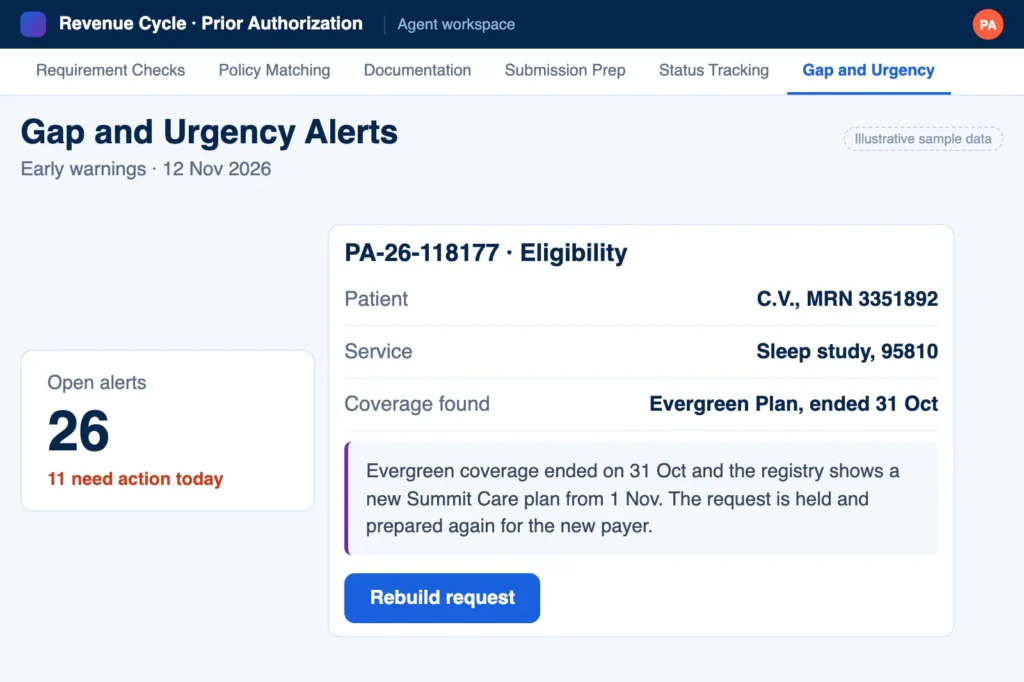
Gap and Urgency Alerts
Missing documents, lapsed eligibility, and cases that qualify for expedited review are flagged early, while there is still time to act.
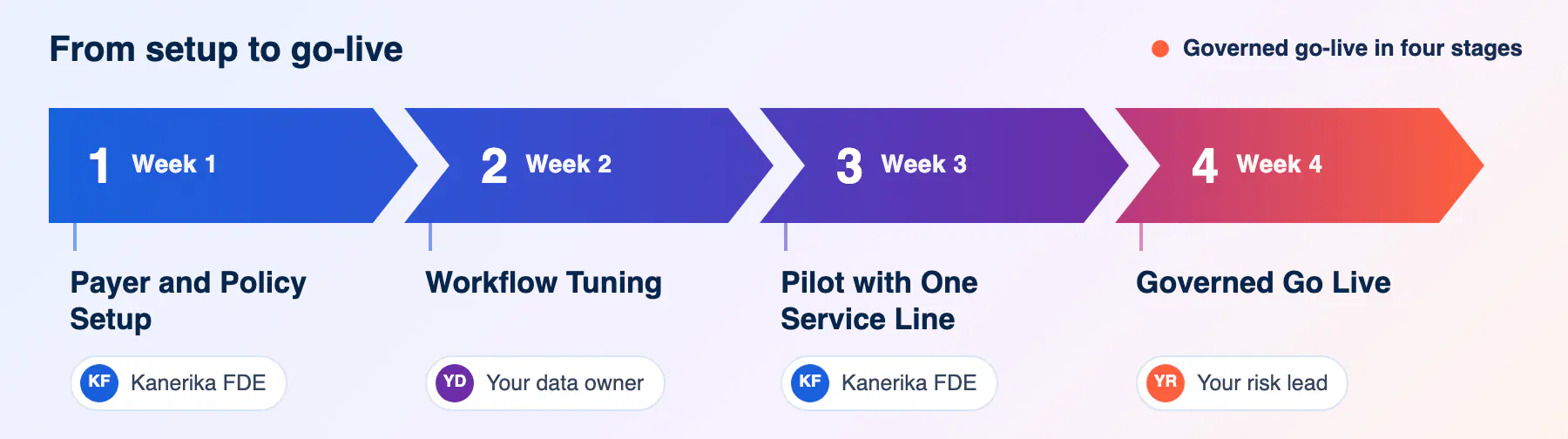
Deploy a Prior Authorization AI Agent in Weeks
Payer and Policy Setup
Kanerika loads your payer mix, plan rules, and medical policy sources, and connects the agent to your EHR and scheduling data.
Workflow Tuning
The agent is tuned to your service lines, order patterns, and documentation templates using historical authorization cases.
Pilot with One Service Line
A single department, often imaging or a specialty clinic, runs live requests through the agent while staff review every submission.
Governed Go Live
The agent expands across service lines with review gates, escalation rules, and full audit trails agreed with compliance.
Where Prior Authorization Automation Removes the Wait
Imaging and Radiology Orders
High-volume MRI, CT, and PET orders are checked and submitted the day they are placed, so scanners stay booked and patients stay on schedule.
Specialty Pharmacy and Infusions
Complex drug authorizations with step-therapy and site-of-care rules are assembled with the clinical history payers expect to see.
Surgical Scheduling
Authorizations are secured before dates are locked, cutting the day-before scrambles that end in cancellations and empty OR time.
Durable Medical Equipment
Documentation-heavy DME requests move through with the right forms, physician attestations, and medical necessity evidence attached.
Behavioral Health Services
Recurring authorizations and visit-limit tracking are managed continuously, so care is not interrupted mid-treatment.
Payer Utilization Management Intake
On the payer side, the same agent structure triages incoming requests, checks completeness, and routes cases to clinical reviewers faster.
Built for Provider and Payer Teams Alike
Health Systems and Hospitals
Centralized authorization teams handle more volume per FTE while referral-to-care time shrinks across departments.
Specialty Clinics
Oncology, cardiology, and orthopedic practices keep treatment plans moving without dedicating clinical staff to payer paperwork.
Imaging Centers
Authorization turnaround becomes a competitive advantage when referring physicians know scans will not stall.
Specialty Pharmacies
Time-to-first-fill drops when drug authorizations are complete on first submission.
Ambulatory Surgery Centers
Case schedules hold because approvals are confirmed days ahead, with eligibility verified alongside. For coverage checks, see Kanerika's insurance coverage verification agent .
Payers and TPAs
Utilization management teams clear intake queues faster and give providers earlier, better-documented decisions. Explore Kanerika's broader AI in healthcare work.
Why Healthcare Teams Choose Kanerika Among Prior Authorization Software Vendors
Built by Kanerika's 300+ engineers, who have delivered for 100+ enterprise clients. Live in weeks, on your own data.
It checks whether a plan needs prior authorization using current payer rules, not last year's spreadsheet.
It pulls the notes, labs and imaging from the chart and lines them up with the payer's checklist.
It tracks every pending request and alerts staff before a deadline or procedure date.
Proof Points from Adjacent Healthcare Deployments
65% Self-Service Resolution with an AI Support Agent
Impact:
- 42% Reduction in ticket volume
- 31% Decrease in cost per ticket
- 25% Increase in member satisfaction
80% Fewer Mismatch Tickets with Context-Aware AI
Impact:
- 22% Bandwidth Savings
- 40% Increase in Mapping Accuracy
- 80% Decrease in Mismatch Tickets
61% Faster Reporting with Power BI for Healthcare
Impact:
- 25% Increase in data-driven decisions
- 40% Decrease in response time
- 61% Reduction in time to information
FAQs
An AI prior authorization agent automates the work before care is delivered. It checks whether a payer requires authorization for an ordered service, assembles the clinical documentation, prepares the submission, and tracks it to a decision. It works as prior authorization software built around your payer mix: Kanerika builds and runs the agent inside your environment, with staff reviewing every request before it goes out.
No. Approval decisions always belong to the payer, and clinical judgments stay with your physicians. The agent prepares requests, checks them for completeness, tracks their status, and flags cases needing clinical input or peer-to-peer review. Its job is making every submission complete and on time, which is where most delays and denials begin.
The agent works from payer rules, plan documents, and published medical policies loaded and maintained for your specific payer mix. When a payer changes a policy, the rule set is updated rather than waiting for a denial to reveal it. Every requirement check records which policy version it applied, so the decision is auditable.
Yes. The agent reads orders, clinical notes, labs, and imaging reports from major EHR systems and writes authorization status back where schedulers can see it. Kanerika handles integration during deployment on your infrastructure. Your clinical and access teams keep working inside the systems they already use, with no parallel data entry.
Yes. The agent runs inside your tenant, inherits your access controls, and never sends PHI to external model training. Kanerika holds SOC 2 Type II, ISO 27001, ISO 27701, and ISO 9001 credentials, is CMMI Level 3 appraised, and follows GDPR-compliant practices. Data handling rules are agreed with your compliance team before go-live.
Coverage verification confirms a patient’s plan is active and what it covers. Prior authorization is the payer’s case-by-case approval for a specific service, with clinical evidence attached. They are adjacent steps, and Kanerika builds an insurance coverage verification agent that pairs naturally with this one in day-to-day patient access workflows.
Yes. On the payer side, the agent triages incoming authorization requests, checks completeness, extracts clinical details, and routes cases to the right reviewer. That cuts intake queues and gives providers faster, better-documented decisions. The deployment model is the same, running on the payer’s own infrastructure under its governance and audit requirements.
Kanerika has published healthcare case studies in analytics and member-facing AI, including Power BI reporting for a healthcare organization and an AI member support agent delivering instant, contextual answers. Both are linked on this page. A named prior authorization case study is not yet published, and this page says so rather than inventing one.
Most deployments reach a governed go-live in weeks, starting with one service line such as imaging. Kanerika loads payer rules, connects the EHR, tunes the agent on historical authorization cases, then pilots with staff reviewing every submission. Scope grows service line by service line, at the pace your compliance team approves.
Check four things. Requirement checks should use current payer rules and record which policy version was applied. Clinical documentation should come straight from the EHR and be matched to each payer’s checklist. Pending requests should be tracked to a decision, with alerts before deadlines and procedure dates. And PHI should stay in your own tenant. Kanerika’s AI prior authorization agent covers all four, with staff signing off on every submission before it is sent.
Let’s Transform Your Business