
TL;DR
AI data governance is the set of rules, owners and controls that decides which data an AI system may train on, retrieve or act on, and keeps it traceable. Training needs provenance and use rights, RAG needs permissions checked at retrieval, prompts need PII kept out, and agents need their own scoped identity. Governance has to follow the data into chunks, embeddings, caches and logs, because deleting a source file leaves those copies behind. Quality checks work best as release gates with an owner and a failure action. Regulators now ask for evidence, and the EU AI Act’s Article 10 data rules apply to Annex III high-risk systems from 2 December 2027. Start with one AI workload, prove its controls in 90 days, then add sources.
Key Takeaways
- Govern the derivatives too, because chunks, embeddings, caches and logs carry the same restrictions as the source.
- Match controls to the workload, since training, RAG, prompts and agents fail in different ways.
- Carry ownership, permitted purpose and restrictions through every pipeline step as metadata.
- Enforce permissions before content reaches the model’s context, never after the answer is written.
- Make quality, revocation and audit measurable, with gates that block or quarantine instead of warning.
- Data governance is a prerequisite for model governance and no substitute for it.
Clean Data Is the Second Problem
Clean data is the wrong first worry for AI. Picture an HR policy assistant that answers a sales manager with a paragraph from a confidential restructuring memo.
Nothing was hacked, and every word of that memo was accurate, so no alarm fired. The assistant read the HR share because its service account could. A quality check would have passed it, since the failure was about permission rather than accuracy.
In practice, data reaches AI through four doors, which are training sets, RAG corpora, prompts and agent tool calls. The term also covers AI that automates governance work, a second meaning this guide treats separately. Each door still needs answers to three questions. Who approved this data, for what use, and can anyone prove it a year from now?
What Is AI Data Governance?
AI data governance is the set of rules, owners and controls that decides which data an AI system may train on, retrieve or act on. It also keeps that data traceable and safe, from the source system to the answer a user reads. Model behavior, bias testing and program oversight sit next to it, but they are separate disciplines.
What Falls Inside the Scope
The scope is wider than the source tables most governance programs already catalog. Once AI is involved, these assets all need owners and rules.
- Source systems and files, including file shares, wikis and ticket queues
- Training, validation and fine-tuning snapshots
- RAG documents, parsed text and chunks
- Embeddings and the vector indexes that hold them
- Prompts, system context and retained outputs
- Answer caches, traces and provider logs
- Tool results and memory created by AI agents
AI Data Governance vs Data Governance vs AI Governance
The three terms overlap, so a short boundary helps. Classic data governance sets policy for all enterprise data, while AI governance oversees models, use cases and accountability. AI data governance is the slice where the two meet, so it covers the data that feeds AI and flows out of it.
| Discipline | Main question | Typical controls |
|---|---|---|
| Data governance | Who owns this data and what are the rules for it? | Catalog, classification, quality rules, access policy |
| AI data governance | Which data may this AI use, and can we prove it? | Use rights, retrieval permissions, derivative lineage, deletion propagation |
| AI governance | Should this AI system exist, and is it behaving? | Risk tiers, model evaluation, human oversight, incident response |
Kanerika’s comparison of AI governance vs data governance covers the wider split. Its guide to AI governance also covers the model and program side in full.
Why AI Data Governance Matters Now
In a February 2025 release, Gartner reported that 63% of organizations either do not have or are unsure whether they have the right data management practices for AI. The same release predicted that through 2026, organizations would abandon 60% of AI projects unsupported by AI-ready data. So this is the year that prediction was written for.
Kanerika’s State of Enterprise AI & Data Modernization 2026 report, drawn from 161 documented engagements, also names the same failure first. It calls the pattern model-first, data-later, where teams build on fragmented, ungoverned data and then spend a year on rework. The report’s fix is to modernize and govern the data foundation before scaling AI.
AI Assessment
Is Your Data Foundation Ready for AI?
Score your organization on data foundations, governance and AI readiness in a few minutes, and see which gaps to close before you scale AI on top of them.
Start Your AI Assessment →Two things make AI harder to govern than a dashboard or a report.
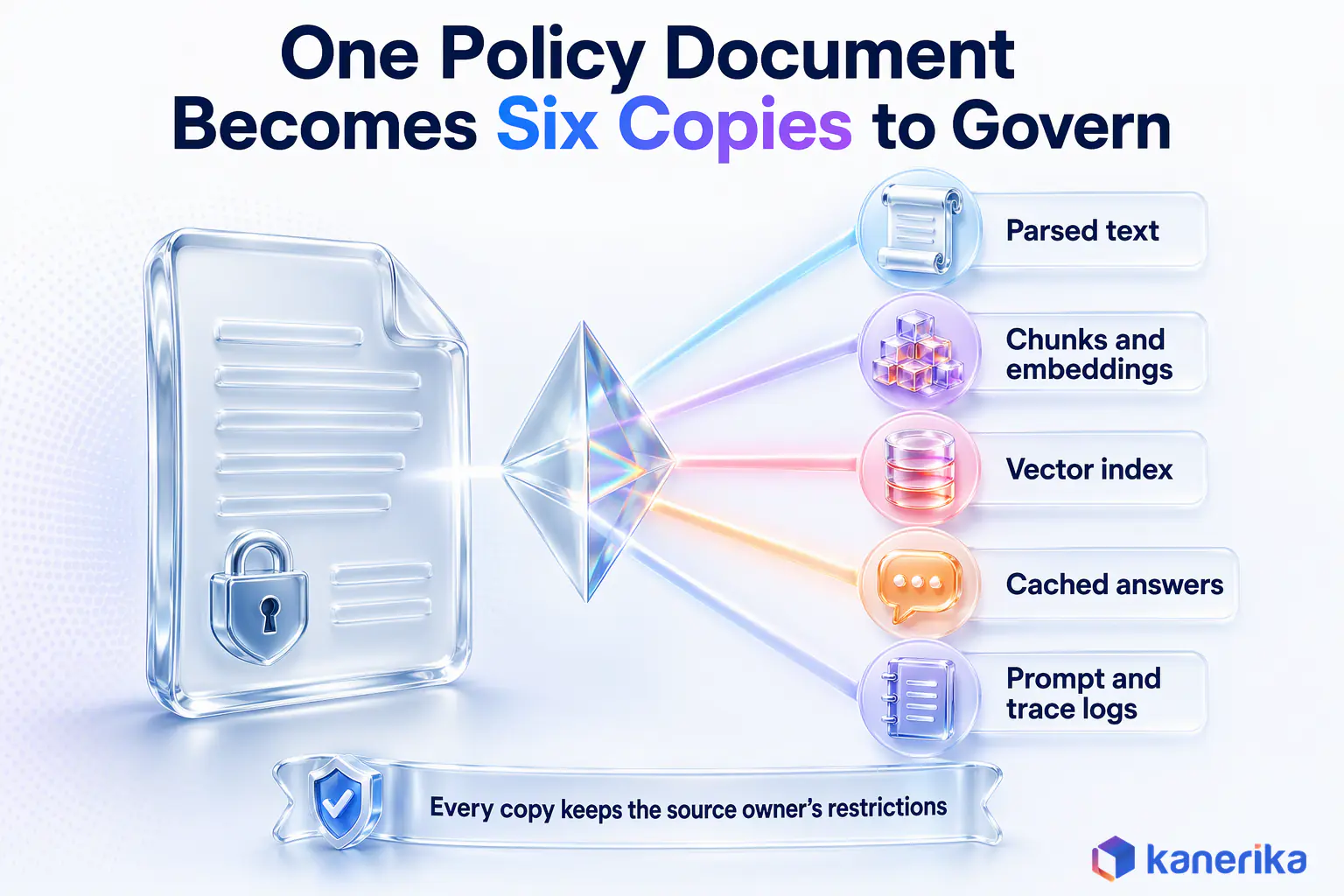
- AI copies data into new forms. One policy PDF becomes parsed text, chunks, embeddings, cached answers and log lines, and each copy can outlive the original.
- AI reads at machine speed across permission boundaries. A person opens a few folders a day, while a retrieval pipeline can index a whole file share overnight.
The Six Pillars of an AI Data Governance Framework, Mapped to Four AI Workloads
Six pillars hold up AI data governance. Each one sounds familiar from classic data governance, but each changes once a model, an index or an agent consumes the data.
Kanerika’s AI governance practice commits to three of them by name. The page names lineage tracking from source to model output, quality checks across training and inference data, and access controls and versioning for every dataset.
1. Ownership and Permitted Use
Every dataset an AI system touches needs a named owner and a recorded purpose. Access rights say who can open a file, while permitted use says whether it may feed a model, an index or an agent. Those are separate decisions, and AI forces teams to write the second one down before any pipeline runs.
2. Provenance and Lineage
Lineage for AI runs further than a warehouse diagram. It traces each source to parsed text, then to chunks, embeddings and an index, and finally to the answer a user saw. The mechanics are in Kanerika’s guide to data lineage. When AI consumes the data, the test is whether you can trace one answer back to its source version.
3. Data Quality and Fitness for the Task
Quality for AI means fit for the task, not only valid columns. For example, a policy assistant needs current, complete and approved documents. A stale but well-formatted PDF is still a quality failure for that assistant.
4. Privacy and Sensitive-Data Protection
Classification has to reach unstructured content, because prompts and documents carry much of the personal data AI sees. A label on a source PDF protects nothing once its chunks land in an index without it. The AI-specific step, then, is making those labels travel with every derivative.
5. Access Control at the Point of Use
Permissions must be checked when data is used, for the person or agent using it. A role that could read a folder last month may not cover an agent acting for a different user today.
6. Retention, Revocation and Audit Evidence
Finally, every control needs a way to show that it worked. That means retention rules for prompts and outputs as well as a deletion path that reaches every copy and logs an auditor can read.
The Workload Matrix
The pillars hold across workloads, but where each control runs changes from one workload to the next.
| Workload | What persists | Where authorization happens | Main quality gate | What removal means |
|---|---|---|---|---|
| Training and fine-tuning | Dataset snapshots, manifests, model weights | Before the dataset is assembled | Provenance, use rights, representativeness | Exclude from future runs; retrain or replace the checkpoint if needed |
| RAG | Parsed text, chunks, embeddings, indexes, caches | At retrieval, before content enters the prompt | Freshness, parsing integrity, entitlement sync | Delete from every index, cache and log; re-embed changed sources |
| Prompts and outputs | Prompts, responses, traces, provider logs | At input and output filtering | Sensitive-data detection, retention limits | Purge from logs and from provider retention under the contract |
| AI agents | Tool results, agent memory, action logs | At every tool call, per request | Scope checks with a logged policy decision | Revoke tool scopes and clear agent memory |
So the matrix is the shortest route to a scoped plan. Pick the row your first AI use case sits in, then build the controls in that row before anything else.
A Minimum Metadata Contract
Controls can only act on what the data carries with it. That is why every asset entering an AI pipeline should hold ten fields.
- Asset ID
- Owner
- Source system and version
- Classification
- Permitted purpose
- Rights basis, such as licence, contract or consent
- Retention period
- Entitlements, meaning who may see it
- Transformation history
- Deletion status
A chunk without an owner field cannot be governed later, and Kanerika’s guide to metadata management covers how catalogs store and sync these fields.
How to Govern Training and Fine-Tuning Data
Training data has the longest memory of any AI input. Once a model has learned from a record, governance can stop that record from being used again, but it cannot easily pull it back out.
Permission to Access Is Not Permission to Train
A team that can read customer support tickets has not automatically earned the right to fine-tune on them. Provenance answers where the data came from, and use rights answer whether a licence, contract or consent covers training. Personal data also adds one more question, which is the purpose it was first collected for.
Generative AI makes that check matter twice, since a fine-tuned model can repeat phrases from its training set. That is one reason many teams keep sensitive content in retrieval instead. There, permissions can still be enforced on every request.
Keep Versioned Dataset Manifests
A manifest lists every source, its version, the inclusion and exclusion rules, who approved it, and which training runs used it. With one, a question like which models saw last March’s customer export takes minutes to answer. Without one, though, the same question turns into a forensic project.
Kanerika’s AI governance practice commits to the same discipline. It covers data lineage from source to model output, quality checks across training and inference data, and versioned, access-controlled datasets.
Use EU AI Act Article 10 as the Checklist
Article 10 of the EU AI Act sets data rules for high-risk systems, and it doubles as a sound checklist for any training set. Article 10(2) lists eight things teams should govern.
- The design choices behind the dataset
- Data collection processes and the origin of the data, plus the original purpose for personal data
- Preparation steps such as annotation, labelling, cleaning, enrichment and aggregation
- Assumptions about what the data is meant to measure
- The availability, quantity and suitability of the data
- Examination for possible biases
- Measures to detect, prevent and mitigate those biases
- Data gaps or shortcomings, and how they will be addressed
In addition, Article 10(3) requires datasets to be relevant, sufficiently representative and, to the best extent possible, free of errors and complete. For high-risk systems under Annex III, it becomes a legal duty from 2 December 2027. Bias testing of the model itself belongs to machine learning governance, so this guide stays with the data.
On the data side, check representativeness by comparing each group’s share of the dataset with its share of the people the system serves. Record the check, the groups tested and any gaps in the dataset manifest. That record is the evidence for the bias items in the list above.
What Deletion Can and Cannot Undo
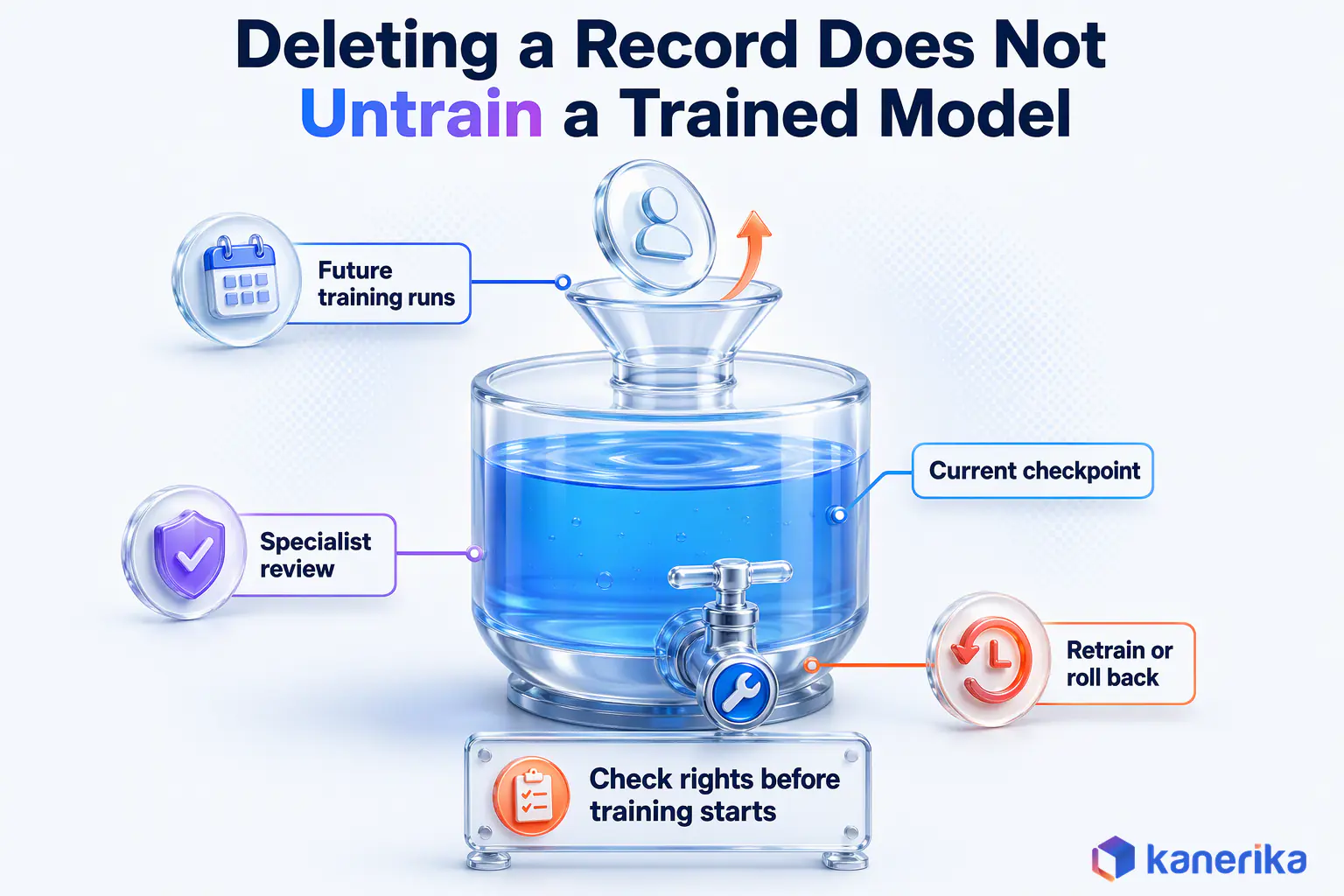
Deleting a source removes it from future training runs. It does not remove what a trained model already learned, so each removal request needs a decision about the model as well as the dataset.
Four options exist, in rising cost. The cheapest two, deleting the record with a logged change and adding it to the exclusion rules, leave current checkpoints untouched. Replacing the checkpoint means retraining or rolling back, while a specialist memorization review gives evidence rather than erasure.
That is the case for checking rights before training starts, when a gap costs an hour of review instead of a retraining cycle.
How to Govern RAG Data: Documents, Chunks, Embeddings and Permissions
Retrieval-augmented generation keeps knowledge outside the model, which makes it the most governable AI workload and also the easiest to get wrong. Every document becomes several copies, so each copy needs the same restrictions as the original.
Approve Documents Before They Are Indexed
Indexing a document is, in fact, a form of publishing it. Before a file joins a RAG corpus, it needs an owner, a freshness date, an intended audience, a classification and an allowed use. Draft policies, superseded contracts and personal folders should stay out unless an owner approves them.
Keep Lineage Through Chunks and Embeddings
First, give every chunk a stable source ID, a chunk ID and the index version it lives in. Embeddings are not automatically anonymous, because they come from the text and often sit beside that text in the same store.
Enforce Permissions at Retrieval, Not After the Answer
Authorization has to happen before content enters the model’s context. Redacting the final answer is too late, because restricted text has already shaped what the model wrote.
For example, Kanerika met this problem at an investment bank where employees searched documents and queried databases through separate interfaces. Access controls sat outside the retrieval process, so every new retrieval path reopened a compliance question. Kanerika put KlarityIQ on the documents and Karl on the databases behind one chat interface, then applied role-based access control at the retrieval layer itself.
A typical authorization sequence runs in five steps.
- Resolve the identity of the user or agent making the request
- Look up that identity’s entitlements
- Apply the entitlement filter inside the vector query
- Re-check each returned chunk’s access control list
- Assemble the prompt only from permitted chunks
The rule is cheapest to apply before the first index exists, and Kanerika’s RAG development services cover new retrieval builds.
Make Updates, Revocation and Deletion Propagate
Deleting a document from a vector database does not remove it from the AI system. Copies survive in places a single delete call never reaches, so every removal request should run the same procedure.
- Mark the source as withdrawn and record who asked and why.
- Delete parsed copies and extracted text.
- Remove its chunks and embeddings from every index version.
- Purge cached answers that cite it.
- Expire or redact it in prompt and trace logs.
- Flag backups so a restore cannot bring it back.
- Run a test query that proves it no longer appears.
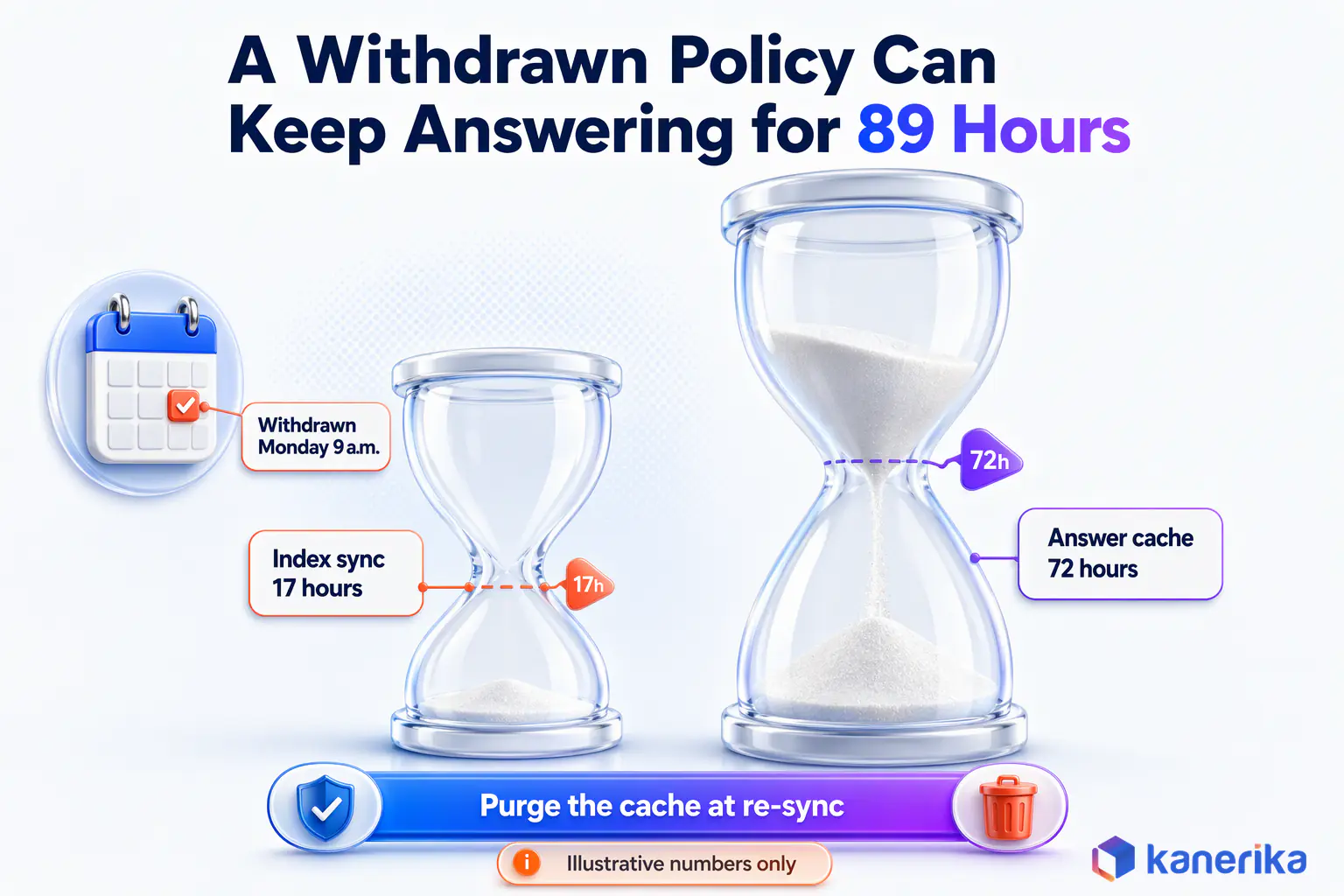
An illustrative setup shows why step four matters, since the cache is the copy teams forget (the numbers are illustrative). A policy is withdrawn at 9 a.m. on Monday, the index re-syncs nightly at 2 a.m., and the answer cache keeps entries for 72 hours.
The index forgets the policy after 17 hours. Still, an answer cached at 1:59 a.m. on Tuesday, just before the re-sync, keeps serving the withdrawn text until early Friday. So the real revocation lag in that setup is 89 hours, more than five times what the sync schedule suggests.
Purging cached answers that cite the policy when the index re-syncs brings the lag back to 17 hours. After that, an event-driven re-index can cut it to minutes.
Test the Boundary With Negative Cases
Positive tests prove the assistant answers. But negative tests prove it refuses, and for governance they matter more.
- A sales user asks for restricted HR content and gets nothing from it.
- Revoked documents no longer appear in any answer.
- Cached answers clear after a permission change.
- Users removed from a group lose access on the next query.
Run them whenever an index rebuilds or group membership changes, and treat any failure as a release blocker.
Keep PII Out of Prompts, Outputs and Logs
Prompts are the least governed door into AI, because anyone with a chat window can open it. A 2025 global study by the University of Melbourne and KPMG asked employees who use AI at work about their habits. Of those, 48% said they had uploaded sensitive company information or copyrighted material into public AI tools.
Kanerika’s State of AI Governance 2026 report cites the same figure. Since public tools like these often sit outside IT’s approved list, Kanerika’s guide to shadow AI covers how to find and govern them.
Map the Prompt Path
Sensitive data enters through more routes than the text box. Map user input, system context, retrieved passages, tool responses, provider processing, traces and retained outputs. Then decide which of them may hold personal data at all.
Minimize Before You Mask
Exclusion is the strongest control, so leave out fields the task does not need. Tokenizing, masking and redacting come next, though each one trades some usefulness for less leakage.
OWASP’s LLM02:2025 guidance on sensitive information disclosure warns that system-prompt rules about what a model may return can be bypassed through prompt injection. So filtering has to sit outside the model, in code that inspects inputs and outputs.
Susan, Kanerika’s PII redaction agent, also applies that idea to documents. It anonymizes names, dates, locations and other identifiers before a file is shared, and it does not store the document.
Set Provider and Retention Boundaries
First, every external model provider needs a written answer on data use, retention period, processing region, subprocessors and log access. On the tooling side, Microsoft documents that Purview sensitive information types and trainable classifiers can find sensitive data in prompts and responses in AI apps. That data security part of Purview continues, unlike its data governance features.
Keep Telemetry Useful Without Copying Everything
Logs are where personal data hides longest. A better default, therefore, is to store prompt hashes, policy decisions and asset IDs. Keep full text only under a short retention window with restricted access.
Turn Data Quality Into Release Gates for AI
Data quality for AI depends on the task more than the table. A policy assistant needs a current, complete and approved corpus, so a column-validity score says little about whether its answers will hold.
Weak quality is costly even before AI multiplies it, because a model or retrieval index passes the bad records it ingests on into its answers. Gartner’s February 2025 release found that 63% of organizations lack, or are unsure they have, the data management practices AI needs. Kanerika’s State of Enterprise AI & Data Modernization 2026 report also cites that figure.
Five Release Gates
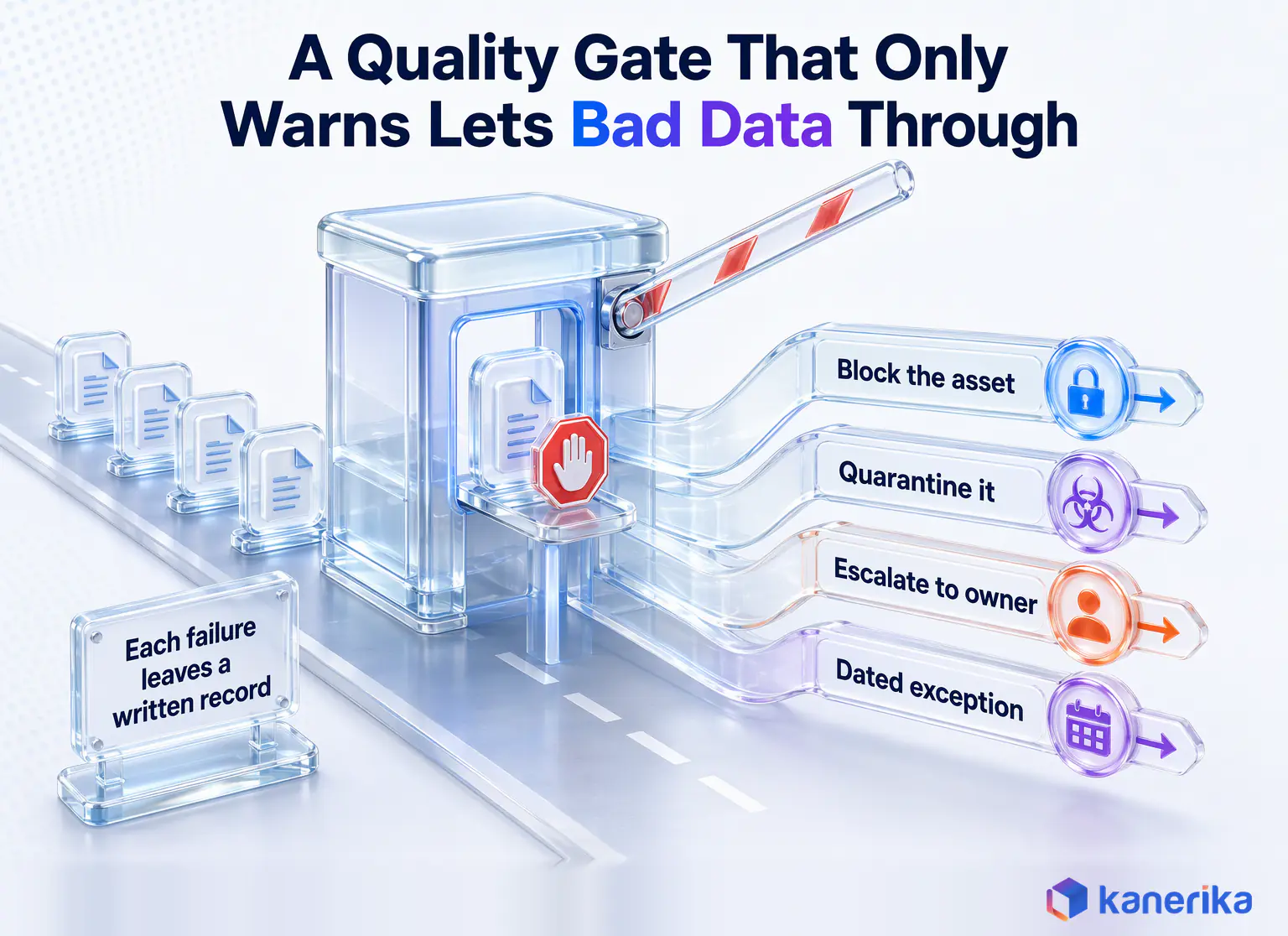
Each gate needs a rule, an owner, a failure action and evidence that it ran. The table uses one template, so every gate reads the same way and none of them depends on someone remembering to check.
| Gate | Rule | Owner | On failure | Evidence |
|---|---|---|---|---|
| 1. Provenance and use rights | Every asset has a source, an owner and a rights basis | Data owner | Block from the corpus | Manifest entry |
| 2. Sensitive data | Restricted classes are excluded or masked | Privacy lead | Quarantine | Scan report |
| 3. Freshness and version | Only the current approved version is indexed | Content owner | Block and alert | Version log |
| 4. Parsing integrity | Text, tables and chunks are complete | Platform team | Re-parse or quarantine | Parse diff |
| 5. Entitlement and deletion state | Index permissions match the source system | Security team | Block retrieval | Sync report |
Quarantine Instead of Publishing Silently
A failed gate should never become a warning in a log nobody reads. Instead, reject the asset, quarantine it, escalate it, or approve an exception with an expiry date, then record which of the four happened.
Kanerika’s guide to data quality tools compares the software that runs these checks.
Measure Control Health
Five numbers show whether the gates work. They are lineage coverage, stale-source share, assets without an owner, revocation lag and failed negative-access tests. Set targets from your own baseline, because published benchmarks for them are scarce, then review them monthly with the gate owners. As an example, a team might require revocation lag under 24 hours and zero failed negative-access tests before each release.
The payoff shows up as less rework. Fewer releases get pulled back for retraining or re-indexing, and audit questions get answered from records instead of rebuilt by hand.
For a staged view of program progress, Kanerika’s AI governance maturity model sets out five levels and six domains with exit criteria. The five control-health numbers above are the data-side measures to track at each level.
Governed Data Access for AI Agents and Multi-Agent Systems
Agents raise the stakes because they act instead of only answering. An agent that can read a customer record can often also update it, email it or pass it to another tool.
Adoption is running ahead of control. Deloitte’s State of AI in the Enterprise 2026 found that close to three-quarters of companies plan to deploy agentic AI within two years. But only 21% of companies report having a mature model for agent governance.
Kanerika’s State of AI Governance 2026 report sets an agent’s starting control tier on four dials, which are autonomy, authority, data and reversibility. Data is one dial among four, so a read-only agent on public content and a write-capable agent on payroll records land in very different tiers.
Pick the Identity Pattern on Purpose
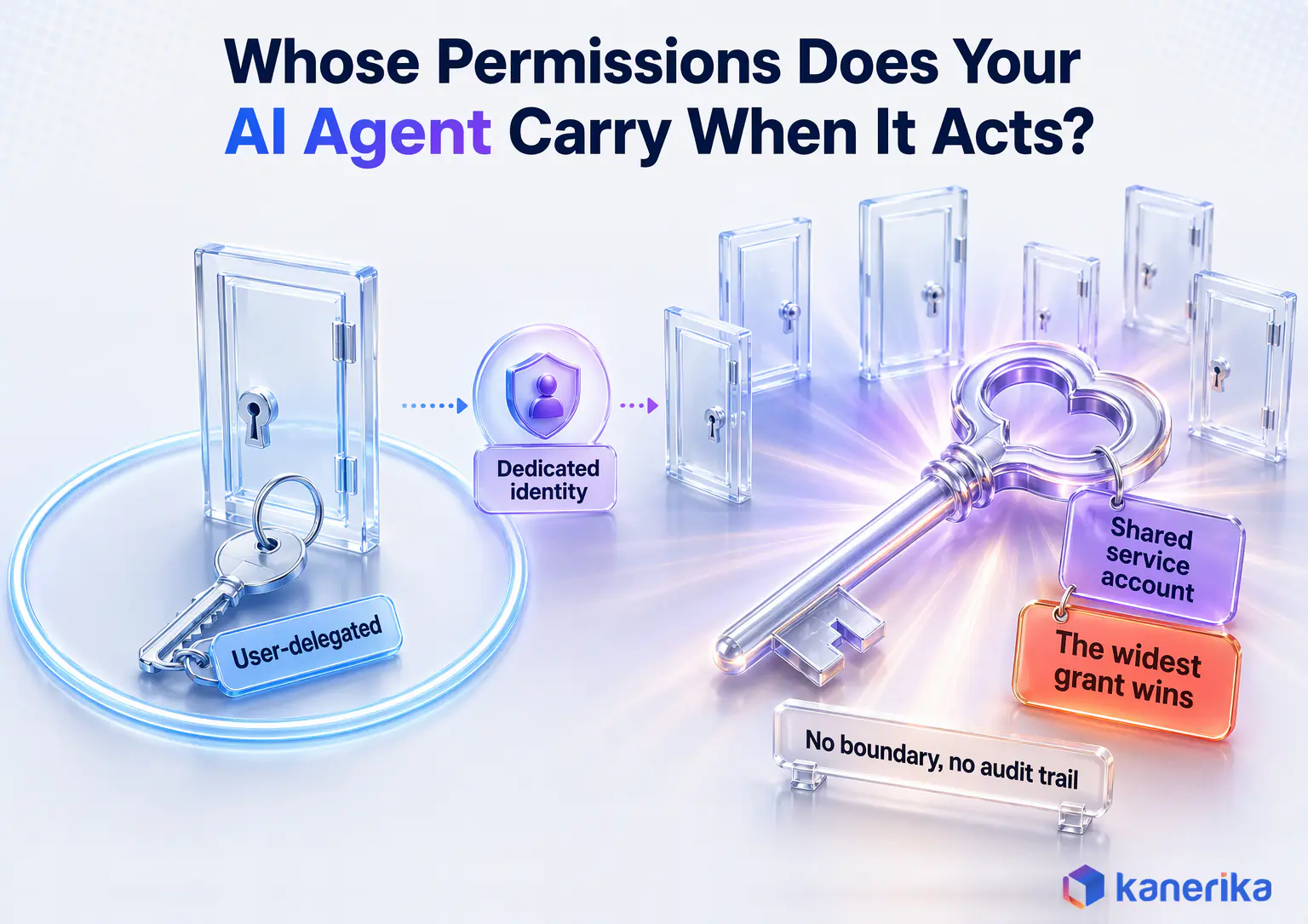
The identity an agent runs under decides what it can reach. Each pattern, then, trades auditability against the risk of over-privilege.
| Identity pattern | How it works | Auditability | Over-privilege risk |
|---|---|---|---|
| User-delegated | The agent acts with the signed-in user’s permissions | High, each action maps to a person | Low, bounded by the user |
| Dedicated service identity | The agent has its own scoped account | Medium, actions map to the agent | Medium, depends on scope design |
| Shared service account | Many agents or users share one account | Low, actions blur together | High, the widest grant wins |
Snowflake’s Horizon Catalog documentation, for example, describes agents running under the same role-based access control policies as human users. That is one vendor’s version of the user-bounded pattern, and it is the opposite of the shared service account in the HR memo story.
Authorize Every Data Access at Execution Time
Check each tool call when it runs, with row and column controls and a recorded purpose. A permission granted at setup time drifts as users change roles, so it cannot stand in for a live check.
Read Access Is Not Write Authority
Retrieving a record and changing it are separate rights. So require explicit grants, and often human approval, for update, export and send actions. Treat instructions inside retrieved documents as untrusted data, and restrict which destinations a tool may send data to.
Kanerika’s guide to AI agent lifecycle management covers how those grants should change as an agent moves from pilot to production.
Log Attribution Without Logging Excess Data
Record the user, the agent, the tool, the asset, the policy decision and the version for every action. That set answers who did what, while the data itself stays out of the log.
Agents that act on customer or product records also need one trusted version of each record. How golden records get their owners and rules is the subject of Kanerika’s guide to master data governance.
Map AI Data Controls to the EU AI Act, NIST AI RMF and ISO/IEC 42001
Four frameworks cover most of what auditors ask about AI data. They overlap, so one set of evidence can serve all four when you plan it that way.
Stanford’s AI Index 2026 shows how organizations weigh them. GDPR remained the most cited regulatory influence on AI governance at 60% in 2025, down from 65% in 2024. ISO/IEC 42001, by comparison, was cited by 36% of respondents and the NIST AI RMF by 33%, both as new entries in 2025.
| Framework | What it asks of data | Evidence to keep |
|---|---|---|
| EU AI Act, Article 10 | Governance of training, validation and test data for high-risk systems | Dataset manifests, bias examination records, data gap analysis |
| GDPR | Lawful basis, purpose limitation, minimization and erasure rights | Records of processing, consent records, deletion logs |
| NIST AI RMF and AI 600-1 | Risk mapping and measurement across the AI lifecycle, plus generative AI risks | Risk register, test results, data lineage |
| ISO/IEC 42001 | An AI management system with documented policies, roles and controls | Policies, control owners, internal audit results |
NIST released the AI Risk Management Framework on January 26, 2023, and its Generative AI Profile, NIST-AI-600-1, on July 26, 2024. Both are voluntary, so they work as a shared vocabulary between data, security and legal teams.
What Changed in 2026
Kanerika’s analysis in its State of AI Governance 2026 report tracks the Digital Omnibus on AI, in force since 27 July 2026. That law pushed Annex III high-risk rules back 16 months to 2 December 2027. Annex I product rules also moved, by 12 months to 2 August 2028.
Obligations already in effect did not change, so the delay buys time for data documentation rather than a pause. For what already applies today, before those later dates, see Kanerika’s EU AI Act compliance guide.
Kanerika Service
AI Governance Services
Kanerika’s AI governance practice covers data lineage from source to model output, quality checks across training and inference data, and access controls and versioning for every dataset in use.
Explore AI Governance ServicesAssign Ownership and Keep Audit Evidence
Controls fail without owners, and AI adds owners most data teams have never had to name. The AI application owner, for example, decides what a use case may do with data that a separate data owner controls. As an illustration, a support assistant’s owner could be the head of customer service, while the CRM product manager owns the ticket data.
| Role | Approves | Typical evidence |
|---|---|---|
| Data owner | Permitted use and rights basis for each dataset | Signed use approvals |
| Data steward | Classification, metadata and quality rules | Catalog entries, gate results |
| Platform team | Pipelines, indexes and enforcement points | Configuration and sync logs |
| Security and privacy | Sensitive-data rules, provider terms and exceptions | Impact assessments, scan reports, exception register |
| AI application owner | What the use case may retrieve or do | Use-case record, negative test results |
Turn Policy Into Enforceable Decisions
A policy line such as “restricted customer data stays out of AI” means nothing until it becomes settings. So translate it into ingestion exclusions, retrieval entitlements, export limits and retention periods, each with an owner.
Kanerika’s State of AI Governance 2026 report frames audit readiness as four records. They show what AI you run, who owns it, whether someone checked it and whether you can stop it. Each record then maps to evidence from the table above.
Kanerika built that kind of traceability for a compliance-solutions provider serving financial institutions. Its AI regulatory-management platform automated requirement mapping, controls monitoring and audit traceability on a structured regulatory data architecture. As a result, manual compliance work fell 60%, regulatory response got 40% faster and audit traceability improved 5X.
Case Study
5X Better Audit Traceability with an AI Regulatory Platform
Kanerika built an AI regulatory-management platform for a compliance-solutions provider serving financial institutions, automating requirement mapping, controls monitoring and audit traceability.
Read the Case Study →Exceptions and Incidents
Every exception needs an approver, a justification, an expiry date, a compensating control and a rollback plan. As an example, a policy might cap exceptions at 90 days, with renewal needing a fresh approval. The program side of incident handling sits in Kanerika’s guide to AI governance best practices, which also covers escalation.
AI Data Governance Tools and Platforms for Enterprise Data Management
The major data platforms now govern AI assets directly, though each puts the enforcement point in a different place. This table compares three of them on documented capabilities rather than ranking them.
| Platform | AI assets it governs | Lineage | Sensitive data | Agent and model controls |
|---|---|---|---|---|
| Databricks Unity Catalog | Tables, volumes, functions, models and services, including MCP services | From source data through to models, services and dashboards | Classifies sensitive data | Access checked when a model is called; activity kept in an audit log system table |
| Snowflake Horizon Catalog | Tables plus models in the Model Registry under the same RBAC | Training data lineage tracked end to end | Automatic classification; masking and row-access policies | Agents run under user RBAC; AI Guardrails redact PII and PHI from agent outputs |
| Microsoft Fabric OneLake catalog with Purview data security | Fabric data and items in the OneLake catalog | Lineage in the OneLake catalog | Purview sensitivity labels, DLP and DSPM for AI | The same permissions, labels and lineage govern how AI uses data |
The details come from each vendor’s own documentation, such as the Unity Catalog overview. On Google Cloud, Dataplex Universal Catalog became Knowledge Catalog on April 10, 2026. Its API, client library, CLI and IAM names stayed the same, so existing automation keeps working.
Kanerika Service
Data Governance Consulting Services
Kanerika’s kanGovern, kanGuard and kanComply services cover catalog, lineage, classification, DLP and compliance on Microsoft Purview, Databricks Unity Catalog and Concentric AI.
Explore Data Governance ServicesThe Purview Change Every Microsoft Shop Must Plan For
Microsoft announced on November 12, 2026 that it will retire Purview Data Governance and end support on November 12, 2027. Customers can no longer create new Purview data governance accounts, and existing capabilities stay in maintenance mode until then. However, Purview’s data security and compliance features remain, including DLP, sensitivity labels and DSPM for AI.
Microsoft’s migration guidance sends catalog work to the OneLake catalog, access enforcement to OneLake security and classification to Purview. It also notes that OneLake Governance Health is not a rules, profiling and scoring engine. Fabric Policies, for their part, support only an Allow effect and three policy types today. So quality gates and deny rules still need another home in a Microsoft estate.
Kanerika’s data governance services, kanGovern, kanGuard and kanComply, are powered by Microsoft Purview, Databricks Unity Catalog and Concentric AI. The first, kanGovern, covers catalog, lineage and business glossary with automated discovery across 150+ sources. The third, kanComply, covers 360+ regulations, standards and frameworks, including GDPR, CCPA and HIPAA. Kanerika’s service page still lists Purview among its engines, so ask which catalog an engagement would use once Purview Data Governance retires.
Beyond these three platforms, Kanerika’s roundup of AI governance tools also compares more options.
How to Choose AI Data Governance Tools for Your Stack
Start with the platform your AI data already lives on, because each catalog above governs the assets inside its own estate. Then test a shortlist against four questions drawn from the workload matrix. Does it check permissions at retrieval time, and does lineage reach chunks, embeddings and model outputs?
The other two questions are about removal and agents. Can a deletion reach every index, cache and log, and can each agent run under its own scoped identity instead of a shared account? A tool that answers no to any of the four leaves that control in custom code, so plan and budget for it before you sign.
Using AI to Run Data Governance
The phrase AI data governance also describes the reverse, which is using AI to do governance work. Classification and documentation are slow and repetitive, so they are where AI helps first. Kanerika’s kanGuard service, for instance, applies AI-powered classification to sensitive data in non-standard file types.
What AI Does Well
AI is good at first drafts of governance work. For example, it can classify documents, draft column descriptions, parse lineage from SQL, map policy text to controls and flag unusual access patterns.
Kanerika’s AI compliance agent for a global expert-network firm shows the shift. The agent connects to internal databases, searches news and professional records, and writes cited reports mapped to disqualification criteria. Expert vetting then ran 3x faster, backlog cases fell 70% and event delays dropped 40%, as the team moved from research to review.
Case Study
3x Faster Expert Vetting with an AI Compliance Agent
An AI agent gathers vetting attributes from internal databases, news and professional records, then writes cited reports mapped to disqualification criteria, so the compliance team reviews instead of researching.
Read the Case Study →What AI Should Not Decide
Still, ownership, risk acceptance, exceptions and the legal basis for processing stay with people. An AI can recommend a classification, but someone accountable signs it off.
As an illustrative rule, a tagger’s PII suggestions below 0.8 confidence go to a steward’s queue, and none publish to the catalog unreviewed.
Will AI Replace Data Governance Teams?
No, the work shifts from finding issues to reviewing them, as the compliance agent case shows. Teams that use AI for governance also have to govern that AI, since it reads some of the most sensitive metadata in the company.
A 90-Day Rollout for One AI Workload
A full program can wait. One AI workload, governed end to end in 90 days, proves the controls and gives later workloads a template to copy.
Before day one, score the workload against the ten-item data-foundation readiness checklist in Kanerika’s State of Enterprise AI & Data Modernization 2026 report. It asks about documented lineage and ownership, role-based access enforced in-platform, embedded PII controls, automated quality monitoring and six more items. A score of 8-10 means AI-ready, 4-7 means close the foundational gaps first, and under 4 means fix the foundation before scaling AI.
Five Phases From Inventory to Operation
The five phases below are a generic plan to adapt, and each one has an owner and an exit criterion.
- Days 1-15, inventory the workload. List its sources, derivatives, consumers, providers and access paths. The platform lead owns it, and the phase ends when a data map names every copy.
- Days 16-35, set owners and use rules. Record rights, purpose, classification, retention and exceptions for each source. Data owners sign off, and the phase ends when every asset passes the metadata contract.
- Days 36-60, build the gates and the authorization path. Add metadata validation, the five quality gates, retrieval-time permissions and restricted telemetry. The phase ends when a blocked asset cannot reach the index.
- Days 61-75, test failure and revocation. Try unauthorized access, stale content, a malformed document, a deletion request and an over-privileged agent. The phase ends when every negative test passes and revocation lag is measured.
- Days 76-90, operate and measure. Track the five control-health numbers each week, then add new sources only through the same gates.
Timing matters more than polish. Kanerika’s State of Enterprise Data Platform Migrations 2026 report backs that up. It finds that governance built in at assessment, rather than at project end, is the single strongest predictor of post-go-live outcomes.
Checklist
AI Governance Checklist
Work through ownership, data, risk and oversight checks for one AI workload, so the gaps show up in the first two weeks of the rollout rather than after go-live.
Get the Checklist →Mistakes That Stall the Rollout
Three mistakes tend to stall a rollout. Two of them appear as failure modes in Kanerika’s 161-engagement State of Enterprise AI & Data Modernization 2026 report.
- Governance bolted on after a compliance scare. The report calls this governance as an afterthought, and its fix is lineage and role-based access in-platform from day one.
- Pilots that never reach production. The report names this pilot purgatory, and its fix is to build for production from pilot one, on governed data, with a clear owner.
- One shared service account for every agent. It erases the user’s boundary and the audit trail at the same time.
Kanerika’s data governance checklist turns the foundations behind these phases into a list that a team can work through before day one.
How Kanerika’s AI Data Governance Consulting Works
So where does Kanerika fit? Kanerika, your trusted partner for AI data governance, works on both sides, the data platform and the AI that reads from it. Its AI governance services page sets out the IMPACT framework, which stands for Identify, Map, Prove, Analyze, Create and Transform.
In practice, Identify surfaces governance gaps before they turn into audit findings. Prove then tests the controls on your highest-risk systems first, and Analyze weighs what a governance failure would cost against the cost of preventing it. And Transform builds governance into ongoing AI operations, so it becomes the operating standard.
If you run on Microsoft, there’s one more thing to plan for. Microsoft’s migration guidance moves catalog work to the Fabric OneLake catalog before Purview Data Governance support ends, while Purview keeps classification, DLP and compliance. That’s where Kanerika’s Microsoft Purview practice does its work, on information protection and data loss prevention.
And some of the day-to-day work runs on Kanerika’s named AI agents. KlarityIQ and Karl handle governed retrieval over documents and databases, and Susan redacts PII before documents are shared.
Talk to Kanerika
Govern the Data Behind Your First AI Workload
Bring one AI use case and its data sources. Kanerika will map the copies, owners and permission points and outline a 90-day plan with exit criteria in a short working session.
Book a Working Session →Make Your AI Data Governance Provable, One Workload at a Time
If you’ve read this far, you likely have an AI use case live or nearly there, and a fair doubt about what it can see. So ask three things of every training set, index, prompt and agent call. Which data may it use, who decided, and can you prove it a year from now?
Many programs have the same gap. The policy exists, but nobody can say which copies of a document now sit in the index, the cache and the logs. The good news is that one workload, governed properly, gives you a template every later one can copy.
That’s the work Kanerika takes on with you, as a Microsoft Solutions Partner for Data and AI certified to ISO 27001 and ISO 27701. Its AI governance services team built the regulatory platform that made audit traceability 5X better for a compliance-solutions provider. Bring one AI use case and its data sources to a working session, and Kanerika will map its copies, owners and permission points.
You’ll leave with a 90-day plan sketched out and its exit criteria named. And if you’d rather read the evidence first, start with the State of AI Governance 2026 report and call when you’re ready.
Frequently Asked Questions
What is AI data governance?
AI data governance is the set of rules, owners and controls that decides which data an AI system may train on, retrieve or act on, and keeps it traceable and safe. It covers training sets, RAG documents, chunks, embeddings, prompts, logs and agent tool results, with an owner, a permitted use and an audit trail for each.
What is the difference between AI governance and data governance?
Data governance sets the rules, owners and quality standards for all enterprise data. AI governance oversees AI systems, including risk tiers, model evaluation, human oversight and incident response. AI data governance sits where they meet, governing use rights for training, permissions at retrieval and PII in prompts. Model governance depends on it but cannot replace it.
What data needs governance in a RAG application?
Every copy a RAG pipeline creates needs governance, not only the source documents. That includes parsed text, chunks, embeddings, vector indexes, cached answers, prompts and trace logs. Each copy should carry the source owner, classification and permissions, and the retriever should check those permissions before any content reaches the model’s context window.
Can sensitive or personal data be used to train AI?
Sometimes, but access alone is not enough. Training needs a rights basis such as a licence, contract or consent, and personal data must fit the purpose it was first collected for. Minimize fields first, document the dataset in a versioned manifest and, for high-risk systems in the EU, follow the data rules in Article 10 of the EU AI Act.
Does deleting a document from a vector database remove it from AI?
No. Deleting the embeddings removes one copy, but parsed text, other index versions, cached answers, prompt logs and backups can still hold the content. A removal request should run a fixed procedure across every copy and finish with a test query that proves the document no longer appears in any answer, cached or fresh.
How should data governance work for AI agents and multi-agent systems?
Give every agent its own scoped identity, ideally delegated from the signed-in user, and never a shared service account, which matters most when several agents work together. Authorize each tool call when it runs, with row and column limits and a recorded purpose. Keep read and write as separate grants, with human approval for exports or updates.
What are the best AI data governance tools for enterprise data?
The best tool is usually the catalog of the platform your data already runs on. Databricks Unity Catalog, Snowflake Horizon Catalog and the Microsoft Fabric OneLake catalog with Purview data security all govern AI assets. Check each for retrieval-time permissions, lineage to embeddings, deletion propagation and scoped agent identities before choosing.
How do I choose an AI data governance consulting partner?
Pick a partner who will govern one live AI workload end to end, with named owners and exit criteria, before proposing a full program. Ask for platform credentials and case evidence. Kanerika, for example, is a Microsoft Solutions Partner for Data and AI and built a regulatory platform that improved audit traceability 5X.
How is AI used in data governance?
AI speeds up the repetitive parts of governance work. It can classify documents, draft metadata descriptions, parse lineage from SQL, map regulations to controls and flag unusual access patterns. People still decide ownership, risk acceptance, exceptions and the legal basis for processing, and the AI doing this work needs the same data controls as any other.
Will AI replace data governance teams?
No. AI shifts governance work from finding issues to reviewing them. Classification, documentation and evidence gathering get faster, while accountable people still approve owners, policies and exceptions. Teams that use AI agents for compliance research can clear backlogs faster, as Kanerika’s compliance-agent case shows, but they also take on the job of governing what those agents can read and do.
What should you implement first for AI data governance?
Start with one AI workload rather than a full program. Inventory its sources and every derived copy, name owners and permitted uses, then build quality gates and retrieval-time permissions. Test failure cases such as unauthorized access and deletion, measure revocation lag, and only then add new sources. A 90-day window is enough for one workload.