
TL;DR
Metadata management is the practice of keeping the information that describes your data (its structure, meaning, owner and lineage) accurate, owned and easy to find. To run it well, start with one domain and one business question, name an owner for every asset, automate the harvesting and let people approve the meaning. Technical, business and operational metadata answer different questions, so a working program needs all three. Passive metadata documents what exists, while active metadata turns changes into alerts and review tasks for the right owner. In a 90-day rollout, days 1 to 30 baseline one domain and agree its contract, while days 31 to 60 connect sources and fill required fields. Days 61 to 90 switch on one active alert and measure ownership coverage, freshness and search success before you expand to the next domain.
Key Takeaways
- Metadata management keeps descriptions of data accurate, owned and findable, while a catalog is only the place people search them.
- The three types of metadata (technical, business and operational) answer different questions, so one trusted metric needs all three.
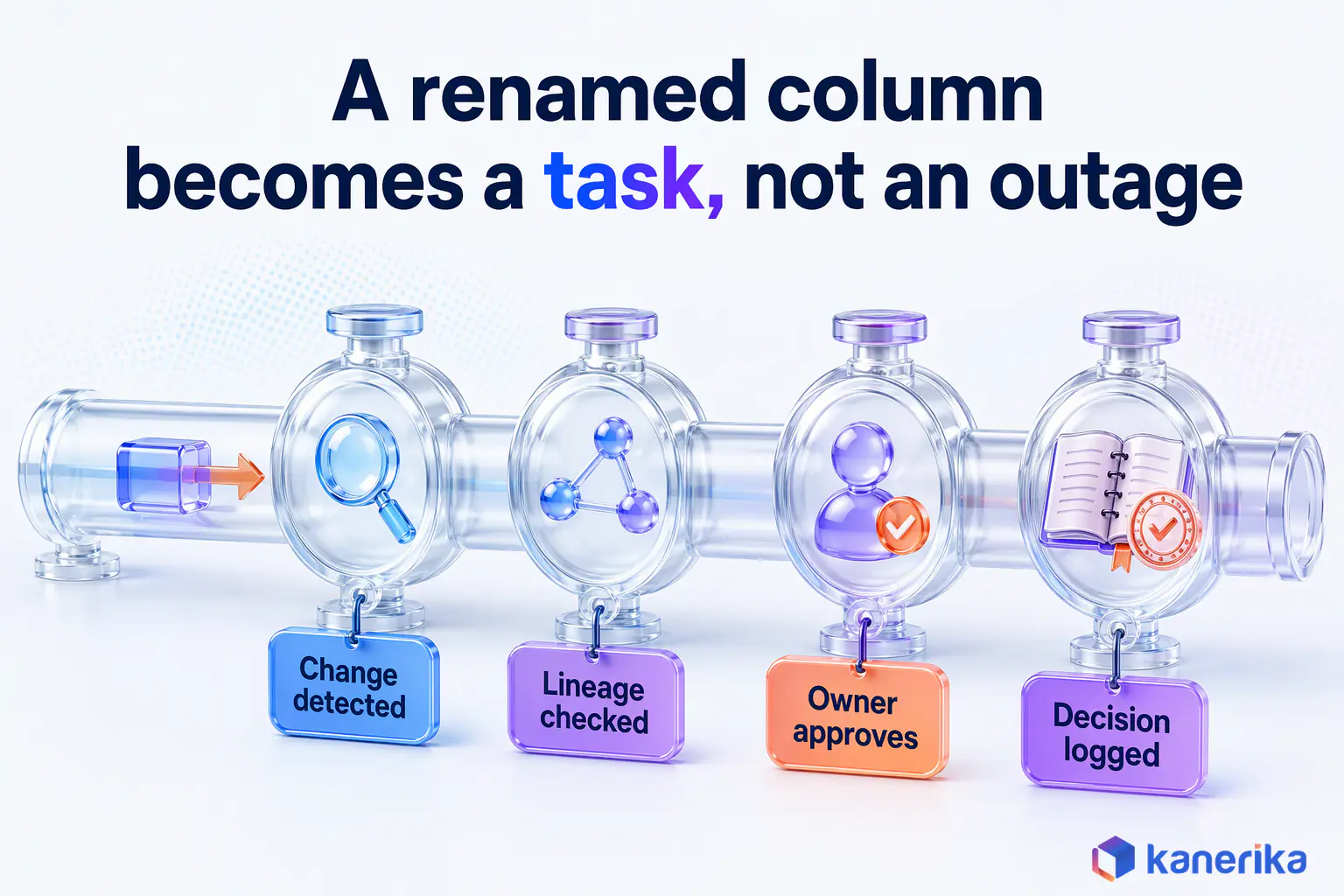
- Active metadata routes a signal, such as a renamed column, to an owner as a task before a dashboard breaks.
- Ownership is a required field, because ingestion alone fills a catalog that nobody trusts.
- A 90-day rollout fits one domain when each phase ends at an exit gate rather than a calendar date.
- Track ownership coverage, required-field completeness, freshness and discovery success against your own baseline.
The Jar Label Nobody Updated
Pick up a jar of pasta sauce and you can trust it without opening the lid. That is because the label lists the ingredients, the maker, a lot number and a best-before date. Now picture the recipe changing while the old label stays on the jar.
Data works the same way. Every table and metric carries a label, and metadata management is the work of keeping that label true when the recipe changes.
So when two teams bring different net-revenue numbers to one meeting, the fight is rarely about arithmetic. Instead, nobody can say which definition, source table or owner is right.
What Is Metadata Management?
Metadata management is the ongoing practice of capturing, organizing, governing and publishing the information that describes your data. That covers where data lives, how it is structured and what it means, as well as who owns it and whether it is fresh. Kanerika’s glossary entry on what metadata is covers the basic term.
The useful version is operational. A program decides which descriptions are required, who approves them and how they stay current. Without those decisions, a catalog fills with stale entries that look official but answer nothing.
Metadata vs Metadata Management
Metadata is the thing itself, such as a column type, a metric definition or a refresh timestamp. A description written once is metadata, while a description with an owner, a review date and a change workflow is managed metadata.
Enterprise Metadata Management
It applies the same discipline across many platforms at once. A warehouse, a lakehouse, three BI tools and a dozen SaaS sources each hold a fragment. So the job is to give each asset a stable identifier and connect those fragments, until one metric can be traced end to end.
A Worked Example: One Net-Revenue Metric
Take an illustrative company (not a Kanerika client) whose October sales sit in an orders table. Gross sales were $5.00 million, returns $0.40 million and discounts $0.30 million. Finance reports net revenue of $4.30 million, but the sales dashboard shows $4.60 million because it never subtracts discounts.
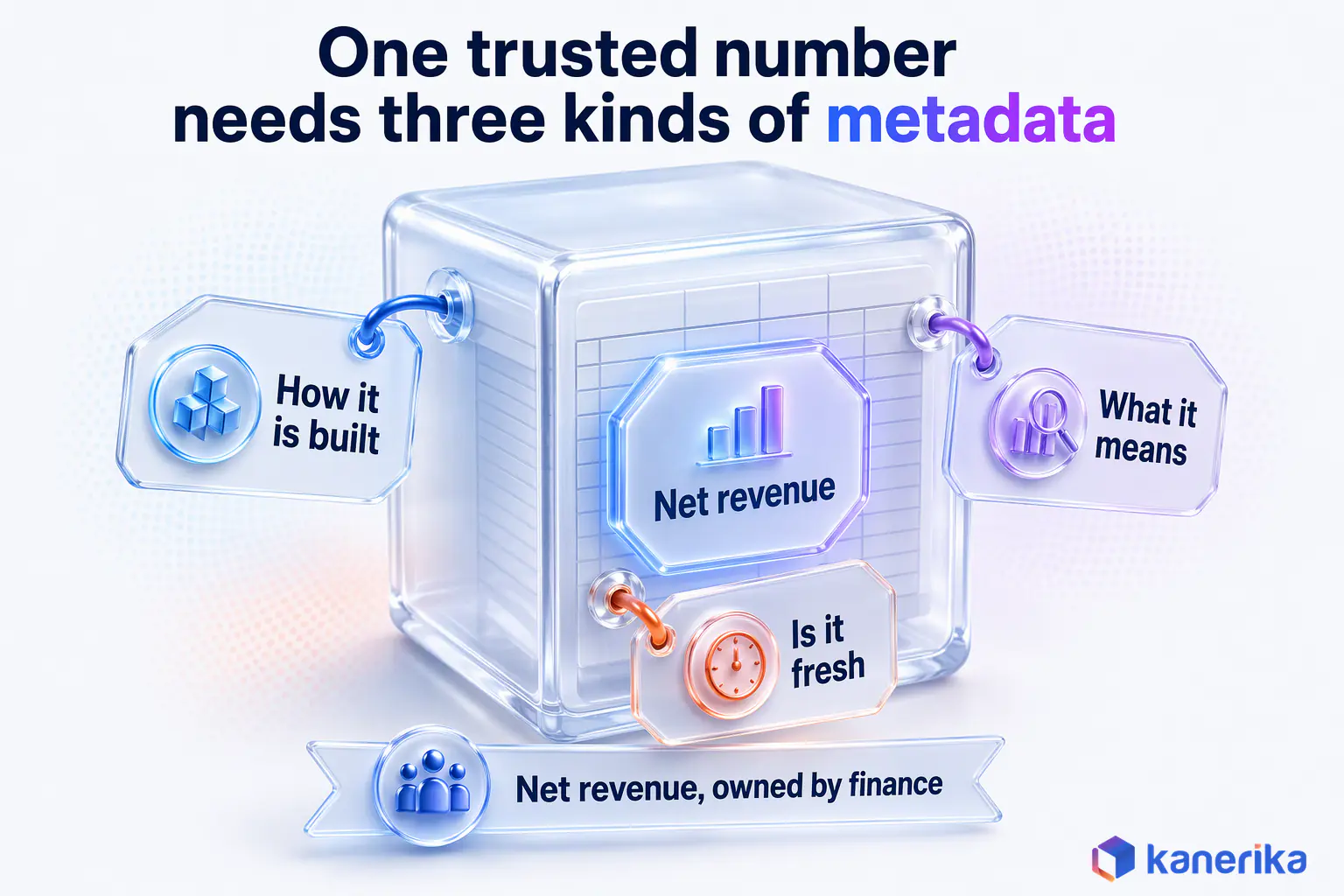
That $300,000 gap, about 7% of net revenue, is a metadata failure rather than a math error. Managed metadata would record one approved definition (gross minus returns and discounts, tax excluded), name finance as owner and link both dashboards to it. Then, when an engineer renames discount_amt, the change becomes a review task for that owner before either report moves.
Why Metadata Management Matters
Every data decision starts with finding the right asset and checking whether it can be trusted. When descriptions are missing, people rebuild datasets that already exist. They also approve changes without knowing what depends on them.
- Faster discovery. When an analyst finds the certified table in minutes, nobody builds a fourth copy.
- One meaning per metric. A glossary term with an owner settles the net-revenue argument before the meeting.
- Impact analysis. Lineage shows which reports read a column, so a rename becomes a planned task.
- Access and audit context. Sensitivity tags and owners tell security teams who may see what, and why.
Migrations Start From the Inventory
The cost shows most clearly in migrations. Industry research compiled in Kanerika’s State of Enterprise Data Platform Migrations 2026 report puts the share at 68%. That is, 68% of failed migration projects cite inadequate technical assessment as a primary contributing factor.
The report traces this to scoping that catalogs report names but skips engineering-level analysis, so dependencies and undocumented business logic surface mid-project. An inventory with owners, lineage and documented logic is exactly what that assessment was missing.
The Three Types of Metadata: Technical, Business and Operational
Practitioners usually sort metadata into three working types, since each answers a different question about the same asset. The split is a convention rather than a formal standard, and IBM’s metadata guide also uses descriptive, structural and administrative labels. Still, the three-way view maps neatly to who keeps each kind correct.
Technical Metadata: Structure and Dependencies
Technical metadata describes how data is built, from schemas, columns and data types to views, transformation code and dependencies. In a database management system, it lives in the system catalog or data dictionary that the engine maintains.
Because systems generate it, it is the easiest type to harvest. Even so, a column called amt_net still needs a person to say whether it excludes discounts.
Business Metadata: Meaning, Rules and Ownership
Business metadata explains what data means and who answers for it, through glossary terms, metric definitions, rules, owners and sensitivity classes. It decays fastest, because it depends on people keeping it current.
Kanerika saw this in a governed ontology project for a global pharma enterprise. KPI definitions and business rules lived inside each Power BI dashboard, so the same metric returned different numbers depending on who ran the report. Kanerika then moved those definitions into one governed ontology on Microsoft Fabric, which Power BI and conversational AI now read from the same place.
Operational Metadata: Runs, Refreshes, Quality Results and Usage
Operational metadata records what happens to data over time, including job runs, refresh times, failures, quality test results and query logs. So it tells you whether a dataset is fresh enough to use today, and also whether anyone uses it at all.
How the Three Types Work Together
| Type | Question it answers | Net-revenue example | Who keeps it right |
|---|---|---|---|
| Technical | How is it built? | Columns in orders, then the step that subtracts returns and discounts | Engineers, because their code produces it |
| Business | What does it mean, and who owns it? | Gross minus returns and discounts, but tax excluded | Finance, since it owns the definition |
| Operational | Is it fresh and used? | Refreshed at 6 a.m., so today’s figure is current | Platform teams, because their jobs emit it |
Read across a row and you see why one tool rarely covers the job. Engineers produce technical metadata as a side effect of their work, but business metadata needs a decision from someone with authority.
Passive vs Active Metadata Management
The difference lies in what happens after metadata is captured. A passive entry sits in a catalog until someone looks it up. Active metadata, on the other hand, is read by other systems. It triggers an action, such as an alert, a review task or a policy check.
Passive Metadata Documents
Passive does not mean manual. A scanner can harvest schemas every night and still produce passive metadata, because the result is an inventory people consult. Its weakness is timing, since nobody learns about a breaking change until a report is already wrong.
Active Metadata Acts
Active metadata connects signals to the people who need them. A schema change, a failed quality test or a new sensitive column becomes an event, and then a rule routes it to an owner. So “active metadata management” usually means a loop of signal, rule, action and audit that runs continuously.
Kanerika’s work with a global bank on Microsoft Purview shows the automated half of that loop. The bank’s data sat across SAP, Dynamics 365, CRM and core systems such as Oracle and Netezza, while manual classification was error-prone.
Purview’s Data Map then classified assets automatically and lineage was automated through the Lakehouse layers. As a result, business users could search quickly and run impact analysis.
Passive vs Active at a Glance
| Aspect | Passive metadata | Active metadata |
|---|---|---|
| Update pattern | Updates when a scan or an editor runs | Updates as soon as an event fires |
| Typical output | Searchable inventory | Alerts and review tasks, as well as policy actions |
| Human review | Periodic, whenever someone looks | Routed to a named owner, then logged |
| Good for | Discovery, audits and onboarding | Change control, especially freshness and access |
What to Automate and What a Person Approves
Automation should handle detection and low-risk notices, while a person approves anything that changes meaning or access. Here is the renamed column from the net-revenue example.
- A deploy renames
discount_amttodisc_amount, and the connector detects it within the next scan. - Lineage then finds three downstream objects, the finance model, the sales dashboard and a forecasting notebook.
- A rule opens a review task for the finance owner, because the column feeds a certified metric.
- Once the owner approves the mapping, the glossary term records a new version and approver.
- Finally, the audit log keeps the signal, the decision and who made it.
An illustrative detection query (not a Kanerika client):
SELECT table_name, column_name, data_type
FROM information_schema.columns
WHERE table_schema = 'sales';
Run it nightly and diff it against yesterday’s snapshot. A column that vanished while a new column of the same data type appeared in the same table is a rename candidate. That candidate opens the review task. The information_schema view name varies by platform.
A stale-data notice can go straight to a channel. A rule that grants or removes access, however, should wait for a human, because a wrong tag there exposes data.
Metadata Management vs Data Catalog, Data Lineage, Data Governance and MDM
These terms overlap, so a short rule helps. Data governance sets the rules, while the metadata program keeps the descriptions those rules depend on. A catalog is where people search those descriptions, and lineage is one kind of metadata.
| Concept | What it is | How it relates |
|---|---|---|
| Data catalog | A searchable inventory of data assets | The interface for managed metadata, rather than the discipline |
| Data lineage | The record of how data moves and changes | One type of metadata, so the program keeps it current |
| Data governance | Policies, roles and decision rights | Sets the rules, while metadata gives them context |
| Master data management | Golden records for shared entities | Manages the records, whereas metadata describes them |
| Business glossary | Approved definitions of business terms | The business layer, once linked to assets |
Each row has its own depth. Kanerika’s comparison of data catalog tools covers the search layer, and the guide to data lineage covers capture methods. The policy side, meanwhile, sits in the overview of data governance.
Master data is the row people mix up most. Kanerika’s guide to master data governance covers who decides which supplier record is the golden one. Metadata then describes that record, including its definition, owner, source and lineage.
Metadata Management Framework: Components and Architecture
A framework here means the components and workflows that capture metadata, connect it and keep it current. Products vary, yet the architecture usually has seven parts. For the catalog layer in more depth, see Kanerika’s blueprint for an enterprise data catalog.
- Connectors and harvesting. Scanners and APIs pull metadata from databases, pipelines, BI tools and SaaS apps.
- A repository with stable identifiers. So the same table seen by three tools is still one table.
- Business glossary. Approved terms, each linked to the assets that implement it.
- Lineage capture. Paths from source to report, either parsed from code or emitted by jobs.
- Classification and policy tags. Sensitivity labels and retention classes, as well as usage rules.
- Access layer. Search, APIs and events, so people and systems read metadata where they work.
- Stewardship workflows. Intake, review and approval tasks that keep the other six honest.
How Metadata Flows Through the Framework
Metadata moves through five steps in a loop. First the framework harvests it, and then it reconciles duplicates against stable identifiers.
Next, stewards enrich assets with owners and terms, before the result is published to search and APIs. Finally, monitoring catches drift and restarts the loop.
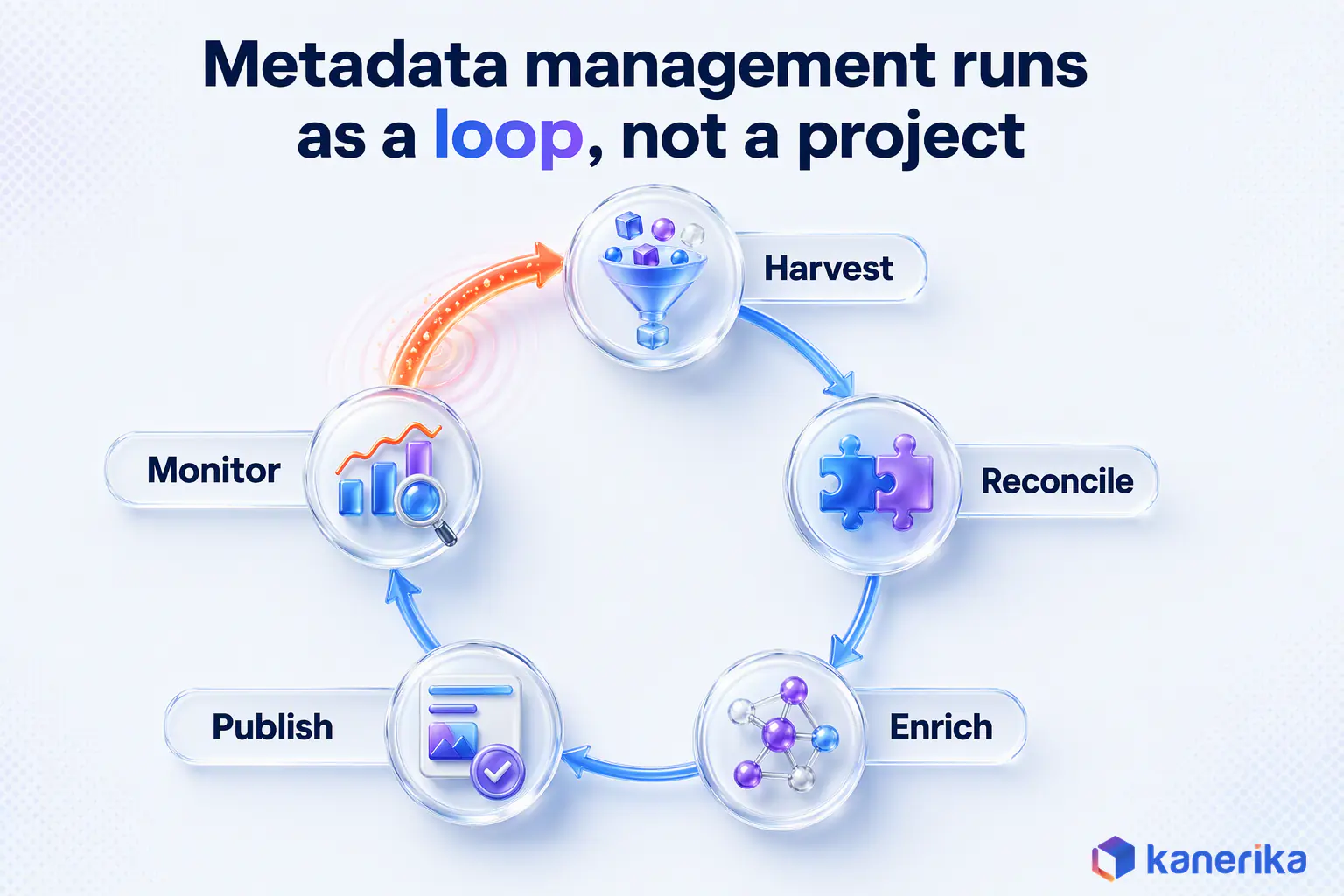
Kanerika’s data governance services page describes KANGovern, its catalog, lineage and business glossary service, in the same terms. It pairs automated data discovery across 150+ sources with standardized terminology across business and IT. It also lists ownership assignment, approval flows and accountability tracking, which map to components 1, 3 and 7 above.
Metadata Standards Worth Knowing
- Dublin Core. Fifteen core elements for describing resources, first standardized in 1998.
- DCAT 3. A W3C Recommendation from August 2024, so web data catalogs share one vocabulary.
- ISO/IEC 11179. The international standard for metadata registries, independent of any one system.
- OpenLineage. An open framework with a standard API for lineage events about datasets, jobs and runs.
In OpenLineage a run’s first state is usually START and its last COMPLETE. Input datasets can be sent with START, COMPLETE or both, because some information is only available at certain times.
Who Owns Metadata? Roles and the Operating Model
Metadata belongs to the business owner of the data it describes. Stewards do the daily upkeep, while engineers keep the pipes running. A catalog with no named owners decays within months, because nobody has the job of confirming a definition.
| Role | Owns | Does |
|---|---|---|
| Data owner | Meaning, approved use and access decisions | Approves definitions before certified assets change |
| Data steward | Quality of descriptions, terms and tags | Fills required fields, then works review tasks |
| Platform and data engineering | Connectors, lineage and technical metadata | Fixes broken scans so harvesting keeps running |
| Security and privacy | Classification rules | Sets tags, since they drive access and retention |
Kanerika saw the cost of a missing model at a top North American healthcare organization. Its data sat across Azure Blob Storage, SQL databases and SaaS applications, but it had no consistent framework for classifying and describing its data.
Kanerika built a centralized Purview catalog and a classification framework that set steward roles and usage policies together. User guides and training then turned stewardship into a habit.
Kanerika Service
Data Governance Consulting Services
Kanerika sets up catalogs, business glossaries, classification frameworks and steward roles, then trains teams so ownership of metadata survives go-live.
Explore Data Governance ServicesThe Minimum Metadata Contract
Every asset in scope should carry a short set of required fields before it is published. Fields vary by asset type, but a practical start looks like this.
- A stable identifier and a plain-language description
- A named owner and a named steward
- The business term it implements, if any
- The source system and its main upstream dependencies
- A sensitivity class and a refresh expectation
An illustrative contract record for the net-revenue metric (not a Kanerika client):
asset:           sales.net_revenue
description:     Gross sales minus returns and discounts, tax excluded
owner:           Finance
steward:         Sales operations
term:            Net revenue (business glossary)
source:          orders table, including discount_amt
sensitivity:     Internal
refresh:         Daily, by 6 a.m.
certified_until: 2027-03-31
Metadata access is not the same as data access, since a sample value can leak sensitive information to someone barred from the table. Kanerika’s guide to data stewardship covers how stewards handle reviews and owner turnover without letting the contract slip.
How to Implement Metadata Management: A 90-Day Rollout
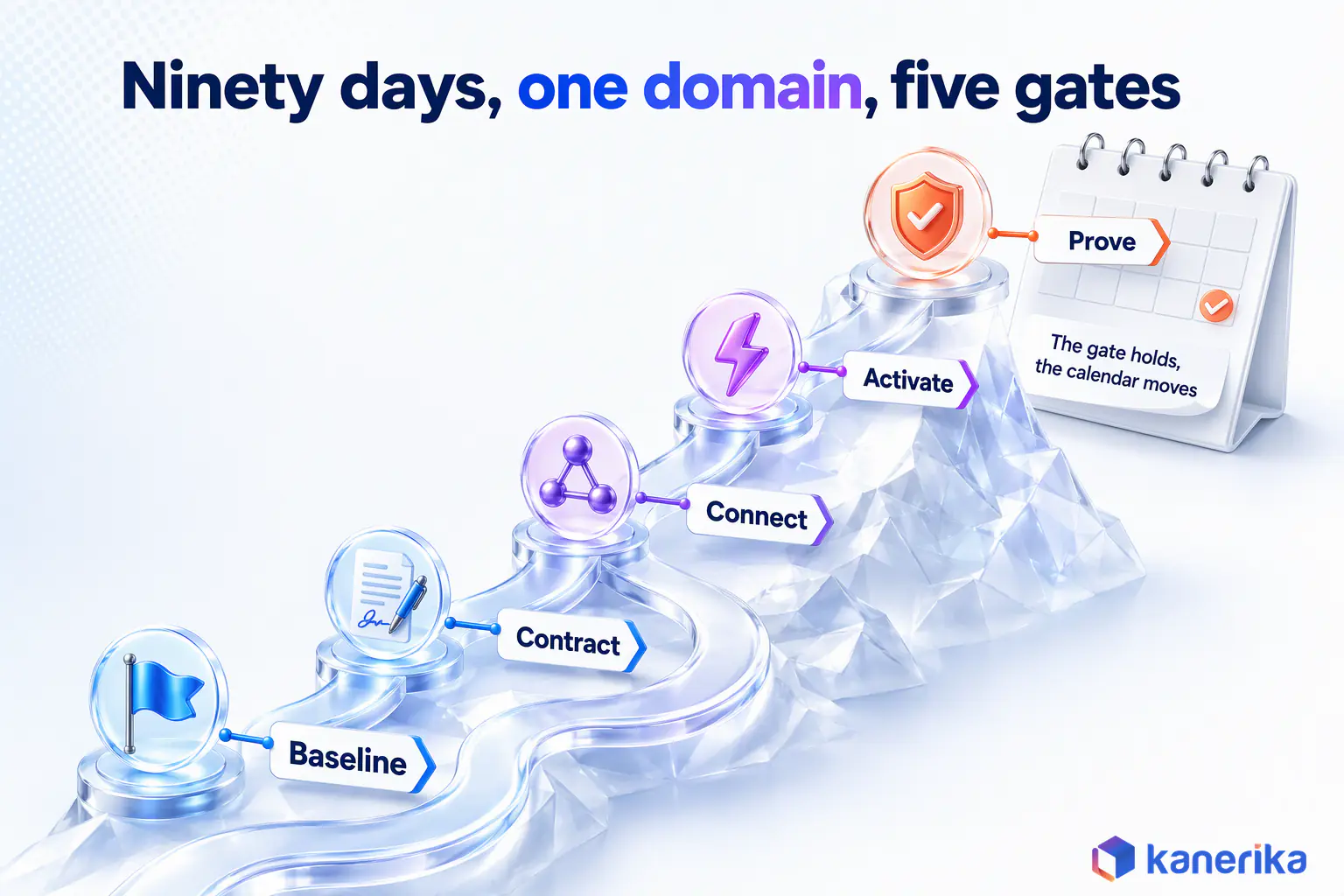
A metadata program starts with one domain, one business question and a fixed scope. Ninety days is a planning model for that first domain, and every phase ends at an exit gate rather than a date. If access, connectors or owners are not ready, the gate holds while the calendar moves.
Scope matters because the work takes real time. Kanerika’s data governance services page gives a realistic breakdown for a full governance program. Initial data discovery and classification takes 4 to 6 weeks, and business glossary and catalog setup takes 6 to 10.
Full program maturity takes 12 to 18 months. Policy framework and access control deployment (8 to 12 weeks) and compliance monitoring activation (4 to 8 weeks) fall outside this first-domain pilot. That is why this plan holds the first 90 days to one domain instead of the whole estate.
The same page says organizations that skip the assessment phase and jump straight to tool deployment extend their timelines by 30 to 50 percent. It also says most teams see measurable compliance gains within the first 60 to 90 days.
Five Phases, Each With an Exit Gate
- Days 1 to 15, pick the domain and baseline it. Choose a disputed question, such as monthly net revenue, then time how long five analysts take to find the right table.
- Days 16 to 30, agree the contract. Settle the required fields, the first 20 to 30 glossary terms and the owners, as well as who may see metadata about sensitive assets.
- Days 31 to 60, connect and fill. Connect only the scoped sources, reconcile identifiers and fill required fields before you test lineage on the reports that matter.
- Days 61 to 75, switch on one active workflow. Route a schema-change or stale-data alert to the owner, then log every decision.
- Days 76 to 90, prove it with real tasks. Train users and repeat the search test, then decide whether to scale, revise or pause.
| Phase | Accountable role | Exit gate |
|---|---|---|
| Days 1 to 15 | Data owner | Owner and steward named, so the baseline can start |
| Days 16 to 30 | Data steward | Owner signs off the contract before connectors run |
| Days 31 to 60 | Platform engineering | Required fields complete once sources are connected |
| Days 61 to 75 | Owner and engineering | A real change routed and then resolved |
| Days 76 to 90 | Program lead | Time to find is lower than the baseline |
Avoid the Pilot That Never Ends
A common way first programs stall is a pilot that never ends. Kanerika’s State of Enterprise AI & Data Modernization 2026 report, drawn from 161 documented engagements, lists it among five failure modes. It tends to begin with a demo that impresses everyone, built on a domain that nobody owns and nobody has scoped.
It calls this failure “pilot purgatory”, meaning impressive demos that never reach production. Its fix applies to metadata too. The pilot should already use the real catalog, the real access rules and the real stewards, so nothing has to be rebuilt later. The report’s wording is: build for production from pilot one on governed data, with a clear owner.
Metadata Management Best Practices and Common Challenges
Good metadata programs share a handful of habits, while failed ones fail in the same few ways. Kanerika’s data governance services page names the two most common governance failures. The first is deploying tools before the operating model is defined, and the second is launching enterprise-wide without a pilot.
For metadata, that means buying a catalog before owners exist, then cataloging everything at once. The six habits below prevent both.
- Start from a business question. A disputed metric gives the program a reason to exist.
- Automate capture, but keep meaning human-approved. Scanners harvest structure, while owners sign off definitions.
- Make ownership a required field. An asset without an owner never reaches certified status.
- Put metadata where people work. Definitions get read when they appear inside the BI tool or a chat assistant.
- Version definitions. Then an old report can be traced to the definition it used.
- Review on a schedule. Certification expires when its review lapses.
Common Challenges and Their Fixes
Most metadata problems trace back to a short list of causes, so the fixes are usually organizational rather than technical.
| Symptom | Likely cause | Fix |
|---|---|---|
| Entries go stale | Connectors break silently | Monitor scans as jobs, so failures get an owner |
| Search returns noise | Everything was cataloged at once | Certify critical assets first, then archive unused ones |
| Teams describe one thing differently | No shared standard | One contract and one glossary per domain |
| Definitions lose their owner | Turnover without a handover | Reassign ownership whenever roles change |
| Alerts get ignored | Too many low-value notices | Route only changes that touch certified assets |
Kanerika’s article on data governance best practices covers the policy side of these habits. Before a rollout, the enterprise data governance checklist also tests whether owners, policies and processes are ready.
Checklist
Enterprise Data Governance Checklist
Check owners, policies and processes against one practical list before you connect the first source to a catalog.
Get the Checklist →How to Measure Metadata Management
Success shows up as coverage, freshness and whether people find what they need, each against a baseline you record first. Targets should be agreed locally, because a regulated finance domain and a marketing sandbox need different thresholds.
| Metric | Formula |
|---|---|
| Ownership coverage | In-scope assets with a named owner, divided by in-scope assets |
| Required-field completeness | Assets with every contract field filled, divided by in-scope assets |
| Freshness compliance | Assets refreshed within their window, divided by assets that have one |
| Lineage coverage | Critical reports with source-to-report lineage, divided by critical reports |
| Discovery task success | Search tasks completed correctly, divided by tasks attempted |
| Time to find | Median minutes before a user locates the right certified asset |
Here is how the formulas read in practice. If 120 of 150 in-scope assets have a named owner, ownership coverage is 80%, so the 30 gaps become the steward’s first queue. Quality test results also count as operational metadata, and Kanerika’s guide to data quality tools covers how those tests are produced.
Kanerika’s data governance services page groups governance KPIs into technical, operational and business sets. Technical metrics cover catalog coverage, classification accuracy, policy compliance rate and access review completion. Business metrics, by contrast, include fewer conflicting reports and user adoption rate, and the page says leading governance services track 8 to 12 metrics monthly.
Datasheet
Microsoft Fabric Ontology for Governed Analytics and AI
Standardize KPIs in one governed ontology on Microsoft Fabric, so every report and AI assistant reads the same definition instead of conflicting versions.
Get the Datasheet →Metadata Management Tool Categories and How to Choose
The tools fall into four broad categories, and the right one depends on how many platforms you run. Kanerika’s metadata management tools guide compares ten platforms in detail, so this section only sorts the field.
| Category | Examples | Fits when |
|---|---|---|
| Standalone catalogs and governance suites | Collibra, Alation, Atlan, Informatica (now part of Salesforce) | Many platforms and heavy approval workflow |
| Platform-native catalogs | Databricks Unity Catalog, Snowflake Horizon Catalog, Microsoft Fabric OneLake catalog, Google Cloud Knowledge Catalog, AWS Glue Data Catalog | Most data sits on one platform |
| Open-source metadata platforms | OpenMetadata, DataHub | Engineering leads and wants APIs and control |
Pick the native catalog when one platform holds most of your data, only a few domains need governing and nobody needs lineage across systems. A cross-platform layer pays off once lineage has to follow a metric from an ERP through a lakehouse into Power BI. It also earns its cost when several domains share one approval workflow.
Platform-native catalogs have moved fast. Snowflake describes Horizon Catalog as a catalog for data inside or outside Snowflake. On AWS, the Glue Data Catalog stores the location, schema and runtime metrics of data sets, filled by crawlers that scan each source.
Google also renamed Dataplex Universal Catalog to Knowledge Catalog on April 10, 2026, keeping its API and IAM names. Kanerika’s guides to Databricks Unity Catalog and the Microsoft Fabric OneLake catalog cover the two most common choices.
How to Choose the Best Metadata Management Tools for Data Governance
Feature lists look alike, so test each shortlisted tool against one real asset instead. The net-revenue metric from earlier works well, because it touches a source table, two dashboards and a business owner.
| Test | What a pass looks like |
|---|---|
| Harvest | It scans the orders table and both dashboards without custom code |
| Lineage | It shows discount_amt flowing into the finance model and the sales dashboard |
| Workflow | A rename opens a review task for the finance owner, then logs the approval |
A tool that fails the workflow test will still fill a catalog. It just won’t keep the label true, which is the whole point.
Metadata Management Software Pricing: How Costs Are Structured
Cost follows the categories above. OpenMetadata and DataHub are released under the Apache 2.0 license, so there is no license fee. You still pay for hosting and the engineers who run them.
Platform-native catalogs bill by usage. On AWS Glue pricing, the first million Data Catalog objects are stored free, then each extra 100,000 objects costs $1.00 a month. Crawlers are billed by the second. For standalone suites, ask each vendor how users, connectors and scanned assets drive the quote.
What Changes for Microsoft Purview Users
Microsoft is retiring Purview’s data governance features, including Unified Catalog. New governance accounts can no longer be created, and existing capabilities stay in maintenance mode through November 12, 2027. Governance moves to the OneLake catalog in Microsoft Fabric, while Purview keeps its security and compliance role.
Microsoft’s transition guide advises moving metadata and ownership in waves. It also says to retire a Purview dependency only after documented acceptance criteria pass.
Kanerika has been one of the earliest Microsoft Purview implementors globally, and its Purview services start with a focused assessment and pilot. For an existing Purview deployment, the data governance services page lists an audit and gap analysis of the current configuration rather than a rip-and-replace. That audit is the sensible first step, because it shows which terms, owners and classifications are worth carrying into the OneLake catalog.
Moving metadata intact is the hard part of any such transition. In one Kanerika project, an automated process carried relationships, calculated tables, columns and security settings from SSAS into Microsoft Fabric. As a result, the business logic arrived with the data.
Case Study
40% Less Manual Maintenance After an SSAS to Fabric Migration
Kanerika automated the transfer of relationships, calculated tables, columns and security settings from SSAS to Microsoft Fabric, cutting manual maintenance effort by 40%.
Read the Case Study →Metadata Management for AI and Agents
AI raises the bar, because a model or an agent uses whatever context it gets without asking whether a definition is current. So lineage, ownership and permissions have to travel with the data into training sets, retrieval indexes and agent tools.
Kanerika’s State of Enterprise AI & Data Modernization 2026 report makes this concrete. “Documented data lineage and ownership” is one of ten checks in its data-foundation readiness checklist.
A score of 8 to 10 means AI-ready, whereas under 4 means fix the foundation first. The report also predicts that lineage and data quality become non-negotiable prerequisites before AI budgets are released.
- Provenance travels with the data. A retrieved passage should carry its source, version and glossary term.
- Permissions survive retrieval. A sensitivity label does not enforce access by itself, so the retrieval layer must check it.
- AI-written descriptions need review. They stay drafts until an owner approves them, a rule that belongs in your data governance framework.
Metadata as the Context Layer for Agents
Agents need a governed source of context, and open-source metadata platforms now pitch themselves as that source. OpenMetadata calls itself an open context layer for data and AI. It lists a metadata knowledge graph, 130+ connectors by the project’s count and an MCP server.
DataHub likewise describes itself as a context platform for data and AI. For how agents reach tools like these, see Kanerika’s guide to the best MCP servers.
The architecture behind that layer is in Kanerika’s piece on the AI data catalog. The policy side, such as who approves model inputs, sits in Kanerika’s guide to AI data governance.
How Kanerika Helps: Metadata Management Services and Consulting
So where does Kanerika fit in? Kanerika, your trusted partner for this work, runs it inside its data governance consulting. It follows the six-phase IMPACT methodology on its live services page: Initiate, Map, Plan, Activate, Check and Track.
Plan carries most of the metadata work, covering the business glossary, policies, classification rules and role assignments before any platform goes live. In practice, the catalog, lineage and glossary work runs through KANGovern, powered by Microsoft Purview, Databricks Unity Catalog and Concentric AI.
On the Microsoft stack, here’s the thing: Purview’s governance features are being retired, which is why new programs build around the Fabric OneLake catalog. An existing Purview estate starts with the audit described above. And the projects above show the pattern, from classification frameworks to one governed ontology shared by Power BI and AI.
Talk to Kanerika
Plan Your First Metadata Domain
Bring one disputed metric and its sources. Kanerika will map owners, required fields and a pilot scope for one domain in a short working session.
Book a Working Session →Start Metadata Management With One Metric You Can Trust
If you keep one idea from this guide, keep this one. Metadata stays useful only when a named person owns its meaning. Scanners will fill your catalog either way, but trust starts when someone with authority signs off “that’s our net revenue.”
And if the last few years sound familiar, you’re in good company. Teams tell Kanerika the same story: a catalog bought before anyone owned anything, everything described at once, then entries going stale. The good news is that starting small fixes most of it, since one owned domain with one live alert gives people a reason to care.
That’s the data governance work Kanerika does, as a Microsoft Solutions Partner for Data & AI and one of the earliest Microsoft Purview implementors globally. Its SSAS-to-Fabric project, for one, cut manual maintenance effort by 40%. So bring one disputed metric to a working session with Kanerika, and we’ll map its owners, required fields and pilot scope with you.
Want the bigger picture first? The State of Enterprise AI & Data Modernization 2026 report explains why documented lineage and ownership now come before AI budgets. Either way, we’d be glad to hear which jar label is giving your team trouble.
Frequently Asked Questions
What is metadata management in simple terms?
Metadata management is the practice of keeping the information that describes your data accurate, owned and easy to find. That information covers where data lives, how it is structured, what it means, who owns it and how fresh it is. It works like a label on a jar, and the job is keeping the label true.
What are the three main types of metadata?
The three working types are technical, business and operational metadata. Technical metadata describes structure, such as tables, columns and dependencies. Business metadata explains meaning, rules and ownership. Operational metadata records runs, refreshes, quality results and usage. One trusted metric needs all three, because each answers a different question about the same asset.
What is active metadata management?
Active metadata management treats metadata as a live signal instead of a static record. A schema change, failed quality test or new sensitive column becomes an event, and a rule routes it to the right owner as an alert or review task. Low-risk notices can be automated, while access and meaning changes still need a person to approve them.
What is the difference between metadata management and a data catalog?
A data catalog is a tool where people search and browse metadata about data assets. The discipline behind it decides what metadata is required, who owns it, how it stays current and where it appears. A catalog without that discipline fills with stale entries, so the catalog is the interface and management keeps it true.
How is metadata management different from master data management?
Master data management creates and maintains golden records for shared entities such as customers, suppliers and products. Metadata describes data of every kind, including those master records, by recording definitions, owners, sources, lineage and freshness. The two work together, because master data programs need well-managed metadata to explain where each golden record came from.
Who is responsible for metadata management?
The business owner of a data domain is accountable for its metadata, especially definitions, approved uses and access decisions. Data stewards keep descriptions, terms and tags current day to day. Platform and data engineers run the connectors and lineage capture, while security and privacy teams set the classification rules that drive access and retention.
What is metadata in a database management system?
In a database management system, metadata is the information the engine stores about its own objects, usually in a system catalog or data dictionary. It lists tables, columns, data types, keys, indexes, views, users and permissions. The database maintains it automatically, which makes it the easiest technical metadata to harvest into a wider catalog.
How do you start a metadata management program?
Start with one domain and one business question people already dispute, such as monthly net revenue. Measure how long it takes to find the right data today, agree a short metadata contract and name owners. Then connect only the scoped sources, switch on one active workflow and repeat the search test before you expand.
Why is metadata management important for AI?
AI models and agents use whatever context they receive, so stale definitions or missing permissions turn into wrong answers or exposed data. Managed metadata keeps lineage, ownership, versions and sensitivity labels attached to the data that feeds training sets, retrieval indexes and agent tools. Reviewed metadata also gives agents a governed source of business meaning.
Which metadata management tools are best for data governance?
The best tool matches how many platforms you run. If most data sits on one platform, its native catalog, such as Databricks Unity Catalog or the Fabric OneLake catalog, is usually enough. Many platforms and heavy approval workflows favor standalone suites like Collibra, Alation or Atlan, while engineering-led teams often choose OpenMetadata or DataHub.
How much does metadata management software cost?
It depends on the category. OpenMetadata and DataHub carry no license fee under Apache 2.0, though hosting and engineering cost money. Platform-native catalogs bill by usage: AWS Glue Data Catalog stores the first million objects free, then charges $1.00 per 100,000 objects a month. For standalone suites, ask how users, connectors and assets drive the quote.
How do I choose a metadata management services partner?
Ask for a pilot on one domain rather than an enterprise-wide rollout, and check that the partner defines owners and the glossary before installing tools. Kanerika, a Microsoft Solutions Partner for Data & AI, follows that order in its IMPACT methodology and starts existing Purview estates with an audit and gap analysis.