
TL;DR
Generative AI in enterprise is now a standing budget line, and 2026 favors buying over building and copilots over fully autonomous agents. Menlo Ventures puts enterprise generative AI spend at $37 billion in 2025, up from $11.5 billion in 2024. Enterprises purchased 76% of their AI use cases instead of building them, and coding tools took 55% of departmental spend. Agents are real but early, because Menlo counts only 16% of enterprise deployments as true agents. Model spend is also spreading across vendors, with Anthropic, OpenAI and Google holding most of it. Most EU AI Act rules have applied since August 2, 2026, so governance now belongs inside every AI budget.
Key Takeaways
- According to Menlo Ventures, enterprise spend on generative AI reached $37 billion in 2025, more than three times the 2024 total.
- Buying now beats building for most use cases, since 76% of AI use cases were purchased in 2025 compared to 53% in 2024.
- Copilots take 86% of horizontal AI spend and agent platforms only 10%, so assistants still carry most production work.
- Model spend is also multi-vendor, as Menlo estimates Anthropic at 40%, OpenAI at 27% and Google at 21% of enterprise LLM spend.
- Projects reach production only when data readiness, named owners, agent reliability and cost visibility are in place.
- The EU AI Act has applied broadly since August 2, 2026. Its high-risk rules follow on December 2, 2027, and on August 2, 2028 for AI built into regulated products.
A CIO Reopens the 2024 Board Deck
Picture a CIO preparing for the November budget review. When she opens the 2024 board deck, its AI slide asks for approval to run a few copilot pilots in two departments. Back then, the ask looked bold.
Her new slide asks different questions. Which agents get write access to the ERP system, and who signs off when they act? Which budget line pays for model usage that now arrives as a monthly bill? Who answers when an EU regulator asks how a hiring tool was tested?
That move from experiment to operating cost is the real story of the past two years. The scene is illustrative, but the numbers behind it are not.
Generative AI in Enterprise Has Become a Budget Line, Not a Pilot
Two years ago, the typical enterprise conversation about generative AI was about pilots. A chatbot ran in one team while a coding assistant ran in another, and each proof of concept had an end date.
By 2026 the conversation is about production, budgets and accountability. Menlo Ventures published its third annual report on the state of generative AI in the enterprise on December 9, 2025. That report counts $37 billion of enterprise spend in 2025. That is about 6% of the global SaaS market, so generative AI in enterprise budgets now sits beside established software categories.
This article explains what changed between 2024 and 2026 and why it matters for your next plan. It also covers where the money goes, which industries lead and how the technology stack is shifting. It then turns to the blockers, the regulation timeline and the questions every AI plan should settle in writing.
How Big Is Generative AI in Enterprise in 2026?
The short version is that nearly nine in ten organizations now use AI, and the spending curve is steep. Adoption stopped being the hard part some time ago, so the useful questions are about scale and return.
Stanford’s AI Index 2026 reports that organizational adoption of AI reached 88%. It also finds that generative AI reached 53% of the population within three years, faster than either the personal computer or the internet.
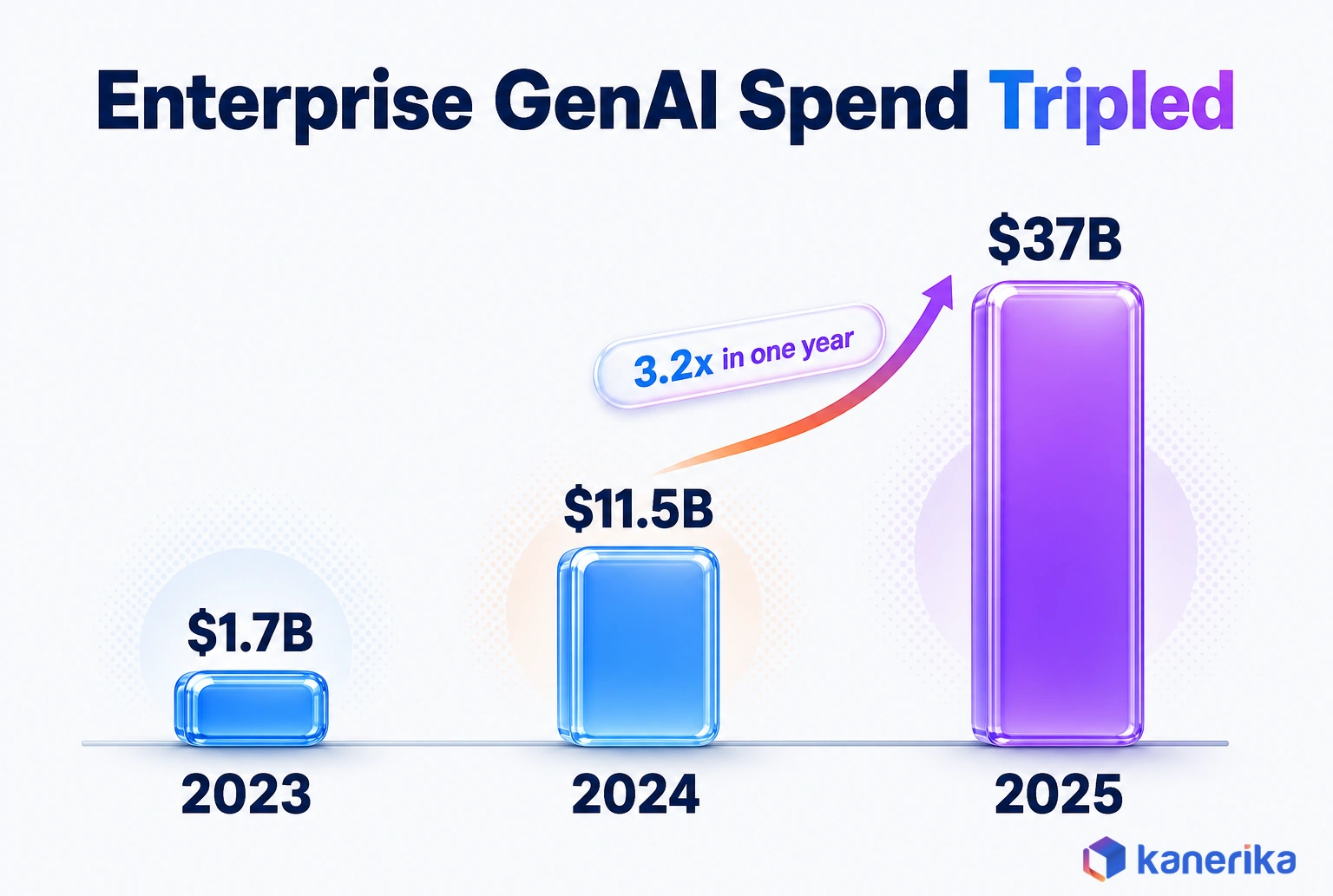
Spending tells the same story in dollars. The Menlo Ventures 2025 report combines a survey of about 500 U.S. enterprise decision-makers with a bottoms-up market model. It estimates enterprise generative AI spend at $1.7 billion in 2023 and $11.5 billion in 2024. Spend then reached $37 billion in 2025, a 3.2x jump in one year.
AI projects also convert at a higher rate than ordinary software purchases. According to Menlo, 47% of AI deals reach production, compared to 25% for traditional SaaS. In other words, close to half of AI evaluations end in a live deployment, nearly double the usual software rate.
The table below summarizes where enterprise generative AI stands, with the earlier value for comparison whenever the source gives one.
| Metric | Earlier figure | Latest figure | Source |
|---|---|---|---|
| Enterprise generative AI spend | $11.5B (2024) | $37B (2025) | Menlo Ventures |
| Infrastructure spend | $9.2B (2024) | $18B (2025) | Menlo Ventures |
| Share of AI use cases purchased | 53% (2024) | 76% (2025) | Menlo Ventures |
| Startups’ share of the AI application market | 36% (prior year) | 63% (2025) | Menlo Ventures |
| AI deals that reach production | 25% for traditional SaaS | 47% for AI | Menlo Ventures |
| Organizational AI adoption | n/a | 88% | Stanford AI Index 2026 |
Seven Shifts Reshaping Enterprise Generative AI in 2026
The headline numbers hide several separate changes, and each one alters a different decision. Some are about technology, such as agents and retrieval, while others are about money and rules. These seven matter most for planning.
1. From Chat Assistants to Agents That Act in Systems
An assistant answers a question, while an agent takes an action, such as filing a ticket or updating a customer record. That difference is why agents attract so much attention, and also why they need more care.
The money says agents are still early. Menlo counts $8.4 billion of horizontal AI spend in 2025, and agent platforms take only $750 million of it, about 10%. Copilots, in contrast, take 86%. Menlo also finds that only 16% of enterprise deployments and 27% of startup deployments qualify as true agents.
The capability is improving fast, though. On OSWorld, a benchmark of everyday computer tasks, the AI Index 2026 reports success rising from 12% to about 66%. Agents still fail roughly one attempt in three on structured benchmarks, so a person should approve actions that touch money, customers or records.
For a 2026 plan, the practical call is copilots for broad use and agents for narrow tasks with full logging and a clear approval step.
2. From One Model Vendor to a Multi-Model Portfolio
Model choice used to be a one-vendor decision for many teams, usually made during the first pilot. That habit has faded since model quality and pricing now shift every few months.
Menlo estimates that Anthropic held 40% of enterprise LLM spend in 2025, up from 24% a year earlier and 12% in 2023. OpenAI held 27%, and Google held 21%, up from 7% in 2023. In coding especially, Anthropic leads with 54% compared to 21% for OpenAI.
| Model provider | Share of enterprise LLM spend, 2025 (Menlo estimate) | Earlier share |
|---|---|---|
| Anthropic | 40% | 24% a year earlier; 12% in 2023 |
| OpenAI | 27% | 50% in 2023 |
| 21% | 7% in 2023 |
OpenAI’s share roughly halved since 2023 while Anthropic’s and Google’s grew, so model spend is now spread across providers.
Open-source models moved the other way, and their share of enterprise use fell from 19% to 11%. That drop suggests most enterprises prefer managed APIs rather than running models themselves.
Architects should avoid hard-wiring one provider. A thin routing layer lets teams pick a model per task and switch when price or quality changes.
3. Retrieval and Context Become the Real Engineering Work
The engineering effort has shifted, so the hard part is now what the model is allowed to see. Menlo reports that prompt design is the most common customization technique, followed by retrieval-augmented generation, or RAG.
RAG means the system first finds relevant passages in approved documents and then asks the model to answer from them. It usually costs less than training a model, and it stays current because the documents can change daily.
Standards are forming around this context layer as well. On December 9, 2025, the Linux Foundation formed the Agentic AI Foundation, with MCP, goose and AGENTS.md as founding projects. The announcement counts more than 10,000 published MCP servers. Our guide to the Model Context Protocol explains how MCP connects models to tools and data.
For enterprises, data becomes the hard problem. Permissions, document freshness and lineage decide whether an answer can be trusted. Unstructured files such as reports, contracts and emails also hold much of the value.
Case Study
55% Less Manual Effort with Generative AI Reporting
A leading conglomerate used generative AI to analyze years of unstructured market reports alongside its structured data, cutting manual analysis effort by 55% and improving decision-making accuracy by 30%.
Read the Case Study →4. From Building to Buying and Embedding
The build-it-yourself instinct of the early pilots has faded. Menlo finds that enterprises purchased 76% of their AI use cases in 2025, up from 53% in 2024.
Startups are taking much of that spend. Their share of the AI application market rose to 63%, up from 36%.
Buying wins on most tasks because vendors ship updates quickly and absorb model churn. Building still makes sense where proprietary data or a distinctive process is the competitive edge.
5. Bigger Bills as Usage Scales
Generative AI is billed by use, so success shows up as a larger invoice. Much of the spend growth described above is that effect at work.
Picture a support team that sends every ticket to the strongest model. After launch, ticket volume through the assistant doubles, and the invoice doubles with it. Now suppose the team routes simple tickets, such as password resets, to a smaller model. The strongest model handles only the hard cases, so each ticket costs less and the same growth produces a smaller bill.
The bill depends on volume and on which model handles each task. Our guide to measuring the ROI of generative AI shows how to set those baselines.
6. Budgets Move From Experiments to Permanent Lines
Spending now sits in operating budgets, and some of it never passes through IT at all. Menlo finds that 27% of AI application spend comes through product-led growth, where a team adopts a tool before IT buys it. The figure for traditional software, in contrast, is only 7%.
Counting tools that employees pay for on personal cards, the share is close to 40%. That money is real budget, but much of it sits outside procurement, security review and data policy.
The fix is to give that demand a governed home. A short catalog of approved tools, with clear data rules, turns shadow AI into managed spend.
7. Regulation Moves From Draft to Enforcement
The EU AI Act has moved from text to enforcement, and the EU AI Office and national authorities have been able to act on it since August 2, 2026. Take a CV-sorting tool for recruitment, which the European Commission names as a high-risk example. Rules for that area apply from December 2, 2027, so its testing and records must be ready first. That turns AI risk into a budget item, because testing, documentation and human oversight all take time and money. Any enterprise that sells into or operates in the EU should keep an inventory of its AI systems and their risk levels. The full timeline is in the governance section below.
Where the Money Goes: Departments and Use Cases in Production
Departmental tools give the clearest view of where generative AI earns its keep, because each one is bought by a team for a specific job. They also show which kinds of work were easiest to trust first.
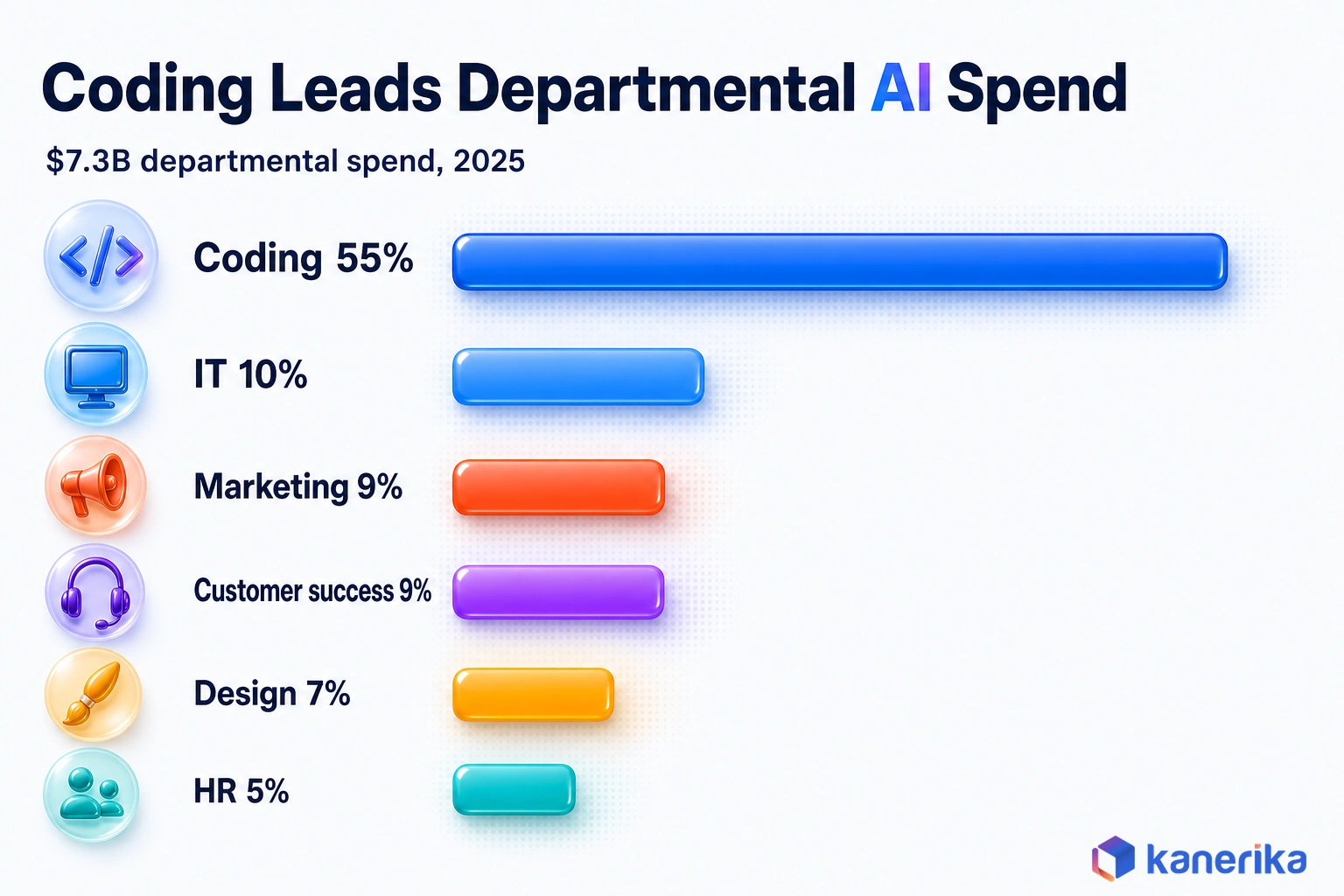
Menlo counts $7.3 billion of departmental AI spend in 2025, 4.1 times the prior year. Coding dominates at $4.0 billion, or 55%, up from $550 million. IT takes 10%, marketing 9%, customer success 9%, design 7% and HR 5%.
Coding leads because its output is easy to check. Code either passes its tests or it does not, so teams can trust the tool sooner. Menlo reports that 50% of developers use AI coding tools daily, rising to 65% in top-quartile organizations.
Within IT’s share, operations tools reached $700 million as teams automated incident response. Departmental tools are only one of three application buckets, though. Horizontal tools used across the company are larger at $8.4 billion. Copilots take $7.2 billion of that, agent platforms $750 million and personal productivity tools $450 million.
| Application category | 2025 spend | What it buys |
|---|---|---|
| Horizontal | $8.4B | Copilots, agent platforms and personal productivity tools used company-wide |
| Departmental | $7.3B | Coding, IT, marketing, customer success, design and HR tools |
| Vertical | $3.5B | Products built for one industry, led by healthcare |
The mix of use cases has settled too. Menlo finds that 59% of use cases are internal-facing, while 41% are customer-facing. Internal work tends to come first because mistakes stay inside the company while the team learns.
For worked examples by function, see our guide to generative AI use cases by department.
Industry Adoption: Where Vertical AI Is Pulling Ahead
Vertical AI means tools built for one industry, such as a documentation assistant made for hospitals. Because these products know the forms, terms and rules of their field, they reach production sooner. That fit with each industry’s rules and workflows is the theme of Kanerika’s rise of vertical AI infographic, a visual summary of domain-specific AI.
Menlo counts $3.5 billion of vertical AI spend in 2025, up from $1.2 billion. Healthcare alone accounts for about $1.5 billion, up from $450 million. That is 43% of all vertical spend and more than the next four verticals combined.
Healthcare moved first because clinical documentation is a heavy, repetitive load. A model can draft the note from a conversation, and the clinician checks it before signing, which keeps a professional accountable for the record.
The same pattern shows up in other industries. Adoption starts where documents pile up and an expert already reviews the output:
- Healthcare: clinical notes, medical coding support and patient messages.
- Legal: contract review, clause comparison and research drafts.
- Financial services and insurance: claims summaries, compliance reporting and service replies.
- Manufacturing and retail: supplier documents, product content and service knowledge bases.
This design suits industries with strict record-keeping rules, because the review step already exists and only the drafting changes.
The 2026 Enterprise Generative AI Stack
A stack is simply the set of layers a working AI system needs, from the model at the bottom to the application a person uses. Knowing the layers helps you see where the money goes and where projects break.
Infrastructure took $18 billion of 2025 spend, double the $9.2 billion of 2024. Foundation model APIs account for $12.5 billion and model training infrastructure for $4.0 billion. The layer for storage, retrieval and orchestration takes only $1.5 billion.
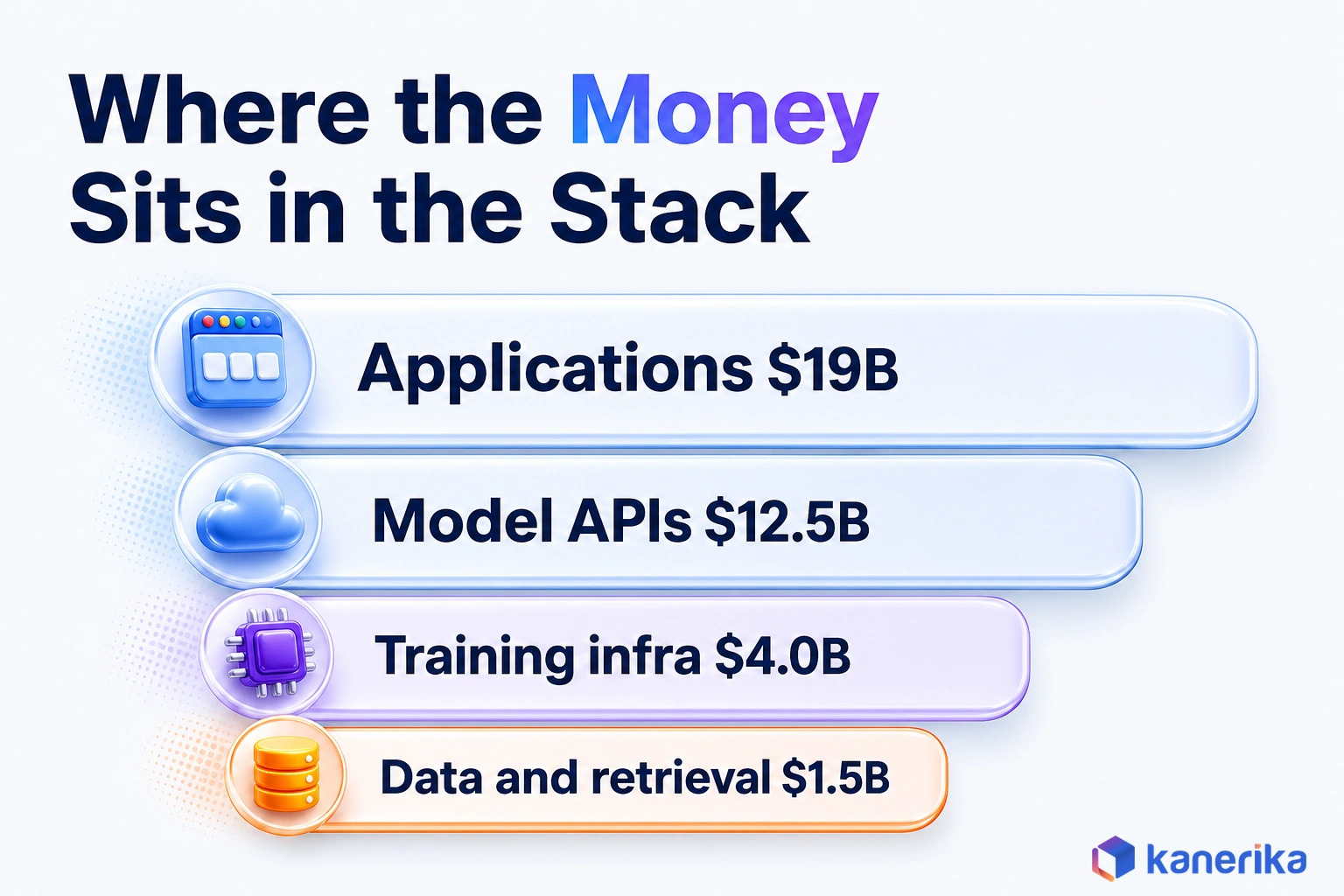
- Training and compute ($4.0B): infrastructure for training and fine-tuning models.
- Foundation model APIs ($12.5B): hosted models called per request.
- Data, retrieval and orchestration ($1.5B): connectors, vector search, MCP servers and access control.
- Guardrails and observability (no separate line in Menlo’s split): evaluation, monitoring, prompt-injection filters and cost tracking.
- Applications ($19B): copilots, agents and vertical products that people actually use.
That small data layer is especially worth watching. It is where retrieval, permissions and orchestration live, and it decides whether answers come from company data or from the model’s memory. Data platforms such as Databricks, Snowflake and MongoDB sit close to this layer, because retrieval runs on data they already hold.
Because guardrails and observability have no budget line of their own, plan one for them explicitly. Without it, problems surface only once a bad output reaches a user.
Should Enterprises Build, Buy or Embed Generative AI?
Every generative AI capability reaches the business in one of three ways. You build it on a model, you buy a product, or you switch on AI inside software you already own.
Take, for example, a legal team that wants faster contract review. It can buy a legal AI product or turn on the AI features of its document platform. It can also build a retrieval assistant on its own clause library. All three can work, but they differ sharply in cost, control and time to value.
In 2026 the default answer is to embed or buy first and to build only where your data is the edge. That matches the 76% purchase rate in the Menlo data. To compare products, see how to compare generative AI tools for business.
| Option | When it fits in 2026 | Data you need | Control | Main risk |
|---|---|---|---|---|
| Embed (AI inside existing software) | Work already done in a platform such as CRM, ERP or office suites | Data already in that platform | Admin settings | Limited customization |
| Buy a product | Common, well-defined jobs such as coding help or support drafting | Low, through vendor connectors | Vendor roadmap | Lock-in and unmanaged purchases |
| Build on foundation models | Proprietary data or a distinctive process sets your edge | High, clean and governed | Full | Cost, talent and upkeep |
When you do build, design choices such as tool access, memory and approval steps matter more than model choice. Our guide to custom AI agents covers those choices in detail.
Talk to Kanerika
Deciding Whether to Build, Buy or Embed?
Kanerika can review your shortlist of generative AI workflows and map which ones to embed, buy or build, based on your data, controls and budget.
Talk to an AI Expert →What Still Holds Enterprise Generative AI Back?
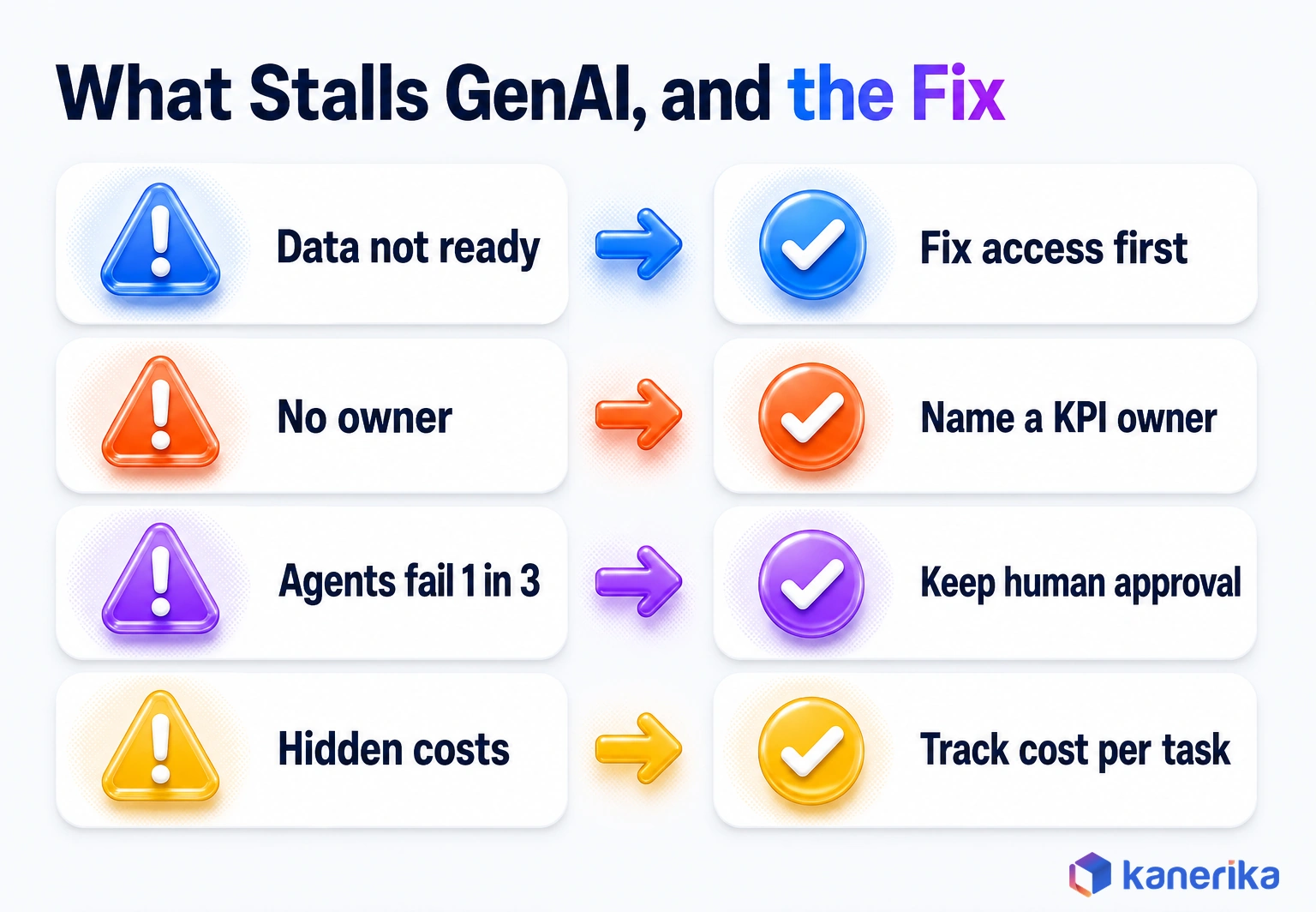
Spending on generative AI in enterprises is up, but plenty of projects still stall between demo and daily use. The causes are well known. Three are organizational and three are technical, and each one below has a practical counter.
- Data readiness and access control. Retrieval only works when documents are current, labeled and permissioned. A common first blocker is a shared drive with no clear owner.
- Pilots without owners. A pilot run by an innovation team often has nobody to own the KPI after launch. Assign a business owner and a baseline before the build starts.
- Agent reliability. The reliability gap from shift 1 still applies, so treat agent access as something earned. Start new agents read-only, log every action, and widen permissions only after a month of clean logs.
- Cost visibility. Usage-based bills are hard to forecast when nobody tags spend by use case. Track cost per task alongside accuracy from the first week.
- Security and shadow AI. Prompt injection and data leakage are especially serious threats for production systems. With close to 40% of AI application spend coming through self-serve purchases, some shadow AI tools reach company data before any security review.
- Skills. Teams need people who can design retrieval, write evaluations and read model output critically. Training the reviewers matters as much as training the builders.
None of these blockers is new, which is the encouraging part. Our guide to moving generative AI from pilot to production walks through the process stage by stage. Our LLM security guide also covers prompt injection and data leakage controls.
Failure Patterns to Test Before Launch
Security teams already share a checklist for these failures. The OWASP Top 10 for LLM Applications 2025 names the risks seen most in production, and four of them map to the blockers above.
- Prompt injection (LLM01): instructions hidden in a document or email steer the model. Test retrieval with planted text before launch.
- Sensitive information disclosure (LLM02): the model repeats data a user should not see. Enforce document permissions at retrieval time.
- Excessive agency (LLM06): an agent holds more functionality, permissions or autonomy than its task needs. OWASP advises human approval for high-impact actions.
- Unbounded consumption (LLM10): uncontrolled requests run up the bill, which OWASP calls denial of wallet. Set rate limits and per-user quotas.
Governance and Regulation Enterprises Must Plan For
Governance is the set of rules, owners and checks that decide which AI systems may run and how they are watched. In 2026 it rests on one binding law in Europe and two widely used voluntary frameworks.
In the United States, the NIST AI Risk Management Framework is the common reference. NIST released AI RMF 1.0 on January 26, 2023, and later added the Generative AI Profile, NIST AI 600-1, on July 26, 2024. NIST also states that the RMF is being revised as part of the White House AI Action Plan.
ISO/IEC 42001, the international standard for AI management systems, gives a third reference point. Mapping internal policy to all three lets one set of controls answer several audiences.
| Framework | Type | What it gives an enterprise |
|---|---|---|
| EU AI Act | Binding EU law | Risk tiers, banned practices, transparency duties and high-risk obligations |
| NIST AI RMF 1.0 and AI 600-1 | Voluntary U.S. framework, under revision | A shared method to govern, map, measure and manage AI risk, plus generative AI specifics |
| ISO/IEC 42001 | International standard | A management system for running AI responsibly |
EU AI Act Dates and the AI Omnibus
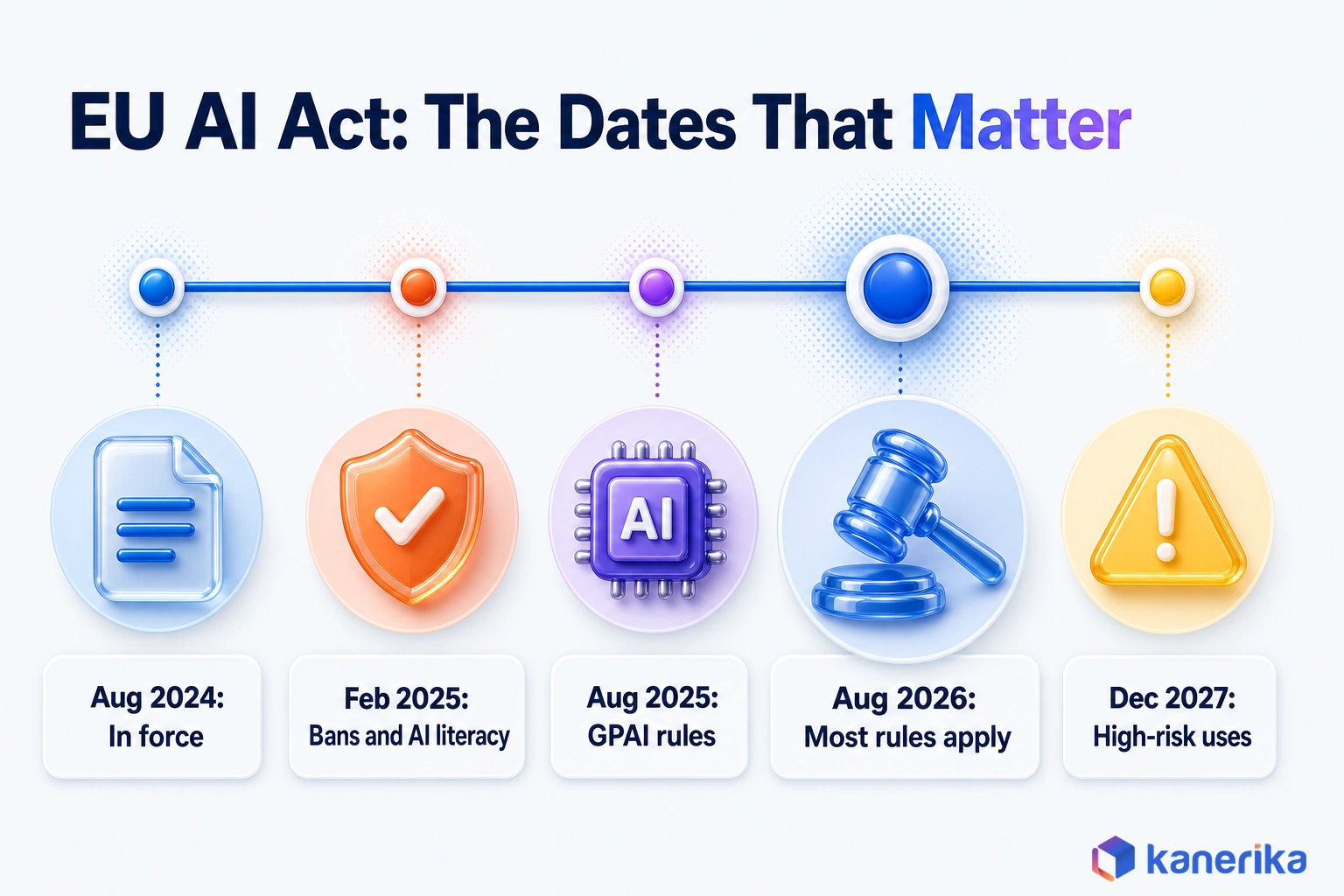
The EU AI Act sets the hard dates. Prohibited practices and AI literacy duties applied from February 2, 2025, and rules for general-purpose AI models then followed in August 2025. Transparency rules and enforcement by the AI Office and member states began on August 2, 2026.
The rules also changed along the way. Proposed on November 19, 2025 and agreed politically on May 7, 2026, the AI Omnibus entered into force on July 27, 2026. Since then, the Commission lists December 2, 2027 for high-risk uses in areas such as biometrics, critical infrastructure, education, employment and migration.
For a multinational, the practical step is one AI inventory that tags each system by risk level and region. Our guides to AI governance and sovereign AI explain how to set ownership and keep data where the rules require.
What This Means for Your 2026-2027 AI Plan
The shifts above turn into a short list of decisions that every AI plan should settle in writing. If your team cannot answer one of these questions, that gap is your next project:
- Which three to five workflows will carry production AI in 2027, and who owns each KPI?
- Which models serve which tasks, and can you switch providers without a rebuild?
- For each workflow, will you embed, buy or build, and why?
- Is the data those workflows need permissioned, current and traceable?
- How will you evaluate output quality before launch and every month after?
- Which budget line pays for usage, and who reviews it?
- Which systems fall under the EU AI Act, and will they be ready for December 2, 2027?
Some ideas on the list will turn out to be forecasting or scoring problems. So before you fund them, check how generative AI differs from predictive AI. For the business case itself, set a baseline for each workflow before launch, then compare cost and quality against it every quarter.
AI Assessment
How Ready Is Your Enterprise for Production Generative AI?
Score your data, processes, governance and skills in a short self-assessment, and see which of the questions above your foundations can already answer.
Start Your AI Assessment →How Kanerika Helps Enterprises Run Generative AI in Production
Kanerika builds generative AI systems that run inside existing workflows, with data foundations and governance in place before scale. Our view from delivery work is that the model is rarely the bottleneck. Instead, data access, retrieval quality and the review step decide whether a system earns trust.
A typical engagement starts with the data a workflow needs and then adds retrieval or an agent. Evaluation, access control and cost tracking come next, before any scale-up. Our generative AI consulting and development services cover each of those layers, from RAG design to agent guardrails.
One example shows the unstructured-data shift in practice. A leading conglomerate across electrical, automobile, construction and FMCG businesses had years of market reports that analysts read by hand. The work was slow, open to bias and disconnected from the structured sales data.
Kanerika built NLP, machine learning and sentiment models with automated collection and text analysis. The output joined the company’s structured sources and fed its reporting views, so insight arrived inside an existing workflow. The results:
- 55% less manual effort for analysis
- 30% more accurate decision-making
- 37% better at identifying customer needs
- 35% faster data processing
The project followed the same playbook described above, with grounded data first and an embedded workflow second.
Kanerika Service
Generative AI Consulting and Development
Kanerika grounds models in governed enterprise data, builds RAG assistants and agents with approval steps, and sets up the evaluation and cost tracking production use needs.
Explore Generative AI ServicesIs Your Enterprise Ready for the Next Phase of Generative AI?
The enterprises that pull ahead from here will treat generative AI like any other production system, with owners, budgets, tests and audit trails. They will buy where the market is mature and build where their data is unique. They will also give agents real work only after the checks are in place. So what is changing in 2026 is how enterprises buy, govern and pay for generative AI, now that using it is a given.
Frequently Asked Questions
How is generative AI used in business today?
Businesses use generative AI to write and review code, answer employee questions from company documents, draft marketing and support content, and summarize long reports. Coding is the largest departmental category, taking 55% of departmental AI spend in 2025 according to Menlo Ventures. Copilots used across the whole company form the largest horizontal category, at 86% of that spend.
Which industries use generative AI the most?
Healthcare leads vertical AI spending. Menlo Ventures estimates healthcare at about $1.5 billion in 2025, which is 43% of all vertical AI spend and more than the next four verticals combined. Legal, financial services, insurance, manufacturing and retail teams also use it for document-heavy work such as contract review, claims summaries and product content.
What is RAG and why do enterprises use it?
Retrieval-augmented generation, or RAG, finds relevant passages in approved company documents and asks the model to answer from them. Enterprises use it because answers stay grounded in current data, permissions can be enforced at search time and it usually costs less than training a model. Menlo ranks it second only to prompt design among customization techniques.
How do enterprises measure generative AI ROI?
Start with a baseline for each workflow before launch, such as hours per task, error rate or cycle time. After launch, compare those numbers with the full cost of the system, including model usage, integration, review time and monitoring. Track results by use case every month so the team can expand the winners and stop weak projects early.
What is the difference between enterprise AI and generative AI?
Enterprise AI is the broad term for any AI used inside a business, including forecasting, fraud scoring, recommendations and process automation. Generative AI is one branch of it that creates new content such as text, code, images and summaries. Most large organizations run both, using predictive models for scores and generative models for drafting and answers.
How long does it take to put generative AI into production?
Timelines depend on the data and the approach. Switching on AI inside software you already own can be quick, while a retrieval assistant on governed documents or a custom agent takes longer because of data preparation, testing and security review. Starting with one narrow workflow, a named owner and a measured baseline is the fastest reliable path.
How big is the enterprise generative AI market?
Menlo Ventures estimates enterprise generative AI spend at $37 billion in 2025, up from $11.5 billion in 2024 and $1.7 billion in 2023. Applications took $19 billion and infrastructure took $18 billion. That total is about 6% of the global SaaS market, which shows how quickly generative AI became a standard enterprise budget item.
What problems can generative AI solve for enterprises?
Generative AI handles work built on language and documents. It drafts code, emails and reports, answers questions from internal knowledge bases, summarizes long files and extracts details from contracts or market research. It works best where a person can check the output quickly, such as code that must pass its tests or a clinical note a doctor signs.
What is changing in enterprise generative AI in 2026?
Generative AI has become a permanent budget line, with spending that reached $37 billion in 2025. Enterprises now buy most of their AI use cases, spread spend across several model vendors and invest in retrieval and data access. Agents are growing but remain a small share of spend, and most EU AI Act rules have applied since August 2, 2026.
Which companies and models lead enterprise generative AI?
Menlo Ventures estimates that Anthropic holds 40% of enterprise LLM spend, OpenAI 27% and Google 21%. In coding, Anthropic leads with 54% of spend. Open-source models account for 11% of enterprise use, down from 19%. On the application side, startups now hold 63% of the AI application market, up from 36% in the earlier Menlo estimate.
Should enterprises build or buy generative AI?
Most enterprises should embed or buy first. They purchased 76% of their AI use cases in 2025, up from 53% in 2024, because products ship faster and absorb model changes. Building makes sense when proprietary data or a distinctive process creates the advantage, and when the team can maintain the system, its evaluations and its access controls.
What are the biggest challenges of generative AI in the enterprise?
The common blockers are data that is not ready for retrieval, pilots with no business owner, agents that still fail about one task in three on structured benchmarks, and bills nobody tracks by use case. Security matters too, especially prompt injection, data leakage and tools bought outside IT that reach company data before any review.
Are enterprises using AI agents in production?
Yes, though agents remain a small share of the total. Menlo Ventures finds that agent platforms took $750 million of $8.4 billion in horizontal AI spend in 2025, and only 16% of enterprise deployments qualify as true agents. Capability is rising quickly, so a sensible start is narrow agents that log every action and need approval for sensitive steps.
What regulations affect enterprise generative AI in 2026?
The EU AI Act is the main binding law. Most of its rules have applied since August 2, 2026. High-risk uses follow on December 2, 2027, or on August 2, 2028 for AI in regulated products. In the United States, the NIST AI Risk Management Framework and its Generative AI Profile serve as voluntary references, alongside ISO/IEC 42001.