
TL;DR
AI personalization beats fixed rules once you have steady behavior data. Rules still suit small catalogs and thin traffic. Use recommenders for product discovery in retail and media, and propensity or next-best-action models for offers and retention in banking and subscriptions. Buy a ready-made platform for speed, or build your own when your data is the edge. Start with clean customer data that people agreed to share. Before you scale, prove the lift against a random group that saw no personalization.
Key Takeaways
- AI personalization scores each person at each moment, while segmentation sorts people into a few fixed buckets.
- Every system runs the same loop: collect signals, resolve identity, predict intent, rank options, deliver, then learn from the response.
- Match the technique to your data, so content-based methods cover new items, hybrids cover long histories and propensity models cover offers.
- The data foundation decides results more than the algorithm, so fund identity resolution, consent and a feature store early.
- Measure lift against a randomized holdout group, and track guardrails such as unsubscribes and complaints next to conversion.
- GDPR Article 22 and California’s opt-out rights shape what you can automate, so design consent and review in from the start.
Two Visitors, One Product Page
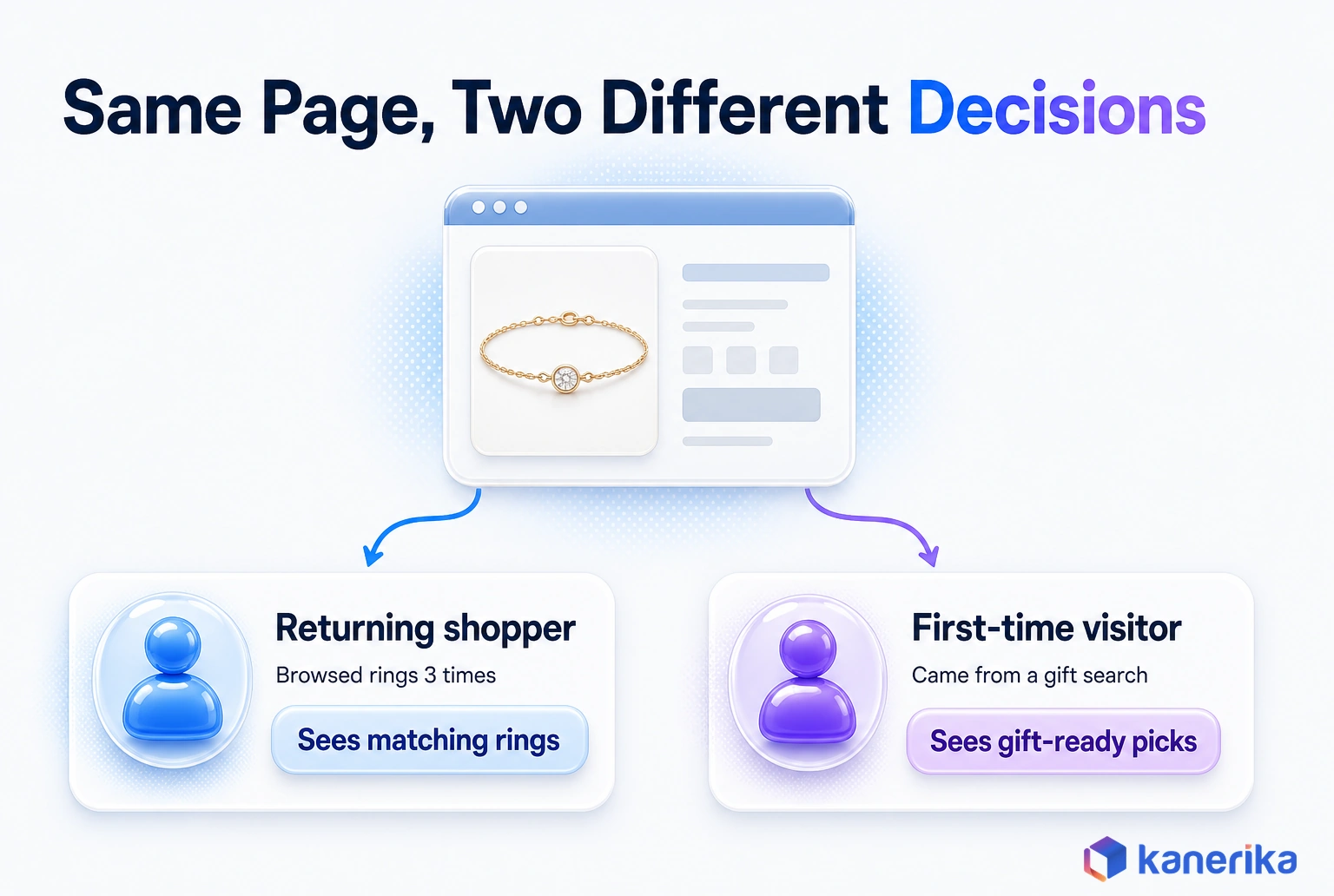
At 9 p.m. on a Tuesday, two people open the same product page for a silver bracelet.
The first is a returning customer. She has viewed rings three times this week, saved one to her wishlist and also opened an email about stacking sets. The second arrived from a search ad for anniversary gifts, and he has never visited the site before.
A rules-based site shows both of them the same “You may also like” row. An AI personalization system instead reads each visit on its own terms. She sees rings that match the bracelet, while he sees gift-ready picks with wrapping and a delivery date before the weekend.
Nothing about the page changed. What changed was the decision about what to show, and on a busy site that decision repeats with every page view.
What Is AI Personalization?
AI personalization is the use of machine learning to decide, for each person and each moment, which product, content, offer or message to show. Instead of following rules a marketer wrote in advance, the system learns from behavior and updates its choices as new signals arrive.
What makes it “AI” is prediction. A rule says to show winter coats to visitors from Chicago. A model, by comparison, estimates how likely this visitor is to click, buy or leave, and then ranks the options by that estimate. The gap shows at scale, since 20,000 items and a million visitors create more combinations than any team could write rules for.
| Approach | Decides by | Data it needs | How fast it updates | Example |
|---|---|---|---|---|
| Rules-based | If-then rules written by a marketer | A few attributes, such as location, device or traffic source | Only when someone edits the rule | A free-shipping banner when the cart passes a set value |
| Segment-based | Membership in a predefined group | Demographics, purchase history, recency scores | Weekly or monthly, so changes lag | A “lapsed high spenders” email |
| AI one-to-one | A model’s prediction for this person, then a ranked choice | Behavior events, context, item data and past outcomes | Per request or per session, while the visit is live | Homepage rows ranked for each visitor |
AI Personalization vs Traditional Personalization and Segmentation
Segmentation sorts people into buckets and treats everyone in a bucket the same way. It still works well for campaign planning, because people can read, debate and approve a segment. Its weakness is lag. A shopper who starts buying gifts instead of buying for herself stays in the old segment until the next refresh.
An AI model instead scores each person at each moment. When the same shopper clicks on a gift guide, her predicted intent changes within minutes, so the next page reflects it.
Mature programs usually run both side by side. Segments define who is eligible for an offer, while models choose which eligible offer each person actually sees. That split keeps human control over the rules, so the model only handles the volume.
What It Changes for the Business
The value of personalization shows up on both sides of a transaction. Customers spend less effort finding what they need, while the business turns the same traffic into more revenue and fewer service contacts. The table pairs each benefit with the KPI that proves it, because that pairing shapes the measurement plan later.
| Benefit for the customer | Benefit for the business | KPI that shows it |
|---|---|---|
| Relevant products sooner | More conversions from the same traffic | Conversion rate, add-to-cart rate |
| Offers that fit their situation | Better margin than blanket discounts | Average order value, discount cost per order |
| Fewer irrelevant emails and alerts | Fewer opt-outs, so customers stay longer | Unsubscribe rate, retention |
| Faster answers and guidance | Fewer contacts handled by agents | Contact rate, self-service resolution |
| Content that fits their role, region or stage | Shorter B2B sales cycles, especially for buying groups | Pipeline velocity, engagement by account |
One caution belongs here. None of these gains is automatic, and published consumer statistics also rarely transfer to a specific business. The number that counts is the lift you measure against your own holdout group, which the measurement section explains step by step.
AI Assessment
Is Your Data Ready for AI Personalization?
Take Kanerika’s AI maturity assessment to see where your organization stands on data, skills and governance before you pick a first personalization use case.
Start Your AI Assessment →How AI Personalization Works: From Customer Signal to Decision
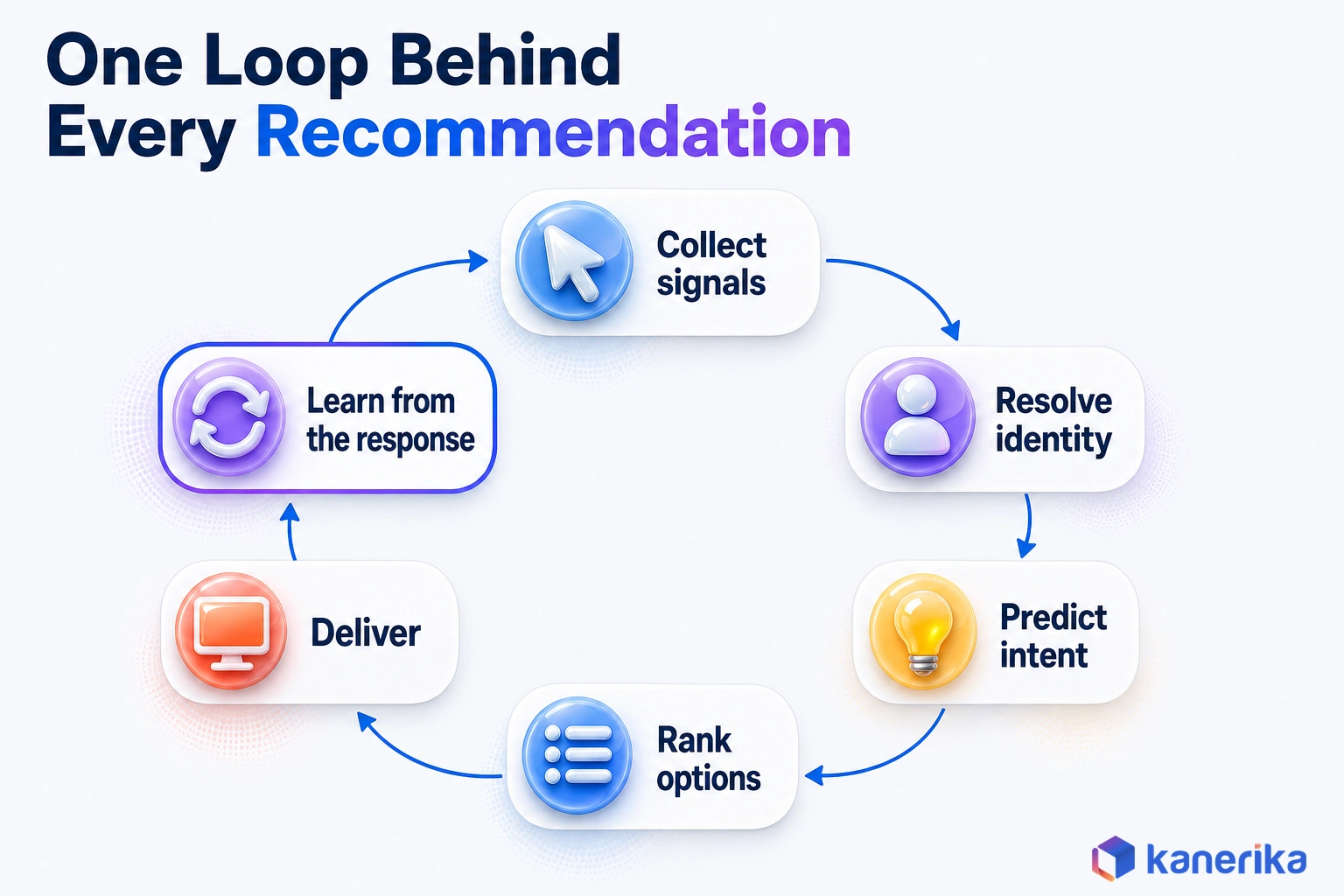
Every personalization system, from a product carousel to a bank’s offer engine, runs the same loop. It turns raw signals into a prediction and the prediction into a ranked choice, then learns from what the person did next. The six steps below follow the returning shopper from the bracelet page through that loop.
- Collect signals: The system captures events such as page views, searches, clicks, add-to-cart actions, purchases, email opens and app sessions. It also records context like device, time of day and referral source. For the bracelet shopper, that means three ring views and an opened email about stacking sets.
- Resolve identity and build a profile: Events from every channel are stitched to one person through a login, loyalty ID or hashed email. Each profile then stores that person’s consent status. Her click on that email is what ties tonight’s session to her account.
- Compute features and predict intent: Raw events become features, for example “viewed rings 3 times in 7 days” or “days since last order.” Models then use them to estimate what the person is likely to want right now.
- Generate and rank candidates: A fast first pass pulls a few hundred plausible items or offers. A ranking model then orders them, while business rules remove anything out of stock, below margin or over a contact cap. For her, that means a few hundred rings and necklaces, minus the sizes that are out of stock.
- Deliver in the channel: The top choices render on the page, in the app, in an email or on a service agent’s screen. Web decisions happen within milliseconds, while email can take minutes or hours. Her ring row renders before the product page finishes loading.
- Measure and feed back: Each response is logged as an outcome for the next prediction.
Step 6 in Practice: Closing the Feedback Loop
A critical element of AI personalization is the feedback loop. Every customer interaction—clicks, purchases, skips, or exits; feeds back into the system. Over time, the algorithms learn what works and continuously refine the recommendations, making personalization smarter and more accurate.
In the bracelet example, the loop closes when the shopper ignores the first row of rings but clicks a matching necklace. That skip carries information too, so the next ranking leans toward sets over single pieces.
Batch vs Real-Time Personalization: When Speed Matters
Speed costs money, so buy it only where intent changes fast. Batch personalization computes scores on a schedule, often overnight, and stores them until the next send or visit. Real-time personalization instead scores at the moment of the request, using what the person did seconds ago.
The rule of thumb is to match latency to how fast intent changes. Session intent, such as a search, a full cart or a browse path, fades within minutes, so it needs real-time scoring. A weekly email or a next-day offer, on the other hand, can run on batch scores at a fraction of the infrastructure cost.
| Dimension | Batch | Real-time |
|---|---|---|
| Latency | Hours to a day | Milliseconds to seconds |
| Typical uses | Email, push campaigns, next-day offers and call lists | Site search, product pages, cart and in-app feeds |
| Infrastructure | Scheduled jobs that write to warehouse tables | Event streaming, an online feature store and low-latency serving |
| Cost and effort | Lower, since jobs run off-peak | Higher; needs on-call support |
| Main risk | Stale scores when behavior changes | Latency spikes and serving errors under load |
Many teams start in batch, prove that the model works and then move only the high-value surfaces to real time. That order also keeps the expensive infrastructure tied to decisions that have already shown lift. Batch scores often reach email tools through reverse ETL, which syncs warehouse tables into those apps.
Core AI Personalization Techniques and When to Use Each
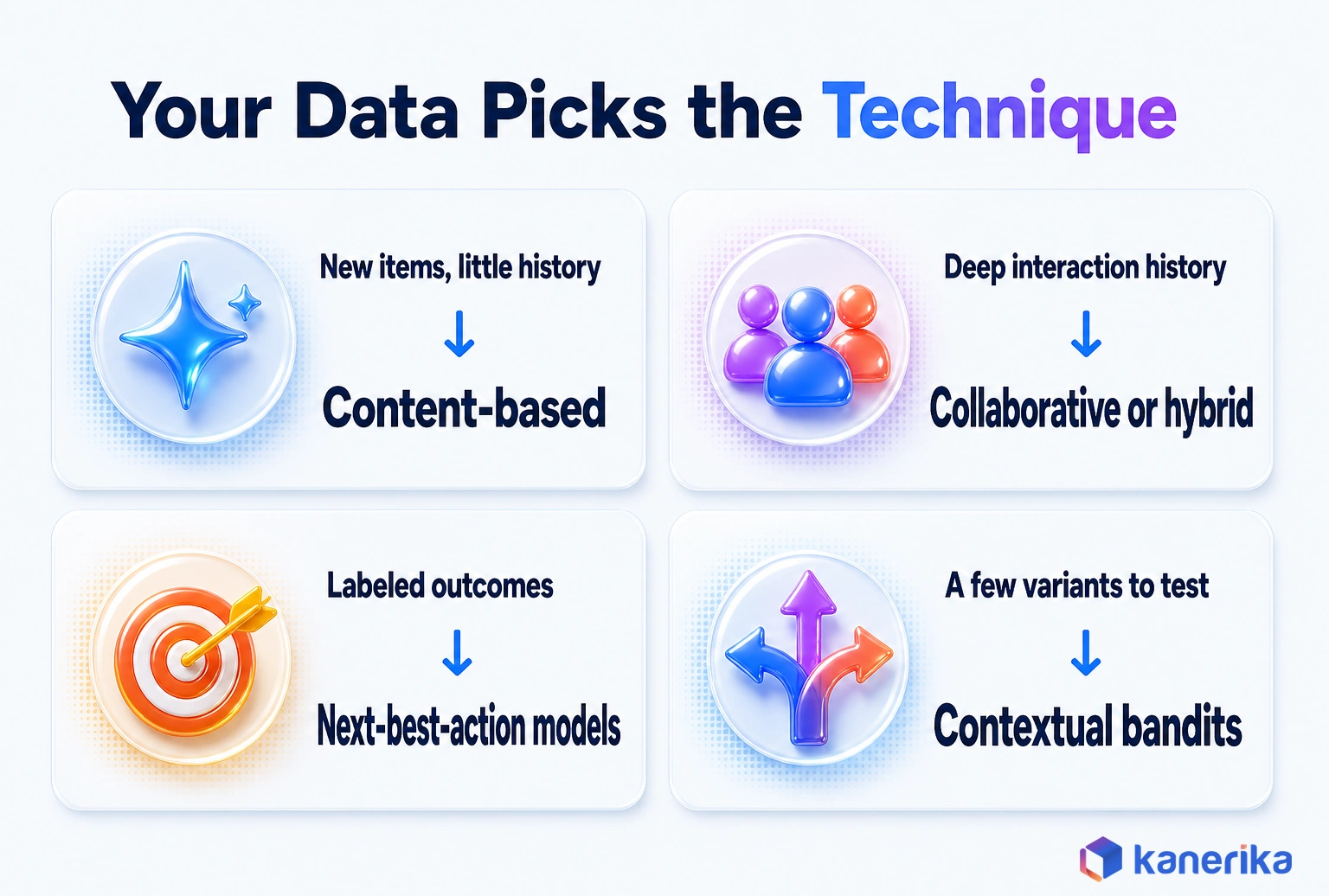
Each technique answers a different question, from what similar people buy to which of five banners a visitor should see. Each also needs different data, so pick by the data you hold to avoid a method your history cannot feed.
| Technique | Best for | Data needed | Cold-start behavior | Example |
|---|---|---|---|---|
| Collaborative filtering | Large catalogs with long interaction history | User-item interactions, such as views, purchases and ratings | Weak when users or items are new | “Customers who bought this also bought” |
| Content-based filtering | New or long-tail items in niche catalogs | Item attributes plus the person’s own history | Handles new items well, since it needs no crowd data | Similar products by style, brand or material |
| Hybrid recommender | Production recommendations at scale | Interactions plus item and user attributes | Falls back on content signals when history is thin | Ranked homepage rows |
| Propensity and next-best-action | Offers, retention and cross-sell | Labeled outcomes, such as purchases, churn or responses | Needs history for each outcome before it predicts well | Choosing a retention offer for an at-risk subscriber |
| Contextual bandits | Choosing among a few variants per visitor | Context features plus live rewards such as clicks | Learns while it serves | Picking one of five hero banners |
| Generative AI | Copy, images and summaries per segment or person | Product data, brand rules and approved claims | Works from prompts, but needs review | Personalized product descriptions |
| Conversational and agentic | Guided selling and service | Catalog, policies and conversation history | Asks questions until the gaps are filled | A stylist assistant that recommends, then adds to cart |
Read the table from the data column first. If most of your products are new each season, collaborative filtering will struggle, so lean on content-based and hybrid methods. When you hold years of offer responses, propensity models are the fastest path to value.
Collaborative Filtering
Collaborative filtering recommends what people with similar behavior chose. Suppose many shoppers who bought a bracelet also bought a matching ring. The ring then becomes a candidate for the next bracelet buyer, even though nobody tagged the two as related. Its strength is discovery, because it finds links that product data never describes.
The weakness is the cold start. A new item has no interactions, so it rarely gets recommended, and a first-time visitor has no history to compare. Popular items also tend to win more exposure, which can bury the long tail unless the model corrects for popularity.
Content-Based and Hybrid Recommenders
Content-based methods compare item attributes with what a person has engaged with. Those attributes include category, color, material, price band and text embeddings of the description. Because they need no crowd history, these methods can recommend a new item from its first day in the catalog.
Production systems usually blend the two approaches. A hybrid recommender uses collaborative signals where history is deep and content signals where it is thin. A ranking model then weighs both together with context.
Managed services follow the same pattern. According to AWS, Amazon Personalize is a “fully managed machine learning service” that turns your data into item recommendations for your users. It also produces user segments and real-time next-best-action recommendations.
Propensity and Next-Best-Action Models
Propensity models predict the likelihood of one outcome, such as buying, churning or responding to an offer. They belong to the same family of predictive analytics models used for demand and risk, although here they train on customer outcomes.
Next-best-action adds a decision layer on top of those scores. The system rates every eligible action for a customer, including a retention discount, a product tip or no contact at all. Then it applies business rules like contact caps and margin floors before anything is sent. The data, models and KPIs behind next-best-offer work are laid out in our guide to predictive analytics in marketing.
The “no contact” option matters more than it looks. A bank might hold back a card offer from a customer who filed a complaint yesterday. It does so even though the model rates her as likely to accept.
Contextual Bandits and Automated Experience Selection
A standard A/B test splits traffic evenly until the test ends, then crowns one winner for everyone. A contextual bandit shifts traffic toward better variants while the test runs. It can also pick a different winner for each kind of visitor. That makes it a good fit for hero banners, subject lines and layouts, where you have a handful of options and fast feedback.
Commercial tools package this approach. Adobe’s documentation says Target’s Auto-Target feature “uses advanced machine learning to select from multiple high-performing, marketer-defined experiences.” As of October 2026, Adobe lists Auto-Target as part of Target Premium. The marketer still designs every experience, while the model decides who sees which one.
Generative AI for Personalized Content
Generative models change what can be personalized. Earlier systems chose among assets a team had already made, which is the core split between generative and predictive AI. A language or image model, by contrast, can draft a product description, an email opening or a banner variant for each segment. It can even write one for each person, so the content library stops being the bottleneck.
Once drafting is cheap, the bottleneck becomes control. Generated copy can invent product claims, drift off brand or state the wrong price. Production setups therefore ground the model in approved product data, often through retrieval-augmented generation, and send new templates through human review. For more patterns, see these generative AI use cases.
Conversational and Agentic Personalization
Conversational personalization works through dialogue. Instead of guessing intent from clicks, a shopping or service assistant asks a question or two and recommends from the catalog. It can then take the next step, such as building a cart or booking an appointment. Each answer is a strong signal that a click stream never provides.
Agentic assistants raise the stakes on data and rules, because they act as well as suggest. They need the same profile, catalog and policy data as a recommender, plus clear limits on what they may do without a person. Our overview of agentic AI trends covers where these assistants are heading. The Kanerika project described later follows this pattern in luxury retail.
Case Study
48% Faster Client Prep with AI-Powered Clienteling
See how Kanerika used AI-powered clienteling to personalize in-store and online experiences, with 48% faster client prep.
Read the Case Study →AI Personalization Use Cases by Industry
The loop and the techniques stay the same from one industry to the next, while the data, the decision and the risk change. A retailer optimizes for basket size, a bank for the right offer under lending rules and a clinic for whether a patient shows up. The table maps each industry to its typical use case and the KPI that proves it.
| Industry | Use case | Data used | KPI |
|---|---|---|---|
| Retail and ecommerce | Product recommendations, search ranking and personalized offers | Browse and purchase events, catalog and inventory | Conversion, average order value, add-to-cart rate |
| Banking and financial services | Next-best-offer, onboarding journeys, service routing | Transactions, products held and service history | Product uptake, retention, complaint rate |
| Healthcare | Appointment reminders, outreach and care-program content | Scheduling data, but only with consented contact preferences | No-show rate, program enrollment |
| Media and entertainment | Content ranking, artwork selection, playlists | Viewing or listening history, session context | Watch or listen time, retention |
| B2B | Account-based content, role-specific journeys | Firmographics, intent signals and CRM activity | Pipeline velocity, meeting rate |
| Internal and employee | Onboarding paths, knowledge search, learning | Role, team and tool usage | Time to productivity, search success rate |
Retail and Ecommerce
Retail is where most teams start, because events, catalog and outcomes are already digital. Typical surfaces include homepage rows and “complete the look” on product pages, as well as search ranking, cart add-ons and post-purchase email.
Store data matters too, since kiosks and clienteling apps can use the same profile. An online browse can then shape an in-store suggestion. Strong programs build on solid retail data analytics first, since inventory and margin data decide which recommendations are worth showing.
Case Study
52% Higher Add-to-Cart Rate with AI Stylist Karl
Kanerika deployed Karl, a virtual stylist trained on a luxury jewelry and apparel retailer’s catalog and lookbooks. The project delivered a 52% increase in add-to-cart rate, a 29% uplift in average order value and a 41% reduction in customer service workload.
Read the Case Study →Banking and Financial Services
Banks use personalization for next-best-offer, onboarding and service. The model might rank a savings product, a card upgrade or simply a fraud-alert explainer when a payment was just declined. Because credit decisions fall under fair-lending and consumer-protection rules, offer models need documented features, bias testing and a review path. These offer engines usually sit inside a wider program of digital transformation in banking.
Healthcare
Healthcare providers personalize outreach, while the treatment itself stays with clinicians. Typical uses include reminder timing, channel choice and the educational content a patient receives before a procedure. Patient records count as protected health information under HIPAA, so consent, minimum-necessary access and a clear line between outreach and clinical advice come first. That outreach usually builds on existing data analytics in healthcare.
Media and Entertainment
Streaming and publishing services rank what each person sees on the home screen. They also pick the artwork or headline shown for a title and assemble playlists from listening patterns. Since the goal is long-term engagement, good teams balance short-term clicks against variety to avoid filter bubbles and fatigue.
B2B Buying Groups
In B2B, the unit of personalization is the account as well as the person. Signals come from several people at one company, for example a CFO reading pricing pages and an engineer reading API docs. Each member then gets role-specific content, while an account-level score tells sales when the group is ready to talk.
Internal and Employee Personalization
The same methods also work inside the company. New hires can get an onboarding path based on role and location, while knowledge search ranks answers by team and past use. These projects carry less regulatory risk than customer programs, so they are a useful place to build skills before going external.
The Data Foundation AI Personalization Depends On
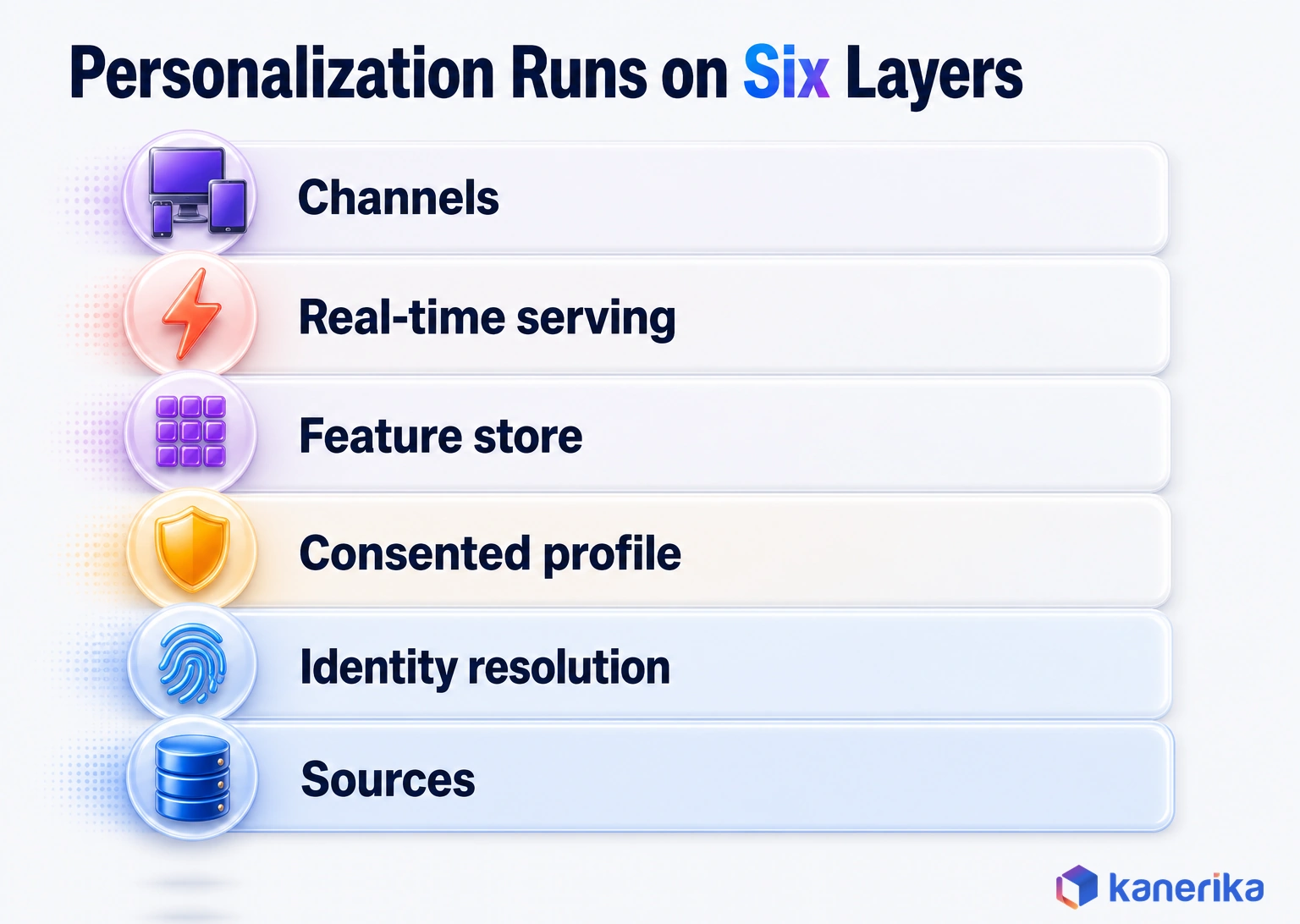
Models get the attention, but the data layer decides most results, and bad data quality undoes even a strong model. A strong ranking model fed a fragmented profile will still recommend a jacket the customer bought last week. That happens because the store purchase never reached the web profile. The foundation has six layers, and each has a failure mode worth naming.
- Sources: web and app events, orders, catalog, CRM and store systems, which fail when events go missing or arrive late.
- Identity resolution: matching devices, emails and loyalty IDs to one person, which fails when duplicates split one customer into three.
- Consented profile: one record per person with permissions attached, which fails when it holds data the person never agreed to share.
- Feature store: shared, versioned features for training and serving, which fails when the two use different definitions.
- Real-time serving: low-latency access to features and models, which fails when timeouts fall back to generic content.
- Channels: web, app, email, contact center and store, which fail when each channel runs its own logic.
Anonymous visitors still get personalized experiences. With no profile, the system relies on session and context signals, such as the search query, landing page, referral source and items viewed so far. When the visitor logs in or clicks an email link, identity resolution stitches that session into the profile, so the early clicks are not lost.
The pipelines that move this data are a discipline of their own, covered in our guide to building an AI data pipeline. For budgeting, the practical point is simple. Plan for integration and identity work to take a large share of the effort, often more than the model itself. Tracking data lineage shows which upstream change broke a recommendation.
Build, Buy or Hybrid: Choosing an AI Personalization Platform
The platform decision comes down to where you want control and how fast you need results. Packaged suites can ship working features quickly, but they decide much of the logic for you. Custom models give full control over data and ranking, although they need a team that can run them in production.
| Option | Control | Time to value | Skills needed | Lock-in risk |
|---|---|---|---|---|
| Packaged personalization suite | Low to medium | Fastest, since features come ready-made | Marketers and analysts | High, because logic lives in the vendor’s tool |
| Cloud ML service | Medium to high | Moderate | Data and ML engineers | Medium |
| Custom models on your data platform | Highest | Slowest, until the team is in place | Data science and MLOps team | Low |
| Hybrid | High where it matters | Moderate | Mixed team with clear roles | Medium |
Many enterprises end up with a hybrid. They buy experience testing and email tooling first. Then they build ranking models where their own data is the edge, such as margin-aware product picks or a bank’s offer engine.
Vendor Categories and When Each Fits
Vendors fall into a few categories, so the table below describes one example of each in the vendor’s own terms. It maps categories without ranking them, because the right pick depends on the stack you already run.
| Category | Example, as the vendor describes it | Fits when |
|---|---|---|
| Managed recommendation service | Amazon Personalize, a fully managed machine learning service for item recommendations, user segments and real-time next-best-action | When you have engineers and want AWS-hosted models on your own data |
| Retail search and recommendations | Google Cloud AI Commerce Search, part of Gemini Enterprise for Customer Experience, with recommendations as well as real-time user events | When retail search and product discovery already run on Google Cloud |
| Experience optimization | Adobe Target Auto-Target, a Target Premium feature that picks among marketer-defined experiences for each visitor | When your marketing team already works in Adobe Experience Cloud |
| CRM-linked personalization | Salesforce Personalization, while existing Marketing Cloud Personalization customers can keep their instance | When customer data and journeys already live in Salesforce |
| Other optimization platforms | Dynamic Yield, Optimizely | When none of the categories above matches your stack; confirm features in a trial on your own data |
The descriptions come from each vendor’s documentation as of October 2026, including the Google Cloud AI Commerce Search overview and the Salesforce Personalization page. Readers comparing full marketing suites can also go deeper with our roundup of AI marketing automation tools.
The build-or-buy call is rarely only technical. Ownership of customer data, the cost of switching later and the skills you can hire all weigh in. The short video below covers how to weigh custom AI against off-the-shelf products.
What Drives the Cost
Personalization budgets depend less on license fees than on the work around them. The main cost drivers are these:
- Data integration: connecting events, orders, catalog and CRM data before any model trains.
- Identity and consent: resolving people across devices while storing their permissions.
- Real-time infrastructure: streaming, an online feature store and model serving.
- Licenses: suites, cloud services or a customer data platform.
- Model operations: monitoring, incident response and scheduled retraining.
- Experimentation: holdout design and test tooling, then analysis of each test.
- People: data engineers, ML engineers and analysts, plus a product owner.
Because the biggest items are data and people, a cheap license can still lead to an expensive program. Price the full stack over three years before you compare vendors.
Platform Selection Checklist
Bring these questions to vendor demos as well as to your own design reviews.
- Which of our use cases does it support out of the box, and which need custom work?
- Can it read our existing events and profiles, or does it need its own tracking?
- How does it resolve identity when one person uses several devices?
- Where is customer data stored, and can we delete one person’s data on request?
- What latency does it reach for real-time decisions when traffic peaks?
- Can we add business rules, such as contact caps, margin floors and exclusions?
- Does it support holdout groups, and does it also report incremental lift?
- Can we export models, features and results if we leave?
- How are generated content and automated decisions logged for audit?
- What skills does our team need before it can run the tool day to day?
How to Measure AI Personalization: Lift, Holdouts and KPIs
Measuring personalization means answering one question: what happened that would not have happened without it? Clicks on a recommendation row cannot answer that, because some of those people would have bought anyway. The answer comes from comparing a personalized group with a random group that did not get personalization.
Measurement works at two levels. Offline metrics test a model on historical data before launch, the same discipline covered in our guide to AI data analysis. Precision@K, for example, counts how many of the top K picks were relevant, while NDCG checks whether the best items sit near the top. Online metrics then test the live system on real customers, and guardrail metrics make sure the lift is not bought with damage elsewhere.
| Metric type | Examples | What it tells you | When to use it |
|---|---|---|---|
| Offline | Precision@K, recall@K, NDCG | Whether the model ranks known good items well | Before launch, on held-out history |
| Online | Conversion, average order value, retention and incremental revenue | Whether customers behave differently when personalized | During pilots and in production |
| Guardrails | Unsubscribe rate, complaints, fairness across groups | Whether gains cause harm somewhere else | Always, alongside online metrics |
A Worked Holdout Example
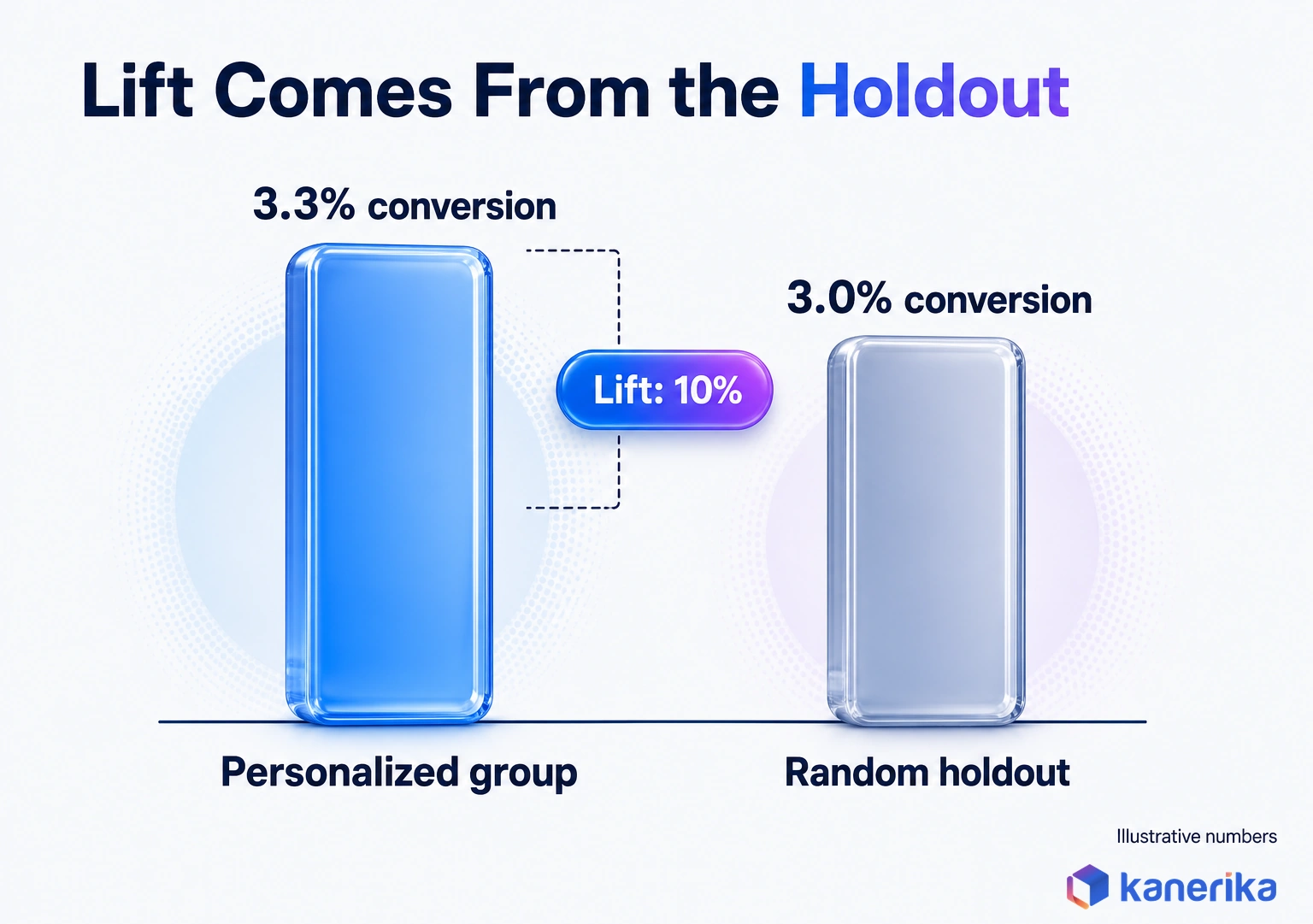
Here is a worked example with illustrative numbers, not benchmarks. A retailer sends 90% of 500,000 visitors to personalized product pages and keeps a random 10% on the standard pages as a holdout. The personalized group converts at 3.3%, while the holdout converts at 3.0%.
The relative lift is 0.3 percentage points divided by 3.0%, or 10%. Across the 450,000 personalized visitors, that gap equals 1,350 extra orders (450,000 × 0.3 percentage points). Only those orders can be credited to personalization. The other 13,500 orders would have happened anyway. At 100,000 visitors the same gap would not clear significance, which is why holdout size is planned before launch.
Three rules keep the comparison honest. Assign the holdout at random, keep it unexposed for the full test and size it so the expected lift stands out from noise. A holdout that still receives personalized email while seeing standard pages measures nothing clean. Dashboards in AI analytics tools can track these metrics, but the holdout design still has to come from your team.
Risks and Governance: Privacy, Bias and Over-Personalization
Personalization uses personal data to make decisions about people, so it carries risks that a static website does not. Four of them show up again and again in real programs, and each has known controls. A clear data governance program also makes all four easier to manage.
Privacy and Consent
Two laws shape most programs that serve European or Californian customers. GDPR Article 22 gives people the right not to be subject to a decision based solely on automated processing, including profiling. That right applies when the decision has legal effects or similarly significant effects on the person, with exceptions for contracts, legal authorization and explicit consent.
Product recommendations rarely reach that bar, while credit, pricing and eligibility decisions can. In California, the CPRA (Proposition 24, passed in November 2020) amended the CCPA. The law gives consumers the right to opt out of the sale or sharing of their personal information, including through the Global Privacy Control signal.
In practice, attach consent status to the profile, check it at decision time and record why each automated decision was made. This is general information and not legal advice, so confirm your obligations with counsel.
Bias and Unfair Outcomes
Models learn from past behavior, but past behavior can encode unequal treatment. An offer model trained on who accepted premium cards may show them less often to groups that were rarely offered them before. Test outcomes across customer groups before launch and monitor them after, the same discipline used in AI risk management for credit and fraud models.
Over-Personalization and Customer Fatigue
Relevance has a ceiling. A message that hints at a health condition the customer never shared with the brand feels intrusive, however accurate the model was. Showing the same item for weeks after someone bought it sends a different signal, namely that nobody is paying attention.
Analyst research puts numbers on this risk. A Gartner survey published in June 2025 polled 1,464 B2B buyers and consumers in November and December 2024. It found that personalized marketing created negative experiences for 53% of customers. Those customers were 3.2x more likely to regret a purchase and 44% less likely to buy again. Yet the same survey found that customers who experienced personalization were 1.8x more likely to pay a premium.
Practical controls include frequency caps per channel, suppression after purchase and cooling-off periods for sensitive categories. A short “why am I seeing this?” note also helps. Letting customers edit their own preferences can then turn a creepy moment into a useful one.
Generative AI Accuracy and Brand Safety
Generated content adds a risk that ranking models do not have, because it can be wrong in new ways. A model might write a polished description claiming a stone is ethically sourced when the catalog says nothing about sourcing. Ground generation in approved product data, block unsupported claims and review new templates before they go live. Our LLM security guide covers wider model controls.
Common Implementation Mistakes
- Starting with the algorithm before the data foundation and identity work are ready.
- Launching without a holdout group, so the lift can never be proven.
- Measuring clicks on the recommendation widget instead of incremental revenue.
- Letting every channel run its own logic, so customers get conflicting messages.
- Ignoring cold start, especially for new products and first-time visitors.
- Treating consent as a banner, when it should be a field checked at decision time.
- Skipping monitoring, so model drift goes unnoticed for months, a gap that data observability helps close upstream.
Each of these mistakes costs less to prevent in design than to fix after launch. That is why the roadmap below puts data and measurement ahead of scale.
Kanerika Service
Data Engineering Services
Kanerika builds the event pipelines, identity resolution and feature layers that personalization models depend on, so pilots start on data you can trust.
Explore Data EngineeringA Phased Roadmap to Take AI Personalization to Production
Successful programs grow from one measurable decision to many, instead of launching a platform and hoping for a result. Each of the five phases below has an owner and an exit test, so the team knows when to move on.
- Pick the use case and KPI: Choose one decision with clear value and enough traffic, such as recommendations on product pages. Owner: a product or marketing lead, while finance signs off on the KPI. Exit test: a written baseline.
- Get the data ready: Connect the events, catalog and orders the use case needs, then resolve identity and attach consent. Owner: data engineering, along with the privacy team. Exit test: features available for both training and serving.
- Pilot with a holdout: Train a first model, set business rules and run it against a randomized holdout for a fixed period. Owner: data science; an analyst owns the readout. Exit test: significant lift with guardrails intact.
- Scale to more channels: Reuse the profile and features in email, app and service, then add real-time serving where intent changes fast. Owner: the platform or MLOps team, supported by the right MLOps tools. Exit test: lift holds in each new channel.
- Operate and govern: Monitor drift, retrain on a schedule, review fairness and refresh holdouts so lift stays proven. Owner: a cross-functional personalization council, backed by a plan for AI change management. Exit test: none, because this phase runs for the life of the program.
The skills map neatly onto the phases. Phase 1 needs product judgment, phases 2 and 4 need data and ML engineering, while phase 3 needs experiment design. Phase 5 then needs all of them, plus legal and brand review.
Talk to Kanerika
Planning an AI Personalization Pilot?
Talk to Kanerika about choosing the first decision to personalize, getting the data ready and proving lift against a holdout group.
Schedule a Demo →How Kanerika Builds AI Personalization Systems
Kanerika treats personalization as a data and decision problem first. Every engagement starts with the foundation: which events exist, how identity is resolved, where consent lives and how lift gets measured. Models and channel delivery come after that, with governance designed in from the start.
One retail project shows the pattern end to end. A luxury jewelry and apparel retailer found that shoppers hesitated to buy high-value pieces online without a stylist’s advice. Support was also thin outside business hours, while cart abandonment kept rising.
Kanerika deployed Karl, its conversational AI assistant, as a virtual stylist and shopping concierge, and trained the FLIP platform on the retailer’s jewelry images, customer preferences and lookbooks. Karl then served recommendations on the eCommerce site as well as on in-store kiosks.
Mapped to the loop in this guide, shopper questions and browsing were the signals, while the trained catalog supplied the product intelligence. Karl ranked the recommendations, and responses from both channels then fed back into the system.
| Metric | Reported result |
|---|---|
| Add-to-cart rate | 52% increase |
| Average order value | 29% uplift |
| Customer service workload | 41% reduction |
The AI stylist case study does not state a measurement period, so read these as results from one engagement and not as benchmarks for yours. Teams that want the same groundwork can start with Kanerika’s data engineering and AI and ML services.
Kanerika Service
AI and ML Services
Kanerika designs and builds recommendation, propensity and conversational AI systems on your own data, with measurement and governance built in.
Explore AI and ML ServicesWrapping Up
AI personalization pays off when you treat it as a series of measured decisions. Pick one decision with real traffic and build the data and consent layer it needs. Then choose the technique your history can support, and prove lift against a holdout before you reuse the foundation in the next channel. For most teams that first decision is product recommendations or a retention offer, since both already have the traffic and outcome data a holdout needs.
Frequently Asked Questions
What is AI personalization?
AI personalization is the use of machine learning to choose the product, content, offer or message each person sees, based on their behavior and context in the moment. The system predicts what each customer is likely to want, ranks the options and learns from every response, so its choices improve over time without anyone rewriting rules by hand.
How does AI personalization work?
It runs a loop of six steps. The system collects behavior signals, links them to one customer profile and turns them into features. Models predict intent and rank candidate products or offers, business rules filter the list, and the top choice is delivered in the channel. Each response is logged and feeds the next prediction.
What challenges come with AI personalization?
The biggest challenges are fragmented data and weak identity resolution, cold start for new items and visitors, proving incremental lift and the cost of real-time infrastructure. There are also risks to manage, including privacy and consent rules, biased outcomes learned from historical data, customer fatigue from overly targeted messages and inaccurate content from generative models.
How does AI personalization protect customer privacy?
Privacy comes from design choices around the model. Teams attach consent status to each profile, check it at decision time and honor opt-outs, including the Global Privacy Control signal in California. They minimize the data used, restrict access, log automated decisions and offer human review where a decision has significant effects, in line with GDPR Article 22.
How do you measure the ROI of AI personalization?
Compare a personalized group with a randomized holdout group that gets the standard experience. The difference in conversion, order value or retention between the two is the incremental lift, and that lift multiplied by traffic and margin gives the return. Subtract the full program cost, including data work and operations, and track guardrails such as unsubscribes.
Should you build or buy an AI personalization platform, and what drives cost?
Buy a packaged suite when speed matters and your needs are standard. Build on cloud ML services when your own data and business rules are the advantage, and many enterprises combine both. The main cost drivers are data integration, identity resolution, real-time infrastructure, licenses, model operations, experimentation and the team needed to run everything.
What does the future of AI personalization look like?
Personalization is moving from choosing among existing assets to generating content and taking actions. Generative models draft copy and images for each segment or person, and agentic assistants ask questions, recommend products and complete tasks such as building a cart. Both raise the bar for accurate product data, consent records, human review and clear limits on automated actions.
How is AI personalization different from traditional personalization and segmentation?
Traditional personalization follows rules a marketer writes, and segmentation places customers in shared groups that refresh weekly or monthly. AI personalization scores each person individually at the moment of the visit, using live behavior and context. Many teams combine the two, with segments defining who is eligible for an offer and models choosing which offer each person sees.
What are examples of AI personalization?
Common examples include product recommendations on retail sites, ranked home screens on streaming services, personalized email content and send times, next-best-offer suggestions in banking apps and search results ordered for each shopper. Conversational assistants are a newer example, since they ask a few questions, suggest products and can build a cart or book an appointment for the customer.
What are the main AI personalization techniques?
The main techniques are collaborative filtering, content-based filtering, hybrid recommenders, propensity and next-best-action models, contextual bandits, generative AI for content and conversational assistants. Each one fits different data. Content-based methods suit new items, collaborative and hybrid methods need interaction history, and propensity models need labeled outcomes such as purchases, responses or churn events.
What are the types of personalization?
Personalization comes in five broad types. Rules-based personalization follows fixed if-then logic, and segment-based personalization treats each group alike. Predictive personalization uses models to score each person, real-time personalization reacts to the current session within milliseconds, and generative personalization creates new copy or images for a segment or individual. Mature programs usually combine several types.
Which industries benefit most from AI personalization?
Retail and ecommerce benefit early because their events, catalog and outcomes are already digital. Banking uses it for next-best-offer and service routing, media for ranking content, healthcare for reminders and outreach, and B2B firms for account-based content. Any business with frequent customer interactions and measurable outcomes can benefit, provided the data foundation is in place.
What data does AI personalization need?
It needs behavior events such as views, searches, clicks and purchases, item data such as categories, attributes and inventory, and context like device, time and channel. It also needs outcomes to learn from and a resolved identity that links activity across devices. Consent status should sit on every profile so the system only uses permitted data.
Can AI personalize experiences for anonymous visitors?
Yes. With no profile available, the system uses session and context signals such as the search query, landing page, referral source, city-level location and the items viewed so far. Content-based and popularity models work well in this situation. When the visitor logs in or clicks an email link, identity resolution joins the session to their profile.
What are the main benefits of AI personalization?
Customers find relevant products and answers faster and receive fewer irrelevant messages. Businesses gain higher conversion and average order value from the same traffic, better offer margins, lower unsubscribe rates and fewer service contacts. The size of each gain varies widely by business, so measure it against a randomized holdout group before scaling the program further.