
TL;DR
AI governance best practices should scale with risk: light for internal tools, strict for high-impact systems. High-impact systems judge people or take actions on their own. The 12 core practices run from an AI inventory to vendor contracts, each with an owner and proof. Start with the inventory and three risk tiers, because every other control depends on them. EU AI Act rules for Annex III high-risk uses start on December 2, 2027. Colorado’s developer documentation duties begin sooner, on January 1, 2027, so start a 90-day plan now.
Key Takeaways
- AI governance best practices are decisions, controls, owners and evidence, scaled to how much harm each AI system can do.
- A live inventory and a three-tier risk model come first, because testing, oversight and monitoring depend on both.
- Every practice needs one accountable owner and one evidence artifact, or it will not survive an audit or a vendor review.
- AI agents need their own controls, such as least-privilege tool access, approval for irreversible actions and a working kill switch.
- The EU AI Act Omnibus moved Annex III high-risk duties to December 2, 2027, while Colorado’s developer duties start January 1, 2027.
- A 90-day minimum set of inventory, tiers, a release gate and Tier 3 monitoring beats a long policy that nobody enforces.
Your Copilot Is Ready to Ship. Who Signs Off?
Picture a procurement team with a contract copilot that works. It reads supplier agreements, flags risky clauses and drafts redlines in minutes, so pilot users love it. The business sponsor also wants it live for every buyer by month end.
Then the questions start. Legal asks which contracts the model saw during testing, while security asks whether the tool can send redlines to suppliers on its own. Risk then wants to know who approved it and where the test results live.
Nobody has a clear answer, because nobody owns the approval. So the copilot waits three weeks while four teams trade emails. No control failed, since none existed yet.
That gap is what AI governance best practices close. They do so by giving each AI system a named owner, a risk tier, a release gate and a record of what was checked. The rest of this guide then walks through 12 practices, a decision framework and a 90-day plan you can start with.
What AI Governance Best Practices Actually Cover
AI governance is the set of rules and routines that decide which AI systems you run and how you keep them safe. Our guide to what AI governance is covers the definition in depth. This guide stays practical: what a team has to do each week.
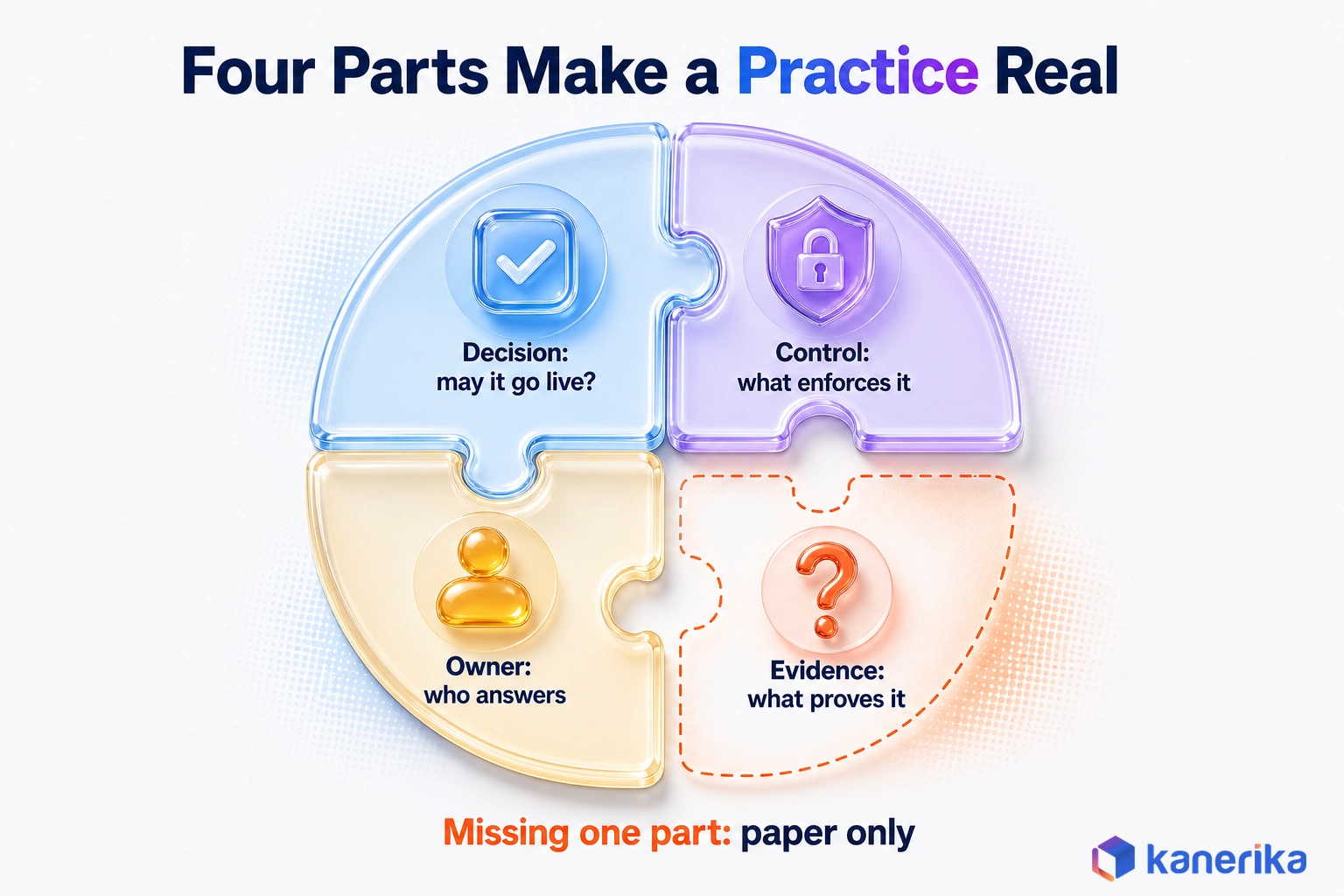
Every useful practice has four parts. There is a decision, such as whether a use case may go live, and a control that enforces it. There is also an owner who answers for it and evidence that proves it happened. When one part is missing, the practice exists on paper only.
Take the contract copilot again. Its decision reads “approved for internal buyers, not for direct supplier emails.” A permission setting that blocks outbound sends acts as the control. Meanwhile the procurement director is the owner, and a signed approval record with test results attached is the evidence.
| Element | Question it answers | Example artifact |
|---|---|---|
| Decision | May this system go live, and for what purpose? | Approval record with scope and conditions |
| Control | What stops the system from going beyond that scope? | Access policy, release gate, output filter |
| Owner | Who answers when something goes wrong? | Named business owner in the AI inventory |
| Evidence | How do we prove the control worked? | Test report, monitoring log, review minutes |
Where Ethics, Data and Maturity Fit
Governance also has neighbors. Ethics sets the values, which our piece on responsible AI practices turns into tests. The OECD AI Principles, updated in May 2024, name five such values. They are inclusive growth, human rights including fairness and privacy, transparency, robustness and safety, and accountability.
Each value lands on a practice in this list. Fairness becomes bias tests (practice 6), and transparency becomes logs and evidence packs (practices 9 and 12). Robustness turns into monitoring and rollback, while accountability is the named owner in practice 2. Concern for people’s rights is why Tier 3 needs a person to approve before a decision takes effect (practice 7).
Data governance, on the other hand, controls the records a model learns from, as our AI governance vs data governance guide explains. Maturity is a third neighbor, and our maturity model scores a program across five levels and six domains. This article covers the operating practices that connect all three.
Kanerika Service
AI Governance Services
Kanerika sets up AI inventories, risk tiers, release gates and monitoring so every AI system ships with an owner and the evidence your auditors ask for.
Explore AI GovernanceWhy the Bar for AI Governance Moved in 2026
For years, AI governance was a voluntary good habit. In 2026, though, the EU AI Act became generally applicable and Colorado signed SB26-189, which dates developer duties to January 1, 2027. Buyers also began asking vendors for governance evidence during due diligence.
The EU AI Act is the biggest driver, because it carries dated duties and fines. As of November 2026, the European Commission’s AI Act page sets out the phased dates, including changes made by the AI Omnibus. That amendment was proposed on November 19, 2025, agreed on May 7, 2026 and entered into force on July 27, 2026. Its main effect was to push the high-risk deadlines back, so teams gained time but not an exemption.
- August 1, 2024: the EU AI Act entered into force.
- February 2, 2025: prohibited practices and AI literacy duties began to apply.
- August 2, 2025: obligations for general-purpose AI models and the governance rules applied.
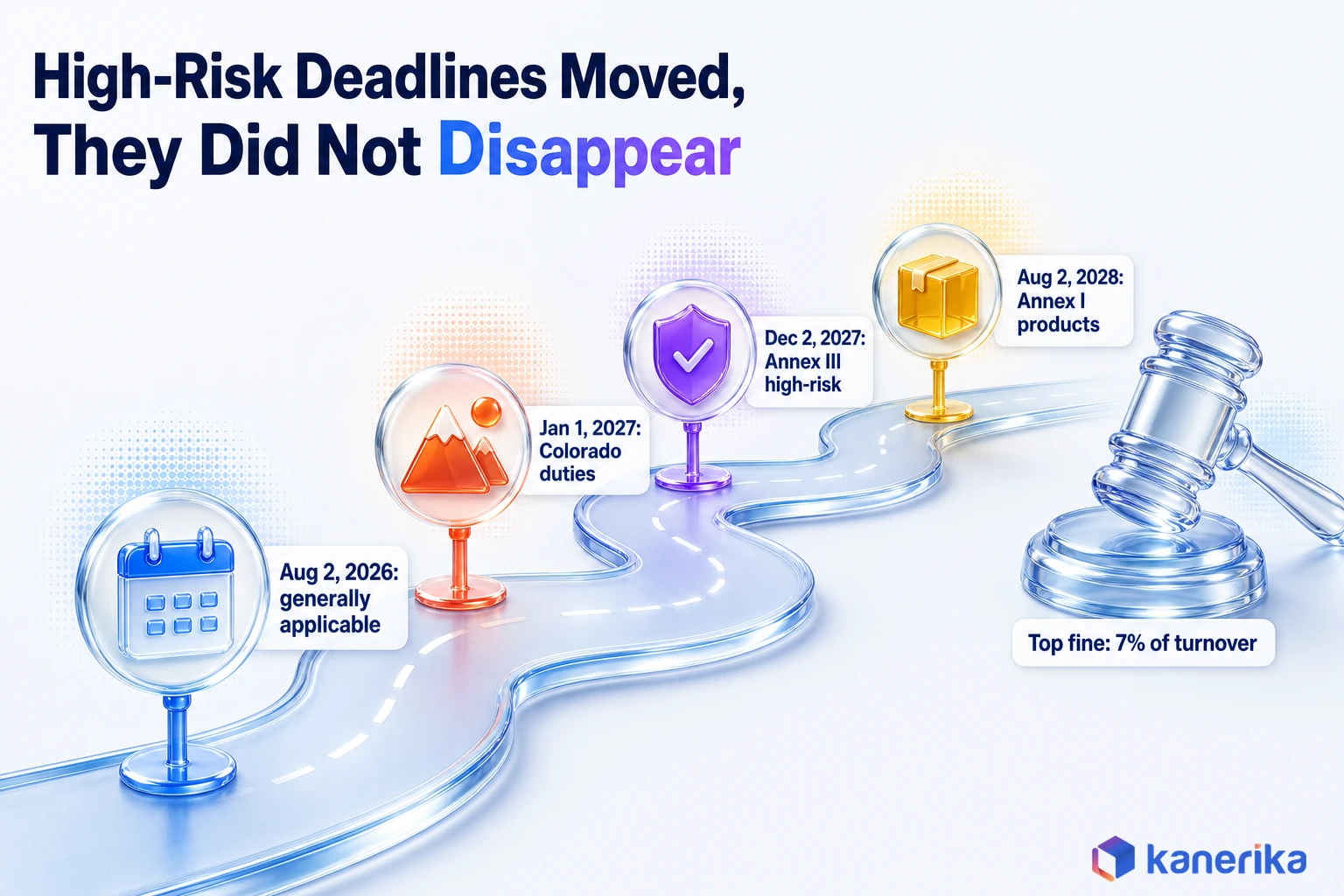
- August 2, 2026: the Act became generally applicable, with exceptions, so the AI Office and national authorities began enforcing.
- January 1, 2027: Colorado’s developer documentation duties start, and the attorney general’s rules are due.
- December 2, 2027: high-risk rules apply to Annex III use cases, such as hiring or credit.
- August 2, 2028: high-risk rules apply to AI inside regulated products under Annex I.
Penalties are real but often overstated. The top fine in the AI Act text on EUR-Lex is up to EUR 35 million or 7% of worldwide annual turnover, whichever is higher. That ceiling applies to prohibited practices rather than to every breach.
Colorado and the Shift to Agents
In the US, Colorado rewrote its first AI law. Colorado SB26-189 repealed and reenacted SB 24-205 to cover automated decision-making technology in consequential decisions, such as access to education. The bill defines that technology as one that processes personal data and uses computation to generate output. It was signed on May 14, 2026, and developer documentation duties start on January 1, 2027.
The second shift is technical, because agents now take actions in business systems instead of only answering questions. Kanerika’s State of AI Governance 2026 report cites EY: two-thirds of C-suite leaders surveyed say their companies let employees build or deploy AI agents. An agent that can update a vendor record carries more risk than a chatbot that can only read one. Controls must therefore follow what the system can do, which is why practice 8 treats agent permissions as a control of their own.
The 12 AI Governance Best Practices
Teams usually build these practices in roughly the order shown. The first three tell you what you have and how risky it is. After that, the middle six control how systems are built and run, while the last three keep the program honest over time.
Each practice also ends with an owner and the evidence that proves it is working. Scale the depth of each one to the risk tier from practice 3, so a Tier 1 tool gets the light version.
1. Keep a Live Inventory of Every AI System, Including Shadow and Vendor AI
You cannot govern what you cannot see. The inventory is a register of every AI system in use, so each entry lists purpose, owner, data sources and model or vendor. It also records the risk tier and the next review date. Include embedded AI inside SaaS tools too, because a feature switched on in a CRM still processes your customers’ data.
Shadow AI is the hard part, since teams adopt tools with a credit card. In a 2025 University of Melbourne and KPMG study, only about two in five employees said their organization has generative AI policy or guidance. Make registration quick, and tie it to something people want, such as access to approved models. Then sweep procurement records, expense reports and network logs every quarter for anything unregistered.
Owner: AI governance lead or the central AI office.
Evidence: A current register with a review date per system and a log of each quarterly sweep.
2. Name a Business Owner and Decision Rights for Each System
Every system needs one person who answers for its outcomes when something goes wrong. That person usually sits in the business rather than in IT, because they own the process the AI changes. The data science team builds and tests, while risk and legal review, and the owner decides.
A simple RACI then makes this concrete. For a Tier 3 credit model, for example, the credit risk head is accountable while the model team is responsible for testing. Compliance is consulted before release, and the board risk committee is informed each quarter. Write it down once per system and store it with the inventory entry.
Owner: The executive sponsor names the business owner, and the AI council confirms decision rights.
Evidence: A signed RACI per system, linked from the inventory.
3. Tier Risk by Use Case, Impact and Autonomy
Risk tiering decides how much of every other practice a system gets. Three questions set the tier. Does the system make or shape a decision about a person? Is its output customer-facing, and can it take actions on its own? The more of these that apply, the higher the tier.
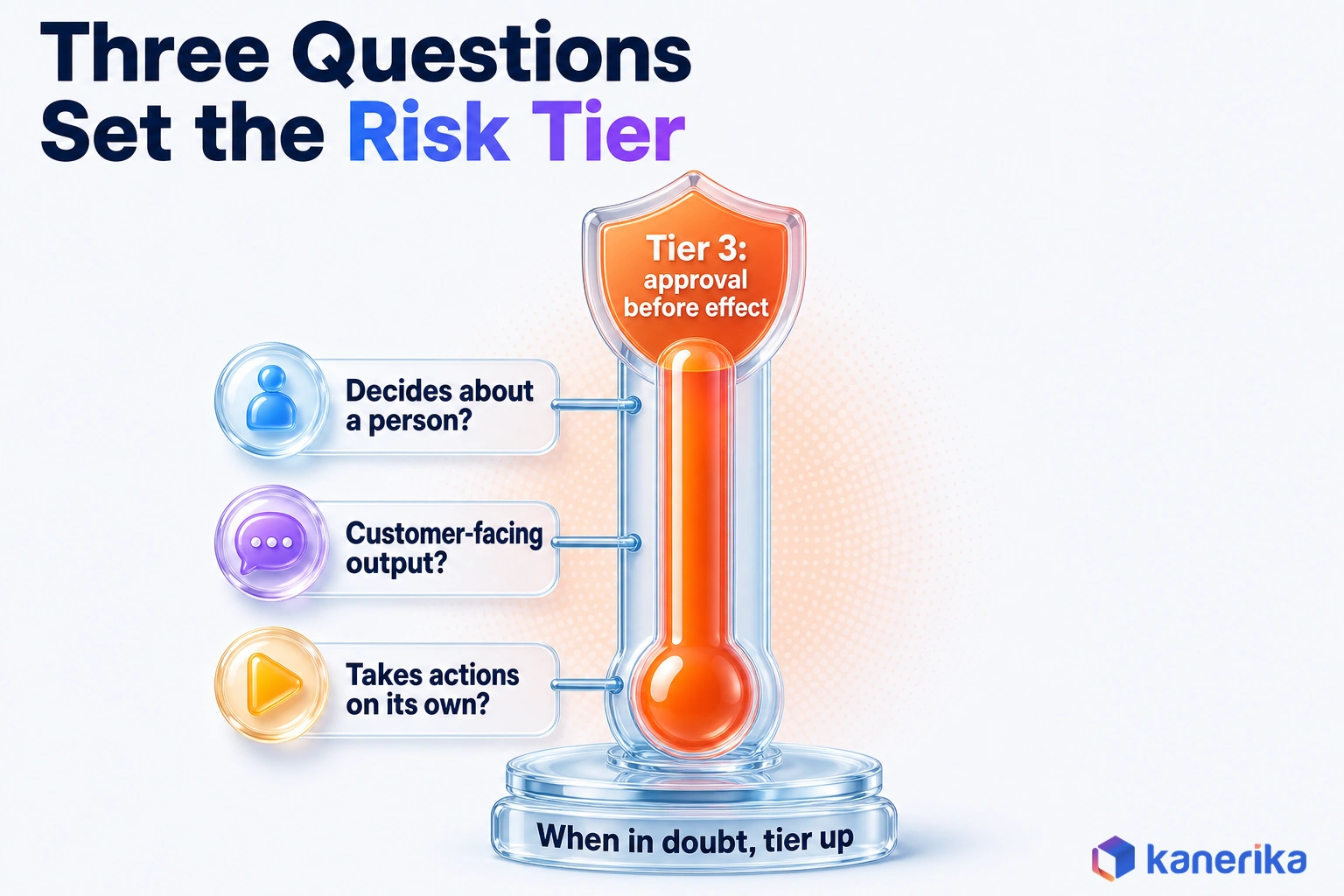
Three tiers are enough for most programs, because more tiers create arguments about borders without changing the controls much. The tiers below also line up with the EU AI Act’s focus on high-risk uses without copying its legal categories.
| Tier | Examples | Required review | Oversight | Monitoring cadence |
|---|---|---|---|---|
| Tier 1, low | Internal tools such as writing aids and meeting summaries, with no decision about a person | Self-assessment and registration | Spot checks by the owner | Usage logging, annual review |
| Tier 2, moderate | Customer-facing assistants, forecasting and business decisions with human review | Peer review of tests and data before release | Human review of flagged outputs | Quarterly review of quality metrics |
| Tier 3, high | Consequential decisions about people, regulated domains and agents that write to systems | Full review by risk, legal and security, then sign-off | Human approval before the decision or action takes effect | Continuous monitoring, monthly review |
When in doubt, tier up and move down later with evidence. A system also moves up when it gains autonomy, such as a Tier 2 assistant that starts sending emails. Every material change should therefore trigger a re-tier, which ties this practice to practice 10.
Owner: The system owner proposes the tier, and the governance lead confirms it.
Evidence: A tiering record with the answers to the three questions.
4. Turn Policy Into Release Gates and an Exception Path
A policy that lives in a PDF changes nothing. Policy only bites when a release gate checks it, so build the gate into the path every system already takes to production. Depending on the company, that path is the MLOps pipeline, the change board or the procurement workflow for vendor AI.
The gate asks for the evidence the tier requires and then blocks the release until it exists. Teams will still hit cases the policy did not foresee, so give them a documented exception path. Each exception still needs a reason, a risk owner’s approval and an expiry date. Without that path, people route around the gate instead.
Owner: Platform or MLOps lead for the gate, and the governance lead for exceptions.
Evidence: Gate logs per release and an exception register with expiry dates.
5. Govern Data Access, Lineage and Retention Under Every Model
A model is only as trustworthy as the data under it. Gartner, cited in Kanerika’s State of Enterprise AI & Data Modernization 2026 report, finds 63% of organizations lack or are unsure of AI-ready data practices. For each system, you should know which sources feed it, who may access them and how long data and prompts are kept. Lineage also answers the question auditors ask first, which is where a given output came from.
Most of this work builds on your existing data governance program. Classification labels, for example, tell you which data a model may touch. Catalogs such as Microsoft Purview record lineage and sensitivity across sources, so retrieval and training can respect the same rules as reports.
For generative AI, also add prompt and output retention rules. Decide what gets logged, who can read the logs and when they are deleted. Our guide to generative AI governance covers acceptable-use and prompt-data rules in more detail.
Owner: Data owner for each source, with the chief data officer accountable overall.
Evidence: Lineage records, access reviews and a retention schedule per system.
Kanerika Service
Data Governance Services
Kanerika builds catalogs, lineage, classification and access policies on Microsoft Purview so the data under every AI model is governed first.
Explore Data Governance6. Test Against Task-Specific Acceptance Criteria Before and After Release
Generic accuracy scores hide the failures that matter. Set acceptance criteria for the actual task before testing starts. For the contract copilot, that could mean recall on high-risk clauses as well as the share of redlines a lawyer accepts unchanged.
Cover three areas at least. Test quality on the task, fairness across the groups the system affects and grounding for any system that cites sources. Grounding tests, in particular, check whether answers stay inside approved content. Teams often score these with a second model, a method we explain in LLM as a judge.
Repeat the same tests after release on fresh data, because a model that passed in March can fail in June when the inputs change.
Owner: Model team lead, with independent review for Tier 3.
Evidence: A test report against the agreed thresholds, stored with the release.
7. Make Human Oversight Specific to Each Tier
“Human in the loop” means little until you say which human, at which step and with what power. Oversight works when a trained person has the information, the time and the authority to change the outcome. A reviewer who clears hundreds of cases an hour cannot really check any of them.
Match oversight to the tier table. Spot checks are enough for Tier 1, while Tier 2 needs review of flagged or low-confidence outputs. For Tier 3, a person approves before the decision lands on someone or the action reaches a system.
Log every override with a reason, since override patterns are among the best early signals of model trouble.
Owner: The business owner designs the review step, and team managers staff it.
Evidence: Review queues, override logs and reviewer training records.
8. Limit Agent Permissions and Secure the AI Workflow
Agents change the risk because they act. An agent that can read a ticket, update a CRM record and email a customer has three permissions, so each one needs a reason. Grant tools by least privilege and scope each tool to the records the task needs. Then require approval for actions you cannot undo.
Security reviews must also cover the new attack paths. Prompt injection can turn a retrieved document into an instruction, so treat content from outside sources as untrusted. Systems built on agentic RAG deserve extra care, since the agent decides what to retrieve and what to do next. Log every tool call with its inputs and outputs so that an incident can be replayed.
The OWASP entry on excessive agency (LLM06:2025) traces agent harm to three root causes: excessive functionality, excessive permissions and excessive autonomy. A permission manifest answers all three in configuration. For the contract copilot, a minimal one could look like this.
# Permission manifest: contract copilot (Tier 2)
agent: contract-copilot
owner: procurement-director
tier: 2
run_as: requesting_user        # no shared service account
log_tool_calls: true
tools:
  - name: contract_search
    access: read
    scope: contracts/approved-for-retrieval
  - name: draft_redline
    access: write
    scope: drafts/own-workspace
    approval: lawyer           # a person approves before release
  - name: send_email
    enabled: false             # outbound blocked at permission level
Each line maps to an OWASP mitigation. Listing only the needed tools limits functionality, and narrow scopes limit permissions. The approval field and the disabled send tool cap autonomy, while run_as executes tools in the user’s context.
Our guide to agentic AI governance goes deeper on action approval and multi-agent hand-offs. For gateway-level controls on one platform, see how the Databricks Unity AI Gateway centralizes model access.
Owner: Security architect for permissions, with the agent’s business owner approving its scope.
Evidence: A permission manifest per agent, tool-call logs and injection test results.
9. Monitor Outcomes in Production, Not Only Uptime
An AI system can be up, fast and wrong. Infrastructure dashboards show latency and errors, but they will not show a model drifting into bad decisions. Outcome monitoring, by contrast, tracks what the system does to the business and to people.
Pick a few signals per system, such as input drift, quality on sampled outputs and complaint rate. The human override rate and grounding failures for retrieval systems are also worth watching. Then set an alert threshold for each signal and name who gets paged. For Tier 3, review the dashboard monthly even when no alert fires.
Owner: Model operations or MLOps team, with alerts routed to the business owner.
Evidence: Monitoring dashboards, alert history and monthly review notes.
10. Version Every Change and Require Proportionate Re-approval
Models change more often than teams admit. A new prompt, a retrained model, a new data source or a vendor’s model upgrade can all shift behavior overnight. Every change therefore needs a version number and a record of what moved.
Re-approval should be proportionate. A prompt tweak on a Tier 1 tool needs only a changelog entry. Adding a data source or tool to a Tier 3 agent, however, means running the full gate again because the risk profile changed. Ask vendors to notify you of model updates as well, since a silent upgrade skips your gate entirely.
Owner: System owner, with the release gate enforcing the rule.
Evidence: Version history and the approval attached to each material change.
11. Rehearse Incident Response, Kill Switches and Rollback
Every AI system will eventually do something wrong in production. The question is how fast you notice, contain and explain it. An AI incident plan therefore defines what counts as an incident, who declares it and how users are told.
Containment needs tools that already work when the incident starts. In ISACA’s 2026 AI Pulse Poll, 39% of respondents did not know whether their organization has a documented shutdown or override process for AI systems. Each Tier 2 and Tier 3 system should have a kill switch and a fallback process people can use. It also needs a tested rollback to the last approved version. Run a drill twice a year for Tier 3 systems, then record what broke and fix it before the next one.
Owner: Incident manager in IT operations, with the business owner deciding on rollback.
Evidence: An incident runbook, drill reports and post-incident reviews.
12. Hold Vendors to AI Clauses, Keep Audit Evidence and Train by Role
Much of your AI arrives through vendors, so contracts carry part of the control. Add clauses on training-data use, model-change notice, incident notice, audit rights and data residency before you sign. Ask for the vendor’s own evidence too, such as test summaries or certifications.
Evidence should live in one place. A standard evidence pack per system holds the tiering record, approvals, test reports, monitoring reviews and incidents. Auditors and enterprise buyers ask for exactly this file, so build it during delivery. For a compliance provider serving financial institutions, Kanerika automated controls monitoring and traceability, delivering 5x better audit traceability and 60% less manual compliance work.
Finally, training closes the loop. The EU AI Act’s AI literacy duty has applied since February 2, 2025, and the Omnibus kept it as a duty to take supporting measures. It is good practice everywhere. Train by role, so builders learn testing, reviewers learn when to override and executives learn what each tier means.
Owner: Legal for contracts, the governance lead for evidence and HR for training.
Evidence: Signed AI clauses, complete evidence packs and training completion by role.
The 12 AI Governance Best Practices at a Glance
The table condenses the 12 practices into one view you can share with a steering committee. It shows who owns each practice and how the minimum effort differs between the lowest and highest tier. That gap is where governance cost is decided, so the heavy reviews land only on high-risk systems.
AI Assessment
Where Does Your AI Program Stand?
Score your data, processes and governance with Kanerika’s AI maturity assessment and see which of the 12 practices to build first.
Start Your AI Assessment →| Practice | Owner | Evidence | Tier 1 minimum | Tier 3 minimum |
|---|---|---|---|---|
| 1. Inventory | Governance lead | Register and sweep log | Registered with an owner | Full entry, reviewed each quarter |
| 2. Ownership | Executive sponsor | Signed RACI | Named owner | RACI as well as risk committee reporting |
| 3. Risk tiering | System owner | Tiering record | Self-assessed | Confirmed by governance lead |
| 4. Release gates | Platform lead | Gate logs, exceptions | Checklist at launch | Blocking gate with sign-off |
| 5. Data controls | Data owners | Lineage, access reviews | Approved sources only | Full lineage and retention rules |
| 6. Testing | Model team | Test report | Basic quality check | Quality, fairness and grounding tests |
| 7. Oversight | Business owner | Override logs | Spot checks | Approval before effect |
| 8. Agent permissions | Security architect | Permission manifest | Read-only by default | Least privilege plus action approval |
| 9. Monitoring | MLOps team | Dashboards, alerts | Usage logging | Outcome signals, monthly review |
| 10. Change control | System owner | Version history | Changelog entry | Full re-approval when a change is material |
| 11. Incidents | Incident manager | Runbook, drills | Off switch | Kill switch, rollback, drills |
| 12. Vendors, evidence, training | Legal, governance lead, HR | Clauses, evidence pack | Standard terms, basic training | AI clauses, full pack, role training |
Use the table to test your own program before an auditor does. Pick one Tier 3 system and then ask for the evidence in each row. The rows where nobody can produce a document show where to start.
Gaps tend to cluster in monitoring, change control and vendor clauses, because those rows depend on habits across teams rather than on one team’s work.
Map the Practices to NIST AI RMF, ISO/IEC 42001 and the EU AI Act
The 12 practices are not a new framework. Instead, they are the working layer underneath the frameworks your auditors and customers already name, so one set of evidence can serve all three.
The NIST AI Risk Management Framework is voluntary and was released on January 26, 2023. It groups activities into four functions: Govern, Map, Measure and Manage. NIST later added a Generative AI Profile, NIST AI 600-1, on July 26, 2024.
ISO/IEC 42001:2023 is the international standard for an AI management system, and organizations can be certified against it. The OECD AI Principles, adopted in May 2019 and updated in May 2024, also sit behind many national policies.
| Practice group | NIST AI RMF function | ISO/IEC 42001 role | EU AI Act relevance |
|---|---|---|---|
| Inventory, ownership, training (1, 2, 12) | Govern | Scope, roles and competence in the management system | Provider and deployer roles, AI literacy |
| Risk tiering, data controls (3, 5) | Map | AI risk and impact assessment | High-risk classification, data governance for high-risk systems |
| Testing, oversight (6, 7) | Measure | Operational controls and verification | Accuracy, robustness and human oversight duties |
| Gates, agents, monitoring, change, incidents, vendors (4, 8 to 12) | Manage | Operation, monitoring and continual improvement | Post-market monitoring and incident reporting |
Following a framework does not make a system legal on its own. NIST and ISO describe good management, while the EU AI Act and state laws set the binding duties. Our governance framework comparison covers how the three differ and which to adopt first.
Choose an Operating Model: Centralized, Federated or Embedded
An operating model decides where governance work happens and who does it. The right choice depends on how many AI systems you run and how different your business units are.
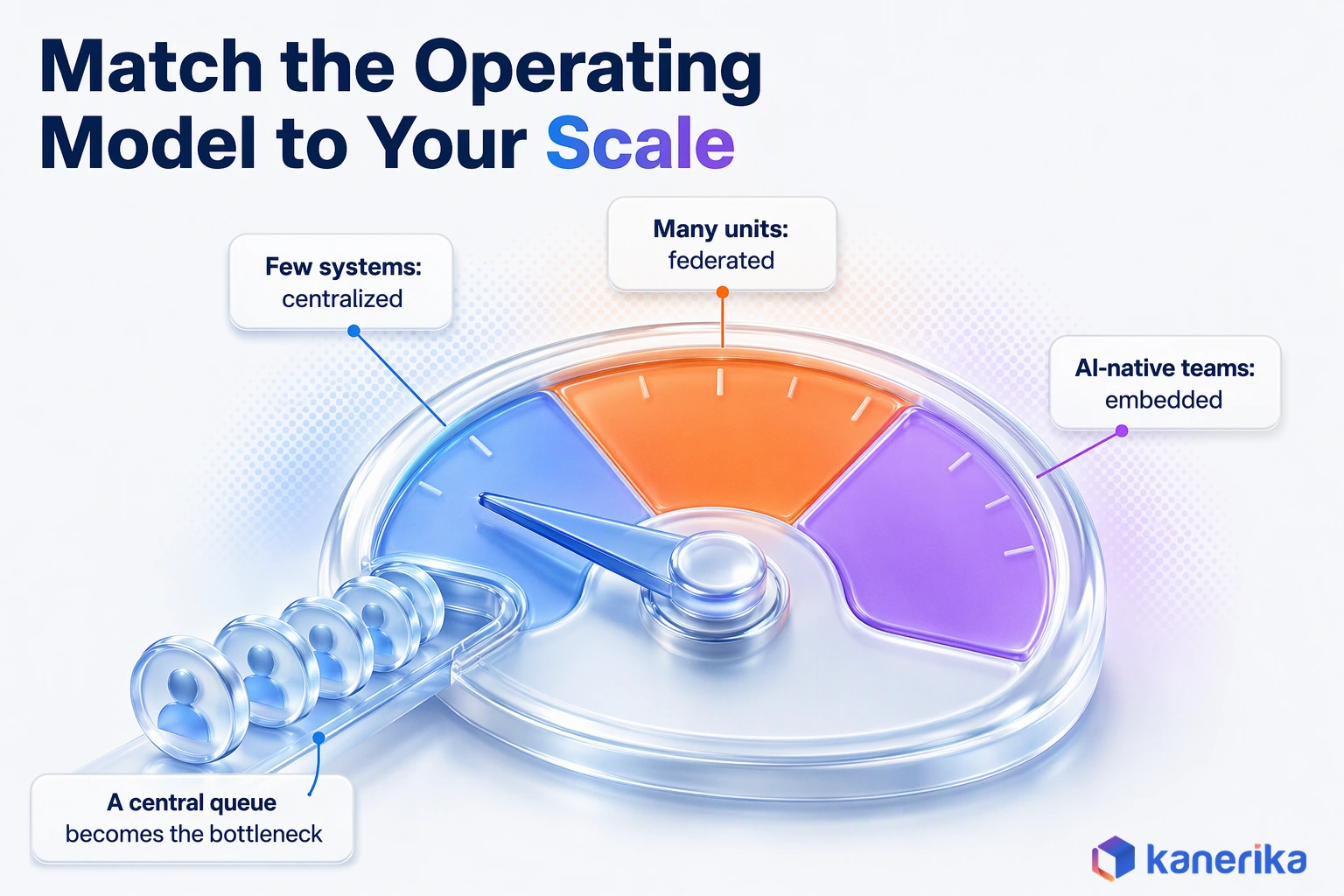
A centralized model puts one AI office in charge of reviews and approvals. Consistency is its strength, but it becomes a queue once dozens of teams ship AI. Under a federated model, standards and Tier 3 reviews stay central, while business units run Tier 1 and Tier 2 reviews themselves. An embedded model, by comparison, places governance specialists inside product teams and suits AI-native companies.
| Model | Fits when | Main risk | Typical owner |
|---|---|---|---|
| Centralized | Few AI systems, one regulator, early program | Review backlog slows delivery | Chief AI officer or AI office |
| Federated | Many business units with mixed risk levels | Units apply standards unevenly | Central AI council with unit leads |
| Embedded | AI-native product teams with mature engineering | No one sees risk across teams | Product leads with a small central team |
In practice, many enterprises end up federated after the first phase. They start central to set the standard, then hand routine reviews to units once the evidence pack is familiar. Our AI governance strategy guide covers how to sequence that move.
Tools then follow the model. You can extend what you have, such as your data catalog, MLOps pipeline and ticketing system, or buy a dedicated governance platform. Building from scratch rarely pays off, though. Our review of AI governance tools compares the platform options.
A Decision Framework From Use Case to Approved Deployment
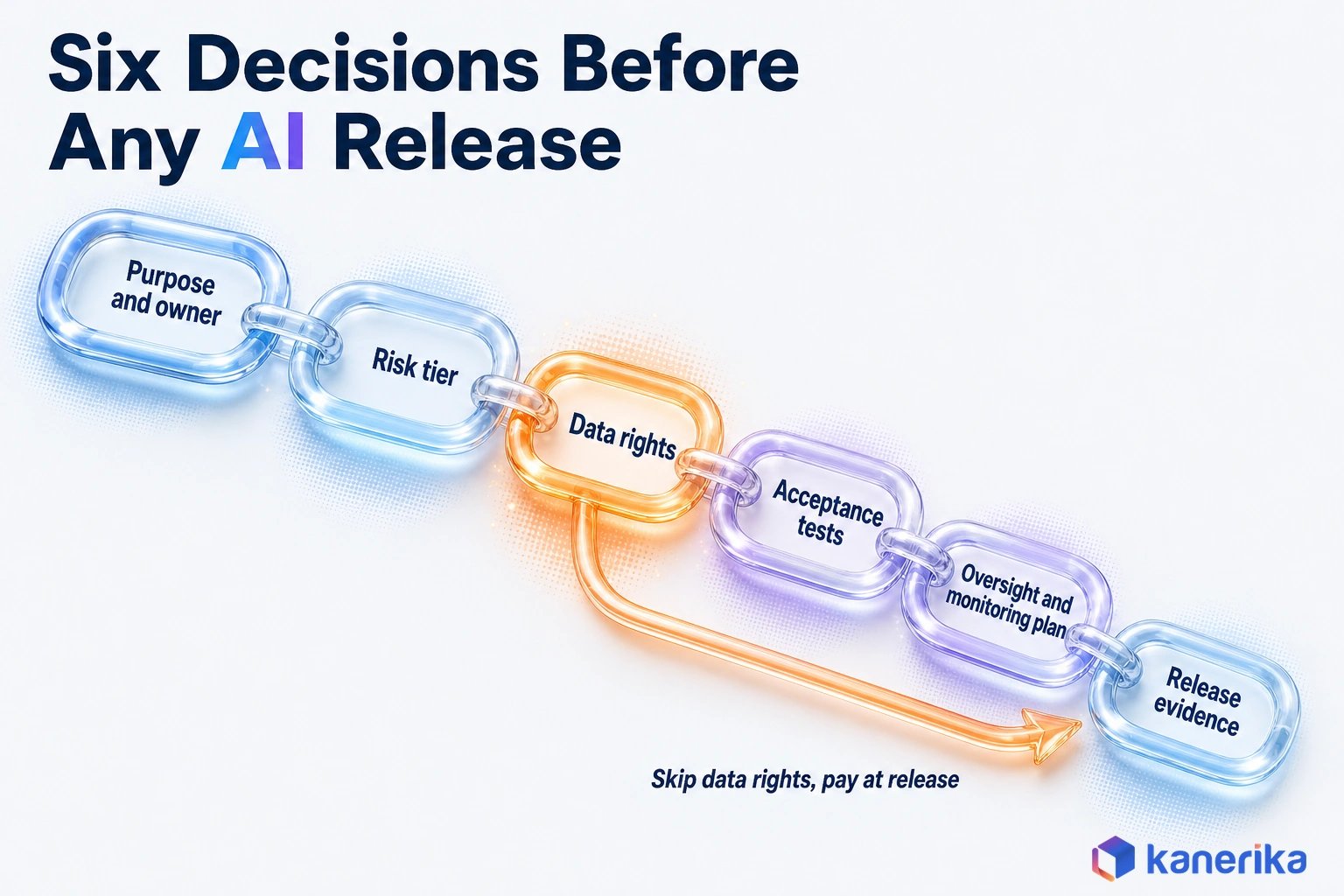
The framework below turns the 12 practices into a sequence that every new use case passes through. Each step produces a decision and a record, so the approval at the end rests on evidence rather than opinion.
- Purpose and owner: state what the system is for and who owns it, because no owner means no project.
- Risk tier: answer the three tiering questions and record the tier.
- Data rights: confirm the sources are approved for this use, with lineage and retention set.
- Acceptance tests: agree the quality, fairness and grounding thresholds before building.
- Oversight and monitoring plan: define the human review step, the signals to watch and the kill switch.
- Release evidence: assemble the evidence pack, then get sign-off at the gate.
Order matters: Kanerika’s State of Enterprise AI & Data Modernization 2026 report names model-first, data-later as a failure mode that ends in rework. Teams that skip to step 4 often build a model on data they were not allowed to use. They then discover the problem at step 6, when it is expensive to fix.
Worked Example: Approving a Procurement Contract Copilot
Return to the contract copilot from the opening. Here is how the six decisions play out for it.
- Purpose and owner: the copilot flags risky clauses and drafts redlines for buyers, while the procurement director owns it.
- Risk tier: it does not decide about people, and lawyers review its drafts, so it is Tier 2. Sending redlines straight to suppliers would make it Tier 3.
- Data rights: legal confirms that past contracts may be used for retrieval but not for training a vendor’s model. That rule then goes into the vendor contract.
- Acceptance tests: the team builds a test set of past contracts with known risky clauses. The copilot must catch them at the agreed rate before release.
- Oversight and monitoring: a lawyer approves every redline before it leaves the company. The team also tracks how often lawyers rewrite a draft, while outbound email stays blocked at the permission level.
- Release evidence: the evidence pack holds the tiering record, the data approval, the test report and the monitoring plan. Once it is complete, the governance lead signs off.
At the gate, the tier table becomes configuration. A rules file like the one below lets the pipeline check the evidence pack automatically. Reviewers can then spend their time on judgment rather than on missing files.
# Release gate rules, one block per tier (mirrors the tier table)
tier_1:
  evidence: [inventory_entry, owner, self_assessment]
  approver: system_owner
  monitoring_review: annual
tier_2:
  evidence: [tiering_record, data_approval, test_report, monitoring_plan]
  approver: governance_lead
  monitoring_review: quarterly
tier_3:
  evidence: [tiering_record, data_approval, test_report, monitoring_plan,
             oversight_design, kill_switch_test, rollback_test]
  approver: [risk, legal, security]
  monitoring_review: monthly
exceptions:
  required: [reason, risk_owner_approval, expiry_date]
The contract copilot ships under the tier_2 block, so the pipeline holds the release until all four evidence files exist. Moving it to Tier 3 would add three files and three approvers, with no policy rewrite needed.
The copilot that waited three weeks now has a path it can pass in days. Nothing in the example slowed the team. Instead, each step answered a question someone was going to ask anyway.
Minimum Viable Governance: What to Do in the First 90 Days
A 90-day plan gives a program a working core before it tries to be complete. The goal is a small set of controls that run every week rather than a long policy nobody follows.
Before day one, take a baseline with an AI governance assessment so you know where the gaps are. Then work in three 30-day blocks.
- Days 1 to 30, see and assign. Build the inventory, including a first shadow AI sweep, and name an owner for every system. Owner: governance lead. Exit criteria: every known system is registered with an owner.
- Days 31 to 60, tier and gate. Tier every system, publish the three-tier table and put a release gate in front of new Tier 2 and Tier 3 launches. Owner: governance lead with the platform team. Exit criteria: no new Tier 3 system ships without sign-off.
- Days 61 to 90, watch and respond. Turn on outcome monitoring and a kill switch for every Tier 3 system. Write the incident runbook and add AI clauses to new vendor contracts as well. Owner: MLOps lead and legal. Exit criteria: one incident drill completed and recorded.
What to Leave Out of the First 90 Days
Leave some things out on purpose, even if they look urgent. A full policy library, a governance platform purchase and fairness testing for every Tier 1 tool can all wait. Each one is useful later, but none of them stops a risky release in the first quarter.
Keep the first 90 days visible as well. A short weekly note to the sponsor listing new registrations, tier decisions and blocked releases builds trust in the program. It also shows the business that the gate moves quickly once the evidence is ready.
Once day 90 passes, widen the controls to Tier 2 and start role-based training. Our 180-day AI governance implementation plan picks up from here with policy, tooling and culture work.
Checklist
AI Governance Checklist
Kanerika’s AI governance checklist turns inventory, risk tiers, testing and monitoring into steps you can tick off before each AI system goes live.
Get the Checklist →How to Tell Whether AI Governance Is Working
Governance metrics should show whether controls run, whether they catch problems and whether they slow delivery. Track all three, because a program can look complete on paper while every release waits weeks for review.
| Metric | What it shows | Example target type |
|---|---|---|
| Share of AI systems in the inventory with an owner and tier | Coverage | All Tier 3 systems first, then all systems |
| Share of releases that passed the gate with a full evidence pack | Coverage | Every Tier 3 release |
| Incidents found by monitoring before a user reported them | Effectiveness | Rising quarter over quarter |
| Human override rate per system | Effectiveness | Stable within an agreed band |
| Days from intake to approval, by tier | Speed | Falling as the evidence pack matures |
| Open exceptions past their expiry date | Speed and discipline | Zero |
Effectiveness metrics depend on alerts that actually fire. In Azure Machine Learning, for instance, a model monitoring schedule is a YAML file. The excerpt below comes from Microsoft’s documented example.
# Excerpt from Microsoft's advanced-model-monitoring.yaml example
trigger:
  type: recurrence
  frequency: day
  interval: 1
create_monitor:
  monitoring_signals:
    advanced_data_drift:
      type: data_drift
      alert_enabled: true
      metric_thresholds:
        numerical:
          jensen_shannon_distance: 0.01
    advanced_data_quality:
      type: data_quality
      alert_enabled: true
      metric_thresholds:
        numerical:
          null_value_rate: 0.05
  alert_notification:
    emails:
      - [email protected]
The example checks drift and data quality every day and emails named recipients when a threshold is crossed. Its values are sample settings, not benchmarks. Set yours from the acceptance tests in practice 6, and put the business owner on the alert list.
Review the numbers quarterly with the AI council, since trends matter more than single readings. If time to approval keeps rising, the program is becoming a bottleneck, so move routine reviews to business units.
Reading the Metrics as a Maturity Level
These metrics also show where a program sits on a maturity scale. Our AI governance maturity model runs from Level 1, ad hoc governance with invisible AI, to Level 5, governance that adapts to risk. The 90-day plan above aims at Level 3, where controls run and leave records.
Level 4 asks for proof that those controls work, which is what the effectiveness rows in this table supply. Not every domain needs to climb further, since Level 5 is the wrong target for some of them.
Common AI Governance Mistakes and How to Fix Them
Governance failures usually come from good intentions applied in the wrong order. The same handful of mistakes also shows up across industries.
- Writing policy before building the inventory. A policy for systems you have not counted cannot be enforced. Fix: build the register first, then write policy for what it shows.
- Treating every system the same. Full review for a meeting summarizer burns goodwill and staff time. Fix: apply the three tiers and keep Tier 1 light.
- Governing models but not data. Many failures start in the source data rather than the model. Fix: tie each system to lineage and access rules from your data catalog.
- Calling a reviewer “oversight” without authority. A reviewer who cannot stop the output is a witness. Fix: give reviewers the power and time to override, and log it.
- Ignoring vendor AI. Embedded AI in SaaS tools often skips every gate. Fix: route AI features through procurement and add AI clauses.
- Approving once and never again. Models, prompts and data change after launch. Fix: version changes and re-approve in proportion to the tier.
- Measuring activity instead of outcomes. Counting policies written says nothing about safety. Fix: track coverage, effectiveness and speed together.
Sector rules add their own wrinkles, as our pieces on AI governance in financial services and AI governance in healthcare explain. For how governance fits with enterprise risk work, see AI governance, risk and compliance.
How Kanerika Puts AI Governance Best Practices to Work
Kanerika, an AI-first data and AI consulting firm with 10+ years of delivery, treats governance as an accelerator rather than a brake. Its engagements follow the same arc as this article (assess, design, build, monitor and enable), compressed into weeks rather than quarters.
The work starts with an assessment and an AI inventory, so the client sees what runs today and who owns it. During the design step, the team sets the risk tiers and the controls for each tier. The build step then puts those controls into the delivery pipeline as release gates, monitoring and agent permissions.
The last two steps produce the evidence packs auditors ask for and train each role to run the program. Our AI governance services cover this full cycle, while our data governance services build the data layer underneath.
Case Study: The Data Layer Under AI Governance
That data layer is where many AI programs stall. A top North American healthcare organization had data spread across Azure Blob Storage, SQL databases and SaaS apps, with no consistent classification framework. Stakeholders also had little shared understanding of what the data held.
Kanerika built a Microsoft Purview catalog with metadata and classifications, as well as a classification framework with steward roles and usage policies. Power BI dashboards, user guides, process documentation and a monitoring and feedback loop completed the work. As a result, the client saw a 57% reduction in data discovery time and a 90% increase in compliance adherence. Data accessibility also improved by 70%.
That project was data governance rather than model governance, and it is the base that practices 1, 2 and 5 depend on.
Case Study
90% Compliance Adherence for Healthcare with Purview
A top North American healthcare organization cut data discovery time by 57% and raised compliance adherence by 90% with a governed Microsoft Purview catalog.
Read the Case Study →Kanerika applies the same discipline to its own operations. It holds ISO/IEC 27001:2022 certification and renewed its ISO 27701:2019 privacy certification in February 2024. Both standards demand the documented controls, owners and audit evidence this article recommends.
The Bottom Line
Good AI governance is a short list of controls that run every week, with an owner and evidence behind each one. Start with the inventory, the three tiers and a release gate, then add monitoring and incident drills for Tier 3.
For enterprise teams in 2026, the clock is set by Colorado’s January 1, 2027 developer duties and the EU’s December 2, 2027 Annex III deadline, so the 90-day core should be running well before either.
So which AI governance best practices matter most? The 12 controls above, applied lightly to low-risk tools and in full to any system that decides about people or acts on its own.
Frequently Asked Questions
What are the most important AI governance best practices?
Start with a live inventory of every AI system and a risk tier for each one. Every other control depends on knowing what you run and how much harm it can do. Then add release gates, data controls, task-specific testing and tiered human oversight. Production monitoring, change control, incident drills and vendor clauses complete the set.
How do you build an AI system inventory?
Create a register that lists each system’s purpose, business owner, data sources, model or vendor, risk tier and next review date. Keep registration quick and tie it to access to approved tools, so teams have a reason to sign up. Then sweep procurement records, expense reports and network logs every quarter to find unregistered AI.
How do you govern AI agents?
Govern agents by what they can do, not only by what they say. Grant each tool on a least-privilege basis and scope it to the records the task needs. Require human approval for actions that cannot be undone. Log every tool call with its inputs and outputs, test for prompt injection and keep a working kill switch.
What metrics show that AI governance is working?
Track three groups of metrics. Coverage shows the share of systems with an owner, a tier and a full evidence pack. Effectiveness shows how many incidents monitoring caught before users did and how override rates move. Speed shows the days from intake to approval by tier. A rising approval time means governance is becoming a bottleneck.
Does following NIST AI RMF or ISO/IEC 42001 make an AI system compliant?
No, they are frameworks rather than laws. The NIST AI RMF is voluntary guidance, and ISO/IEC 42001 is a certifiable management system standard. Both help you organize controls and evidence. Legal duties come from laws such as the EU AI Act and state laws like Colorado’s, so map your practices to those duties separately.
What is the difference between AI governance and data governance?
Data governance controls the data itself, including quality, access, lineage, classification and retention. AI governance controls the systems that use that data, including risk tiers, testing, human oversight, monitoring and incident response. The two overlap at the data layer. A model built on poorly governed data cannot be governed well, however strong its other controls are.
What is AI risk tiering and how many tiers do you need?
Risk tiering sorts AI systems by potential harm and scales controls to match. Three tiers are enough for most programs. Tier 1 covers internal tools that make no decision about a person. Tier 2 covers customer-facing or business decisions with human review. Tier 3 covers consequential decisions about people, regulated domains and agents that write to systems.
When does an AI system need human-in-the-loop review?
A system needs human review before its output takes effect when it makes consequential decisions about people or acts inside business systems. That is Tier 3 in a three-tier model. Tier 2 systems need review of flagged or low-confidence outputs. The reviewer must have the information, time and authority to override, and every override should be logged.
How often should production AI models be reviewed?
Review frequency should follow the risk tier. High-risk systems need continuous outcome monitoring and a monthly review of the dashboard. Moderate-risk systems suit a quarterly review of quality metrics. Low-risk tools can follow an annual review with usage logging. Any material change, such as a new data source, retrained model or new tool, triggers an extra review.
What should an AI incident response plan include?
The plan should define what counts as an AI incident, who can declare one and how affected users are told. It needs a kill switch for each higher-risk system, a fallback process and a tested rollback to the last approved version. Run drills for high-risk systems and record what broke, then fix those gaps before the next drill.
Which AI clauses belong in vendor contracts?
Vendor contracts should cover whether your data may train the vendor’s models, notice before model changes, notice of incidents, audit rights and data residency. Ask the vendor for its own evidence as well, such as test summaries or certifications. Route AI features in existing SaaS tools through the same procurement review, since they often skip every internal gate.
How long does it take to implement AI governance best practices?
The timeline depends on how many AI systems you run, their risk tiers and the state of your data governance. A working core of inventory, tiers, a release gate and Tier 3 monitoring can be built in about 90 days. Full coverage, training and tooling take longer, and the program keeps evolving as systems change.
Who should own AI governance in a company?
An executive sponsor, often a chief AI or chief data officer, owns the program and its policies. A governance lead runs the inventory, tiering and release gates day to day. Each AI system also needs one named business owner who answers for its outcomes. Risk, legal and security review higher-risk systems before they go live.
Should AI governance be centralized or federated?
Centralized governance suits a young program with few AI systems, because one team can set a consistent standard. As AI spreads across business units, a central queue slows delivery. A federated model then works better, with standards and high-risk reviews kept central while units run routine reviews themselves. Many companies start central and move to federated.