TL;DR
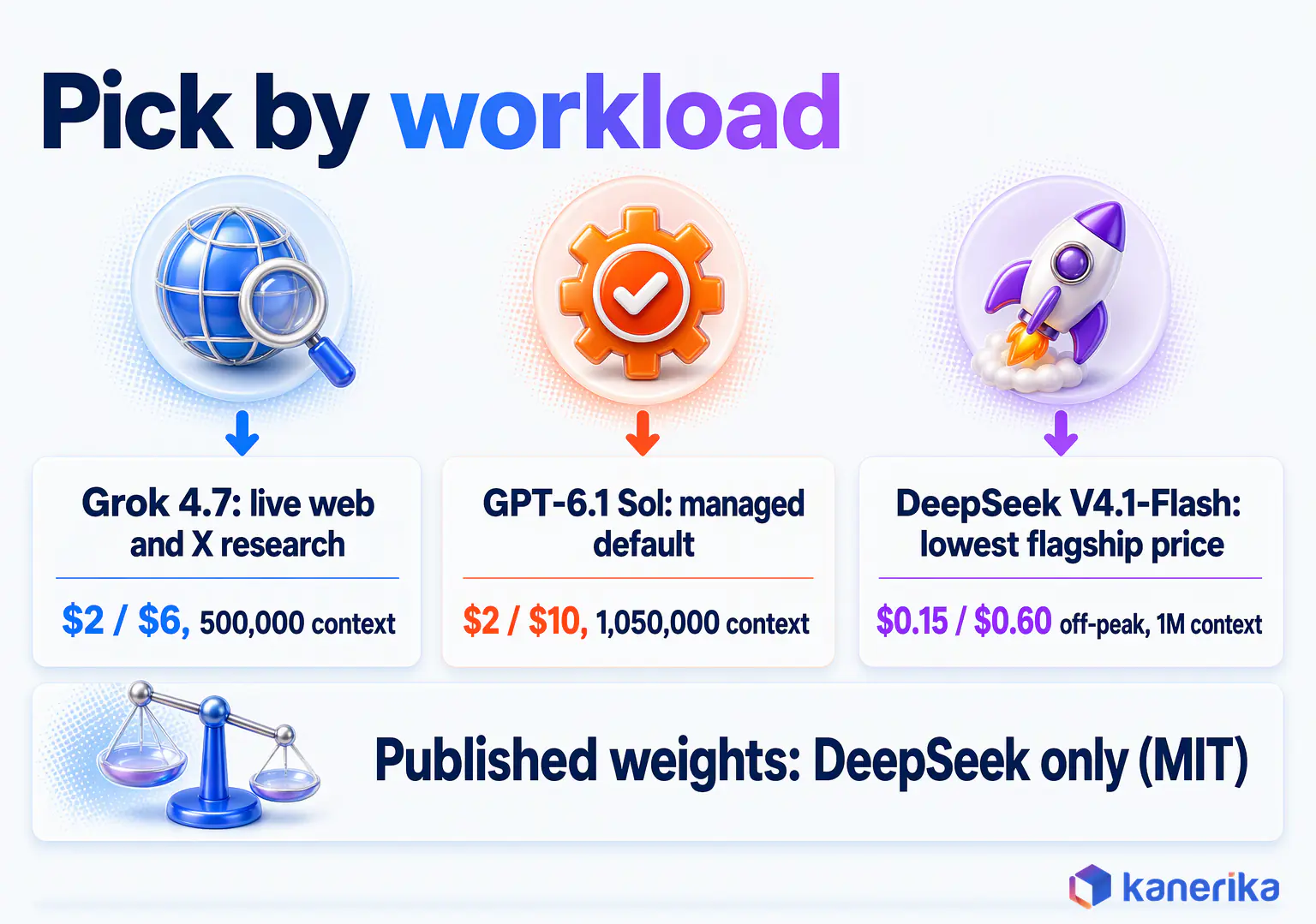
For Grok vs ChatGPT vs DeepSeek, GPT-6.1 Sol is the managed default for most enterprise API work at $2 input and $10 output per 1M tokens. Grok 4.7 is the pick when research needs live web and X data, at $2 / $6 with a 500,000-token context window. DeepSeek V4.1-Flash is the low-cost pick at $0.15 / $0.60 off-peak, and it is also the only one of the three flagship models here with published weights. Regulated or personal data should not go to the hosted DeepSeek API, so self-host the open weights or skip it for those workloads. Budget for the long-prompt rules at 200k tokens on Grok and 272K on OpenAI, as well as DeepSeek’s peak-hour pricing. Then test all three on your own tasks for 30 days before you commit.
Key Takeaways
- Grok 4.7 has a 500,000-token context window, and every token in a request bills at the higher rate once a prompt reaches 200k tokens.
- GPT-6.1 Sol has the widest window of the three at 1,050,000 tokens, while the OpenAI ladder runs from GPT-6 Luna ($0.10 / $0.50) to GPT-6 Astra ($10 / $50).
- DeepSeek V4.1-Flash lists at $0.15 / $0.60 off-peak but doubles in peak hours, which cover up to about 21% of the week.
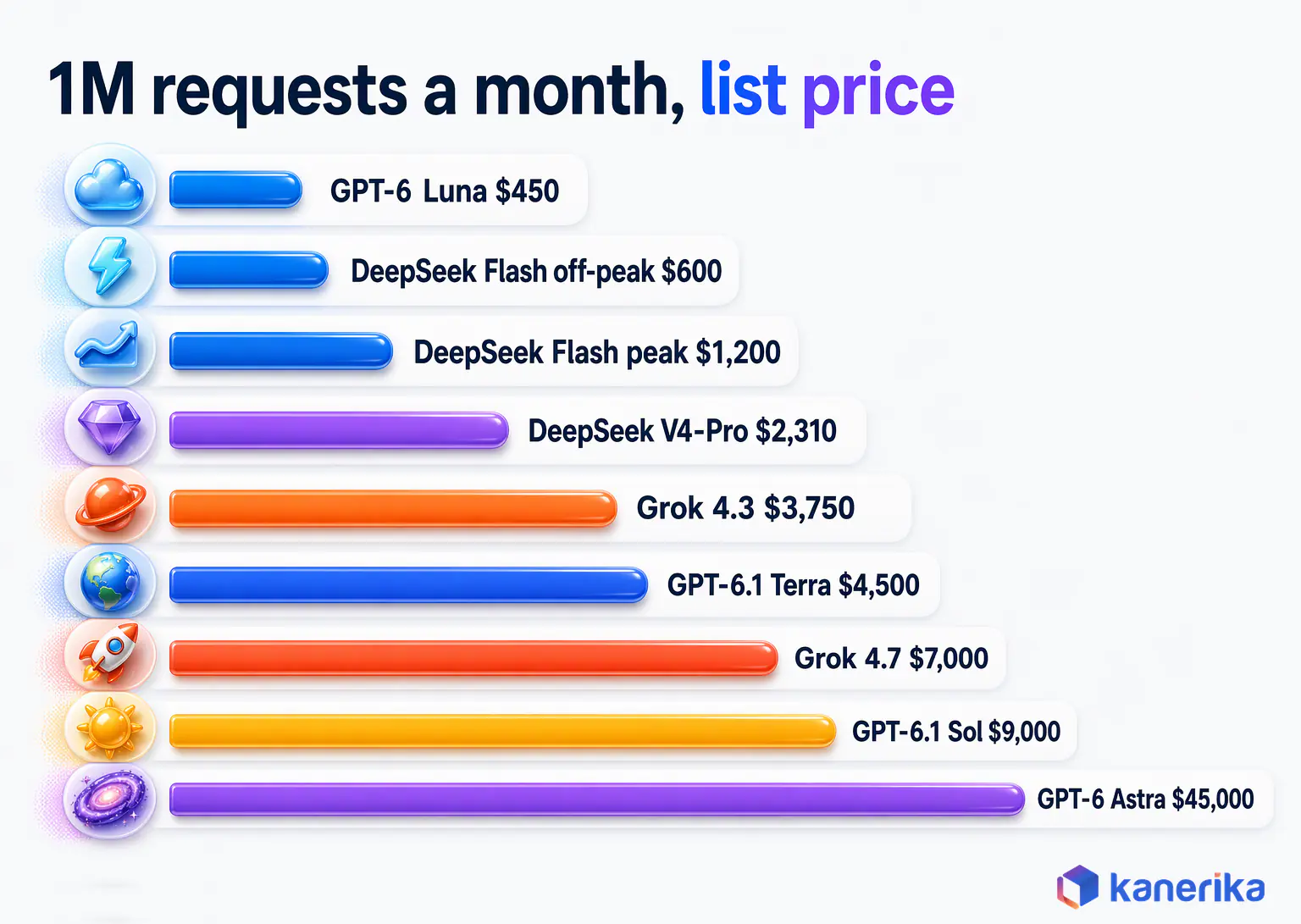
- At 1M requests a month, list-price arithmetic puts Flash at $600, compared to $7,000 on Grok 4.7 and $9,000 on GPT-6.1 Sol.
- The hosted DeepSeek API is the wrong home for regulated data, while its MIT-licensed V4.1-Flash weights can run inside your own network.
- Run a 30-day test on your own tasks before you choose, scoring quality, cost per successful task, data terms, latency and integration effort.
The Month a 200k-Token Prompt Doubled the Bill
Picture a product team that ships a contract-review assistant on Grok 4.7. At first, each prompt carries a 150,000-token contract bundle, so the monthly bill matches the spreadsheet.
Then the legal team adds two appendices, and the typical prompt grows past 200,000 tokens. Every token in those requests now bills at the higher rate, $4 instead of $2 per 1M input and $12 instead of $6 output, so input spend per request jumps from about $0.30 to $0.80 with no change in traffic.
Pricing rules such as this one decide the Grok vs ChatGPT vs DeepSeek question for most API buyers. This guide compares the three as API products for CTOs, AI leads and product owners, with consumer chatbot plans covered only where they affect budgets. Models and prices checked November 2, 2026.
Grok vs ChatGPT vs DeepSeek: The Short Answer
GPT-6.1 Sol is the safest default for enterprise API work, with the widest context window of the three. Grok 4.7 fits research when it needs live web and X data.
DeepSeek V4.1-Flash is the cheapest of the three and the only one of the three flagship models here with published weights. Still, its hosted API is the wrong home for regulated data.
The three vendors solve different problems, so the useful question is which workload you are buying for. A support bot answering millions of short questions has a different cost profile than an analyst tool that reads 300-page filings.
The table below compares the flagship API model from each vendor on the numbers procurement teams ask about first. For a wider ranking across many vendors, see our guide to the top LLMs for enterprise use. For the other three-way contest, also read how ChatGPT compares with Gemini and Claude.
| Provider | Model ID | Input / output per 1M tokens | Context window | Weights published | Strongest fit |
|---|---|---|---|---|---|
| xAI | grok-4.7 | $2 / $6 (under 200k tokens) | 500,000 | No | Research on live web and X data |
| OpenAI | gpt-6.1-sol | $2 / $10 | 1,050,000 | No | Managed default for broad enterprise work |
| DeepSeek | deepseek-flash (V4.1-Flash-1017) | $0.15 / $0.60 off-peak | 1M | Yes, MIT license | High-volume or self-hosted work |
Strengths by Task: Coding, Reasoning, Long Documents and Writing
Each vendor describes its model’s strengths on its own page, and those claims differ in kind. Sources checked November 2, 2026 are the Grok 4.7 model page, the GPT-6.1 Sol model page and the DeepSeek V4.1-Flash model card.
| Task | Grok 4.7 | GPT-6.1 Sol | DeepSeek V4.1-Flash |
|---|---|---|---|
| Coding | Described as a frontier model for coding and agentic tasks | Aimed at complex coding and computer use | Self-reported 74.2 on DeepSWE v1.1 at maximum effort (V4.1-Flash card; the later -1017 card lists 77.0) |
| Reasoning | Low to xhigh reasoning effort, default high | Five effort levels from low to max, default medium | Adjustable reasoning effort from 1 to 100 |
| Long documents | 500,000 tokens, higher rate from 200k | 1,050,000 tokens, 128,000 output | 1M tokens, max_tokens of 256K or more advised |
| Writing | No writing claim (lists knowledge work) | No writing claim (lists professional work) | Not stated |
The Current Models Behind Grok, ChatGPT and DeepSeek (Checked November 2, 2026)
Each vendor sells a ladder of models, while the flagship name rarely tells you what you will pay. Once you know the rungs, you can route cheap traffic to cheap models and save the flagship for hard tasks.
The table lists every rung covered here, as well as the dates the vendor pages give.
| Model | API model ID | Input / output per 1M tokens | Context window | Date on vendor page |
|---|---|---|---|---|
| Grok 4.7 | grok-4.7 | $2 / $6 (under 200k) | 500,000 | Not published |
| Grok 4.3 | grok-4.3 | $1.25 / $2.50 (under 200k) | 1M | Not published |
| GPT-6.1 Sol | gpt-6.1-sol | $2 / $10 | 1,050,000 | September 29, 2026 |
| GPT-6.1 Terra | gpt-6.1-terra | $1 / $5 | 1,050,000 | Not published |
| GPT-6 Astra | gpt-6-astra | $10 / $50 | 1.05M | Not published |
| GPT-6 Luna | gpt-6-luna | $0.10 / $0.50 | 1.05M | Not published |
| DeepSeek V4.1-Flash-1017 | deepseek-flash | $0.15 / $0.60 off-peak | 1M | October 17, 2026 (news item) |
| DeepSeek V4-Pro-0813 | deepseek-v4-pro | $0.66 / $1.98 off-peak | 1M | August 13, 2026 (GA) |
xAI: Grok 4.7 and the Grok Ladder
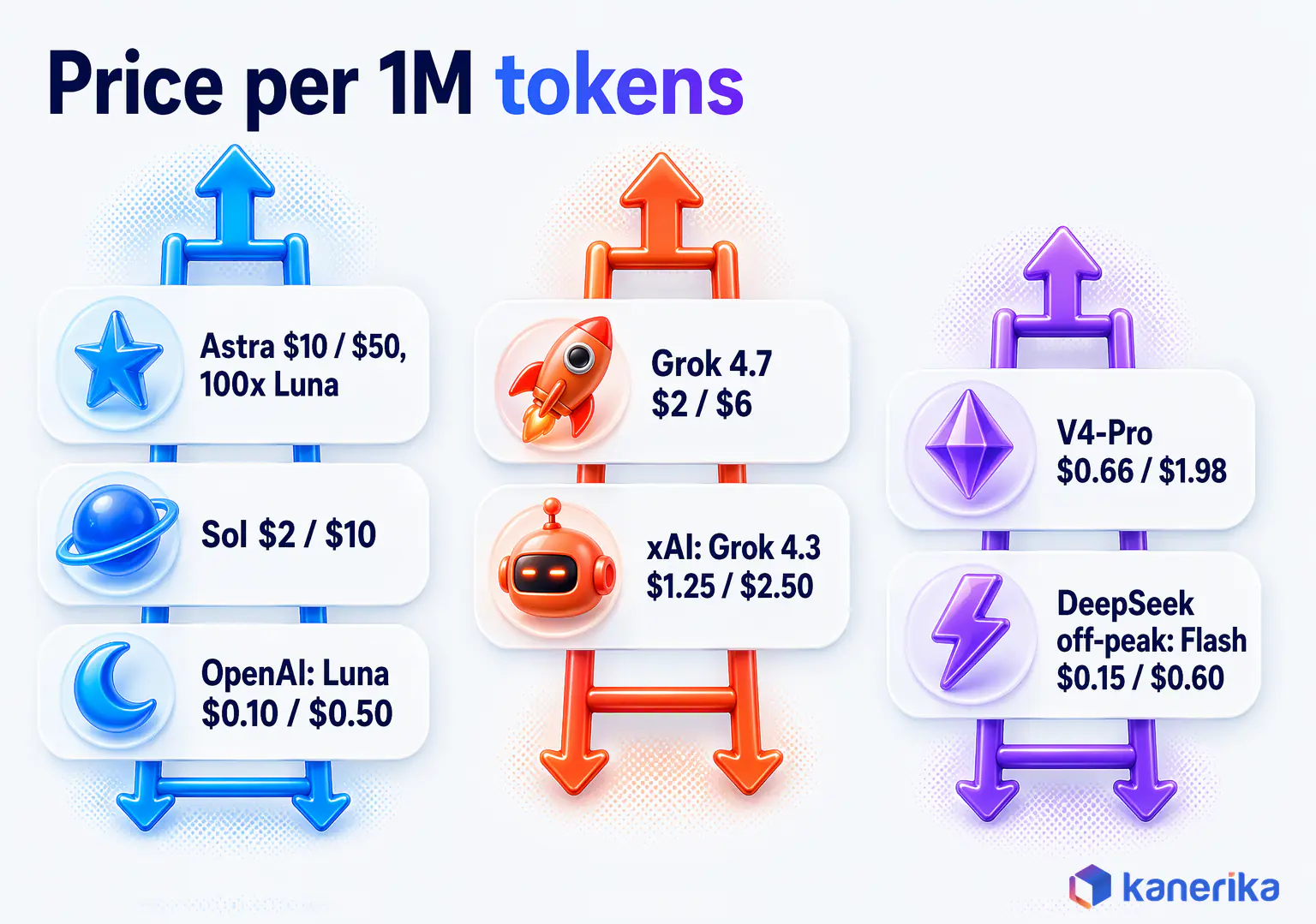
Grok 4.7 (model ID grok-4.7) is listed on the xAI models page. It has a 500,000-token context window and lists at $2 input and $6 output per 1M tokens until a prompt reaches 200k tokens.
Grok 4.6 is the earlier release and still shares those prices and that window. Grok 4.3, by comparison, is the budget rung, with a 1M-token window at $1.25 / $2.50 under 200k tokens.
OpenAI: GPT-6.1 Sol, Terra, Astra and Luna
The OpenAI API ladder has four rungs on its API models page. GPT-6.1 Sol (gpt-6.1-sol), published September 29, 2026, lists at $2 input, $0.10 cached input and $10 output per 1M tokens.
Terra, the mid rung, lists at $1 / $5. GPT-6 Astra is the premium rung at $10 / $50, while GPT-6 Luna is the volume rung at $0.10 / $0.50.
OpenAI retired gpt-4-turbo, o1, o3-mini and gpt-4o-2024-05-13 on October 23, 2026, and is scheduled to retire gpt-5, o3 and o3-pro on December 11, 2026.
After that, the GPT-4o and GPT-4.1 snapshots retire on January 14, 2027. Our guide to GPT models and the OpenAI family covers each rung in detail.
DeepSeek: V4.1-Flash and V4-Pro
The DeepSeek API updates page carries a V4.1-Flash-1017 news item dated October 17, 2026. The API serves it as deepseek-flash, with a 1M-token window at $0.15 input (cache miss) and $0.60 output per 1M tokens during off-peak hours.
V4-Pro-0813 (deepseek-v4-pro) became generally available on August 13, 2026 and lists at $0.66 / $1.98 off-peak. For background on the company and its earlier releases, see our guide to DeepSeek models.
Pricing: Token Rates, Long-Prompt Tiers and DeepSeek Peak Hours
Token prices look simple until a workload hits a threshold. All three vendors change the rate on some requests, although each one uses a different trigger.
List Prices per Million Tokens
The table lists standard API rates from the xAI pricing page, the OpenAI models page and the DeepSeek pricing page. DeepSeek rates are off-peak cache-miss rates.
| Model | Input | Cached input | Output |
|---|---|---|---|
| Grok 4.7, under 200k tokens | $2 | $0.50 | $6 |
| Grok 4.7, 200k tokens and over | $4 | $1 | $12 |
| Grok 4.3, under 200k tokens | $1.25 | Not listed here | $2.50 |
| GPT-6.1 Sol | $2 | $0.10 | $10 |
| GPT-6.1 Terra | $1 | $0.05 | $5 |
| GPT-6 Astra | $10 | $1.00 | $50 |
| GPT-6 Luna | $0.10 | $0.01 | $0.50 |
| DeepSeek V4.1-Flash, off-peak | $0.15 (cache miss) | Not listed here | $0.60 |
| DeepSeek V4-Pro, off-peak | $0.66 | Not listed here | $1.98 |
On list price alone, Flash input is about 13x cheaper than Grok 4.7 or GPT-6.1 Sol. Flash output is 10x cheaper than Grok 4.7 and about 17x cheaper than Sol.
The Long-Prompt Rules
xAI applies its higher rate to the whole request once a prompt reaches 200k tokens. A 199,000-token prompt to Grok 4.7 costs about $0.40 in input, and a 200,000-token prompt costs $0.80, because every token then bills at $4.
The OpenAI rule starts later. Sol and Terra prompts over 272K tokens cost 2x on input and 1.5x on output. For example, a 300,000-token Sol prompt costs $1.20 in input, and its output then bills at $15 per 1M.
DeepSeek has no long-prompt tier in the data checked, so a 300,000-token Flash prompt costs about $0.045 in input off-peak. Its surcharge depends on the clock instead.
DeepSeek doubles its prices during peak hours, 01:00 to 04:00 and 06:00 to 10:00 UTC, Monday to Friday, excluding Chinese public holidays. That is 35 of 168 hours a week, up to about 21%, and Flash rises to $0.30 / $1.20 inside those windows. Map your users’ working hours onto the UTC windows before you forecast spend.
Caching and Batch Discounts
Repeated context, such as a system prompt or a policy document sent with every request, can bill at a cached rate. Grok 4.7 cached input lists at $0.50 under 200k tokens, while Sol cached input lists at $0.10, a 95% cut from its $2 input rate.
OpenAI Batch and Flex processing cost 50% less when work can wait. A nightly classification run is a natural fit, whereas a live chat reply is a poor one.
ChatGPT Plans vs API Billing
A ChatGPT plan buys one person’s access to the app. The plans are Free ($0), Go ($8), Plus ($20) and Pro (from $100, in $100, $200 and $500 tiers). Plus also includes GPT-6.1 Sol and GPT-6 Luna.
The API bills per token, so cost rises and falls with traffic. ChatGPT Business is the team plan, and its price is not quoted here because it was not confirmed. The xAI consumer plan is SuperGrok, though its prices were not on the pages read.
Token billing suits products and pipelines that call a model from code, and our OpenAI API guide covers setup and billing in detail.
AI Assessment
See How Ready Your Data and Teams Are for Production AI
Score your data, governance and team readiness before you commit budget to a model or a vendor.
Start Your AI Assessment →What Each Model Costs Under a Real Workload
A worked example turns per-token rates into a monthly number that a budget owner can use. Take 1,000,000 requests a month, each with 2,000 input tokens and 500 output tokens.
That is 2 billion input tokens and 0.5 billion output tokens. Every prompt stays under the 200k and 272K thresholds, and no caching is applied. The figures below are list-price arithmetic, not a measured test.
| Model | Monthly cost at list price |
|---|---|
| GPT-6 Luna | $450 |
| DeepSeek V4.1-Flash, all off-peak | $600 |
| DeepSeek V4.1-Flash, all peak | $1,200 (about $725 with traffic spread evenly across the week) |
| DeepSeek V4-Pro, all off-peak | $2,310 |
| Grok 4.3 | $3,750 |
| GPT-6.1 Terra | $4,500 |
| Grok 4.7 | $7,000 |
| GPT-6.1 Sol | $9,000 ($4,500 with Batch) |
| GPT-6 Astra | $45,000 |
GPT-6 Luna and DeepSeek Flash both stay under $1,000 a month, while GPT-6.1 Sol costs 15 times the Flash off-peak figure. GPT-6 Astra, by comparison, costs 100 times Luna for the same traffic.
Cost per Successful Task, Not Cost per Token
Token price ignores the cost of failure. For instance, a model that fails one task in five needs reruns, extra review or a human fix. Those costs can then erase part of a price gap.
Track cost per successful task instead. Add total token spend to the cost of review time, then divide by the number of tasks that pass your acceptance check.
A model at twice the token price can still win if it needs fewer retries on your hardest tasks.
Where Small Models Fit
Routine traffic such as classification, extraction, short summaries and intent routing rarely needs a flagship model. GPT-6 Luna, Grok 4.3 and DeepSeek V4.1-Flash sit at the bottom of their vendors’ ladders, so they suit this volume tier.
Send hard tasks to the flagship and everything else to the cheap rung, then measure both routes. Our comparison of small language models and LLMs explains when a smaller model is enough.
A split like that also changes the worked example. Send 80% of the 1M requests to Luna and 20% to Sol, and list-price arithmetic gives about $2,160 a month. That compares to $9,000 for Sol alone.
Context Windows and Long-Document Work
A context window is the amount of text a model can read in one request. It decides whether a long contract or a full codebase fits in a single call or has to be split.
GPT-6.1 Sol and Terra list 1,050,000 tokens, and GPT-6 Astra and Luna list 1.05M. DeepSeek V4.1-Flash and Grok 4.3 list 1M, while Grok 4.7 has the smallest window here at 500,000 tokens. Output limits differ too, since Sol caps a reply at 128,000 tokens. DeepSeek’s pricing page lists a 384K output maximum for its API models.
Even so, a large window does not prove the model recalls every detail inside it.
Test recall on your own long documents instead, with questions whose answers sit deep in the text. The price rules usually bite before the window does. A Grok 4.7 prompt crosses its 200k pricing line at 40% of its window. A Sol prompt crosses 272K at about a quarter of its window.
Our guide to context engineering covers how to trim and structure long prompts.
Real-Time Data and Research Capabilities
Fresh information matters for questions about a market move, a breaking story or a public conversation.
The Grok API has web search and X search tools, described on the xAI web search tool page. Grok 4.7 is therefore the natural pick for analyst tools that track public sentiment or news on X. The GPT-6.1 Sol model page also lists a web search tool, so Sol can answer from fresh pages without the X feed. DeepSeek works from its training data unless you add retrieval, so plan a search or document layer if freshness matters.
For enterprise answers, retrieval on your own governed data usually matters more than public web search. Our guide to RAG versus a plain LLM explains how retrieval keeps answers grounded in your sources.
Coding and AI Agent Development
Coding results depend heavily on the codebase, because every repository has its own conventions, tests and build quirks.
Run each model on your own repository instead of trusting a leaderboard. Pick 20 to 30 real tickets, then measure four things:
- Tests passed, with no edits to the tests.
- Multi-file edits that compile and keep the existing behavior.
- Tool-call success when the model runs commands or reads files.
- Recovery after a failed call, such as a broken build or a missing file.
Run the test at the reasoning effort you plan to pay for. Grok 4.7 defaults to high effort and Sol to medium, and a higher setting spends more output tokens on each ticket. DeepSeek’s pricing page also limits fill-in-the-middle completion, the mode editor autocomplete uses, to non-thinking mode.
A coding agent that can run commands needs human approval before it touches production systems, plus a log of every action it takes.
Switching cost is lower when your code talks to a common API shape. Check each vendor’s API compatibility notes before you build, and keep prompts provider-neutral. Our guide to AI coding agents covers tools and review workflows.
Kanerika Service
LLM Development Services
Kanerika designs, tests and deploys LLM applications across vendors, with evaluation, routing and monitoring built in.
Explore LLM DevelopmentBenchmarks and Accuracy: What Vendor Scores Miss
A benchmark score tells you how a model did on someone else’s test, under someone else’s settings. It is a useful signal for a shortlist, but a weak basis for a contract.
In particular, vendor-published scores depend on reasoning effort, prompt format, dataset version and the date of the run. Two vendors can report the same benchmark with different settings, so the numbers rarely compare cleanly.
The DeepSeek V4.1-Flash model card, checked November 2, 2026, shows the problem. It reports 74.2 on DeepSWE v1.1 and 90.6 on Terminal-Bench 2.1, all at its maximum reasoning effort of 100. Its OpenAI column is GPT-5.6 Sol, an earlier model than GPT-6.1 Sol, at 73.0 and 88.8. The card does not say who ran the rival scores. Its HLE result without tools reads 36.8, or 39.1 on a text-only subset. The later V4.1-Flash-1017 card lists different numbers, such as 77.0 on DeepSWE, so check which card a score came from.
A team that runs Flash at lower effort to save tokens should expect different numbers from the card. Test data can also leak into training sets, and a 2024 survey of benchmark data contamination finds this makes evaluation results unreliable.
Your own evaluation is therefore the number that predicts production behavior. Our LLM evaluation framework guide shows how to build a test set and score it.
Run a Known-Answer Hallucination Test
A known-answer test checks each model against facts you have already verified.
- Collect 50 to 100 questions whose answers sit in your own documents, then record the checked answer for each.
- Run every model on the same set, together with the same retrieval context and prompt.
- Count unsupported claims, wrong numbers and missing citations in every answer, then rank them by severity.
- Repeat the run after any model upgrade, because results can shift between versions.
Our guide to LLM hallucination explains the common causes and fixes.
Multimodal Input: Check Per Model ID
Multimodal support means a model accepts images, audio or files in addition to text. Support still differs by model ID and by endpoint, even within one vendor’s family.
The vendor pages checked November 2, 2026 list these inputs, each with a workflow it suits:
- GPT-6.1 Sol: text and image in, text out, with audio and video marked unsupported. PDF input is not stated on the model page, so a fit is line-item extraction from scanned invoice images.
- Grok 4.7: text and image in, text out, per its model page, and the xAI models page caps images at 20MiB in JPG or PNG. A fit is reading a chart screenshot alongside live X search results.
- DeepSeek V4.1-Flash: the pricing page marks image input as supported for deepseek-flash but not for V4-Pro. The open weights also process images natively, so scanned claim forms can be read on self-hosted GPUs.
Recheck the exact model ID before you build. Our multimodal AI guide explains the main patterns.
Data Security, Privacy and Jurisdiction
For a regulated team, data terms often decide the outcome. Where a prompt goes, who can read it and which law applies can rule a model out before price matters.
Treat data terms as a pass-or-fail gate, checked before quality testing begins.
Hosted APIs and Training Defaults
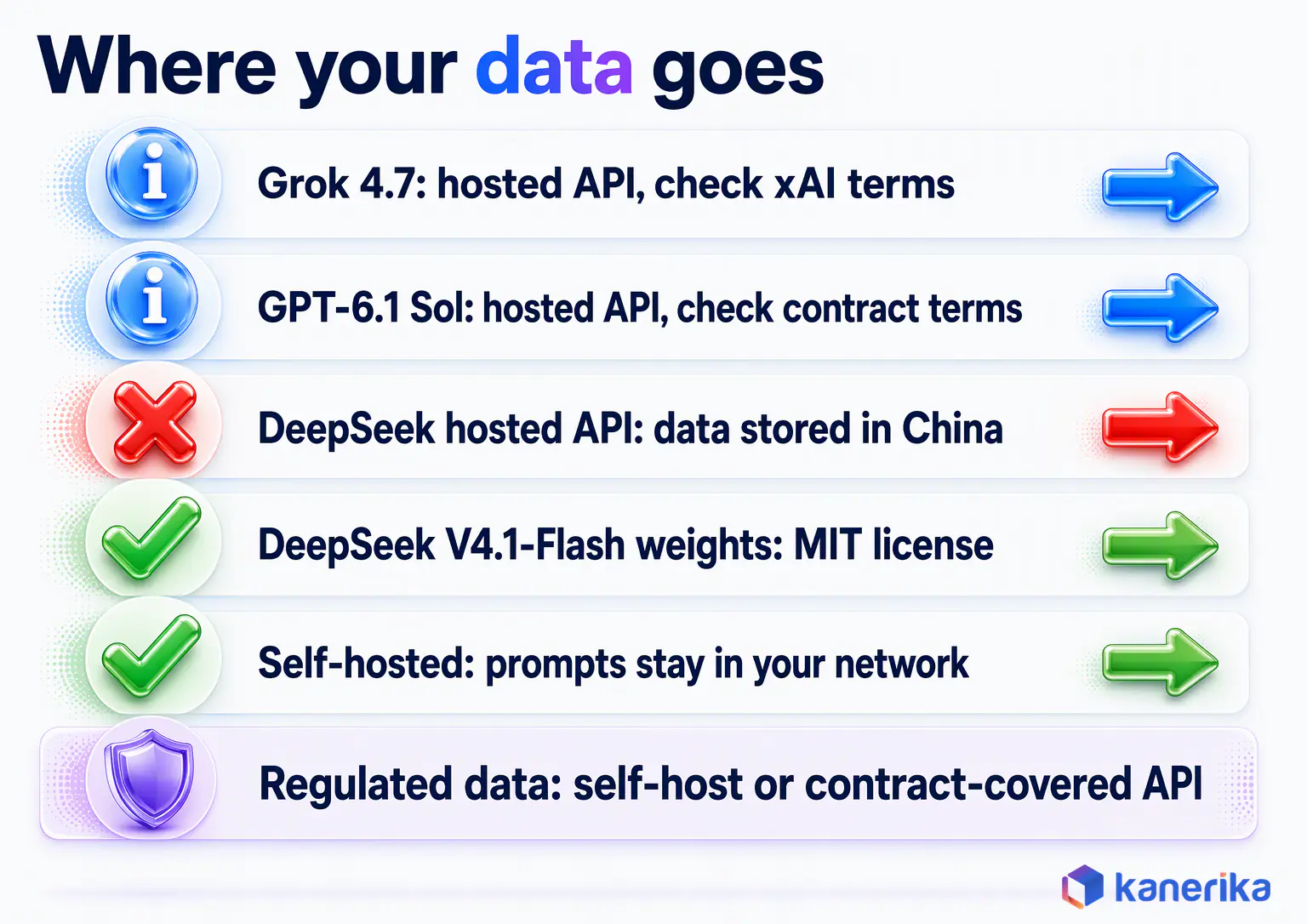
OpenAI states that data sent to its API is not used to train or improve its models unless you opt in, and keeps abuse-monitoring logs for up to 30 days (how your data is handled). Read the terms in force when you sign, and match them against your contract.
For xAI, check the enterprise terms directly instead. This guide makes no claim about xAI data handling.
DeepSeek’s Hosted API and Data Location
The DeepSeek privacy policy says personal data is stored in the People’s Republic of China. For a bank, insurer, health provider or public body, that location alone can therefore fail a data-transfer review.
For that reason, regulated teams should not send personal or client data to the hosted DeepSeek API. Public, low-risk workloads may still pass if your own policies allow them.
Self-Hosting DeepSeek V4.1-Flash
DeepSeek publishes the V4.1-Flash weights on Hugging Face under the MIT license. You can run the model on your own GPUs, so prompts never leave your network.
The model card describes a mixture-of-experts model with 552B backbone parameters, of which 8B are active per token in prefill and 16B in decode. The weight files include FP8 tensors, and the card describes an FP4 key-value cache.
For hardware, the NVIDIA Dynamo recipe for V4.1-Flash serves it on eight H200 GPUs, each with 141 GB of HBM3e memory. That layout is disaggregated, with one four-GPU prefill worker and one four-GPU decode worker. Aggregated serving on H200 uses 16 GPUs. Eight B200 or GB200 GPUs also work. The recipe uses vLLM on every GPU type and offers SGLang on GB200 only.
On the recipe’s agentic workload of 64K input and 400 output tokens, the 8x H200 disaggregated split measured about 359 output tokens per second per GPU. That run used 64 concurrent requests, with a median time to first token of about 178 ms.
For smaller hardware, the model card links to 145 community quantized builds for llama.cpp, Ollama and LM Studio, but it does not report their accuracy. Run any quantized build through the same known-answer test before you trust it.
Self-hosting also moves patching, scaling and monitoring to your team, so the price per token becomes a hardware and staffing cost.
Fixed GPU Cost vs Per-Token Price
The break-even below is an illustrative calculation, not a quote. It assumes eight GPUs at $4 per GPU-hour for 730 hours, or $23,360 a month before staff.
At the worked example’s 2,000 input and 500 output tokens, hosted Flash costs $0.0006 per request off-peak. Break-even then sits near 39 million requests a month.
Long prompts move the line. At the recipe’s 64K shape, taken as 64,000 input tokens, a hosted request costs about $0.00984 off-peak. Break-even then falls to about 2.4 million requests a month. The measured 8x H200 rate works out to roughly 18.9 million such requests a month, so long-context agent traffic can pay for the hardware. Short chat traffic needs far more volume to break even, so data control is usually the stronger reason to self-host.
Our comparison of vLLM and Ollama covers two common serving engines. Our open-source LLMs guide compares other open-weight options in case DeepSeek does not fit.
Controls You Still Own
Your team still owns the security controls around any model, hosted or self-hosted. Four of them belong in every deployment:
- PII redaction before prompts leave your network.
- Access control on who can call which model with which data.
- Logging of prompts and outputs, with clear retention rules.
- Prompt-injection tests on any agent that can call tools.
Prompt-injection testing matters for DeepSeek in particular. An independent NIST CAISI evaluation was published September 30, 2025. It found agents built on DeepSeek R1-0528 were 12 times more likely than evaluated U.S. frontier models to follow malicious instructions. That study covered earlier DeepSeek models, not V4.1-Flash, so treat it as a reason to run your own tests.
Our LLM security guide covers each control in detail. Our piece on sovereign AI also explains how data residency rules shape model choice.
Limitations of Grok, ChatGPT and DeepSeek
Every option on this shortlist carries trade-offs worth naming before the pilot starts.
Grok
Grok 4.7 has the smallest window of the three flagships at 500,000 tokens. The 200k all-tokens rule also makes long prompts jump in price. The xAI pages read for this guide list neither consumer plan prices nor a Grok 4.7 release date.
OpenAI
GPT-6 Astra is expensive at $10 / $50, and four API rungs plus several ChatGPT plans make the choice sprawl. Retirements on December 11, 2026 and January 14, 2027 also force migration work on teams pinned to older models.
DeepSeek
The data location in the hosted API’s privacy policy rules it out for regulated data. Peak hours also double the price for up to about 21% of the week, while self-hosting needs GPU capacity and an operations team.
Our guide to generative AI risks covers the wider risk list for enterprise deployments.
Which One Fits Your Team and Use Case
Matching each workload to one model keeps the Grok vs ChatGPT vs DeepSeek decision concrete. The picks below therefore follow from the prices, windows and data terms above.
Still, treat them as starting points for your own test. Our enterprise LLM guide covers platform-level planning once the shortlist is set.
- Content and marketing: GPT-6.1 Sol, the managed default with a 1,050,000-token window for long briefs and brand guides. Plus seats also include it for individual writers.
- Engineering: GPT-6.1 Sol or Terra for agent work, tested against DeepSeek V4.1-Flash on your own repository. Flash makes high-volume code review cheap when the code is not regulated.
- Research and analysts: Grok 4.7, because its web and X search tools suit work that tracks public news and sentiment.
- Customer support at volume: GPT-6 Luna or DeepSeek V4.1-Flash for routine questions, with escalation to Sol for hard cases. At 1M requests a month, Luna lists at $450, compared to $600 for Flash off-peak.
- Regulated enterprises: GPT-6.1 Sol under contract, or DeepSeek V4.1-Flash self-hosted inside your network. Keep regulated data away from the hosted DeepSeek API.
Many teams end up with two or three of these models in production, so a routing layer keeps the mix manageable.
Checklist
Generative AI Checklist
Work through the data, security, governance and infrastructure checks to clear before a generative AI rollout.
Get the Checklist →How to Choose: A 30-Day Evaluation, Weighted Scorecard and Routing
A 30-day pilot on your own tasks settles most model debates with evidence.
The 30-Day Plan
- Scope (week 1): pick 50 to 100 real tasks, record a baseline from your current process and get data approval before testing starts.
- Integrate (week 2): connect all three APIs behind one interface, together with logging on cost, latency and output. Include prompts above 200k and 272K tokens and traffic inside DeepSeek’s peak windows, so measured cost reflects the pricing rules.
- Test (week 3): score quality, cost per successful task and security findings, such as a known-answer hallucination run.
- Pilot and decide (week 4): run a limited pilot with real users on the leading model, then make the decision.
Weighted Scorecard
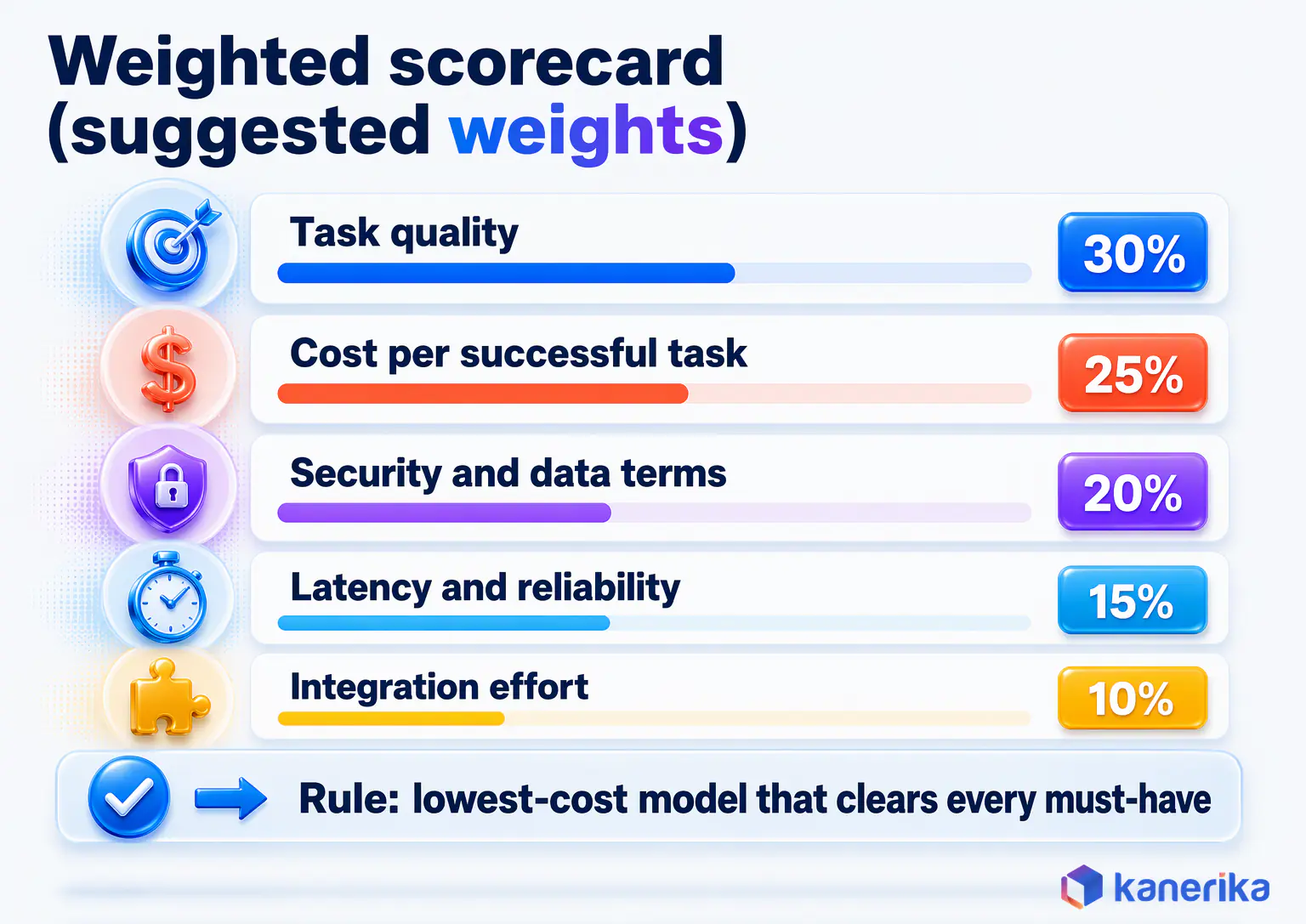
Score each model on five criteria with suggested weights. Adjust them to your risk profile, and write them down before the test starts. Score every model at the reasoning effort you would run in production, since vendor cards often report the maximum.
- Task quality: 30%
- Cost per successful task: 25%
- Security and data terms: 20%
- Latency and reliability: 15%
- Integration effort: 10%
Then use one decision rule. Pick the lowest-cost model that meets every mandatory requirement, then compare weighted scores among the models that pass.
Route by Task With a Gateway and Fallback
A gateway sits between your apps and the model APIs. It routes each request type to the right model and fails over when one provider is slow or down. Our guide to the LLM gateway pattern explains the setup.
Route by data class as well as by task, so a prompt carrying client data can reach only an approved endpoint. A gateway can also shift DeepSeek traffic to another route during its weekday peak windows, when the price doubles. Give every route a named fallback model, and test that failover each month so a provider outage does not reach users.
Pin exact model IDs in the gateway instead of floating aliases. Retest each route before a retirement date, and log quality and cost per route so a drop shows up within days. Our guide to LLM observability covers the metrics worth tracking.
How Kanerika Helps Enterprises Select and Run LLMs
Kanerika helps enterprises choose, build on and govern LLMs from more than one vendor. Kanerika is an OpenAI Select Partner, and its selection work still follows the same vendor-neutral evaluation method described above. Its teams also build AI agents on governed enterprise data, such as the member support agent in the case study below.
Case Study: 65% Self-Service Resolution With an AI Support Agent
A global expert-network firm with over one million subject-matter experts faced a heavy load of repetitive member tickets. Members sent questions by email, phone, chat or Zendesk, and many followed standard patterns such as account setup, profile updates and basic compliance checks.
Staff still looked up each answer by hand across knowledge bases and Zendesk archives, so turnaround was slow. That manual work also kept executives away from higher-value member conversations, while escalations drove up support costs.
Kanerika built an AI agent connected to the knowledge base and Zendesk, as well as chat and voice channels. It writes ticket summaries with next steps and routes complex cases to live executives when its confidence is low. Routine queries are now answered instantly and around the clock, which frees executives for high-impact interactions.
The published results are 65% self-service resolution and a 42% reduction in ticket volume. Cost per ticket also fell 31%, while member satisfaction rose 25%. The low-confidence handoff is the same routing-and-fallback pattern described in the evaluation section.
Case Study
65% Self-Service Resolution With an AI Support Agent
How an AI member support agent with a low-confidence handoff resolves routine member queries on its own.
Read the Case Study →Four Stages of an LLM Selection Engagement
A typical engagement runs in four stages:
- Use-case and data readiness review: classify the data each workload will send, which alone decides whether DeepSeek’s hosted API is eligible. This also sits within Kanerika’s AI strategy services.
- Shortlist and 30-day evaluation: test Grok 4.7, GPT-6.1 Sol or Terra and DeepSeek V4.1-Flash on the client’s own tasks, scored on quality, cost per successful task, latency and data terms, through LLM development services.
- Build on governed data: RAG development with source citations, agentic AI workflows, data pipelines on FLIP, document Q&A with KlarityIQ and PII redaction with Susan before prompts leave the network.
- Govern and monitor: routing rules, pinned model IDs, retirement dates and cost-per-task tracking under AI governance services.
Log cost per successful task from day one, and keep prompts provider-neutral behind a gateway so a model swap is a configuration change.
Also keep regulated data on self-hosted or contractually covered endpoints. Retest every route before a retirement date.
Talk to Kanerika
Shortlisting an LLM for Production?
Talk to Kanerika about a 30-day evaluation of Grok, ChatGPT and DeepSeek on your own tasks and data.
Talk to an Expert →Final Verdict: Grok vs ChatGPT vs DeepSeek
GPT-6.1 Sol, the model behind ChatGPT Plus and the OpenAI API, is the managed default for broad enterprise work. Grok 4.7 is the research pick when work needs live web and X data. DeepSeek V4.1-Flash is the low-cost pick when data terms allow it or when you self-host the weights.
Budget for the long-prompt and peak-hour rules, and also keep regulated data off the hosted DeepSeek API. Then let a 30-day test on your own tasks make the final call, and talk to Kanerika if you want help running it.
Frequently Asked Questions
Which is better: Grok, ChatGPT, or DeepSeek?
GPT-6.1 Sol is the best default for most enterprise API work, with the widest context window of the three. Grok 4.7 suits research on live web and X data. DeepSeek V4.1-Flash is the cheapest of the three and the only one of the three flagship models here with published weights. Regulated data should stay off its hosted API. Test all three on your own tasks.
Which is cheapest for API use: Grok, ChatGPT, or DeepSeek?
DeepSeek V4.1-Flash is the cheapest of the three flagship models at $0.15 input and $0.60 output per 1M tokens off-peak. Peak hours double that rate. OpenAI’s GPT-6 Luna lists even lower at $0.10 and $0.50. At 1M requests a month, list-price arithmetic gives $450 on Luna, $600 on Flash and $7,000 on Grok 4.7.
Which DeepSeek model should I use: V4.1-Flash or V4-Pro?
Start with V4.1-Flash, which lists at $0.15 input and $0.60 output per 1M tokens off-peak with a 1M-token window. V4-Pro-0813 lists at $0.66 and $1.98 off-peak. Test both on your hardest tasks with the same test set, and move to Pro only if its results justify an input price more than four times higher.
Is Grok 4.7 available for business use?
Yes, through the xAI API as the model grok-4.7. It lists at $2 input and $6 output per 1M tokens under 200k tokens, with a 500,000-token window. Prompts of 200k tokens or more bill every token at $4 and $12. Check the xAI enterprise terms on data handling before you send business data.
What context window do Grok 4.7, GPT-6.1 Sol, and DeepSeek V4.1-Flash support?
GPT-6.1 Sol supports 1,050,000 tokens with up to 128,000 output tokens. DeepSeek V4.1-Flash supports 1M tokens. Grok 4.7 supports 500,000 tokens, the smallest window of the three. A large window does not guarantee accurate recall, so test long-document questions on your own files before you rely on one for production work.
Should enterprises use one AI model or combine Grok, ChatGPT, and DeepSeek?
A mix of models behind one gateway usually serves an enterprise well. Route routine traffic to a cheap rung such as GPT-6 Luna or DeepSeek V4.1-Flash, research to Grok 4.7 and hard tasks to GPT-6.1 Sol. Pin model IDs, set fallbacks and track cost per successful task for each route.
How does ChatGPT pricing compare to Grok and DeepSeek?
ChatGPT plans charge per person, with Free at $0, Go at $8, Plus at $20 and Pro from $100. The APIs charge per token instead. GPT-6.1 Sol lists at $2 and $10 per 1M tokens, Grok 4.7 at $2 and $6, and DeepSeek V4.1-Flash at $0.15 and $0.60 off-peak. SuperGrok prices were not confirmed.
Why does DeepSeek charge different prices at different times of day?
DeepSeek prices its API by time of day. Rates double in a peak window that runs from 1 to 4 a.m. and from 6 to 10 a.m. UTC, Monday to Friday, excluding Chinese public holidays. V4.1-Flash rises from $0.15 and $0.60 to $0.30 and $1.20 per 1M tokens. Those hours cover up to about 21% of the week, so schedule batch jobs outside them.
Which is best for coding: Grok, ChatGPT, or DeepSeek?
Results vary by codebase, so test on your own repository before you choose. Run 20 to 30 real tickets through Grok 4.7, GPT-6.1 Sol and DeepSeek V4.1-Flash. Measure tests passed, multi-file edits, tool-call success and recovery after failed calls. Require human approval before any coding agent touches production systems or merges code.
Is DeepSeek safe for enterprise data?
DeepSeek’s privacy policy says personal data is stored in the People’s Republic of China. That makes its hosted API a poor fit for regulated, personal or client data. Public and low-risk workloads may still pass your own review. For sensitive data, self-host the MIT-licensed V4.1-Flash weights inside your own network.
Can DeepSeek be self-hosted?
Yes. DeepSeek publishes the V4.1-Flash weights on Hugging Face under the MIT license, so you can run the model on your own GPUs. Prompts then stay inside your network. Your team takes on GPU capacity, the serving engine, patching, scaling and monitoring, so budget for operations as well as hardware.
Can Grok, ChatGPT, and DeepSeek access real-time information?
The Grok API has web search and X search tools, which suit live news and sentiment work. OpenAI’s GPT-6.1 Sol model page also lists a web search tool, so Sol can answer from fresh pages without the X feed. DeepSeek answers from its training data unless you add retrieval. For enterprise questions, retrieval over your own governed documents usually matters more, because answers can then cite internal sources.
Can teams switch between models without rewriting their codebase?
Usually, if the code calls a common API shape through a gateway. Check each vendor’s API compatibility notes, keep prompts provider-neutral and pin exact model IDs. A switch then becomes a configuration change plus a retest. Budget time for prompt tuning, because the same prompt can behave differently on another model.
Which is most accurate: Grok, ChatGPT, or DeepSeek?
No vendor-neutral accuracy figure covers all three models under the same settings. Vendor scores depend on effort level, dataset version and test date. Run a known-answer test with 50 to 100 questions from your own documents. Count unsupported claims, wrong numbers and missing citations, and repeat the test after every model upgrade.