
TL;DR
A data lakehouse for financial services is the right call for lenders, insurers and markets firms with mixed data, while a small bank with stable reports should keep its warehouse and add lakehouse items when AI work starts. It keeps one governed copy of data in open table formats such as Delta Lake or Apache Iceberg and serves reports, risk and AI from it. The real gain for a regulated institution, though, is evidence: lineage, access policies and reconciliations an examiner can trace back to source. Revised interagency model risk guidance (SR 26-2) replaced SR 11-7 on April 17, 2026, which raises the bar for showing where model data came from. Choose the platform from hard constraints first, such as cloud, residency, key management, format openness and team skills. Then start with one governed workload, run it beside the old reports until the numbers reconcile and scale by domain.
Key Takeaways
- A data lakehouse stores one governed copy of data in open table formats and serves BI, regulatory reports and models from it.
- For banks and insurers, the payoff is traceable evidence: lineage, tag-based access policies and reconciliations to the general ledger.
- SR 26-2 and OCC Bulletin 2026-13 replaced the old model risk guidance on April 17, 2026, so model input data needs a clear trail.
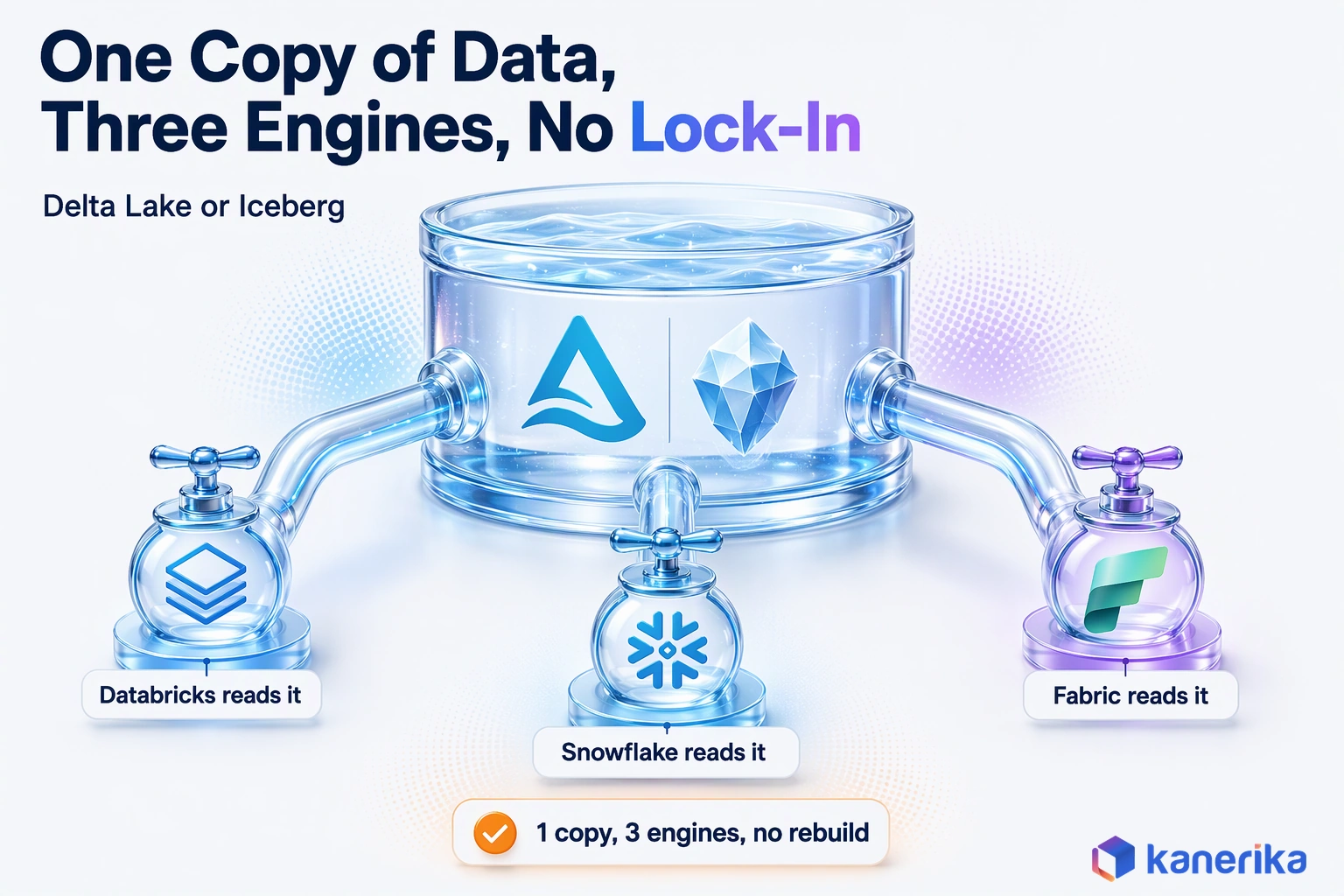
- Open formats are your exit plan, because Databricks, Snowflake and Microsoft Fabric can all work with Delta Lake or Iceberg tables.
- Pick a lakehouse when data is mixed and read by several teams, keep the warehouse when reports are stable, and go hybrid in between.
- Start with one governed workload, such as a reconciled loan exposure dataset, then run it in parallel with old reports before retiring copies.
When Risk and Finance Numbers Disagree the Night Before a Filing
Picture a regional lender at nine in the evening before a quarterly filing. The risk team’s loan exposure total does not match the finance team’s general ledger figure. Nobody in the room can say which one is right.
Both numbers come from the same loans, but not from the same copy. Risk pulled them from a data lake copy refreshed overnight, while finance used a warehouse extract built from a different cut of the servicing system. Each copy carries its own logic, its own fixes and its own owner, so explaining the gap takes analysts until morning.
A data lakehouse is one answer to that night, because it removes the second copy. It keeps a single governed copy of the data and records how every number was built. Risk, finance and the model team then read the same tables. This guide covers the architecture, the controls regulators care about, the platform choice and a framework for deciding when a lakehouse is the right move.
What Is a Data Lakehouse for Financial Services?
In plain terms, it is a data platform that keeps one governed copy of an institution’s data. Reporting, risk and AI then all read from that copy. It also pairs the low-cost, flexible storage of a data lake with the transactions, schemas and access controls of a warehouse.
The data sits in open table formats on cloud object storage, so several engines can read the same tables without copying them. For a bank, that copy might hold loan servicing records, card transactions, general ledger balances and market data. An insurer adds policy, claims and actuarial tables, while an asset manager adds positions, trades and client entitlements. The architecture is the same in each case, so the real difference is which controls matter most.
The term gets stretched in vendor material, so a working test helps. Suppose your reports, risk models and notebooks read the same governed tables. If they also share one set of permissions and one lineage record, you have a lakehouse. If each team still keeps its own extract, you have a lake sitting next to a warehouse.
Data Lake vs Data Warehouse vs Lakehouse in a Regulated Institution
The three patterns differ less in where they store data than in what they can prove. For the general comparison see our guide to data lake vs data warehouse. The table below sticks to the points a risk or compliance lead raises first.
| Point | Lake | Warehouse | Lakehouse |
|---|---|---|---|
| Storage | Files on object storage | Proprietary managed storage | Open table formats on object storage |
| Schema | Applied on read, often loosely | Enforced on write | Enforced on write, with controlled schema changes |
| ACID transactions | No | Yes | Yes, through the table format |
| Governance | Folder permissions, little lineage | Strong, but only inside the warehouse | One catalog for tables, files, models and lineage |
| Typical FS workload | Raw logs, documents, model experiments | Regulatory and management reporting | Reporting, risk analytics, fraud scoring and AI on one copy |
| Exit risk | Low, but data is ungoverned | High where the storage format is proprietary | Low when tables stay in an open format you control |
The exit-risk row is the one buyers skip, although it often matters most. A warehouse with proprietary storage makes leaving slow and expensive, especially at scale. That matters to any institution that reviews concentration risk in its critical technology vendors, such as a core banking provider.
Open Table Formats and Why They Are Your Exit Plan
An open table format is a published layout for a table’s files and metadata. Because the layout is public, any engine that supports it can read the data. Delta Lake and Apache Iceberg are the two that matter most for banks and insurers, since engine support for them is widest. Both also store data as Parquet files and add a metadata layer for transactions, schema changes and time travel.
The formats are also converging. Databricks can generate Iceberg metadata for a Delta table, so Iceberg clients read one copy of the Parquet files. This works on Databricks Runtime 14.3 LTS and above, so check your runtime first (Databricks Iceberg reads documentation). Snowflake also supports Iceberg tables. They can sit in Snowflake-managed storage or in an external volume on Amazon S3, Google Cloud Storage or Azure (Snowflake Iceberg tables guide). Similarly, Microsoft OneLake stores tables in Delta Parquet or Iceberg format, and Fabric engines work on that one copy (Microsoft OneLake overview).
That convergence turns format choice into a risk decision rather than a cosmetic one. Data held in an open format can move to another engine without rebuilding the storage layer. For a regulated firm, that is the practical exit plan, and it costs nothing extra to keep if you choose it on day one.
Why Financial Institutions Are Revisiting the Lakehouse in 2026
Four pressures are pushing banks and insurers to look at the lakehouse again, and only one of them is about technology.
The first is the cost and confusion of duplicate copies. Many institutions run a data lake for raw data while a separate warehouse serves reporting, with pipelines copying data between them. Every copy then needs its own reconciliation. Each reconciliation is another place where numbers drift apart, exactly as they did on filing night.
The second pressure comes from supervisors, who want evidence rather than assurances. BCBS 239 sets out the Basel Committee’s principles for risk data aggregation and risk reporting. It was published on January 9, 2013 (Bank for International Settlements, BCBS 239). It still shapes how large banks are judged on whether risk numbers can be traced, reconciled and produced quickly under stress.
The 2026 Model Risk Guidance and AI
The third pressure is newer than the others. On April 17, 2026, revised interagency guidance on model risk management, SR 26-2, superseded and replaced SR 11-7 and SR 21-8 (Federal Reserve SR 26-2). The OCC issued it as Bulletin 2026-13, which rescinds OCC 2011-12, 2021-19 and 1997-24 (OCC Bulletin 2026-13). The guidance defines a model as a method that turns input data into quantitative estimates. So the data behind a model is also part of the review.
Two scope notes matter. The agencies say the guidance is most relevant to banks with over $30 billion in total assets. It also leaves generative AI and agentic AI models outside its scope, so those still need their own internal controls.
The fourth pressure comes from AI rather than regulation. Fraud models, credit models and GenAI assistants all need governed data, as our look at AI in finance shows. When a team cannot show where training data came from, its model struggles to get approved. Put together, these pressures change what a data platform must do:
- One copy, not two: fewer reconciliations between lake and warehouse extracts.
- Lineage as evidence: a trail from each reported number back to its source files.
- Model data on record: versioned inputs for every model a validator reviews.
- AI on governed data: the same access policies for a notebook, a report and a retrieval index.
Still, a lakehouse does not deliver those by default. It makes them cheaper to build, because governance applies to one set of tables instead of several copies.
Kanerika Service
Data Governance Services
Kanerika sets up catalogs, lineage, classification and tag-based access policies so a regulated institution can show examiners how every reported number was built.
Explore Data Governance ServicesReference Architecture With Control Points
A financial-services lakehouse has the same layers as any lakehouse; the difference is that each layer must leave evidence behind. Data lands from sources such as core banking, card and payment streams, market data feeds and change data capture on operational databases. It then moves through bronze (raw), silver (cleaned and conformed) and gold (business-ready) layers.
The generic mechanics of those layers are covered in our guide to Databricks lakehouse architecture. What matters here, instead, is the control at each step and what it proves.
Think of the layers as a chain an examiner can walk backward when a number is challenged. A regulatory report points to a gold table, and the gold table points to the silver rules that built it. Those rules then point to the raw files that arrived on a given date. Unless every link is present, the number cannot be defended.
Control Points Layer by Layer
| Layer | What lands there | Control | What it proves to an examiner |
|---|---|---|---|
| Ingestion | Core banking extracts, card and payment events, market data, CDC streams | Source registration, schema checks, arrival logs | Data arrived complete and on time |
| Bronze | Raw records exactly as received | Write-once storage, retention rules | The original record still exists |
| Silver | Cleaned, deduplicated, conformed tables | Data quality rules, conformed keys | Business rules ran the same way every load |
| Gold | Reporting and model-ready tables | Reconciliation to the general ledger, owner sign-off | Reported totals tie to the books |
| Governance spine | Catalog, lineage, access policies, masking, retention | Automated lineage capture, tag-based policies | Who saw what, and how each number was built |
| Consumption | Regulatory reports, BI, feature store, GenAI retrieval | Role-based access, audit logs | Each consumer read only what it was allowed to |
Two ingestion details deserve care. Streaming sources such as card authorizations need deduplication so a fraud score never counts the same transaction twice. Batch extracts from the core system need arrival checks, because a missing file on a Friday turns into a wrong exposure figure on Monday.
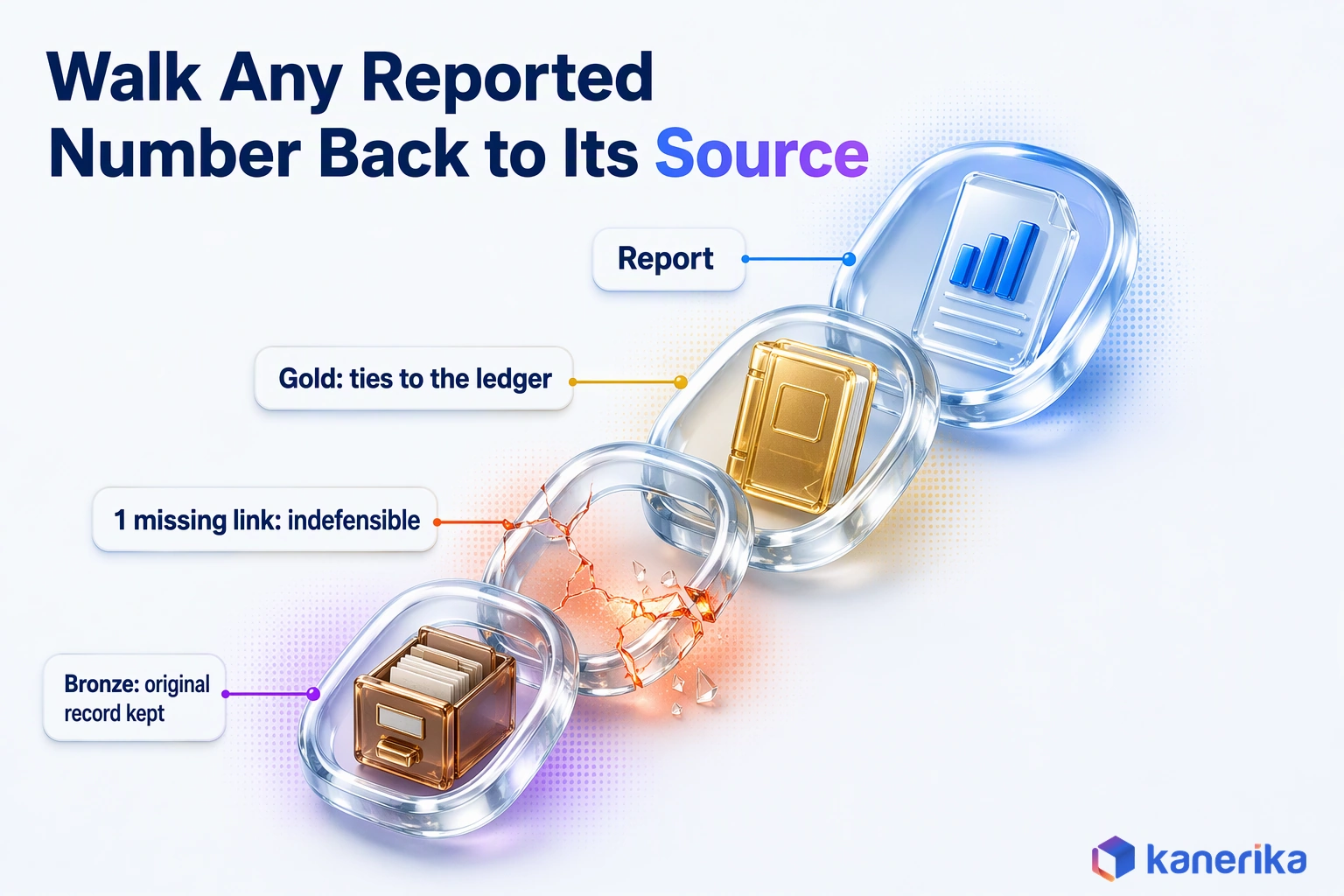
The governance spine, however, is the part teams most often bolt on late. Design it with the risk and compliance teams before the first pipeline runs, because retrofitting policies onto live tables leaves gaps.
Worked Example: Building a Reconciled Loan Exposure Dataset
The quickest way to see the controls in action is to follow one dataset from source to report before looking at regulations. Take a lender that wants a daily loan exposure table for its credit risk report and for a probability of default (PD) model.
The data comes from three systems: loan servicing, the general ledger and collateral management. Each step below then names the check and the evidence it leaves. The example is illustrative, so it carries no volumes or timings.
- Land the sources in bronze as received. Check that row counts and file checksums match each source extract. Evidence: an arrival log per file.
- Conform the keys in silver. Map loan IDs, customer IDs and GL account codes to one standard, a step covered in our guide to data standardization. Evidence: an exceptions table of unmapped records.
- Join collateral and compute exposure. Keep exposure rules in versioned code, not spreadsheet steps. Evidence: the code version stamped on every output row.
- Reconcile to the general ledger. Compare total outstanding principal with the GL balance for the same accounts and date, within an agreed tolerance. Evidence: a break report with an owner and a resolution note.
- Capture lineage. Record which bronze files and silver tables fed each gold row. Evidence: a lineage graph an examiner can follow.
- Apply access policy by role. Credit risk sees full detail, BI users see masked borrower names and the model team sees tokenized identifiers. Evidence: policy definitions and access logs.
- Publish the gold table. The same table feeds the risk report and the PD model’s training set. Evidence: one dataset, one sign-off, two consumers.
Automating the Reconciliation Check
Step four is the control most teams still leave in a spreadsheet. Written as a query, it can run on every load and keep its output as evidence:
-- Daily break check: loan exposure vs general ledger
-- :as_of_date and :tolerance are set by risk and finance
SELECT e.gl_account,
       SUM(e.outstanding_principal)                    AS exposure_total,
       g.ledger_balance,
       SUM(e.outstanding_principal) - g.ledger_balance AS difference
FROM   gold.loan_exposure e
JOIN   silver.gl_balances g
  ON   g.gl_account = e.gl_account
 AND   g.as_of_date = e.as_of_date
WHERE  e.as_of_date = :as_of_date
GROUP  BY e.gl_account, g.ledger_balance
HAVING ABS(SUM(e.outstanding_principal) - g.ledger_balance)
       > :tolerance * ABS(g.ledger_balance);
Every row the query returns is a break, so it needs an owner. The tolerance is a business decision, so risk and finance agree it in writing before the first run. Once the break table stays empty for an agreed period, the two teams have a number they both sign.
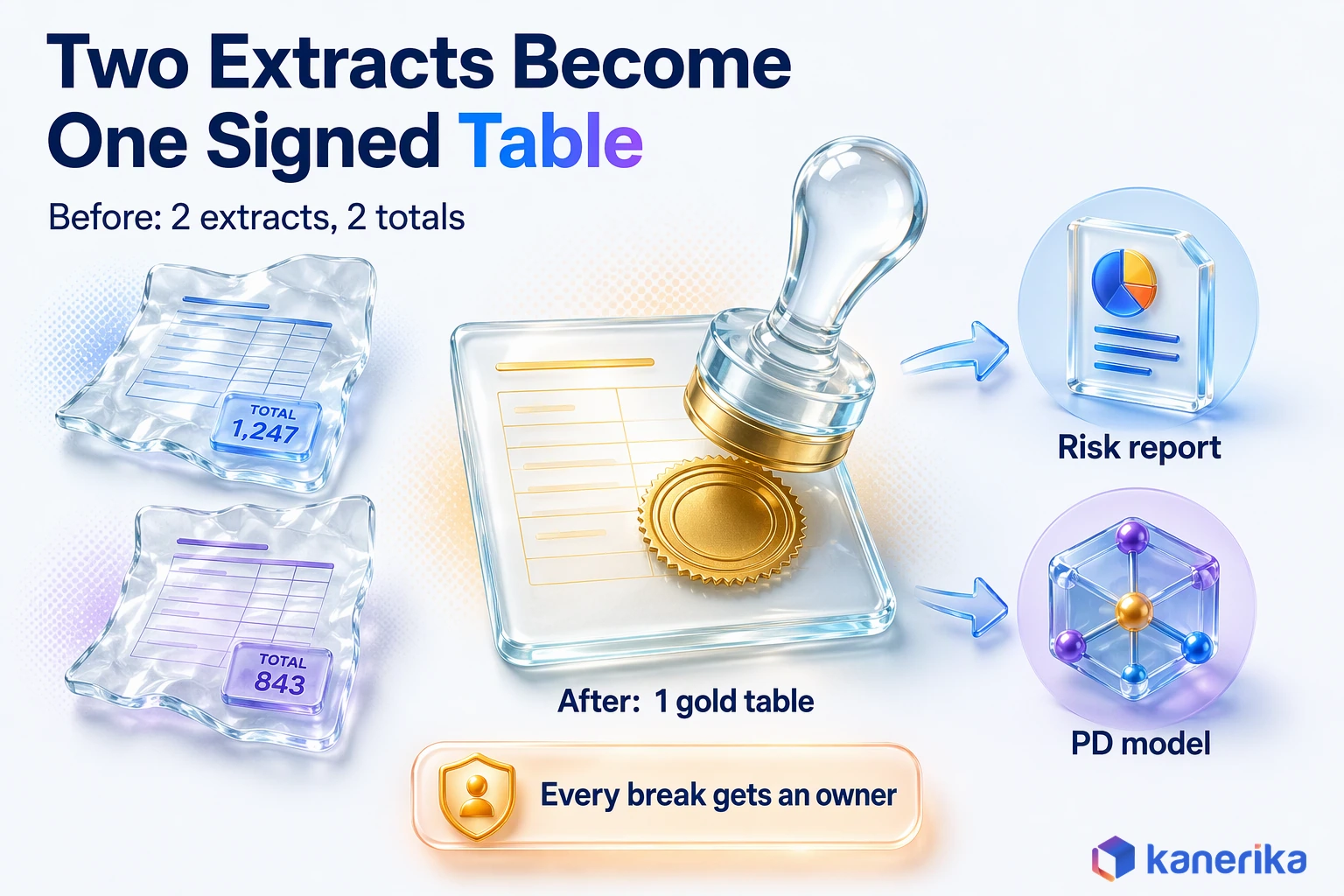
Step seven is where the lakehouse finally pays for itself. Risk and the model team stop arguing over two extracts because only one table exists, and the reconciliation shows it ties to the books.
Mapping Regulations to Lakehouse Controls
Regulations rarely mention a lakehouse. Even so, most of them ask three things of data: know where it came from, control who sees it and prove it is accurate. No platform is compliant by itself; compliance comes from the controls you configure and the evidence they produce.
So the useful question for a vendor is which controls it makes easy to evidence. The table maps the rules a US institution meets most often, then the main global ones.
| Rule | Who it applies to | What it asks of data | Lakehouse control |
|---|---|---|---|
| SR 26-2 and OCC Bulletin 2026-13 (model risk) | US banking organizations, most relevant above $30 billion in assets | Sound development, validation and governance of models that turn input data into estimates | Lineage from model inputs to sources, versioned training tables |
| GLBA privacy and safeguards rules | US financial institutions | Protect customer information and limit how it is shared | Classification, masking, tokenization, access logs |
| SOX | US public companies | Effective internal control over financial reporting | Reconciliation to the ledger, change control on transformation code |
| NYDFS Part 500 | Entities regulated by the New York Department of Financial Services | A cybersecurity program and its controls | Encryption, identity management, audit logging |
| BCBS 239 | Banks, in particular global systemically important banks | Accurate, complete and timely risk data aggregation | Conformed keys, reconciliation, lineage |
| DORA | EU banks, insurers, investment firms and other financial entities | Resilience against ICT disruptions, including third-party risk | Tested recovery, resilient storage, an exit path through open formats |
| GDPR and CCPA | Firms processing personal data of EU or California residents | Lawful processing, plus access and deletion rights | Classification, retention rules, deletion workflows |
DORA and Firms With EU Operations
DORA has applied since January 17, 2025, and it reaches banks, insurers and investment firms in the EU (EIOPA on DORA). A US institution with EU operations will therefore meet it alongside the US rules above.
For a data platform, DORA asks for more than backups. It treats the cloud vendor as an ICT third-party risk to be managed, and it expects regular digital operational resilience testing. For ICT services that support critical or important functions, firms must also put documented exit strategies in place (Regulation (EU) 2022/2554, Article 28). This is where the open-format argument from earlier pays off. Tables kept in Delta Lake or Iceberg on your own storage give that exit plan something concrete to point to.
What the Map Tells You
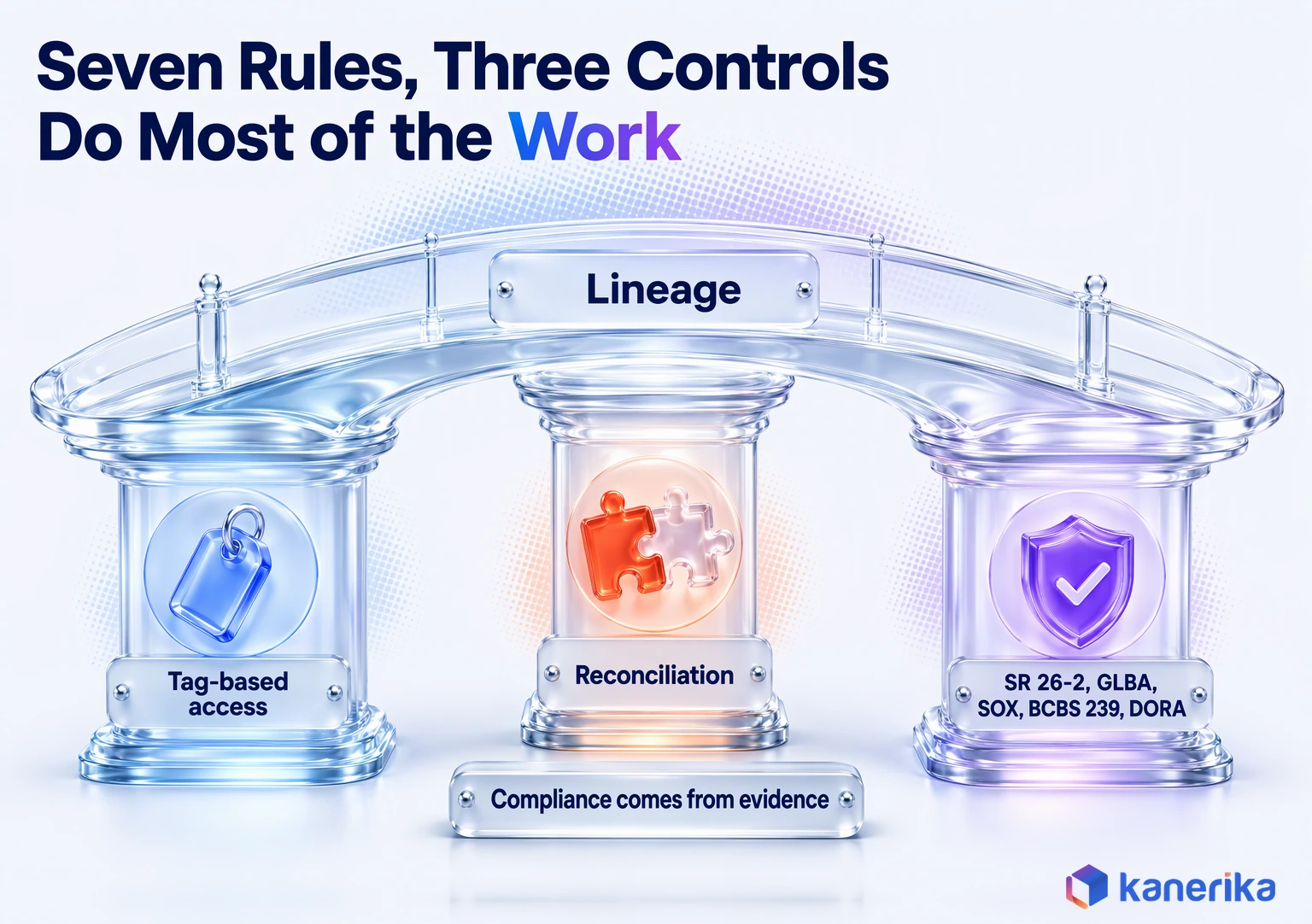
Read down the last column and a pattern appears. Lineage, tag-based access and reconciliation recur in almost every row, so three well-built controls answer most of the map. That is the strongest argument for putting governance on one platform rather than repeating it per copy.
On Databricks, Unity Catalog governance carries much of this load, especially for access. Its attribute-based access control lets you write policies on governed tags rather than on single tables. Row filter and column mask policies then apply wherever a tagged column appears (Databricks ABAC documentation). Some ABAC features are still in Beta, so confirm the status of any control you plan to show an examiner.
Security Controls Regulated Institutions Expect
Security reviews at banks and insurers ask about the same five controls, whichever platform you pick. Our guide to data security covers each in more depth:
- Encryption with customer-managed keys. Data is encrypted at rest and in transit, and the institution holds and rotates its own keys.
- Identity and attribute-based access. Access follows roles and data tags, not one-off grants on individual tables.
- Network isolation. Private connectivity keeps the platform off the public internet, in line with zero trust data security.
- Audit logging. Every read, write and policy change is logged and kept for the retention period your rules require.
- Masking and tokenization. Card numbers, account numbers and personal identifiers are masked or tokenized for users who do not need them.
Check each control against the exact cloud, region and service tier you plan to use. Private networking support can vary by tier, and we come back to keys in the platform choice. A gap found during a security review delays the whole program.
On-Demand Webinar
Transform Your Data Strategy with Microsoft Purview: Governance
An on-demand Kanerika session on classifying sensitive data, tracing lineage and setting governance policies with Microsoft Purview.
Watch the Webinar →Where a Lakehouse Pays Back First: Use Cases by Sub-Sector
A lakehouse earns its keep fastest where data is large, mixed in shape and read by more than one team. Fraud scoring is the classic example, because it mixes all three. It needs streaming card events, years of customer history and a model the risk team can explain, all at once.
A warehouse handles the history well but struggles with the stream. A lake holds the stream but cannot govern the features. Model teams usually pair the lakehouse with a feature store for governed model features, so the same feature definition serves training and real-time scoring.
Use Cases and First KPIs by Sub-Sector
| Sub-sector | Use case | Data shape | Why a lakehouse helps | First KPI to baseline |
|---|---|---|---|---|
| Banking | Fraud and AML | Streaming transactions plus history | One copy for scoring and investigation | False positive rate |
| Banking | Credit risk | Loans, collateral, bureau data | A reconciled exposure table feeds report and model | Time to produce the risk report |
| Banking | Regulatory reporting | GL, positions, reference data | Lineage from report line to source | Manual adjustments per cycle |
| Banking | Treasury and liquidity | Cash flows and positions through the day | Fresher data for intraday views | Data latency |
| Insurance | Claims and actuarial | Policies, claims, notes, images | Structured and unstructured data together | Claim cycle time |
| Capital markets | Tick data and entitlements | High-volume time series, licensed data | Low-cost storage with governed entitlements | Entitlement exceptions found in audit |
| Payments | Streaming fraud scoring | Event streams | Fresh features at scoring time | Fraud losses per period |
Insurers often hit a different first problem, especially once AI agents for insurance claims enter the picture. Claims data mixes structured fields with adjuster notes, photos and partner files that arrive in many layouts. Ingestion, rather than analytics, is usually the step that decides how fast an insurance lakehouse delivers.
Datasheet
Insurance Data Ingestion Accelerator for Databricks Lakehouse
A Kanerika datasheet on an accelerator that brings insurance data into a Databricks lakehouse, the step that most often sets the pace for claims and actuarial work.
View the Datasheet →How to Sequence the First Workload
Sequencing matters more than the list. Pick one workload where the pain is visible and the data owner is willing, such as the credit risk report that takes days to reconcile. Build it end to end with its controls, and measure the KPI before and after.
Avoid opening with the most ambitious use case, such as a GenAI assistant over all customer data. It touches every control at once and fails slowly. A governed risk or regulatory dataset proves the platform first and builds the trust that later AI work needs.
Choosing a Platform: Databricks, Snowflake, Microsoft Fabric or an Open Iceberg Stack
The platform choice for a regulated institution should start with constraints you cannot change rather than with feature lists or benchmarks. For example, a bank committed to Azure starts from a different place than an insurer with a large Spark team on AWS.
Residency rules, key management requirements and the catalog the security team already trusts will remove options before price or speed comes up. The table therefore puts those constraints first.
| Constraint | Databricks | Snowflake | Microsoft Fabric | Open Iceberg stack |
|---|---|---|---|---|
| Cloud and residency | AWS, Azure, Google Cloud | AWS, Azure, Google Cloud | Azure, with OneLake built on ADLS | Any cloud or on-premises object store |
| Table format | Delta Lake, with Iceberg reads | Native tables plus Iceberg tables | Delta Parquet or Iceberg in OneLake | Iceberg |
| Governance catalog | Unity Catalog | Built-in governance features | Fabric governance plus Microsoft Purview | An Iceberg catalog you run and secure |
| Streaming | Structured Streaming | Snowpipe Streaming | Real-Time Intelligence | Flink or Spark streaming |
| Skills it suits | Python and Spark engineering teams | SQL-first analytics teams | Microsoft and Power BI shops | Teams with deep platform engineering |
| Exit path | Delta files with Iceberg metadata in your storage | Iceberg tables on an external volume | Open-format tables in OneLake | Full control of formats and storage |
Read the table by constraint rather than by column. A bank committed to Azure and Power BI starts at Fabric, while an insurer with a large Spark team on AWS starts at Databricks. A SQL-first analytics team usually starts at Snowflake, and only firms with deep platform engineering should run an open Iceberg stack themselves. Each of those is a starting point inside the lakehouse decision, so the gates in the next section still have the final say.
Key Management and Performance Checks
Key management gets its own check before any shortlist is final. Confirm customer-managed key support for the exact cloud, region and tier with each vendor. It is the control that most often blocks a bank’s security sign-off, so settle it early.
Performance comes later in the list, though it still matters for reporting at quarter end. On Databricks, the Photon query engine is the piece to test against your heaviest reporting queries. The same applies to warehouse sizes on Snowflake data warehouse deployments and to Fabric capacities. Run each test on your own data, because published benchmarks rarely match a bank’s query mix.
Datasheet
Snowflake vs Databricks vs Microsoft Fabric
A Kanerika datasheet comparing the three platforms side by side, useful once residency, key management and skills have narrowed the shortlist.
View the Datasheet →Decision Framework: Lakehouse, Keep the Warehouse, or Hybrid
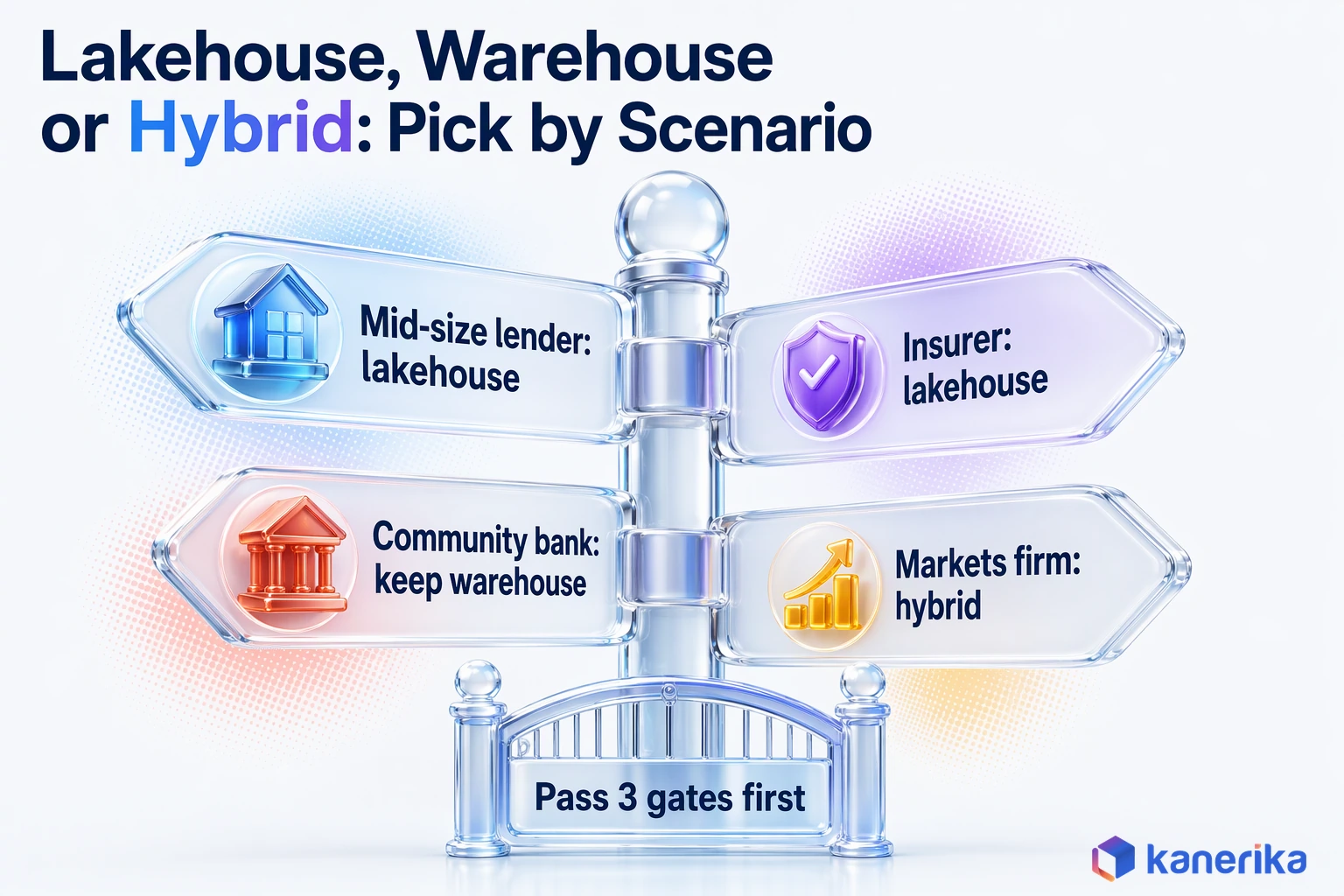
Whether a lakehouse is right for your institution comes down to three gates and a short scoring pass. Our data platform migration decision framework applies the same method more widely. The gates remove options you cannot live with, and the scoring then ranks what is left.
- Residency gate. Can the platform keep regulated data in the regions your rules require, with keys you control?
- Examiner evidence gate. Can it produce lineage, access logs and reconciliation records for a named report on request?
- Skills gate. Can your team run it, or can you hire and train for it within the program budget?
Options that pass all three are scored on data variety, number of consuming teams, AI plans, reporting stability and the cost of running copies. A high score on the first three points toward a lakehouse. High reporting stability with little new data points toward keeping the warehouse. Our post on data lakehouse vs data warehouse covers that trade-off in general terms.
Stated Picks by Scenario
| Scenario | Stated pick | Why |
|---|---|---|
| Community bank on the Microsoft stack, stable reporting | Keep the warehouse, go hybrid later | Reports work and data variety is low; add Fabric lakehouse items when AI work starts |
| Mid-size lender adding daily credit-risk analytics | Lakehouse | Mixed data, several consuming teams and model evidence needs |
| Insurer with claims and actuarial silos | Lakehouse | Structured and unstructured data must sit together under one set of policies |
| Capital-markets firm with tick data | Hybrid | Lakehouse for tick data and research; the existing warehouse keeps finance reporting until it is migrated |
Here is how the lender’s decision plays out. It passes the residency gate on its current cloud and the skills gate with a small Spark team plus training. The evidence gate is the reason to move, because its credit risk report and PD model read different extracts today.
It scores high on data variety and consuming teams, but only medium on reporting stability. So the pick is a lakehouse, starting with the reconciled loan exposure dataset from the worked example. Meanwhile the old warehouse keeps running until reconciliation is signed off.
Cost and Effort: What Actually Drives the Bill
The cost of a financial-services lakehouse depends less on the license than on three things: how much data you keep, how long you run two systems and how much testing regulators expect. Vendor price lists cover compute and storage. They do not cover the months of parallel running and reconciliation that a bank needs before it can switch off an old report.
That is why this guide gives drivers rather than dollar ranges. Two banks with the same data volume can see very different bills, depending on retention rules and how many reports need sign-off. Compute tuning still helps, and the levers in our Snowflake cost optimization guide carry over to most platforms.
| Driver | Why it grows in financial services | How to contain it |
|---|---|---|
| Compute | Month-end and quarter-end peaks, model training, fraud scoring | Auto-scaling, scheduled clusters, workload isolation |
| Storage and retention | Long retention rules and many table versions | Tiered storage, version cleanup aligned to retention policy |
| Egress | Data moving across clouds or back to on-premises systems | Keep engines close to the data; share tables instead of copying |
| Governance tooling | Catalog, lineage, classification and monitoring across domains | Use the platform’s native catalog before adding tools |
| Parallel run period | Old and new reports run side by side until numbers tie | Agree exit criteria per report before the run starts |
| Reconciliation and testing | Every regulatory report needs evidence that it still ties | Automate break checks, as in the worked example |
| People | Data engineers, platform admins, data owners and validators | Train existing staff; name data owners early |
Retention and the Parallel Run
Banking records rules and table time travel pull in opposite directions: one says keep data for years, the other keeps every old version unless you clean it up. Align version cleanup with the retention policy, so you keep what the rules require and stop paying for copies nobody will read.
Even so, the parallel run is the line item teams underestimate most. Set exit criteria per report in advance, such as a number of clean reconciliation cycles. Without them, two systems run for months longer than planned.
Talk to Kanerika
Which Costs Will Drive Your Lakehouse Bill?
Kanerika reviews your reports, retention rules and source systems with your team, then maps the drivers and exit criteria for a parallel run before any build starts.
Book a Working Session →Risks and Common Mistakes
Lakehouse programs in banking tend to stall for organizational reasons rather than technical ones. The platform usually works; the controls, owners and sign-offs around it are what slip.
A skeptic’s point also belongs here. A lakehouse does not fix bad source data. If the loan servicing system holds wrong maturity dates, the lakehouse will hold the same wrong dates in a tidier format. Its lineage will simply show where they came from, which is why data quality during migration needs its own plan.
- Adding governance after go-live. Access policies and lineage retrofitted onto live tables cost more and leave gaps an examiner will find.
- Lifting and shifting warehouse logic. Copying old stored procedures as they are carries old errors into the new platform.
- Skipping the parallel run. Switching a regulatory report without signed reconciliation puts the filing at risk.
- Treating format choice as cosmetic. A proprietary format chosen for convenience becomes the exit problem later.
- Ungoverned GenAI access. A retrieval index built over customer data without the same masking rules leaks what the reports hide, a core concern of data security in AI.
- Unclear data ownership. When nobody owns a table, nobody can approve its definition or resolve its breaks.
- Measuring nothing before go-live. Without a baseline KPI, the program cannot show the board what it changed.
Most of these trace back to one cause: treating the lakehouse as a technology project instead of a control program. Naming a business owner for each gold table, before the first pipeline is built, prevents several of them at once.
Checklist
Data Governance Checklist
Kanerika’s data governance checklist covers ownership, definitions, quality rules, access and lineage, the controls that keep a lakehouse program from stalling.
Get the Checklist →Migrating Without Disrupting Reporting
Moving to a lakehouse should never put a regulatory report at risk, so the migration runs alongside the old platform rather than replacing it overnight. The sequencing section above covers which domain goes first. Here the focus is the cut-over, and four steps keep it safe so long as each has an owner:
- Start from the first workload. Use the domain chosen in “How to Sequence the First Workload” rather than reopening the choice.
- Switch consumers report by report. Move one report, dashboard or model feed at a time to the new tables, and keep its old source readable until the owner confirms the switch.
- Decommission the extracts. Once a report reads only from the lakehouse, switch off the extract that fed it and remove its access, so the duplicate copies do not creep back.
- Plan the cut-over window. Schedule each switch away from month-end and filing dates, with a tested rollback to the old source if a break appears.
The mechanics of moving data out of legacy platforms are covered in our guide to data migration in fintech. Moves off older platforms follow the steps in our guide to legacy systems to Databricks migration. Report and dashboard moves also have their own pitfalls, which our post on BI migration for financial services walks through.
Downtime is the worry every operations head raises first, and rightly so. Building alongside and switching consumers one domain at a time keeps the old reports live until the new ones have proven they match.
How Kanerika Delivers a Data Lakehouse for Financial Services in Stages
Kanerika delivers the platform in stages, and each one ends with a result the risk and compliance teams can check. Our data engineering services team builds the pipelines, while governance is designed alongside them. The work runs with those teams from the first week rather than after the build.
- Assess and pick one workload. Map the current copies, reports and owners, and choose the first governed workload.
- Design controls with risk and compliance. Agree lineage, access policies, retention and reconciliation rules before pipelines are built.
- Build and reconcile. Build the bronze, silver and gold layers with break checks that run on every load.
- Run in parallel. Produce old and new outputs side by side until reconciliation is signed off.
- Scale by domain. Add the next domain on the same governance spine, so controls do not need to be rebuilt each time.
Kanerika is a Microsoft Solutions Partner for Data and AI with the Analytics Specialization, a registered Databricks Consulting Partner and a Snowflake Select Tier Partner. Its banking and financial services work also covers governance, analytics and data platform modernization.
Case Study: Data Governance for a Global Bank’s Lakehouse
The client is a prominent global bank with nearly 9,000 branches and 22,000 ATMs. Privacy laws required it to classify personal data across many source systems and a centralized lakehouse.
Challenge: Data was spread across SAP, Dynamics 365, CRM, core banking systems such as Oracle and Netezza, and file systems. Identifying and classifying sensitive data was manual and error-prone, and silos slowed analysis across divisions.
Solution: Kanerika set up automated discovery and classification with the Microsoft Purview Data Map. Purview policies governed how PII, PCI and PHI were classified and handled, and automated lineage traced data from sources through the lakehouse layers.
Results: data classification accuracy improved by 72%. Business users could find the right data faster, while the bank also gained a clearer view of its compliance posture through centralized governance metrics.
Case Study
Zero Breaches, 100% Compliance for a Bank with Purview
A global bank with nearly 9,000 branches automated discovery, classification and lineage across its source systems and centralized lakehouse, improving data classification accuracy by 72%.
Read the Case Study →Conclusion: Start With One Governed Workload
A data lakehouse for financial services works when it is built as a control program first and a data platform second. The architecture is familiar, but every layer now leaves evidence, from arrival logs to reconciliations against the general ledger.
Once you see it that way, the decision is simple to state. Choose a lakehouse when your data is mixed, several teams read it and models need a clear trail. Keep the warehouse when reports are stable and data variety is low, and go hybrid when the two coexist.
Whichever side you land on, start with one governed workload and run it in parallel until the numbers tie. So is a data lakehouse for financial services worth building? For most lenders, insurers and markets firms it is, as long as the first workload reconciles to the books before anything old is switched off.
Frequently Asked Questions
What is a data lakehouse in financial services?
A data lakehouse in financial services is a platform that keeps one governed copy of a bank’s, insurer’s or asset manager’s data in open table formats. Reporting, risk analytics and AI models all read that same copy. Lineage, access policies and reconciliations sit on top, so every reported number can be traced back to its source.
What is the purpose of a data lakehouse?
A data lakehouse removes the need to keep separate copies of data in a lake and a warehouse. It stores raw and curated data together, adds transactions and schema control, and lets BI, data engineering and machine learning work from the same tables. Fewer copies mean fewer reconciliations and fewer numbers that disagree between teams.
Can a lakehouse replace a data warehouse?
A lakehouse can replace a data warehouse for many reporting workloads, since it supports transactions, schemas and SQL queries for BI. In financial services the switch should happen report by report. Each report runs in parallel on both platforms until reconciliation is signed off, and only then is the old warehouse extract retired for good.
Do banks use Databricks?
Yes, banks and other financial institutions use Databricks for risk analytics, fraud detection, regulatory reporting and machine learning. Kanerika works with financial institutions as a registered Databricks Consulting Partner. The right choice for any one bank still depends on its cloud, residency rules, key management needs and the skills of its data team.
How much does it cost to build a lakehouse?
Lakehouse cost depends on drivers rather than a fixed price. The main ones are compute for peak reporting and model training, storage and retention, data egress, governance tooling, the parallel run period, reconciliation testing and people. In banking the parallel run and testing effort are often the largest items, so set exit criteria early.
Which table format should a financial-services lakehouse use?
Choose Delta Lake or Apache Iceberg, the two open formats with the widest engine support. Delta fits a Databricks-centered estate and can expose Iceberg metadata for other readers. Iceberg suits a multi-engine or Snowflake-centered setup. Microsoft OneLake accepts both. What matters most is that the format stays open and the storage stays under your control.
How long does it take to implement a data lakehouse at a bank?
Timing depends on the number of domains, the reports that need parallel runs and the state of source data. Work moves through assessment, control design, build and reconciliation, a parallel run, and then scaling by domain. The first governed workload proves the platform, and later domains go faster because they reuse the same governance spine.
How does a lakehouse support model risk management under the 2026 interagency guidance?
SR 26-2, issued on April 17, 2026, replaced SR 11-7 and defines a model as a method that turns input data into estimates. A lakehouse helps by keeping versioned training tables, lineage from model inputs to source systems and access logs. Validators can then see exactly which data a model used and how it was prepared.
How do you secure customer data in a financial-services lakehouse?
Start with encryption at rest and in transit using keys the institution controls. Add identity and attribute-based access so policies follow data tags, keep the platform on private networking, and log every read and policy change. Mask or tokenize card numbers, account numbers and personal identifiers for any user who does not need them.
What are the biggest risks of migrating a bank to a lakehouse?
The biggest risks are adding governance after go-live, copying old warehouse logic with its errors, and switching regulatory reports before reconciliation is signed off. Unclear data ownership and ungoverned GenAI access to customer data also cause trouble. A lakehouse cannot fix bad source data either, so data quality work still has to happen at the source.
How does a data lakehouse differ from a data warehouse or data lake?
A data lake stores raw files cheaply but offers weak governance and no transactions. A data warehouse enforces schemas and governance but uses proprietary storage suited mainly to reporting. A lakehouse keeps data in open formats on object storage while adding transactions, schema enforcement and one catalog, so it serves reporting, analytics and AI together.
What are the benefits of using a data lakehouse for financial institutions?
Financial institutions gain one governed copy of data instead of several extracts, which cuts reconciliation work. Lineage and tag-based access policies produce evidence that examiners and auditors can follow. Open table formats reduce vendor lock-in. Fraud, credit and AI teams can also work on the same reconciled data that feeds regulatory and management reports.
Is Databricks a lakehouse or warehouse?
Databricks describes its platform as a lakehouse. It stores data in Delta Lake tables on cloud object storage and can also expose those tables to Iceberg clients. Databricks SQL provides warehouse-style querying for BI on the same data, so a single platform covers data engineering, analytics and machine learning without a separate warehouse copy.
Is Snowflake a data warehouse or lakehouse?
Snowflake began as a cloud data warehouse and now supports lakehouse patterns as well. Its Iceberg tables can live in Snowflake-managed storage or in an external volume on Amazon S3, Google Cloud Storage or Azure. That lets Snowflake query open-format data that other engines can also read, rather than holding everything in proprietary storage.
What is a data lake in banking?
A data lake in banking is a central store for raw data such as transaction logs, card events, documents and market feeds, kept in its original form. Banks use it for exploration and model development. On its own it lacks strong governance and transactions, which is why many banks now add a lakehouse table layer on top.
How does a data lakehouse improve data governance and compliance?
A lakehouse applies one catalog, one set of access policies and one lineage record to all tables, rather than separate rules per copy. Teams can mask sensitive columns by tag, log every access and reconcile gold tables to the general ledger. Those controls produce the evidence that rules such as BCBS 239, SOX and GLBA call for.
Can a data lakehouse support real-time analytics and AI use cases in finance?
Yes, a lakehouse can ingest streaming card and payment events while keeping years of history in the same governed tables. Fraud scoring, anti-money laundering monitoring and intraday liquidity views all benefit. Models train and score on features built from that one copy, which makes it easier to show validators where the input data came from.
When to use lakehouse vs data warehouse?
Use a lakehouse when data is mixed in shape, several teams read it and AI or model work depends on it. Keep a data warehouse when reporting is stable, data is mostly structured and few new sources are coming. Many institutions run both for a period, moving domains to the lakehouse once reconciliation proves the numbers match.