TL;DR
Legacy data migration is a modernization initiative, not a lift-and-shift — the real risk lives in undocumented business logic and data quality issues that stayed hidden in old systems and surface immediately on modern platforms.
Most enterprise IT budgets are quietly held hostage. Industry research from Gartner research consistently shows that 60 to 80 percent of IT spend goes toward keeping legacy systems running, leaving little budget for AI, analytics, or anything that drives growth. A 2025 GAO audit found U.S. federal agencies spend 79 percent of a $105 billion-plus IT budget just on operations and maintenance.
The pressure to migrate is real, but so is the risk. Gartner estimates that 80 percent of legacy modernization projects fail, usually because teams underestimate embedded business logic, undocumented dependencies, and quality problems that have aged into the data itself. In this article, we will cover what makes legacy data migration so different from a regular data move, the strategic decisions that shape outcomes, and how enterprises can de-risk the work.
Key Takeaways Legacy data migration is a modernization initiative, not a relocation project. Treating it as a transformation effort delivers better results than lift-and-shift. The biggest risks live in undocumented business logic, broken data relationships, and tribal knowledge that retired with the original developers. Data quality issues hidden inside legacy systems surface immediately on modern platforms because new tools enforce the validation rules old systems ignored. Strategic choices made in week one (what to retire, phased vs parallel cutover, target platform) determine cost, risk, and timeline more than execution does. Automation and accelerators are no longer optional for large estates. Manual approaches do not scale across thousands of pipelines, reports, and embedded rules. Partnering with Kanerika helps ensure secure, compliant, and efficient legacy data migration with minimal disruption.
What Is Legacy Data and Why It Is Hard To Migrate Legacy data migration is the process of moving business-critical data from outdated systems, formats, or platforms onto modern infrastructure while preserving data integrity and embedded business logic. The work usually involves cloud or unified analytics targets, validation gates, and decisions about what to migrate versus retire.
Legacy data is business-critical information trapped inside outdated systems, formats, or programming languages that the rest of the organization can no longer easily access. Age alone does not make a system legacy. Strategic dependence does. A mainframe running interest calculations for a regional bank is legacy because replacing it carries real business risk, even if the hardware was refreshed last year.
1. Defining Legacy Data Beyond Age Legacy data sits in places where the technology stack, the people who built it, and the documentation have all moved on. The data is still mission-critical. The infrastructure around it has gone quiet.
File formats no longer supported by current tooling Programming languages with shrinking developer pools (COBOL, RPG, PL/I) Hardware whose original manufacturer has discontinued support Database engines on versions that have not received security patches in years
2. Common Legacy Platforms In Enterprise Use Banking, insurance, and government still run core operations on IBM z/OS systems that are over 50 years old. On-premises databases on older Oracle, SQL Server, or DB2 versions hold decades of transactional history. Proprietary formats from defunct vendors lock data into shapes nobody else can read. Custom-built internal systems often run without documentation because the original developers retired.
Mainframes with COBOL, JCL, and CICS workloads On-prem Oracle, SQL Server, and DB2 databases past their active support windows Vendor-specific archive formats with no migration path Internal applications that grew organically over 15 to 20 years
3. Embedded Business Logic Hidden In Code The hardest part of any legacy migration is not the data. It is the business logic encoded inside application code that no living employee can fully explain. Interest calculations, pricing rules, approval workflows, and validation logic often live inside COBOL programs or stored procedures. Extracting that logic before migration is essential and difficult.
Pricing and discount rules baked into application code rather than rule engines Validation logic that fires inside legacy apps but does not exist in the database layer Approval workflows defined by hard-coded conditional statements Calculation methods that have drifted from the documented spec over the years
4. Operational And Regulatory Risks Legacy environments carry risk that newer systems do not. Audit trails are partial or absent. Compliance documentation has decayed across reorganizations. Quality issues have accumulated for years without anyone willing to touch the system long enough to fix them. According to IBM’s 2025 Cost of a Data Breach Report , the global average breach cost reached $4.44 million, and breach response inside legacy environments runs higher because logging and instrumentation are limited.
Missing or partial audit trails that fail current regulator expectations Compliance documentation lost during prior org changes Data quality drift that nobody dared correct in production Undocumented downstream dependencies that fail without warning when source data changes
Evolution Of Legacy Data Migration Approaches Migration practice has evolved significantly because the early playbooks failed expensively. Understanding how the industry got here helps avoid repeating the mistakes.
1. Early Lift-And-Shift Attempts The first wave of cloud migrations assumed new infrastructure would automatically improve old data. It did not. Bad data moved faster on better hardware, but it stayed bad. Inefficient legacy schemas became inefficient cloud schemas. Embedded business logic moved unchanged into platforms that could not optimize it.
Same data quality issues in a more expensive environment Schema designs built for 1990s storage constraints carried into modern engines Missed opportunity to fix performance bottlenecks during the move
2. Shift Toward Modernization, Not Relocation The next wave recognized that migration is the right moment to fix things. Re-platforming projects normalize databases, standardize formats, and clean quality issues during the transfer. Business logic gets extracted from application code into configurable rule engines. The work takes longer but delivers actual modernization rather than a hosted version of the old problem.
Schemas redesigned to match how the business uses the data today Reference data deduplicated and standardized during the move Business logic surfaced into rule engines or low-code workflows
3. Migration As Business Transformation Modern enterprises now treat legacy migration as a business event, not an infrastructure event. Migrations are scoped against acquisition integration, new analytics initiatives, or product launches that the legacy system cannot support. Process redesign, organizational change, and capability building move alongside data movement.
Migration objectives tied to a specific business outcome, not just decommissioning Process owners involved from week one Internal training and capability transfer planned in parallel with technical work
4. Lessons From The Failure Patterns Most migration failures fall into a small set of recurring patterns. Underestimated complexity destroys timelines. Ignored data quality creates post-migration chaos that the new platform cannot hide. Big-bang cutovers with no rollback plan turn small problems into outages. Phased approaches, upfront quality investment, and tested rollback plans are now standard for any serious enterprise migration.
Phased cutovers with validation gates between waves Quality remediation funded as a discrete workstream, not as a side task Rollback procedures rehearsed before go-live, not designed during it
5 Core Challenges in Legacy Data Migration Migration of legacy data presents special hurdles that need special skills and wise planning. These challenges are known to aid organizations in making practical plans.
1. Poor Documentation And Tribal Knowledge Legacy documentation either does not exist or stopped being maintained a decade ago. The original developers have retired. The few employees who still understand how the system actually works have it in their heads, not on the wiki. Discovery becomes expensive because the artifacts that should answer questions cannot.
System behaviors driven by unwritten rules nobody can fully explain Critical knowledge held by two or three retiring employees Discovery surfacing requirements only after an early test fails Original design intent lost across multiple ownership changes
2. Inconsistent Schemas And Embedded Business Rules Database schemas evolved over the years without architectural review. Tables hold duplicate columns, inconsistent naming, and cryptic foreign key relationships. Business rules sit inside application code rather than the database. Different systems implement the same rule slightly differently, which surfaces as conflict during consolidation.
Tables with parallel columns that mean almost the same thing Foreign keys defined but not enforced, then quietly broken over time Identical business rules implemented three different ways across systems Naming conventions that changed every time a new team took over
3. Accumulated Data Quality Issues Quality problems compound year over year. Duplicate customer records multiply. Missing values increase as validation rules weaken. Old data references discontinued products, retired employees, or org units that no longer exist. The legacy application tolerated these problems through workarounds. The modern target platform will not.
The same customer represented as five slightly different records Reference data pointing to entities that have not existed for years Inconsistent date and currency formats across regional systems Quality issues that nobody fixed because fixing them was riskier than ignoring them
4. High System Dependencies Legacy systems sit inside dependency webs that are difficult to fully map. Applications connect through interfaces that were never properly documented. Batch jobs depend on specific file formats and arrival times. Downstream systems expect data shapes exactly. One broken link can cascade through the enterprise.
Undocumented interfaces between applications Batch jobs that fail silently when upstream timing changes Downstream consumers that depend on specific column orderings Cross-departmental dependencies that complicate migration governance
5. Limited Modernization Skills Talent is the silent constraint. Few developers still know mainframe technologies well. Cloud architects often lack any experience with legacy platforms. The talent that bridges both worlds is rare and expensive. According to industry estimates, fewer than 2,000 COBOL programmers graduated worldwide in 2024, and the average RPG programmer is approaching retirement age.
Mainframe and COBOL talent shrinking faster than the workload is shrinking Cloud architects without context on legacy constraints Long onboarding curves for cross-platform migration work Resource bottlenecks that extend migration timelines beyond original estimates
Strategic Decisions That Shape Legacy Migration Outcomes Legacy migration decisions made early determine project success or failure. These critical choices affect timelines, budgets, and final system quality significantly.
1. What Data Should Be Migrated vs Retired Not all legacy data deserves migration . Data retirement decisions reduce project scope and costs substantially. Should you move 20-year-old customer records nobody accesses? Archive completed transactions beyond regulatory requirements instead of migrating them. Test data, temporary records, and obsolete product information waste migration resources. Smart organizations analyze data usage patterns before deciding what moves forward versus what gets archived or deleted permanently.
2. Migrating Logic vs Redesigning Logic Legacy systems contain decades of business logic embedded in code. Should you replicate this logic exactly or redesign it? Also, exact replication preserves proven business rules but perpetuates inefficiencies.
In industrial and operational environments, legacy system modernization from specialists like Salem Automation presents a practical middle ground, replicating the behavior of legacy hardware and software precisely enough that surrounding business logic can be preserved and validated before any redesign decisions are made.
Redesigning improves processes but risks introducing errors. Moreover, some logic represents competitive advantages worth preserving while other rules became obsolete years ago. This choice dramatically impacts migration complexity and timeline.
3. Phased vs Parallel Migration Approaches Phased migration moves data incrementally with validation between stages, reducing risk but extending timelines. Conversely, parallel migration runs old and new systems simultaneously until confidence builds, maintaining business continuity but doubling operational costs temporarily. Adding to that, big-bang approaches cut over completely, fastest but riskiest option. Your choice depends on acceptable downtime, budget constraints, and risk tolerance levels.
4. Impact on Cost, Risk, and Quality Early strategic choices cascade throughout projects. Retiring unnecessary data saves millions in transfer and storage costs. Redesigning logic extends timelines but improves long-term maintainability. Parallel approaches cost more initially but reduce cutover risks substantially. Furthermore, rushed decisions create technical debt requiring expensive fixes later.
5. Technology Platform Selection Choosing target technology platforms shapes entire migration strategies. Moving to cloud-native databases versus traditional on-premises systems requires different approaches. Selecting modern data lakes versus conventional warehouses affects architecture design fundamentally. Platform decisions determine which tools work, what skills teams need, and how data gets structured. Moreover, wrong platform choices discovered mid-project cause expensive rework and extended delays.
Governance and Compliance in Legacy Data Migration Legacy migration governance becomes critical when moving decades of regulated data between systems. Poor governance creates compliance violations and operational chaos.
1. Regulatory Expectations Legacy data often contains information subject to strict regulations. GDPR requires tracking personal data location and usage. SOX demands financial data accuracy and audit trails. HIPAA protects healthcare records throughout their lifecycle. PCI-DSS governs payment information handling. Legacy systems built before these regulations may not meet current standards. Therefore, migration provides opportunities implementing proper controls while transferring data.
2. Lineage, Audit Trails, and Traceability Regulators demand complete data lineage showing how information moved and transformed . Audit trails must document who accessed data , when changes occurred, and why modifications happened. Traceability requirements prove data integrity throughout migration. Legacy systems often lack these capabilities. Modern platforms must capture comprehensive lineage automatically. Furthermore, audit evidence needs generation without manual effort.
3. Data Ownership Challenges Legacy environments rarely have clear data ownership. Nobody knows who’s accountable for customer data quality or transaction accuracy. Departments blame each other when problems surface. Organizational changes over decades obscured original ownership assignments. Migration forces establishing explicit ownership. Business units must claim responsibility for their data domains before migration proceeds.
Read More: Interactive Analytics: What Most Teams Get Wrong
4. Governance as Risk Reduction Strong governance frameworks reduce migration risks substantially. Clear policies prevent unauthorized data access during transfers. Quality standards catch errors before production deployment. Defined approval workflows ensure proper review happens. Change control processes to document all decisions. Furthermore, governance provides structure for managing complex legacy migrations systematically.
5. Retention and Archival Policies Data retention requirements complicate legacy migrations significantly. Different data types have varying retention periods like financial records for seven years, medical records decades longer. Legacy systems mixed retention requirements together. Modern platforms need proper archival strategies to separate active data from historical records. Organizations must comply with both retention minimums and deletion maximums simultaneously.
Legacy data modernization moves information from outdated systems to platforms supporting current business needs . Understanding target options helps organizations choose appropriate destinations.
1. Cloud Data Warehouses and Lakehouses Cloud warehouses like Snowflake, Azure Synapse , and Google BigQuery provide scalable analytics platforms replacing legacy databases. They handle massive data volumes efficiently. Lakehouse platforms including Databricks and Microsoft Fabric combine data lake flexibility with warehouse performance. These modern solutions eliminate infrastructure management headaches plaguing legacy systems. Organizations gain automatic scaling, better disaster recovery, and lower operational costs.
2. BI and Analytics Modernization The use of old-fashioned reporting systems such as Cognos and Crystal Reports is substituted with new BI systems like Power BI, Tableau, and Looker. These tools offer the self-service features that could not be offered by the legacy systems. Moreover, there are interactive dashboards instead of traditional ones. Real-time data visualization allows businesses to make decisions faster. In addition, mobile access enables executives to track operations at any location.
3. Supporting Advanced Use Cases Modern platforms enable real-time analytics to process streaming data instantly impossible with batch-oriented legacy systems. Moreover, AI and machine learning need clean and integrated information such platforms deliver by default. Fraud detection , predictive models, and personalization engines rely on current infrastructure. The old systems are just incapable of these high-tech capabilities, which are the demand of business today.
4. Platform Choice Impact Different target platforms create varying migration complexity . Moving to similar relational databases proves simpler than switching to completely different architectures. Cloud platforms require rethinking security and access patterns. Data lakes need new governance approaches. Furthermore, choosing wrong platforms discovered mid-project causes expensive rework.
5. Integration and Ecosystem Considerations Newer platforms have to blend well with the current enterprise systems. APIs, connectors and data exchange protocols are important. Vendor ecosystem strength affects long-term success as strong communities provide better support and third-party tools. Organizations benefit from platforms offering robust partner networks. Furthermore, interoperability standards prevent future lock-in when business needs evolve again.
The Ultimate Data Migration Checklist for Enterprises: 2026 Edition Explore a practical, end-to-end data migration checklist that enterprises can actually follow from planning and execution to validation and post-migration success.
Learn More
Automation and Accelerators in Legacy Data Migration Migration automation transforms how organizations handle complex legacy data transfers. Manual approaches simply cannot handle the scale and complexity modern migrations require.
1. Why Manual Migration Doesn’t Scale Manual legacy migration becomes impossible with millions of records across dozens of systems. Hand-coding transformations for thousands of tables takes years. Manual validation misses errors human reviewers cannot catch in massive datasets. Testing every scenario manually extends timelines unreasonably. Furthermore, documentation created manually becomes outdated immediately as requirements change continuously.
2. Role of Automation Automated mapping tools analyze legacy schemas and suggest target structures reducing weeks of manual analysis to hours. Validation automation compares source and target data continuously catching discrepancies immediately. Testing frameworks execute thousands of scenarios automatically that manual teams never attempt. Furthermore, automated documentation generation maintains current records without manual effort.
3. Preserving Business Logic Business rule extraction tools identify logic embedded in legacy code automatically. Automated analysis discovers calculations, validations, and workflows hidden in COBOL programs. These tools convert legacy logic into modern formats without manual rewriting. This preservation maintains proven business processes while reducing migration effort substantially.
4. Automation as Consistency Enabler Standardized automation ensures identical approaches across all migration workstreams. Manual teams introduce variations based on individual preferences. Automated processes execute identically every time eliminating human inconsistency. Quality standards apply uniformly rather than varying by team. Furthermore, repeatable automation enables continuous improvement – lessons learned enhance future migrations automatically.
5. Accelerating Time-to-Value Migration accelerators compress timelines from years to months through pre-built templates and reusable components. Organizations don’t rebuild common patterns repeatedly. Accelerators include proven transformation logic for typical legacy scenarios. Quick wins early in projects build stakeholder confidence. Furthermore, faster migrations reduce business disruption and opportunity costs significantly.
Managing Business Continuity During Legacy Migration Migration business continuity ensures that business does not suffer as the systems migrate to new systems. Interruptions in essential system modifications are costly in millions and a blow to customer confidence.
1. Avoiding Downtime in Mission-Critical Systems There is zero-downtime migration which ensures that business operates even during transitions. Revenue generating processes can not be halted in long durations using legacy systems. Also, the services facing the customers must be available whenever needed.
Some of the methods that organizations employ during the migration process include parallel processing, incremental cutover, and data synchronization where the organization continues to operate. Moreover, it is advisable to plan the migration when the traffic is low to reduce the effect when temporary disruptions are inevitable.
2. Parallel Run and Reconciliation Strategies Parallel running operates old and new systems simultaneously until confidence builds. Both platforms process identical transactions allowing comparison. Reconciliation processes verify results match between systems continuously. Discrepancies get investigated immediately rather than discovered after legacy shutdown. This approach catches problems before they affect customers.
3. Rollback and Recovery Planning Every migration needs tested rollback procedures reverting to legacy systems if critical issues arise. Document exact steps, assign responsibilities, and practice rollbacks during testing. Maintain legacy system capability throughout transition periods. Quick recovery options prevent minor problems becoming disasters. Furthermore, backup strategies ensure data protection if rollbacks require restoring earlier states.
4. Maintaining Stakeholder Confidence Open communication helps to keep the executives, users, and customers at par with migrations. Frequent engagement of users with status updates on progress fosters trust. Moreover, concerns should be handled in advance before there is panic in the event of minor problems. Essential escalation lines solve issues fast without the need to lose confidence in the face of adversity.
Measuring Success in Legacy Data Migration Are you certain that your legacy data migration project provided anything other than transfer of files between systems? Most organizations rejoice that data transfer have been done, yet true success is found in further quantification of business and operational enhancement. Three categories of metric tell the real story:
Metric Category Examples What It Proves When To Track Quality and Adoption Accuracy, completeness, validation pass rate, active users, query volume, dashboard usage Data crossed intact and the new platform is genuinely replacing the old From cutover onward Performance and Risk Query response time, report cycle time, downtime frequency, backup posture, security controls, redundancy Operational gains and a stronger risk profile justify the migration cost Month 1 to Month 12 Long-Term Modernization Maintenance cost trend, new analytics capability, automated compliance evidence, AI and ML viability Strategic value delivered, budget freed for innovation Year 1 onward
1. Quality and Adoption Matter Most Success starts with data quality metrics like accuracy rates, completeness scores, and validation results. But equally important are adoption metrics showing how quickly users embrace new systems. High-quality data means nothing if teams still rely on old spreadsheets or shadow systems.
A successful legacy data migration process must provide quantifiable performance improvements. Seek quicker response of queries, better report creation speed and less system downtimes. Also, monitor operational risk mitigation by improving backup processes, increased security control measures, and removed single points of failure.
3. Long-Term Modernization Benefits The largest victories will be in the long run. The migrations achieved successfully will lower maintenance fees by 30-50 percent and allow the implementation of new functionality, such as real-time analytics, automated reporting, and advanced data science projects. There is also enhanced compliance in organizations through enhanced audit trails and standardized data governance practices.
Kanerika: Proven Data Migration Excellence Kanerika is a Microsoft Solutions Partner for Data and AI with the Analytics Specialization, a Microsoft Fabric Featured Partner , a Databricks Consulting Partner , and a Snowflake Consulting Partner. The team holds ISO 27001 and ISO 27701 certifications, SOC II Type II compliance, GDPR compliance, and is CMMI Level 3 appraised. These credentials matter when migrations involve regulated data and audit-grade evidence requirements.
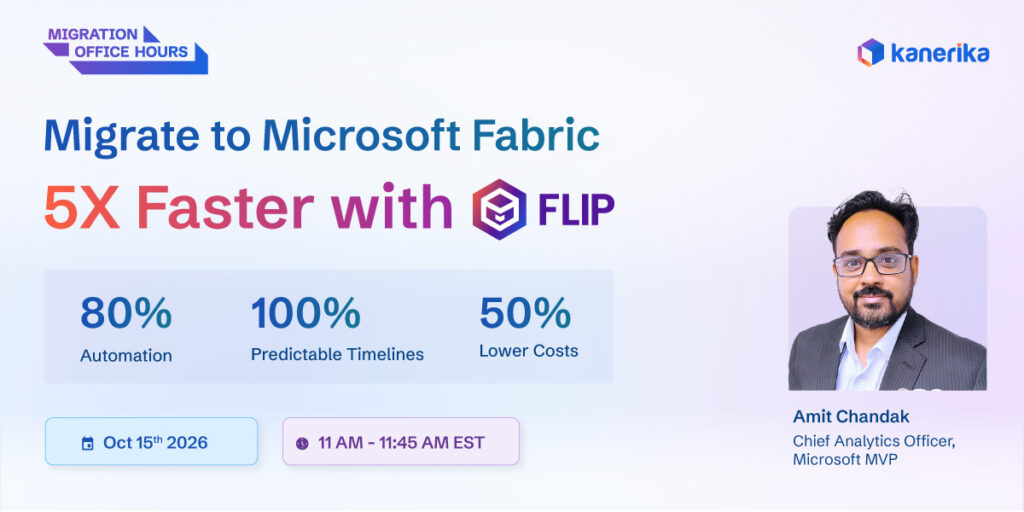
FLIP is Kanerika’s IP-led migration platform, available on Azure Marketplace and built around twelve purpose-built accelerators rather than a generic conversion script. Coverage spans ETL paths like Informatica, SSIS, and Azure Data Factory into Fabric or Databricks; BI migrations like Crystal Reports, Cognos, Tableau, and SSRS into Power BI; data warehouse modernization into Fabric; and RPA migrations like UiPath to Power Automate . Documented outcomes include 50 to 60 percent reduction in manual migration effort, an average 2,485 hours saved per ADF to Fabric engagement, and 75 percent licensing cost reduction on UiPath migrations.
Migration is one of the highest-risk windows for data exposure, so Kanerika’s engagements with100+ enterprise clients and over 10+ years include end-to-end encryption in transit and at rest, role-based access controls limiting exposure during transfer, full audit trails covering every migration activity, and compliance with GDPR, HIPAA, SOC 2, and ISO 27001 standards. Post-cutover, the engagement continues with 90 days of performance monitoring and tuning, knowledge transfer workshops for internal teams, full architecture and operations documentation, and optional ongoing optimization support beyond the initial scope.
How BI Migration for Logistics Organizations Improves Efficiency BI migration helps in streamline data, improve decision-making, and modernize systems for faster, clearer operations.
Learn More
Case Study: SSIS To Microsoft Fabric Migration for a Large Enterprise A large enterprise with extensive data integration needs was running complex SSIS pipelines to process high volumes of data for analytics, reporting, and operational efficiency. With infrastructure costs rising and scalability constraints becoming critical, the business needed a cloud-native solution that would keep day-to-day operations fully intact through the transition.
Challenges Large-scale SSIS environments required extensive manual effort for maintenance, upgrades, and troubleshooting On-premises infrastructure and ongoing support contracts were expensive and resource-intensive Legacy SSIS pipelines struggled to handle increasing data volumes and analytics workloads Traditional on-premises systems lacked modern cloud security and compliance capabilities
Solutions Built an automated extraction and migration framework covering the full SSIS pipeline portfolio Implemented PySpark notebooks for advanced transformations and Power Query (M Queries) to convert SSIS transformation logic within Fabric Migrated to Microsoft Fabric’s cloud-native architecture, eliminating on-premises infrastructure costs entirely Deployed role-based access control, encryption, and real-time monitoring to improve data integrity and compliance posture
Results 30% improvement in data processing speeds 40% reduction in infrastructure and maintenance costs 99.9% data integrity maintained throughout migration Dynamic pipeline scaling now happens automatically based on business demand
Wrapping Up Legacy data migration is rarely a clean technical exercise. Old systems carry decades of embedded logic, undocumented dependencies, and quality drift that shows up the moment the data hits a stricter modern platform. The enterprises that succeed treat migration as a transformation effort, retire data that does not deserve the move, automate the work that does not need humans, and protect business continuity throughout the transition. For a deeper look at why most projects fail and what the latest research shows, see our analysis of enterprise data migration failures in 2026 . The cost of getting it wrong is high. The cost of waiting is higher still.
Frequently Asked Questions
What is legacy data migration? Legacy data migration is the process of transferring data from outdated systems to modern platforms while preserving data integrity and business logic. This complex undertaking involves extracting information from aging databases, transforming it to meet current standards, and loading it into contemporary infrastructure like cloud environments or unified data platforms. Organizations pursue legacy system migration to reduce maintenance costs, improve performance, and enable advanced analytics capabilities. The process requires careful planning to avoid data loss and minimize operational disruption. Kanerika’s data platform migration services ensure seamless transitions with zero data loss connect with our team to plan your modernization journey.
What are the four types of data migration? The four types of data migration are storage migration, database migration, application migration, and cloud migration. Storage migration moves data between physical or virtual storage systems. Database migration transfers data between different database platforms or versions. Application migration involves moving data alongside software to new environments. Cloud migration shifts on-premises data to cloud infrastructure. Each type presents unique challenges for legacy data migration projects, including schema mapping, data validation, and compatibility testing. Understanding these categories helps enterprises select the right migration approach. Kanerika specializes in all four migration types schedule a consultation to identify the optimal strategy for your environment.
What does legacy data mean? Legacy data refers to information stored in outdated systems, formats, or databases that organizations no longer actively maintain but still need to access. This data often resides in aging infrastructure like mainframes, deprecated databases, or discontinued software platforms. Legacy data typically uses older file formats, proprietary structures, or obsolete encoding standards that create compatibility challenges with modern applications. Enterprises retain this historical information for regulatory compliance, business continuity, and institutional knowledge preservation. Managing legacy data effectively requires specialized expertise in data extraction and transformation. Kanerika helps enterprises unlock the value trapped in legacy systems reach out for a comprehensive data assessment.
Why do companies replace legacy systems? Companies replace legacy systems to eliminate escalating maintenance costs, security vulnerabilities, and operational inefficiencies that outdated technology creates. Aging infrastructure often lacks vendor support, integration capabilities, and the performance needed for modern business demands. Legacy system replacement enables organizations to leverage cloud computing, advanced analytics, and AI-driven automation unavailable on older platforms. Enterprises struggle to find skilled professionals who can maintain decades-old codebases and proprietary technologies. Modernization also addresses compliance requirements that legacy environments cannot adequately support. Kanerika’s legacy data migration expertise helps enterprises transition smoothly while protecting critical business operations let us assess your modernization readiness today.
Is it worth it to modernize your legacy codebase? Modernizing your legacy codebase delivers substantial long-term value through reduced technical debt, improved system performance, and enhanced developer productivity. Organizations typically see decreased maintenance costs, faster feature deployment, and better security posture after modernization. The investment pays off when legacy code creates integration bottlenecks, limits scalability, or requires expensive specialists to maintain. However, the decision depends on factors like system criticality, available budget, and business timeline requirements. A phased modernization approach often balances risk with business continuity needs during legacy data migration projects. Kanerika provides ROI-focused modernization strategies tailored to your specific constraints request a migration ROI assessment to quantify your potential savings.
Is replacing a legacy system worth it? Replacing a legacy system is worth it when ongoing maintenance costs exceed modernization investment and the system restricts business growth. Organizations gain competitive advantages through improved agility, better analytics capabilities, and reduced operational risk after successful legacy system migration. The ROI calculation should include hidden costs like lost productivity, security incident risks, and missed opportunities from outdated technology limitations. Enterprises that delay replacement often face compounding technical debt and diminishing talent pools capable of supporting aging platforms. Strategic planning ensures the transition delivers measurable business outcomes without disrupting operations. Kanerika’s migration accelerators reduce project timelines and risk connect with us to build your business case for modernization.
What are the risks of legacy code? Legacy code presents significant risks including security vulnerabilities from unpatched software, integration failures with modern applications, and single points of failure when key personnel leave. Outdated codebases often lack documentation, making troubleshooting and modifications time-consuming and error-prone. Performance degradation accelerates as data volumes grow beyond original design specifications. Compliance risks emerge when legacy systems cannot meet evolving regulatory requirements for data protection and audit trails. Legacy code frequently creates vendor lock-in situations where migration becomes increasingly difficult over time. These compounding risks make legacy data migration a strategic imperative rather than optional. Kanerika’s assessment services identify your highest-priority legacy risks schedule an evaluation to understand your exposure.
What are the stages of data migration? Data migration follows five core stages: planning, data profiling, design, execution, and validation. Planning establishes scope, timelines, and success criteria for the migration project. Data profiling analyzes source systems to understand data quality, relationships, and transformation requirements. The design phase creates mapping specifications and migration architecture. Execution involves extracting, transforming, and loading data into target systems. Validation confirms data integrity, completeness, and application functionality post-migration. Each stage requires rigorous testing and stakeholder alignment to prevent costly rework during legacy data migration initiatives. Proper stage management minimizes business disruption and ensures successful outcomes. Kanerika’s proven migration methodology accelerates each stage talk to our team about structuring your migration project.
What is a legacy data example? A legacy data example includes customer records stored in a decades-old mainframe database using COBOL, historical financial transactions in flat files with proprietary formatting, or employee information maintained in discontinued ERP systems. Healthcare organizations often have patient records in legacy formats that predate modern electronic health record standards. Manufacturing companies frequently retain production data in systems running outdated operating systems no longer supported by vendors. These legacy data repositories contain valuable business intelligence trapped in formats incompatible with modern analytics platforms and cloud infrastructure. Extracting this information requires specialized legacy data migration expertise. Kanerika has migrated legacy data from mainframes, deprecated databases, and obsolete platforms share your scenario for a tailored approach.
What is a legacy data system? A legacy data system is outdated technology infrastructure that stores critical business information but no longer receives vendor updates or meets current performance standards. These systems include aging mainframes, deprecated database platforms, discontinued enterprise applications, and obsolete file storage solutions. Legacy data systems typically operate in isolation, creating data silos that prevent integration with modern analytics and automation tools. Organizations maintain these systems because migration appears costly or risky, yet the technical debt compounds annually. Common characteristics include proprietary data formats, limited API capabilities, and reliance on specialized programming languages. Kanerika modernizes legacy data systems across industries request an infrastructure assessment to map your path forward.
What are the 7 migration strategies? The seven migration strategies, known as the 7 Rs, are rehost, replatform, repurchase, refactor, retire, retain, and relocate. Rehosting lifts and shifts applications without modification. Replatforming makes minimal optimizations during migration. Repurchasing replaces systems with commercial alternatives. Refactoring redesigns applications for cloud-native architecture. Retiring decommissions unnecessary systems. Retaining keeps certain applications in place temporarily. Relocating moves workloads to different infrastructure. Each strategy offers different cost, risk, and timeline profiles for legacy data migration projects, and enterprises often combine multiple approaches based on application portfolios. Kanerika evaluates your systems to recommend the optimal strategy mix schedule a discovery session to align your modernization roadmap.
What is legacy data migration in an enterprise context? Legacy data migration in an enterprise context involves transferring massive data volumes across complex, interconnected systems while maintaining business continuity and regulatory compliance. Enterprise-scale migrations require coordination across multiple departments, stakeholder alignment, and rigorous governance frameworks that smaller projects do not demand. These initiatives often span terabytes of historical data stored in heterogeneous environments including mainframes, on-premises databases, and distributed systems. Enterprise legacy data migration must address data lineage, access controls, and audit requirements throughout the transition. The complexity increases when migrations involve mission-critical applications supporting revenue-generating operations. Kanerika delivers enterprise data platform migrations with built-in governance and compliance controls discuss your enterprise requirements with our specialists.
Why do legacy data migrations require a clear strategy? Legacy data migrations require a clear strategy because unplanned approaches lead to data loss, extended downtime, budget overruns, and failed implementations. Complex dependencies between legacy systems mean changes cascade unpredictably without proper mapping and sequencing. A migration strategy defines data prioritization, transformation rules, validation checkpoints, and rollback procedures essential for risk management. Strategic planning also aligns technical execution with business objectives, ensuring migrations deliver expected outcomes rather than just moving data between platforms. Organizations without clear strategies frequently encounter scope creep and stakeholder misalignment mid-project. Kanerika develops comprehensive migration strategies that anticipate challenges before they impact your timeline start with our strategic planning workshop.
What are the biggest security risks in legacy data migration? The biggest security risks in legacy data migration include data exposure during transfer, unauthorized access to sensitive information, and compliance violations when moving regulated data. Legacy systems often lack modern encryption standards, creating vulnerabilities when extracting data for migration. Temporary staging environments may not meet production security requirements, exposing data during transformation processes. Credential management becomes complex when bridging old authentication systems with modern identity frameworks. Incomplete data masking during testing phases can leak personally identifiable information. Audit trail gaps during migration complicate regulatory compliance documentation and incident response. Kanerika implements security-first migration architectures with encryption, access controls, and compliance validation let us assess your security requirements before migration.
How do enterprises ensure data quality when migrating legacy systems? Enterprises ensure data quality during legacy system migration through comprehensive profiling, cleansing, and validation processes executed at each migration phase. Initial profiling identifies duplicates, inconsistencies, missing values, and format anomalies that require remediation before transfer. Data cleansing standardizes formats, corrects errors, and enriches incomplete records according to defined quality rules. Validation compares source and target datasets using automated reconciliation tools that verify record counts, checksums, and business rule compliance. Continuous monitoring throughout migration detects quality degradation before it propagates downstream. Establishing data quality metrics and acceptance criteria upfront prevents disputes during cutover. Kanerika’s FLIP platform includes built-in data quality governance to ensure migration integrity explore how we maintain quality at scale.
Why is scalability a major concern in legacy data migration? Scalability is a major concern in legacy data migration because data volumes often exceed what legacy extraction tools can handle efficiently, causing extended migration windows and business disruption. Legacy systems were designed for smaller datasets and slower processing speeds than modern platforms require. Migration processes must scale to handle terabytes of historical data while maintaining transformation accuracy and validation thoroughness. Target platforms need proper capacity planning to accommodate migrated data alongside future growth projections. Underestimating scalability requirements leads to performance degradation, failed jobs, and extended project timelines that impact business operations. Kanerika architects migration solutions that scale with your data volumes and growth trajectory discuss your scalability requirements with our engineers.
How can enterprises avoid business disruption during legacy migration? Enterprises avoid business disruption during legacy migration by implementing phased rollouts, parallel running periods, and comprehensive rollback procedures. Phased approaches migrate data and functionality incrementally, allowing validation and correction before proceeding. Parallel running maintains both legacy and modern systems simultaneously until the new environment proves stable. Thorough testing in production-equivalent environments catches issues before cutover impacts users. Scheduling migration activities during low-usage periods minimizes operational impact on revenue-generating processes. Clear communication with stakeholders sets expectations and coordinates dependent workflows around migration windows. Contingency planning ensures rapid recovery if unexpected issues arise during execution. Kanerika’s migration accelerators minimize disruption through automated validation and proven execution frameworks plan your low-risk migration with our team.
How do organizations measure the success of legacy data migration? Organizations measure legacy data migration success through data completeness metrics, application functionality validation, performance benchmarks, and business outcome achievement. Data completeness compares record counts and values between source and target systems to verify nothing was lost or corrupted. Application validation confirms all dependent systems function correctly with migrated data. Performance benchmarks ensure the new environment meets or exceeds legacy system response times and throughput. Business metrics track whether migration delivered expected benefits like cost reduction, improved analytics capabilities, and operational efficiency gains. User acceptance testing validates that workflows operate correctly from end-user perspectives. Kanerika establishes measurable success criteria upfront and tracks progress throughout migration partner with us to ensure your migration delivers verified results.