

TL;DR
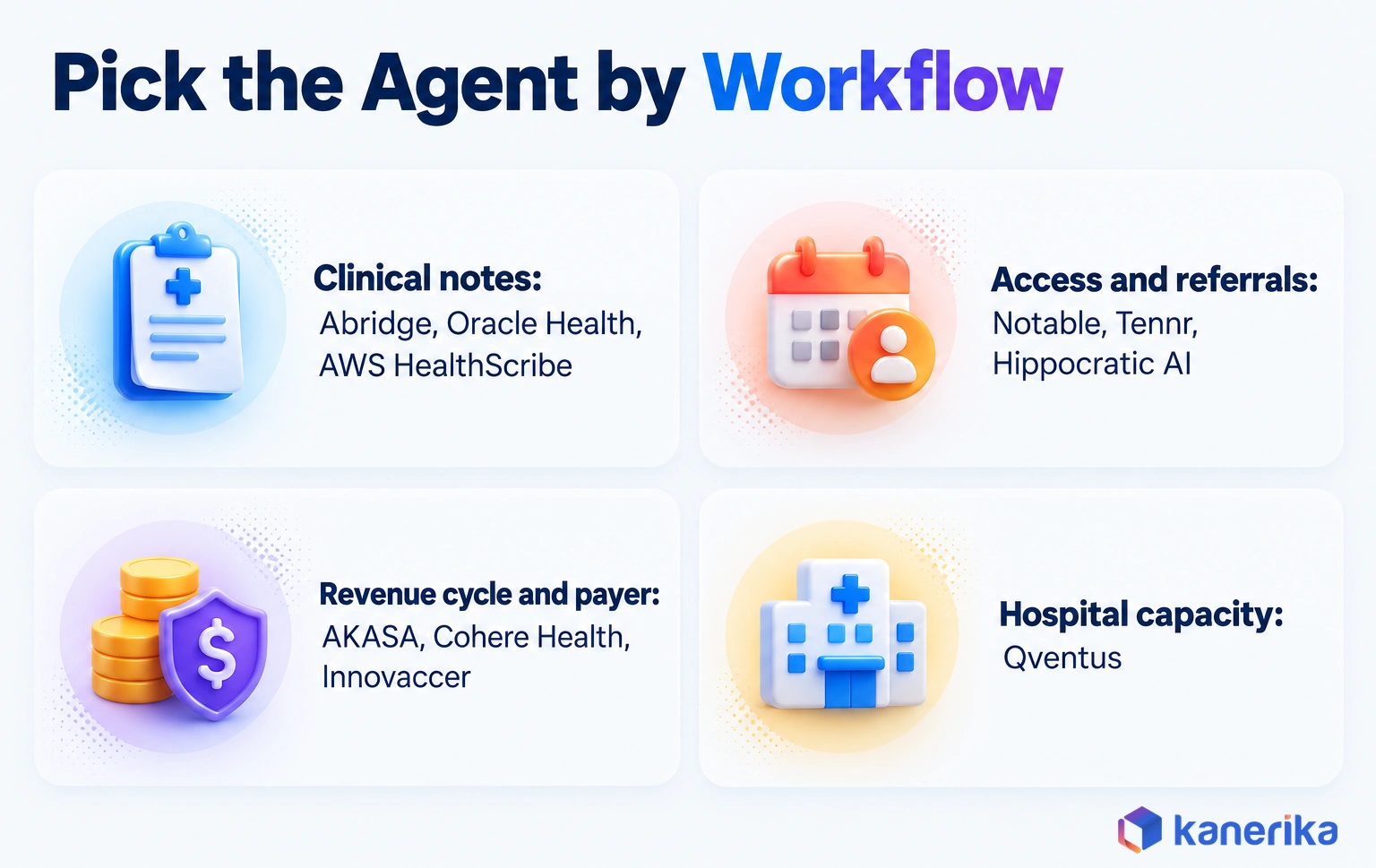
The right healthcare AI agents depend on the job you need done, so choose by workflow, not brand. For clinical notes, try Abridge, Oracle Health or AWS HealthScribe. Notable, Tennr or Hippocratic AI suit referrals and patient calls. For coding and insurance work, try AKASA, Cohere Health or Innovaccer, and try Qventus for hospital beds. Start with paperwork and billing, where mistakes are easy to catch, and keep clinicians approving anything clinical. Then pick the AI agents for healthcare that stay accurate on your own cases, work with your EHR and record every action.
Key Takeaways
- A healthcare AI agent works toward a goal in steps, uses systems such as the EHR, and escalates to a person at its limits.
- Autonomy is a setting per task, from suggest and draft to act with approval or within limits, and clinical decisions stay at draft level.
- Ten agents worth evaluating in 2026 cover documentation, patient access, referrals, prior authorization, coding and hospital capacity, so match the shortlist to your first workflow.
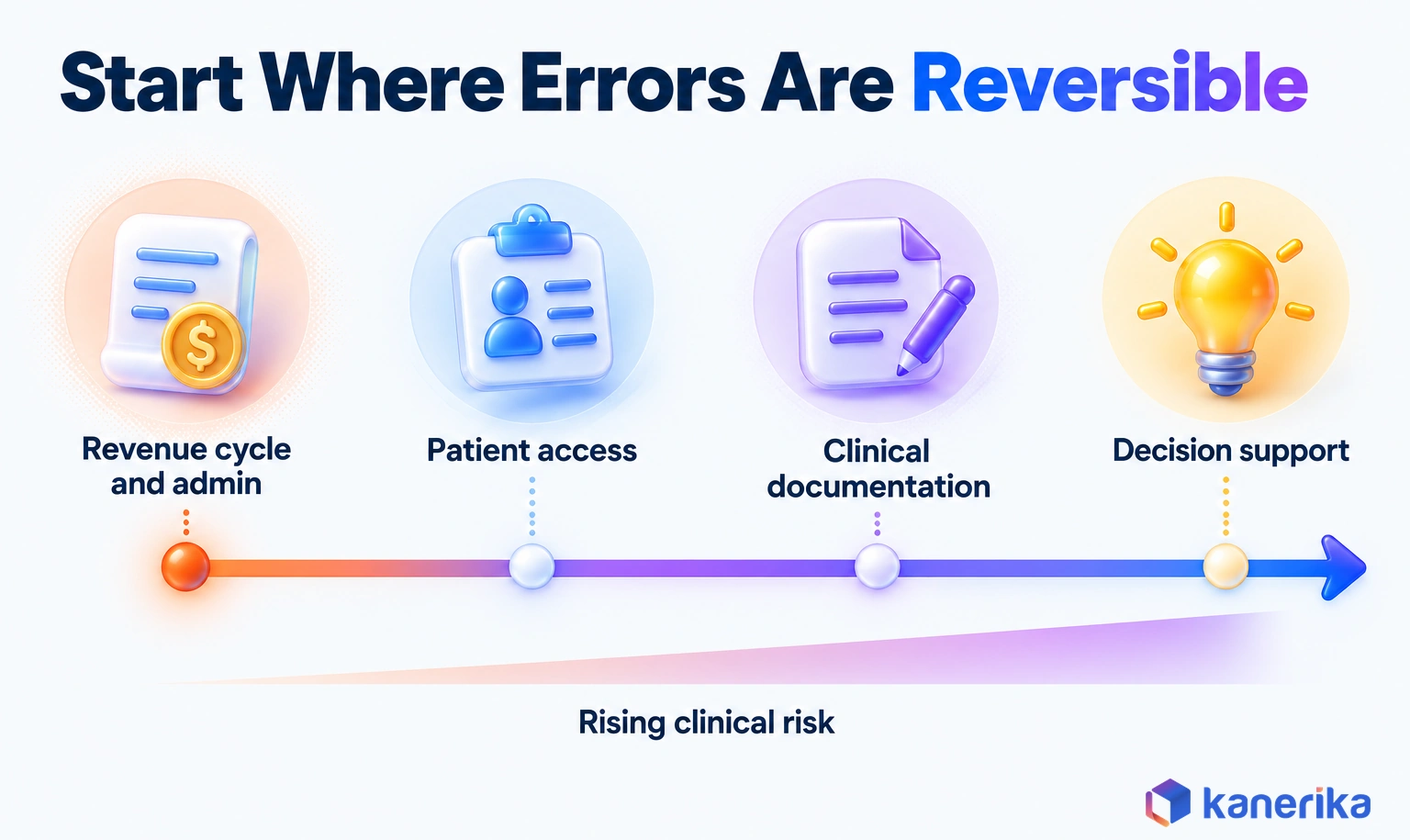
- Start with administrative and revenue-cycle agents because their errors are reversible, then move to patient access and clinical documentation.
- Payer rules under CMS-0057-F and the FDA’s clinical decision support guidance shape what agents may do and when.
- Measure cost per completed task, touchless rate, turnaround time and override rate against a baseline before you expand any agent.
The Prior Authorization That Sat in a Fax Queue for Four Days
Picture a cardiology referral that needs prior authorization before a stress test can be booked. First, a staff member pulls chart notes, copies them into the payer’s form and faxes it. Then she waits, calls for a status update and resubmits when a page goes missing.
Four days pass before anyone gives the patient a date, and nobody on the team can say exactly where the time went.
That workload is common across US practices. In the 2025 AMA prior authorization physician survey, physicians and their staff reported spending 13 hours each week on prior authorizations. Forty percent also said they have staff who work exclusively on them.
Now replay the same referral with an agent. It reads the order, then gathers the relevant notes and test results from the EHR and drafts the request in the payer’s format. A nurse reviews the draft, adds one missing detail and then approves it. The agent submits, tracks the status and flags the case when the payer asks for more.
That is the practical promise of healthcare AI agents. They do not replace the nurse’s judgment, but they take the gathering, typing and chasing off her desk and log every step. This guide explains what these agents are, ten worth evaluating in 2026, and how to choose between them.
What Is a Healthcare AI Agent?
A healthcare AI agent is software that receives a goal and works toward it in steps, instead of answering one prompt and stopping. It reads context from systems such as the EHR, the scheduling tool or a payer portal, then decides what to do next. It uses those systems to act, but only within permissions someone set in advance.
Two more behaviors also separate a real agent from a clever script. When it meets something outside its limits, such as a missing consent form or an unusual lab value, it hands the case to a person. It also records what it read and did, so a reviewer can trace each step later. Agents in a clinic need both habits, because a silent error in a patient record is far harder to catch than a visible handoff.
Take a discharge as an example. A chatbot can answer a patient’s question, such as how to take her new medications. An agent can instead check the discharge order and book the follow-up visit. It then sends instructions in her language and alerts the care manager if she never confirms. For a wider view of how agents are classified, see our guide to the types of AI agents.
Kanerika Service
Agentic AI Services
Kanerika designs and builds AI agents with scoped permissions, human checkpoints and audit logs, so each agent fits its workflow and the controls your compliance team expects.
Explore Agentic AI ServicesAgents vs Chatbots, Copilots and RPA
Vendors use these labels loosely, so the clearest way to separate them is to ask who takes the action. Rule-based automation follows a fixed script. A chatbot answers, and a copilot suggests while a person does the work (see our guide to AI agents vs chatbots).
An agent plans and acts, while a person approves wherever the risk calls for it. That difference matters for procurement, because an agent needs write access to real systems and a chatbot does not. Our guide to agentic AI also explains how this autonomy differs from earlier automation.
| Type | What it does | Example in a hospital | Who acts |
|---|---|---|---|
| Rule-based automation (RPA) | Repeats fixed steps on screens or files | Copies eligibility results into the billing system | The bot, on a fixed script |
| Chatbot | Answers questions in a conversation | Answers common questions, such as clinic hours or prep steps | Nobody; it only replies |
| Copilot | Suggests or drafts inside a person’s workflow | Drafts a reply to a patient portal message | The clinician, after editing |
| AI agent | Plans steps toward a goal, then uses several systems | Assembles, submits and tracks a prior authorization request | The agent, within permissions and approvals |
Four Levels of Autonomy for Healthcare AI Agents
You set autonomy per task, and the right level depends on what a mistake would cost. Think of it as a dial with four positions rather than a single switch.
A reminder sent at the wrong hour is an annoyance, but a wrong medication in a drafted order is a safety event. So the same agent can run fully on its own for scheduling while it only drafts for anything that touches diagnosis or treatment.
| Level | What the agent does | Hospital example | Fit for clinical work |
|---|---|---|---|
| 1. Suggest | Recommends a next step, but a person does the work | Flags a patient when a screening is overdue | Yes, as advisory support |
| 2. Draft | Prepares the output, then a person edits and sends it | Drafts the visit note from the recorded conversation | Yes, with clinician sign-off |
| 3. Act with approval | Executes once a person approves | Submits a prior authorization after a nurse approves it | Administrative steps only; clinical content is still reviewed |
| 4. Act within limits | Executes alone inside tight rules and logs everything | Fills a canceled slot, then sends a reminder | No, never for diagnosis or treatment decisions |
Clinical work stops at level two. An agent may draft a note, summarize a chart or suggest an order, but a licensed clinician signs before anything enters the record. Levels three and four belong to administrative tasks, because a mistake there can be caught and reversed.
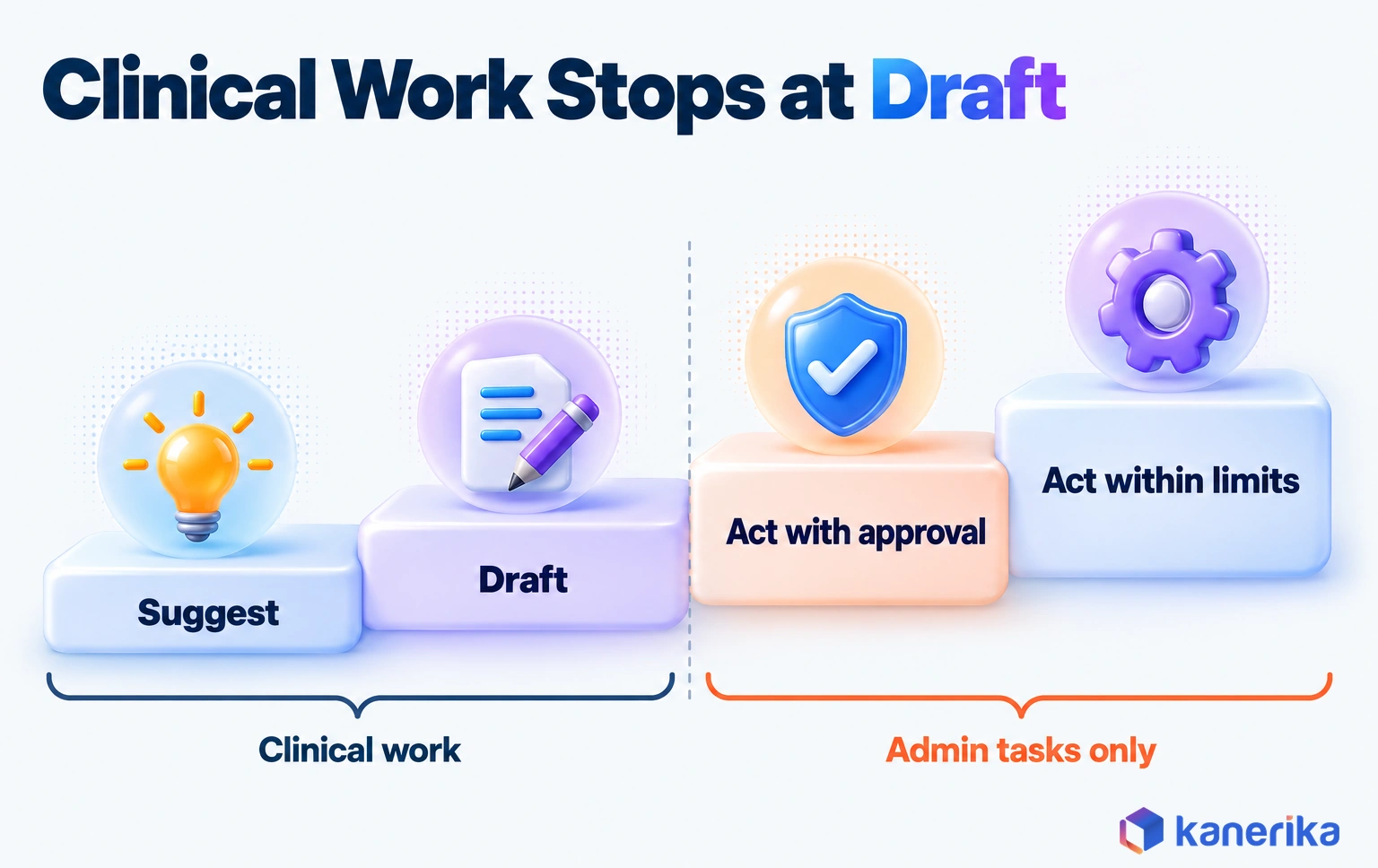
Write the level for every task into the project charter before the pilot starts, and share it with every reviewer. When the agent proves itself on real volume, you can move a task up one level with evidence rather than optimism. A sensible trigger is an approval step that staff pass unchanged on nearly every case for several weeks, with no safety events logged.
How Healthcare AI Agents Work Inside a Health System
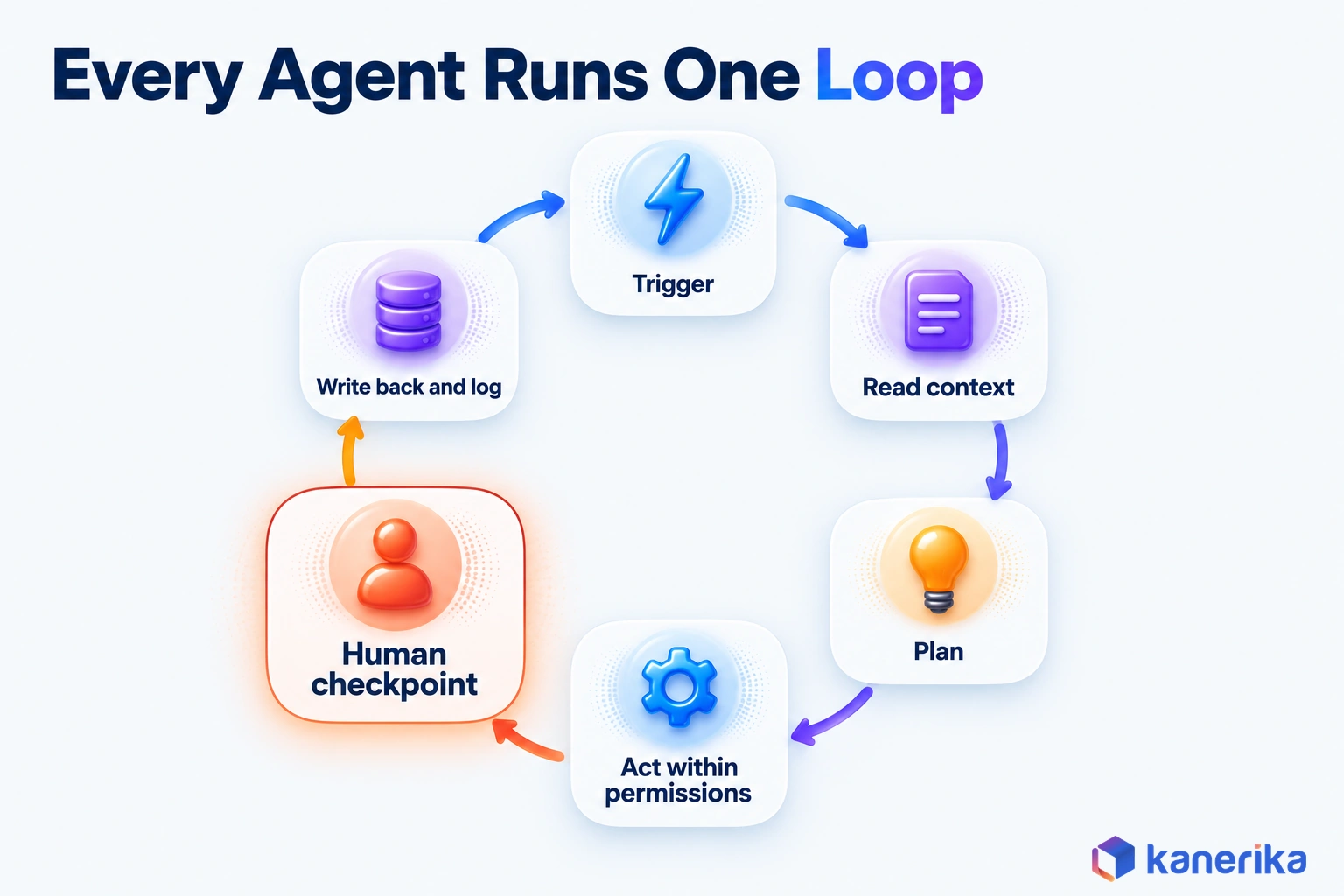
Every agent, whatever the vendor, runs the same basic loop. Something triggers it, then it gathers context, plans, acts and reports what it did, in that order every time. Each step is also a place where you set a permission or a checkpoint, so the loop doubles as a map for your vendor questions.
Following One Missed Visit Through the Loop
The easiest way to see the loop is to follow one case through it. Take a patient who misses a primary care visit. Swap in a referral or a denied claim, and only the trigger, the data and the tools change.
- Trigger: the patient misses the 2 p.m. visit, and the scheduling system records a no-show. A new referral, a denied claim or a finished encounter can start the loop the same way.
- Read context: the agent pulls the record from the EHR through FHIR APIs and finds an open referral and a diabetes care gap. It also checks the scheduling system for open slots and sees from past messages that she answers texts faster than calls.
- Plan: it decides on two steps, a text message and a rebooking offer, and picks the messaging tool and the scheduler to carry them out. If she does not reply within a day, the plan adds a call from the front desk. It picks only from tools it was granted.
- Act with scoped permissions: it sends the text and proposes three open slots near her usual visit time. It can book a visit, but it cannot change the care plan or cancel other appointments. Those limits come from the scope list shown under Building Blocks below.
- Human checkpoint: rebooking sits within its autonomy level, so no approval is needed. Had the patient reported new symptoms, the agent would route the case to a nurse instead. It would also stop and ask if the chart showed a hospital admission since the missed visit.
- Write back and log: the booked visit and a short note return to the chart, so the care team can see the open care gap is being handled, while every step lands in an audit log.
Building Blocks and Permissions
Under the hood, most agents combine four building blocks. A large language model reads and writes text, while retrieval pulls the right records and tool connectors call systems. Rules then set what the agent may never do. The model gets the attention, yet the connectors and rules usually decide whether a project ships.
Permissions deserve the closest look, because they decide most of the risk. Grant each agent the smallest access its task needs, and start with draft-only write access until accuracy is proven. The table below shows what an agent typically touches, as well as where the exposure sits.
| System | What the agent reads or writes | Permission risk |
|---|---|---|
| EHR (via FHIR APIs) | Reads problems, medications and notes, then writes drafts or tasks | Writing to the chart; keep it to drafts until validated |
| Scheduling | Reads open slots; books and cancels visits | Double-booking or canceling the wrong visit |
| Payer portal or API | Reads requirements; submits requests and checks status | Sending incomplete data or the wrong patient’s data |
| Patient messaging | Sends reminders, instructions and surveys | Wrong recipient or unapproved clinical advice |
| Billing and coding | Reads documentation; proposes codes | Coding errors and compliance exposure if unreviewed |
One design choice follows from that table. Put a human checkpoint wherever an agent writes to a system that a clinician or payer will rely on later. That keeps the speed gain while the agent earns trust on real volume.
What a Scoped Permission List Looks Like
For FHIR-based EHRs, those permissions become concrete through SMART on FHIR scopes. The SMART App Launch 2.2 specification writes each scope as context, resource and allowed actions, drawn from create, read, update, delete and search. A backend agent with no user session asks for system-level scopes.
Here is how the no-show agent from the loop above could declare its access. The scopes follow the specification, while the other field names are our own illustration rather than a standard.
{
  "agent": "no-show-rebooking",
  "autonomy_level": 4,
  "trigger_query": "Appointment?patient={patient_id}&status=noshow",
  "smart_scopes": [
    "system/Patient.rs",
    "system/Appointment.crs",
    "system/Slot.rs",
    "system/ServiceRequest.rs",
    "system/Communication.c"
  ],
  "never_write": ["MedicationRequest", "CarePlan", "Condition"],
  "escalate_to": "front-desk-queue",
  "audit_log": "every read, write and handoff"
}
The agent can search a patient’s FHIR Appointment records for the status noshow and book a new visit. It holds no update or delete rights, so it cannot cancel other visits or write to medications or the care plan. Ask every vendor on your shortlist for the same list, and treat a wildcard such as system/*.cruds as a red flag.
Agents that use other connectors, such as the Model Context Protocol, need the same scoped list on the tool side.
Where Healthcare AI Agents Deliver Value Today
The best early use cases share three traits: high volume, clear rules and a person who can check the output quickly. That is why clinical documentation, patient access, referrals, prior authorization, coding and capacity planning all qualify.
Diagnosis and treatment are different. They carry the highest risk and stay advisory, so agents there suggest rather than act. The table also maps each workflow to its sign-off owner and market maturity.
| Workflow | What the agent does | Who signs off | Market maturity | Main benefit |
|---|---|---|---|---|
| Clinical documentation | Drafts notes from the visit conversation | Treating clinician | Mature, many vendors | Less after-hours charting |
| Patient access | Handles intake, scheduling and reminders | Front-office lead, by exception | Maturing | Fewer no-shows and calls |
| Referrals and prior authorization | Classifies documents, then drafts and tracks requests | Nurse or authorization specialist | Maturing | Shorter time to care |
| Revenue cycle and coding | Proposes codes and checks claims before submission | Coder or billing lead | Maturing | Fewer denials and rework |
| Care coordination and capacity | Plans discharges and operating room schedules | Charge nurse or perioperative lead | Early to maturing | Better use of beds and rooms |
| Clinical decision support | Surfaces risks, such as sepsis, and guideline reminders | Treating clinician, every time | Early; regulated | Earlier attention to risk |
The start order runs by risk, not by the order of this table. Begin with revenue cycle and referrals, as the graphic below shows, because errors there are visible, reversible and cheap to fix.
Clinical Documentation and Ambient Scribing
Ambient documentation is the most familiar agent in clinics. With the patient’s consent, it listens to the visit, turns speech into text and then organizes it into the clinic’s note format. A clinician reviews, edits and signs the draft.
The win is time returned to clinicians, especially the charting they would otherwise finish at night. Still, a note can add a symptom nobody mentioned or drop a medication. Good tools therefore let the reviewer jump from any sentence back to its moment in the transcript. Our guide to generative AI in healthcare also covers the underlying models in more depth.
Patient Access: Intake, Scheduling and Follow-Up
Patient access agents handle the front door. They collect intake forms and verify insurance details before they offer open slots and send reminders. When a visit is missed, they reach out to rebook without a staff member dialing.
The same agents also handle follow-up after virtual visits and nudges for remote monitoring, covered in our guide to AI in telehealth. Some vendors also offer mental health check-ins between sessions, though the evidence there is still preliminary. Keep a clear path to a human, especially for anything that sounds urgent.
Referrals and Prior Authorization
Referral and authorization work is document-heavy, so agents fit it well. Incoming faxes, portal uploads and orders get classified and matched to the right patient before they reach a work queue. For prior authorization, the agent then gathers evidence from the chart and drafts the request in the payer’s format.
A nurse or authorization specialist approves before anything is submitted. The document step relies on intelligent document processing. For the wider choice between RPA, APIs and agents, see our guide to automation in healthcare, which also includes a full prior authorization walkthrough.
Revenue Cycle, Coding and Payer Calls
In the revenue cycle, agents read documentation and propose codes, check claims before submission and draft appeal letters for denials. Some also handle the long phone calls to payers about claim status. Coders still own final code selection, so they review the cases the agent marks as uncertain.
This is also where provider and payer data meet. Eligibility and coverage checks, such as insurance coverage verification, feed the agent the facts it needs before a claim goes out. For the payer side of the same data, see our guide to insurance data analytics. Our insurance coverage verification AI agent automates those eligibility checks.
Care Coordination and Hospital Capacity
Operations agents look at the whole hospital rather than one patient. They forecast discharges and flag patients whose discharge is likely to slip, then coordinate the tasks that hold up a bed. In surgery, they also help fill open operating room time and keep case schedules realistic.
Charge nurses and perioperative leads still make the calls, using forecasts like those in our guide to predictive analytics in healthcare. The agent’s job is to put the right list in front of them early enough to act.
Kanerika Service
AI Solutions for Healthcare
See how Kanerika applies AI, automation and data engineering to healthcare workflows, from document-heavy administrative tasks to the analytics that care and operations teams rely on.
Explore AI in HealthcareClinical Decision Support: Where Agents Stay Advisory
Decision support is the clearest case of the clinical limit set in the autonomy table above. An agent can surface signals such as a sepsis risk, a missed screening or a guideline reminder. But it should never order the test or change the plan on its own.
Software that drives clinical decisions may also count as a medical device, under the FDA guidance covered in the governance section below. Treat any clinical function as regulated until the vendor shows you otherwise. The FDA’s list of AI-enabled medical devices names authorized products, though the agency says the list does not cover every device.
Why 2026 Is a Different Buying Year
Three shifts change the shortlist itself, not just the technology behind it. The first comes from the EHR vendors. As of October 2026, Oracle Health provides a Clinical AI Agent that summarizes charts, drafts notes and orders, and lets nurses capture charting by voice. Because the record system ships its own agent, “extend your EHR” is now a real option to weigh against a specialist vendor.
A deadline is the second shift. Under the CMS rule covered below, payer tools such as Cohere Health and provider tools such as Notable now work toward fixed dates. Clarity on the clinical side comes third, since the FDA’s decision support guidance tells you which features deserve the closest scrutiny. Patient-facing voice agents, meanwhile, now place outreach calls for adherence, vaccinations and screenings, with a human nurse on escalations. Together, these shifts mean you choose a workflow first and a vendor second.
10 Healthcare AI Agents to Evaluate in 2026
The list below is a starting shortlist, not a ranking. Each entry is described from the vendor’s own product pages. The right choice depends on your first workflow as well as the EHR you run.
Use the table to narrow the field, then read the short profiles for fit. Prices are not listed because vendors quote them per contract.
| Agent | Category | What it does | Best-fit buyer |
|---|---|---|---|
| Abridge | Clinical documentation | Drafts documentation from clinical conversations | Health systems scaling ambient notes |
| Oracle Health Clinical AI Agent | EHR-native documentation | Summarizes charts, drafts notes and orders, voice charting for nurses | Oracle Health EHR customers |
| AWS HealthScribe | Developer service | Creates clinical notes with traceable transcript references | Software vendors building documentation tools |
| Hippocratic AI | Patient outreach | Patient-facing calls for adherence, vaccination and screening | Care management and population health teams |
| Notable | Patient access and revenue | Intake, referrals, prior authorization, appeals, care gaps | Systems automating the front office |
| Tennr | Referral intake | Classifies and routes faxed and portal documents | Referral-heavy specialty practices |
| Cohere Health | Payer prior authorization | Prior authorization and utilization management | Health plans |
| Qventus | Hospital operations | Perioperative coordination, capacity and discharge planning | Hospital operations leaders |
| AKASA | Revenue mid-cycle | Inpatient coding and clinical documentation integrity | HIM and mid-cycle teams |
| Innovaccer | Platform | Agents for scheduling, referrals, intake, prior authorization, scribing and coding | Systems wanting one platform across workflows |
1. Abridge
Abridge applies generative AI to clinical conversations and drafts documentation for physicians and nursing staff. Its documentation also supports the revenue cycle, because a complete note is a billable note. Shortlist it if you want ambient notes across many specialties and care teams. In the pilot, compare edit time per note in your two busiest specialties, not just in primary care.
2. Oracle Health Clinical AI Agent
Oracle Health’s Clinical AI Agent sits inside the Oracle Health clinical suite. It summarizes charts and drafts notes and orders, while nurses can capture charting by voice. Its August 19, 2026 release added professional fee coding, dictation and AI-assisted chart review. The nursing version also became commercially available in the US in September 2026, so the agent now reaches beyond notes. A natural fit when you already run the Oracle Health EHR and want the agent inside the record.
3. AWS HealthScribe
AWS HealthScribe is a HIPAA-eligible service for software vendors rather than a finished clinical app. It combines speech recognition and generative AI to create clinical notes, while each summary statement links back to the transcript it came from. The catch is that you build and host the clinician review screen yourself. It suits a product team building its own documentation tool, provided that team has the engineers to own the interface.
4. Hippocratic AI
Hippocratic AI builds patient-facing generative AI agents that hold phone conversations with patients. Typical uses include medication adherence, remote monitoring check-ins and vaccination or screening outreach, while a human nurse takes escalations. Consider it when care management teams cannot staff enough outreach calls. Test the escalation path hardest: script calls where a patient reports chest pain or confusion, then time how fast a human nurse picks up.
5. Notable
Notable provides AI agents for intake and registration, referral management, prior authorization, appeal letters and care-gap outreach. That spread covers much of the front office as well as part of the revenue cycle on one platform. It fits a health system that wants to automate several patient access tasks together. During the pilot, follow one referral from intake to approved authorization and count how many times staff have to step in.
6. Tennr
Tennr focuses on the documents behind referrals and intake. It classifies and routes patient documents arriving by fax, portal or order, so staff see a sorted queue instead of a pile. Look at it first if fax traffic slows scheduling in a specialty practice. Feed the pilot your worst documents, such as skewed scans and handwritten orders, and measure how many land in the right patient’s queue.
7. Cohere Health
Cohere Health serves the payer side of prior authorization. Its platform applies AI to prior authorization and utilization management for health plans. That makes it the payer counterpart to provider tools such as Notable. A health plan preparing for the CMS-0057-F timelines should test how its decisions and reasons reach the requesting provider.
8. Qventus
Qventus describes its agents as “AI teammates” for hospital operations. They support perioperative coordination and surgical growth, as well as inpatient capacity and discharge planning. Operations leaders who need more cases and fewer bed delays without adding coordinators should take a look. Compare its discharge forecasts against your current huddle list for a few weeks before anyone acts on them.
9. AKASA
AKASA targets the revenue mid-cycle with autonomous inpatient coding and clinical documentation integrity. Coding is high-volume, rule-bound work, so it suits an agent while coders review its exceptions. HIM and coding teams with backlogs or hiring gaps are the obvious buyers. Ask for the share of charts it codes without a human touch on your own cases, and audit a sample of those.
10. Innovaccer
Innovaccer positions its “Agentic Cloud for Healthcare” as one platform for many agent tasks. It provides omnichannel agents for scheduling, referrals and intake, as well as prior authorization, ambient scribing and coding. The appeal is one vendor across many workflows, especially if you already plan a unified data layer. Check depth as well as breadth: pilot its weakest-looking workflow against a specialist from this list.
Which should you shortlist first? Start from the workflow you picked in the use-case table, then pair one platform with one specialist. Every pairing below stays within the ten agents above.
Prior authorization splits by which side you sit on. A health plan looks at Cohere Health, while a provider organization compares Notable with Innovaccer. For coding, AKASA is the specialist and Innovaccer the platform, so run both on the same charts. Outreach calls point to Hippocratic AI, measured against what your care managers achieve today.
Capacity work sets Qventus against the operations tools your EHR already includes. A product team building its own documentation tool starts with AWS HealthScribe rather than a finished app. A system starting with referrals might compare Notable against Tennr, while one starting with notes would weigh Abridge against its EHR vendor’s own agent.
AI Assessment
Is Your Health System Ready for AI Agents?
Score your data, integration, governance and team readiness, then see which agent workflows you can pilot first and which gaps to close before procurement.
Start Your AI Assessment →How to Evaluate a Healthcare AI Agent Before Procurement
A demo shows what an agent can do on the vendor’s data. Procurement, by comparison, has to establish what it will do on yours, inside your EHR and under your permissions.
The fastest way to learn that is a scored pilot. Take 200 to 500 recent cases from the target workflow, then run them through the agent in a test setting. Then have your own staff grade the output against what actually happened, using the methods in our guide to AI agent evaluation. That one exercise answers accuracy, integration and review workload questions far better than any slide.
The Procurement Scorecard
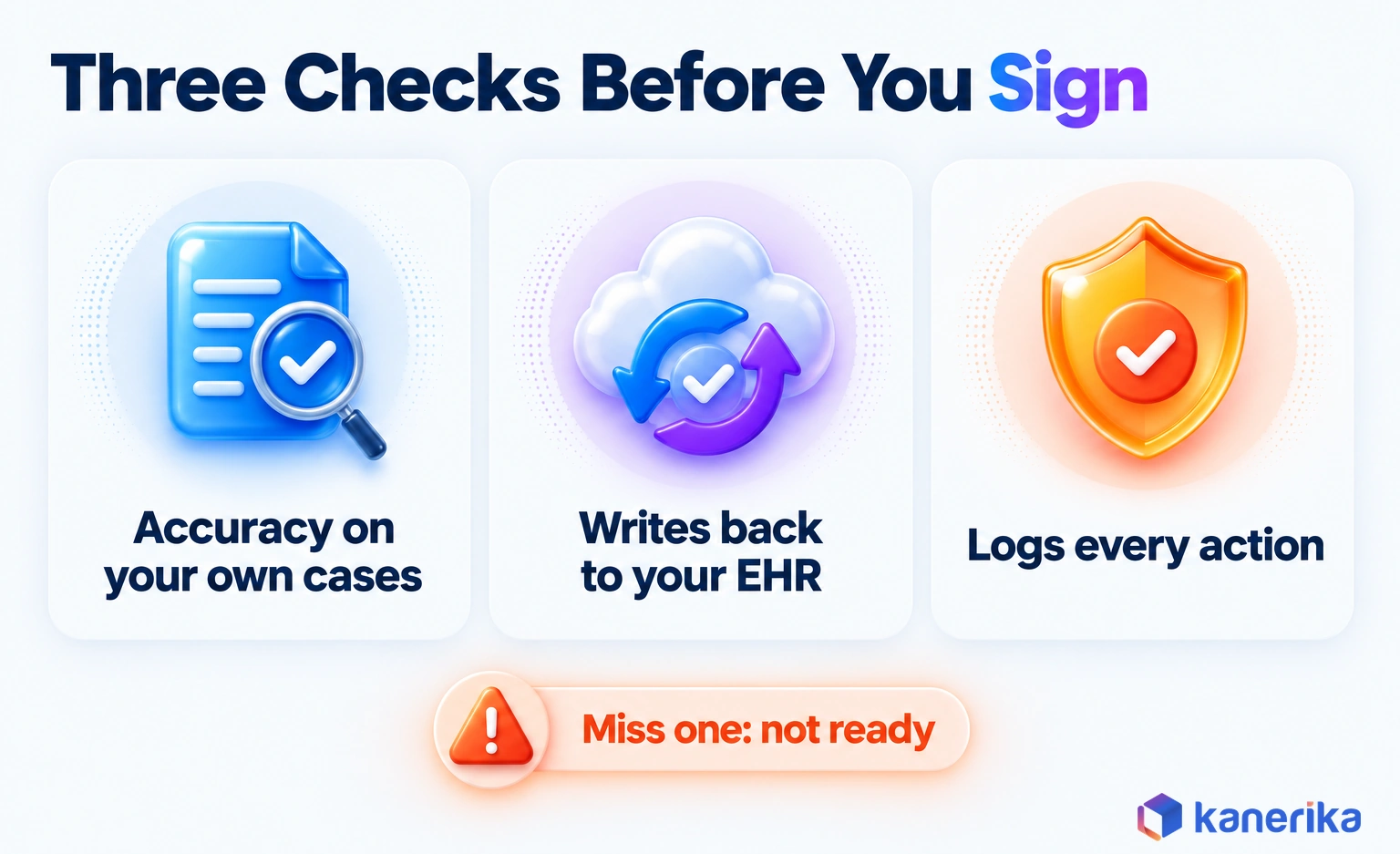
Three questions tend to decide the outcome. Does the agent hold its accuracy on your data, does it write back into your EHR, and does it log every action it takes? A vendor that cannot show all three is not ready for production, however good the demo looked.
| Criterion | What to ask | Red flag |
|---|---|---|
| Accuracy on your data | Can we test it on our own recent cases before signing? | Only vendor benchmarks, no local test |
| EHR integration | Does it read and write through FHIR APIs or certified connectors? | Screen scraping or manual copy and paste |
| Permissions | Can access be limited per task and per role? | One broad service account for everything |
| Audit log | Is every read, action and approval logged and exportable? | Logs only on request, or none at all |
| HIPAA and BAA | Will you sign a business associate agreement? | Hesitation, or PHI sent to unvetted subprocessors |
| FDA status | Which functions are clinical, and what is their regulatory status? | No clear answer for clinical features |
| Human review design | Where does a person approve, and how fast is that step? | Review screens that hide the source evidence |
| Override reporting | Do you report how often staff override the agent? | No override or error metrics in the product |
| Vendor viability | Who are your reference customers in our segment? | No live customers in a similar health system |
Then weight the criteria by the autonomy level you plan to grant. A drafting agent with clinician sign-off can live with lower accuracy than an agent that submits on its own. An agent that acts alone, however, needs near-perfect logging and a fast way to stop it.
Buy, Extend Your EHR, or Build?
Every health system faces this choice once it has a shortlist. Buying a specialist agent is the fastest route. Extending your EHR vendor’s agents gives the tightest integration, while building gives the most control at the highest effort.
| Option | Speed | Workflow fit | Integration | Control | Cost profile |
|---|---|---|---|---|---|
| Buy a specialist agent | Fastest | Strong for its one workflow | Depends on the vendor’s connectors | Low to medium | Subscription per use or per seat |
| Extend your EHR’s agents | Fast if you run that EHR | Good for common workflows | Tightest | Medium | Add-on to the existing contract |
| Build your own | Slowest | Fits unusual workflows exactly | You build it | Highest | Engineering plus ongoing operation |
In practice, many systems mix all three: the EHR’s agent for notes, a specialist for referrals and a custom agent for the rest. A single agent is easier to govern, while several cooperating agents fit longer processes such as referral-to-appointment. Our guide to AI agent architecture explains both patterns, while our overview of custom AI agents covers the build route.
If you run Oracle Health and start with notes, extend the EHR before you buy a separate scribe. If faxed referrals are the bottleneck, buy a specialist such as Tennr. Build only when no vendor covers the workflow and you have engineers to run it.
What Healthcare AI Agents Cost and How to Measure ROI
Pricing for healthcare AI agents follows a few common models, and the model shapes your incentives more than the headline number does. For example, documentation tools are often priced per clinician or per encounter, and administrative agents per completed task. Platforms sell a license, while custom builds carry engineering cost plus ongoing operation.
Per-task pricing looks attractive because you only pay when work gets done. Yet it can grow quickly once volume rises, so model it at full scale before you sign.
| Cost driver | Why it matters |
|---|---|
| Licensing or usage fees | Pricing per encounter or per task scales differently than a platform license |
| EHR and payer integration | Connectors and write-back often take more effort than the agent itself |
| Data preparation | Messy templates and scanned documents slow accuracy until they are cleaned |
| Validation and pilot | Staff time to grade outputs before go-live |
| Human review time | Every approval step costs minutes, so it offsets part of the savings |
| Monitoring and support | Override tracking, error review and model updates continue once the agent is live |
The KPIs That Prove ROI
A prior authorization drafted in seconds saves nothing if the nurse spends longer checking it. Total cost, not task speed, is what the department pays. Likewise, if staff hours are freed but nobody redeploys them, the savings exist only on paper. Measure the whole workflow, including review time, rather than the agent’s speed alone.
| KPI | What it shows |
|---|---|
| Cost per completed task | The true unit cost, once review time is included |
| Touchless rate | Share of cases finished without a human edit |
| Turnaround time | Time from trigger to completed task, such as referral to booked visit |
| Staff hours returned | Time freed, and where it was redeployed |
| Denial and appeal rate | Whether payer outcomes improve rather than just speed |
| Override rate | How often staff reject or change the output before it is used |
| Patient safety events | Any harm or near miss linked to the agent, even if caught |
Record a baseline for each KPI before the pilot starts. Without one, a team can feel faster and still be unable to prove it.
Talk to Kanerika
Scope the Cost of Your First Agent
Talk to Kanerika about one workflow, its baseline and its integration needs, and get a realistic view of what a supervised pilot will take.
Schedule a Demo →Risks, Regulation and Governance
An agent that acts on patient data inherits every obligation that applies to that data, plus a few new ones. The main risks are therefore privacy, regulatory scope, wrong output and silent drift after launch. The World Health Organization’s guidance on large multi-modal models treats them as ethics and governance questions across health care and public health.
Governance for healthcare AI agents is how you keep each risk owned, and it builds on existing data governance in healthcare. It works best when it is designed with the pilot, not bolted on after go-live.
HIPAA, BAAs and Least-Privilege Access
Any agent that touches protected health information runs under HIPAA, so the vendor should sign a business associate agreement. Also check where data is processed and which subprocessors handle it.
Least privilege matters even more for agents than for ordinary apps, because an agent acts without a person clicking each step. Give each agent its own identity and the narrowest access its task needs, a pattern our agentic AI security guide covers. Then encrypt data in transit and at rest. Our guide to HIPAA-compliant software development covers the technical controls in detail.
FDA, CMS and the Clinical Line
Two federal rule sets shape what agents may do. On the clinical side, the FDA’s final guidance on Clinical Decision Support Software, dated January 2026, describes when such software falls under device rules. Administrative agents, such as scheduling, generally sit outside device rules. Agents that recommend diagnoses or treatments need careful review, which is why clinical work stays at the draft level.
On the payer side, the CMS prior authorization final rule (CMS-0057-F) applies operational provisions generally from January 1, 2026. Its API requirements generally follow from January 1, 2027, and exact dates vary by payer type. That timeline pushes payers and providers toward electronic exchange, such as the HL7 Da Vinci Prior Authorization Support FHIR guide, giving agents a structured channel.
Bias, Hallucination and Human Review
Language models can produce fluent text that is wrong. In a note, for example, that might be a symptom nobody reported or a dose that was never discussed. Bias is the quieter problem, because an agent trained on narrow data may perform worse for some patient groups.
Human review is the main control, but only if reviewers can check quickly. The strongest pattern links every drafted statement to its source, such as the evidence links in AWS HealthScribe notes. Reviewers then verify instead of re-reading everything. Test accuracy separately across age, language and payer groups before launch, a core step in responsible AI practice.
Monitoring Agents in Production
An agent that passed its pilot can still degrade. For instance, a new note template, a payer form change or a model update can shift its accuracy unnoticed. NIST’s AI Risk Management Framework, released in January 2023, lists Measure and Manage among its four core functions, so drift checks belong in the plan.
Track the override rate weekly and sort errors into a simple taxonomy, such as missing data, wrong data and wrong action. Keep audit logs searchable, and alert a named owner when a metric moves outside its range. Our guide to AI agent observability also describes the tracing and monitoring setup in more detail.
Governance Checklist Before Go-Live
Run through this list before go-live with clinical, compliance and IT owners in the same room. Our review of AI governance tools also covers software that can track each item. Each item closes a gap that would otherwise surface after launch, when it is harder to fix. The committee, validation and change-control side of that go-live review is covered in AI governance in healthcare.
- Name a clinical owner as well as an operational owner for the agent.
- Set the autonomy level for every task in writing, then share it with staff.
- Sign the BAA before any patient data reaches the agent.
- Limit permissions to the records and actions each task needs.
- Confirm the FDA status of any clinical function.
- Record a baseline for every KPI before the pilot.
- Assign an owner to every alert and override report.
- Agree on a stop procedure so the agent can be paused in minutes.
Teams that skip the baseline cannot prove value, while teams without an alert owner find problems late. Both mistakes cost more than the hour this list takes.
Checklist
Agentic AI Readiness Checklist
Check data readiness, permissions, human oversight, monitoring and ownership before an agent goes live, so the go-live review covers the gaps that usually surface after launch.
Get the Checklist →How Kanerika Builds Healthcare AI Agents
Kanerika builds healthcare AI agents around one workflow at a time, starting with the data and the permissions rather than the model. The work runs in four stages, and each stage has an exit test before the next begins.
- Assess the workflow and data. We map the current process and measure the baseline, then check whether the EHR, payer and document data can support an agent.
- Design the agent and its permissions. Our agentic AI services team sets the autonomy level per task, the human checkpoints and the audit trail before writing code.
- Run a supervised pilot. Staff review every output on real cases, while we track accuracy, override rate and review time against the baseline. Our guide on moving an AI pilot to production also explains the exit criteria.
- Deploy, monitor and expand. The agent goes live with alerts and a named owner, then moves up an autonomy level only when the numbers support it.
The approach reflects our AI work in healthcare, where we start with administrative tasks because their results are easiest to measure.
Case Study: AI Automation for a Healthcare Workforce Platform
One example is a technology platform for healthcare workforce optimization. Its team shortlisted skilled clinical talent through manual standard operating procedures, so shortlisting was slow. Manual document verification also caused errors, while growth depended on adding operations headcount.
Kanerika applied AI and machine learning to automate candidate shortlisting and document verification. As a result, the platform reached 90% operational AI accuracy and a 64% reduction in wastage. It also saw a 32% boost in business support and 30% better workforce efficiency.
This was administrative automation rather than a clinical agent. Still, it follows the same pattern as the agents in this guide: a document-heavy task, clear rules and a person reviewing the output.
Case Study
64% Less Wastage in Healthcare with AI and ML
A healthcare workforce platform automated talent shortlisting and document verification with Kanerika, reaching 90% operational AI accuracy and a 64% reduction in wastage.
Read the Case Study →What Comes Next for Healthcare AI Agents
The next stage moves healthcare AI agents from single tasks to connected multi-agent AI systems. Instead of one agent per task, health systems will run several agents that hand work to each other and to people.
Picture a referral that an intake agent registers, an authorization agent clears with the payer and a scheduling agent books. A nurse steps in only at the approval. The payer API channel from the CMS rule covered above makes that handoff easier to automate end to end. Each agent reads the same structured request.
Voice is the second shift, and patient outreach shows it first. More outreach calls and payer calls will run by voice, while humans still take escalations. That puts an agent in direct conversation with patients and payers, so its limits need to be as clear as a new hire’s. Before any live traffic, script the hard calls, such as a confused patient or a payer asking for a missing record.
Each of these raises the stakes on governance and on AI agent orchestration. More connected agents mean more permissions to scope and more logs to watch, so the groundwork described above matters more over time, not less. Each handoff between two agents also needs a named owner, because an error that starts in the intake agent may only surface at scheduling.
The first systems to benefit will be those that measure their workflows, track overrides and treat every agent as a supervised member of staff.
Wrapping Up
Healthcare AI agents earn their place when they take repetitive work off clinicians and staff, under clear permissions and human sign-off. Start with administrative and revenue-cycle agents, because errors there are reversible and savings are measurable. Move to patient access next, then clinical documentation with clinician sign-off.
Your next step can fit in one week of planning. Pick one workflow and pull 200 to 500 recent cases from it. Then run two agents from the ten above side by side on those cases and compare their override rates and review time. Choose the one your staff override least, as long as it writes back to your EHR and logs every action.
Frequently Asked Questions
What is an AI agent in healthcare?
An AI agent in healthcare is software that works toward a goal in steps, such as booking a follow-up or drafting a prior authorization. It reads context from the EHR, scheduling or payer systems, acts within permissions set in advance and logs each step. When a case falls outside its limits, it hands the work to a person.
How do AI agents improve hospital efficiency?
AI agents take over repetitive, rule-bound work that consumes staff time. They draft clinical notes, sort referral documents, prepare prior authorization requests, fill canceled appointment slots and plan discharges. Staff then review exceptions instead of doing every step by hand. Efficiency gains are real only when review time is counted and freed hours are put to other work.
How do you measure the ROI of a healthcare AI agent?
Record a baseline before the pilot, then track cost per completed task, touchless rate, turnaround time, staff hours returned, denial and appeal rates, override rate and patient safety events. Include human review time in every calculation. An agent that works fast but needs long checks may save nothing, so measure the whole workflow rather than speed alone.
How are bias and hallucination risks controlled in healthcare AI agents?
The main control is human review designed for speed. Every drafted statement should link to its source, such as a transcript moment or chart entry, so reviewers verify rather than reread. Test accuracy across age, language and payer groups before launch. After go-live, track overrides, sort errors by type and alert a named owner when metrics drift.
Should a health system buy, build or extend its EHR for AI agents?
Each route fits a different need. Buying a specialist agent is fastest for one workflow, and extending your EHR vendor’s agents gives the tightest integration. Building gives the most control for unusual workflows but needs engineering and ongoing operation. Many systems mix all three, using the EHR agent for notes and specialists for referrals or coding.
How long does it take to deploy a healthcare AI agent?
Timelines depend on integration and data quality more than on the agent itself. Deployment runs in phases. First assess the workflow and record a baseline, then design permissions and checkpoints. Next comes a supervised pilot on real cases, followed by go-live with monitoring. Each phase should end only when its exit test is met.
Are AI agents in healthcare HIPAA compliant?
An agent can be deployed in a HIPAA-compliant way, but compliance depends on the setup, not the label. Any vendor handling protected health information should sign a business associate agreement. The agent needs its own identity, least-privilege access, encryption and complete audit logs. Check where data is processed and which subprocessors touch it before any pilot begins.
Can AI agents integrate with EHR systems?
Yes, and integration usually decides whether a project succeeds. Strong agents read and write through FHIR APIs or certified EHR connectors rather than screen scraping. Some EHR vendors, such as Oracle Health, also ship their own agents inside the record. Start with draft-only write access, and widen permissions only after the agent proves accurate on your own cases.
Do AI agents replace doctors or nurses?
No. Agents take over gathering, typing, sorting and chasing, while clinicians keep every diagnosis and treatment decision. A drafted note, summary or suggested order still needs a licensed clinician to review and sign it. Fully autonomous clinical agents are not a safe goal, so well-run programs keep a person approving anything that affects patient care.
What are examples of AI agent use cases in healthcare?
Common use cases include ambient clinical documentation, patient intake and scheduling, referral document routing, prior authorization drafting, inpatient coding, denial appeal letters, outreach calls for adherence and screenings, and discharge and operating room planning. Clinical decision support is also a use case, but there the agent stays advisory and a clinician makes every final call.
How much do AI agents for healthcare cost?
Cost depends on the pricing model and the integration work. Documentation tools are often priced per clinician or per encounter, administrative agents per completed task, and platforms by license. Custom builds carry engineering plus ongoing operation. The main cost drivers are EHR and payer integration, data preparation, validation, human review time and monitoring after launch.
How do healthcare AI agents differ from chatbots and RPA?
RPA repeats a fixed script on screens or files, and a chatbot only answers questions in a conversation. An AI agent plans the steps toward a goal, uses several systems and acts within permissions, escalating to a person when needed. Unlike plain generative AI, which produces text on request, an agent also takes action and logs it.
Are healthcare AI agents regulated by the FDA?
It depends on what the agent does. Software that drives diagnosis or treatment decisions may count as a medical device. The FDA’s final guidance on clinical decision support software, dated January 2026, explains where that line sits. Administrative agents, such as scheduling, generally fall outside device rules but still sit under HIPAA and payer requirements.
Which healthcare workflow should we automate with an AI agent first?
Start with administrative or revenue-cycle work, such as referral intake, prior authorization drafting or coding support. These tasks have high volume and clear rules, and a mistake can be caught and reversed. Move to patient access next, then clinical documentation with clinician sign-off. Keep clinical decision support for last, and keep it advisory.