

TL;DR
The best AI sales tools match your team’s needs by addressing bottlenecks, matching expected volume, and integrating easily into your existing workflows. Salesforce Sales Cloud manages CRM and sales pipelines, while ZoomInfo and UserGems are great for prospect identification and research. Artisan, Reply, and Linked Helper automate outbound prospecting, personalize outreach, and manage follow-ups across email and LinkedIn. KrispCall and CloudTalk are great for call management. Tidio, involve.me, and Zendesk support inbound lead engagement, while Gong provides conversation intelligence, and Rings AI provides relationship insights.
Key Takeaways
- The right AI sales tool can automate time-consuming tasks, personalize outreach, qualify leads, and improve conversions.
- Investing time in learning how to launch highly targeted, personalized outreach with AI sales tools can pay off many times over compared to mass outreach campaigns.
- Selected AI sales tools should integrate well with the toolkit and workflows that you already have, unless you’re ready to rebuild your tech stack from scratch.
- Tool performance is best measured by qualified meetings, new opportunities, time saved, and conversion rates rather than activity metrics alone.
- AI sales tools can support different stages of the sales funnel, from prospect research and outreach to lead qualification and conversation analysis.
Turning potential prospects into customers takes more than a persuasive email or a talented sales rep. It starts with finding the right people, understanding what they need, and knowing when and how to reach out. As your pipeline grows, keeping every conversation moving and every opportunity on track becomes increasingly difficult, making the right sales tools essential to staying on track.
AI is changing how sales teams handle that workload. Tasks that once took hours of manual research, data entry, and follow-ups can now be completed in minutes, freeing reps to focus on building relationships and closing deals. With the right combination of tools, businesses can create a more efficient sales process, handle a growing pipeline, and scale their efforts without adding the same amount of manual work.
But with so many platforms promising to do it all, knowing which ones actually fit your needs can be tricky. This guide explores some of the best AI-powered sales tools, what they bring to the table, and how they can help at different stages of your sales process.
Free Assessment
Is Your Business Ready for AI in Sales?
Before adding new AI tools to your sales stack, check how ready your data, processes, and teams are. Kanerika’s free AI Maturity Assessment reviews your AI and ML foundations, generative AI, and AI agent readiness, and returns personalized recommendations.
Take the Assessment →How AI Sales Tools Support the Sales Funnel
AI-powered sales tools can assist with multiple stages of the sales funnel, but they’re not necessarily interchangeable. Each tool has its own strongest set of capabilities, and while some features may overlap, the key is to choose tools that complement one another and cover the entire process, from identifying potential buyers to managing outreach and analyzing sales conversations. Prospecting tools identify customers, outreach platforms manage and automate communication, and conversation intelligence tools capture valuable insights into what customers think.
Lead Acquisition and Enrichment
The full sales cycle starts with prospecting, where you identify potential buyers, find the best way to reach them, and enrich CRM records to build a complete picture of each prospect. AI-powered prospecting tools are several steps ahead of manual research, helping teams identify relevant contacts and buying signals and enrich lead data faster, leaving more time to focus on the leads that matter most.
Prospecting and Outbound Engagement
Once you’ve identified your prospects and enriched your CRM, the next step is to know exactly where and when to connect. For the best chances of conversion, the message needs to be clear, timely, and highlight a clear value for the lead. This step is time-consuming to do manually, so tools that use AI agents for automated follow-ups, calls, emails, and even internal reminders can help teams maintain consistent communication that leads to predictable conversions.
Lead Engagement and Conversion
Once leads become interested in a particular solution, they lead with questions about the specific solutions to their problems. That’s where AI-powered chat assistants do wonders. They keep the conversation going by answering common questions, gathering relevant information through interactive forms, and asking follow-up questions that uncover a lead’s needs. More importantly, they give businesses the opportunity to understand their customers and their main pain points.
Conversation Intelligence and Deal Insights
The sales process can quickly become overwhelming, leaving room for missed steps, unnoticed signals, and overlooked opportunities. For a business, these gaps can cost valuable deals and revenue. Conversation intelligence tools help automate routine tasks and capture important context to improve follow-ups and help teams make better-informed sales decisions.
13 Best AI Sales Tools: Side-by-Side Comparison
| Provider | Key Features | Starting Price | Best For |
|---|---|---|---|
| Salesforce Sales Cloud | CRM, lead/opportunity scoring, forecasting, AI-assisted workflows | From $25/user/month (Starter Suite); forecasting from Pro Suite, AI features from Core or as add-ons. | CRM and pipeline management |
| ZoomInfo | B2B company/contact data, intent and prospecting intelligence | Custom pricing; contact sales. | B2B prospecting and account prioritization |
| UserGems | Job-change and buying signals, account prioritization, supports automated outreach workflows and account/contact scoring | Starting at $40,000/year (Core); implementation fees from $3,000. | Trigger-based prospecting |
| Artisan | AI sales agent and outbound prospecting workflows | Custom pricing; contact sales. | AI-assisted outbound |
| Reply | Multichannel sales engagement and sequence automation | Starting at $49/user/month (Email Volume, billed annually) | Outbound engagement |
| Linked Helper | LinkedIn workflows, follow-ups, AI message personalization | Starting at $15/month per license; cloud storage from $29.90/month. | LinkedIn-focused prospecting |
| KrispCall | Cloud business phone, call routing, dialers, AI call summaries (add-on) | Starting at $12/user/month, billed annually. | Business calling |
| CloudTalk | Business phone system, dialers, call analytics and AI add-ons | Starting at €25/user/month, billed annually (Starter) | Sales calling teams |
| Tidio | Live chat, ticketing, Lyro AI agent and lead-capture flows | Free plan available; paid plans from $24.17/month, billed annually. | Website chat and inbound engagement |
| involve.me | Interactive funnels, lead scoring, email automation, free CRM | Free plan available; paid plans from $29/month, billed annually. | Lead capture and qualification |
| Zendesk | Ticketing, messaging, customer service workflows and AI agents | From $19/agent/mo | Support-led customer engagement |
| Gong | Call recording and transcription, AI conversation analysis, deal intelligence, revenue forecasting, sales coaching | Custom pricing; contact sales | Conversation intelligence and deal insights |
| Rings AI | Relationship intelligence platform and relationship-focused CRM | Custom pricing; confirm with the provider. | Relationship intelligence |
AI Sales Intelligence & Lead Acquisition Tools
Finding the right prospects is easier when you know where to look and what signals to pay attention to. AI-powered sales intelligence tools can help by gathering company and contact data, spotting buying signals, and identifying prospects worth pursuing, so your sales team doesn’t need to waste time searching.
Each tool has its own strengths, so let’s look at what they offer and which sales teams they’re best suited for.
Salesforce Sales Cloud
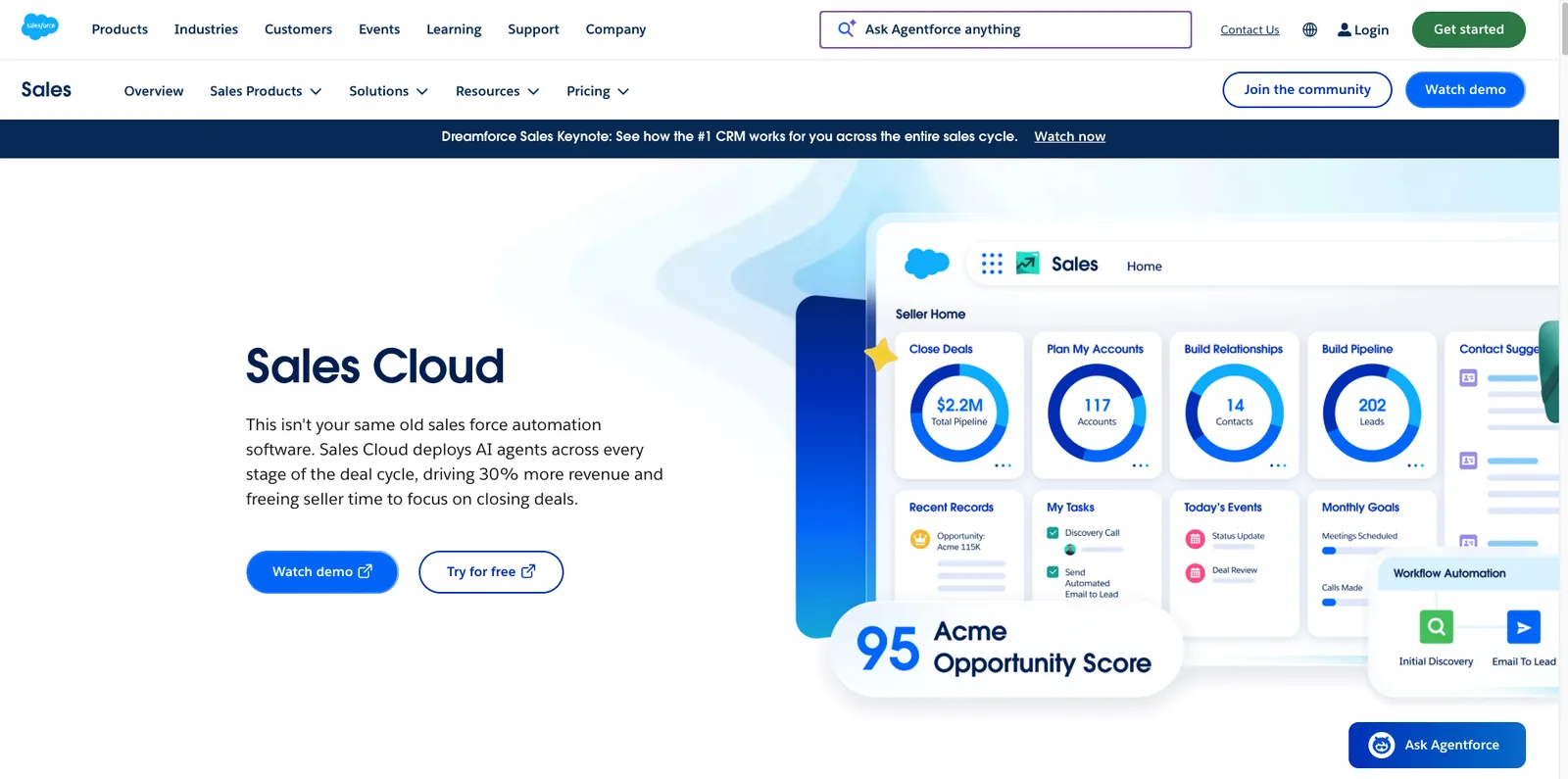
Salesforce Sales Cloud brings leads, accounts, contacts, and potential deals together in one CRM, so your team can see exactly where every opportunity stands without jumping between tools. Depending on the plan, lead prioritization, sales forecasting, performance analytics, workflow automation, and AI-powered assistance help reps stay on top of their pipeline, manage prospects at scale, and keep deals moving toward a more predictable close.
Best for: AI-powered CRM and sales pipeline management
Starting price: From $25/user/month (Starter Suite); forecasting from Pro Suite, AI features from Core or as add-ons.
Features: CRM; lead and opportunity scoring; forecasting; AI-assisted workflows.
Pros: AI-powered lead scoring, sales forecasting, and CRM automation in one platform.
Cons: Advanced features can require higher-tier plans or add-ons, and implementation can be complex.
ZoomInfo
ZoomInfo helps sales teams find potential buyers using B2B company and contact data. It further streamlines prospect prioritization by providing account insights and buying signals. Its AI-powered Copilot also recommends prospects and helps personalize outreach. This helps sales teams prioritize the right prospects when they’re most likely to buy. ZoomInfo builds targeted prospect lists so businesses can focus on the most relevant accounts and personalize outreach where it matters most. It’s especially helpful for B2B sales teams looking to improve prospecting and identify new sales opportunities.
Best for: B2B prospecting and account prioritization
Starting price: Custom pricing; request a quote.
Features: Company and contact data; intent signals (start at the Copilot Advanced tier); account insights; integrations.
Pros: Combines contact research with account-level context.
Cons: Confirm data credits, coverage, and package inclusions before committing.
UserGems
UserGems is an AI-powered sales intelligence platform that helps sales teams identify which prospects to contact, when to reach out, and what makes an account worth pursuing. Its strongest feature is the combination of buying signals, account and contact scoring, and automated outreach, helping teams focus on promising opportunities instead of spending hours researching leads or contacting prospects without a clear reason.
Best for: Sales triggers and buyer signals
Starting price: Core at $40,000/year ($3,333/month); Advanced at $75,000/year; Elite at $150,000/year. Implementation fees: Core $3,000, Advanced $5,000, Elite $10,000.
Features: Job-change signals; contact monitoring; account signals; CRM workflows.
Pros: Highlights timely reasons to contact known people.
Cons: Value depends on signal relevance and consistent follow-up.
AI Sales Outreach & Engagement
Sales today involves much more than cold calling or cold emailing. Your competitors may already be one step ahead, and AI-powered tools can strengthen your competitive advantage by automating repetitive tasks, personalizing customer touchpoints, and automatically handling follow-ups.
The right combination of tools and their capabilities depends on your outreach channels, the level of personalization your business needs, and how much control your team wants to retain.
Artisan
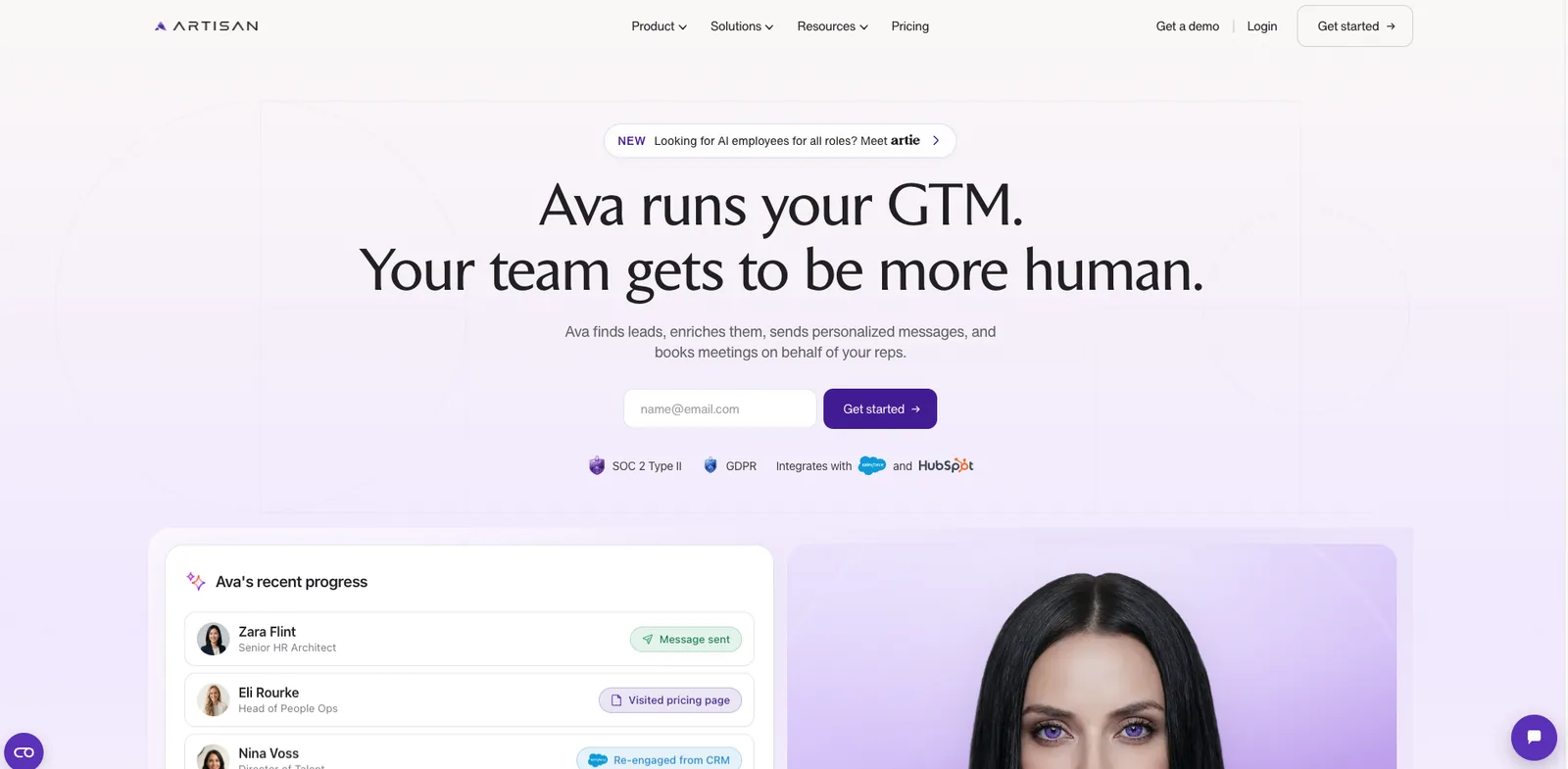
Artisan helps sales teams scale outbound prospecting without spending hours on manual research and follow-ups. Its AI sales agent, Ava, identifies potential buyers, researches prospects, and creates personalized messages for email outreach campaigns. Ava can also handle replies and book meetings, helping teams move prospects through the sales process faster. AI workflows automate repetitive tasks, while configurable rules let teams control which actions require human approval.
Best for: AI-assisted outbound prospecting
Starting price: Contact Artisan for current pricing.
Features: AI sales agent (namely Ava) and outbound prospecting workflows, find and research prospects, personalize outreach, manage replies, and book meetings.
Pros: Brings prospecting and outreach support into one AI-led workflow.
Cons: Message quality and targeting still need human review.
Reply
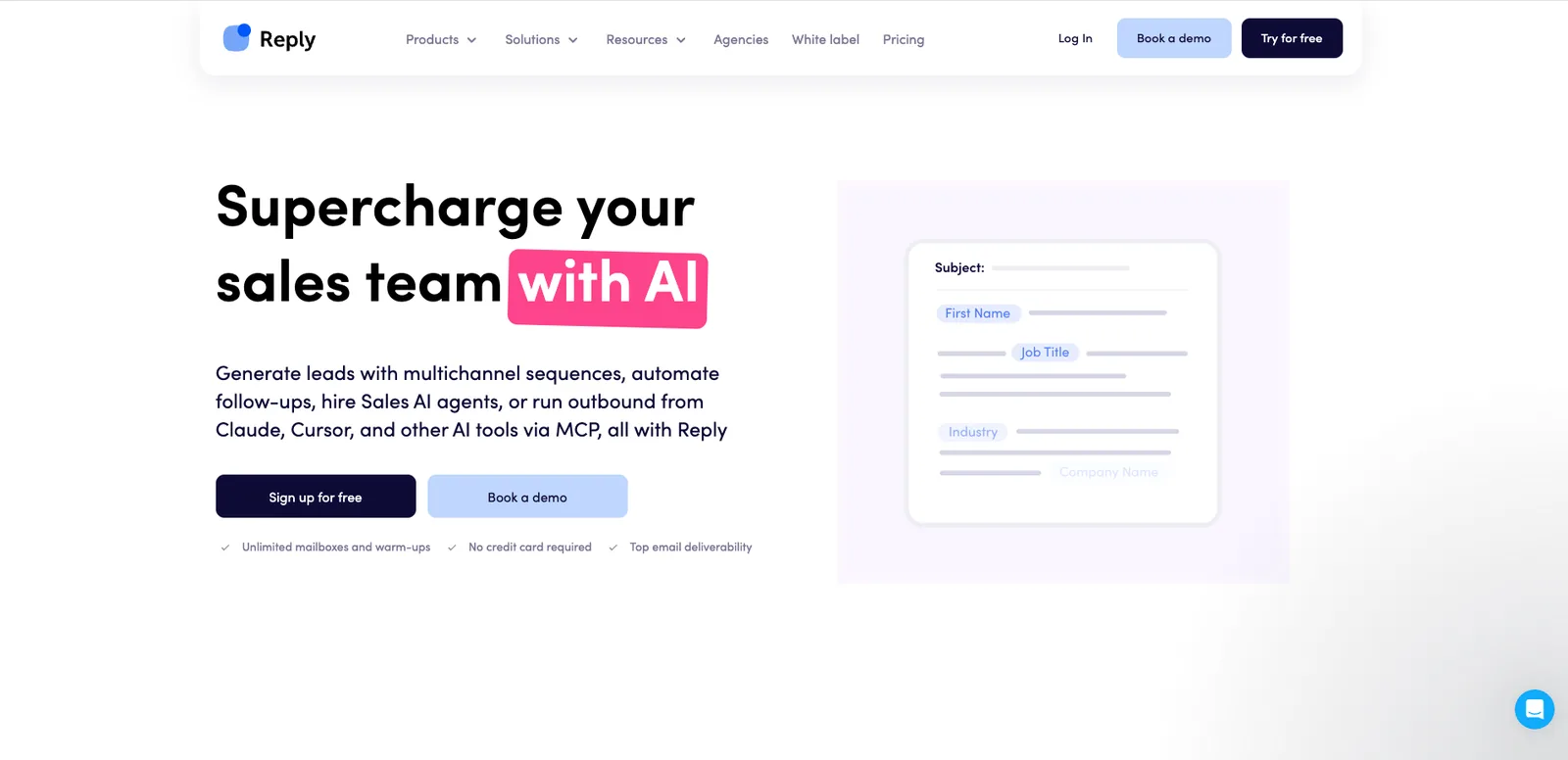
Reply helps sales teams scale outbound prospecting without managing every step manually. Its multichannel sequences coordinate emails, LinkedIn messages, calls, and follow-ups based on prospect activity. Its AI sales agent, Jason, finds potential buyers, researches prospects, creates personalized messages, handles replies, and books meetings. Teams can review messages before sending or let Jason run campaigns automatically.
Best for: Multichannel sales engagement
Starting price: Free trial available. Email Volume starts at $49/user/month, billed annually (includes 1,000 active contacts); Multichannel starts at $89/user/month, billed annually; and Jason AI starts at $500/month, billed annually. Prices vary for monthly billing.
Features: Multichannel sequences; follow-up automation; campaign reporting; CRM integrations.
Pros: Provides a structured way to coordinate outreach and follow-ups.
Cons: Cost and fit depend on channels and limits in the selected plan.
Linked Helper
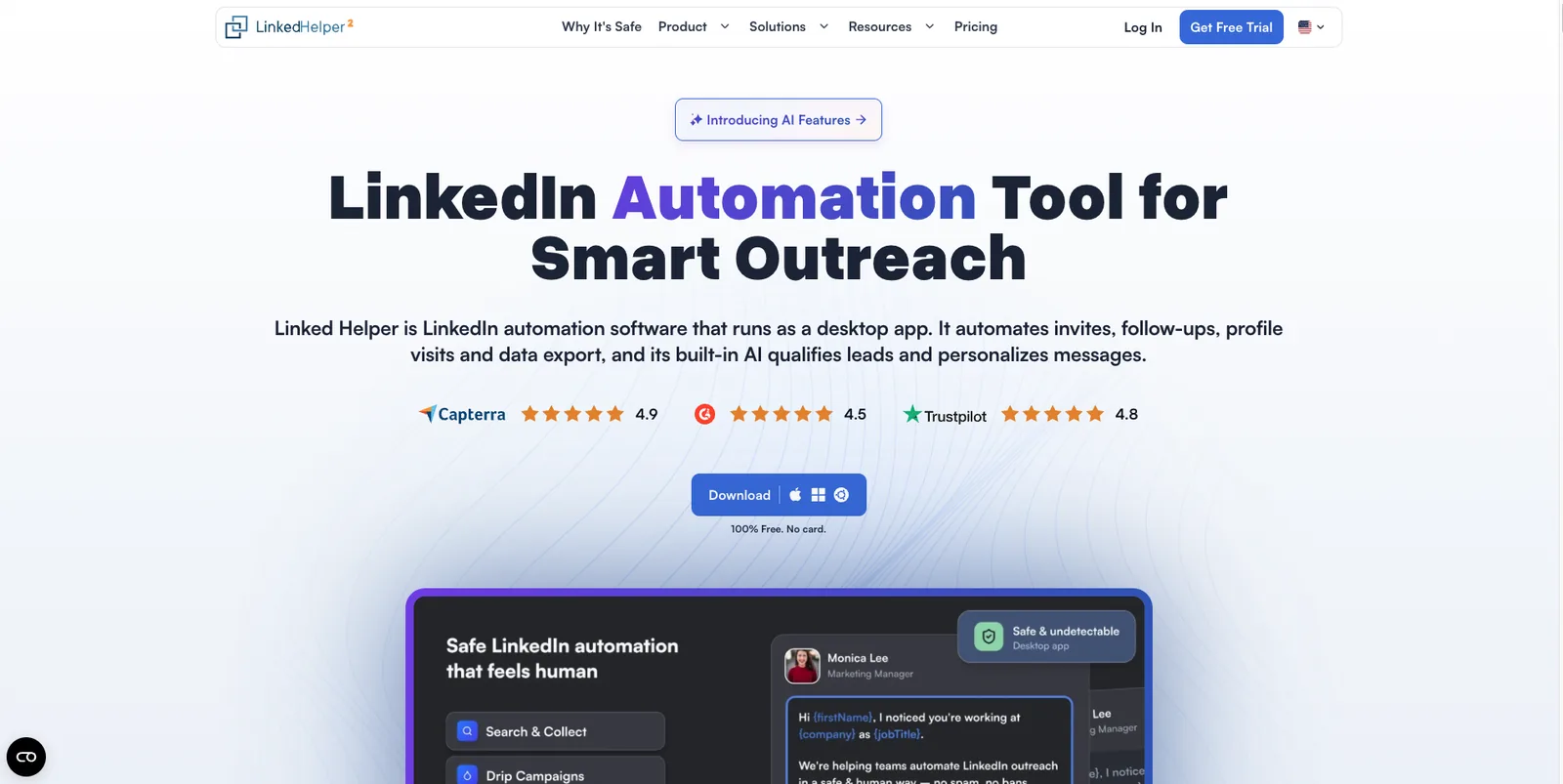
LinkedIn prospecting quickly spirals into a time-consuming process of finding profiles, sending connection requests, chasing replies, and keeping conversations alive. Linked Helper automates much of that process, allowing sales teams to run message sequences, schedule follow-ups, and manage outreach without manual intervention throughout every step. Its built-in CRM keeps contacts and conversations organized, while reply detection automatically stops follow-ups when a prospect responds. AI features help with lead qualification, message personalization, and even suggest replies.
Best for: LinkedIn-focused prospecting
Starting price: From $15/month per license (lower on longer terms, with annual billing discounts available).
Features: LinkedIn invitations; message sequences; reply detection; data collection; AI-assisted personalization.
Pros: Offers a dedicated workflow for LinkedIn prospecting and follow-ups.
Cons: It is LinkedIn-focused, and automation requires careful limits to avoid account restrictions.
KrispCall
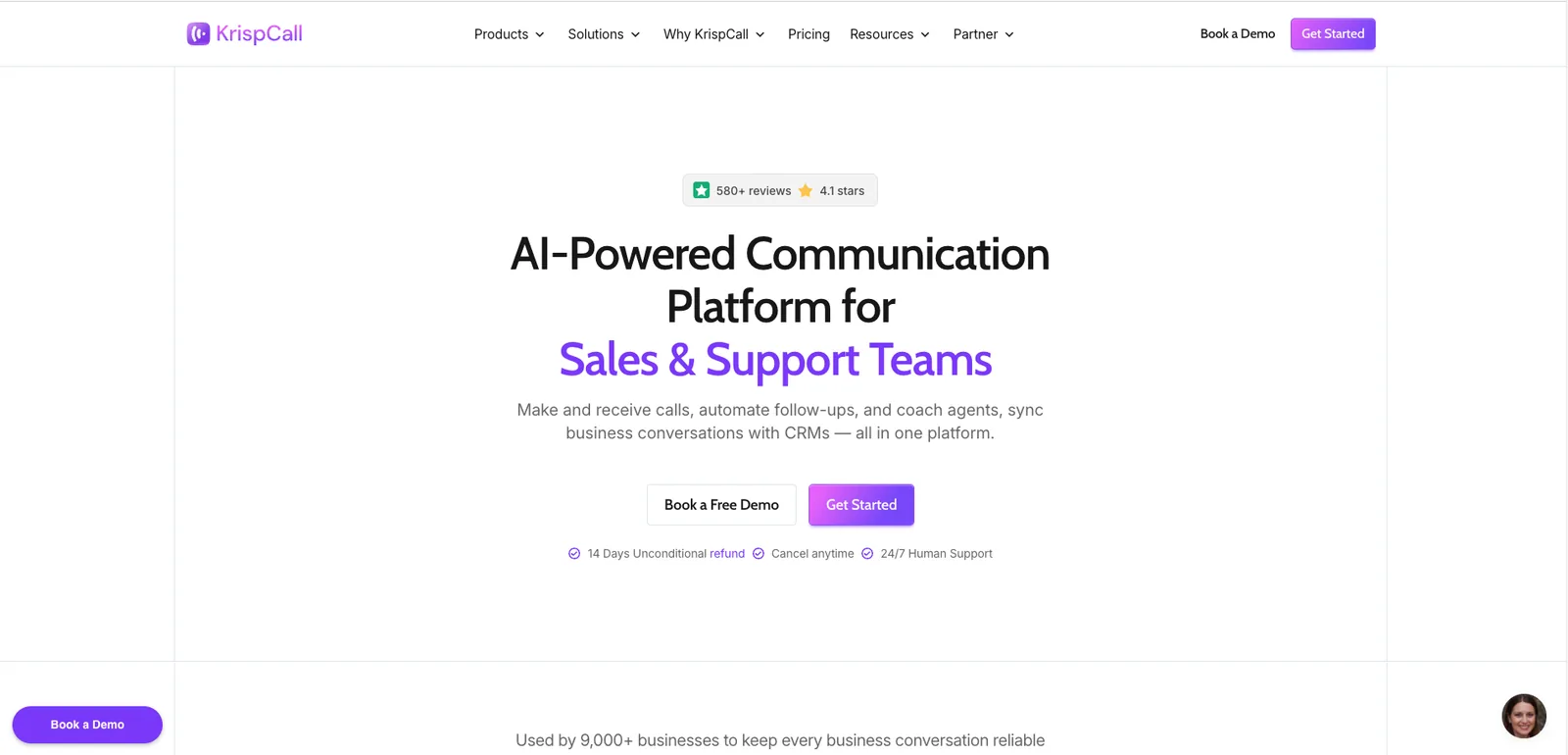
KrispCall helps sales teams manage customer conversations over the phone, with business phone numbers, call routing, and integrations with other sales tools. Its dialers and call management features help reps handle outbound calls more efficiently, while optional add-ons include transcription and AI-generated summaries. These features make it easier to track customer conversations, review key details, and reduce manual note-taking. Available features depend on the plan you choose.
Best for: Business calling and sales communication.
Starting price: Starter starts at $12/user/month billed annually; usage and some features may cost extra.
Features: Cloud business phone, call routing, dialer; AI call summaries and transcription as an add-on (Advance plan); power dialer (Advance and Max plans).
Pros: Connects calling workflows with customer records through integrations.
Cons: Usage charges and add-ons can raise costs for high-volume or international teams.
CloudTalk
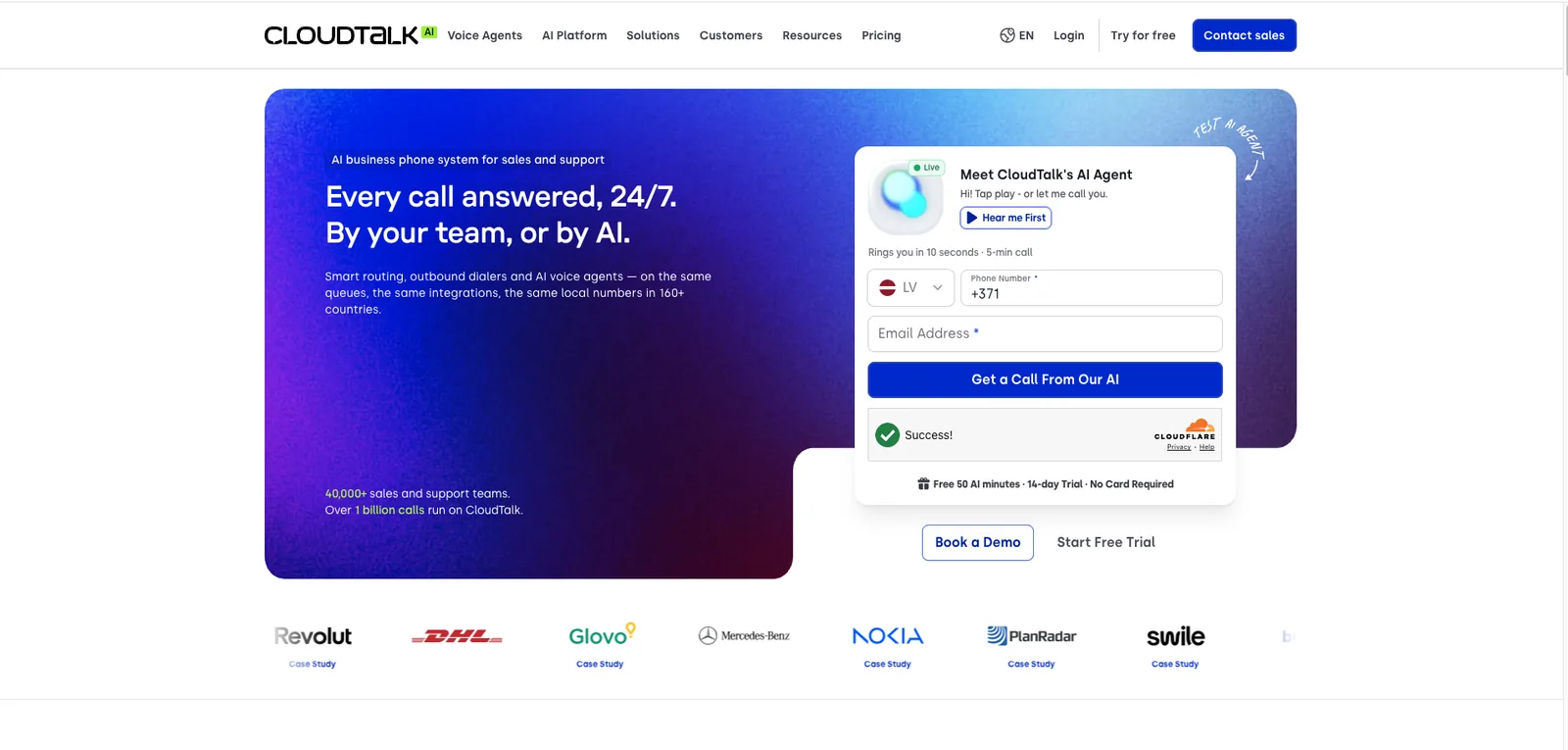
CloudTalk helps sales teams manage business calls with call routing, automated dialers, CRM integrations, AI voice agents, and analytics. These features help streamline outbound calling and track team performance. The Conversation Intelligence add-on provides AI-powered call transcription, summaries, topic extraction, sentiment analysis, and call scoring. AI voice agents are available as a separate product, billed through minute bundles. This makes CloudTalk useful for teams that want to improve call efficiency, analyze customer conversations, and coach reps more effectively.
Best for: AI-enabled business calling and sales communication
Starting price: From €25/user/month, billed annually (Starter); other charges may apply for different features
Features: Cloud phone system; AI voice agent, routing and dialers; CRM integrations; analytics; AI conversation features.
Pros: Connects calling workflows with analytics and optional AI review.
Cons: AI capabilities and regional calling options vary by plan.
Kanerika Service
Agentic AI Services
Kanerika builds and deploys AI agents that connect to your existing CRM, ERP and data systems, with human approval steps built into each workflow.
Explore Agentic AI ServicesAI-Powered Lead Engagement & Conversion
Inbound sales is another key stage of the sales process, and AI-enabled sales tools act like a 24/7 digital sales assistant, engaging visitors and turning interest into sales opportunities. Tidio focuses on website chat and automated responses, while involve.me combines lead capture, qualification, CRM management, and email automation in one platform. Zendesk manages customer conversations and support. Each tool serves a slightly different purpose, from answering questions and collecting prospect details to managing inquiries and directing them to the right team.
Tidio
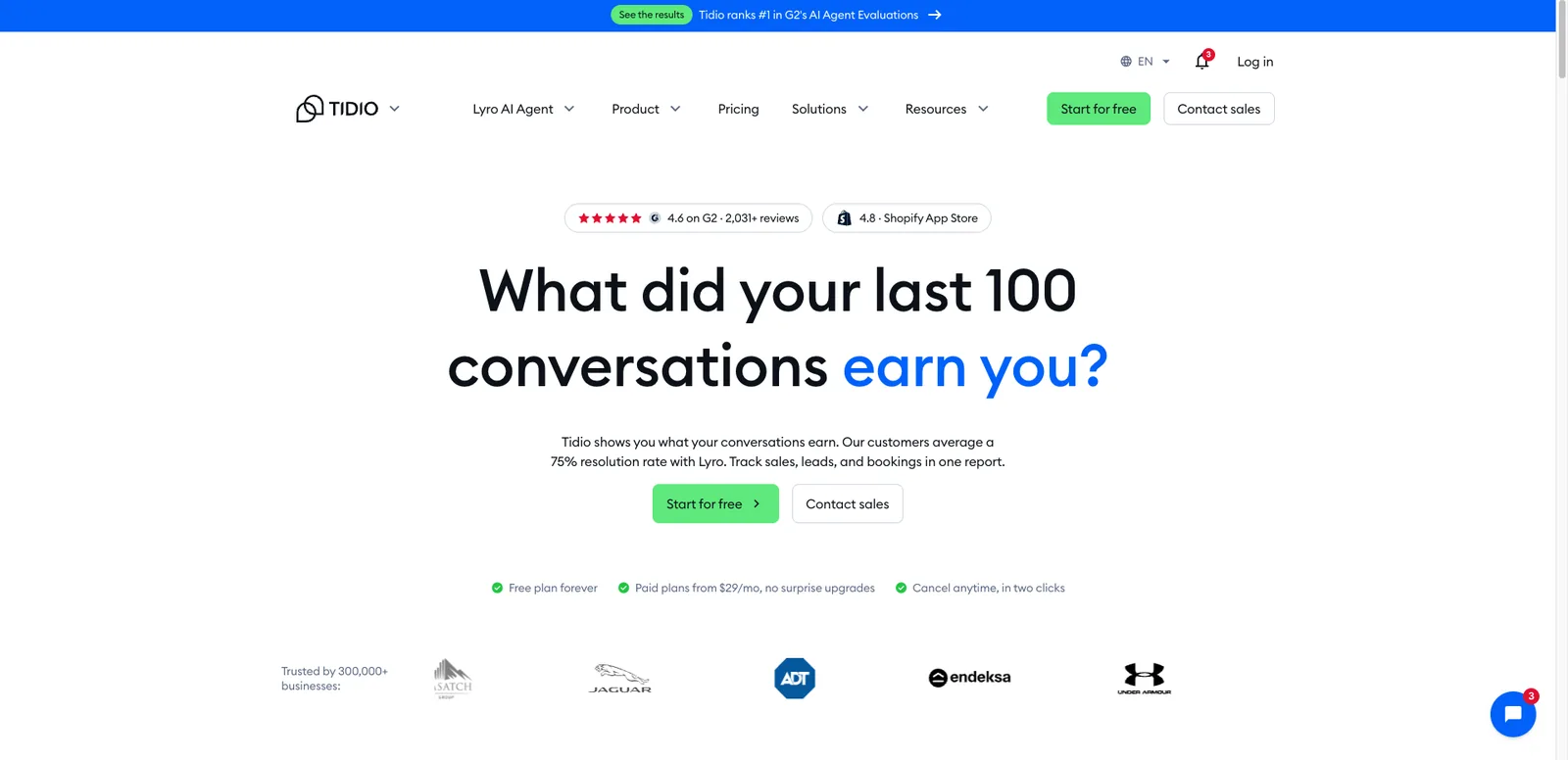
Tidio helps businesses engage website visitors through live chat, automated Flows, and its Lyro AI agent, which answers common questions and collects lead details. Its ticketing system organizes customer inquiries, while more complex issues can be handed off to human representatives. Together, these capabilities make Tidio a strong choice for capturing leads, answering questions in real time, and converting website visitors into engaged prospects.
Best for: Website chat and inbound lead engagement
Starting price: Free plan available; Starter from $24.17/month billed annually. Starter includes 100 billable conversations per month and 50 one-time Lyro AI conversations. The Growth plan starts at $49.17/month billed annually.
Features: Live chat; ticketing; Lyro AI Agent; automated Flows; lead capture.
Pros: Helps teams respond quickly and route promising conversations.
Cons: Conversation limits and AI add-on costs can affect total spend.
involve.me
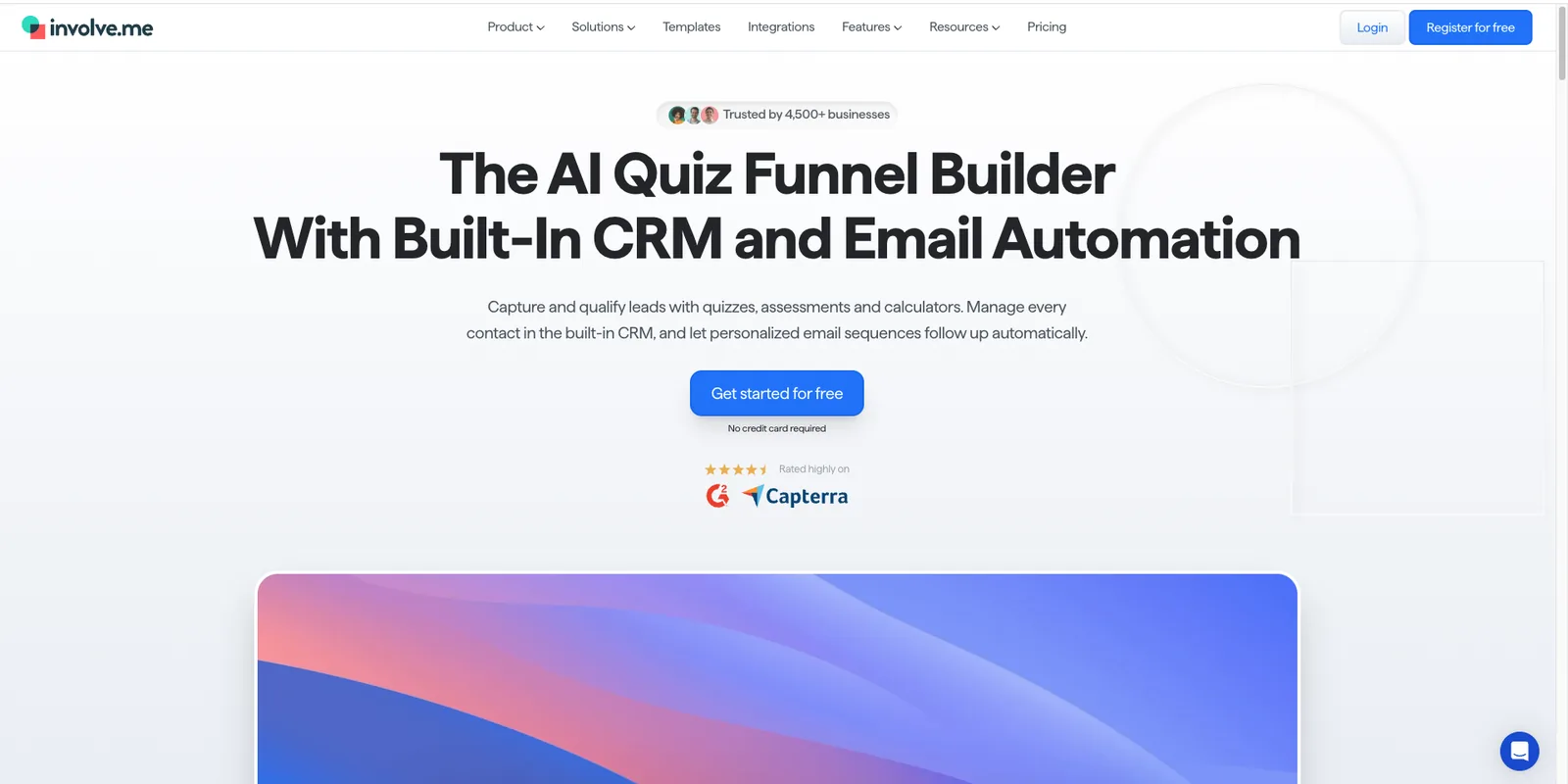
Involve.me brings lead capture, CRM, and email automation together in one connected platform. Businesses can create interactive forms, quizzes, and calculators to capture prospect details and qualify leads based on their answers. Its AI features personalize each funnel and create tailored experiences, while email automation sends relevant follow-up email sequences, reducing manual work and giving businesses better insight into prospect needs.
Best for: Lead capture, qualification, and marketing automation
Starting price: Free plan available; Start is listed at $29/month billed annually.
Features: Interactive funnels, lead scoring, email automation, free CRM
Pros: Collects qualification details before a sales rep follows up.
Cons: Results depend on useful questions and relevant form design.
Zendesk
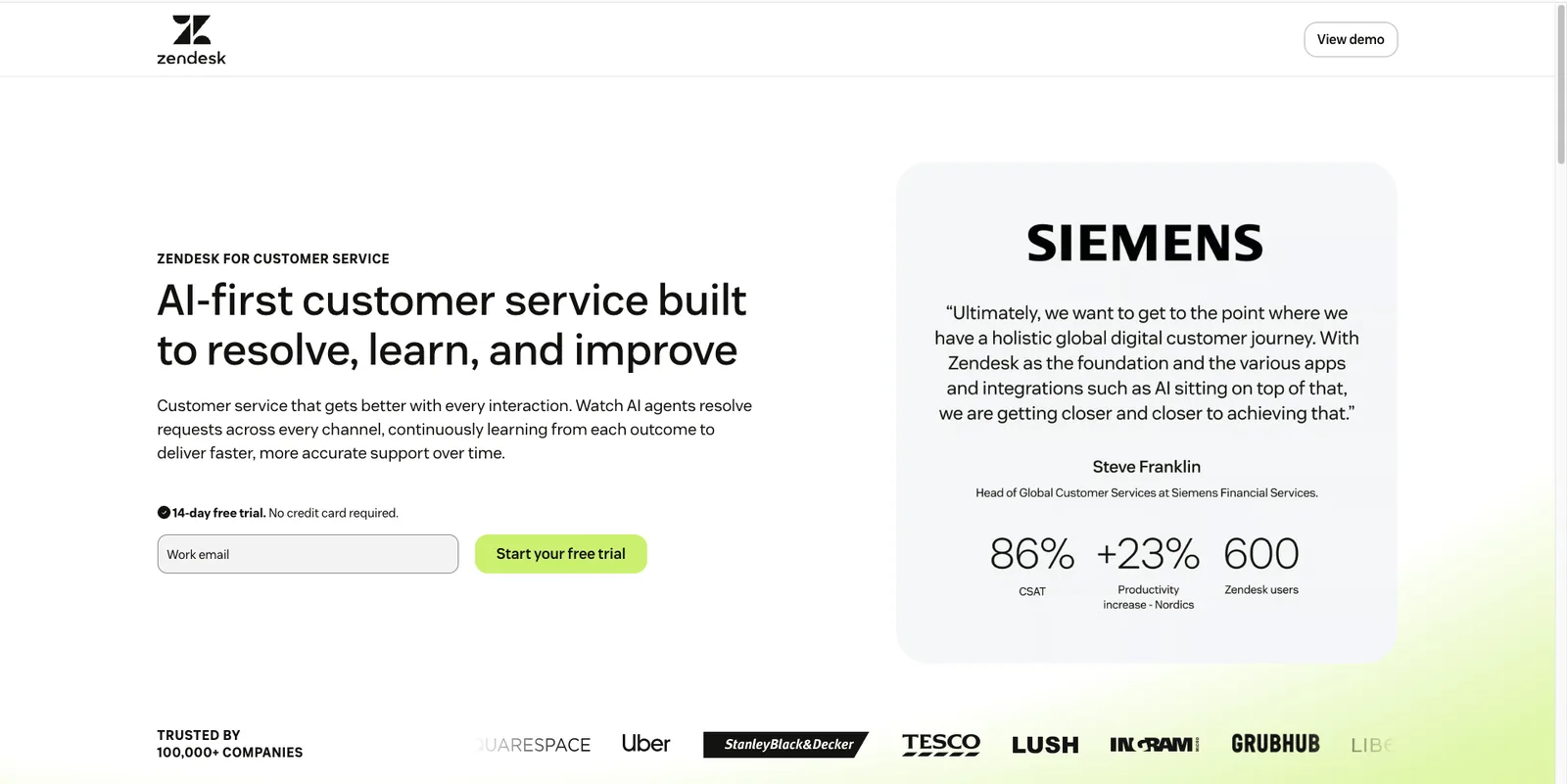
Zendesk helps businesses manage customer inquiries and support tickets in one place. Its AI agents can answer common questions, resolve routine issues, and route more sensitive conversations to human representatives. Higher-tier Suite plans add intelligent triage, which detects intent and routes requests to the right team. This makes Zendesk useful for improving response times, reducing support workloads, and turning customer conversations into sales opportunities.
Best for: Customer conversations and support-led engagement
Starting price: Support Team starts at $19/agent/month billed annually; Suite plans cost more.
Features: Ticketing; messaging; shared workflows; AI agents on eligible plans.
Pros: Keeps customer conversations organized and supports handoffs to sales.
Cons: It is not a dedicated prospecting platform; some capabilities require higher tiers.
Conversation Intelligence & Deal Insights
Customer conversations can reveal valuable details about buyer needs, objections, and potential opportunities, but capturing and acting on these insights consistently can be challenging. Gong and Rings AI help sales teams preserve this context in different ways. Gong records and analyzes sales conversations to uncover buying signals, identify deal risks, and improve sales performance, while Rings AI maps relationships between people and organizations to reveal potential warm introductions. Both tools help sales teams navigate complex B2B deals, whether they need deeper conversation insights or better access to key decision-makers.
Gong
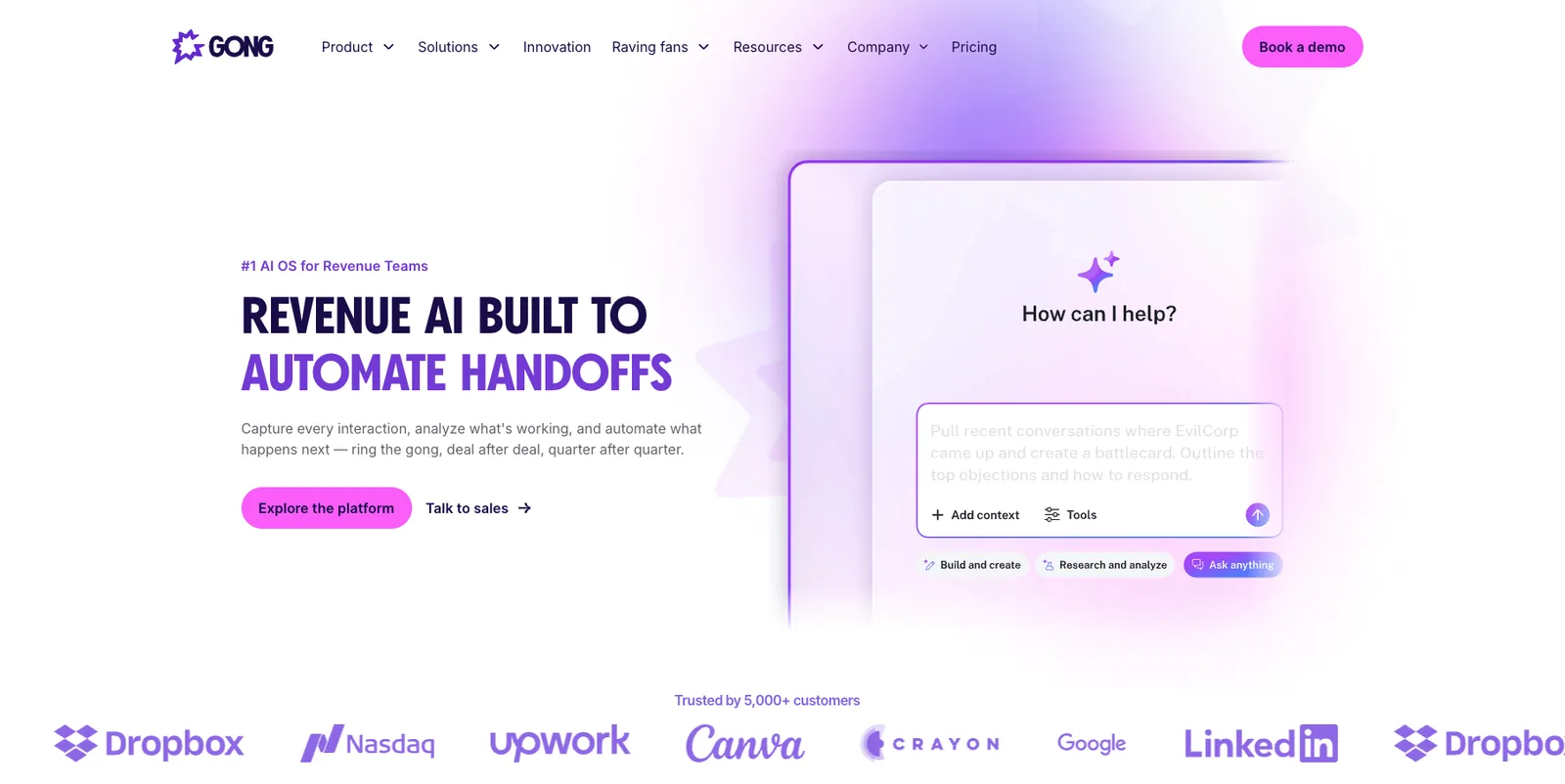
Gong helps sales teams capture and analyze customer interactions to understand buyer needs, identify deal risks, and improve sales performance. Its AI-powered conversation intelligence records and transcribes sales calls, generates summaries, tracks action items, and highlights important buying signals. Gong also provides deal intelligence, revenue forecasting, and sales coaching insights, helping teams identify opportunities, prioritize follow-ups, and make better-informed decisions throughout the sales cycle.
Best for: Conversation intelligence, deal insights, and sales coaching
Starting price: Custom pricing; contact Gong for a quote.
Features: Call recording and transcription; AI-powered summaries; conversation analytics; deal intelligence; revenue forecasting; sales coaching.
Pros: Combines conversation analysis with deal insights to help teams identify risks and improve sales execution.
Cons: Pricing is not publicly listed
Rings AI
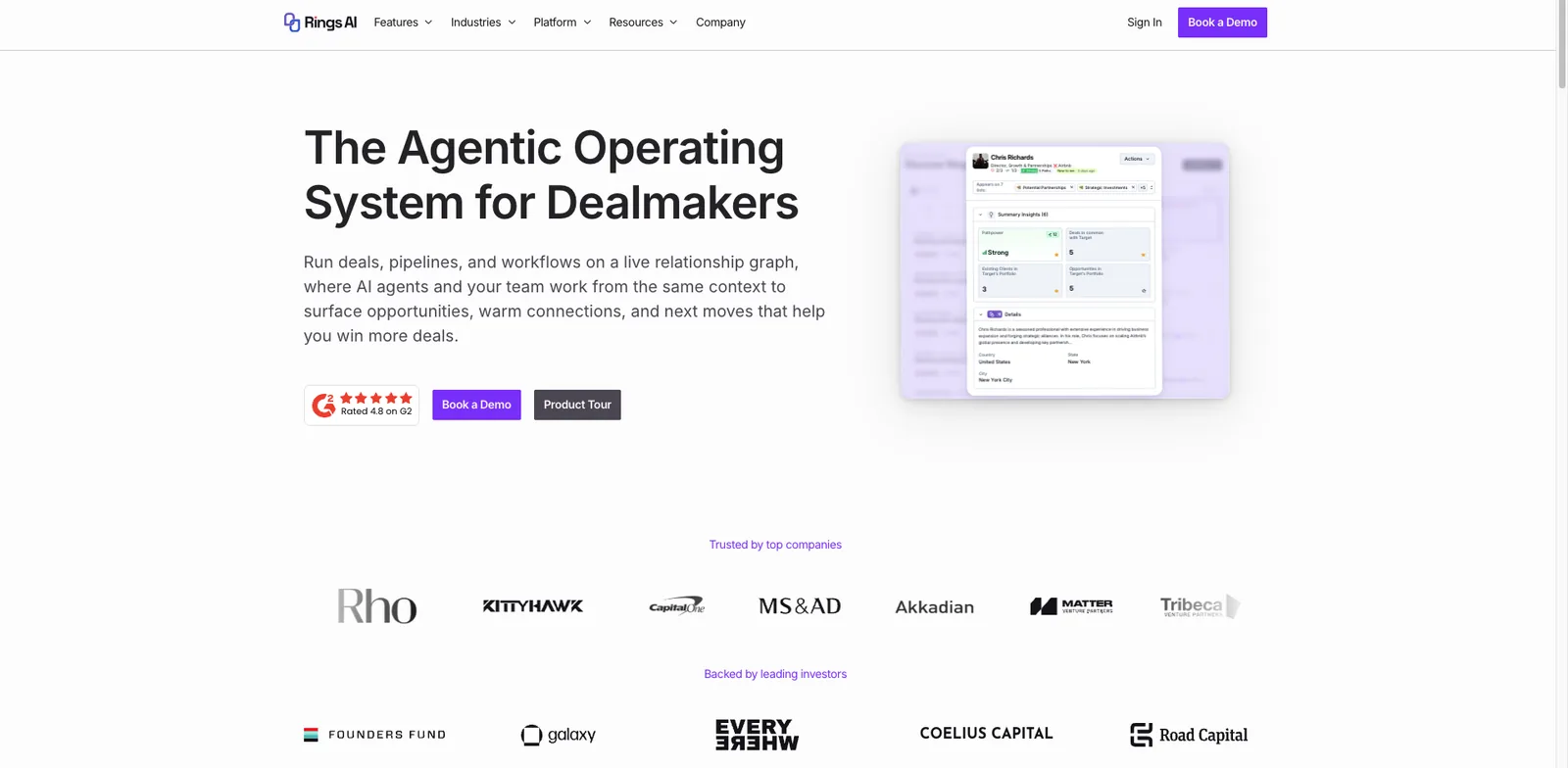
Rings AI helps dealmakers understand relationships between people and organizations, map relationship paths to key contacts, and uncover potential warm introductions. Its relationship intelligence maps existing connections to reveal paths to decision-makers who might otherwise be difficult to reach. This helps reps build trust and open doors at target accounts without relying solely on cold outreach. For the best results, connect up-to-date data sources and integrate the tool into your existing sales workflows.
Best for: Relationship intelligence for investment professionals.
Starting price: Not publicly listed; contact vendor.
Features: Relationship intelligence; stakeholder mapping; warm-introduction insights.
Pros: Adds relationship context to account research and outreach.
Cons: Usefulness depends on connected data quality and freshness.
Case Study
22% Better KPI Accuracy with a Generative AI CRM Dashboard
Kanerika added generative AI to the CRM dashboard of a fast-growing CRM software provider, delivering a 14% boost in sales and revenue, 10% higher customer retention, and 22% more accurate KPI identification.
Read the Case Study →How to Choose the Right AI Sales Tool
Start by identifying the bottlenecks in your sales process. Assess how long each part of the process takes, where leads drop off, and which tasks require the most manual work. Then look at what needs improvement. You might find that your team is struggling with contact research, outreach response rates, lead qualification, or deal progression. Depending on your findings, it should be easier to narrow down the tools and features your team needs most.
Once you’ve shortlisted the tools with the highest potential to improve your sales process, the next step is to check whether the data quality and integration capabilities match your needs and current workflows. You may run into duplicate records or limited data coverage. If the selected tool doesn’t support the channels your workflows rely on, redesigning the entire workflow might not be worth the effort. If everything aligns, don’t forget to supervise AI output. More often than not, the process will require manual checks to ensure AI doesn’t generate inaccurate information or send inappropriate messages.
Listen on Spotify
Is Your Enterprise AI Investment Paying Off in 2026?
How Kanerika Helps Businesses Implement AI Solutions
So, you’ve chosen the right tool or software and identified the bottleneck, but that is only the first step toward streamlining your AI sales process setup. AI strategy, integration, and workflow automation are equally important in designing a sales process that delivers consistent results. This is where Kanerika steps in. Kanerika helps businesses develop AI strategies, integrate existing systems into a unified solution, and automate workflows for improved operational efficiency. By connecting the right technologies and adjusting them to business needs, Kanerika helps businesses build scalable AI-powered processes that support long-term growth.
Talk to Kanerika
Planning to Bring AI Into Your Sales Workflow?
Kanerika connects AI agents to your CRM, data, and existing sales systems, then automates the workflows around them. A conversation with our team will show where AI can take work off your reps and where people should stay in control.
Schedule a Demo →Wrapping Up
A growing sales team doesn’t necessarily need more tools for the sake of it. What it truly needs is a system that makes every stage of the sales funnel faster and more convenient. Any sales process has multiple parts, like finding the right prospects, keeping conversations alive, and turning interest into revenue. AI-powered sales tools make things especially interesting by automating repetitive work, identifying opportunities that might fall through the cracks, and giving reps more time to focus on building real relationships.
Choosing the right tool depends on identifying the key bottlenecks in your sales process. But the selection process goes further than that: new tools should match your existing setup and integrate into your workflow without interruptions, so they don’t create more work for your team. Start small, automate where it genuinely helps, and build a sales stack that can grow alongside your business.
Frequently Asked Questions
What are AI sales tools?
AI sales tools are software platforms that use artificial intelligence to handle parts of the sales process, such as finding prospects, scoring leads, writing personalized outreach, answering inbound questions, and analyzing sales calls. Most of them focus on one stage of the funnel: ZoomInfo and UserGems on prospecting, Artisan and Reply on outreach, Tidio and involve.me on inbound engagement, and Gong on conversation intelligence. A CRM such as Salesforce Sales Cloud ties that activity together in one pipeline.
Which AI sales tool is best for B2B prospecting?
It depends on the signal your team prospects from. ZoomInfo suits teams that need broad B2B company and contact data with intent signals, while UserGems suits teams that want to act on job changes and other buying triggers among people they already know. Linked Helper is a narrower option for teams that prospect mainly on LinkedIn.
Can AI fully automate outbound sales?
AI can take on much of the outbound workload. Artisan’s AI agent Ava and Reply’s AI agent Jason can find prospects, research them, draft personalized messages, handle replies, and book meetings, and both platforms let teams decide which actions need human approval. Human review still matters for accuracy, targeting, consent, and channel rules, especially on LinkedIn, where aggressive automation can lead to account restrictions.
How much do AI sales tools cost?
Pricing varies widely. Tidio and involve.me offer free plans, and paid entry points start at $12 per user per month for KrispCall, $15 per month per license for Linked Helper, and $25 per user per month for the Salesforce Starter Suite. UserGems starts at $40,000 per year, while ZoomInfo, Artisan, Gong, and Rings AI use custom pricing. Add-ons, usage charges, and AI features often raise the total cost, so compare full plan costs rather than starting prices.
What is the difference between sales engagement and conversation intelligence tools?
Sales engagement tools such as Reply and Linked Helper run outreach: they send sequences across email, LinkedIn, and calls and manage follow-ups. Conversation intelligence tools such as Gong work after the conversation happens, recording and transcribing calls, summarizing them, and flagging buying signals and deal risks. Many teams use both, one to start conversations and the other to learn from them.
Do AI sales tools work with an existing CRM?
Most tools in this list connect to CRMs. Reply, CloudTalk, and UserGems support CRM integrations or workflows, and KrispCall links calls to customer records through integrations. Before buying, check which CRM is supported, which direction data syncs, and which plan includes the integration, since duplicate records and gaps in data coverage are common when a new tool joins an existing stack.
How do I measure whether an AI sales tool is working?
Track outcomes rather than activity. Qualified meetings, new opportunities, conversion rates, and time saved per rep show whether a tool is improving the pipeline, while email volume or call counts can rise without producing more revenue. Record a baseline before rollout so you can compare results once the tool has been in use for a full sales cycle.
How do I choose the right AI sales tool?
Start with the bottleneck in your sales process, whether that is contact research, outreach response rates, lead qualification, or deal progression. Shortlist tools built for that stage, test their data quality and integrations against your current workflows, and calculate the full cost, including add-ons. Then decide where people need to review AI output before it reaches prospects.