
Data Migration Services in Ohio for Manufacturers
Ohio manufacturers, insurers, health systems, and retailers run core reporting on platforms they outgrew years ago. Kanerika delivers data migration services in Ohio that move those estates to modern platforms while operations keep running. FLIP accelerators convert ETL jobs, BI reports, and RPA bots automatically, cutting manual rework, license spend, and cutover risk.
Faster Migrations
Cost Savings
Predictable Timelines
Get Started with Ohio Data Migration Solutions












Migration ROI Calculator
FLIP, Kanerika’s IP-led accelerator, can automate up to 80% of a platform migration. Enter your pipeline, report, and bot counts to see the cost, developer hours, and delivery weeks it saves.
FLIP is Kanerika's proprietary migration accelerator. Here's exactly where the savings come from:
How Ohio Businesses Modernize Their Data
Across Ohio, companies run a mix of legacy databases, cloud systems, analytics tools, and line-of-business applications that no longer connect cleanly. Our migration services consolidate that mix through automated conversion, validated at each step.
Data Platform Migrations
Move Informatica, Alteryx, or Azure jobs to Talend, Databricks, or Microsoft Fabric. FLIP pulls mappings and workflows out of the source repository along with every parameter and dependency.
Highlights:
- Shared logic gets untangled before any conversion begins.
- Each transformation stage compares source output against target output.
- Workloads process faster on cloud-native compute after landing.
BI Platform Migrations
Bring Tableau, SSRS, Crystal Reports, or Cognos content into Power BI. Filters, calculated fields, and row-level security rules carry over as defined, instead of being reverse-engineered from what old reports display.
Highlights:
- Reports, dashboards, and access rights move across in one pass.
- Datasets and their connection strings travel as a single unit of work.
- Users gain native Microsoft 365 access and richer visuals after cutover.
RPA Platform Modernization
Move UiPath automations onto Microsoft Power Automate. Scheduled processes, attended bots, and XAML sequences retain their exception handling, which counts most when the original developer has left.
Highlights:
- Bots continue running throughout the switchover period.
- Business rules and exception paths arrive unchanged.
- Your current Microsoft licensing covers the workload afterward.

AI-Powered Migration Accelerators
Kanerika built FLIP, its Intelligent Workflow Automation Platform, around single routes. Every accelerator handles one source and one target, from repository extraction and dependency mapping through conversion and validation, instead of stretching one script across many platforms.












What Ohio Companies Gain From Automated Migration
The figures below come from FLIP-delivered data platform, BI, and RPA migrations, tracked on reporting speed, data volume handled, and ongoing maintenance cost. Accuracy holds because each accelerator targets one source-to-target route, the point where generic scripts tend to break down.
Migration
60% Faster Migration: Crystal Reports to Power BI
Impact:
- 60% Faster Migration
- 10x Data Scale
- 99.5% Refresh Success Rate
Migration
60% Faster Analytics with Informatica to Alteryx
Impact:
- 45% Faster Reporting Cycles
- 38% Reduction in Maintenance Costs
- 60% Improved Analytics Turnaround
Migration
74% Faster Retail Reporting with Microsoft Fabric
Impact:
- 74% Faster Reporting Cycles
- 65% Increase in Reporting Stability
- 72% Faster Access to Current Metrics
Migration That Stays On-Premises and Secure
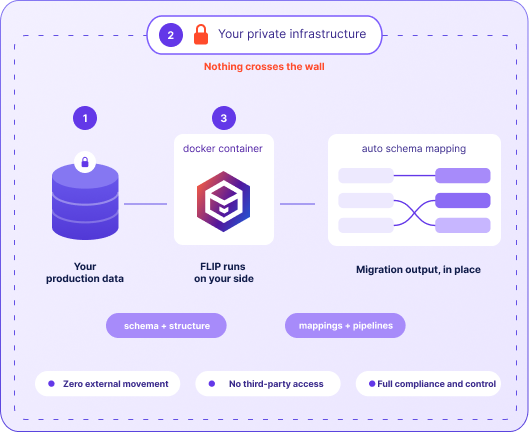
FLIP installs inside your own infrastructure as Docker containers, so conversion happens next to your systems.
Metadata-Level Processing Only
Only schemas and structural dependencies are read. Production records are never opened, staged, or sent anywhere.
No Data Leaves Your Network
Everything executes behind your perimeter. There is no outbound data path and no third-party access to govern.
On-Prem Automation
Pipelines are generated and schemas mapped at full speed, while you keep complete ownership of audit trails and access controls.
How Our IMPACT Framework Cuts Migration Time and Cost
Every Ohio engagement follows IMPACT, a methodology in which each phase ends with a working deliverable rather than a status report.
OUR PROCESS
Our Data Migration Consulting Approach for Ohio Organizations
We begin by reading your entire source environment. From there, our migration consultants design the target architecture, tune FLIP to your specific route, run automated conversion with validation at every step, and remain engaged through post-launch monitoring until the legacy system is retired.

Step 1
Understand Business Goals

Step 2
Analyze Data & Workflows

Step 3
Design Sound Solutions

Step 4
Develop & Deploy Solutions

Step 5
Ongoing Support
01
Step 1
Understand Business Goals
02
Step 2
Analyze Data & Workflows
03
Step 3
Design Sound
Solutions
04
Step 4
Develop & Deploy Solutions
05
Step 5
Ongoing
Support


The Platforms and Tools We Support
Kanerika is a data migration company that moves Ohio organizations off on-premises platforms and onto Microsoft Fabric, Databricks, Power BI, and Talend.










INNOVATE
Data Platform Migration Across Ohio's Core Industries
Ohio’s economy leans on manufacturing, automotive, insurance, healthcare, and logistics, and each sector carries legacy data that slows decisions down.








What Makes Ohio Enterprises Pick Kanerika for Migration Work
FLIP handles most conversion automatically, extracting business logic from the source repository and checking every object as it converts. Pricing follows how complex your estate is, not how many assets it holds.
Every accelerator is purpose-built for a single source and target, rather than one script aimed at many platforms.

FLIP reads the source repository itself, picking up mappings, parameters, and dependencies that workflow reviews overlook.

Checksums and reconciliation confirm every transformation as it converts, followed by parallel runs before cutover.

Empowering Alliances
Our Strategic Partnerships
The pivotal partnerships with technology leaders that amplify our capabilities, ensuring you benefit from the most advanced and reliable solutions.






Your Data Migration Questions, Answered
What is included in data migration services in Ohio?
The work runs from discovery of your sources through target architecture, asset conversion, validation, cutover, and retirement of the old platform. It covers ETL estates on Informatica or Azure Data Factory, reporting on Tableau, Cognos, Crystal Reports, or SSRS, and UiPath automation. We support twelve source-to-target paths, and every path has a dedicated accelerator.
What can replace a manual rewrite of legacy systems?
Automated conversion. Rather than developers rebuilding mappings, reports, and bots one at a time, an accelerator reads the source repository and produces the equivalent on the target platform. The catch is that the tooling must be designed for your exact source and target. General-purpose converters generate output that developers end up rewriting anyway, which puts you back where you started.
What should you ask before hiring a legacy data migration partner?
Three questions matter. What share of conversion on your specific path is automated instead of hand-coded? How will undocumented business logic be found and handled? Does validation happen during conversion or wait until user acceptance testing? A vendor quoting per asset is signalling manual work, regardless of what the proposal claims about accelerators.
What role does ETL play in migration?
ETL stands for extract, transform, and load, the pipelines that carry data from one system to another. During a migration those pipelines are what moves, not the tool doing the moving. They hold years of lookups, transformation rules, and error handling. Recreating that logic on the new platform is the difficult part, and it is where most schedule overruns begin.
Which approaches exist for converting ETL code?
Three. Developers can rewrite every mapping on the target by hand, which is accurate but grows in step with volume. Generic converters cover simple transformations and hand the remainder back to developers. Path-specific accelerators extract from the source repository and output pipelines native to the target. Which fits depends on how much undocumented logic sits in your estate.
How do legacy BI reports move onto a modern cloud platform?
Begin with an inventory of reports, datasets, sources, and permissions, because reporting estates conceal dependencies that only appear when something fails. Conversion then carries calculated fields, filters, and row-level security onto the target, usually Power BI when coming from Tableau, Cognos, Crystal Reports, or SSRS. A parallel run confirms the numbers agree before users switch.
How do you confirm migrated data is correct before cutover?
FLIP accelerators do the conversion, and comparison proves the result. Row counts and hash checksums confirm every transformation produced the expected output. Referential integrity checks catch relationships that conversion broke. Then source and target run side by side while business users check real results. Anything that fails to reconcile is flagged before cutover, not found in production.
Should Databricks be the target for our migration?
That depends on your workloads. Databricks fits heavy processing, lakehouse designs, and machine learning pipelines. Microsoft Fabric fits organizations already committed to Microsoft 365 and Power BI. Snowflake fits warehouse-first analytics with simpler governance needs. Choose the target your workloads call for, not the one with the loudest marketing. We make this assessment during the Map phase.
What role do consultancies play in platform migrations?
Most supply headcount: discovery staff, project managers, and developers who rewrite assets manually, so cost and schedule rise with asset count. Kanerika brings the conversion platform first and engineers second, which decouples price from volume. Our consultants spend their time on architecture choices and on the logic that automation cannot settle by itself.
Does the Ohio Data Protection Act affect how we migrate data?
Yes. Ohio has no comprehensive consumer privacy law, but its Data Protection Act (Ohio Revised Code Chapter 1354) gives businesses an affirmative defense against data breach tort claims when they keep a written cybersecurity program aligned with a recognized framework such as NIST or ISO 27001. Since a migration changes where data lives and who can reach it, that program has to cover the project. FLIP touches metadata only and runs inside your network, so records in your Columbus, Cleveland, or Cincinnati systems stay under existing controls. Kanerika is ISO 27001 and SOC 2 certified.
What does Kanerika do for Ohio data migration projects?
We plan, automate, run, and validate complex Ohio migrations using FLIP accelerators, our IMPACT methodology, and hands-on experience across platforms.
Can Kanerika handle cloud data migration for Ohio companies?
Yes. We handle cloud data migration and modernization for enterprise data estates, moving Ohio organizations from legacy platforms onto current cloud technology.
How does Kanerika lower migration risk?
Through automation, a structured method, and continuous validation and testing, which together cut manual effort, downtime, errors, and cutover risk.
Which platforms can Kanerika migrate between?
Databases, ETL tools, BI platforms, legacy applications, cloud environments, and enterprise data platforms are all in scope, depending on what your migration requires.