RAG Development for Governed, Production-Ready AI Solutions
Off-the-shelf LLMs do not know your contracts, processes or customers. We build RAG systems that ground every answer in your own data, so teams find what they need in seconds, cut research time and trust every response.
Efficiency gain from AI
Faster time-to-market
AI projects delivered




Recognitions & Achievements
ISO 27001, 27701:2019 and ISO 9001:2015 certified, ensuring secure practices.
SOC 2 Type II compliant for security and data protection controls.
CMMI Level 3 appraisal for defined, repeatable delivery processes.
Recognized by Forbes as a best startup employer in USA.
Named as a top Data & AI Specialist by Everest Group.
Featured by Intellyx for leadership in digital transformation.
Identified as Microsoft Fabric Featured Partner globally recognized
Received the data warehouse migration to Azure Specialization.
Identified as Infrastructure Azure Solutions Partner
Microsoft Azure Services PEAK Matrix® Assessment 2026
Received Digital & App Innovation Azure Badge recognition globally
Unlocked the Analytics on Azure Advanced Specialization.
Unlocked the Snowflake AI Data Cloud Services Select Tier Partner Status.
Kanerika is a Certified Partner in the Claude Partner Network.
Recognized by GoodFirms as an Industry Leader in Data Analytics.
Full-Stack RAG Engineering, From Data Ingestion to Governed Deployment
Retrieval, ranking and grounding built to turn a base model into an application your teams rely on daily.
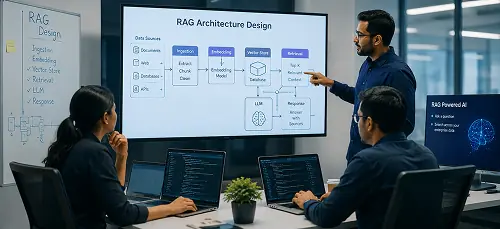
RAG Architecture Design
- Retrieval flows designed around real user questions
- Embedding and hybrid search matched to your data types
- An architecture that scales with your content

Data Ingestion Pipelines
- Connect structured and unstructured sources in one flow
- Prepare and chunk documents for precise retrieval
- Keep answers current with continuous content updates

Retrieval Engineering
- Vector databases configured for enterprise scale
- Hybrid search and reranking tuned for relevance
- Higher retrieval accuracy on real user queries

LLM Orchestration Layer
- Open-source and commercial models, your choice
- Prompts and orchestration built for grounded responses
- Retrieval, reasoning and tool use working together

Evaluation & Guardrails
- Continuous measurement of retrieval and answer quality
- Hallucinations caught before they reach users
- Policy guardrails on sensitive topics

Deployment & Oversight
- Cloud or on-premise deployment
- Accuracy, latency and retrieval monitored live
- Retraining and tuning cycles that keep quality high
Our IMPACT Method: Predictable RAG Delivery From Pilot to Production
A defined path from data audit to live deployment, so your RAG system reaches production accurate, secure and measurable.
Reviews That Speak for Themselves

4/5
2 reviews
"Built a flexible Snowflake data model for changing needs."

5/5
19 reviews
"Delivered projects with structure, flexibility, and clear communication."

5/5
6 reviews
"Improved daily workflows through AI and analytics solutions."

5/5
19 reviews
"Reduced our reporting time from hours to minutes."

5/5
19 reviews
"Delivered AI and data engineering with responsive support."

5/5
31 reviews
“Modernized data systems around real customer usage.”

5/5
38 reviews
“Completed consulting delivery on time and within budget.”

5/5
11 reviews
“Supported analytics delivery with reliable technical expertise.”

5/5
13 reviews
“FLIP bridged our banking systems to deliver a 360-degree customer view.”

5/5
6 reviews
“Managed delivery efficiently while maintaining communication.”

5/5
5 reviews
“Improved data visibility and confidence across operations.”
Where RAG Turned Trusted Data Into Business Results
See how enterprises turn trusted data into faster decisions and lower research effort.
43% Faster Document Retrieval for an Investment Bank
Impact:
- 43% Faster information retrieval
- 100% Role-based compliance achieved
- 35% Higher workforce efficiency
60% Faster Brand Approvals with Conversational AI
Impact:
- 35% Higher Brand Compliance Rate
- 60% Lower Approval Turnaround Time
- 70% Less Manual Effort Per Brand Query
80% Ticket Auto-Resolution with LLM-Driven AI
Impact:
- 80% Auto-response of tickets
- 70% Reduced cost of staffing
- 50% Decrease in ticket resolution time
Governed RAG for Industries Where Accuracy Is Non-Negotiable





Why Enterprises Choose Kanerika for RAG Development
Production-ready RAG grounded in your enterprise data, secured for regulated industries.
We run RAG in production today, including KlarityIQ and Karl, so your build starts from proven patterns.

We connect to your existing sources, including Fabric, Synapse and SQL platforms, without a rebuild.

Role-based access, audit trails and data masking are designed in from day one.

Frequently Asked Questions (FAQs)
What is RAG and how is it different from standard LLM implementation?
Standard LLM integration uses the model’s baked-in training knowledge: static, potentially outdated, with no access to your internal data. RAG retrieves relevant content from your documents or databases at query time and feeds it to the model as context. The model generates a response grounded in what your organization actually knows, with citations traceable to specific source documents. See how the two compare in our RAG vs LLM guide.
When should we use RAG instead of fine-tuning?
Use RAG when your data changes frequently, when compliance requires source traceability, or when document volume is large. Use fine-tuning when you need the model to adopt a specific tone or domain vocabulary and the underlying data is relatively static. Many enterprise production systems combine both. Our RAG vs fine-tuning guide compares the two in detail.
How long does a RAG engagement take?
A focused use case (single document type, defined query scope) typically takes 8 to 12 weeks from architecture through production deployment. Multi-source, cross-system, or regulated-industry deployments run 3 to 6 months. Kanerika’s advisory phase (4 to 6 weeks) produces a production blueprint and effort estimate before the build starts.
How does Kanerika handle data security in RAG deployments?
Role-based access controls are built into the retrieval layer, so users only retrieve what they’re authorized to see. Every retrieval event is logged for audit. PII detection and redaction happens before document ingestion via Susan, our AI agent for PII redaction. Azure deployments run within your existing Microsoft security perimeter with private endpoint configuration.
Can the RAG system integrate with Microsoft Teams or existing enterprise apps?
Yes. KlarityIQ deploys via Microsoft Teams and WhatsApp. Custom RAG systems expose retrieval capabilities as APIs consumable by Salesforce, ServiceNow, SAP, SharePoint, or any API-connected enterprise application.
How do you keep the RAG system accurate as documents change?
Incremental indexing pipelines update the vector index as source documents change, with no full re-indexing required for most updates. We also implement retrieval freshness scoring and configure document expiry rules for time-sensitive content. Post-deployment monitoring tracks retrieval drift and triggers alerts when accuracy degrades.
What does RAG development cost?
Cost depends on the number of data sources, how messy the documents are, permission requirements, and the accuracy bar for go-live. A pilot on one use case is the cheapest way to get a reliable estimate before committing to the full build and its ongoing maintenance.
How do you measure RAG answer quality before go-live?
Before building, we agree on a test set of real questions with known answers. Every version is scored on retrieval quality and answer accuracy against that set before anything reaches users, and every answer cites its source document so reviewers can check it quickly.
Which models and vector databases can you work with?
We integrate open-source and commercial foundation models and configure vector databases for enterprise scale. Model choice depends on accuracy, latency, cost, and data residency, and we validate it against your own test questions before the system goes live, so the final stack fits your security requirements.
Do you offer RAG as a service?
Yes. We build the system and then run it with you. After the production build, our Run and Improve phase keeps the index fresh as documents change, tracks answer quality and tunes retrieval as usage grows. You can deploy in your own cloud tenant or an on-premise environment. We run RAG in production today, including KlarityIQ and Karl.
What does a production RAG architecture include?
A production RAG system wraps the language model in five working layers: data ingestion and chunking, embeddings in a vector database, hybrid retrieval with reranking, an orchestration layer that assembles the prompt, and evaluation with guardrails. Deployment and monitoring keep it reliable after launch. Our guide to RAG architecture shows how the layers fit together, and our RAG development services cover each one.
How do you choose an embedding model for RAG?
We choose the embedding model by testing it on your own documents and test questions. The deciding factors are retrieval accuracy on your content, language and domain coverage, latency and cost. The embedding stage of our RAG pipeline guide explains the trade-offs in more detail.
Do you use hybrid search and reranking in RAG?
Yes. Hybrid search combines keyword and vector matching, so exact terms such as part numbers or clause IDs still match while meaning-based search finds paraphrases. Reranking then re-scores the top results before they reach the model. We tune both to your real queries as part of retrieval engineering. Our guide to advanced RAG techniques covers hybrid search and reranking.
How do you chunk documents for RAG?
We chunk for retrieval, not for storage. Documents are split so each passage makes sense on its own, then we test chunk size against your real questions and adjust until the right passage comes back. Scans and tables take more preparation than clean text. The chunking stage of our stage-by-stage RAG pipeline guide goes deeper.
What are the most common enterprise RAG use cases?
Common enterprise uses include knowledge search across manuals and policies, customer and ticket support grounded in your own data, regulatory and compliance Q&A, and document retrieval for analysts. We have built RAG for document retrieval at an investment bank and for LLM-driven ticket response. Our guide to RAG applications covers the main types.
What is agentic RAG, and can you build it?
Agentic RAG lets an AI agent decide what to retrieve, when to retrieve it and which tools to use, instead of running one fixed search per question. It builds on a solid RAG foundation, so grounded retrieval, citations and evaluation come first. We extend production RAG systems with agent workflows through our agentic AI development services. Our guide to agentic RAG explains the patterns.