As a data migration company, Kanerika delivers data migration services across the USA for enterprises completing legacy data migration without disrupting business operations. Our FLIP accelerators automate ETL conversion, BI report migration, and RPA rebuilds, reducing manual effort, licensing costs, and cutover risk.
Faster Migrations
Cost Savings
Predictable Timelines












FLIP, Kanerika’s migration accelerator, handles up to 80% of a data platform migration, freeing your team from most of the time, cost, and resourcing burden.
FLIP is Kanerika's proprietary migration accelerator. Here's exactly where the savings come from:
Enterprises across the USA need dependable data migration services to modernize complex environments that span legacy platforms, cloud systems, analytics tools, and line-of-business applications. Kanerika delivers this through a structured, automated migration method.
This path moves Informatica, Alteryx, or Azure workloads to Talend, Databricks, or Microsoft Fabric. FLIP extracts mappings and workflows, preserving business rules that were never documented anywhere else.
Move Tableau, SSRS, Crystal Reports, or Cognos estates onto Power BI. The calculated fields, filters, and permission structures users depend on come across intact instead of being recreated approximately.
Rebuild UiPath estates on Microsoft Power Automate with FLIP. Attended bots, unattended processes, and XAML sequences bring their exception handling to the target without manual reconstruction.

FLIP is Kanerika's Intelligent Workflow Automation Platform, home to purpose-built accelerators for data platform, BI, and RPA migration. Each is engineered for a single source-to-target route, which is where conversion stays accurate and generic scripting fails.
Results from data migration solutions delivered with FLIP, measured on reporting speed, data scale, and maintenance cost.
Migration
Migration
Migration
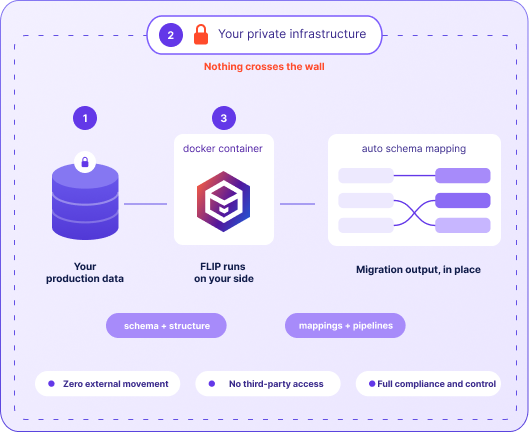
FLIP installs in your own infrastructure through Docker. Conversion proceeds while your data remains exactly where it is, never leaving.
FLIP inspects schema definitions and structural dependencies, never production records, which are not accessed, staged, or transmitted.
Execution happens within your network perimeter, so no outbound data path exists and no third-party access needs governing.
Schema mapping and pipeline generation run at full throughput, while compliance controls and audit trails remain in your hands.
Kanerika runs every US data migration engagement through the IMPACT methodology, which links each phase to a delivered result rather than a status update.
Each engagement begins with a thorough review of your source environment. Our data migration consultants then architect the target state, set up FLIP for your route, carry out automated conversion with validation running throughout, and remain engaged through post-launch monitoring and legacy retirement. For local requirements, see our data migration services in New York, Chicago, Charlotte, Houston, and Ohio.

Understand Business Goals

Analyze Data & Workflows

Design Sound Solutions

Develop & Deploy Solutions

Ongoing Support
01
Understand Business Goals
02
Analyze Data & Workflows
03
Design Sound
Solutions
04
Develop & Deploy Solutions
05
Ongoing
Support
Kanerika handles legacy data migration from Informatica, Talend, UiPath, and SQL Server to Microsoft Fabric, Databricks, Snowflake, Power BI, and Power Automate.









Kanerika provides data platform migration services for US enterprises in key industries, helping organizations modernize legacy data environments with minimal disruption.
FLIP was purpose-built for migration rather than adapted to it. Across 12 platform paths it manages repository extraction, dependency mapping, asset conversion, and parallel-run validation. Automation covers upto 80% of conversion work, which is why migration cost stops climbing with asset count.
Our migration experts have led platform transitions across ETL, BI, and RPA, supported by a team of certified engineers.

Combining the IMPACT framework with FLIP accelerators cuts migration timelines by 60%, with validation automated throughout.

Our team remains engaged before, during, and after migration, carrying through transition and into ongoing optimization.

The pivotal partnerships with technology leaders that amplify our capabilities, ensuring you benefit from the most advanced and reliable solutions.
Four triggers drive most programs. Vendor support is ending on the current version. A license renewal arrives at a price the business will not accept. A cloud or AI mandate needs architecture the legacy platform cannot supply. Or a merger leaves two estates doing the same work. US enterprises most often move on the first two, where a fixed date sets the schedule.
Discovery catalogs every asset and dependency in the source environment, the target architecture is designed and the estate is split into waves. Conversion moves mappings, reports, or workflows to the new platform, with validation reconciling source and target output at every stage. Cutover shifts consumers across, and the legacy system is decommissioned after parallel running confirms parity.
Hand rewriting fits small estates whose logic is documented and worth rebuilding deliberately. Automated conversion fits large estates carrying years of undocumented business rules, since cost no longer scales with asset count. What decides it is how much logic exists only inside the platform. If no one can say, that uncertainty is the reason to automate extraction.
Security patches stop, which typically violates internal policy long before any regulation. Vendor escalation paths close, so production incidents lose their route to resolution. Connectors to current systems degrade without maintenance, and an unsupported platform weakens your position in the next audit. With the date fixed, planning backwards from it is the only approach that works.
Cloud data migration relocates workloads from on-premises infrastructure to a cloud platform, while platform modernization replaces the tooling and converts business logic for a new environment. Most US programs combine the two, moving an on-premises legacy platform to Fabric or Databricks in one effort. That combination is where schedule risk gathers and where thorough discovery repays its cost.
It should cover target architecture, wave sequencing, validation criteria, rollback triggers, and decommission timing, stating which workloads move in each wave and what evidence approves it. Teams without documented rollback conditions learn mid-cutover that reversal is off the table. Kanerika builds this strategy across the Initiate, Map, and Plan phases, ahead of any conversion.
Validation happens at three checkpoints instead of one final test. Source profiling finds duplicates, nulls, and broken referential integrity before data moves. During conversion, row-count reconciliation and hash checksums confirm accuracy per transformation. After cutover, parallel running compares source and target output until the legacy system can be retired. FLIP reconciles continuously and flags any variance live.
Cost follows asset count, path complexity, and delivery model. Manual conversion grows linearly because engineers rewrite every object individually. FLIP automates 70 to 80% of that effort, breaking the link between cost and volume. Our Migration ROI Calculator projects spend, developer hours, and timeline for your path. Include the legacy licensing that ends at decommission in the model as well.
Look for depth on your exact source-to-target route, purpose-built automation instead of manual scripting, and validation that runs during conversion rather than after it. Microsoft Solutions Partner and Databricks Consulting Partner status signals verified capability, and ISO 27001 and SOC 2 become mandatory once regulated data moves. Kanerika delivers across US time zones.
Data migration services help US organizations move data from legacy systems, databases, and applications to modern cloud, analytics, and enterprise platforms with limited disruption.
Kanerika helps US enterprises plan, automate, execute, and validate complex migrations through FLIP accelerators, a structured methodology, and deep platform expertise.
Yes. Kanerika supports cloud data migration and modernization across enterprise data environments, guiding organizations from legacy platforms onto modern cloud technology.
Kanerika relies on migration automation, structured methodology, validation, and testing to minimize manual effort, downtime, errors, and cutover risk.
Kanerika covers database, ETL, BI, legacy system, cloud, and enterprise data platform migrations, depending on what each project requires and how complex it is.

We use cookies to give you the best experience. Cookies help to provide a more personalized experience and relevant advertising for you, and web analytics for us.