Data Migration Services in New York Without Disruption
Banks, insurers, and health systems across the five boroughs run on decades of legacy data. Our data migration services in New York move it to modern platforms without pausing operations. FLIP accelerators convert ETL jobs, BI reports, and RPA bots, lowering manual effort, license costs, and cutover risk.
Faster Migrations
Cost Savings
Predictable Timelines





Migration ROI Calculator
FLIP, Kanerika’s in-house accelerator, automates up to 80% of a data platform migration, giving back budget and engineering hours.
FLIP is Kanerika's proprietary migration accelerator. Here's exactly where the savings come from:
Migration Work Sized for New York's Regulated Enterprises
From core banking ledgers to claims systems and research databases, many New York enterprises carry data spread across on-premises warehouses, cloud tenants, and BI tools. Our data migration services consolidate that sprawl with automated conversion and staged cutovers.
ETL and Data Pipeline Migrations
Move Informatica workloads to Talend, Alteryx, Databricks, or Microsoft Fabric using ETL migration accelerators engineered to keep mappings accurate and disruption minimal.
Highlights:
- Source and target outputs are reconciled at every stage before moving on.
- Automated conversion compresses months of manual rewriting.
- After landing, workloads process faster on cloud-native compute.
BI Platform Migrations
Move Tableau, SSRS, Crystal Reports, or Cognos workloads onto Power BI with connectors that carry dashboards, datasets, and calculation logic across.
Highlights:
- Existing dashboards, reports, and user permissions stay in place.
- Post-cutover, users gain richer visuals and direct Microsoft 365 access.
- Reports, datasets, and data connections transition together as one unit.
RPA Platform Modernization
Move UiPath bots to Microsoft Power Automate with FLIP, carrying over workflow logic, exception handling, and business rules instead of rebuilding by hand.
Highlights:
- Business processes keep running through the whole transition.
- Once on Power Automate, bots connect natively with Microsoft 365 and Azure.
- Lower downtime and lower licensing spend after migration.

AI-Powered Migration Accelerators
FLIP, Kanerika's Intelligent Workflow Automation Platform, includes purpose-built accelerators for cloud data migration, ETL migration, and RPA platform transitions.




Outcomes Our Migration Engagements Have Produced
Enterprises in regulated and asset-heavy sectors have shortened timelines and lowered costs using Kanerika’s migration approach. The case studies below each document measured results.
Migration
60% Faster Migration: Crystal Reports to Power BI
Impact:
- 60% Faster Migration
- 10x Data Scale
- 99.5% Refresh Success Rate
Migration
60% Faster Analytics with Informatica to Alteryx
Impact:
- 45% Faster Reporting Cycles
- 38% Reduction in Maintenance Costs
- 60% Improved Analytics Turnaround
Migration
74% Faster Retail Reporting with Microsoft Fabric
Impact:
- 74% Faster Reporting Cycles
- 65% Increase in Reporting Stability
- 72% Faster Access to Current Metrics
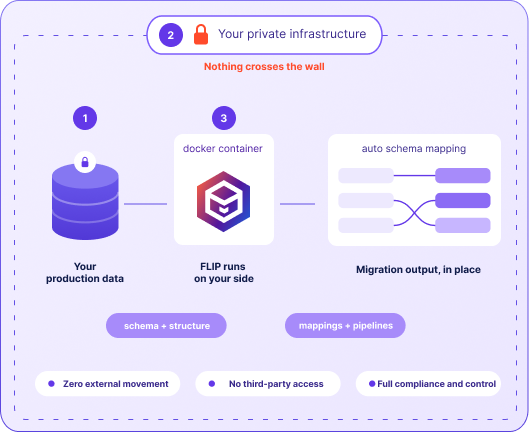
Data Migration Services That Stay On-Premises
FLIP runs as Docker containers inside your own infrastructure, so conversion happens without your data ever leaving it. For New York banks, insurers, and other NYDFS-regulated firms, that design supports Part 500 cybersecurity controls and SHIELD Act security safeguards by keeping third parties away from sensitive records.
Metadata-Level Processing Only
We read schema and structure only. Your production data is never read, copied, or exposed.
No Data Leaves Your Network
Everything runs inside your network, with no external movement and no third-party access.
On-Prem Automation
Fast schema mapping and pipeline generation, with compliance and control kept in-house.
How the IMPACT Framework Lowers Migration Risk
Every New York data migration project follows IMPACT, a phased method that ties each step to a measurable result instead of a progress report.
OUR PROCESS
Our Data Migration Consulting Process, Step by Step
Work starts with a complete assessment of the source estate. From there, our consultants design the target architecture, tune FLIP to your specific path, run automated conversion with built-in validation, and remain on hand through post-launch monitoring and retirement of the old system.

Step 1
Understand Business Goals

Step 2
Analyze Data & Workflows

Step 3
Design Sound Solutions

Step 4
Develop & Deploy Solutions

Step 5
Ongoing Support
01
Step 1
Understand Business Goals
02
Step 2
Analyze Data & Workflows
03
Step 3
Design Sound
Solutions
04
Step 4
Develop & Deploy Solutions
05
Step 5
Ongoing
Support


Platforms and Tools Our Engineers Support
Kanerika, a data migration company serving New York, works hands-on across Informatica, Talend, UiPath, Microsoft Fabric, Databricks, Snowflake, Azure, and AWS for legacy and cloud estates alike.








INNOVATE
Data Platform Migration for New York's Core Industries
Finance, insurance, and healthcare are central to New York’s economy. Kanerika modernizes legacy data in these sectors and the others below without stalling operations.








What Makes Kanerika a Trusted Migration Partner for New York Enterprises
Our credentials include Microsoft Solutions Partner status for Data and AI, Databricks Consulting Partner certification, and ISO 27001 accreditation, backed by 250+ enterprise engagements delivered with FLIP and our consulting teams.
Our certified engineers have run your exact source-to-target route before, across ETL, BI, and RPA estates. Every one is a specialist.

Pairing FLIP with the IMPACT framework shortens migration timelines by up to 60%, and automated reconciliation checks each stage as it completes instead of waiting for the end.

Our delivery team stays engaged from planning through cutover and hypercare until the legacy platform is decommissioned, so nothing is left unowned.

Empowering Alliances
Our Strategic Partnerships
The pivotal partnerships with technology leaders that amplify our capabilities, ensuring you benefit from the most advanced and reliable solutions.




Common Questions About Data Migration
What does planning look like for data migration services in New York?
We begin by cataloging the whole source estate: mappings, workflows, reports, and the dependencies between them. That inventory drives the target architecture, the order of migration waves, and a written record of edge-case logic that automation alone would miss. In our IMPACT framework this is the Initiate and Map work. Skipping it causes more timeline overruns and post-cutover logic gaps than anything else.
What timeline should we expect for migration?
With tooling, BI platform moves usually finish in 4 to 8 weeks. Mid-complexity ETL routes like Informatica to Microsoft Fabric need 8 to 16 weeks when automated, compared with 6 to 12 months of manual work. A full-stack enterprise program takes 3 to 9 months. Across paths, automated conversion lands 40 to 60% faster and carries less risk of overrun. Working sessions run on Eastern Time, so reviews fit New York business hours.
What should a New York enterprise budget for data migration?
Three factors set the price: how many assets you have, how complex the path is, and the delivery model. Manual work grows in step with volume, since developers rewrite every object individually. FLIP automates 70 to 80% of conversion and flattens that cost curve. Use our Migration ROI Calculator to estimate total cost, developer hours, and timeline for your path. New York enterprises should count the legacy license fees that end at decommission.
Which problems derail data migrations most often?
The usual culprits are schema mismatches that drop records without warning, business rules hidden in old ETL code, cutover downtime, and scope creep from shallow discovery. Exposure of data in transit between platforms adds a fifth risk. Most of these start with hand conversion and a thin initial assessment. Automated extraction, dependency mapping, and parallel-run checks bring them to light mid-migration, well before go-live.
How is migrated data checked for accuracy?
We check data three times, not once at the finish. Before migration, profiling finds duplicates, nulls, and broken referential integrity in the source. While conversion runs, row-count reconciliation and hash checksums confirm each transformation stage. After cutover, source and target run in parallel and their outputs are compared before the legacy system goes dark. FLIP keeps reconciliation running throughout and raises failures as they happen.
What belongs in a data migration strategy?
A sound strategy sets out the target architecture, wave sequencing, validation criteria, rollback triggers, and when the old platform is retired. It names the workloads in each wave and the evidence needed to sign that wave off. If rollback conditions are never written down, teams learn mid-cutover that they can no longer reverse. IMPACT covers this in the Initiate, Map, and Plan phases, before conversion starts.
What safeguards stop data loss in a large migration?
Most loss happens through schema mismatches and truncation when data types convert, not through failed transfers. Three controls catch it: profiling the source before anything moves, checksum reconciliation after each transformation, and row-by-row comparison during the parallel run. For New York firms, FLIP’s metadata-only design adds one more safeguard. The migration tooling never handles production records, so the only data movement is the governed load into your target platform, which reconciliation checks end to end.
Does AI speed up moving data between platforms?
AI is good at the pattern-matching side of migration: reading legacy repositories, tracing dependencies, and rewriting transformation logic in the target syntax. FLIP applies it to automate 70 to 80% of conversion on supported paths. The other 20 to 30% covers undocumented logic and architecture choices where an engineer has to decide. So AI cuts the effort, and human review still signs off the result.
How do healthcare providers move to Azure or Microsoft Fabric and stay HIPAA-compliant?
Staying HIPAA-compliant comes down to where protected health information sits at every step. Because FLIP reads metadata only, PHI never passes through the migration tooling. It runs inside your network boundary, under the access controls and audit logging you already have. New York providers must also meet the SHIELD Act, which adds state breach notification duties on top of HIPAA.
How should a New York firm pick a data migration consulting partner?
Judge providers on depth in your exact migration path, automation built for that path instead of handwritten scripts, and validation that runs throughout the project rather than after it. Microsoft Solutions Partner and Databricks Consulting Partner status show verified capability, and ISO 27001 and SOC 2 matter once regulated data is involved. Kanerika works Eastern Time hours with remote delivery and onsite workshops when needed. Multi-state programs can start from our data migration services across the USA.