
Finance-Grade Data Migration Services in Chicago
Chicago enterprises with aging ETL, BI, and RPA estates turn to Kanerika for data migration services that move workloads onto modern platforms while operations keep running. FLIP accelerators convert jobs, reports, and bots, cutting manual rework, legacy licensing, and cutover risk.
Faster Migrations
Cost Savings
Predictable Timelines
Get Started with Chicago Data Migration Solutions


Migration ROI Calculator
FLIP, Kanerika’s IP-led accelerator, automates up to 80% of migration work. Estimate below how much time, cost, and staffing load that removes for you.
FLIP is Kanerika's proprietary migration accelerator. Here's exactly where the savings come from:
ETL, BI, and RPA Migration Paths Chicago Enterprises Rely On
Legacy warehouses, on-premises databases, reporting tools, and automation bots rarely retire on the same schedule. Our data migration services give Chicago businesses one structured, automated route for moving all of them onto cloud and analytics platforms.
Data Platform Migrations
Shift Informatica, Alteryx, or Azure pipelines to Talend, Databricks, or Microsoft Fabric. FLIP pulls mappings and workflow logic from the source, so rules nobody wrote down make it across.
Highlights:
- Source and target output reconciled at each transformation step.
- Business rules hidden in mappings are extracted and preserved.
- Workloads gain throughput from distributed cloud compute after landing.
BI Platform Migrations
Power BI becomes the new home for Tableau, SSRS, Crystal Reports, or Cognos content. What users depend on, from calculated fields to filters to permission models, is reproduced exactly instead of approximated.
Highlights:
- Reports, dashboards, and access rights move in one step.
- Datasets and their connection strings travel together rather than as separate workstreams.
- Power BI brings Microsoft 365 integration and better visuals from launch.
RPA Platform Modernization
FLIP rebuilds UiPath estates on Microsoft Power Automate. Attended and unattended bots and their XAML sequences keep exception handling on the new platform, with no hand rebuilding.
Highlights:
- Bots keep running while the migration window is open.
- Business rules and exception handling move unchanged.
- Post-cutover, the workload runs under Microsoft licenses you already own.

AI-Powered Migration Accelerators
FLIP results are tracked on three measures: reporting speed, data scale, and maintenance cost, across data platform, BI, and RPA routes. Every accelerator targets a single source-to-target pairing, because that narrow focus is what keeps conversion accurate where generic scripts break down.




What Enterprises Gain from FLIP-Led Data Migration
FLIP, Kanerika’s Intelligent Workflow Automation Platform, ships with dedicated accelerators for ETL, BI, and RPA moves. Narrow scope is deliberate: an accelerator built for one route converts accurately in places where general-purpose scripts lose logic.
Migration
60% Faster Migration: Crystal Reports to Power BI
Impact:
- 60% Faster Migration
- 10x Data Scale
- 99.5% Refresh Success Rate
Migration
60% Faster Analytics with Informatica to Alteryx
Impact:
- 45% Faster Reporting Cycles
- 38% Reduction in Maintenance Costs
- 60% Improved Analytics Turnaround
Migration
74% Faster Retail Reporting with Microsoft Fabric
Impact:
- 74% Faster Reporting Cycles
- 65% Increase in Reporting Stability
- 72% Faster Access to Current Metrics
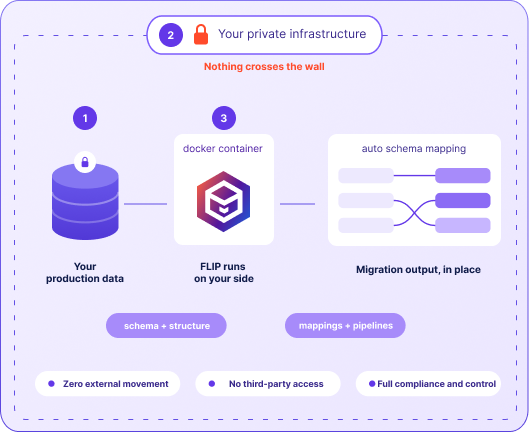
Data Migration That Stays On-Premises
Docker packaging lets FLIP sit on servers you control, so conversion runs against data that stays put.
Metadata-Level Processing Only
FLIP inspects schemas and structural links, and never opens, copies, or transmits a production record.
No Data Leaves Your Network
All processing happens inside your perimeter. With no outbound data path, there is no third-party access to govern.
On-Prem Automation
Pipelines are generated and schemas mapped without throttling, while audit trails and compliance controls stay in your hands.
How the IMPACT Framework Speeds Up Migration
Every data migration project we run follows IMPACT, a methodology where each phase ends with something you can use, not a status report.
OUR PROCESS
How Our Data Migration Consulting Works in Chicago
Nothing is converted until we have read the whole source environment. Our data migration consultants lay out the target design and configure FLIP for your route. Conversion runs under continuous validation, and we remain after go-live to monitor the platform and retire the old system.

Step 1
Understand Business Goals

Step 2
Analyze Data & Workflows

Step 3
Design Sound Solutions

Step 4
Develop & Deploy Solutions

Step 5
Ongoing Support
01
Step 1
Understand Business Goals
02
Step 2
Analyze Data & Workflows
03
Step 3
Design Sound
Solutions
04
Step 4
Develop & Deploy Solutions
05
Step 5
Ongoing
Support


Platforms and Tools Our Engineers Use
Kanerika is a data migration company that Chicago businesses call for legacy and cloud data migration across Informatica, Talend, UiPath, Power Automate, Microsoft Fabric, Snowflake, and Azure.








INNOVATE
Why Chicago Industries Are Modernizing Their Data
Data platform migration in Chicago is driven by sector pressures that legacy environments can no longer absorb, from trading floors to freight yards.








What Sets Kanerika Apart for Data Migration in Chicago?
FLIP started life as a migration product rather than a general tool adapted later. Across its 12 platform paths it extracts repositories, maps dependencies, converts assets, and validates in parallel runs. With 70 to 80% of conversion automated, your budget stops rising with every asset you add.
Certified engineers on our team have led ETL, BI, and RPA platform transitions for enterprises across many industries.

Combined, IMPACT and FLIP can shorten timelines by as much as 60%, while checks run automatically.

We stay involved before, during, and after cutover, then keep optimizing the new platform.

Empowering Alliances
Our Strategic Partnerships
The pivotal partnerships with technology leaders that amplify our capabilities, ensuring you benefit from the most advanced and reliable solutions.




Questions Chicago Businesses Ask Us
When are Chicago data migration services needed?
Usually a date forces the decision. The vendor retires support for your version, or a license renewal lands at a figure finance will not sign. Those two account for most Chicago projects. The other common causes are a cloud or AI initiative the old platform cannot host, and an acquisition that leaves two estates doing the same job.
What are the stages of a migration?
It begins with discovery, which catalogs every asset and dependency on the source side. Next comes target architecture design and grouping the estate into waves. Conversion translates mappings, reports, or workflows to the new platform, and validation reconciles output from both sides at every stage. At cutover, consumers switch over, and the legacy system is retired after parallel running proves parity.
Is automated conversion better than rewriting pipelines by hand?
Size and documentation decide it. A small estate with well-recorded logic can be rebuilt by hand at modest cost. A large one, full of rules that live only inside the platform, is cheaper to convert automatically because effort no longer climbs per asset. If nobody knows how much hidden logic you have, automate the extraction.
What is the risk of running a data platform past end of support?
Security patches stop arriving, which typically violates internal policy well before it violates any regulation. Vendor escalation disappears, so production incidents have nowhere to go. Connectors stop being maintained and integrations with current systems start to fail. Unsupported software also weakens your standing at the next audit. Because the end date cannot move, the only sensible plan works backward from it.
What does cloud data migration involve?
It means shifting workloads off on-premises servers and onto a cloud platform. Platform modernization is a separate exercise: it swaps the tooling and rewrites business logic for the new environment. Many Chicago programs do both together, leaving an on-prem legacy platform for Fabric or Databricks. Running the two in parallel is where schedule risk builds up, and where thorough discovery pays for itself.
What goes into a sound migration plan?
Write down the target architecture, wave order, pass criteria for validation, rollback triggers, and the switch-off date for each legacy system. Each wave needs a defined workload list and sign-off evidence. Leaving rollback undefined is the usual mistake, and teams discover it mid-cutover. We settle all of it in the Initiate, Map, and Plan phases.
How do you prove migrated data is correct?
We validate at three points instead of a single check at the end. Before anything moves, source profiling exposes duplicates, nulls, and broken referential integrity. While conversion runs, row-count reconciliation and hash checksums verify every transformation. After cutover, the old and new systems run in parallel and their outputs are compared before retirement. FLIP reconciles continuously and flags variance as it appears.
What does Illinois BIPA mean for migrating sensitive data?
The Biometric Information Privacy Act covers identifiers such as fingerprints and face geometry and lets individuals sue directly, so who holds that data during a migration matters. FLIP works on metadata alone, which keeps biometric records out of the tooling and inside your network. Logs and conversion evidence stay in your environment, which also narrows the breach-notification surface under Illinois PIPA.
How much should we budget for a Chicago migration?
Three variables drive the budget: how many assets you hold, how hard your route is, and the engagement model. Rewriting by hand means every extra object adds engineer time. With FLIP handling 70 to 80% of the conversion, that curve flattens. Use the Migration ROI Calculator for estimates of spend, developer hours, and duration, then subtract the legacy licensing you will no longer pay.
How do I choose data migration consultants in Chicago?
A credible firm can show depth on your source and target, ships automation built for that pairing instead of hand-written scripts, and validates while conversion is running. Kanerika holds Microsoft Solutions Partner and Databricks Consulting Partner status. If regulated records are in scope, insist on ISO 27001 and SOC 2. We keep Central Time hours, delivering remotely with onsite workshops when needed. Once the new platform is live, our Chicago analytics practice can take over reporting work.
What do data migration services include?
They shift records, applications, and databases off aging systems onto modern cloud, analytics, and enterprise platforms, planned so daily operations see little disruption.
What role does Kanerika play in a Chicago migration?
Our role covers planning, automation, execution, and validation, using FLIP accelerators and a tested methodology to carry complex Chicago migrations through to cutover. If your estate stretches beyond Illinois, see our national data migration practice.
Can Kanerika move our workloads to the cloud?
Yes. Cloud moves are central to our work, whether that means lifting data estates off legacy infrastructure or modernizing them en route.
How does Kanerika keep migration risk low?
Automation removes manual effort; a set method and stage-by-stage testing lower downtime, errors, and cutover exposure.
Which platforms can Kanerika migrate from?
Depending on your requirements, we migrate databases, ETL and BI platforms, legacy systems, cloud environments, and wider enterprise data platforms.