
Audit-Ready Data Migration Services in Charlotte
Moving Charlotte’s financial data off aging platforms leaves little room for error. Kanerika delivers data migration services Charlotte banks, insurers, and health systems use to retire legacy ETL, BI, and RPA estates. FLIP accelerators convert that logic automatically, cutting manual effort, license spend, and cutover risk.
Faster Migrations
Cost Savings
Predictable Timelines
Get Started with Charlotte Data Migration Solutions












Migration ROI Calculator
Up to 80% of a data platform migration can be automated with FLIP, Kanerika’s IP-led accelerator. Add your asset counts below to estimate the budget, engineering hours, and delivery weeks you get back.
FLIP is Kanerika's proprietary migration accelerator. Here's exactly where the savings come from:
Modernizing Data Estates for Charlotte Businesses
Banks, insurers, utilities, and hospital systems in Charlotte carry decades of data across legacy databases, cloud services, analytics tools, and line-of-business applications. Our data migration services move that estate in planned, automated stages so reporting keeps running.
Cloud migration for Charlotte organizations. For most businesses here, the destination is the cloud. We shift on-premises ETL, warehouses, and BI onto Microsoft Fabric, Azure, Databricks, or Snowflake, and reconcile control totals ahead of cutover so ledgers, loan books, and regulatory reports remain auditable.
Data Platform Migrations
Shift Informatica, Alteryx, or ADF pipelines onto Talend, Databricks, or Microsoft Fabric. FLIP reads mappings and workflows directly from the source repository, so nothing depends on outdated documentation.
Highlights:
- Circular references and shared logic untangled before any conversion starts.
- Every transformation stage checked by comparing source and target output.
- Throughput improves once workloads run on cloud-native compute.
BI Platform Migrations
Move Tableau, SSRS, Crystal Reports, or Cognos reporting onto Power BI. Row-level security, filters, and calculated fields carry over from their original definitions, not rebuilt by reverse-engineering what old reports display.
Highlights:
- Report definitions, dashboards, and access permissions migrate together as one package.
- Each report brings its datasets and connection strings along.
- After cutover, users get Microsoft 365 integration and stronger visuals.
RPA Platform Modernization
Move UiPath automation to Microsoft Power Automate. Scheduled processes, attended bots, and XAML sequences keep their exception handling, including logic that was never written down anywhere.
Highlights:
- Automations stay live while the switch happens.
- Error branches and business rules arrive unchanged.
- Once cut over, current Microsoft licenses cover the workload.

A Dedicated Accelerator for Each Migration Route
Kanerika built FLIP as its Intelligent Workflow Automation Platform. Each accelerator targets one source and target pair, handling repository extraction, dependency mapping, conversion, and validation for that route rather than reusing a generic script.












Where the Return on Migration Shows Up
The payback appears in lower platform bills, faster close and reporting cycles, lighter maintenance loads, and dashboards built on today’s numbers instead of last night’s.
Migration
60% Faster Migration: Crystal Reports to Power BI
Impact:
- 60% Faster Migration
- 10x Data Scale
- 99.5% Refresh Success Rate
Migration
60% Faster Analytics with Informatica to Alteryx
Impact:
- 45% Faster Reporting Cycles
- 38% Reduction in Maintenance Costs
- 60% Improved Analytics Turnaround
Migration
74% Faster Retail Reporting with Microsoft Fabric
Impact:
- 74% Faster Reporting Cycles
- 65% Increase in Reporting Stability
- 72% Faster Access to Current Metrics
Our Conversion Engine Runs Inside Your Environment
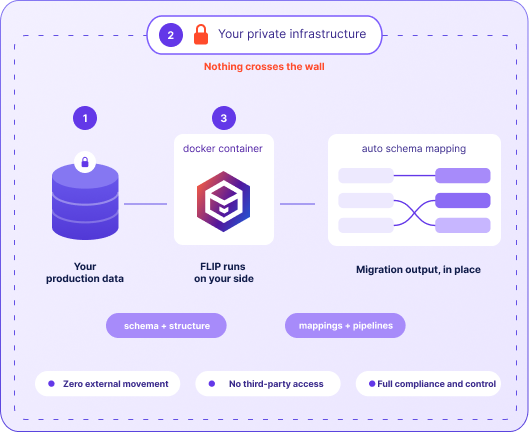
FLIP is installed in your infrastructure as Docker containers and works only with metadata. Because conversion happens next to your existing systems, regulated records never leave the controls that already govern them, and the vendor security review that usually stalls a migration start gets much shorter.
Metadata Processing Only
Only table definitions, mappings, and dependency structures are read. Production records are never touched, staged, or sent anywhere.
Nothing Leaves Your Network
Every job runs within your network perimeter, so no data travels externally and no outside party needs access rights.
On-Prem Automation
Reconciliation output, conversion logs, and access records are written to your environment and kept under your retention rules.
How the IMPACT Framework Speeds Up Platform Migrations
IMPACT runs from the first source inventory to monitoring after cutover. The gates are what matter: most migration overruns start with a phase that someone signed off before it was actually complete.
OUR PROCESS
How Our Data Migration Consulting Works in Charlotte
Each stage exists to remove guesswork from the migration. You get defined steps, a clear deliverable at the end of every one, and the same people from the opening assessment until operations settle into steady state.

Step 1
Understand Business Goals

Step 2
Analyze Data & Workflows

Step 3
Design Sound Solutions

Step 4
Develop & Deploy Solutions

Step 5
Ongoing Support
01
Step 1
Understand Business Goals
02
Step 2
Analyze Data & Workflows
03
Step 3
Design Sound
Solutions
04
Step 4
Develop & Deploy Solutions
05
Step 5
Ongoing
Support


The Platforms and Tools Our Engineers Use
Kanerika is a data migration company that takes Charlotte organizations from on-premises platforms to Microsoft Fabric, Databricks, Power BI, and Talend, covering both legacy data migration and cloud data migration work.









INNOVATE
Migration Outcomes for the Industries That Drive Charlotte's Economy
Charlotte ranks among the largest US banking centers, with strong healthcare, energy, and logistics sectors. Here is what migration fixes in each.








What Charlotte Businesses Gain by Migrating with Kanerika
FLIP takes on the bulk of conversion work, extracting business logic from the source repository and checking every object as it is converted. Pricing follows how complex your estate is, not how many assets it holds.
ETL, BI, RPA, and platform moves run through one accelerator, not four vendors.

Before you commit, we map cost, timeline, risk, effort, and complexity.

Checksums, row-count reconciliation, and parallel testing generate a documented parity report on every run.

Empowering Alliances
Our Strategic Partnerships
The pivotal partnerships with technology leaders that amplify our capabilities, ensuring you benefit from the most advanced and reliable solutions.



Common Questions About Data Migration
What are Charlotte data migration services?
They cover the planning and engineering that moves data and its logic from an old system to a new one. For a large enterprise that typically means retiring a legacy platform and rebuilding its pipelines, reports, and automations on the replacement. Copying records is the easy part. Carrying years of embedded business rules across intact is where the effort goes.
Which stages make up a migration program?
There are six. First, inventory the source estate and its dependencies. Second, design the target architecture. Third, group assets into migration waves. Fourth, convert them to the new platform. Fifth, reconcile results against the source. Sixth, cut over and decommission. Rushing inventory and design usually shows up later as conversion and reconciliation trouble.
Can a warehouse move happen without customers noticing anything?
Yes, if both warehouses run side by side until the new one has earned trust. Reports and applications keep reading from the legacy system while the target loads and reconciles in the background. Traffic moves over only after outputs agree for an entire reporting cycle. Because rollback remains possible the whole time, switching becomes a controlled decision instead of a bet.
What counts as warehouse migration?
Warehouse migration replaces the platform underneath your analytics: schemas, load pipelines, and every report that depends on them. Copying tables takes little effort. The real test is reproducing transformation rules, incremental load patterns, and the historical fixes made over many years, so the new warehouse produces the same figures as the old one. SQL Server shops can read about our SQL Server to Microsoft Fabric migration service.
How should data move to the cloud?
Start by separating workloads that gain from elastic cloud compute from those moving only because a license is expiring. Shape the target platform around the first group. Rebuild pipelines and reports with native components instead of lifting them as they are, because a lifted legacy pipeline often costs more in the cloud than on premises. Validate everything, then move in waves.
What happens to CRM records and integrations during migration?
We treat CRM integration and migration as one pipeline that links customer records in Salesforce or Dynamics 365 to the target data platform. Conversion runs in your own environment, and tooling sees metadata wherever it can, so personal data never lands on a vendor platform. Field mappings are reviewed before anything executes, since CRM schemas collect custom fields that different departments use in different ways. Record counts and key relationships are reconciled before the old instance is retired.
Can several legacy systems be merged into one platform?
Yes, but order matters more than tools. Merging fails when nobody has decided which system owns the master version of shared entities such as customers or accounts. Settle that question first, then migrate wave by wave with reconciliation in between. At Kanerika this happens in the Map phase, ahead of any scheduled conversion.
How do lenders confirm financial figures still match after migrating?
Through reconciliation at three levels. Record counts prove no rows were lost. Control totals prove balances and aggregates agree with the source. Finally, a set of period-end reports is produced on both platforms and compared line by line. In banking, the case to test hardest is totals that match while the underlying detail does not.
What does moving a legacy ERP into an AI-ready platform involve?
It begins with master data. Customer, supplier, and product records are deduplicated and reconciled before anything else, since a model fed inconsistent master data returns inconsistent results. Transaction history then moves into a governed platform such as Microsoft Fabric or Databricks, where lineage and access controls are set up before any AI work starts. Most use cases need clean history in an analytics layer, not a replica of the ERP schema. The legacy ERP stays read-only until reconciliation shows the history matches.
Which questions should a Charlotte business put to migration vendors?
Ask how much of the conversion is automated for your specific source and target, not as an average. Ask how undocumented logic gets handled. Ask whether validation happens during conversion or waits for user acceptance testing. Then request a converted-asset log from a similar project. A vendor that prices per asset is quoting for manual work.
Which Charlotte organizations benefit most from migration?
Banks, insurers, health systems, and energy companies running aging warehouses, ETL tools, or reporting platforms see the clearest gains when moving to modern cloud and analytics platforms.
What role does Kanerika play in your migration?
We plan, automate, execute, and validate the migration using FLIP accelerators and our methodology, with remote delivery and onsite workshops when needed.
Can Kanerika move on-premises workloads to cloud data platforms?
Yes, from legacy platforms onto cloud technologies. North Carolina lacks a comprehensive privacy law, so controls follow sector rules such as GLBA, HIPAA, and PCI DSS. For multi-state programs, see our data migration services across the USA.
What does Kanerika do to lower migration risk?
Automated conversion, a structured method, and testing at each step reduce manual effort, downtime, errors, and cutover risk.
Which source and target platforms are supported?
Databases, ETL tools, BI platforms, legacy systems, cloud environments, and enterprise data platforms are all in scope, depending on what your program needs. Frequent routes are Informatica to Microsoft Fabric, Tableau to Power BI, and UiPath to Power Automate.

