TL;DR
SAP BusinessObjects mainstream maintenance ends December 31, 2026, with security fixes continuing through 2027, after which organizations relying on it for regulated reporting face growing risk as new systems and integrations may break the deployment with no fix path. SAP reversed course in 2025, committing to BI 2027 and BI 2029 with maintenance through 2031, so on-premise BusinessObjects survives, but with a narrower future. Power BI has been Gartner’s Magic Quadrant Leader for 18 straight years, and most enterprises already pay for it through Microsoft 365, unlike SAP BO which stacks separate licensing costs. The hardest step isn’t rebuilding reports, it’s translating BusinessObjects universes into a new semantic model. Kanerika’s FLIP accelerator cuts that effort by 50 to 60 percent.
For nearly twenty years, SAP BusinessObjects has been an effective BI tool of enterprise reporting. Finance teams built it into their close cycle. Operations teams piped it into their KPI dashboards. Auditors expected to see Crystal Reports outputs in the binder. Then SAP set a date on the calendar that changed the conversation. Mainstream maintenance for SAP BusinessObjects 4.3 ends on December 31, 2026, with security fixes available for one additional year through 2027. After that, organizations have a real choice to make, not a theoretical one.
In this article, we’ll cover what the SAP BusinessObjects end of life timeline actually says, where the genuine migration options sit, and why Power BI keeps winning the destination decision.
Key Takeaways SAP BusinessObjects 4.3 mainstream maintenance ends Dec 31, 2026, with security fixes through 2027. SAP reversed course in 2025: BI 2025 and BI 2027 keep on-premise alive through 2031, but the platform is being narrowed. Power BI is the Gartner MQ Leader for the 18th year running, with 30 million monthly active users. Most enterprises already pay for Power BI through Microsoft 365, while SAP BO stacks licensing, infrastructure, and admin cost on top. Universe to semantic model translation is the hardest part of the migration, not report rebuild. Kanerika’s FLIP accelerator cuts migration effort by 50 to 60 percent and licensing costs by up to 75 percent.
The 2027 Deadline Forcing a Real Decision Most enterprises running SAP BusinessObjects 4.3 have spent the last three years deferring the migration conversation. That gets harder now. SAP has set a firm date for the end of mainstream maintenance, and the date is no longer comfortably distant.
What Officially Ends and When SAP BusinessObjects 4.3 mainstream maintenance ends on December 31, 2026. Security fixes for high-severity vulnerabilities continue through December 31, 2027. After that, support is available only through Customer Specific Maintenance , which does not include bug fixes or new updates.
The risk to a stable production environment is not catastrophic on January 1, 2028. Reports keep running. Dashboards keep refreshing. But every new operating system, browser, database driver, and third-party integration introduced after that date may break the deployment without a path to fix it.
That is the practical end of life for any organization that depends on BusinessObjects for regulated reporting, audit trails, or critical operational dashboards.
What SAP Changed in 2025 For years the official story was that SAP BusinessObjects 4.3 would be the last on-premise release, and after 2027 the platform would only be available in Private Cloud Edition. That changed in March 2025 with the release of SAP BusinessObjects BI 2025 .
SAP also confirmed BI 2027 for Q1 2027, with BI 2029 to follow, and committed to mainstream maintenance through at least end of 2031 . The on-premise option survives, but with caveats.
The BI 2025 release deprecates several components, including the Universe Design Tool and .unv universes, Live Office, Crystal Enterprise, and Lumira Discovery . The toolset is shrinking even as the support window extends.
Why the 2025 Reversal Does Not Change the Migration Math The fact that SAP brought on-premise back from the brink does not change the underlying decision. Staying on BusinessObjects means continuing to pay annual maintenance, infrastructure, and specialized administration costs for a platform that is being narrowed rather than expanded.
Migrating to Power BI means consolidating BI spend into a license many enterprises already pay for through Microsoft 365, with a vendor that has been the BI market leader for nearly a decade. The deadline forces the conversation. The economics decide where it ends up.
Migrate from Legacy SAP BusinessObjects to Power BI Faster! Partner with Kanerika for automated BI migration services.
Book a Meeting
What SAP BusinessObjects Is and What It Was Built For Before discussing where to migrate, it helps to be honest about what BusinessObjects actually does well and where its design has held up less well over time.
The Core Suite Components Still in Use SAP BusinessObjects is a centralized BI platform that originated at Business Objects SA in 1990 and was acquired by SAP in a $6.8 billion deal in 2007. The suite includes several distinct tools, each built for a different reporting style.
Web Intelligence is the ad-hoc reporting tool most business analysts touch directly. Crystal Reports handles pixel-perfect, fixed-layout reports that finance and operations teams depend on. Analysis for Office runs inside Excel for multidimensional analysis against SAP BW data.
The Universe is the semantic layer that translates physical database structures into business terms, and it is the piece of BusinessObjects most heavily customized in mature business intelligence deployments.
Where BusinessObjects Has Historically Been Strong BusinessObjects was built for centralized, IT-managed enterprise reporting in an era when that model made sense. Three areas where it still delivers value, even now:
Pixel-perfect formatted reporting. Crystal Reports remains hard to beat for compliance reports, regulated outputs, invoices, and statements that need to print or render to PDF with exact layouts.Direct SAP source connectivity. The deep integration with SAP ERP , SAP BW, and SAP HANA gave BusinessObjects a default position in any organization with significant SAP investment.Mature scheduling and distribution. The Central Management Console handles complex scheduling, bursting, and distribution patterns that many newer reporting tools have to bolt on.Where the Design Has Aged Less Gracefully The same architectural choices that made BusinessObjects strong in the 2000s create friction in modern analytics workflows . The platform was built before self-service business intelligence became table stakes, and that shows.
Report development is IT-led, slow, and gated by a small group of universe experts. Dashboards lag the interactive, AI-augmented experiences that modern users now expect from tools like Power BI. Infrastructure overhead is high, and specialized administrators are expensive to keep on staff.
The newer tools in the SAP BO suite, including SAP Analytics Cloud , attempt to close the gap but introduce their own learning curve and licensing model.
Five Forces Driving the Migration Wave Off BusinessObjects The migration wave is not a single trend. It is five reinforcing forces hitting at the same time, and each one alone would be enough to justify a serious evaluation. Together they make the decision unavoidable.
1. The 2027 Deadline Removes the Option to Coast For the last several years, enterprises could defer the migration conversation by pointing at the SAP roadmap. That argument is closing.
After December 31, 2027 , SAP will not provide security fixes for SAP BusinessObjects 4.3. Continuing to run the platform beyond that date in a regulated environment becomes a live audit exposure, not a theoretical one.
Even the BI 2025 upgrade path, which extends on-premise support, requires a significant upgrade project of its own. There is no zero-effort option for organizations that need to plan around enterprise transformation timelines.
2. The Cost Difference Is Dramatic and Growing SAP BusinessObjects carries a heavy and visible cost structure – annual SAP maintenance fees, dedicated on-premise infrastructure, specialized administrators , and platform-specific consultants for every major change.
Power BI sits at the other end of the cost spectrum. The SaaS model removes the hardware refresh cycle entirely. Pro licenses come bundled with many Microsoft 365 E5 SKUs that enterprises are already paying for. Premium capacity scales horizontally without procurement cycles, and organizations on Microsoft Azure Consumption Commitments can apply that spend to Power BI Premium directly.
For organizations running enterprise data modernization programs, the total cost of ownership gap between BusinessObjects and Power BI typically widens further once you factor in retiring server hardware, reassigning the BO administration team to higher-value work, and reducing the cloud cost management overhead of running a parallel infrastructure footprint.
3. Power BI Has Been the Market Leader for Nearly Two Decades Microsoft has been positioned as a Leader in the Gartner Magic Quadrant for Analytics and Business Intelligence Platforms for eighteen consecutive years, with Power BI furthest on Completeness of Vision in the 2025 report.
Power BI now has 30 million monthly active users globally. That scale matters for practical reasons – a deep partner ecosystem, a steady release cadence, and a hiring pool that does not require six months of niche training to onboard.
BusinessObjects has not seen that pace of innovation since the SAP acquisition. The platform has been narrowed, deprecated in parts, and held at parity rather than pushed forward, while Power BI continues to evolve as the analytics surface for Microsoft Fabric .
4. Self-Service Is Now Table Stakes for Business Users BusinessObjects was designed for centralized reporting run by IT. Power BI was designed for the opposite. Business users build their own dashboards, analysts answer their own ad-hoc questions, and IT moves from reporting factory to governance and platform owner.
That shift in operating model is doing more to drive migration than any feature comparison ever has. Time from question to insight collapses from weeks to hours when the dashboard owner does not have to file a ticket. For more on this shift, see our analysis of self-service business intelligence and the broader move toward augmented analytics .
5. The Microsoft Fabric and Azure Ecosystem Fit Is Hard to Argue with Most enterprises that are running BusinessObjects today are also running Microsoft 365, Teams, SharePoint, and an Azure footprint that has grown steadily over the last several years. Azure cloud solutions and BI consolidation conversations now sit at the same table.
Power BI plugs into that ecosystem natively. With Microsoft Fabric now positioning Power BI as the analytics surface for a unified lakehouse and data warehouse platform, the architectural fit gets stronger every quarter.
For organizations already on the Azure journey, the question shifts from “should we migrate?” to “why are we still running a parallel BI vendor relationship?” Compare this directly against Microsoft Fabric vs Tableau for a sense of how the architectural fit advantage plays out at the platform level.
Driver What’s Forcing the Decision 2027 deadline Mainstream maintenance ends Dec 2026, security fixes end Dec 2027 Cost structure Annual maintenance, hardware, and specialized admin vs bundled SaaS pricing Market leadership 18 years as Gartner MQ Leader, 30 million MAU vs narrowing SAP roadmap Self-service shift IT-led reporting model vs business-user dashboard ownership Ecosystem fit Native to Microsoft 365 and Fabric vs separate vendor stack
The forces are not stacking by accident. They reflect a structural shift in how enterprises buy and operate BI, and BusinessObjects is on the wrong side of that shift.
Popular Migration Options for Enterprises Using BusinessObjects Enterprises evaluating the move have four real destinations, and they are not equally suited to every organization. Picking the wrong target turns a one-time migration project into a two-year detour.
1. Power BI: The Default Choice for Most Enterprises Power BI is the destination most BusinessObjects customers end up at, and the reasons are practical rather than ideological. The product is mature, the licensing fits inside existing Microsoft agreements, and the partner ecosystem is deep enough to handle complex migrations.
Where Power BI fits best – Organizations with significant existing Microsoft 365 and Azure investment – Teams looking to consolidate BI spend rather than maintain a separate vendor stack – Use cases dominated by interactive dashboards, self-service analytics, and embedded data analytics reporting – Regulated industries with strong audit requirements that benefit from Microsoft Purview integration
For a deeper look at the destination platform itself, see our overview of Power BI dashboard development , the Power BI versus Tableau comparison, and our guide to field parameters in Power BI for advanced report design.
2. SAP Analytics Cloud: The SAP-Loyal Path SAP Analytics Cloud is SAP’s strategic BI direction, and it is the natural choice for organizations deeply committed to the SAP roadmap and SAP-only data sources .
Where SAC fits best – Organizations with a clear S/4HANA or BW future and minimal non-SAP analytics workload – Use cases dominated by planning, predictive, and SAP-native reporting – Teams that need direct connectivity to BW universes without a translation layer
The cost and learning curve are real, and SAC does not have the market position of Power BI in non-SAP data analytics use cases.
3. Tableau: The Visualization-First Option Tableau is a strong destination for organizations that prioritize visualization quality and analyst-led exploration over enterprise reporting. The gap with Power BI has narrowed significantly in the last five years, but the use cases have not converged.
Where Tableau fits best – Analytics-heavy organizations with strong individual contributor analysts – Use cases where visual exploration is more important than enterprise distribution – Teams without a strong Microsoft ecosystem commitment
Cost remains higher than Power BI for comparable enterprise deployments. Compare the two in detail in our Power BI vs Tableau guide, and the platform-level comparison of Microsoft Fabric vs Tableau .
4. Qlik Sense and Others The Niche Play Qlik Sense , ThoughtSpot, and Looker each have specific strengths but smaller market positions. For most BusinessObjects shops the question reduces to Power BI versus SAC, with Tableau as a credible third option in some segments.
Destination Strongest Fit Weakest Fit Typical TCO Profile Power BI Microsoft-aligned enterprises, mixed source environments Pure SAP-only shops with no Microsoft footprint Lowest, especially when bundled with M365 SAP Analytics Cloud S/4HANA-centric organizations, SAP-only BI workloads Multi-source analytics, broad self-service needs Medium to high, depends on user count Tableau Analyst-led visual exploration, Salesforce-adjacent shops Cost-sensitive enterprise reporting at scale Highest at scale Qlik Sense Associative analytics use cases, specific industry niches Broad enterprise consolidation Medium, depends on tier
The honest read is that Power BI wins most evaluations not because it is the only good option, but because it is the most defensible default for the average BusinessObjects customer. For a closer look at how the destination decision plays out against another common option, see our analysis of Qlik Sense vs Power BI .
Why Power BI is the Best Alternative for SAP BusinessObjects Power BI is the most common destination for BusinessObjects migrations for reasons that go beyond the deadline. The product itself has compounded a significant lead in five specific areas that matter for the migration decision.
1. Bundled Licensing Inside Microsoft 365 For most enterprises, Power BI Pro is already included in the Microsoft 365 E5 SKU that pays for Teams, SharePoint, and the rest of the productivity stack. That changes the licensing conversation from “what new vendor do we sign up with?” to “why are we paying twice for analytics?”
Power BI Premium adds capacity-based licensing for organizations that need paginated reports, AI features, and high concurrency . The cost remains predictable and tied to consumption rather than seat count, which fits more cleanly with cloud cost management discipline than per-seat enterprise licensing.
2. Self-Service Built into the Product Power BI Desktop is free, intuitive enough for a business analyst to learn in a week, and produces outputs that publish directly to the Power BI Service for distribution. The IT-gated development cycle that defines BusinessObjects is not how Power BI operates.
That changes which people in the organization can answer their own questions, and how quickly. For the deeper case on this shift, see our analysis of self-service business intelligence and business analytics examples .
3. Native Microsoft Fabric and Copilot Integration Power BI is now the analytics surface for Microsoft Fabric , which means semantic models , lakehouses , data warehouses , and real-time intelligence all run through the same compute fabric. The same is true of DAX calculations in Fabric , which carry over directly from Power BI Desktop. For more detail on the integration, see our guide to agents and copilots in Fabric and Microsoft Fabric data agents .
Copilot for Power BI adds natural language report generation, automatic insight surfacing, and conversational data exploration. Those capabilities are evolving fast and do not have direct equivalents in the SAP BusinessObjects 4.3 release. For the broader picture on AI augmentation in analytics, see generative AI for data analytics and AI in business analytics .
4. Pixel-Perfect Reporting Still Works One of the strongest historical objections to leaving BusinessObjects was Crystal Reports and the formatted, pixel-perfect outputs that finance and operations teams depend on. Power BI Paginated Reports closes most of that gap.
The migration is not always one-to-one, but the destination capability exists, and most regulated reporting use cases land on Paginated Reports without losing audit fidelity. This is one of the areas where Kanerika’s Crystal Reports to Power BI migration work has documented the closest mapping.
5. A Faster Innovation Pace Power BI ships meaningful updates every month. New visuals, new AI features, new connectors, new governance controls. BusinessObjects has been on a much slower release cadence for years, and the BI 2025 release is more about extending support than expanding capability.
That delta compounds. The longer the migration is deferred, the larger the gap between what BusinessObjects can do and what Power BI users are doing with DAX calculations , field parameters , and direct lake semantic models .
The Technical Challenges That Make This a Migration, Not a Conversion Anyone who tells you a BusinessObjects to Power BI move is a one-to-one report conversion has not done one. The migration is real translation work, and four areas in particular tend to consume the project budget if they are not planned for.
1. Universe to Semantic Model Translation The Universe is the crown jewel of any mature BusinessObjects deployment. It abstracts complex SQL into business terms, encodes joins, calculations, and security rules, and has often been refined over a decade by a small team that understands every edge case.
Power BI uses a Tabular semantic model with DAX as the calculation language. The translation is doable, but it is not literal. Universe contexts, derived tables, and predefined filters all need to be reproduced using a different abstraction model.
This is where most migrations either succeed or stall , and it is the area where automation accelerators pay back the most. The DAX learning curve for Universe developers is real but usually faster than expected.
2. Report Rebuild with Different Visual Primitives Web Intelligence and Crystal Reports were built around tables, sections, and breaks. Power BI is built around visuals, slicers, bookmarks, and filters. The mental model of the report is different.
A direct visual-for-visual conversion produces Power BI reports that look like BusinessObjects reports running in a different tool, and that defeats most of the value of migrating in the first place. The right approach is to rebuild reports with Power BI’s idioms while preserving the data and logic. Custom visual options including custom labels in Power BI and text slicer visuals close most of the visual gaps that BusinessObjects developers worry about up front.
For pixel-perfect outputs, Paginated Reports handles most use cases, and the migration approach there is closer to a literal port.
3. Security Model and Row-Level Filtering BusinessObjects uses a Central Management Console with profiles, security groups, and universe-level restrictions. Power BI uses workspace roles, row-level security defined in DAX, and Entra ID for identity.
The translation is not technically hard, but the security audit at the destination has to match the security model at the source exactly, and that requires careful mapping rather than a copy-paste. For more on the governance side of the move, see our overview of enterprise data governance , data governance best practices , and Microsoft Fabric governance .
Read More: 12 AI Governance Best Practices for Enterprise Teams in 2026
4. Scheduled Report Distribution and Bursting BusinessObjects has a deep history of scheduled reports, email bursts, and complex distribution rules that mature deployments rely on. Power BI Service handles scheduling and subscriptions natively, and Premium capacity adds more sophisticated paginated report distribution.
The translation is usually straightforward, but high-volume bursting patterns sometimes need to be redesigned around Power BI’s distribution model rather than ported as-is. The risks in data migration framework applies as much to report distribution as to source data itself.
Migration Area BusinessObjects Construct Power BI Equivalent Translation Effort Semantic layer Universe (.unx) Tabular semantic model High; requires DAX rewrite Ad-hoc reports Web Intelligence Power BI Desktop Medium; rebuild with new visuals Pixel-perfect Crystal Reports Power BI Paginated Reports Medium; closer to literal port Security Profiles, restrictions RLS in DAX, workspace roles Medium; requires careful mapping Distribution CMC scheduling, bursting Power BI Service subscriptions Low to medium
The takeaway – a successful migration treats this as a translation project with a clear inventory, not a copy-paste exercise. The automation tools that exist today significantly reduce the manual effort, but they do not eliminate the need for thoughtful architecture decisions at the destination.
The Manual vs Accelerator Migration Decision Once the destination is picked, the next decision is how to actually get there. There are two real approaches, and the right one depends on the size of the deployment, the team’s capacity, and the migration timeline.
The Manual Rebuild Path A manual rebuild treats each Universe and each report as a separate development project. Skilled Power BI developers reverse-engineer the BusinessObjects logic, rebuild the semantic model in DAX, and reconstruct each report in Power BI Desktop.
This approach works for small deployments with fewer than 100 reports and a generous timeline. It also gives the team the deepest possible understanding of the new platform, which can be critical for ongoing operations and BI consulting services capacity-building.
The downsides are real. Cost scales linearly with report count. Timelines stretch from months to years for mature BusinessObjects estates. Consistency suffers when multiple developers interpret the same Universe differently. The same data migration framework discipline applies, but the unit of work is each report rather than each pipeline.
The Accelerator-Led Path An automation accelerator reads BusinessObjects metadata directly, extracts Universe logic, parses Web Intelligence and Crystal Reports definitions, and generates Power BI artifacts as a starting point.
The output is rarely production-ready on day one. The accelerator handles the mechanical translation work and produces a draft semantic model, draft reports, and a mapping document that the migration team refines. This is the same architecture that drives RPA for data migration and ETL-class data migration tools more broadly.
What changes is the ratio of mechanical effort to design effort. Instead of spending eighty percent of the project budget on report rebuilds, the team spends twenty percent on rebuild and eighty percent on architectural decisions, testing, and user validation.
Where Accelerators Move the Numbers Migration accelerators consistently shorten timelines by half or more for medium and large deployments. They also produce more consistent output, because the same parsing logic runs against every Universe and every report regardless of who built the original.
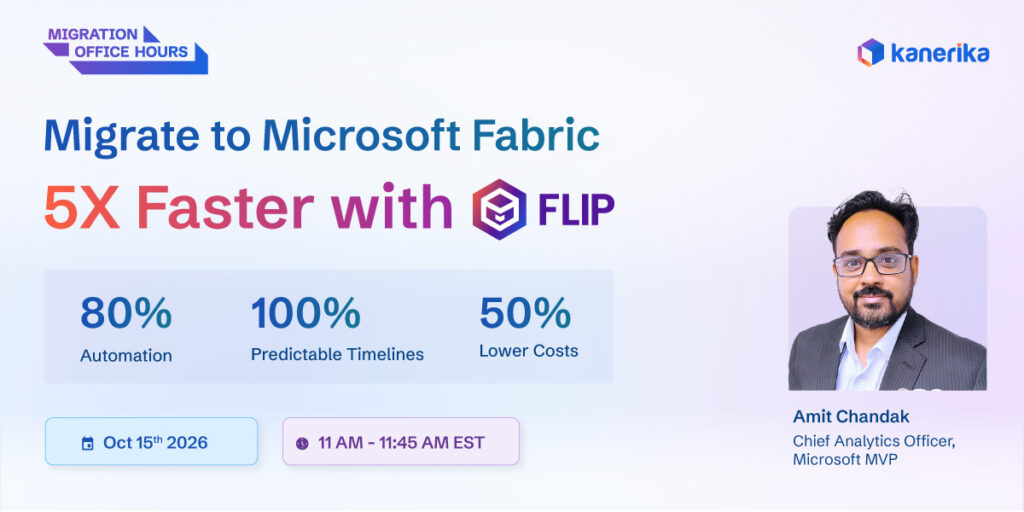
Kanerika’s FLIP migration accelerator has delivered measured results across Tableau to Power BI , Crystal Reports to Power BI , Cognos to Power BI , and SSRS to Power BI migrations – 50 to 60% reduction in migration effort, 40 to 60 percent faster post-migration loading, and 75 percent reduction in annual licensing costs once the legacy stack retires.
For organizations evaluating the role of automation in migration projects, the accelerator-led approach is now the default for any deployment with more than a few hundred reports. The same is true across other BI modernization work streams.
Building the Migration Plan: A Practical Sequence The migration projects that finish on time and on budget tend to follow a similar sequence. The ones that miss tend to skip one of these phases or treat it as optional.
1. Inventory and Rationalize the Existing Estate Before touching the destination, the source estate needs a real inventory. How many Universes, how many Web Intelligence reports, how many Crystal Reports, how many users, how many scheduled jobs.
A surprising number of reports in mature BusinessObjects deployments have not been opened in eighteen months. Rationalization typically removes 20 to 40 percent of the report inventory before migration even starts, which makes the data migration risks significantly easier to manage.
2. Map the Destination Architecture The destination needs its own design. Workspace structure, semantic model boundaries, security model, capacity planning, and the lifecycle process for moving from development to production.
Treating migration as a copy-paste at this stage produces a Power BI tenant that looks like a BusinessObjects deployment running in a different tool, and that defeats most of the value of moving. For more on the architectural side, see our analysis of BI modernization and Microsoft Fabric capacity planning .
3. Run the Accelerator on the Prioritized Estate The accelerator generates draft semantic models and draft reports. The team validates, refines, and parameter-tests against the source.
This is the phase where automation pays back the most, and where the team learns the specific quirks of the BusinessObjects estate that the accelerator surfaces. End-to-end Power BI implementation experience matters most in this phase.
4. Validate, Test, and Run in Parallel Production cutover should not happen without parallel runs against the source. Numbers should match, scheduled reports should fire on the same cadence, and security should resolve to the same users with the same data access.
The same data migration vs data integration discipline applies here – validation is not optional, and parallel runs are the cleanest way to surface logic mismatches before they reach the business.
5. Cutover, Retire, and Recover the Cost Once the parallel period confirms the destination matches the source, the BusinessObjects environment can be retired. That is where the cost reduction actually arrives, because the source platform stops accumulating annual maintenance.
The licensing cost recovery typically pays back the migration project inside 18 to 24 months for mature deployments, and the savings compound year after year for organizations that previously ran significant on-premise infrastructure.
Phase Goal Typical Duration Inventory and rationalize Know what’s actually being used 4 to 8 weeks Map destination architecture Define the target state 4 to 6 weeks Accelerator-led generation Build draft outputs at scale 8 to 16 weeks Validate and parallel run Match source numbers exactly 6 to 12 weeks Cutover and retire Decommission the source 4 to 8 weeks
The duration ranges vary with deployment size. Most mid-market estates land in the lower half of each range; large enterprise deployments tend to land in the upper half.
How Kanerika Approaches BusinessObjects Migrations Kanerika has built migration accelerators for most of the legacy BI platforms enterprises run today, and the same architecture and methodology applies directly to SAP BusinessObjects.
The Migration Paths Kanerika Has Built and Delivered Each of the migration accelerators below is in production and has been used on real enterprise deployments:
Crystal Reports to Power BI : RPT file parsing, formula translation, dashboard generationCognos to Power BI : Framework Manager package extraction, report rebuildSSRS to Power BI : RDL conversion, paginated report mappingTableau to Power BI : Workbook parsing, calculation translation, visual mappingQlik to Power BI : Script translation, expression conversion, model rebuildA SAP BusinessObjects to Power BI accelerator follows the same architectural pattern: Universe metadata extraction, Web Intelligence and Crystal Reports parsing, automated semantic model generation, and a structured migration map for the rebuild team. The same approach underpins Kanerika’s SSAS to Microsoft Fabric migration work and SSIS to Fabric and Azure to Fabric projects.
Case Study: Global Laboratory Informatics Provider Modernizes Reporting with Crystal Reports to Power BI Migration About the Client
A global healthcare information and diagnostics organization serving medical laboratories, public health agencies, and research institutions worldwide. Reporting sits at the center of its compliance, operations, and enterprise performance work.
Challenges
Crystal Reports could not support the interactive analytics and scalable reporting the business now needed High manual effort to build or improve reports slowed development and inflated maintenance cost Reports were tightly coupled with application logic, putting critical workflows at risk during any change Growing data volumes strained the legacy architecture with no clear path to scale Solution
An automation-driven Crystal Reports to Power BI migration that preserved accuracy at scale Kanerika’s FLIP platform handled configuration, execution, and monitoring of report migrations from a single interfaceOriginal report layouts, calculations, and business logic preserved through automated extraction A complexity-based framework standardized conversion across simple, medium, and complex reports Business Impact
60% faster migration vs manual rebuild10x data scale supported in the new Power BI environment99.5% refresh success rate across the migrated estateReusable migration framework established for future Crystal Reports projectsRead the full case study .
The same accelerator architecture and methodology directly applies to SAP BusinessObjects migrations, with the addition of Universe metadata parsing and Web Intelligence report translation specific to the BusinessObjects platform.
What Kanerika Brings to a BusinessObjects Migration The architectural patterns from prior BI migrations transfer directly. What changes is the source platform parsing layer and the Universe to semantic model translation rules.
Microsoft Solutions Partner for Data and AI with Analytics Specialization, including an in-house Microsoft MVP for Power BI on the Chief Analytics Officer roleFLIP migration accelerator available on Azure Marketplace , MACC eligible, with measured results across five existing migration pathsCMMI Level 3, ISO 27001, SOC 2 Type II compliance baseline for enterprise deployments98% client retention across 100+ enterprise clients over more than a decade of data and analytics engagements Existing case studies documenting Crystal Reports , Cognos , SSRS , and Tableau migrations with verified outcomesWhat Happens If You Wait Until 2027 The cost of delay is real, and it compounds. Two patterns repeat across enterprises that pushed the migration past the deadline.
Audit and Compliance Exposure Grows Running an unsupported BI platform in a regulated industry creates a documented audit finding. After December 2027, SAP BusinessObjects 4.3 receives no security fixes, and that becomes a fact that has to be disclosed in audit reviews.
The cost of that exposure is hard to quantify upfront, but it shows up in regulatory conversations, insurance renewals, and customer security reviews. The data governance challenges of running an unsupported platform compound the cost.
Talent and Partner Availability Tightens The pool of BusinessObjects-skilled developers has been shrinking for years, and the migration wave concentrates the remaining experts in a small number of large engagements. The longer you wait, the more expensive and harder to staff the eventual migration becomes.
The same is true for the Power BI partner ecosystem, where migration capacity is fully booked through the 2026 to 2027 window for several of the larger systems integrators. Industry-specific deployments in insurance business intelligence , manufacturing analytics , retail business intelligence , and healthcare data analytics are seeing the same capacity squeeze.
The right time to commit was 18 months ago. The next best time is now.
Wrapping Up SAP BusinessObjects has earned its place in enterprise IT history. The platform shaped how a generation of finance, operations, and IT teams thought about reporting, and it ran the audit binder for two decades. None of that is in question.
What is in question is whether continuing to invest in a platform that SAP is narrowing rather than expanding makes sense when Power BI is the BI market leader, sits inside licenses you likely already own, and integrates natively with the rest of your Microsoft stack. The 2027 deadline forces the conversation. The economics, the talent market, and the product roadmap decide where it ends up. For most enterprises, that destination is Power BI, and the migration is most efficient with an accelerator-led approach rather than a manual rebuild. The right time to scope the move is well before the deadline narrows the available options further.
Frequently Asked Questions
When does SAP BusinessObjects 4.3 reach end of life? SAP BusinessObjects 4.3 mainstream maintenance ends December 31, 2026, and security fixes for high-severity vulnerabilities continue through December 31, 2027. After that, support is available only through Customer Specific Maintenance, which does not include new bug fixes or feature updates. The platform will still run, but new vulnerabilities, OS incompatibilities, and integration issues will not be addressed by SAP.
Is SAP discontinuing BusinessObjects entirely after 2027? No. In 2025, SAP released BusinessObjects BI 2025 and confirmed BI 2027 and BI 2029 with mainstream maintenance guaranteed through at least end of 2031. Both on-premise and Private Cloud Edition deployment options continue. However, the platform is being narrowed: several components including the Universe Design Tool, .unv universes, Live Office, and Lumira Discovery are deprecated in the BI 2025 release.
What is the best alternative to SAP BusinessObjects? Power BI is the most common migration destination for SAP BusinessObjects customers, largely because of its market leadership, native Microsoft 365 and Azure integration, and bundled licensing for many enterprises. SAP Analytics Cloud is the natural choice for organizations deeply committed to the SAP-only roadmap. Tableau is a credible third option for analyst-led visual exploration use cases. The right destination depends on the enterprise’s existing technology stack and analytics maturity.
How long does a typical SAP BusinessObjects to Power BI migration take? Most mid-sized BusinessObjects estates migrate to Power BI in six to twelve months when an accelerator-led approach is used. Larger enterprise deployments with several thousand reports and multiple Universes can take twelve to eighteen months. Manual rebuild approaches typically take twice as long because each report and Universe is reconstructed individually rather than processed through automation.
What is the cost difference between SAP BusinessObjects and Power BI? The cost difference depends on user count and deployment scale, but Power BI is consistently lower total cost of ownership for most enterprises. Power BI Pro licensing is bundled with Microsoft 365 E5, eliminating standalone analytics licensing. The SaaS model removes hardware refresh cycles. Specialized administration overhead drops because Power BI requires less platform-specific expertise than BusinessObjects. Kanerika has documented up to 75 percent reduction in annual licensing costs post-migration when the legacy BO stack fully retires.
Can Power BI handle pixel-perfect reports like Crystal Reports? Yes. Power BI Paginated Reports is designed for fixed-layout, pixel-perfect outputs that match what Crystal Reports has historically delivered. Most regulated reporting, invoices, statements, and audit outputs map cleanly to Paginated Reports without losing fidelity. Paginated Reports requires Power BI Premium capacity or a Premium Per User license, and the migration from Crystal Reports is typically closer to a literal port than the Web Intelligence to Power BI Desktop migration.
Why is the Universe to Power BI semantic model translation difficult? The BusinessObjects Universe encodes complex SQL abstractions, predefined joins, contexts, and derived tables that have often been refined for years. Power BI uses a Tabular semantic model with DAX as the calculation language, and the translation is not literal. Universe contexts, derived tables, and embedded business logic all need to be reproduced using Power BI’s different abstraction model. This is the area where most migrations either succeed or stall, and where automation accelerators deliver the most concentrated value.
Should I migrate to Power BI now or wait for SAP BusinessObjects BI 2027? Most enterprises do not need to wait. BI 2027 extends the on-premise SAP roadmap but does not expand the platform’s capability in ways that change the underlying migration math. The talent market, partner capacity, and audit timeline all favor scoping the migration now rather than after the deadline forces the decision. Organizations deeply committed to SAP-only data sources may have a different calculus, but for the typical Microsoft-aligned enterprise the answer is to start the migration scoping conversation now.