TL;DR
Data migration is a one-time, finite move—shut the old system down once data lands and validates—while data integration keeps multiple live systems continuously synced; most enterprises need migration for historical data and integration to keep active systems talking, and the right pick depends on whether the source system is being retired or staying in use.
A team commits nine months to a CRM migration, then discovers the new system can’t read live pricing from finance or push order status to support tickets. Half the promised outcomes are blocked by what migration didn’t cover.
This is the trap at the data fork. MuleSoft’s 2025 Connectivity Benchmark Report found the average enterprise runs 897 applications, with only 2% properly connected. The call between migration and integration decides whether the next year of work pays off.
Migration and integration both move data, but they solve different problems. Pick the wrong one and rework eats the savings. In this article, we’ll cover a four-question check, how to decide, when to use both, and what changes as AI agents reason across these systems.
Key Takeaways
The Core Distinction: One-Time Move vs. Continuous Flow Data migration is a finite project with a clear start and finish. You move data from one system to another, validate everything works, and then shut down the old system. Think of it like moving houses. You pack everything up, transport it to the new place, unpack, and you’re done.
Most migrations follow predictable timelines. Small migrations with under 5TB of data and simple schemas finish in 3-6 months. Medium complexity projects involving multiple databases and applications take 6-12 months. Enterprise migrations with legacy mainframes, complex data relationships, and regulatory requirements stretch to 12-18 months or longer.
What defines a migration project:
Fixed scope with specific data sources and destinations Clear timeline with measurable milestones One-time execution with a cutover date Legacy system gets retired after successful completion Project team disbands once everything validates successfully
Companies migrate when data center leases expire, vendor support ends, or maintenance costs become unsustainable. You might be running an old ERP system that can’t support your business anymore. Migration lets you move that data into a modern system and finally turn off those expensive servers.
Data Integration: Ongoing Operations Data integration keeps systems talking to each other continuously. Your e-commerce platform needs real-time inventory data from your warehouse system. Your CRM needs customer purchase history from your billing platform. These connections run 24/7 and never stop.
Integration projects don’t end. You launch, monitor, optimize, and maintain the integration indefinitely. As your business adds new systems or changes processes, you add more integrations or modify existing ones.
What defines an integration operation:
Permanent connections between active systems Data flows automatically based on triggers or schedules Information moves in real-time or near real-time Systems stay operational and keep generating new data Requires ongoing monitoring and maintenance
Your sales team adopts a new tool. You need integration with your existing systems. Your supplier changes their API. You adjust your integration. Business requirements shift constantly, and your integrations shift with them.
Why Most Organizations Need Both Approaches Real businesses run on a mix of migration and integration. You migrate your old customer database to a new CRM platform. But you still need integration between that CRM and your marketing automation tool , support ticketing system, and billing platform. One doesn’t replace the other.
Some companies migrate first, then build integrations in the new environment. Others set up integrations between old and new systems during migration to keep business running smoothly. The simultaneous approach costs more upfront but reduces disruption.
Migration cleans up your technical debt and consolidates systems. Integration connects what remains so data flows where it needs to go. Together, they create a modern, connected technology environment.
Data Migration vs Data Integration: Key Differences Explained Feature / Aspect Data Migration Data Integration Definition Moving data from one system to another, usually to replace the old system Connecting multiple active systems so they can share data Primary Purpose Shift data during upgrades, cloud moves, or legacy replacement Keep data aligned for analytics and workflows Process Type One-time or phased project with a clear end Ongoing process that runs continuously Technology Used Bulk transfer, transformation, and validation ETL, ELT, and APIs (real-time or scheduled) Scope Between a source system and a new target system Across multiple systems and teams Frequency Occasional, tied to major system changes Continuous or scheduled Business Impact Prevents data loss during system transitions Improves visibility and decision-making Analytics Impact Unlocks historical data for analysis Keeps dashboards current and consistent Key Challenges Data loss, downtime, mapping, and security risks Data quality , sync delays, and API limits Typical Tools Migration tools , ETL utilities, automation, validation tools Integration platforms, APIs, monitoring tools
5 Critical Factors to Decide the Right Data Approach for Your Business Run through each factor below. The answer points clearly to one approach, or tells you both are in play.
1. System Decommissioning Timeline If a system is going away, migration makes sense. The vendor is ending support, the data center lease expires, or mainframe maintenance has become too costly. These scenarios demand migration because integration would be temporary and wasteful.
If every system stays running, integration is the answer. You’re not replacing anything, you just need data to flow between tools. Building an integration between an existing warehouse management system and an existing accounting platform keeps both running without the cost and risk of a full migration.
Watch out for indefinite delays. Technical debt compounds, and old systems get harder to maintain every year. Forced migrations under crisis conditions cost three to five times more than planned ones.
Decision cue: Sunset date within 18 months points to migration. No sunset planned points to integration.
2. Data Freshness Requirements Real-time needs favor integration. A customer service rep needs current order status during a live call, and a batch process running overnight won’t work. Historical reporting that doesn’t need instant access runs fine on scheduled transfers.
A quick freshness framework:
Needed within seconds during live interactions, use real-time integration Needed shortly after events, use near-real-time integration Needed within the same business day, use scheduled integration or micro-batches Reviewed for reporting or audits, use batch transfers Accessed rarely, manual exports or one-time migration may be enough Real-time integration costs more because it needs failover, monitoring, and resilient infrastructure. Batch processes cost less but limit freshness. Balance actual business need against the premium for instant data.
Decision cue: Minutes-level freshness points to integration. Daily or slower points to batch or migration.
3. Budget Structure Migration hits the budget once. Software, services, infrastructure, and testing get paid for, then it’s done. This works if capital budget is available but operational budget is tight.
Integration platforms charge monthly or annual fees indefinitely. If capital budget is tight but operational budget exists, integration fits better.
Calculate migration costs including licensing, services, downtime, and training. Calculate integration costs over 36 months including platform fees, data transfer, and maintenance. Many companies find integration costs less over three years for systems that all stay operational.
Decision cue: Capex-heavy budget favors migration. Opex-heavy budget favors integration.
4. Organizational Change Readiness A team has to learn a new system after migration. Processes change, some employees resist, and cutover planning is real work. Budget for change management or the migration fails even if the technical work succeeds.
Integration needs someone watching for failures, optimizing performance, and updating connections when APIs change. Without those skills internally, factor in training or managed services.
Assess honestly what the team has versus what each approach needs. Migration usually needs database expertise and project management, while integration needs API knowledge and monitoring capability. The gap between current and required skills drives total cost and risk.
Decision cue: Teams with migration PM and DBA depth handle migration well. Teams with API and DevOps depth handle integration well.
5. Data Volume and Velocity Under 1TB, either approach works. Between 1 and 10TB, migration gets more complex but is manageable. Over 100TB, a phased migration or keeping some systems integrated is usually smarter than migrating everything.
Low-velocity data that rarely changes migrates easily. High-velocity data that’s constantly updating creates a moving-target problem during migration. Streaming integration handles high velocity better than trying to migrate a changing dataset.
If data grows 50% annually, factor that in. A 10TB system today might be 30TB in three years. Migration timelines and costs scale with volume, while integration costs scale more predictably.
Decision cue: Large volume with low change points to migration. Small-to-medium volume with high change points to integration.
Common Misconceptions About Migration and Integration 1. Why Migration Alone Isn’t Enough A CRM migration solves one problem and creates another. The new CRM needs live data from billing, support, marketing tools, and an analytics warehouse. Migration closed one gap and opened several integration requirements.
Most companies can migrate about 80% of their systems over time. The remaining 20% stay separate for good reasons. Vendor constraints, regulatory rules, acquired systems, and specialty tools all keep platforms out of scope, and those systems need ongoing integration with the migrated environment.
Budget for post-migration integration. A company spends $200,000 on migration, then discovers it needs another $100,000 in integration work to make the new system genuinely useful. Plan for both from the start.
2. Why Integration Doesn’t Eliminate the Need for Migration Keeping old systems running through integration doesn’t remove technical debt. That legacy system still needs patches, specialized skills, and maintenance. Integration buys time, not a cure.
Old systems get slower. Integration can’t fix poor performance in the source. If a legacy database takes 30 seconds to run a query, the integration platform still waits 30 seconds.
Eventually old systems become unmaintainable. Skilled staff retires, vendors stop supporting ancient software, and hardware fails with no replacement available. Integration might work for five years, but at some point migration becomes unavoidable.
3. Why Cloud Migration Doesn’t Solve Integration Challenges Lifting an application to the cloud without changing it doesn’t create integration capability. The lifted-and-shifted app still can’t talk to other systems unless connections get built.
Cloud systems need integration too. AWS talks to Azure, Salesforce needs data from Google Cloud databases, and SaaS tools need to sync with each other. Cloud migration changes where integration happens, not whether it’s needed.
Most companies keep some systems on-premises and move others to cloud. Now integration has to span on-premises, AWS, Azure, and SaaS applications. Hybrid environments make integration harder, not easier.
4. Why ETL Tools Can’t Handle Both Equally Traditional ETL tools are built for batch data movement. They struggle with real-time streaming. API-based integration platforms handle real-time well but aren’t optimized for massive batch migrations.
Some vendors claim their platform does everything. Usually those multi-purpose tools do several things adequately and nothing exceptionally. Purpose-built migration tools offer features for one-time moves, and purpose-built integration platforms optimize for continuous flow.
Use migration tools for large database moves, integration platforms for ongoing API connections, and streaming platforms for real-time event processing. Forcing one tool to do everything leads to compromises in performance, cost, or capability.
Data Ingestion vs Data Integration: Which One Do You Need? Understand data ingestion vs integration: key differences & Kanerika’s approach to seamless data handling.
Learn More
When Should a Business Choose Data Migration and Data Integration? Most decisions fall into one of three patterns. The trick is spotting which one matches the situation before committing resources.
When Migration Is the Right Call Legacy systems can’t scale with the business and need to be replaced Moving databases from on-premises servers to cloud platforms Consolidating systems after a merger or acquisition Rolling out a new ERP or CRM that needs all historical data loaded Preserving records for compliance while the underlying system changes When Integration Is the Right Call Multiple systems remain in active use and must share data Teams depend on current data in dashboards, alerts, or workflows Analytics pulls from many sources into one reporting layer Cross-system processes need to run automatically The business wants flexibility to add or swap tools over time When Both Are Needed at Once Scenario What Happens Phased system replacement Core data migrates first, integration keeps old and new systems in sync during cutover Cloud modernization Historical data moves in bulk, integration connects cloud tools to remaining on-premises systems Mergers and acquisitions Historical data consolidates into one platform, integration keeps active systems sharing data Enterprise data platform build-out Large datasets migrate into a warehouse, integration feeds ongoing data from source systems Risk-managed transitions Both methods run together so teams can validate and cut over in stages
How Do Data Migration and Data Integration Affect Analytics? Migration and integration are important factors in how businesses use data to generate analytics . Migration provides access to historical and operational data in the appropriate system. On the other hand, Integration makes sure that data from various sources is linked together and is updated in real-time.
How Data Migration Improves Analytics Getting old data into new systems: Migration takes data stuck in outdated systems and puts it where modern tools can use it. Your old records become available in cloud warehouses and BI platforms, and now you can actually analyze information that was locked away before. Seeing the bigger picture over time: When you migrate years of data, you can spot patterns you missed and see how sales changed over the seasons. Track performance across decades, which helps with forecasting and understanding how your business has grown. Cleaning up messy data: Migration forces you to fix problems. Duplicate records are removed, dates are formatted consistently, and field names are standardized. Your analytics work better when the data underneath is clean. Making cloud analytics possible: After moving data to the cloud, you get access to powerful tools. Run complex queries faster, build better visualizations, and your old servers no longer hold you back.
How Data Integration Improves Analytics Bringing all your data together: Integration connects sales numbers with financial data, marketing metrics with operational data. Instead of jumping between systems, teams see everything in one report . Watching changes as they happen: Connected systems feed live data to dashboards. Managers see metrics updates throughout the day and alerts fire when something needs attention. Therefore, no more waiting for weekly reports. Getting everyone on the same page: Integration makes sure all systems use the same definitions. Revenue means the same thing in every report, and numbers match across departments.Making smart predictions possible: AI and forecasting tools need complete, current data. Integration provides a steady stream of information that these tools require. Better data means better predictions. Without proper migration, analytics may miss key historical data . Without integration, insights may be delayed or incomplete due to disconnected systems.
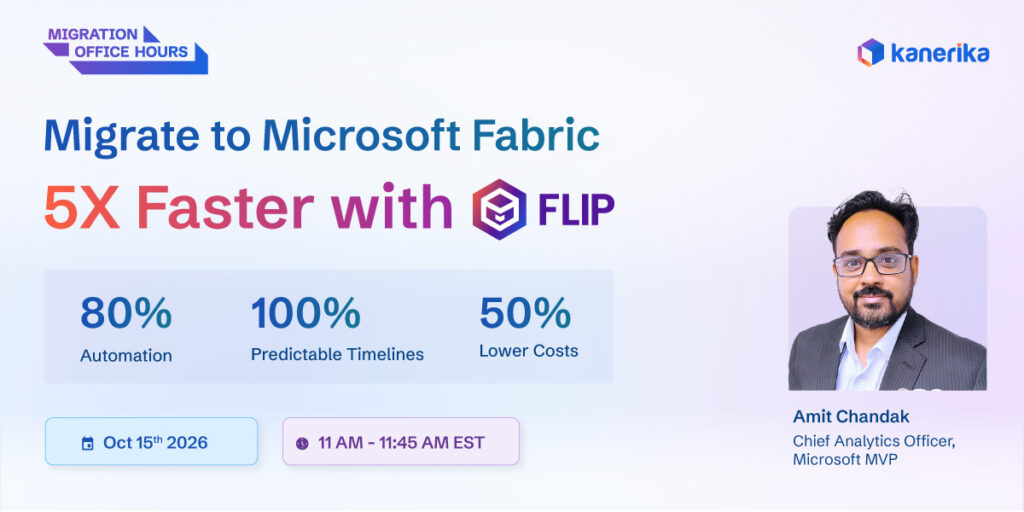
Kanerika’s End-to-End Support for Data Migration and Integration Projects At Kanerika, we specialize in helping businesses move from legacy systems to modern platforms with minimal disruption. Our FLIP migration accelerators make it faster and easier to transition from tools like Informatica, SSIS, Tableau, and SSRS to platforms such as Talend, Microsoft Fabric, and Power BI. We handle the entire process—from assessment to execution—so your data stays accurate, secure, and ready for use.
We also help link systems within your organization to ensure data flows freely and without security concerns . You can use cloud-based or on-premise, or a combination of both, and we ensure that information flows continuously. We are also working on real-time data sync , API automation, and cloud-ready solutions that minimize system gaps. This provides the teams with good information, improved reports, and the day-to-day workings.
What makes our approach different is how closely we work with your team. We take the time to understand your goals, systems, and real challenges. Based on that, we build migration and integration plans that fit how your business actually runs, not just how the technology works. Our work spans various industries, including banking, retail, logistics, healthcare, and manufacturing, and we’ve helped clients reduce costs, enhance data security , and gain better insights.
With Kanerika, you get more than just a service provider; you get a trusted partner in data migration vs data integration. Whether you’re upgrading platforms, connecting systems, or preparing for AI and advanced analytics , we’re committed to making your data work smarter. Let us help you turn your data into a real business advantage .
Modernizing Reporting with SSRS to Power BI using FLIP Challenge The client used SSRS for reporting but the setup became rigid. Reports were fixed and slow to update. SQL changes created risk. Business teams depended on IT for even small edits. Report performance varied, and this slowed decision-making while increasing the IT workload.
Solution Kanerika used the FLIP method to move the client to Power BI . Metadata and queries were extracted automatically to cut manual work. Dashboards were rebuilt with interactivity. Existing logic was preserved through careful mapping. Validation checks confirmed accuracy and performance. Self-service access allowed business teams to explore information without waiting for IT.
Result • 40% reduction in manual report work
Enhancing Operational Efficiency through Data Integration Challenge The client operated many SAP and non-SAP systems, which created isolated data sources. Manual consolidation caused delays and errors. Reports lacked timely updates. Teams did not have a single trusted view of financial and operational data which slowed planning.
Solution Kanerika built a unified reporting layer with Power BI and Azure. Data from all systems was brought into one consistent model. Automated pipelines replaced manual steps. Standard models improved reporting quality. Near real-time access, supported everyday visibility, and self-service options helped teams work independently.
Result • 60% reduction in manual consolidation effort
Conclusion Migration and integration solve different problems and often get picked for the wrong reasons. Migration fits when systems are being retired. Integration fits when systems stay live and need to share data.
Most businesses need both at the same time, and teams that plan for that combination upfront move faster than those that treat each project as separate. The stakes got higher in 2026 because AI agents now reason across these same systems. Get the foundation right, and everything downstream gets easier.
FAQs
What is the difference between data migration and data integration? Data migration is a one-time transfer of data from one system to another, typically during platform upgrades or cloud transitions. Data integration, in contrast, establishes ongoing connections between multiple systems to enable continuous data flow and synchronization. Migration focuses on moving and transforming data permanently, while integration maintains real-time or scheduled data exchange across applications without relocating the source data. Both processes require careful planning around data quality, mapping, and validation. Kanerika helps enterprises navigate both strategies with tailored solutions that minimize disruption and maximize data accuracy.
What is data integration and migration? Data integration connects disparate systems to enable unified data access and real-time synchronization across your enterprise. Data migration involves permanently relocating data from legacy systems to modern platforms like cloud environments or data warehouses. Integration supports ongoing operational workflows, while migration serves transformation initiatives such as system consolidation or platform modernization. Organizations often need both capabilities at different stages of their digital transformation journey. Kanerika delivers comprehensive data platform migration and integration services designed to unify your data ecosystem efficiently.
What are the four types of data migration? The four primary types of data migration are storage migration, database migration, application migration, and cloud migration. Storage migration moves data between physical or virtual storage systems. Database migration transfers data between database platforms, such as SQL Server to Microsoft Fabric. Application migration involves moving data when replacing enterprise applications. Cloud migration relocates on-premises data to cloud infrastructure. Each type requires distinct validation and transformation strategies to ensure data integrity throughout the process. Kanerika specializes in all four migration types with proven accelerators that reduce project timelines significantly.
What are the types of data integration? Common types of data integration include ETL-based integration, real-time data integration, application integration, and data virtualization. ETL extracts, transforms, and loads data into centralized repositories. Real-time integration synchronizes data continuously across systems as changes occur. Application integration connects enterprise software through APIs and middleware. Data virtualization provides unified access without physically moving data. Each approach serves different business requirements around latency, volume, and system architecture. Kanerika implements integration solutions using platforms like Microsoft Fabric and Databricks tailored to your specific data unification needs.
When should a business choose data migration over data integration? Choose data migration when decommissioning legacy systems, consolidating data centers, or transitioning to modern platforms like cloud data warehouses. Migration suits scenarios where source systems will be retired and data needs permanent relocation. Integration is better when source systems remain operational and require ongoing data exchange. Migration projects also fit regulatory compliance initiatives requiring data centralization or archival. The decision depends on your infrastructure roadmap and whether systems need retirement or continuous connectivity. Kanerika assesses your environment to recommend the optimal approach for your transformation goals.
Are data migration and data integration used together? Yes, data migration and data integration frequently work together in enterprise transformation projects. Organizations often migrate historical data to a new platform while simultaneously establishing integration pipelines for ongoing data flows from operational systems. For example, migrating a legacy ERP to cloud while integrating real-time sales data from CRM systems requires both approaches. This combined strategy ensures complete data consolidation plus continuous synchronization post-migration. Executing both in parallel demands careful orchestration and governance. Kanerika delivers unified migration and integration solutions that work seamlessly together for comprehensive data modernization.
What are the main challenges in data migration vs data integration? Data migration challenges include data loss risk, extended downtime, schema incompatibility, and validating completeness after transfer. Integration challenges center on maintaining real-time synchronization, managing API dependencies, handling data format inconsistencies, and ensuring latency meets business requirements. Both approaches face data quality issues, governance complexities, and transformation logic errors. Migration carries higher one-time risk, while integration demands ongoing monitoring and maintenance. Proper planning, testing environments, and rollback strategies mitigate these challenges significantly. Kanerika employs proven methodologies and automated validation frameworks to address these challenges across migration and integration projects.
Which is more important for analytics: data migration or data integration? Data integration is typically more critical for analytics because it enables continuous data flow from multiple sources into analytics platforms, ensuring dashboards and reports reflect current information. However, data migration becomes essential when establishing a modern analytics foundation by moving historical data to platforms like Microsoft Fabric or Databricks. Effective analytics requires both: migrated historical datasets for trend analysis and integrated real-time feeds for operational intelligence. The relative importance depends on whether you need retrospective insights or live monitoring capabilities. Kanerika architects analytics-ready data environments combining migration and integration for complete intelligence coverage.
Which tool is best for data migration? The best data migration tool depends on your source and target platforms, data volume, and transformation complexity. Microsoft Fabric excels for organizations within the Microsoft ecosystem requiring unified analytics migration. Databricks suits large-scale lakehouse migrations with complex transformations. Informatica and Talend offer robust enterprise capabilities for heterogeneous environments. Cloud-native tools like AWS DMS or Azure Data Factory streamline cloud migrations specifically. Evaluate tools based on connector availability, transformation capabilities, and automation features for your specific migration scenario. Kanerika provides tool-agnostic expertise and proprietary accelerators that optimize migration execution regardless of platform choice.
What tools are commonly used for data migration and data integration? Common data migration tools include Microsoft Fabric, Azure Data Factory, AWS Database Migration Service, Informatica PowerCenter, and Talend. Popular data integration tools encompass MuleSoft, Dell Boomi, Apache Kafka for streaming, Fivetran, and Airbyte. Many platforms like Microsoft Fabric and Databricks support both migration and integration workflows within unified environments. Tool selection depends on your existing infrastructure, real-time requirements, and target architecture. Enterprise projects often combine multiple tools for different data sources and use cases. Kanerika maintains deep expertise across these platforms and helps organizations select the optimal toolset for their requirements.
What role does data quality play in both approaches? Data quality is foundational to successful data migration and data integration outcomes. During migration, poor quality data transfers problems to new systems, creating technical debt and unreliable analytics. In integration scenarios, inconsistent data flowing between systems causes synchronization failures and erroneous reporting. Both approaches require data profiling, cleansing, and validation processes before, during, and after execution. Implementing data governance frameworks ensures quality standards persist across all data movement activities. Organizations that neglect quality assurance face costly remediation and user distrust. Kanerika embeds data quality management into every migration and integration engagement for reliable, trustworthy results.
Is ETL the same as data migration? ETL and data migration are related but distinct concepts. ETL describes a process methodology that extracts data from sources, transforms it according to business rules, and loads it into target systems. Data migration refers to the broader initiative of moving data between systems, which often uses ETL as its execution mechanism. Migration encompasses project planning, validation, cutover strategies, and decommissioning that extend beyond ETL processes alone. You can perform migration using ETL tools, but migration projects involve additional governance and coordination activities. Kanerika leverages ETL best practices within comprehensive migration frameworks that ensure complete, validated data transfers.
Is ETL considered integration? Yes, ETL is a foundational data integration technique used to unify data from multiple sources into centralized repositories like data warehouses. ETL pipelines extract data from disparate systems, apply transformations for consistency, and load unified datasets for analytics and reporting. However, modern data integration encompasses additional patterns beyond traditional ETL, including real-time streaming, API-based integration, and data virtualization. ETL remains particularly effective for batch-oriented integration scenarios where transformation complexity requires staged processing. Kanerika implements ETL-based integration alongside modern approaches like ELT and streaming to match your specific latency and complexity requirements.
What is an example of data migration? A common data migration example is moving from an on-premises SQL Server database to Microsoft Fabric or Azure cloud infrastructure. This involves extracting all historical records, transforming schemas to match the target platform structure, loading data into the new environment, and validating completeness before decommissioning the legacy server. Another example is migrating from Informatica ETL pipelines to Databricks, which requires converting transformation logic while preserving business rules. ERP system replacements, such as moving from legacy systems to SAP S/4HANA, represent large-scale migration projects. Kanerika has delivered hundreds of migrations across these scenarios with proven accelerators.
How can a business decide which approach is right? Evaluate whether source systems will be retired or must remain operational to determine between data migration and data integration. If decommissioning legacy platforms, migration transfers data permanently to new systems. If source systems continue operating and require ongoing data exchange, integration maintains continuous connectivity. Consider your analytics requirements: historical analysis needs migrated datasets, while operational dashboards need integrated real-time feeds. Budget, timeline, and technical complexity also influence the decision, as migration is typically a bounded project while integration requires sustained investment. Kanerika conducts thorough assessments to recommend the right approach aligned with your business objectives.
Is data ingestion the same as ETL? Data ingestion and ETL overlap but serve different purposes within data pipelines. Data ingestion focuses on capturing and landing raw data from sources into storage layers with minimal transformation, prioritizing speed and volume. ETL includes ingestion but adds substantial transformation logic before loading data into structured repositories. Modern architectures often separate these functions: ingestion pipelines rapidly land data in lakes, then ETL or ELT processes transform it for specific use cases. Streaming ingestion tools like Kafka differ significantly from batch ETL platforms in latency characteristics. Kanerika designs data architectures that optimize both ingestion and transformation layers for your performance requirements.
Will ETL be replaced by AI? AI will augment rather than replace ETL processes entirely. Machine learning enhances ETL through intelligent data mapping, automated schema detection, anomaly identification, and self-healing pipelines that adapt to source changes. AI-powered tools can generate transformation logic and optimize pipeline performance automatically. However, ETL fundamentals of extraction, transformation, and loading remain essential regardless of automation level. Organizations increasingly adopt AI-augmented integration platforms that combine traditional ETL reliability with intelligent automation capabilities. The future involves smarter, more autonomous data pipelines rather than ETL elimination. Kanerika integrates AI capabilities into data pipelines to accelerate development and improve pipeline resilience.
Can Kanerika support projects that need both migration and integration? Kanerika specializes in comprehensive data modernization projects requiring both migration and integration capabilities. Our teams have executed complex engagements involving legacy system migrations to Microsoft Fabric, Databricks, and Snowflake while simultaneously establishing real-time integration pipelines for operational systems. We use proprietary accelerators that reduce migration timelines and proven integration frameworks ensuring reliable data synchronization. Our unified approach addresses data quality, governance, and validation across both workstreams. Whether consolidating analytics infrastructure or building connected data ecosystems, we deliver end-to-end solutions. Connect with Kanerika for a free assessment of your migration and integration requirements.