TL;DR
SSIS to Microsoft Fabric migration is now a time-sensitive move, not just a modernization option, after Microsoft’s SSIS 2025 GA announcement deprecated several legacy SSIS components outright — teams still running classic SSIS pipelines need a migration plan before those components lose support.
At Microsoft Ignite in late 2025, Microsoft announced SSIS 2025 as generally available, marking a turning point for enterprise data teams evaluating SSIS to Microsoft Fabric migration. Several long-standing components were deprecated outright, including the Legacy Integration Services Service, the SSIS Package Store, Attunity CDC components, and the Microsoft Connector for Oracle .
At the same time, FabCon 2026 followed with Data Agents reaching GA, Fabric IQ launching as a platform-level AI assistant, and OneLake Security moving toward full GA. For teams still running SSIS pipelines, the direction is clear: Microsoft’s active investment is in Fabric, and SSIS is entering a maintenance phase.
A 2024 SnapLogic survey found that businesses spend an average of $2.9 million annually maintaining and upgrading legacy systems SnapLogic , with 65% of organizations now investing more than $2 million annually in legacy maintenance, double the figure from five years prior. Meanwhile, Fabric has reached 28,000+ organizations in production , with teams consolidating data engineering, analytics, and governance onto one platform rather than managing separate tools.
Many SSIS environments were built years ago and now carry ongoing maintenance overhead, manual scaling requirements, and growing integration complexity. In this blog, we explore what SSIS to Microsoft Fabric migration involves, why organizations are making the shift, and how Kanerika’s FLIP accelerator compresses a months-long migration into weeks.
Key Takeaways Legacy systems like SSIS are shifting into maintenance mode as enterprises move toward modern, cloud-native platforms with continuous innovation.Rising maintenance costs and operational inefficiencies are making legacy environments increasingly unsustainable for growing data needs. Scalability and performance limitations in older architectures restrict the ability to handle large data volumes and real-time workloads. Modern platforms consolidate data engineering , analytics, governance, and AI into a unified, scalable ecosystem. Automated migration solutions reduce timelines, minimize errors, and ensure business logic is preserved during the transition.
Why Migrate from SSIS to Microsoft Fabric? SSIS packages that ran reliably five years ago frequently fail under today’s data loads . Organizations lose $322 billion annually to productivity gaps, and slow ETL processes are a major contributor. The issues compound across three areas.
1. Scalability and Performance Bottlenecks Single-server architecture means every performance problem gets solved with hardware, not configuration. As data volumes grow, the ceiling drops lower.
Memory limitations cause packages to fail during peak loads and high-volume processing windows Single-server processing creates performance ceilings that hardware upgrades only temporarily raise Package execution times grow as data volumes increase, compounding delays across dependent workflows Complex transformations consume excessive CPU on aging hardware, slowing downstream warehouse operations
2. Infrastructure and Cloud Readiness Gaps SSIS ties operations to physical servers and licensing structures that scale poorly. Cloud environments, distributed sources, and modern authentication sit outside what it was built to support.
SQL Server licensing scales by core count, with physical server maintenance, disaster recovery, and capacity planning adding overhead at every stage Cloud storage integration requires complex workarounds, with managed identities and modern authentication patterns unavailableProcessing is batch-only; real-time streaming, event-driven architectures, and CI/CD workflows fall outside what SSIS was built to support
3. What Microsoft Fabric Offers Instead Fabric replaces server-bound infrastructure with auto-scaling, built-in governance, and native AI on one platform. Two significant additions landed in 2026: OneLake Security reached GA for unified governance, and Fabric IQ launched as a platform-level AI assistant.
Fabric consolidates data engineering , warehousing, analytics, and reporting on one platform, with OneLake Security and Fabric IQ covering governance and AI assistance Compute resources scale automatically, with pause-and-resume capabilities removing charges during idle periods Built-in Git integration supports CI/CD workflows, with multi-user development enabled across shared workspaces Organizations adopting Fabric report 25% productivity gains and a 90% reduction in time spent searching, integrating, and debugging data workflows
Migrating from SSIS to Microsoft Fabric? Kanerika has a structured SSIS → Fabric migration framework.
Book a Meeting
Before You Migrate: Assessing Your SSIS Environment Most migration delays trace back to a skipped or rushed assessment. Teams discover mid-project that packages have undocumented dependencies, custom scripts requiring full rewrites, or authentication models that break in cloud environments. Kanerika’s FLIP runs a pre-migration extraction utility that removes these surprises before they become problems.
Inventories every .dtsx file, its execution schedule, and upstream and downstream dependencies Scores each package by complexity: simple (source-to-destination), medium (conditional logic, looping), or complex (Script Tasks, COM components, third-party assemblies) Flags Script Tasks with C# or VB.NET code that fall outside automated conversion and require manual rewriting Maps all connection strings and authentication dependencies, catching OLE DB connections that break under Entra ID Surfaces business logic held in package configurations that a manual rewrite would miss or approximate incorrectly
SSIS vs Microsoft Fabric: A Side-by-Side Comparison The table below covers the main differences across infrastructure, pricing, development environment, and capabilities.
Feature SSIS Microsoft Fabric Platform Type On-premises ETL within SQL Server End-to-end cloud analytics platform Infrastructure Requires dedicated Windows servers and SQL Server installation Fully managed cloud service with no infrastructure management Pricing Model Fixed licensing cost per core plus SQL Server licensing Pay-as-you-go consumption, from $0.024/GB storage monthly Scalability Limited by physical server resources and manual scaling Auto-scaling based on workload demand Development Environment SQL Server Data Tools (SSDT) on local machines Web-based interface accessible from any browser Version Control Manual export/import with limited Git integration Built-in CI/CD with native Git integration Authentication SQL Server and Windows authentication Microsoft Entra ID for centralized identity-based security Real-Time Processing Batch processing only Real-time streaming and batch processing Collaboration Single developer per package with limited sharing Multi-user development with shared workspaces Monitoring Basic SQL Server logging and custom solutions Built-in monitoring and alerting across all workloads Machine Learning Requires separate ML services integration Native AI and ML , plus Fabric IQ platform-level AI assistant Maintenance Manual patching, updates, and server maintenance Automatic updates handled by Microsoft Disaster Recovery Manual backup and restore with additional infrastructure Built-in high availability and disaster recovery
The Challenge with Traditional Migration Approaches SSIS to Microsoft Fabric migration typically takes months of manual work. Most organizations underestimate what is involved, and the shortfalls compound across timeline, error rate, and resource consumption.
Inconsistent Conversion Standards Across Teams: Different developers handle conversion differently, leading to varied code quality and future maintenance challenges. What works for one package may produce a different implementation on a similar one, creating technical debt in the new environment.Project Timeline Delays: Manual conversion processes are unpredictable and consistently run longer than planned. Teams frequently underestimate the time needed to analyze package dependencies and rewrite complex transformation logic for cloud-native architectures.High Error Risk During Conversion: Minor mistakes in data mapping or transformation logic lead to inconsistencies, historical data loss, or extended system downtime. Manual rewriting introduces human error at every stage of the process.Resource-Intensive Requirements: Manual migration demands expertise in both SSIS internals and Microsoft Fabric architecture, which most teams lack in-house. This creates expensive hiring or consulting requirements for the duration of the project.Business Logic Documentation Gaps: Critical business rules often exist only in SSIS package configurations. Manual migration requires reverse-engineering this logic, which takes significant time and risks losing processing details accumulated over years of operation.Testing Complexity That Scales with Package Count: Every manually converted component needs individual testing and validation. The more packages in scope, the more testing scenarios required, extending go-live dates significantly.
How SSIS Components Map to Microsoft Fabric Before starting migration, teams need a clear picture of how existing components translate. Most standard SSIS components have direct Fabric equivalents that automated tools can handle. Custom Script Tasks and third-party assemblies require manual redesign regardless of the migration method used.
Script Tasks using C# or VB.NET, COM components, and third-party connector assemblies fall outside automated conversion. These require redesign using PySpark notebooks or Azure Functions. Identifying them before migration starts is what makes the pre-migration assessment worth running carefully.
SSIS Component Microsoft Fabric Equivalent Notes Data Flow TaskDataflow Gen2 Power Query-based transformation engine; handles most standard flows directly Control Flow / Execute Package Task Data Pipeline Activity-based orchestration with parallel execution and dependency management Execute SQL Task Script Activity / Stored Procedure Activity Direct SQL execution; maps cleanly in most cases Foreach Loop Container ForEach Activity in Pipeline Near-direct equivalent; iteration logic preserved automatically OLE DB Source / Destination Fabric Warehouse Connector SQL Server connections replaced with Entra ID authentication Flat File Source / Destination OneLake Connectors CSV and text files accessed via ADLS Gen2 within OneLake Script Task (C# / VB.NET) Notebook Activity (Python / PySpark) Requires manual rewriting; FLIP flags these for review Package Configurations Pipeline Parameters / Key Vault Environment-based config replaced with secure parameter management SSIS Catalog (SSISDB) Fabric Workspace / Git Integration Deployment and version control handled natively in Fabric
Making SQL Server to Microsoft Fabric Migration Faster with Kanerika’s FLIP Most companies still run SQL Server services like SSIS, SSAS, and SSRS. These tools work, but they cannot keep pace with what modern data infrastructure requires. Moving them manually takes months, introduces errors, and consumes resources that should go toward building new capabilities.
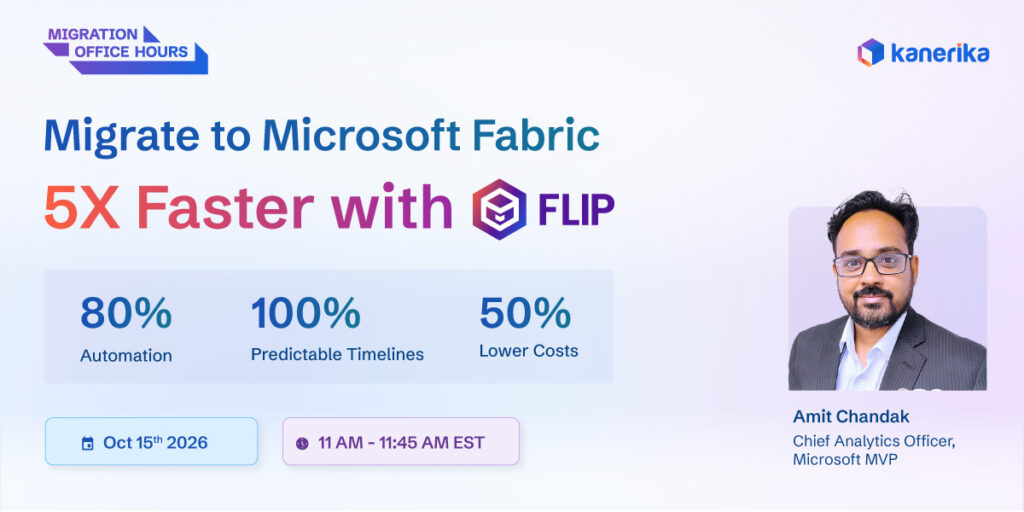
Kanerika built the FLIP accelerator to solve this. It converts SQL Server components to Fabric automatically, handling SSIS, SSAS, and SSRS simultaneously or in stages. Environments with 50 to 100 pipelines finish in 2 to 3 weeks. Complex environments with 500 or more pipelines complete in 6 to 8 weeks. FLIP reduces migration effort by 75% compared to manual conversion.
Step 1: Extract Your SQL Server Components FLIP pulls SSIS packages, SSAS models, and SSRS reports from their current location and saves them as standard files. All business logic, transformations, and settings are preserved during extraction, with nothing approximated or discarded.
SSIS packages export with complete workflows and transformation rules intact SSAS models retain cube structures, dimensions, measures, and calculations SSRS reports maintain layouts, parameters, queries, and formatting
Step 2: Bundle and Upload to FLIP Package the extracted files and upload them to the FLIP platform, selecting the target Fabric workspace during this step. All three SQL Server components can be uploaded at once or migrated separately in phases based on the rollout preference.
Step 3: Let FLIP Handle the Conversion FLIP analyzes the uploaded files and begins converting them to Fabric equivalents. Standard packages complete in minutes rather than the weeks required for manual work.
SSIS packages become Fabric data pipelines that move and transform data exactly as before SSAS models become Fabric semantic models with all analytical relationships and calculations preservedSSRS reports convert to Power BI reports with visuals and parameters intact
FLIP flags any custom Script Tasks or non-standard components that fall outside automated conversion, surfacing them for manual review rather than producing incorrect output silently.
Step 4: Deploy to Your Fabric Workspace Converted components appear in the Fabric workspace ready for use. Data pipelines land in the Data Factory section. Semantic models go into the Power BI section with all relationships intact. Reports are available immediately through standard Fabric access controls.
Business Benefits of Migrating with FLIP: ROI and Efficiency Gains FLIP cuts migration time, reduces error rates, and lowers the resource overhead required to move from SSIS to Fabric. The impact shows up across five areas.
Clean Architecture from Day One: FLIP produces standardized Fabric components that follow Microsoft best practices from the start. Every converted component is production-ready, with documentation generated automatically and no additional cleanup required.Migration in Weeks, Rather than Months: Manual SSIS migration takes 3 to 6 months for complex environments. FLIP reduces this to 2 to 8 weeks by automating package analysis, logic conversion, and component deployment. Multiple packages are processed simultaneously rather than sequentially.Lower Error Rate Across the Full Portfolio: Automated conversion applies the same methodology to every package in the environment. Validation checks catch issues before they reach production, removing the inconsistencies that come with manual code conversion.Reduced Resource Requirements: FLIP cuts the consultant hours and specialized expertise needed for a successful migration. Internal teams can manage the process with minimal external support, keeping senior developers focused on strategic platform work.Business Logic Preserved Exactly: FLIP captures the exact transformation rules and processing logic from original SSIS packages. Institutional knowledge held in package configurations carries over intact, with automated documentation generated for data lineage and transformation logic.
Why Choose Kanerika for SSIS to Microsoft Fabric Migration Kanerika is a Microsoft Solutions Partner for Data and AI with Analytics Specialization and a Microsoft Fabric Featured Partner. The team holds ISO 27001, ISO 27701, and ISO 9001 certifications and is SOC II Type II compliant. These credentials matter directly for migrations that move sensitive enterprise data to cloud environments, where security posture and data governance requirements carry real accountability.
FLIP handles SSIS, SSAS, and SSRS simultaneously or in phases, reducing migration effort by 75% compared to manual conversion Automated validation runs at every stage, with data lineage documentation generated during conversion rather than recreated after the fact Internal teams can manage the process with minimal external support, keeping senior developers on strategic platform work throughout Proven across large enterprise environments, with 99.9% data integrity maintained throughout migration
Post-migration, teams stop managing infrastructure and start working with current data. Data governance improves because Fabric’s architecture supports it from the start, not as a layer bolted on later. Companies that work with Kanerika see measurable improvements in data access speed, reporting accuracy, and infrastructure cost, typically within weeks of cutover.
Case Study: Migration of Data Pipelines from SQL Server Integration Services (SSIS) to Microsoft Fabric A large enterprise with extensive data integration needs was running complex SSIS pipelines to process high volumes of data for analytics, reporting, and operational efficiency. With infrastructure costs rising and scalability constraints becoming critical, the business needed a cloud-native solution that would keep day-to-day operations fully intact through the transition.
Challenges Large-scale SSIS environments required extensive manual effort for maintenance, upgrades, and troubleshooting On-premises infrastructure and ongoing support contracts were expensive and resource-intensive Legacy SSIS pipelines struggled to handle increasing data volumes and analytics workloads Traditional on-premises systems lacked modern cloud security and compliance capabilities
Solutions Built an automated extraction and migration framework covering the full SSIS pipeline portfolio Implemented PySpark notebooks for advanced transformations and Power Query (M Queries) to convert SSIS transformation logic within Fabric Migrated to Microsoft Fabric’s cloud-native architecture, eliminating on-premises infrastructure costs entirely Deployed role-based access control, encryption, and real-time monitoring to improve data integrity and compliance posture
Results 30% improvement in data processing speeds 40% reduction in infrastructure and maintenance costs 99.9% data integrity maintained throughout migration Dynamic pipeline scaling now happens automatically based on business demand
Wrapping Up Migrating from SSIS to Microsoft Fabric follows a consistent path: assess the environment, map components to Fabric equivalents, convert standard packages, redesign the custom ones, and validate before go-live. The migration process is well understood. The variable is time, and how much of it the team wants to spend on manual conversion.
Manual migration takes 3 to 6 months for complex environments. Kanerika’s FLIP accelerator handles the same work in 2 to 8 weeks, with lower error rates and consistent quality across every package. If maintenance costs or performance ceilings have become a recurring conversation for the data team, the path forward is clear.
Frequently Asked Questions
Is SSIS being discontinued? SSIS is not officially discontinued, but Microsoft has shifted active development toward cloud-native solutions like Azure Data Factory and Microsoft Fabric. While SSIS remains supported for existing on-premises SQL Server deployments, no major feature updates are planned. Organizations running legacy SSIS packages should evaluate migration timelines now rather than waiting for end-of-support announcements. The shift toward unified analytics platforms makes modernization increasingly urgent for enterprises seeking scalability and cost efficiency. Kanerika helps organizations plan and execute SSIS to Microsoft Fabric migrations with minimal disruption—connect with our team for a readiness assessment.
What is replacing SSIS? Microsoft Fabric and Azure Data Factory are replacing SSIS as the primary data integration platforms. Fabric consolidates data engineering, warehousing, and analytics into a unified SaaS experience with Data Factory capabilities built in. Unlike SSIS, Fabric offers serverless compute, native lakehouse integration, and seamless connectivity across Microsoft’s ecosystem. Organizations migrating from SSIS gain modern orchestration, improved scalability, and reduced infrastructure management overhead. The transition requires converting existing SSIS packages to Fabric Data Pipelines and dataflows. Kanerika’s FLIP accelerator automates SSIS package conversion to Fabric—schedule a demo to see the migration process in action.
Can you run SSIS in Fabric? SSIS packages cannot run natively within Microsoft Fabric. Fabric uses Data Pipelines and dataflows for data integration rather than the SSIS runtime engine. To modernize your ETL workflows, you must convert SSIS packages into Fabric-native constructs or leverage Azure Data Factory’s SSIS Integration Runtime as an interim step. Direct package execution within Fabric’s architecture is not supported because Fabric employs a fundamentally different serverless compute model. Most enterprises opt for full conversion to maximize Fabric’s unified analytics capabilities. Kanerika’s migration specialists convert complex SSIS packages to Fabric Data Pipelines—reach out to discuss your migration strategy .
What is the difference between Fabric and SSIS? Microsoft Fabric is a unified SaaS analytics platform combining data integration, engineering, warehousing, and BI, while SSIS is a standalone on-premises ETL tool within SQL Server. Fabric operates serverlessly with auto-scaling compute, whereas SSIS requires dedicated infrastructure and manual resource management. Fabric natively integrates with OneLake, Power BI, and Copilot, offering end-to-end analytics capabilities SSIS cannot match. SSIS uses package-based development; Fabric employs Data Pipelines, dataflows, and notebooks. The architectural shift enables faster development cycles and lower operational costs. Kanerika helps enterprises transition from SSIS to Fabric efficiently—contact us for a technical comparison tailored to your environment.
How to connect SQL Server to Fabric? Connect SQL Server to Microsoft Fabric using Fabric’s built-in data connectors or mirroring capabilities. Within Fabric Data Factory, create a data pipeline and select SQL Server as your source, then configure connection strings and authentication credentials. For real-time synchronization, enable Fabric Mirroring to replicate SQL Server databases into OneLake automatically. You can also use dataflows Gen2 for scheduled data ingestion and transformation. Gateway configuration is required for on-premises SQL Server instances. These methods enable seamless data movement from legacy databases into Fabric’s lakehouse architecture. Kanerika configures SQL Server to Fabric connections as part of comprehensive migration engagements—let us streamline your setup.
Is Microsoft Fabric an ETL tool? Microsoft Fabric includes robust ETL capabilities but is far more than a standalone ETL tool. Fabric is a comprehensive analytics platform that integrates data engineering, data warehousing, real-time analytics, data science, and business intelligence into one unified environment. Its Data Factory component handles ETL and ELT workloads through Data Pipelines and dataflows Gen2. Unlike traditional ETL tools such as SSIS, Fabric provides serverless compute, lakehouse architecture, and native integration with Power BI and Azure services. This unified approach eliminates the need for multiple disconnected tools. Kanerika implements end-to-end Fabric solutions for enterprises modernizing their data platforms—explore how we can accelerate your transformation.
Can Fabric be used for ETL? Fabric excels at ETL and ELT workloads through its integrated Data Factory capabilities. You can build data pipelines that extract from diverse sources, transform data using dataflows Gen2 or Spark notebooks, and load into Fabric’s lakehouse or data warehouse. The platform supports both code-free visual authoring and programmatic approaches with Python or SQL. Unlike legacy ETL tools, Fabric offers serverless execution, automatic scaling, and unified governance across all data assets. Transformations happen within OneLake, eliminating unnecessary data movement and reducing latency. Kanerika designs Fabric ETL architectures that replace complex SSIS workflows—reach out to discuss your data integration requirements.
Does Azure Data Factory replace SSIS? Azure Data Factory serves as Microsoft’s cloud-native replacement for SSIS ETL workloads. ADF offers Data Pipelines for orchestration, data flows for code-free transformations, and an SSIS Integration Runtime for lifting and shifting existing packages during transitional phases. While ADF can host SSIS packages, most organizations eventually convert them to native ADF constructs or migrate further to Microsoft Fabric, which incorporates ADF capabilities within a unified analytics platform. ADF provides the scalability, managed infrastructure, and cloud integration that SSIS lacks. Kanerika executes SSIS to Azure Data Factory migrations and can guide your path toward full Fabric adoption—connect with our specialists today.
How does Kanerika's FLIP tool handle SSIS package conversion for automated migration? Kanerika’s FLIP accelerator automates SSIS package conversion by parsing existing DTSX files, extracting transformation logic, and generating equivalent Fabric Data Pipeline definitions. FLIP maps SSIS control flows, data flows, and connection managers to their Fabric counterparts while preserving business logic integrity. The tool identifies unsupported components and flags them for manual review, reducing conversion errors significantly. Automated validation compares source and target outputs to ensure data accuracy post-migration. This approach cuts migration timelines dramatically compared to manual rewriting. Start with a FLIP proof-of-concept to validate automated conversion for your SSIS inventory—contact Kanerika to schedule your assessment.
What do you get after using FLIP for migration to Microsoft Fabric? After completing migration with FLIP, you receive fully functional Fabric Data Pipelines replicating your SSIS logic, comprehensive documentation of converted workflows, and validation reports confirming data integrity. The output includes optimized dataflows leveraging Fabric’s native capabilities rather than direct one-to-one translations. FLIP delivers a migration assessment detailing complexity scores, conversion coverage, and any manual intervention requirements. You also gain a modernized architecture with improved scalability, reduced licensing costs, and unified governance through Fabric’s platform. Ongoing performance benchmarks ensure parity with legacy workloads. Kanerika provides post-migration support to optimize your new Fabric environment—explore our migration packages today.
How long does FLIP take compared to manual migration methods for ETL modernization? FLIP reduces SSIS to Fabric migration timelines by up to seventy percent compared to manual conversion approaches. Manual migrations require developers to analyze each package, rewrite logic from scratch, and perform extensive testing—often taking months for large SSIS inventories. FLIP automates code parsing, logic translation, and initial validation within days for typical package portfolios. Complex transformations requiring customization add incremental time but remain faster than starting from zero. Accelerated delivery means quicker realization of Fabric’s cost savings and capabilities. Kanerika’s team supplements FLIP automation with expert oversight—request a timeline estimate based on your specific SSIS landscape.
How do you handle data integration and transformation in Microsoft Fabric? Microsoft Fabric handles data integration and transformation through Data Factory pipelines, dataflows Gen2, and Spark notebooks. Pipelines orchestrate data movement from hundreds of connectors into OneLake, while dataflows provide a low-code transformation experience using Power Query. For complex transformations, Spark notebooks enable Python, Scala, or SQL-based processing at scale. All data lands in Fabric’s lakehouse using Delta format, enabling unified access across analytics workloads. This architecture replaces fragmented SSIS-based integration with a cohesive, governed platform. Kanerika architects data integration solutions within Fabric tailored to enterprise requirements—speak with our team about your transformation needs.
What is the modern version of SSIS? The modern evolution of SSIS is Microsoft Fabric’s Data Factory, which provides cloud-native data integration capabilities within a unified analytics platform. Azure Data Factory also serves as a direct successor for organizations preferring standalone integration services. Both platforms offer visual pipeline development, extensive connector libraries, and serverless execution that SSIS cannot match. Unlike SSIS’s on-premises architecture, these modern alternatives deliver auto-scaling, managed infrastructure, and tight integration with Power BI and Azure services. Migration from SSIS to these platforms is increasingly standard for enterprises modernizing data infrastructure. Kanerika guides organizations through SSIS modernization to Fabric or ADF—let us map your upgrade path.
Does Fabric replace SQL Server? Microsoft Fabric does not replace SQL Server but complements it as a unified analytics platform. SQL Server remains the enterprise choice for transactional OLTP workloads, while Fabric excels at analytics, data warehousing, and large-scale data integration. Fabric can ingest data from SQL Server via mirroring or pipelines, enabling real-time analytics on operational data without impacting source systems. Organizations often run both: SQL Server for applications and Fabric for analytics and reporting. Fabric’s data warehouse uses T-SQL, easing the transition for SQL Server users. Kanerika helps enterprises integrate SQL Server with Fabric for comprehensive data architectures—contact us to explore your options.
Can you use SQL in Microsoft Fabric? SQL is a primary query language within Microsoft Fabric across multiple workloads. Fabric’s data warehouse supports full T-SQL for querying, transformations, and stored procedures familiar to SQL Server users. The lakehouse SQL analytics endpoint enables SQL queries directly against Delta tables without data movement. Data pipelines support SQL-based transformations, and you can embed SQL scripts within notebooks alongside Python or Scala. This extensive SQL support ensures minimal learning curve for teams migrating from SSIS and SQL Server environments. Fabric’s SQL compatibility accelerates adoption and reduces retraining costs. Kanerika leverages Fabric’s SQL capabilities when modernizing SSIS workloads—reach out to learn how we preserve your SQL investments.
Does Microsoft have an ETL tool? Microsoft offers multiple ETL tools across its data platform portfolio. Azure Data Factory provides cloud-native data integration with visual pipeline design and hundreds of connectors. Microsoft Fabric includes Data Factory capabilities along with dataflows Gen2 for code-free transformations. SSIS remains available for on-premises SQL Server deployments, though it receives limited updates. Power Query within Power BI and Excel handles self-service data transformation for business users. Each tool serves different scenarios, from enterprise-scale pipelines to departmental analytics. For modern cloud-first strategies, Fabric represents Microsoft’s strategic direction for unified data integration. Kanerika implements Microsoft ETL solutions aligned to your architecture—discuss your requirements with our data integration experts.
Is SSIS still in demand? SSIS remains in demand for organizations maintaining on-premises SQL Server infrastructure, but demand is declining as enterprises shift to cloud-native platforms. Job postings requiring SSIS skills have decreased compared to Azure Data Factory and Microsoft Fabric requirements. Many companies still operate legacy SSIS packages and need professionals to maintain or migrate them. However, investing heavily in SSIS expertise offers diminishing returns given Microsoft’s cloud-first roadmap. Professionals benefit from upskilling toward Fabric and ADF while leveraging existing SSIS knowledge during migration projects. Kanerika helps organizations transition SSIS workloads while minimizing operational disruption—explore our migration services to future-proof your data infrastructure.
What are the disadvantages of SSIS? SSIS presents several disadvantages driving migration to modern platforms. Infrastructure dependency requires dedicated servers with manual scaling, increasing operational costs. Limited cloud connectivity complicates hybrid and multi-cloud architectures. Package development in Visual Studio feels outdated compared to web-based tools. Version control and collaboration remain cumbersome without modern DevOps integration. Performance tuning demands significant expertise, and debugging complex packages proves time-consuming. SSIS lacks native integration with lakehouse architectures, modern AI services, and real-time streaming capabilities. These limitations make cloud-native alternatives like Microsoft Fabric increasingly attractive for data-driven enterprises. Kanerika assesses SSIS environments and identifies modernization opportunities—request an evaluation to understand your migration benefits.
Does SSIS have a future? SSIS has limited future development as Microsoft prioritizes Azure Data Factory and Microsoft Fabric for data integration. While SSIS continues receiving security patches and compatibility updates with new SQL Server releases, no significant feature enhancements are expected. Microsoft’s investment focuses on cloud-native, serverless architectures that SSIS cannot support. Organizations dependent on SSIS face increasing technical debt and reduced access to modern capabilities like AI-powered transformations and real-time analytics. Planning migration now ensures continuity before support eventually diminishes. The strategic path forward leads to Fabric for unified analytics. Kanerika helps enterprises plan SSIS sunset strategies and execute migrations with confidence—start your assessment today.
Are SSIS and SSAS still relevant? SSIS and SSAS remain relevant for organizations with existing SQL Server investments but face diminishing strategic importance. SSIS handles ETL for on-premises environments, while SSAS supports multidimensional and tabular analytical models. However, Microsoft Fabric and Power BI Premium increasingly absorb these capabilities with modern alternatives. Fabric’s lakehouse replaces many SSAS use cases, and its Data Factory supersedes SSIS for new development. Maintaining these tools makes sense during transition periods, but new projects should target cloud-native platforms. Skills in both remain valuable for migration work. Kanerika modernizes SSIS and SSAS workloads to Fabric and Power BI—discuss your legacy analytics modernization with our consultants.
What is the competitor of Microsoft Fabric? Microsoft Fabric competes with several unified analytics platforms in the enterprise market. Databricks offers a lakehouse platform with strong data engineering and machine learning capabilities. Snowflake provides cloud data warehousing with expanding data engineering features. Google BigQuery delivers serverless analytics with built-in ML integration. AWS offers a combination of Redshift, Glue, and Lake Formation for similar functionality. Each platform has distinct strengths: Databricks excels in Spark workloads, Snowflake in ease of use, while Fabric offers tightest Microsoft ecosystem integration. Selection depends on existing technology investments and workload requirements. Kanerika evaluates platform options and executes migrations to your chosen target—contact us for an unbiased assessment.