TL;DR
The top Microsoft Fabric consulting companies in the USA range from global system integrators like Accenture and Cognizant to specialist partners like Kanerika and Simform. The right choice depends on program scope, compliance requirements, and whether you need migration acceleration or co-engineering knowledge transfer. Kanerika leads for mid-market and enterprise organizations that need data foundation, migration, and AI delivery from a single partner with ISO and SOC 2 certified delivery.
Microsoft Fabric now runs in production at more than 28,000 organizations worldwide , including 70% of the Fortune 500 . The platform unifies data engineering, real-time analytics, data science, and business intelligence into one SaaS layer built on OneLake. The implementation complexity that comes with that unification is exactly why the right consulting partner determines whether a Fabric rollout delivers the 379% three-year ROI that Forrester’s Total Economic Impact study documents or turns into a cost overrun.
This guide covers the top 10 Microsoft Fabric consulting companies operating in the USA, what each one specializes in, and how to match the right partner to a given program scope.
Key Takeaways Microsoft Fabric adopters can realize a documented 379% ROI over three years, with productivity gains across data engineering and business analysis generating millions in measured value The right consulting partner depends on program scope, compliance requirements, and team capacity, rather than Microsoft partner tier alone Kanerika is the strongest choice for mid-market and enterprise organizations that need data foundation, migration, and AI delivery from a single partner Avanade and Accenture serve the largest multi-region enterprise programs where global delivery scale is the primary requirement Cognizant’s 2026 acquisition of the Azure specialist 3Cloud gave it one of the largest pools of certified Fabric engineers in the market For regulated industries, look for firms with HIPAA, SOC 2, and ISO certifications treated as delivery standards, ahead of optional add-ons
See How Kanerika Implements Microsoft Fabric for Enterprise Teams. From OneLake architecture and legacy migration to governance and AI deployment, Kanerika covers the full Fabric stack.
See Our Microsoft Fabric Practice
What to Look for in a Microsoft Fabric Consulting Company Most Microsoft Fabric consulting companies pass a credentials check. The questions that genuinely differentiate them sit a level deeper.
Who on the delivery team is Fabric-certified? Look for DP-600 (Fabric Analytics Engineer Associate) and DP-700 (Fabric Data Engineer Associate) on the engineers who will build the system, rather than on the sales team that wins the deal.Can they show production outcomes, over pilots? Ask for case studies naming the legacy platform migrated, the timeline delivered, and a measurable outcome after go-live. A proof-of-concept demo counts for little.How is governance implemented? Firms that treat governance as a Microsoft Purview configuration task built into the delivery methodology consistently outperform those that schedule a governance workshop once the system is already live.What happens at engagement end? The answer reveals whether the firm builds dependency or transfers capability. A formal knowledge transfer deliverable with a defined overlap period is the difference.Do they run a real migration accelerator? Manual migration from Informatica, SSIS, or Azure Synapse at scale produces the budget overruns that stall Fabric programs. Partners with tooling that automates a meaningful share of that work compress timelines in ways manual approaches rarely match.
Top 10 Microsoft Fabric Consulting Companies in the USA 1. Kanerika Microsoft credentials: Microsoft Solutions Partner for Data and AI, Microsoft Fabric Featured Partner, Everest Group Major Contender in the Microsoft Azure Services PEAK Matrix Assessment 2026 , a Microsoft Data Platform MVP on staff
Kanerika is an AI-first data and automation consulting firm based in Austin, Texas, serving 100+ enterprise clients across banking, healthcare, manufacturing, retail, and logistics at a 98% client retention rate.
What Kanerika specializes in:
End-to-end Microsoft Fabric implementation covering data engineering , OneLake architecture, real-time intelligence, and Fabric-native AI workloads Legacy migration from Informatica, SSIS , SSAS, Azure Synapse, and on-premises warehouses using FLIP , Kanerika’s proprietary migration accelerator, which cuts migration effort by 50 to 60% and typically compresses complex timelines to around 90 days Data governance implementation using Microsoft Purview, with lineage tracking, classification, and masking configured at the platform layer before analytics workloads go liveProduction deployment of Karl, a native Fabric workload for AI-powered data insights, running inside enterprise environments
Industries served: Banking, healthcare, manufacturing, retail, logistics, insurance
Certifications: ISO 27001, ISO 27701, ISO 9001, SOC 2 Type II, CMMI Level 3
Best for: Mid-market and enterprise organizations on or moving to the Microsoft stack that need data foundation work, migration, governance, and AI delivery from a single partner rather than two separate vendors.
2. Avanade Microsoft credentials: Microsoft Solutions Partner across all six solution areas, 60,000+ Microsoft-certified professionals globally
Avanade is a joint venture between Microsoft and Accenture, headquartered in Seattle, Washington, dedicated exclusively to Microsoft technology. That relationship gives Avanade early access to Microsoft product roadmaps and engineering support that independent partners rarely receive.
What Avanade specializes in:
Large enterprise Fabric programs spanning data engineering , governance, and AI integration Migration from legacy BI platforms including Tableau, Cognos, and SSRS to Fabric and Power BI Multi-region enterprise deployments where governance consistency across geographies is the primary requirement Advanced reporting and semantic model development using Power BI Direct Lake
Industries served: Financial services, healthcare, retail, manufacturing, government
Best for: Large enterprises running multi-country Fabric programs where Microsoft-native alignment and global delivery scale are the primary requirements.
3. Accenture Microsoft credentials: Microsoft Solutions Partner, Global System Integrator designation
Accenture , headquartered in Dublin, Ireland, with major delivery hubs across the US, delivers Microsoft Fabric consulting through its data and AI practices, with particular depth in helping large enterprises unify fragmented data architectures and prepare for AI at scale.
What Accenture specializes in:
Enterprise-scale Fabric deployments combined with AI readiness and business process transformation Industry-specific compliance frameworks for regulated deployments in financial services, healthcare, and public sector Change management and user adoption programs that run parallel to technical implementation Integration of Fabric with Copilot and Azure AI services for enterprise intelligence programs
Industries served: Financial services, healthcare, manufacturing, retail, public sector
Best for: Organizations running large multi-year digital transformation programs where data modernization is one component of a broader business change initiative.
4. Cognizant Microsoft credentials: Microsoft Solutions Partner, 21,000+ Azure-certified specialists following its 2026 acquisition of 3Cloud
Based in Teaneck, New Jersey, Cognizant completed its acquisition of 3Cloud , a Chicago-based Azure and Fabric specialist, effective January 1, 2026. The combined practice pairs Cognizant’s global delivery scale with 3Cloud’s deep Azure and Fabric technical bench, covering Power BI to Fabric migration, Copilot and OpenAI integration, and legacy platform modernization from Oracle and Teradata into Fabric’s unified ecosystem.
What Cognizant specializes in:
Legacy data warehouse modernization from Oracle, Teradata, and Netezza into Fabric Power BI to Fabric migration with preserved semantic model logic Copilot and OpenAI integration for enterprise intelligence workloads on Fabric Managed services and post-go-live support at global enterprise scale
Industries served: Financial services, healthcare, manufacturing, retail, technology
Best for: Large enterprises with complex legacy data warehouse estates requiring a partner with both global delivery scale and deep Azure Fabric technical certification depth.
5. Capgemini Microsoft credentials: Microsoft Solutions Partner, Global System Integrator designation
Capgemini , headquartered in Paris with a strong US delivery presence, brings process maturity and global delivery infrastructure to Microsoft Fabric programs, with particular strength in manufacturing, automotive, retail, and energy sectors where operational data complexity runs high.
What Capgemini specializes in:
Enterprise analytics transformation combining Fabric implementation with custom data engineering Integration of Fabric with SAP and other ERP systems for manufacturing and supply chain analytics Business intelligence modernization including Power BI development and reporting consolidation Data governance framework design using Microsoft Purview across multi-cloud environments
Industries served: Manufacturing, automotive, retail, energy, financial services
Best for: Global enterprises running SAP or multi-ERP environments that need a partner with both Fabric depth and operational domain expertise in their industry.
6. Slalom Microsoft credentials: Microsoft Solutions Partner, active in 43+ markets
Based in Seattle, Washington, Slalom differentiates through local market presence. Regional offices operate with senior practitioners who maintain direct client relationships rather than blended account teams managed centrally, a model that suits organizations prioritizing accountability and direct access to senior architects over global delivery scale.
What Slalom specializes in:
Microsoft Fabric architecture and implementation for mid-market and enterprise organizations Power BI and analytics modernization with local delivery teams Data strategy and roadmap development preceding Fabric implementationAzure cloud migration and integration with Fabric as the analytics destination
Industries served: Financial services, healthcare, retail, technology, manufacturing
Best for: Organizations that value local market presence and direct senior architect engagement over centralized global delivery models.
7. Simform Microsoft credentials: Microsoft Fabric Featured Partner, Azure Expert MSP
Simform , headquartered in Orlando, Florida, operates a co-engineering delivery model where client engineering teams participate alongside Simform specialists throughout the implementation, building internal capability rather than creating dependency on managed services.
What Simform specializes in:
Microsoft Fabric implementation with co-engineering knowledge transfer built into the engagement Agentic AI deployment on Fabric data foundations for enterprise workflowsCloud-native data engineering pipelines from ingestion through analytics Microsoft Azure , Fabric, and Power BI integrated programs with AI-ready output
Industries served: Technology, healthcare, retail, financial services, manufacturing
Best for: Organizations that want to build strong internal Fabric capability alongside the delivered system, with knowledge transfer as a defined engagement deliverable.
8. Neudesic Microsoft credentials: Microsoft Solutions Partner with multiple advanced specializations in Data and AI
Neudesic is a Microsoft Azure specialist headquartered in Irvine, California, acquired by IBM in 2022 and now operating inside IBM Consulting’s hybrid cloud business, with nationwide delivery capability and particular depth in data platform modernization and enterprise cloud architecture.
What Neudesic specializes in:
End-to-end data platform modernization from legacy warehouses to Fabric Azure cloud architecture design integrated with Fabric as the analytics layer Application modernization alongside data platform work for connected enterprise systems Post-go-live managed services and ongoing Fabric optimization
Industries served: Financial services, healthcare, energy, manufacturing, technology
Best for: US-based mid-market and enterprise organizations wanting a Microsoft specialist with national delivery coverage and deep data platform modernization experience.
9. Pragmatic Works Microsoft credentials: Microsoft Solutions Partner, recognized Fabric training and enablement partner
Based in Jacksonville, Florida, Pragmatic Works built its reputation on Microsoft data platform training and enablement before expanding into Fabric consulting services, combining technical implementation with structured team training so internal teams can operate and extend Fabric environments after go-live.
What Pragmatic Works specializes in:
Microsoft Fabric implementation combined with structured internal team training Power BI and data analytics modernization with Power BI Direct Lake integration Fabric Analytics Engineer training programs for organizations building internal capability Data engineering pipeline development and Fabric workspace configuration
Industries served: Mid-market organizations across technology, retail, financial services, and healthcare
Best for: Organizations where building internal Fabric capability alongside the implementation carries equal weight to the delivered system.
10. Insight Microsoft credentials: Microsoft Solutions Partner, publicly traded Fortune 500 solutions integrator
Insight , headquartered in Tempe, Arizona, built its business on hardware and infrastructure supply chain before expanding into cloud, data, and AI consulting, giving its Fabric practice a strong grasp of the Azure infrastructure a Fabric deployment sits on top of.
What Insight specializes in:
Microsoft Fabric consulting bundled with broader Azure infrastructure and licensing engagements Cloud migration and data platform modernization backed by long-standing technology partner relationships Managed services spanning cloud, data, cybersecurity, and intelligent edge Fabric implementation for organizations already sourcing hardware or licensing through Insight
Industries served: Business, government, education, healthcare
Best for: Organizations already sourcing hardware or licensing through Insight that want to bundle Fabric consulting into an existing vendor relationship.
Comparison at a Glance Company Best For Microsoft Credentials Delivery Model Compliance Depth Kanerika Mid-market and enterprise, migration plus AI Solutions Partner, Fabric Featured Partner, MVP, Everest Group Major Contender Azure PEAK Matrix 2026 End-to-end with migration accelerator ISO 27001/27701/9001, SOC 2, CMMI L3 Avanade Large enterprise, multi-region programs All six Solutions Partner designations, 60K+ certified Microsoft-native, global scale Strong Accenture Multi-year transformation with business change Solutions Partner, Global SI Strategy through implementation Strong Cognizant Large enterprise legacy warehouse migration Solutions Partner, largest Fabric-certified pool via 3Cloud Global delivery with managed services Strong Capgemini Manufacturing and ERP-heavy environments Solutions Partner, Global SI Industry-specific delivery with SAP depth Strong Slalom Local market presence, mid-enterprise Solutions Partner, 43+ markets Senior practitioner-led, regional Good Simform Co-engineering, AI-ready delivery Fabric Featured Partner, Azure Expert MSP Co-engineering with knowledge transfer Good Neudesic Data platform depth, US national Multiple advanced Data and AI specializations Platform modernization through managed services Strong Pragmatic Works Training-first implementation Solutions Partner, training partner Implementation plus structured enablement Good Insight Infrastructure-bundled Fabric delivery Solutions Partner, Fortune 500 integrator Infrastructure-first, managed services Good
How to Choose the Right Microsoft Fabric Consulting Company for Your Program The partner decision comes down to four variables evaluated in this order.
1. Program Scope A focused OneLake migration and Power BI modernization needs a different partner than a multi-year enterprise analytics transformation. Match the partner’s scale to the program’s scope, rather than to the company’s ambition. Bringing in a global systems integrator for a 12-week migration adds coordination overhead the program struggles to absorb.
2. Compliance Requirements Organizations in banking, healthcare, and insurance should prioritize partners with ISO and SOC 2 certifications as delivery standards rather than company-level claims. Governance built into the delivery methodology consistently outperforms governance added after implementation is complete. Ask specifically how the partner configures Microsoft Purview and whether masking and row-level security are delivery deliverables or post-go-live recommendations.
3. Internal Capability Goals If the organization wants to own and extend the Fabric environment independently after go-live, choose a partner that treats knowledge transfer as a formal engagement deliverable with defined artifacts and an overlap period. If ongoing managed services are the preference, confirm post-go-live support terms before the engagement starts rather than negotiating them once the project ends.
4. Migration Complexity Organizations moving large, complex legacy estates from Informatica, SSIS, or Synapse benefit most from partners with migration accelerators. Manual migration at scale produces the timelines and budget overruns that stall Fabric programs before they deliver value. Verify accelerator claims are specific: which source systems are supported, what percentage of migration work runs automated, and what a realistic timeline looks like for the scope in question.
Case Study: FoodPharma Consolidates Reporting on Microsoft Fabric FoodPharma ran six separate operational systems, including NetSuite, RedZone, Parity Factory, UpKeep, Paychex, and Outlook, each holding its own slice of the picture with nothing tying them together.
Challenge Cross-functional reporting took a full two business days to assemble each cycle. The BI team spent roughly 15 hours a week on manual data reconciliation just to keep numbers current, and 50+ tables plus close to 1TB of historical data sat scattered across disconnected systems.
Solution Kanerika consolidated the environment onto Microsoft Fabric, unifying every data source into a single governed platform on a seven-week timeline, verified directly by Microsoft as an official customer story .
Results: Cross-functional reporting cut from two business days to 90 minutes Roughly 15 hours a week of manual data work recovered by the BI team Six previously siloed operational systems consolidated onto one platform 50+ tables and close to 1TB of historical data unified in a single governed environment
“Microsoft Fabric would have been our choice from the beginning, had it only existed then,” said Thu Nguyen, VP of FP&A and BI at FoodPharma.
Wrapping Up The right Microsoft Fabric consulting partner depends on what a given program is trying to do and how fast. The evaluation criteria in this guide, platform credentials, migration track record, compliance depth, and knowledge transfer as a deliverable, narrow the list faster than any ranking will. Match the partner’s scale to the program scope, verify certifications at the team level, and confirm that governance gets built into the delivery model from day one rather than added after go-live.
Ready to Start Your Microsoft Fabric Implementation? Kanerika handles architecture, migration, governance, and AI deployment across the full Fabric stack with ISO and SOC 2 certified delivery.
Book a Meeting
FAQs
1. What do Microsoft Fabric consulting companies do? Microsoft Fabric consulting companies design, implement, and support Microsoft Fabric environments for enterprise clients. Services cover OneLake architecture, data pipeline development, migration from legacy platforms, governance configuration using Microsoft Purview, Power BI integration, and user training. The best firms also handle knowledge transfer so internal teams can operate and extend the platform after go-live.
2. How do I choose the right Microsoft Fabric consulting company in the USA? Evaluate partners on Microsoft Solutions Partner status for Data and AI, Fabric-specific certifications on the delivery team, migration track record with production outcomes, compliance certification depth for your industry, and whether knowledge transfer is a formal deliverable. Match the partner’s scale to your program scope rather than defaulting to the largest firm available.
3. What is the difference between a Microsoft Solutions Partner and a Microsoft Fabric Featured Partner? Microsoft Solutions Partner for Data and AI is the foundational credential requiring verified delivery track record, customer satisfaction scores, and technical capability across the Microsoft data and AI portfolio. Microsoft Fabric Featured Partner is an additional designation for firms that have demonstrated deep technical investment specifically in the Fabric platform, with certified engineers and documented Fabric implementations.
4. How long does a Microsoft Fabric implementation take? A focused pilot or initial workload deployment can go live in six to ten weeks with the right partner and tooling. Full enterprise migrations from complex legacy environments typically run twelve to twenty weeks depending on data volume, source system count, and governance requirements. Partners with migration accelerators compress timelines for the data migration component by 50 to 60% compared with manual migration approaches.
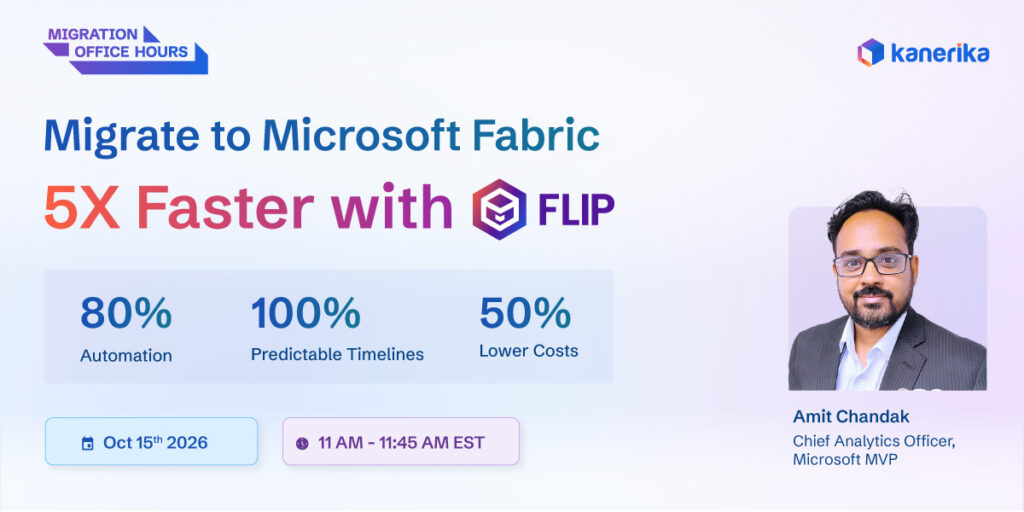
5. What is FLIP and how does it help with Microsoft Fabric migrations? FLIP is Kanerika’s proprietary migration accelerator available on Microsoft Azure Marketplace. It automates 70 to 80% of the migration work involved in moving from legacy platforms including Informatica, SSIS, SSAS, and Azure Synapse into Microsoft Fabric. FLIP cuts migration effort by 50 to 60% and compresses complex timelines to approximately 90 days.
6. Do I need a US-based Microsoft Fabric consulting company? US-based engagement fits programs that require on-site presence during discovery and go-live, regulated industry compliance under US frameworks like HIPAA and FedRAMP, and time-zone alignment for support. Most of the firms listed here offer both US-based and global delivery models. For programs requiring hybrid or global delivery, verify that governance and compliance standards apply consistently across all delivery locations.
7. What industries have the most Microsoft Fabric implementations in the USA? Financial services, healthcare, manufacturing, and retail lead Microsoft Fabric adoption in the USA. Financial services firms value Fabric’s native Purview governance integration for compliance. Healthcare organizations use Fabric for clinical and operational data consolidation with HIPAA-compliant data handling. Manufacturing uses Fabric for real-time operational analytics combining IoT and ERP data.
8. What is the ROI of Microsoft Fabric implementation? Forrester’s Total Economic Impact study documents an average 379% ROI over three years for Microsoft Fabric adopters. Productivity gains in data engineering average $1.8 million and in business analysis average $4.8 million across the studied organizations. Actual ROI depends on program scope, quality of implementation, and how effectively the internal team adopts and extends the platform after go-live.