TL;DR
Cutting Microsoft Fabric migration cost comes down to four moves: automate the pipeline conversion, shorten the dual-platform overlap, consolidate what Fabric costs to run, and apply for Microsoft funding. Platforms like Informatica, Alteryx, SAP BusinessObjects, and SSIS are legacy, high-maintenance data platforms that organizations are abandoning due to high licensing costs, complex on-premises architectures, and a modern industry shift toward cloud-native, scalable cloud data stacks. Kanerika’s FLIP accelerator automates most of the pipeline conversion work. Two of the four cost lines scale with elapsed time, so a shorter timeline saves money on its own. Microsoft funds part of the migration, but approval sits entirely with Microsoft.
Salesforce closed its acquisition of Informatica in November 2025 , and PowerCenter 10.x support windows have already expired. SQL Server 2016 lost extended support on July 14, 2026 . Qlik’s Open Studio has no free tier left, and SAP’s BusinessObjects 4.3 mainstream maintenance ends this December.
None of these dates are hypothetical anymore. Organizations running any of these platforms are already inside a support clock, whether they planned for it or not. The real question most teams face is what a Fabric migration costs, and whether any of that cost gets offset.
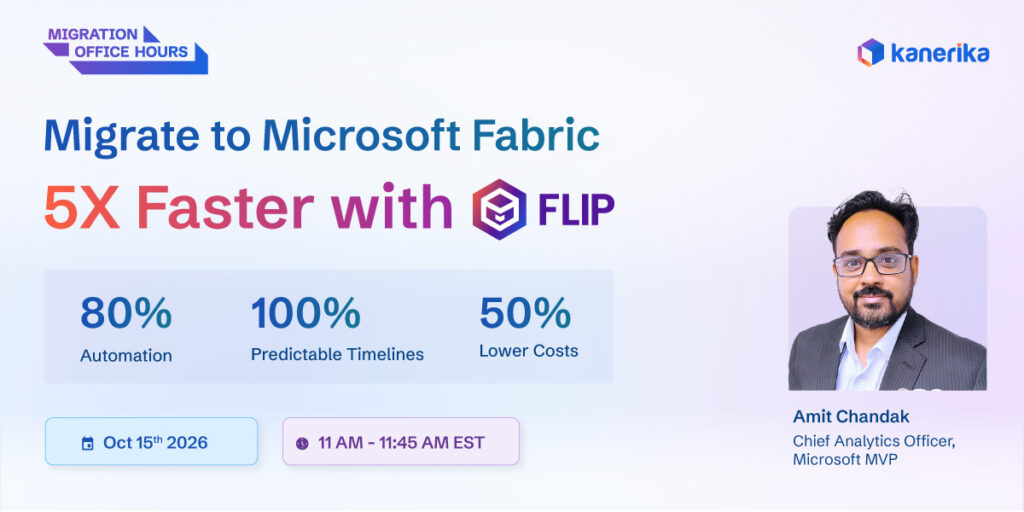
Kanerika ran a live session on August 20, 2026 called Migration Office Hours: How to Reduce Your Fabric Migration Cost with Microsoft Funding. Vish Nath, Senior Vice President of Digital Transformation, and Kshitij Mehrotra, Solutions Engineer, walked through four specific levers that lower the cost of a Fabric migration. This post covers what they presented, including a live Informatica-to-Fabric conversion and the mechanics of Microsoft’s funding programs.
Key Takeaways Almost every legacy ETL and BI platform, including Informatica, Alteryx, SAP BusinessObjects, IBM DataStage, and Qlik, now carries a support, ownership, or pricing pressure event that has already landed. Migration cost breaks into four lines: conversion labor, dual-run overlap, data movement, and platform run-rate. Two of these four scale with elapsed time rather than the size of the estate. Kanerika’s FLIP accelerator automates 70 to 80% of the conversion work across 16 migration paths, using a five-stage engine that inventories, scores, converts, and validates every pipeline before cutover. Compressing the migration timeline is its own cost lever, since every month removed from the middle of a phased rollout is a month of not paying for two platforms at once. Microsoft Fabric consolidates ETL, warehouse, BI, and AI workloads into one capacity model, and reserved one-year capacity runs cheaper than pay-as-you-go for the same SKU. Microsoft funds part of a Fabric migration through partner-nominated or field-nominated routes, but approval sits entirely with Microsoft and depends on scoping the engagement correctly before formal consent is given.
Get Your Fabric Migration Cost Assessment A 30-minute working session with Kanerika covers all four levers: what converts automatically, a realistic wave plan, indicative capacity sizing, and which Microsoft funding route applies.
Book a Meeting
Why the Fabric Migration Conversation Is Already Overdue Every platform on a typical legacy ETL estate now has a specific dated event behind it. Some already happened. Others are locked in for later this year.
Competitive ETL and BI estates: Informatica (PowerCenter, IDMC, CAI): acquired by Salesforce in a deal that closed in November 2025 . PowerCenter 10.x support windows have already expired.Alteryx (Designer, Server): private equity owned since 2024, with renewal pricing and roadmap pressure building each cycle.SAP (BusinessObjects, Crystal Reports): BI 4.3 mainstream maintenance ends December 31, 2026, after which only customer-specific maintenance remains.IBM (DataStage, Cognos, Planning Analytics): long-lived on-premises estates, where IBM’s own cloud path is itself a re-platforming project.Qlik (Replicate, Talend, Open Studio): Thoma Bravo-backed with an IPO filed. Open Studio was discontinued in January 2024, with no free tier remaining.
Microsoft data estate: SSIS on-premises packages are tied directly to the SQL Server lifecycle.SQL Server integration workloads lost extended support on July 14, 2026 . Extended Security Updates buy time, not a strategy.Azure Data Factory pipelines and dataflows have Fabric Data Factory as the stated go-forward path, with a native migration experience already shipping.Synapse Pipelines , dedicated and serverless, lost Synapse Data Explorer in October 2025, with Synapse-centric guidance deprecated in April 2026.
Almost none of these dates sit ahead of most organizations anymore. The real choice is whether the move happens on your own calendar or on your vendor’s renewal notice.
Four Doors Out of a Legacy ETL Estate Every organization facing these deadlines has four realistic paths forward. Three of them look cheaper than they are.
Path What Happens Outcome Stay put Extend support, absorb the risk Higher cost, risk stays, AI stalls Re-buy the category Move to IDMC, Qlik Talend Cloud, or SAC Same problem, new invoice Assemble best-of-breed Snowflake, dbt, Fivetran, and Tableau as four separate contracts Integration tax, forever Consolidate on Fabric ETL, warehouse, BI, and AI in one platform and one capacity One estate, one bill, faster ROI
Microsoft Fabric has grown past a $2 billion annual revenue run rate with more than 31,000 customers, up 60% year over year , according to Microsoft’s fiscal Q2 2026 results. OneLake removes the copies most best-of-breed stacks depend on, and Purview governance plus Copilot come built into the same platform. The fourth door is also the cheapest one to walk through, since an accelerator automates most of the rebuild and Microsoft investment can cover part of the proof of value.
See How Microsoft Funding Can Cut Your Fabric Migration Cost. Watch the on-demand session covering how to access Microsoft migration funding through the right partner channel.
Watch On Demand
Where Migration Money Goes Every migration budget breaks into four cost lines. Two of them behave very differently from the other two.
Conversion labor (scales with scope): pipelines, stored procedures, and semantic models rebuilt by hand, asset by asset. This is usually the single largest line in a migration budget.Dual-run overlap (scales with time): both platforms licensed and staffed while they run in parallel. Every extra month of migration is another month of paying twice.Data movement (one-off): egress charges for pulling multi-terabyte estates out of a third-party cloud or warehouse, plus the replication compute going in.Platform run-rate (ongoing): what the destination costs to run, and whether the fragmented licensing you were trying to leave follows you there.
Two of these four lines are driven by elapsed time, not by how many assets an organization owns. Compressing the timeline is a cost lever on its own, separate from any convenience it adds.
Lever 1: Automate the Conversion FLIP is Kanerika’s own migration accelerator, built out of the migrations the company has already delivered rather than licensed from Microsoft or wrapped around another vendor’s tool. It covers 16 migration paths through one engine: 12 from competitive ETL and BI estates, and 4 from the Microsoft data estate itself.
The two motions behave differently. Competitive migrations are a genuine translation problem between systems that share no vocabulary. Microsoft-to-Microsoft migrations sit closer to re-platforming, since SSIS packages and ADF pipelines already speak a dialect Fabric understands.
1. Discover FLIP connects directly to the source platform and inventories every pipeline, mapping, and dependency. Nothing gets exported into a spreadsheet or re-keyed by hand first.
2. Assess Each asset gets a complexity and parity score, which turns a rough estimate into a defensible scope before anyone commits budget.
3. Convert The accelerator auto-generates native Fabric data pipelines and Dataflow Gen2 objects, with business logic mapped across rather than rebuilt from scratch.
4. Validate Converted output runs against the source output and gets reconciled row by row, using row counts, checksums, and a parallel-run comparison.
5. Cut Over A sequenced go-live hands over a full asset log and migration report, closing out the engagement with a documented trail.
FLIP automates 70 to 80% of the conversion work across all 16 paths. The remaining share lands on a specific set of decisions a machine shouldn’t make alone.
Edge cases and undocumented logic, including transformations nobody in the organization can explain anymore. Architecture decisions, such as lakehouse versus warehouse and how the medallion layers get cut. Performance tuning, which only becomes possible once real data volumes arrive. Business sign-off from whoever owns the number the migration is supposed to reproduce.
During the session, Kshitij Mehrotra ran a live conversion of a real Informatica mapping rather than a slide describing one. The accelerator read the source mapping’s own metadata directly, generated a native Fabric pipeline, and reconciled the converted output against the original row by row. Kanerika’s own migrations using FLIP have run at 60 to 70% lower migration labor cost, since conversion labor is usually the biggest single line in the budget.
Lever 2: Compress the Dual-Run Window Two of the four cost lines scale with time rather than scope, and this lever attacks the biggest one directly. Kanerika structures a migration into four phases instead of one long build-then-cutover sequence.
1. Discover and Assess (Weeks 1 to 2) Automated inventory and complexity scoring produce a defensible scope and effort model before budget gets committed.
2. Prove (Weeks 3 to 4) A representative slice of the estate gets converted end-to-end and validated against source, turning an estimate into evidence.
3. Convert in Phases (Weeks 5 to 16) Assets move in prioritized waves, each validated before the next starts, while the business keeps running on the legacy platform throughout.
4. Cut Over (Week 17 Onward) Go-live happens in sequence with reconciliation, followed by decommissioning the legacy platform. The legacy license stops the day the last wave signs off, not before it and not on an optimistic date in the plan.
These week ranges are indicative, not commitments. The actual timeline depends on the data estate, its structures, and its models, which is exactly why Kanerika scopes each engagement before quoting a schedule.
Lever 3: Consolidate the Run-Rate Fabric replaces several separately billed tools with one capacity model. What an organization pays for today usually spreads across four different bills.
What You Pay For Today What You Pay For on Fabric ETL compute (ADF integration runtimes, SSIS nodes) One capacity, sized as an F-SKU from F2 to F2048 Warehouse compute (Synapse pools, dedicated clusters) Every workload draws from the same shared pool BI capacity (Power BI Premium, per-user licenses) No per-query or per-pipeline-run billing Storage, priced and managed separately from each OneLake storage billed separately, once, for all of it
Cheaper on a one-year capacity reservation , discounted against pay-as-you-go pricing for the same SKU. Reserved capacity can’t be paused, so it suits steady production load rather than spiky trial use.0 capacity units to refresh a Direct Lake model, since Direct Lake queries Delta tables in OneLake in place, without an import copy or a DirectQuery pushdown to the source.24-hour smoothing window on usage bursts, which averages short spikes instead of throttling at the peak, letting most organizations size below peak rather than for it.
These three mechanics work regardless of Microsoft funding. They come from how Fabric bills capacity, independent of any funding program.
Lever 4: Offset With Microsoft Investment Microsoft consolidated its FY27 Azure investment programs under a single framework on July 1, 2026. Two routes exist to bring funding into a migration, and neither is a form an organization fills out alone.
1. Two Routes to Microsoft Funding Route Partner-Nominated Microsoft Field-Nominated Who initiates it The delivery partner, through Microsoft’s partner system The organization’s own Microsoft account team, through End Customer Investment Funds Who it suits Organizations without a long-standing Microsoft field relationship Larger programs and existing strategic accounts What it requires A partner holding the right Azure designation Sponsorship from an existing Microsoft account team What it unlocks Pre-sales assessment and proof-of-value funding Azure credits, plus Microsoft-delivered assessment tooling at no cost
Both routes share the same rules underneath.
Approval sits with Microsoft, on Microsoft’s criteria. The funds reach the delivery partner, not the customer’s account, except for Azure credits, which can go direct. Formal customer consent is a required step on both routes. Completed work must be documented and signed off before a claim is paid.
2. Where Funding Applies Different kinds of support exist at different stages of the project, and the last one is the stage most people skip.
Envision: a structured session on what the platform could do for a specific estate, with no obligation and no contract required.Assess and Approve: funded discovery of the data estate, including Microsoft-delivered assessment tooling at no cost on the field-nominated route.Deploy: the migration engagement itself, where the largest share of investment usually sits.Adopt and Skill: training and certification for the analysts and engineers who inherit the platform once the migration team leaves.
Skilling is a named pillar of Microsoft’s FY27 framework, and almost nobody asks about it. A migration that hands over a platform nobody can operate stops short of its own goal. That’s worth raising in the same conversation as the build, not eighteen months after go-live.
3. What You Control, and Where Funding Gets Lost Most of the funding process is handled by the delivery partner. Three specific parts land on the customer, and each one has a deadline attached.
Scope it properly : The estimated engagement size gets fixed at the moment consent is requested and can’t be revised afterward, so a loose scope caps what gets funded later.Give formal consent : This confirms the engagement through Microsoft’s partner system, and it’s the one step only the customer can take.Let it be evidenced: Completed work has to be documented and signed off inside the claim window for approval to hold.
Funding gets lost in a few specific ways.
Consent requested but never returned inside the window. Scope estimated low, then the real project turns out bigger. Work delivered, but evidence never assembled or submitted in time.
Qualify yourself in sixty seconds: Kanerika’s own filter for whether funding is realistic comes down to a short list on each side.
Funding is realistic if: A Microsoft account team or a nominating partner is already in place. The move is off a named legacy or competing platform. Fabric or Azure data services are the destination. A consumption trajectory after go-live can be described. The migration is planned but not yet under contract.
Funding is unlikely if: Neither the organization nor a qualified partner can open a Microsoft route. The destination isn’t a Microsoft platform. The migration contract is already signed and underway. The work is staffing or app development rather than a platform migration. There’s no expected consumption on the other side.
Landing on the second list costs one lever out of four, not all four. Automation, timeline compression, and run-rate consolidation stay available on their own, and together they carry most of the saving.
Microsoft funding programs are administered by Microsoft at its sole discretion. Eligibility, amounts, and availability are set by Microsoft, vary by opportunity, and are subject to change. Kanerika does not guarantee funding approval for any engagement.
What Kanerika and FLIP Bring to Microsoft Fabric Migrations Kanerika is a Microsoft Solutions Partner for Data and AI, ranked in the top 1% globally, holding Microsoft Fabric Featured Partner designation and ESIF enablement status, the same partner-side certification behind field-nominated Microsoft funding routes. Kanerika delivers Microsoft’s in-a-day workshops directly, including Dashboard in a Day, Fabric Analyst in a Day, RTI in a Day, and Agent in a Day. That partner depth is what makes Microsoft funding routes accessible through a single engagement rather than a separate procurement process.
FLIP is Kanerika’s workflow automation platform. Beyond the migration accelerator, it runs on four pillars:
Deploy: Puts AI agents to work inside existing workflows, including Karl for data analytics, Ember for customer operations, and Klara for compliance monitoringReconcile: Validates data across systems and flags variances automatically, with an audit-ready log for every checkOrchestrate: Runs data workflows through a visual pipeline builder with event-driven scheduling and multi-source routingAutomate: Handles end-to-end processes like AP and invoice processing with policy-aware approval flows, SLA tracking, and governance built in
Every FLIP deployment runs on the same compliance standards: ISO 27001, ISO 27701, ISO 9001, GDPR, and SOC 2, whether delivered as a managed migration or inside a customer’s own environment. 120+ enterprise transformations and a 95% client retention rate back the delivery record.
Wrapping Up Four levers exist to cut the cost of a Fabric migration, and only one of them depends on someone else’s decision. Automating the conversion, compressing the dual-run window, and consolidating the run-rate work regardless of Microsoft funding. Microsoft’s investment strengthens a business case that already needs to work without it.
The full session, including the live Informatica-to-Fabric conversion and the Q&A on governance, security, and partner eligibility, covers each lever in more depth than this recap. Organizations ready to see where their own estate lands on these four levers can start with a Migration Cost Assessment , a 30-minute session with no cost and no obligation.
Get Your Fabric Migration Cost Assessment Kanerika reviews your data estate against all four levers and tells you honestly which funding route, if any, applies.
Book a Meeting
FAQs
1. What Is Microsoft Fabric Migration Funding? Microsoft Fabric migration funding refers to Azure investment programs that offset part of the cost of moving to Fabric. Microsoft funds the work through a delivery partner, using either a partner-nominated route or a Microsoft field-nominated route through End Customer Investment Funds. Approval, amounts, and eligibility are set entirely by Microsoft.
2. How Much of a Fabric Migration Can Microsoft Fund? The amount varies by opportunity and depends on the source platform, the Azure consumption expected after go-live, and which funding route applies. Microsoft evaluates every request on its own criteria, and no partner can guarantee a specific figure in advance.
3. What Is Kanerika's FLIP Migration Accelerator? FLIP is Kanerika’s own migration accelerator, covering 16 paths from competitive and Microsoft ETL platforms into Fabric through one engine. It automates 70 to 80% conversion work across discovery, assessment, conversion, validation, and cutover, with the remaining share flagged to a specialist for edge cases and architecture decisions.
4. How Long Does a Microsoft Fabric Migration Take? Timelines depend on the size and complexity of the data estate, so Kanerika scopes each engagement before quoting a schedule. A phased approach typically runs discovery and proof in the first month, converts assets in prioritized waves over the following months, and cuts over once the final wave is validated.
5. Can I Still Get Microsoft Funding If I've Already Bought Fabric? Funding routes that cover the migration itself generally apply while a purchase decision is still open, not after capacity has already been bought and provisioned. Some post-sale funding, such as skilling and enablement support, can still apply after go-live.
6. What's the Difference Between Partner-Nominated and Field-Nominated Funding? Partner-nominated funding is opened by the delivery partner directly through Microsoft’s partner system, and it suits organizations without a long-standing Microsoft relationship. Field-nominated funding runs through an organization’s own Microsoft account team using End Customer Investment Funds, and it suits larger programs with an existing strategic account.
7. What Happens During a Kanerika Migration Cost Assessment? The assessment is a 30-minute working session covering which assets convert automatically, a realistic wave plan for the migration, indicative capacity sizing for Fabric, and which Microsoft funding route applies. It carries no cost and no obligation, and Kanerika states plainly if funding isn’t available in a given scenario.
8. Is Kanerika's FLIP Migration Accelerator Secure and Compliant? FLIP runs under two delivery models: Migration as a Service, where Kanerika operates the conversion, and Platform as a Service, where FLIP deploys inside the customer’s own environment. Both models follow a defined governance and security posture, and the platform aligns with Kanerika’s ISO 27001, ISO 27701, ISO 9001, GDPR, and SOC 2 compliance standards. A full security posture document is available once a migration conversation moves into scoping.