Kanerika provides data migration services for businesses in Oahu looking to modernize legacy data platforms without disrupting business operations. Our FLIP accelerators automate ETL conversion, BI report migration, and RPA rebuilds, helping reduce manual effort, licensing costs, and cutover risk.
Faster Migrations
Cost Savings
Predictable Timelines












FLIP, Kanerika’s IP-led accelerator, automates up to 80% of a data platform migration. Enter your asset counts to see the cost, developer hours, and delivery weeks it removes from your program.
FLIP is Kanerika's proprietary migration accelerator. Here's exactly where the savings come from:
Businesses in Oahu often need reliable data migration services to modernize complex data environments across legacy platforms, cloud systems, analytics platforms, and business applications. Kanerika helps organizations modernize these environments through structured, automated data migration.
Convert Informatica, Alteryx, or Azure workloads onto Talend, Databricks, or Microsoft Fabric. FLIP reads mappings and workflows from the source repository, capturing parameters and dependencies.
Move Tableau, SSRS, Crystal Reports, or Cognos estates onto Power BI. Calculated fields, filters, and row-level security definitions transfer as written rather than being re-derived from old report output.
Rebuild UiPath estates on Microsoft Power Automate. Attended bots, scheduled processes, and XAML sequences keep their exception handling, which matters once the bot author is gone.

FLIP is Kanerika's Intelligent Workflow Automation Platform. Each accelerator is engineered for a single source-to-target route, covering repository extraction, dependency mapping, conversion, and validation for that specific pairing rather than a script reused across platforms.
FLIP is Kanerika’s Intelligent Workflow Automation Platform, carrying purpose-built accelerators for data platform, BI, and RPA migration. Each is engineered for one specific source-to-target route, which is where conversion accuracy holds and generic scripting fails.
Migration
Migration
Migration
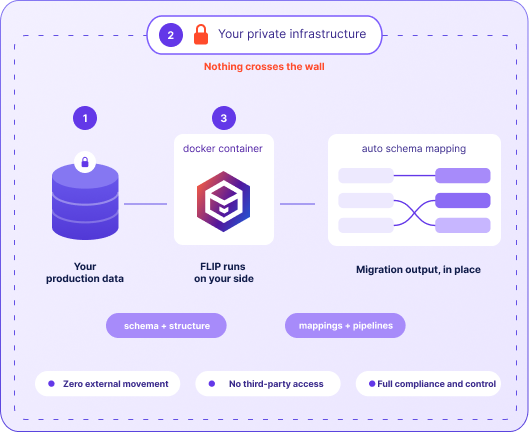
FLIP deploys into your own infrastructure through Docker. Conversion runs where your systems already exist.
We read schema definitions and structural dependencies. Production records are never accessed, staged, or transmitted.
Execution stays inside your network perimeter. No outbound data path exists and no third-party access needs governing.
Schema mapping and pipeline generation run at full throughput while audit trails and access controls remain entirely under your ownership.
Kanerika runs every Oahu data migration project through the IMPACT methodology, which ties each phase to a delivered outcome rather than a progress update.
Every engagement opens with a full read of your source environment. Our data migration consultants then architect the target state, configure FLIP for your path, run automated conversion with validation throughout, and stay through post-launch monitoring and decommission of the legacy system.

Understand Business Goals

Analyze Data & Workflows

Design Sound Solutions

Develop & Deploy Solutions

Ongoing Support
01
Understand Business Goals
02
Analyze Data & Workflows
03
Design Sound
Solutions
04
Develop & Deploy Solutions
05
Ongoing
Support
As a data migration company serving Oahu, Kanerika works across the full source and target stack, from legacy on-premises platforms through to Microsoft Fabric, Databricks, Power BI, and Talend.









Kanerika provides data platform migration services for organizations in Oahu across key industries, helping modernize legacy data environments with minimal disruption.
FLIP automates most of the conversion work on a migration, pulling business logic straight from the source repository and validating each object as it converts. Cost tracks complexity rather than asset volume.
Each accelerator is engineered for one source-to-target pairing, not a generic script pointed at different platforms.

FLIP reads source repositories directly, capturing mappings, parameters, and dependencies a workflow review misses.

Reconciliation and checksums verify each transformation as it converts, with parallel running before cutover.

The pivotal partnerships with technology leaders that amplify our capabilities, ensuring you benefit from the most advanced and reliable solutions.
A Kanerika engagement spans source discovery, target architecture design, asset conversion, validation, cutover, and decommission of the legacy platform. Scope covers ETL estates such as Informatica and Azure Data Factory, reporting estates on Tableau, Cognos, Crystal Reports, or SSRS, and RPA estates on UiPath. Twelve source-to-target paths are supported, each with its own accelerator.
Automated conversion is the practical alternative. Instead of developers rewriting each mapping, report, or bot by hand, an accelerator reads the source repository and generates the target equivalent. The tradeoff is that tooling has to be built for your specific source and target pairing. Generic conversion utilities produce output that still needs rewriting, which returns you to the original problem.
Ask three things. How much of the conversion is automated rather than hand-written for your exact path. What happens to business logic that was never documented. And whether validation runs during conversion or only at user acceptance testing. Vendors who price by asset count are telling you the work is manual, whatever the proposal says about accelerators.
ETL describes the extract, transform, and load pipelines that move data between systems. In a migration, those pipelines are the thing being migrated rather than the method. Years of transformation rules, lookups, and error handling live inside them. Rebuilding that logic on a new platform is the hard part of any ETL migration and where most timeline slippage originates.
Three. Hand-rewriting each mapping on the target, which is accurate but scales linearly with volume. Generic conversion utilities, which handle simple transformations and leave the rest for developers. Or path-specific accelerators that extract from the source repository and generate target-native pipelines. The right choice depends on how much undocumented logic your estate is carrying.
Start by inventorying reports, datasets, data sources, and permission structures, since reporting estates hide dependencies that surface only when something breaks. Conversion then maps calculated fields, filters, and row-level security onto the target. Power BI is the common destination from Tableau, Cognos, Crystal Reports, and SSRS. Parallel running confirms figures match before users move across.
Fidelity is proven by comparison, not asserted. Row counts and hash checksums confirm each transformation produced what it should. Referential integrity checks catch relationships broken during conversion. Source and target then run in parallel while business users compare actual output. Anything that cannot be reconciled is flagged before cutover rather than discovered in production.
Cloud vendors supply lift-and-shift utilities that move data well and convert logic poorly. Generic ETL conversion tools handle simple mappings. Purpose-built accelerators extract from the source repository and generate target-native pipelines, which is what an estate with embedded business rules requires. Evaluate any tool on what percentage of your specific path converts without manual intervention.
It depends on workload. Databricks suits large-scale processing, lakehouse architecture, and ML pipelines. Microsoft Fabric suits organizations already standardized on Microsoft 365 and Power BI. Snowflake suits warehouse-centric analytics with straightforward governance. The target should follow the workloads you actually run rather than the platform with the strongest current marketing. We assess this during the Map phase.
Most provide people. Discovery, project management, and developers who rewrite assets by hand, which means cost and timeline scale with your asset count. Kanerika provides the conversion platform first and engineers second, so asset volume stops driving the price. Consulting effort concentrates on architecture decisions and the logic automation cannot resolve on its own.
Data migration services help businesses in Oahu move data from legacy systems, databases, and applications to modern cloud, analytics, and enterprise platforms with minimal disruption.
Kanerika helps organizations in Oahu plan, automate, execute, and validate complex data migrations using its FLIP accelerators, migration methodology, and platform expertise.
Yes. Kanerika supports cloud data migration and modernization across enterprise data environments, helping organizations transition from legacy platforms to modern cloud technologies.
Kanerika uses migration automation, structured methodologies, validation, and testing to reduce manual effort, downtime, errors, and cutover risk.
Kanerika supports migrations across databases, ETL platforms, BI platforms, legacy systems, cloud environments, and enterprise data platforms, depending on the migration requirements.

We use cookies to give you the best experience. Cookies help to provide a more personalized experience and relevant advertising for you, and web analytics for us.