Kanerika provides data migration services for New York enterprises looking to modernize legacy data platforms without disrupting business operations. Our FLIP accelerators automate ETL conversion, BI report migration, and RPA rebuilds, helping reduce manual effort, licensing costs, and cutover risk.
Faster Migrations
Cost Savings
Predictable Timelines












FLIP, Kanerika’s IP-led accelerator, automates up to 80% of a data platform migration. saving time, costs, and resources significantly.
FLIP is Kanerika's proprietary migration accelerator. Here's exactly where the savings come from:
New York enterprises often need reliable data migration services to modernize complex data environments across legacy platforms, cloud systems, analytics platforms, and business applications. Kanerika helps organizations modernize these environments through structured, automated data migration.
Move from Informatica to Talend, Alteryx, Databricks, or Microsoft Fabric using our ETL migration accelerators engineered for accuracy and minimal disruption.
Move Tableau, SSRS, Crystal Reports, or Cognos workloads onto Power BI with connectors that carry dashboards, datasets, and logic across intact.
Convert UiPath estates to Microsoft Power Automate through FLIP. Workflow logic, exception paths, and business rules carry forward without a manual rebuild.

FLIP is Kanerika's Intelligent Workflow Automation Platform, with purpose-built accelerators for data migration, ETL migration services, and RPA transitions. Each one automates discovery, conversion, and validation across the 12 paths we support for New York clients.
Enterprises across regulated and asset-heavy industries have cut cost and timeline with Kanerika’s data migration solutions. Every engagement below has documented outcomes.
Migration
Migration
Migration
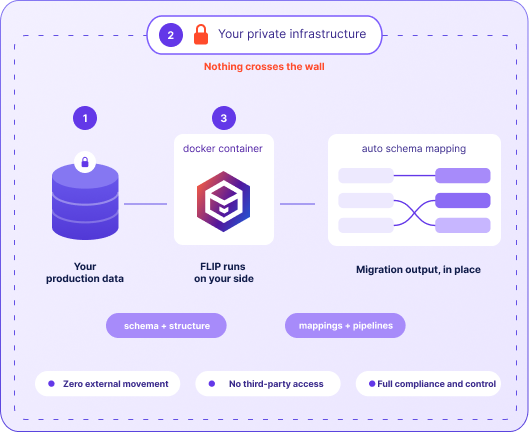
FLIP deploys into your own infrastructure through Docker. The migration moves forward while your data stays exactly where it is. That matters for New York firms working under NYDFS Part 500 and the SHIELD Act, where data residency and third-party access are scrutinized.
We read schema and structure. Your production data is never read, copied, or exposed.
Everything runs inside your network. No external movement, no third-party access.
Get high-speed schema mapping and pipeline generation while maintaining full compliance and control.
Kanerika runs every New York data migration project through the IMPACT methodology, which keeps each phase tied to a measurable outcome rather than a status update.
Each engagement opens with a full read of your source environment. Our data migration consultants then design the target architecture, configure FLIP for your path, run automated conversion with validation built in, and stay through post-launch monitoring and source system decommission.

Understand Business Goals

Analyze Data & Workflows

Design Sound Solutions

Develop & Deploy Solutions

Ongoing Support
01
Understand Business Goals
02
Analyze Data & Workflows
03
Design Sound
Solutions
04
Develop & Deploy Solutions
05
Ongoing
Support
As a premier data migration company serving New York, Kanerika operates across a wide stack.









Kanerika provides data platform migration services for New York enterprises across key industries, helping organizations modernize legacy data environments with minimal disruption.
Kanerika holds Microsoft Solutions Partner status for Data and AI, Databricks Consulting Partner certification, and ISO 27001 accreditation. Our FLIP accelerators and consulting teams have delivered across 250+ enterprise engagements.
Certified engineers who have already run your exact source-to-target route across ETL, BI, and RPA estates. No generalist bench.

The IMPACT framework paired with FLIP accelerators cuts migration timelines by 60%, with automated reconciliation running at every stage rather than at the end.

Our Central-time delivery team stays engaged before, during, and after the migration, through transition, hypercare, and decommission of the legacy platform.

The pivotal partnerships with technology leaders that amplify our capabilities, ensuring you benefit from the most advanced and reliable solutions.
Planning starts with a full inventory of the source environment, covering every mapping, workflow, report, and dependency. From there we define target architecture, sequence the move into waves, and document edge-case business logic that automation will not catch. Kanerika’s IMPACT framework handles this in the Initiate and Map phases. Skipping it is the largest single cause of timeline overrun and post-cutover logic gaps.
Timeline depends on asset volume, platform complexity, and whether conversion is automated. BI platform migrations run 4 to 8 weeks with tooling. Mid-complexity ETL paths such as Informatica to Microsoft Fabric take 8 to 16 weeks automated, against 6 to 12 months by hand. Full-stack enterprise data migration runs 3 to 9 months. Automated conversion consistently lands 40 to 60% faster with lower overrun risk.
Cost tracks asset count, path complexity, and delivery model. Manual migration scales linearly with volume because developers rewrite each object by hand. FLIP automates 70 to 80% of conversion, which flattens that curve. Our Migration ROI Calculator estimates total project cost, developer hours, and timeline for your specific path. New York firms should also model the legacy licensing that stops once the source platform is decommissioned.
Schema mismatches that silently drop records, undocumented business logic buried in legacy ETL, downtime during cutover, and scope creep caused by thin discovery. Security exposure while data moves between platforms is a fifth. Most trace back to manual conversion and weak upfront assessment. Automated extraction, dependency mapping, and parallel-run validation surface these during the migration rather than after go-live.
Validation runs at three points rather than once at the end. Pre-migration profiling flags duplicates, nulls, and broken referential integrity in the source. During conversion, row-count reconciliation and hash checksums verify accuracy at each transformation stage. After cutover, a parallel-run period compares source and target output before the legacy system is switched off. FLIP runs this reconciliation continuously and flags failures in real time.
A migration strategy defines target architecture, wave sequencing, validation criteria, rollback triggers, and decommission timing. It should name which workloads move in which wave and what evidence signs each wave off. Without documented rollback conditions, teams discover mid-cutover that reversing is no longer possible. Kanerika’s IMPACT framework builds strategy across the Initiate, Map, and Plan phases before any conversion begins.
Data loss usually comes from schema mismatches and truncation during type conversion rather than from transfer failure. The controls that catch it are source profiling before the move, checksum reconciliation at every transformation, and row-level comparison during parallel run. FLIP’s metadata-only model adds a further layer for New York firms, since production records never leave your network and cannot be lost in transit.
AI handles the parts of migration that are pattern-recognition problems, including parsing legacy repositories, mapping dependencies, and translating transformation logic into target syntax. FLIP uses this to automate 70 to 80% of conversion across supported paths. The remaining 20 to 30% involves undocumented logic and architectural decisions requiring engineering judgment. AI shortens the work without removing the need for review.
HIPAA compliance during cloud data migration depends on where protected health information sits at each stage. FLIP processes metadata only, so PHI never enters the migration tooling. Deployment runs inside your network boundary under your existing access controls and audit logging. New York healthcare systems also fall under the SHIELD Act, which layers breach notification duties on top of HIPAA obligations.
Evaluate on platform depth for your exact path, purpose-built automation rather than manual scripting, and a validation framework that runs during migration instead of after. Microsoft Solutions Partner and Databricks Consulting Partner status reflects verified capability. ISO 27001 and SOC 2 matter once regulated data moves. Kanerika delivers on Eastern hours with on-site availability across the New York metro.

We use cookies to give you the best experience. Cookies help to provide a more personalized experience and relevant advertising for you, and web analytics for us.