Kanerika provides data migration services for Chicago enterprises looking to modernize legacy data platforms without disrupting business operations. Our FLIP accelerators automate ETL conversion, BI report migration, and RPA rebuilds, helping reduce manual effort, licensing costs, and cutover risk.
Faster Migrations
Cost Savings
Predictable Timelines












FLIP, Kanerika’s IP-led accelerator, automates up to 80% of a data platform migration, taking significant time, cost, and resource load off your team.
FLIP is Kanerika's proprietary migration accelerator. Here's exactly where the savings come from:
Chicago enterprises often need reliable data migration services to modernize complex data environments across legacy platforms, cloud systems, analytics platforms, and business applications. Kanerika helps organizations modernize these environments through structured, automated data migration.
Move Informatica, Alteryx, or Azure workloads onto Talend, Databricks, or Microsoft Fabric. FLIP extracts mappings and workflows, so rules that were never documented elsewhere survive the conversion.
Convert Tableau, SSRS, Crystal Reports, or Cognos estates to Power BI. Calculated fields, filters, and permission structures that users depend on are carried across rather than approximated on the target.
Rebuild UiPath estates on Microsoft Power Automate through FLIP. Attended bots, unattended processes, and XAML sequences carry their exception handling into the target without manual reconstruction.

FLIP is Kanerika's Intelligent Workflow Automation Platform, carrying purpose-built accelerators for data platform, BI, and RPA migration. Each is engineered for one specific source-to-target route, which is where conversion accuracy holds and generic scripting fails.
FLIP is Kanerika’s Intelligent Workflow Automation Platform, carrying purpose-built accelerators for data platform, BI, and RPA migration. Each is engineered for one specific source-to-target route, which is where conversion accuracy holds and generic scripting fails.
Migration
Migration
Migration
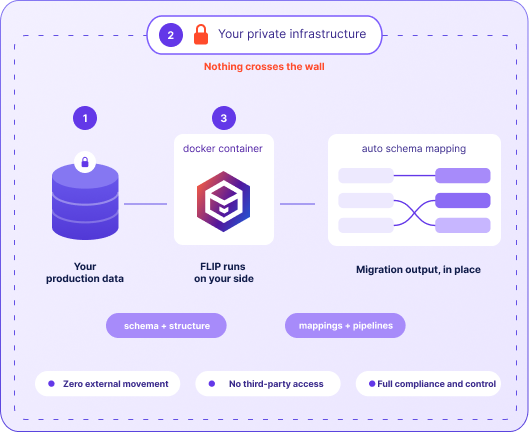
FLIP deploys into your own infrastructure through Docker. Conversion proceeds while your data stays exactly where it sits.
We read schema definitions and structural dependencies. Production records are never accessed, staged, or transmitted.
Execution stays inside your network perimeter. No outbound data path exists and no third-party access needs governing.
Schema mapping and pipeline generation run at full throughput while compliance controls and audit trails remain under your ownership.
Kanerika runs every Chicago data migration project through the IMPACT methodology, which ties each phase to a delivered outcome rather than a progress update.
Each engagement opens with a complete read of your source environment. Our data migration consultants then architect the target state, configure FLIP for your path, execute automated conversion with validation running throughout, and remain through post-launch monitoring and legacy system decommission.

Understand Business Goals

Analyze Data & Workflows

Design Sound Solutions

Develop & Deploy Solutions

Ongoing Support
01
Understand Business Goals
02
Analyze Data & Workflows
03
Design Sound
Solutions
04
Develop & Deploy Solutions
05
Ongoing
Support
As a specialist data migration company serving Chicago, Kanerika operates across the full source and target stack on every engagement.









Kanerika provides data platform migration services for Chicago enterprises across key industries, helping organizations modernize legacy data environments with minimal disruption.
FLIP is built for migration rather than adapted to it. Across 12 platform paths it handles repository extraction, dependency mapping, asset conversion, and parallel-run validation. That automation covers 70 to 80% of conversion work, which is why migration cost stops scaling with your asset count.
Our data migration experts have run platform transitions across ETL, BI, and RPA, backed by a team of certified engineers.

The IMPACT framework paired with FLIP accelerators cuts migration timelines by 60%, with automated validation.

The team stays engaged before, during, and after the migration, through transition and into ongoing optimization.

The pivotal partnerships with technology leaders that amplify our capabilities, ensuring you benefit from the most advanced and reliable solutions.
Four triggers account for most programmes. Vendor support ends on your current version. A licence renewal arrives at a number the business will not approve. A cloud or AI mandate needs architecture the legacy platform cannot supply. Or an acquisition leaves two estates doing identical work. Chicago enterprises most often move on the first two, where a fixed date sets the timeline.
Discovery inventories every asset and dependency in the source environment. Target architecture is designed and the estate is sequenced into waves. Conversion translates mappings, reports, or workflows onto the new platform. Validation reconciles source and target output at each stage. Cutover moves consumers across, and the legacy system is decommissioned once parallel running confirms parity.
Manual rewriting suits small estates where existing logic is documented and worth rebuilding deliberately. Automated conversion suits large estates carrying years of undocumented business rules, because cost stops scaling with asset count. The deciding question is how much logic exists only inside the platform. If nobody can answer that, you have found your reason to automate extraction.
Security patching stops, which usually breaches internal policy before it breaches any regulation. Vendor escalation paths close, leaving production incidents without a route to resolution. Integration with current systems degrades as connectors go unmaintained. Running unsupported also weakens your position at the next audit. The date is fixed, so planning backwards from it is the only workable approach.
Cloud data migration moves workloads from on-premises infrastructure onto a cloud platform. It differs from platform modernization, which replaces the tooling and converts business logic for a new environment. Most Chicago programmes run both at once, moving off an on-prem legacy platform onto Fabric or Databricks. That overlap is where timeline risk concentrates and where discovery earns its cost.
Target architecture, wave sequencing, validation criteria, rollback triggers, and decommission timing. It should state which workloads move in which wave and what evidence signs each wave off. Teams that skip documented rollback conditions discover mid-cutover that reversing is no longer available. Kanerika builds this across the Initiate, Map, and Plan phases before any conversion begins.
Validation runs at three checkpoints rather than once at the end. Source profiling surfaces duplicates, nulls, and broken referential integrity before anything moves. During conversion, row-count reconciliation and hash checksums confirm accuracy per transformation. After cutover, parallel running compares source and target output before the legacy system is retired. FLIP runs reconciliation continuously and flags variances live.
BIPA governs biometric identifiers such as fingerprint and facial geometry data and carries a private right of action, which makes custody during migration a genuine liability exposure. FLIP processes metadata only, so biometric records never enter the migration tooling or leave your network. Access logs and conversion evidence remain in your environment under your own retention policy.
Cost follows asset count, path complexity, and delivery model. Manual conversion scales linearly because engineers rewrite each object individually. FLIP automates 70 to 80%, which breaks that relationship. Our Migration ROI Calculator projects spend, developer hours, and timeline for your path. Model the legacy licensing that stops at decommission, since it often covers a meaningful share of the programme.
Assess on depth for your exact source-to-target route, purpose-built automation rather than manual scripting, and validation that runs during conversion instead of after. Microsoft Solutions Partner and Databricks Consulting Partner status signals verified capability. ISO 27001 and SOC 2 become mandatory once regulated data moves. Kanerika delivers on Central hours with on-site availability across Chicagoland.
Data migration services help Chicago businesses move data from legacy systems, databases, and applications to modern cloud, analytics, and enterprise platforms with minimal disruption.
Kanerika helps Chicago enterprises plan, automate, execute, and validate complex data migrations using its FLIP accelerators, migration methodology, and platform expertise.
Yes. Kanerika supports cloud data migration and modernization across enterprise data environments, helping organizations transition from legacy platforms to modern cloud technologies.
Kanerika uses migration automation, structured methodologies, validation, and testing to reduce manual effort, downtime, errors, and cutover risk.
Kanerika supports migrations across databases, ETL platforms, BI platforms, legacy systems, cloud environments, and enterprise data platforms, depending on the migration requirements.

We use cookies to give you the best experience. Cookies help to provide a more personalized experience and relevant advertising for you, and web analytics for us.