TL;DR
ChatGPT vs Gemini vs Claude is a choice between three model families, and the best enterprise starting point is the mid tier of each. GPT-6.1 Sol, Gemini 4 Argon and Claude Sonnet 5.5 all list at $2 input and $10 output per million tokens in November 2026. Add Claude Opus 5.5 or GPT-6 Astra only for tasks the mid tier fails in your own tests. Budget for Google’s mid-tier price doubling to $4 and $20 on December 1, 2026. Price chatbot seats and API usage as two separate purchases. Check each model’s retention terms before sensitive data goes in, because Claude Fable 5.1 requires 30-day retention.
Key Takeaways
- GPT-6.1 Sol, Gemini 4 Argon and Claude Sonnet 5.5 share a $2 / $10 per million token list price, so test quality before you compare price.
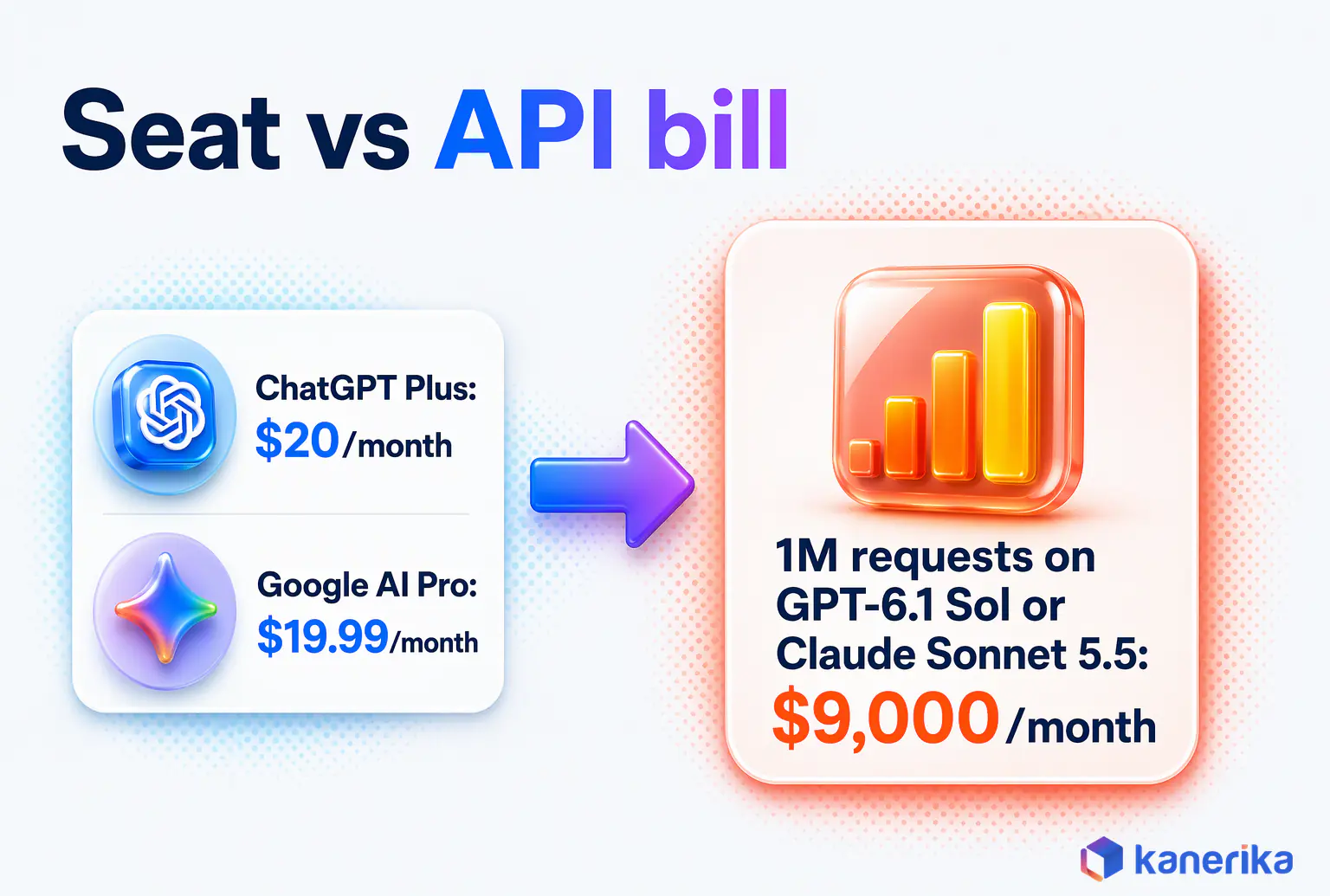
- A $20 ChatGPT Plus or $19.99 Google AI Pro seat buys one person’s chat access, while production apps run on API tokens billed per model.
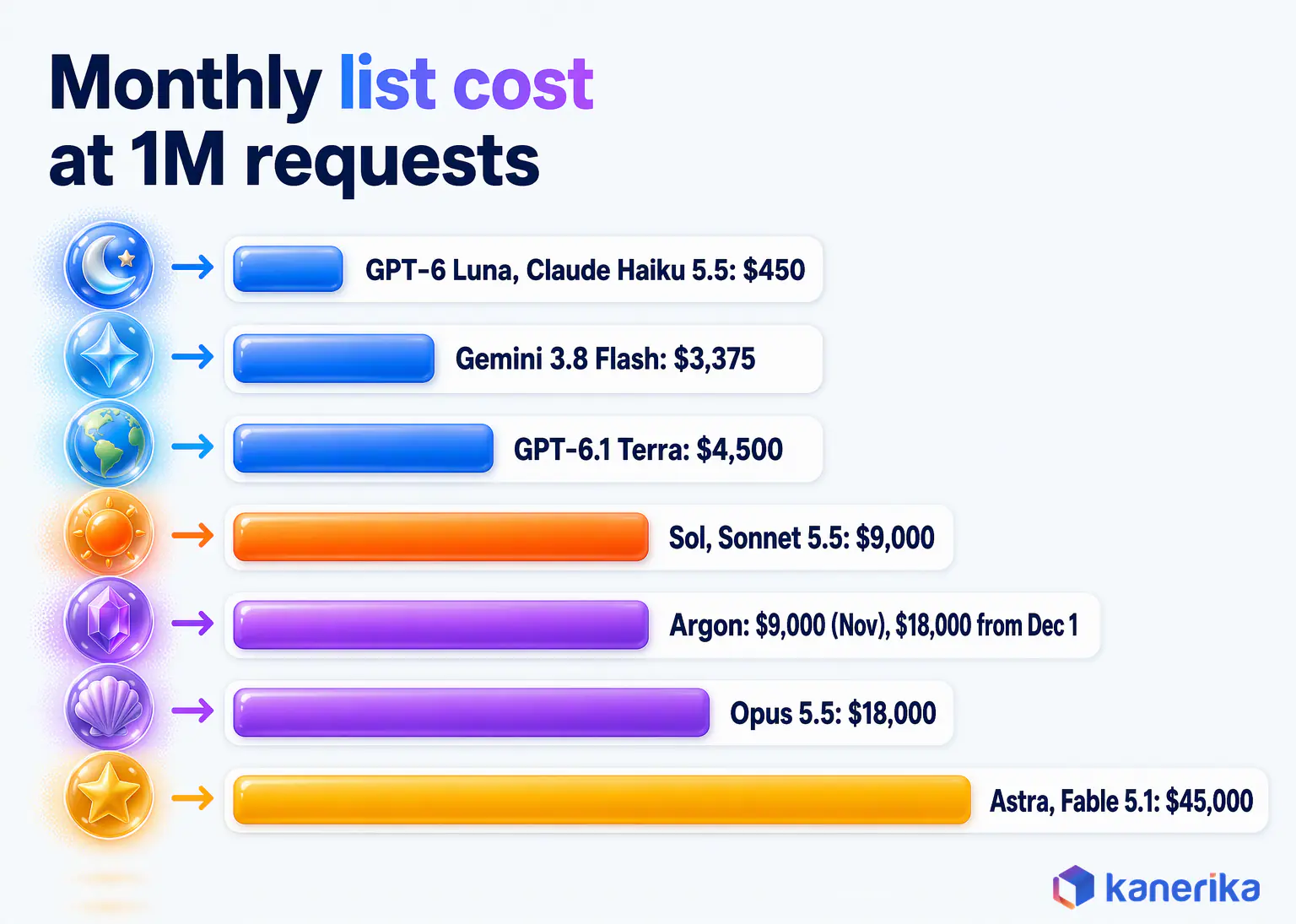
- At 1 million requests a month, list-price cost runs from $450 on GPT-6 Luna or Claude Haiku 5.5 to $45,000 on GPT-6 Astra or Claude Fable 5.1.
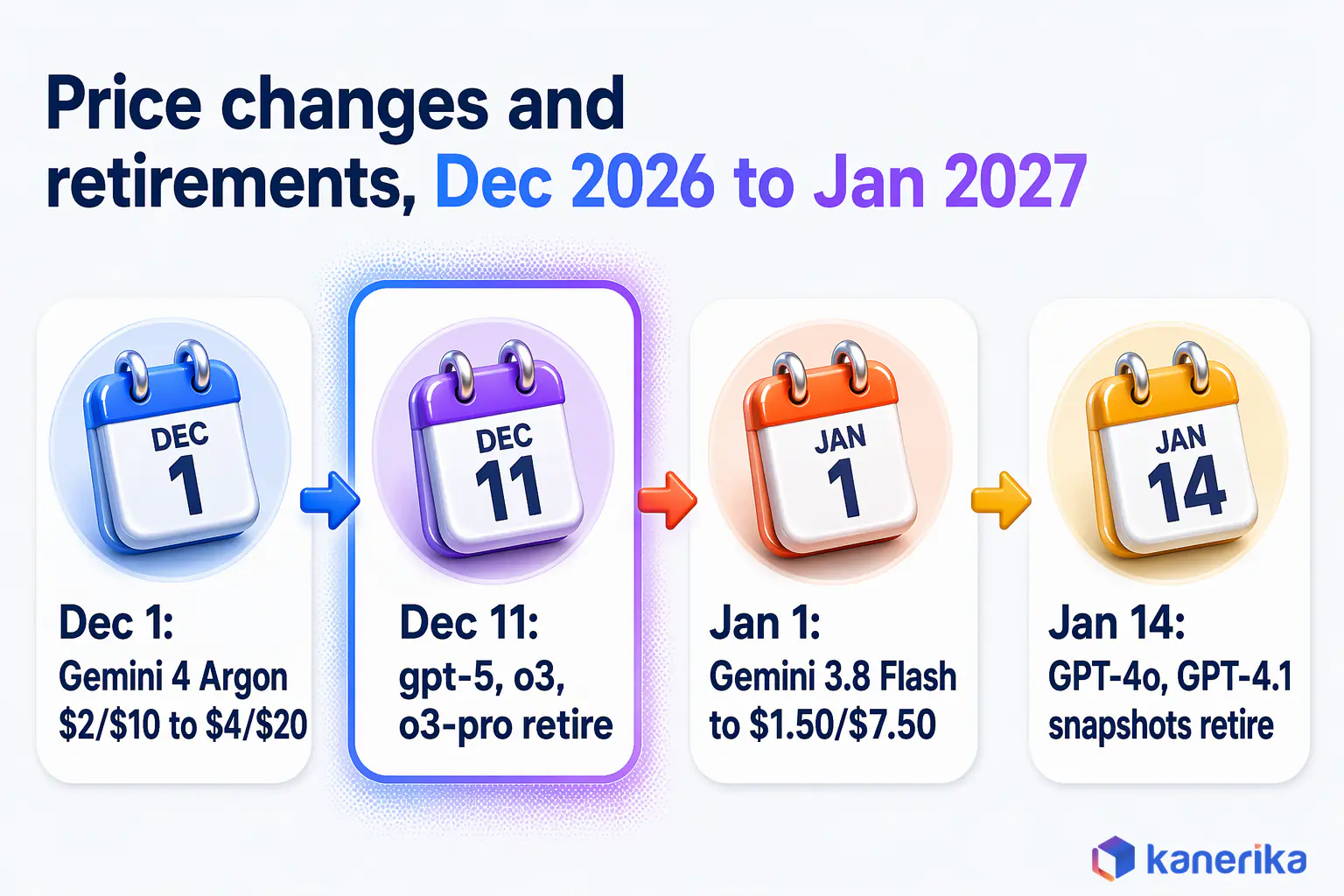
- Dated changes move budgets, since Gemini 4 Argon doubles on December 1, 2026 and OpenAI retires gpt-5, o3 and o3-pro on December 11.
- OpenAI and Google do not train on paid API data by default, while Claude Fable 5.1 carries a 30-day retention rule.
- Pick the lowest-cost model that clears every mandatory requirement in a 30-day test on your own data, then compare weighted scores.
The Shortlist Meeting With Three Logos on the Whiteboard
Picture a Monday shortlist meeting with three logos on the whiteboard. The product lead wants Claude because the engineers already code with it. Finance, meanwhile, asks why the Gemini quote changes in December, and security wants to know which vendor keeps prompts for 30 days.
All three questions are fair, but a ranking of writing quality answers none of them. So this ChatGPT vs Gemini vs Claude guide compares the three the way a buying committee does. It also covers what each purchase includes, what it costs at volume and how each vendor handles your data.
This guide is for the CTO, product lead or AI lead who must defend the choice later. Every price below is a list price, and every claim points to a vendor page so you can check it yourself.
Prices and model lineups checked November 2, 2026.
ChatGPT vs Gemini vs Claude: The Short Answer for Enterprise Teams
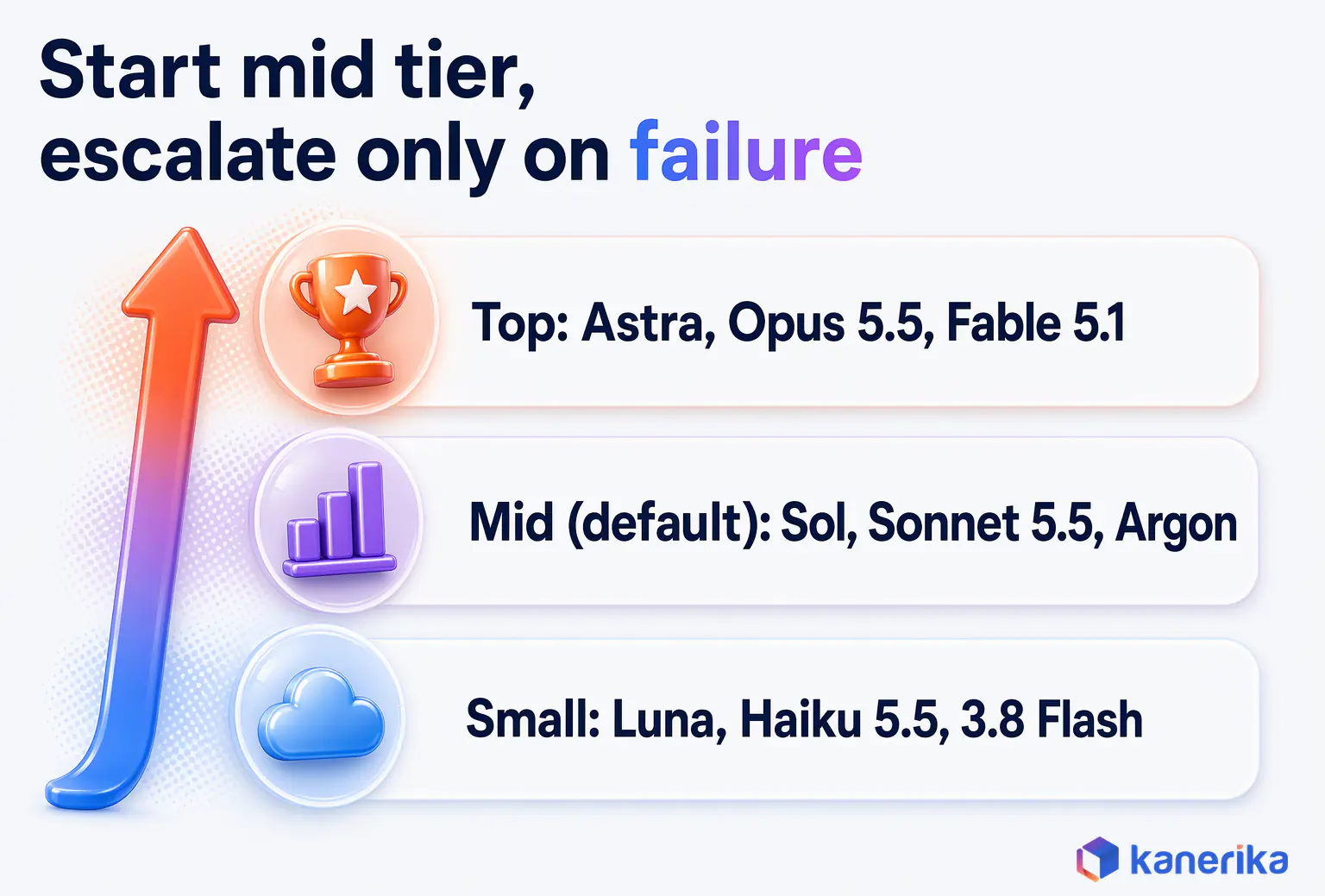
For most enterprise teams, the short answer is to start with the mid tier of each family. GPT-6.1 Sol, Gemini 4 Argon and Claude Sonnet 5.5 cost the same at list price in November 2026, even though their strengths differ.
The decision therefore rests on task quality, data terms and the tools your teams already use. Move up a tier only when the mid tier fails.
That answer holds because the three vendors now sell similar ladders. Each one sells a cheap model for volume, a mid-tier model for most work and a premium model for the hardest tasks. The useful comparison, then, is rung by rung.
ChatGPT vs Gemini vs Claude at a Glance
The table below summarizes each provider, although it covers three vendors only. When you also want open-weight options, see our broader ranking of top LLMs. For the company-level story behind two of these vendors, read our OpenAI vs Anthropic comparison.
| Provider | Best-value production model | Top-tier model | Paid consumer plan (verified) | Strongest fit |
|---|---|---|---|---|
| OpenAI | GPT-6.1 Sol ($2 / $10) | GPT-6 Astra ($10 / $50) | ChatGPT Go at $8 a month | One vendor across chat, API and a wide model range |
| Gemini 4 Argon ($2 / $10 until November 30, 2026) | Gemini 4 Argon, since Gemini 4 Carbon is announced only | Google AI Pro at $19.99 a month | Teams standardized on Google Workspace and Google Cloud | |
| Anthropic | Sonnet 5.5 ($2 / $10) | Opus 5.5 ($4 / $20) or Fable 5.1 ($10 / $50) | Pro and Max, so check Anthropic’s pricing page | Engineering and document-heavy teams testing agent workflows |
Before moving on, look closely at the top-tier column. Moving up from the mid tier costs 2x on Claude Opus 5.5 and 5x on GPT-6 Astra or Claude Fable 5.1. That gap is why the default should stay in the middle until a test proves otherwise.
Chatbot Apps vs API Models: Two Different Purchases
Enterprises buy these models in two ways, and mixing them up distorts every budget. A chatbot seat is a monthly fee so that one person can use an app. An API key, on the other hand, bills your software for every token it sends and receives.
Both purchases often sit in the same company, so it helps to name them separately in the budget. Seat spend grows with headcount, while API spend grows with traffic and prompt size.
What a Seat Buys
A seat covers one user in ChatGPT, Gemini or Claude, and the vendor decides which models that plan can reach. For example, ChatGPT Plus at $20 a month includes GPT-6.1 Sol and GPT-6 Luna. Google AI Pro, for its part, costs $19.99 a month or $199.99 a year.
Seats suit knowledge workers who draft, summarize and research inside the app. However, they cannot power a customer-facing product, and team or enterprise seat prices are usually quoted per contract.
What an API Key Buys
An API key gives your application direct access to a specific model ID, such as gpt-6.1-sol, gemini-4-argon or claude-sonnet-5-5. You pay per million input and output tokens, so cost grows with traffic instead of headcount.
The key also gives you control over prompts, logging and routing. Our OpenAI API guide also covers those mechanics on the OpenAI side.
Why the App and the API Differ Even When the Name Matches
The same brand name can behave differently in each channel. Plans decide which models a user sees, while the API bills by model ID. Rate limits also differ between consumer accounts and production keys.
Data terms differ too, and that difference matters most. Consumer accounts and business contracts carry separate training and retention rules, which the data handling section below covers. For a wider view of production rollouts, see our guide to enterprise LLM adoption.
The Current Models From OpenAI, Google and Anthropic (Checked November 2026)
Each vendor now sells a ladder of models, from a cheap high-volume tier to an expensive top tier. Knowing the ladder matters more than knowing the newest name, because most enterprise traffic belongs on the lower rungs. This guide covers three vendors, while our Grok vs ChatGPT vs DeepSeek comparison covers two more.
OpenAI: GPT-6.1 and GPT-6
OpenAI’s current API lineup has four tiers. At the center sits GPT-6.1 Sol, published September 29, 2026, at $2 input and $10 output per million tokens. Its sibling GPT-6.1 Terra then halves that to $1 and $5.
At the top, GPT-6 Astra costs $10 and $50, while GPT-6 Luna covers bulk traffic at $0.10 and $0.50. All four list a 1,050,000-token context window and 128,000 maximum output tokens. Our guide to GPT models explains how the OpenAI family evolved.
Google: Gemini 4 Argon and Gemini 3.8 Flash
Google’s flagship API model is Gemini 4 Argon, whose model card was published October 13, 2026. It is live on the Gemini API, so you can call it today with up to 1 million tokens of combined context. Even so, Google’s pages do not mark it as generally available or as a preview.
Argon costs $2 and $10 through November 30, 2026, then $4 and $20 from December 1. Below it, Gemini 3.8 Flash costs $0.75 and $3.75 until December 31, 2026. Meanwhile, Gemini 4 Carbon was announced in October 2026 with no price or availability yet.
The Gemini API models page lists current model IDs, so check it before you pin one. For more background, see our Google Gemini AI overview.
Anthropic: Claude 5.5 and Fable 5.1
Anthropic’s lineup runs from Claude Haiku 5.5 up to Claude Fable 5.1. In the middle, Claude Opus 5.5, announced September 22, 2026, costs $4 and $20, and Anthropic recommends it for most work.
Sonnet 5.5, announced September 28, 2026, matches the $2 and $10 mid-tier price. Haiku 5.5, announced October 7, 2026, starts at $0.10 and $0.50. At the top, Fable 5.1 costs $10 and $50.
Every current Claude model also lists 1 million tokens of context and 128,000 output tokens. Older models such as Fable 5, Opus 5, Sonnet 5 and Haiku 4.5 are now legacy, so pin new work to current IDs.
How to Read the Model Table
The table lists every current model with its API ID, price, limits and status. Read it by row when you want one model’s full profile, and by column when you compare price or context across vendors.
| Model (API ID) | Input / output per 1M tokens | Context / max output | Status |
|---|---|---|---|
| GPT-6 Astra (gpt-6-astra) | $10 / $50 | 1.05M / 128K | Current |
| GPT-6.1 Sol (gpt-6.1-sol) | $2 / $10 | 1,050,000 / 128,000 | Current (September 29, 2026) |
| GPT-6.1 Terra (gpt-6.1-terra) | $1 / $5 | 1,050,000 / 128,000 | Current |
| GPT-6 Luna (gpt-6-luna) | $0.10 / $0.50 | 1.05M / 128K | Current |
| Gemini 4 Argon (gemini-4-argon) | $2 / $10 to November 30, then $4 / $20 | Up to 1M combined | Live, not labeled GA or Preview |
| Gemini 3.8 Flash (ID on Google’s models page) | $0.75 / $3.75 to December 31, then $1.50 / $7.50 | Not stated on pages checked | Priced on the Gemini API |
| Gemini 4 Carbon (no ID yet) | No price yet | No figure yet | Announced, no price or availability |
| Claude Fable 5.1 (claude-fable-5-1) | $10 / $50 | 1M / 128K | Current |
| Claude Opus 5.5 (claude-opus-5-5) | $4 / $20 | 1M / 128K | Current, recommended for most work |
| Claude Sonnet 5.5 (claude-sonnet-5-5) | $2 / $10 | 1M / 128K | Current |
| Claude Haiku 5.5 (claude-haiku-5-5) | $0.10 / $0.50 (prompts up to 100K) | 1M / 128K | Current |
| Claude Fable 5, Opus 5, Sonnet 5, Haiku 4.5 (various) | Not compared here | Not compared here | Legacy |
Subscription Plans Compared
Subscription plans are the cheapest way to give staff access, and the verified prices sit close together. Still, the real differences are which models each plan reaches and what business tiers add in admin and data controls.
| Plan | Price (checked November 2, 2026) |
|---|---|
| ChatGPT Free | $0 |
| ChatGPT Go | $8 a month |
| ChatGPT Plus | $20 a month, which includes GPT-6.1 Sol and GPT-6 Luna |
| ChatGPT Pro | From $100 a month ($100, $200 or $500 tiers) |
| Google AI Pro | $19.99 a month or $199.99 a year |
| Claude Free, Pro, Max, Team and Enterprise | See Anthropic’s pricing page, since prices were not verified here |
Team and enterprise seat prices are negotiated or were not verified for this guide, so ask each vendor for a written quote. When you compare quotes, weigh admin controls, single sign-on and data terms, since those shape the contract more than the monthly fee.
ChatGPT Pro, from $100 a month, suits a small group of heavy users rather than a whole department. So start most staff on a lower plan and move individuals up only when their usage justifies it.
Individual plans also tend to spread quietly inside a company. Once staff pay for their own seats, company data can end up under consumer terms, so give people an approved option early.
API Pricing and the Price-Change Calendar
API pricing is where enterprise budgets are won or lost. List prices look simple, yet long prompts, caching, batch discounts and dated price changes can move a monthly bill by 2x either way.
List Prices per Million Tokens
Grouping the models by tier makes the price ladder easier to compare than a flat list. Each cell shows input and then output price per million tokens.
| Tier | OpenAI | Anthropic | |
|---|---|---|---|
| Small | GPT-6 Luna, $0.10 / $0.50 | Gemini 3.8 Flash, $0.75 / $3.75 | Claude Haiku 5.5, $0.10 / $0.50 |
| Mid | GPT-6.1 Sol, $2 / $10; GPT-6.1 Terra, $1 / $5 | Gemini 4 Argon, $2 / $10 to November 30 | Claude Sonnet 5.5, $2 / $10 |
| Top | GPT-6 Astra, $10 / $50 | Gemini 4 Carbon announced, no price | Claude Opus 5.5, $4 / $20; Claude Fable 5.1, $10 / $50 |
Because rates change, Google publishes its current figures on the Gemini API pricing page. Treat every figure here as list price before discounts or committed-use agreements.
Long Prompts, Caching and Batch
Four pricing rules change the arithmetic once traffic grows:
- GPT-6.1 Sol and Terra charge 2x input and 1.5x output on prompts over 272K tokens.
- Claude Haiku 5.5 output rises from $0.50 to $2.50 per million once a prompt passes 100K tokens.
- Cached input is far cheaper, such as Claude Opus 5.5 cache reads at $0.20 per million and GPT-6.1 Sol cached input at $0.10.
- OpenAI’s Batch and Flex processing run 50% below standard rates for Sol and Terra.
A support bot that resends the same long policy document on every call is the classic caching win. Caching that stable prefix is therefore the first cost lever to test. Batch suits overnight jobs such as document tagging, where nobody waits for the answer.
Dates to Put in the Budget
- Gemini 4 Argon keeps its $2 / $10 price through November 30, 2026.
- From December 1, 2026, Argon moves to $4 / $20.
- OpenAI retires gpt-5, o3 and o3-pro on December 11, 2026.
- Gemini 3.8 Flash holds $0.75 / $3.75 until December 31, 2026, then moves to $1.50 / $7.50.
- On January 14, 2027, OpenAI retires the GPT-4o and GPT-4.1 snapshots.
OpenAI already retired gpt-4-turbo, o1, o3-mini and gpt-4o-2024-05-13 on October 23, 2026. Any application still pinned to one of those IDs needs a migration plan now.
What Each Model Costs Under a Real Workload
Per-token prices only become useful once you multiply them by real traffic. So take one workload of 1,000,000 requests a month, each with 2,000 input tokens and 500 output tokens.
Together, that adds up to 2 billion input tokens and 500 million output tokens a month. Every prompt stays under the 100K and 272K thresholds, so no long-prompt surcharge applies. Also note that the table is list-price arithmetic, not a measured test.
To check one row by hand, take GPT-6.1 Sol as an example. Its 2,000 million input tokens at $2 cost $4,000, and its 500 million output tokens at $10 cost $5,000, for $9,000 in total.
| Model | Monthly cost at list price |
|---|---|
| GPT-6 Luna | $450 |
| Claude Haiku 5.5 | $450 |
| Gemini 3.8 Flash | $3,375 (from January 1, 2027: $6,750) |
| GPT-6.1 Terra | $4,500 |
| GPT-6.1 Sol | $9,000 (Batch: $4,500) |
| Claude Sonnet 5.5 | $9,000 |
| Gemini 4 Argon | $9,000 in November; $18,000 from December 1, 2026 |
| Claude Opus 5.5 | $18,000 |
| GPT-6 Astra | $45,000 |
| Claude Fable 5.1 | $45,000 |
What the Worked Example Shows
The spread is 100x from the cheapest row to the most expensive one. Three mid-tier models land on the same $9,000 in November, but Gemini 4 Argon doubles to $18,000 once the December price applies.
The Batch figure for GPT-6.1 Sol shows what timing flexibility is worth. When the same work can wait for an overnight run, the bill halves to $4,500 because Batch runs 50% below standard rates.
Your own workload will differ, but the arithmetic scales in a straight line. If you double the requests, you double the bill, as long as prompts stay under the long-prompt thresholds.
Notice also how output dominates the bill on most rows. Output tokens cost five times more than input on these models. So asking for shorter answers often saves more than trimming the prompt.
Cost per Successful Task Matters More Than Cost per Token
A token bill hides the cost of failure. Every retry, rejected answer and minute of human review adds to the real price of a finished task.
Suppose a small model fails 1 in 5 tasks, and each failure triggers a mid-tier retry plus a reviewer’s time. The cheaper model can then cost more per finished task than the mid tier alone. For that reason, measure cost per successful task during evaluation and compare models on that number.
Route Routine Traffic to Small Models Before Paying for More
Production systems rarely need one model for everything. Instead, a router can send classification, extraction and short replies to GPT-6 Luna or Claude Haiku 5.5. It then escalates harder requests to the mid tier.
Single-provider routing is simpler to secure and support, since one contract covers every call. Multi-provider routing, on the other hand, adds a fallback when one vendor has an outage or retires a model.
Either way, an LLM gateway keeps keys, logging and cost tracking in one place. It also lets you change the routing rules without redeploying the application.
Coding and Agentic Engineering
Coding is where vendor claims are loudest, so your own repository is the only fair judge. Still, the verified benchmark data point is narrow. On Terminal-Bench 4.0, Anthropic reports 66.4% for Claude Opus 5.5 and 55.8% for Claude Fable 5.1.
Anthropic’s published benchmarks show Opus 5.5 matching or beating Fable 5.1 on most listed benchmarks. Treat that as a reason to include Opus 5.5 in your test, because it is cheaper than Fable 5.1. It says nothing about how GPT-6.1 Sol or Gemini 4 Argon perform on your code.
A fair coding evaluation separates three things:
- Code quality on your own tickets, judged by your own reviewers.
- Multi-step task completion, where the model plans, edits files and runs tests.
- Safety controls, with human approval required before any agent touches production.
Tooling also shapes results as much as the model does. Our comparisons of Gemini CLI vs Claude Code and GPT Codex vs Claude Code show how the agent tooling changes daily developer work.
Agentic work also raises the cost question again. An agent that loops through ten tool calls resends the growing context each time. As a result, one long session can cost far more than a chat reply.
Research, Documents, RAG and Data Analysis
Research and document work depends more on how you feed the model than on which model you pick. A 1-million-token window lets you paste a large contract set, yet it does not guarantee the model finds the right clause.
Retrieval-augmented generation, or RAG, fetches the relevant passages first and then asks the model to answer with citations to those sources. Our guide to building a RAG application covers the design choices, from chunking to ranking.
Data quality and governance decide answer quality more than vendor choice. When source documents are stale, duplicated or badly permissioned, every model answers confidently from bad inputs. Document Q&A tools such as Kanerika’s KlarityIQ return answers with source citations, so reviewers can check each claim.
For analytics, ask the model to write and explain SQL or Python against a governed dataset. That way every figure traces back to a query a person can rerun later, such as during an audit.
A simple test shows the difference quickly. Ask each model the same ten questions over the same document set, then check whether each cited passage really supports the answer.
Kanerika Service
RAG Development
Kanerika builds retrieval-augmented generation systems that answer from your governed documents, with source citations reviewers can check.
Explore RAG DevelopmentContext Windows and Long-Document Work
Context windows have converged near 1 million tokens across the three vendors. GPT-6.1 Sol and Terra list 1,050,000 tokens, while every current Claude model lists 1 million. Gemini 4 Argon also handles up to 1 million combined, and for contrast, Grok 4.7 lists 500,000.
The headline window matters less than the pricing rules attached to it. Sol and Terra prompts over 272K tokens cost 2x on input. Similarly, Claude Haiku 5.5 output costs 5x more above 100K tokens.
Sending only the passages a task needs usually beats filling the window. Keep long, stable instructions in a cached prefix. Also test accuracy at the prompt lengths you will really use, since quality can drift as prompts grow.
For a long contract review, for example, split the work into steps. First ask for the clauses that match a topic, then ask for analysis of only those clauses, so each call stays short and cheap.
Writing and Everyday Productivity
Everyday writing quality is close enough across the three that workflow fit decides most choices. The better question is where your people already work:
- Google Workspace teams get Gemini alongside the documents, mail and sheets they already use.
- Microsoft 365 teams often compare ChatGPT with Microsoft Copilot, which sits inside Office apps.
- Teams with no suite preference can run ChatGPT or Claude as standalone apps.
Run a one-week trial with real tasks, such as a proposal draft, a meeting summary and a policy rewrite. Then ask the people doing the work to score the outputs blind, because brand loyalty skews open scoring.
Adoption also depends on habits as much as tools. When the assistant sits inside the app people already open every morning, usage tends to follow, so suite fit often decides the rollout.
Talk to Kanerika
Rolling Out AI Assistants Across Teams?
Talk to Kanerika about matching ChatGPT, Gemini or Claude to the way your teams already work, with access and data controls in place.
Talk to an Expert →Multimodal Input
Image, document and media input now depends on the exact model you call, so check the model ID before you design a workflow around it. The table lists only what each vendor’s own model page states, checked November 2, 2026.
| Model | Image | Audio | Video | Output | Vendor source | |
|---|---|---|---|---|---|---|
| GPT-6.1 Sol (OpenAI) | Yes | Yes, as file inputs | Not supported | Not supported | Text | GPT-6.1 Sol model page, File inputs guide |
| Gemini 4 Argon (Google) | Yes | Yes | Yes | Yes | Text | Gemini 4 Argon model page |
| Gemini 3.8 Flash (Google) | Yes | Yes | Yes | Yes | Text | Gemini 3.8 Flash model page |
| Claude Fable 5.1, Opus 5.5, Sonnet 5.5, Haiku 5.5 (Anthropic) | Yes | Yes | Not listed | Not listed | Text | Claude models overview, PDF support page |
Among these models, only the two Gemini pages list audio and video input. A call-recording or video-review workflow therefore narrows the shortlist to Google, while image and PDF work stays open to all three vendors.
Confirm each input type in the vendor’s model documentation before you design around it. Our overview of multimodal AI explains where image and document inputs add value in enterprise workflows.
A practical example is a scanned invoice or a chart in a slide deck. Before you build on that input type, test it with your own files, because layout, scan quality and language can all change the result.
Kanerika Service
LLM Development and Evaluation
Kanerika shortlists, tests and builds LLM applications on your own tasks and data, scoring quality, cost per task and data terms before anything reaches production.
Explore LLM DevelopmentIntegrations and Ecosystem
Integration effort often outweighs a small quality gap between models, especially at enterprise scale. Gemini fits naturally where Google Workspace and Google Cloud are already standard, because identity, data and billing sit in one place.
Microsoft environments raise a different set of options. Teams there often weigh ChatGPT against Copilot, as our Microsoft Copilot vs ChatGPT comparison explains. They also build model-based apps on Microsoft Foundry.
The heavier integration work usually happens in the data platform. Data may sit in Microsoft Fabric, Databricks or Snowflake, for instance. In each case, the model needs governed access, clean pipelines and logged queries before it can answer business questions well.
Each vendor documents its own integration path. OpenAI’s MCP servers guide lists built-in connectors for SharePoint, Microsoft Teams, Gmail and Google Drive. The same guide deprecates those connectors for models released after September 1, 2026, so the guide points new builds to remote MCP servers.
Anthropic’s models overview lists IDs for every current Claude model on Amazon Bedrock, Google Cloud and Microsoft Foundry. On the Google side, admins switch the Gemini app on or off by organizational unit or group in the Google Workspace Admin console.
Identity is the other integration that teams underrate. When the model platform connects to your single sign-on and access groups, you reuse existing permissions. That saves building a new access model from scratch.
For Claude, SCIM provisioning with group mappings sets each user’s role and seat tier from identity provider groups, on Enterprise and Console organizations only.
Data Handling: Training, Retention and Zero Data Retention
Data handling is the section buyers skim and security reviews stop on. All three vendors publish terms for paid and business use, and the sharpest differences sit in retention.
Training Defaults on Paid and Business Tiers
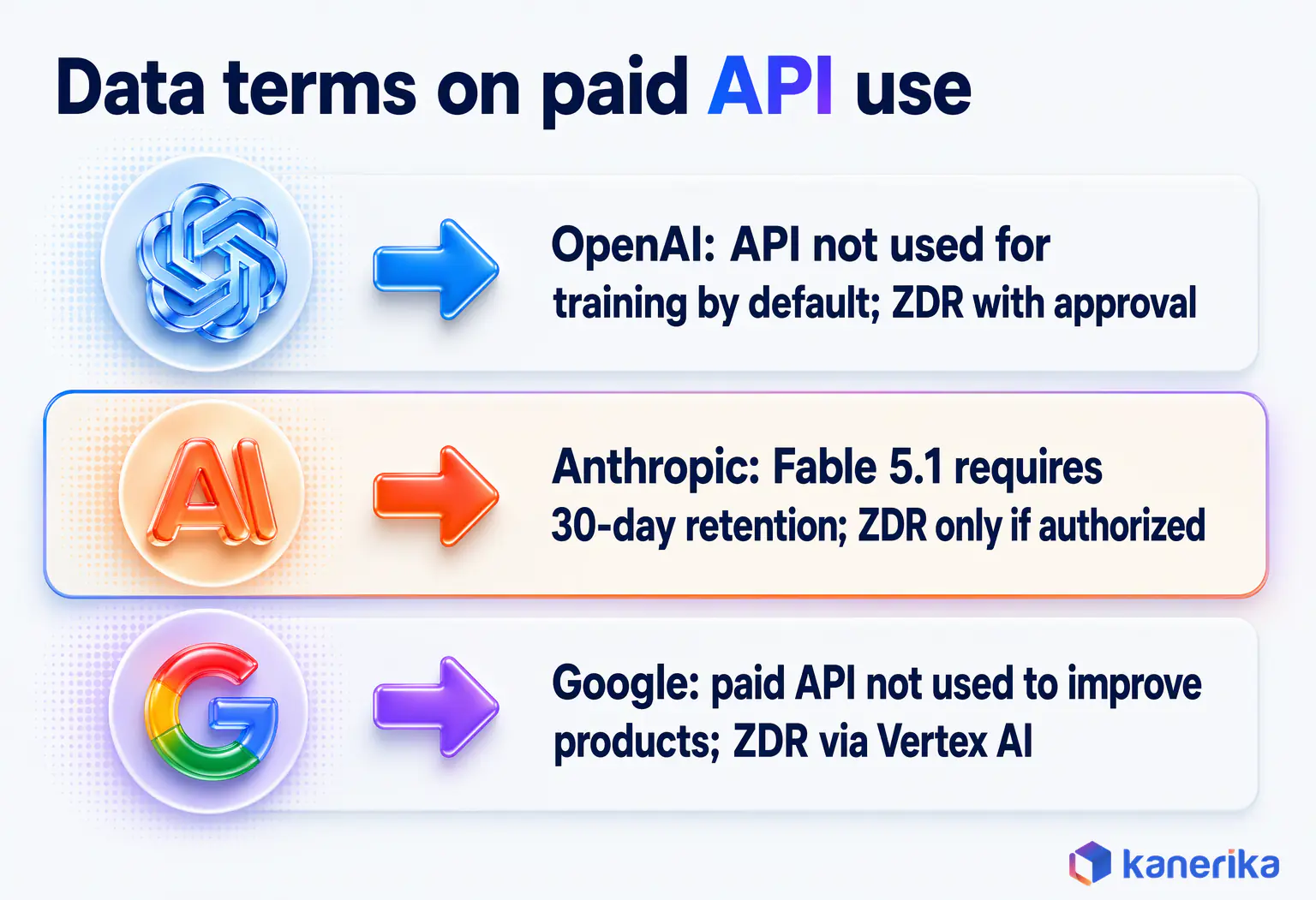
OpenAI states that data sent to its API is not used to train or improve its models unless the customer opts in. For ChatGPT Business and Enterprise seats, confirm the training terms on its enterprise privacy page before you sign.
Google says paid Gemini API use is not used to improve its products, per the Gemini API terms. Paid use here means a Cloud project with active billing. However, the free tier and unpaid AI Studio use can be, so keep company data off free accounts.
Consumer accounts follow different rules from business contracts, so a staff member’s personal account is not covered by your enterprise terms. That is also why an approved company plan matters for security.
Anthropic states that retained data is never used for model training without your express permission. Its commercial terms still deserve the same written check before procurement signs. Then ask each vendor to confirm the training position for the exact plan and model you will use.
Retention Windows and Zero Data Retention Exceptions
OpenAI may keep API data for up to 30 days for abuse monitoring. It also provides Zero Data Retention to eligible customers, as its data controls guide describes.
Google applies limited logging for policy enforcement. For guaranteed zero data retention, it points customers to Vertex AI.
Anthropic’s rule is the key differentiator. Its Covered Models, including Claude Fable 5 and Fable 5.1, require 30-day retention under a policy effective June 9, 2026; Fable 5.1 was added to the Covered Models list on August 31, 2026. Zero Data Retention does not apply to them unless Anthropic expressly authorizes it.
The rule is documented on Anthropic’s API data retention page and in its covered models article. So a team that needs zero retention should confirm in writing which models its contract treats as covered.
Controls You Still Own
- Redact personal data before prompts leave your network.
- Restrict who can call which model, with keys held in a gateway instead of in code.
- Log prompts, outputs and costs under your own retention policy.
- Test for prompt injection before any model reads untrusted documents or email.
Our LLM security guide goes deeper on each of these controls, with examples. Vendor terms set the floor, while your own controls decide what actually reaches the model.
Checklist
Enterprise AI Readiness Checklist
Work through the data, security, governance and operating questions to settle before an LLM reaches production.
Get the Checklist →Benchmarks: What They Show and What They Miss
Benchmarks are a useful starting filter but a poor finish line. Vendor-published scores come from the vendor’s own setup, prompts and effort settings, and those choices can shift results noticeably.
Effort settings are a good example, because they change both quality and price. Many models can spend more reasoning effort per answer, which raises accuracy and cost together. A score published without its effort level therefore cannot be compared fairly with another score.
The Terminal-Bench 4.0 figures above show a gap between two Claude models and nothing more. Build your own scored test set instead, using the approach in our LLM evaluation framework guide.
A good internal test set also outlives any single vendor release. When a new model ships, you can rerun the same tasks in a day and see whether it really moves your numbers.
Limitations of ChatGPT, Gemini and Claude
Every vendor carries trade-offs that matter more at scale than in a demo. Plan for them before signing, because each one has a cost in people or budget.
ChatGPT and OpenAI
OpenAI’s range is wide, which also makes it sprawling. Four GPT-6 tiers, older snapshots and a busy retirement calendar mean someone must own model IDs and migrations. The next deadline is December 11, 2026, when gpt-5, o3 and o3-pro retire.
Gemini and Google
Google’s flagship doubles in price on December 1, 2026, and its pages do not label Gemini 4 Argon GA or Preview. Some procurement teams will query that status before they sign. Since Gemini 4 Carbon is announced only, any plan built around it is speculative for now.
Claude and Anthropic
Anthropic’s highest-priced model, Claude Fable 5.1, costs $10 and $50 per million tokens and carries the 30-day retention rule. Claude plan prices were not verified for this guide, so check them on Anthropic’s site before you compare seat budgets.
Limits All Three Share
Some limits apply to ChatGPT vs Gemini vs Claude alike. Each model can still produce a confident wrong answer, and each vendor changes prices and retires models on its own schedule.
So build checks into the workflow instead of trusting any single output. Keep a human review step where errors are costly, and keep a tested fallback model ready.
When none of the three fits a hard constraint, such as on-premises hosting, an open-weight model may suit better. Our roundup of open-source LLMs covers those options.
How to Choose: Picks by Team, a 30-Day Evaluation and a Weighted Scorecard
Choosing well is a process with a clear end point. Start from team needs, test on real work for 30 days, then score the finalists against weights agreed in advance. The tier picker below is the starting map for that process.
Picks by Team
- Engineering teams should test Claude Opus 5.5, Claude Sonnet 5.5 and GPT-6.1 Sol on their own repository, with human approval on every production change.
- Analytics teams can start with the mid tier of each family and ask for SQL or Python with explanations against governed data.
- Customer support teams can route routine replies to GPT-6 Luna or Claude Haiku 5.5 and escalate complex tickets to the mid tier.
- Content teams should pick the app that fits their suite, which means Gemini for Google Workspace and ChatGPT or Claude elsewhere.
- Regulated teams should shortlist on retention terms first and confirm that the Fable 5.1 30-day rule fits their policy.
Run a 30-Day Evaluation
Use the same dataset, prompts and tools for every candidate so the comparison stays fair. Pull a representative set of real tasks from your backlog, and define a correct answer for each before testing starts.
Record accuracy, retries, latency and cost for every task, as well as reviewer time. Then review failures by hand each week, because the pattern of errors often matters more than the average score.
By the end of the month, you should have a cost per successful task for each candidate. That figure, together with the mandatory checks, feeds the scorecard below.
Weighted Scorecard
| Criterion | Suggested weight | What to measure |
|---|---|---|
| Task quality | 30% | Correct, complete answers judged by your reviewers |
| Operating cost | 25% | Cost per successful task at expected volume |
| Security and governance | 20% | Training, retention and Zero Data Retention terms, plus access controls |
| Latency and reliability | 15% | Response time and error rate under load |
| Integration effort | 10% | Work needed to connect identity, data and monitoring |
Mandatory requirements come before the weights. For example, a regulated team may require zero retention, while a support team may require replies within a set time. Any model that misses a mandatory requirement leaves the shortlist, whatever its score.
These are suggested weights, so adjust them to your risk profile. Once the scores are in, the decision rule is simple. First pick the lowest-cost model that meets every mandatory requirement, then compare weighted scores among the models that pass.
Kanerika Service
Estimate the Return of an AI Use Case
Model the expected return of a planned AI use case before you commit budget to a model or vendor.
Estimate Your ROIHow Kanerika Helps Enterprises Select and Run LLMs
Kanerika builds on both Anthropic’s Claude and OpenAI’s models. Kanerika is an OpenAI Select Partner and is certified in the Claude Partner Network, and model selection work follows four stages:
- A use-case and data readiness review covers what the model will see, where personal data sits and which governance rules apply, through AI strategy work.
- A shortlist and 30-day evaluation on the client’s own tasks scores quality, cost per task, latency and data terms, through LLM development services.
- The build stage delivers RAG development and agentic AI on governed data, with PII redaction through Susan, cited document Q&A through KlarityIQ and data pipelines on FLIP.
- The govern-and-monitor stage covers routing, cost tracking, retention settings and model retirements through AI governance services, including the kanSuite governance services kanGovern and kanGuard.
Day to day, that means pinning model IDs and re-testing before each retirement date. Prompts also stay provider-neutral where possible, so a model can be swapped without rewriting the application.
The first constraint in a real deployment often sits in the data. In the support engagement described below, repetitive tickets, customers who skipped the product manuals and trouble retaining skilled support staff were the starting problems. So the team prepared historical tickets and a knowledge base before building the LLM-based resolution system.
Each engagement also plans for change from the start. Since vendors retire models on fixed dates, the retirement calendar becomes part of the delivery plan, and a re-test runs before each date.
Cost per task is also logged from the first day of production. As a result, the next model decision becomes a comparison of real numbers instead of a debate about brands.
Case Study: 80% Ticket Auto-Resolution With an LLM
Kanerika worked with a B2B SaaS company that serves SMB clients in more than 40 countries. The team built a knowledge base from historical tickets and then an LLM-based ticket resolution system on top of it.
The published results were 80% auto-response of tickets and 70% reduced staffing cost. Ticket resolution time also fell by 50%, while customer satisfaction rose by 30%.
Case Study
80% Ticket Auto-Resolution with LLM-Driven AI
A B2B SaaS company serving SMB clients in 40+ countries reached 80% ticket auto-response, 70% lower staffing cost and 50% faster resolution with an LLM system built by Kanerika.
Read the Case Study →Final Verdict on ChatGPT vs Gemini vs Claude
ChatGPT vs Gemini vs Claude is a close race at the mid tier, so the winner for your team comes from your own test. The three mid-tier models share a $2 and $10 list price in November 2026, which makes them the right place to start.
Move up to Claude Opus 5.5 or GPT-6 Astra only where the mid tier fails, and budget for Google’s December 1 price change. Read each vendor’s retention terms before sensitive data goes in. When you are ready, Kanerika can run that 30-day evaluation with your team on your own data.
Frequently Asked Questions
Which is better for business: ChatGPT, Gemini, or Claude?
No single tool wins every business task. GPT-6.1 Sol, Gemini 4 Argon and Claude Sonnet 5.5 share a $2 input and $10 output list price per million tokens in November 2026. Start with all three on your own tasks. Pick the one that clears your quality, cost and data requirements, then add a top-tier model only where needed.
Which is best for coding: ChatGPT, Claude, or Gemini?
Test all three on your own repository before deciding. The verified data point is Anthropic’s Terminal-Bench 4.0 result, with Claude Opus 5.5 at 66.4% and Claude Fable 5.1 at 55.8%. That compares two Claude models only. Score code quality, multi-step task completion and review effort separately, and require human approval before agents touch production.
Can businesses use ChatGPT, Gemini, and Claude together?
Yes, and many production systems do. A router can send routine requests to a small model and harder ones to a mid-tier model. Using two vendors adds a fallback when one has an outage or retires a model. An LLM gateway keeps keys, logging and cost tracking in one place.
How should a CTO choose an AI model for a production application?
Start with mandatory requirements such as data terms, latency and integration. Then run a 30-day evaluation on real tasks using the same prompts for every candidate. Score quality, operating cost, security, reliability and integration effort. Pick the lowest-cost model that meets every requirement, then compare weighted scores among the finalists.
Which AI is best for enterprise data analysis?
Any of the three mid-tier models can support analysis when it works against governed data. Ask the model to write and explain SQL or Python, then run the queries yourself. That keeps every figure traceable. Data quality and access controls decide answer quality more than the choice between ChatGPT, Gemini and Claude.
Which is more accurate: ChatGPT, Gemini, or Claude?
Accuracy depends on the task, the prompt and the data you supply. Vendor benchmarks use their own setups and effort settings, so they rarely transfer to your work. Build a scored test set from real tasks. Record accuracy, retries and review time for each model, and decide on cost per successful task.
How does Grok compare to Claude?
Grok 4.7 lists a 500,000 token context window. It costs $2 input and $6 output per million tokens under 200K tokens, and $4 and $12 for the whole request once a prompt reaches 200K tokens. Claude Sonnet 5.5 costs $2 and $10 with a 1 million token context. Test both on your own tasks before choosing, and compare cost per successful task.
Who is ChatGPT's biggest competitor in 2026?
Google Gemini and Anthropic Claude are ChatGPT’s closest competitors for enterprise buyers. Their mid-tier models, Gemini 4 Argon and Claude Sonnet 5.5, match GPT-6.1 Sol at $2 input and $10 output per million tokens. The right rival depends on your suite, data terms and the results of your own tests.
Will Gemini API prices change after November 2026?
Yes. Gemini 4 Argon moves from $2 input and $10 output per million tokens to $4 and $20 on December 1, 2026. Gemini 3.8 Flash stays at $0.75 and $3.75 until December 31, 2026, then rises to $1.50 and $7.50. Build both changes into any annual budget, and re-run cost estimates before each date.
Which AI is best for enterprise use in 2026?
The best enterprise choice is the model that passes your own 30-day evaluation at the lowest cost. A sensible shortlist starts with GPT-6.1 Sol, Gemini 4 Argon and Claude Sonnet 5.5. Weigh task quality, cost per successful task, data terms, latency and integration effort. Many enterprises end up routing work across more than one vendor.
Which is cheapest: ChatGPT, Gemini, or Claude?
On the API, GPT-6 Luna and Claude Haiku 5.5 tie as the cheapest models at $0.10 input and $0.50 output per million tokens. Gemini 3.8 Flash costs $0.75 and $3.75 until December 31, 2026. For seats, ChatGPT Go costs $8 a month and Google AI Pro costs $19.99 a month.
Can I use ChatGPT, Gemini, or Claude for free?
Yes, each vendor offers some free access. ChatGPT has a Free plan at $0, Anthropic offers Claude Free, and the Gemini API has a free tier (Gemini 3.8 Flash has one; Gemini 4 Argon does not). Free use suits personal testing only. Google says free tier and unpaid AI Studio data can be used to improve its products, so keep company data on paid plans.
Is Claude safer than ChatGPT for confidential business data?
Safety depends on the contract and your own controls more than the brand. OpenAI offers Zero Data Retention to eligible API customers. Anthropic requires 30-day retention for Covered Models such as Claude Fable 5.1 unless it authorizes an exception. Redact personal data, restrict access and log usage whichever vendor you choose.
Do ChatGPT, Gemini, or Claude train on business data?
OpenAI says data sent to its API is not used to train or improve its models unless the customer opts in. Google says paid Gemini API use is not used to improve its products. Free Gemini tiers can be. Anthropic says retained data is never used for training without your express permission, but check its retention rules for each model before signing.
Which has the largest context window: ChatGPT, Gemini, or Claude?
The three are close. GPT-6.1 Sol and GPT-6.1 Terra list 1,050,000 tokens, every current Claude model lists 1 million, and Gemini 4 Argon offers up to 1 million combined. Pricing rules matter more than the headline. Sol and Terra charge 2x input on prompts over 272K tokens, so check prompt sizes before you budget.
Is Gemini better than ChatGPT for Google Workspace users?
Gemini is usually the easier fit for teams that already run on Google Workspace and Google Cloud. Identity, data and billing sit with one vendor, which cuts integration work. Quality still needs testing on your own tasks. Run a one-week trial with real documents and ask users to score outputs blind.
What makes Claude different from Gemini and ChatGPT?
Claude comes from Anthropic, and its current lineup runs from Haiku 5.5 to Fable 5.1. Anthropic recommends Claude Opus 5.5 for most work at $4 input and $20 output per million tokens. Every current Claude model lists a 1 million token context. Its 30-day retention rule for Fable 5.1 is a key data difference.