

Migrate from SSIS to Microsoft Fabric with Kanerika
Transform your legacy SSIS infrastructure into Microsoft Fabric's modern cloud-native platform. Kanerika's migration accelerator ensures rapid, seamless transition to Fabric with minimal disruption to your operations.
Get Started with SSIS to Microsoft Fabric Migration
The Tech Debt
The Cost of Not Modernizing Your Data Platforms

80%
IT budgets are spent on legacy system maintenance.

44%
CIOs see legacy systems as growth barriers.

50%
Developer productivity is lost due to outdated tools

70%
Digital transformation efforts fail due to legacy systems
Experience Our
SSIS to Fabric Migration
The SSIS to Microsoft Fabric Advantage
Transform Your Data Integration with Fabric's Next-Gen Capabilities

Eliminate Infrastructure Overhead
- Eliminate server maintenance and hardware upgrade cycles
- Scale compute resources automatically based on workload demands
- Transform capital expenses into predictable operational costs

Unified Analytics Platform
- Integrate semantic modeling, data warehousing, and reporting seamlessly
- Consolidate ETL, reporting, and machine learning workflows
- Streamline data flow from ingestion to insights

Cloud-Native Performance & Scale
- Process massive datasets without performance bottlenecks
- Leverage parallel processing capabilities beyond SSIS limitations
- Distribute data globally with built-in redundancy

Modern Development Experience
- Build semantic models using intuitive web-based interfaces
- Monitor performance and usage with advanced analytics capabilities
- Collaborate through integrated version control and deployment pipelines
The Migration Process
Transform Your ETL Workflows Effortlessly with Our Migration Accelerator
Automated Package Upload & Configuration
Upload your SSIS .dtsx ZIP files to FLIP, select migration options, and configure connection settings. Our intelligent tool automatically processes your existing packages and prepares them for cloud transformation.


Metadata Extraction & Power Query Conversion
FLIP extracts comprehensive SSIS metadata and converts it into optimized Power Queries. This automated process ensures all your business logic, transformations, and data relationships are preserved during the migration.

Semantic Model & Template Generation
Upon successful execution, FLIP generates a ready-to-deploy semantic model and Power Query Template directly in your Fabric workspace. The template loads automatically with refreshed scripts for immediate use.

Dataflow Deployment & Validation
Dataflow Gen2 is produced to replicate your SSIS logic in the cloud environment. Final validation confirms that all structures, connections, and data flows are intact and ready for production deployment.

ROI YOU CAN EXPECT
Unlock Microsoft Fabric's Potential with a Cost-Effective Transition
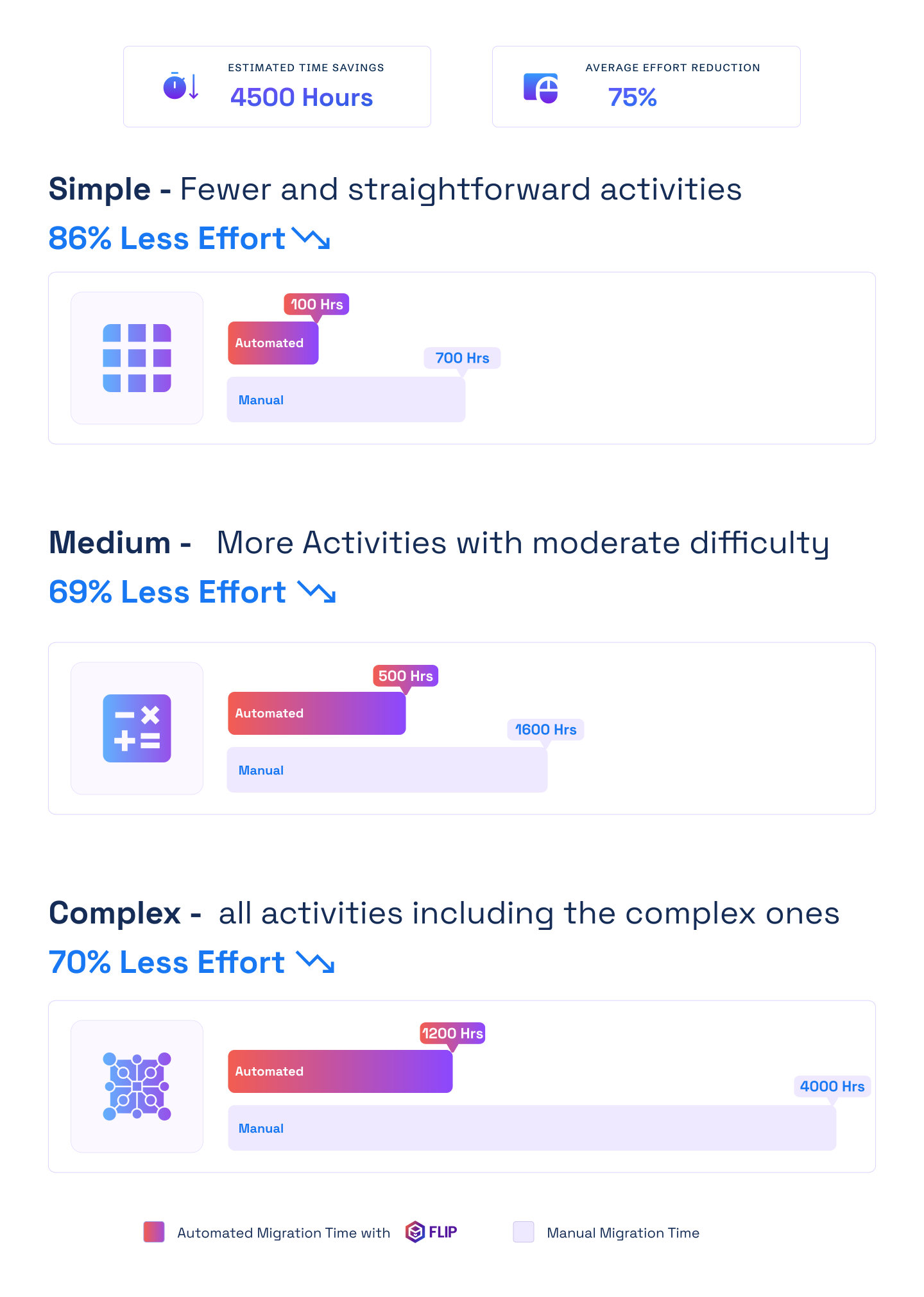

ESTIMATED TIME SAVINGS

Average effort reduction
Simple - Fewer and straightforward activities
Less Effort

Medium - More Activities with moderate difficulty
Less Effort
Complex - all activities including the complex ones
Less Effort

Case studies
Achieving Superior Results with Automated Migrations
Migration
Modernizing Enterprise Reporting with Crystal Reports to Power BI Migration
Impact:
- 60% Faster Migration
- 10x Data Scale
- 99.5% Refresh Success Rate
Migration
Modernizing Financial Analytics with Informatica to Alteryx Migration
Impact:
- 45% Faster Reporting Cycles
- 38% Reduction in Maintenance Costs
- 60% Improved Analytics Turnaround
Migration
Transforming Retail Reporting and Analytics with SQL to Microsoft Fabric Migration
Impact:
- 74% Faster Reporting Cycles
- 65% Increase in Reporting Stability
- 72% Faster Access to Current Metrics
Frequently Asked Questions (FAQs)
The timeline varies based on your ETL complexity, but Kanerika’s automated migration accelerator significantly reduces deployment time, completing the transition much faster than traditional manual approaches.
Microsoft Fabric offers intuitive low-code/no-code interfaces that are easy to learn. Teams familiar with Azure or Microsoft tools can adapt quickly, requiring minimal training to become productive.
Microsoft Fabric eliminates server infrastructure costs and reduces operational overhead by up to 60%. You’ll save on hardware maintenance while gaining cloud-scale performance and reliability.
No. Our migration process ensures zero downtime by running parallel systems during transition, guaranteeing continuous data flow without any operational disruption.
Post-migration, you’ll experience enhanced scalability, real-time processing capabilities, unified analytics, and simplified maintenance, enabling faster insights and better data governance across your organization.
SSIS requires expensive on-premises infrastructure with manual server maintenance and complex scaling. Microsoft Fabric eliminates these costs with cloud-native architecture that scales automatically. You get unified analytics combining ETL, data warehousing, and reporting in one platform. Microsoft is prioritizing investment in Microsoft Fabric while SSIS receives only maintenance updates. Kanerika’s proprietary migration accelerator, powered by FLIP, automates the entire transition, converting SSIS packages to Microsoft Fabric pipelines in days instead of months.
Microsoft Fabric Data Pipelines provide cloud-native scalability without infrastructure management. Built-in monitoring and error handling exceed SSIS logging capabilities. Native integration with Power BI, OneLake, and Microsoft Fabric warehouse eliminates complex connections. Real-time data processing capabilities surpass SSIS batch limitations. Parallel processing handles massive datasets without performance bottlenecks. Kanerika’s proprietary migration accelerator, powered by FLIP, ensures your SSIS packages leverage these advantages immediately after migration.
Not directly. Microsoft Fabric doesn’t support SSIS integration runtime. However, Kanerika’s proprietary migration accelerator, powered by FLIP, automates complete conversion. The tool extracts SSIS metadata from .dtsx files and converts them to Microsoft Fabric-compatible pipelines and dataflows. All business logic, transformations, and data relationships transfer automatically. You avoid months of manual package recreation through intelligent automation that preserves your ETL functionality.
Kanerika’s proprietary migration accelerator, powered by FLIP, intelligently maps SSIS control flow tasks to Microsoft Fabric pipeline activities. Data flow tasks convert to Dataflow Gen2 or Power Query transformations. Execute SQL tasks map to stored procedure activities. File system tasks translate to Microsoft Fabric file operations. Precedence constraints become pipeline dependencies. The accelerator handles these mappings automatically while optimizing for Microsoft Fabric’s cloud-native capabilities.
SQL Agent job schedules convert to Microsoft Fabric pipeline triggers automatically through Kanerika’s proprietary migration accelerator, powered by FLIP. Time-based schedules map to schedule triggers. Event-driven jobs convert to event-based triggers. Job dependencies translate to pipeline orchestration. We document all job configurations and recreate equivalent scheduling in Microsoft Fabric. Your automated ETL processes continue running on the same schedules after migration.
With Kanerika’s proprietary migration accelerator, powered by FLIP, migrations complete in 2-6 weeks depending on package complexity. Simple SSIS packages with straightforward activities migrate in days. Medium complexity packages with moderate difficulty complete in 1-2 weeks. Complex packages with all advanced activities finish in 3-6 weeks including validation. Manual migration without automation extends timelines to 6-12 months with high error risk. Our accelerator reduces migration effort by 70%.
Yes. Kanerika’s proprietary migration accelerator, powered by FLIP, handles hybrid scenarios where data sources remain on-premises. We configure on-premises data gateways for secure connectivity to Microsoft Fabric. SSIS packages accessing on-prem databases convert to Microsoft Fabric pipelines using gateway connections. You can maintain hybrid architecture during phased migration. This approach eliminates forced immediate cloud data movement.
Kanerika’s proprietary migration accelerator, powered by FLIP, preserves all SSIS transformation logic during conversion. We run parallel SSIS and Microsoft Fabric environments during testing. Output data is compared row by row to verify accuracy. The accelerator validates all data flows, transformations, and business rules. Comprehensive audit reports document conversion accuracy. Rollback capabilities exist at every stage to ensure complete data integrity throughout migration.
Yes. Kanerika’s proprietary migration accelerator, powered by FLIP, converts SSIS package configurations to Microsoft Fabric parameters automatically. Connection managers map to Microsoft Fabric connections. Variables convert to pipeline parameters. Configuration files transform to Microsoft Fabric parameter groups. Environment-specific settings transfer to workspace configurations. The accelerator maintains all dynamic configuration capabilities that existed in SSIS.
Microsoft Fabric provides cloud-native parallel processing that exceeds SSIS capabilities. Automatic scaling handles peak loads without manual intervention. Distributed architecture processes massive datasets faster than on-premises SSIS servers. OneLake integration reduces data movement overhead. Organizations typically see 40-60% improvement in ETL processing times after migration. Kanerika’s proprietary migration accelerator, powered by FLIP, optimizes pipelines for Microsoft Fabric’s performance advantages during conversion.
Yes. Microsoft Fabric handles real-time streaming through Eventstreams and Real-Time Intelligence capabilities. Event-based triggers enable event-driven architectures impossible in traditional SSIS. You can process streaming data with lower latency than SSIS batch processing. Microsoft Fabric’s continuous data ingestion supports modern real-time analytics. Kanerika’s proprietary migration accelerator, powered by FLIP, converts batch SSIS packages while enabling teams to add real-time capabilities post-migration.
Yes. Microsoft Fabric consolidates capabilities from both SSIS and Azure Data Factory into one unified platform. You get ETL functionality from SSIS plus cloud orchestration from ADF. Microsoft Fabric eliminates the need to manage separate services. OneLake provides centralized storage that both platforms lacked. Kanerika’s proprietary migration accelerator, powered by FLIP, handles migrations from SSIS, ADF, or both simultaneously to Microsoft Fabric.
Kanerika’s proprietary migration accelerator, powered by FLIP, converts SSIS error handling to Microsoft Fabric’s enhanced logging capabilities. Event handlers map to pipeline error activities. Logging configurations transfer to Microsoft Fabric’s monitoring hub. Retry logic converts to pipeline retry policies. Microsoft Fabric provides better visibility into failures with integrated monitoring dashboards. Alerting capabilities exceed SSIS event notifications through native Teams and email integration.
Microsoft Fabric eliminates SSIS server licensing and infrastructure costs. You pay only for compute consumption instead of maintaining dedicated servers. Hardware refresh cycles disappear with cloud infrastructure. Organizations typically reduce total ETL costs by 40-60% after migration. Operational overhead drops significantly with managed services. Kanerika’s proprietary migration accelerator, powered by FLIP, cuts migration costs another 70% through automation.
Kanerika’s proprietary migration accelerator, powered by FLIP, preserves all SSIS security configurations during migration. SQL Server authentication maps to Azure Active Directory. Package encryption converts to Microsoft Fabric connection security. Role-based access controls transfer to workspace permissions. Microsoft Fabric provides enhanced compliance through Microsoft Purview integration. Audit trails and data lineage exceed SSIS capabilities. Built-in certifications support GDPR, HIPAA, and SOC 2.
Yes. Microsoft Fabric and Power BI are deeply integrated. Pipelines trigger semantic model refreshes automatically. Power BI reports embed directly in Microsoft Fabric workspaces. Synapse capabilities are built into Microsoft Fabric, eliminating separate integration. OneLake provides shared storage across all services. Kanerika’s proprietary migration accelerator, powered by FLIP, ensures your migrated SSIS packages connect seamlessly to existing Power BI reports and analytics.
Kanerika’s proprietary migration accelerator, powered by FLIP, includes comprehensive validation. We run parallel SSIS and Microsoft Fabric pipelines with identical source data. Outputs are compared row by row for accuracy. All transformations, calculations, and business rules are verified. Performance benchmarks measure processing times. The accelerator generates detailed validation reports documenting every check performed. User acceptance testing confirms functionality before production deployment.
Yes. We provide hands-on training specific to pipelines migrated through Kanerika’s proprietary migration accelerator, powered by FLIP. Training covers Microsoft Fabric Data Factory, monitoring hub, Dataflow Gen2, and troubleshooting. Your team learns using their actual converted pipelines rather than generic examples. Most developers become productive within 2-3 weeks since Microsoft Fabric’s interface is more intuitive than SSIS management tools.
Main prerequisites include inventory of all SSIS packages and dependencies, access to SSIS package files (.dtsx), documentation of data sources and schedules, and Microsoft Fabric workspace with appropriate capacity. Kanerika’s proprietary migration accelerator, powered by FLIP, performs comprehensive pre-migration assessment. We analyze package complexity, identify unsupported features, and plan conversion strategy. This assessment determines exactly how much automation handles versus manual intervention needed.
Yes. We provide 30-90 day support periods after go-live to address any issues with pipelines migrated through Kanerika’s proprietary migration accelerator, powered by FLIP. Our team monitors Microsoft Fabric capacity usage, pipeline performance, and error rates. We provide optimization recommendations based on actual workload patterns. Managed services are available if you need ongoing Microsoft Fabric administration beyond initial migration support.
Yes. Microsoft Fabric provides modern alternatives for all three platforms. Microsoft Fabric Data Factory replaces SSIS functionality. Power BI and Microsoft Fabric reporting replace SSRS capabilities. Microsoft Fabric semantic models replace SSAS cubes. Microsoft continues supporting these legacy tools but focuses innovation on Microsoft Fabric. Kanerika’s proprietary migration accelerator, powered by FLIP, handles migrations from all three platforms, helping you modernize your entire Microsoft analytics stack.
Yes. Microsoft Fabric represents Microsoft’s strategic direction for unified data analytics. The company is actively investing in Microsoft Fabric development while SSIS receives only maintenance updates. Major organizations are migrating to Microsoft Fabric for cloud-native capabilities. With growing adoption and continuous feature releases, Microsoft Fabric is clearly Microsoft’s platform of the future. Kanerika’s proprietary migration accelerator, powered by FLIP, positions you to leverage this next-generation platform.
Kanerika’s proprietary migration accelerator, powered by FLIP, converts SSIS packages to Microsoft Fabric pipelines and Dataflow Gen2. Data sources connect through on-premises gateways or cloud connections. We use Microsoft Fabric’s native copy activities for data movement. OneLake serves as the centralized storage layer. Incremental load patterns transfer from SSIS to Microsoft Fabric’s optimized approaches. The accelerator automates entire conversion process while preserving all data movement logic.
With Kanerika’s proprietary migration accelerator, powered by FLIP, the assessment phase takes 1-2 weeks to analyze all SSIS packages. Conversion and deployment complete in 2-4 weeks for most environments. Complex enterprises with hundreds of packages finish in 4-6 weeks including testing. Manual migration without automation extends to 6-12 months. Our accelerator reduces overall timeline by 70% through intelligent automation that handles 90-95% of conversions automatically.
SSIS uses control flow and data flow tasks within packages. Microsoft Fabric uses pipeline activities and Dataflow Gen2 for transformations. Kanerika’s proprietary migration accelerator, powered by FLIP, converts SSIS transformations to Power Query M language or PySpark notebooks. Microsoft Fabric provides better scalability through cloud-native distributed processing. The visual interface is more intuitive than SSIS Designer. Most SSIS transformation capabilities have Microsoft Fabric equivalents.
Main challenges include converting custom components without direct Microsoft Fabric equivalents, handling SSIS script tasks with embedded C# code, and managing complex package dependencies. Kanerika’s proprietary migration accelerator, powered by FLIP, addresses these through pre-migration assessment that identifies all issues upfront. The tool converts 90-95% automatically and flags remaining items for manual attention. We provide detailed conversion guidance for complex scenarios.
Measure infrastructure cost savings by comparing server maintenance to Microsoft Fabric consumption charges. Track development time reduction through faster pipeline creation. Monitor ETL processing time improvements from cloud scalability. Calculate operational overhead reduction from eliminated server management. Organizations typically see 40-60% cost reduction and 50% faster development cycles. Kanerika’s proprietary migration accelerator, powered by FLIP, delivers additional savings through 70% reduced migration effort.
Microsoft continues expanding Microsoft Fabric connector library, enhancing AI-powered development through Copilot, and improving performance optimization. Real-Time Intelligence capabilities are rapidly evolving. Microsoft Purview integration is strengthening governance. Early migration positions organizations to leverage these advancements. Waiting risks falling further behind as Microsoft Fabric capabilities accelerate. Kanerika’s proprietary migration accelerator, powered by FLIP, ensures you’re ready for future Microsoft Fabric innovations.
Best practices include running parallel SSIS and Microsoft Fabric environments during testing, comparing outputs row by row with identical source data, validating all error handling and retry logic, testing performance under production-like loads, and conducting user acceptance testing before cutover. Kanerika’s proprietary migration accelerator, powered by FLIP, implements these practices automatically. We provide comprehensive validation reports documenting all tests performed.
SSIS requires costly infrastructure maintenance and struggles with cloud scalability. Microsoft Fabric eliminates servers, scales automatically, and unifies analytics in one platform. Real-time processing exceeds SSIS batch capabilities. Built-in governance surpasses SSIS logging. Microsoft’s investment focus is on Microsoft Fabric, not SSIS. Organizations delaying migration risk technology debt and competitive disadvantage. Kanerika’s proprietary migration accelerator, powered by FLIP, makes the transition fast and low-risk.
SSIS uses package execution trees with precedence constraints. Microsoft Fabric uses pipeline activities with dependencies and conditional execution. SSIS requires SQL Agent for scheduling. Microsoft Fabric has built-in triggers and orchestration. SSIS packages run on servers. Microsoft Fabric pipelines execute in cloud compute. Kanerika’s proprietary migration accelerator, powered by FLIP, translates SSIS orchestration patterns to Microsoft Fabric equivalents automatically while optimizing for cloud capabilities.
Kanerika’s proprietary migration accelerator, powered by FLIP, maps SSIS control flow tasks to Microsoft Fabric pipeline activities intelligently. Execute SQL tasks become stored procedure activities. File system tasks convert to file operations. Loops map to ForEach activities. Data flow tasks convert to Dataflow Gen2 with Power Query transformations. Complex transformations may use PySpark notebooks. The accelerator handles these conversions automatically during migration.
SSIS custom components require analysis during pre-migration assessment with Kanerika’s proprietary migration accelerator, powered by FLIP. We identify custom code functionality and recreate equivalent logic in Microsoft Fabric. Script tasks convert to Python or PySpark notebooks. Custom transformations may use Power Query M language. Some proprietary components need rewriting using Microsoft Fabric native capabilities. Our accelerator documents all custom components requiring manual attention.
SSIS uses precedence constraints for task sequencing. Microsoft Fabric uses pipeline dependencies with success, failure, or completion paths. Kanerika’s proprietary migration accelerator, powered by FLIP, converts all SSIS dependencies to Microsoft Fabric equivalent structures. Complex branching logic transfers accurately. Parallel execution patterns optimize for Microsoft Fabric’s distributed processing. The accelerator ensures proper execution order matches original SSIS package behavior.
Kanerika’s proprietary migration accelerator, powered by FLIP, converts SSIS configurations to Microsoft Fabric parameters automatically. Connection strings become connection objects with parameters. Package variables map to pipeline parameters. Configuration files transform to parameter groups. Environment-specific settings move to workspace configurations. Dynamic expressions convert to Microsoft Fabric parameter syntax. All configuration flexibility that existed in SSIS transfers to Microsoft Fabric.
SSIS supports distributed transactions through DTC. Microsoft Fabric uses activity-level error handling and retry policies. OneLake provides consistent storage with ACID guarantees for Delta tables. Kanerika’s proprietary migration accelerator, powered by FLIP, converts SSIS transaction logic to Microsoft Fabric error handling patterns. Most transactional requirements are met through proper pipeline design and Microsoft Fabric’s built-in consistency mechanisms.
Microsoft Fabric’s monitoring hub exceeds SSIS logging with real-time pipeline execution visibility, cross-workspace analytics, and AI-powered insights. Error notifications integrate with Teams and email. Detailed activity logs track every transformation step. Performance metrics identify bottlenecks automatically. Kanerika’s proprietary migration accelerator, powered by FLIP, converts SSIS logging configurations to Microsoft Fabric’s enhanced monitoring, often providing better visibility than original SSIS packages.
Microsoft Fabric handles schema evolution through Dataflow Gen2 automatic schema detection and Delta Lake schema merging capabilities. OneLake’s schema-on-read approach provides flexibility SSIS lacks. Pipeline activities can dynamically adapt to schema changes. Kanerika’s proprietary migration accelerator, powered by FLIP, converts SSIS schema handling to Microsoft Fabric patterns. We implement best practices for managing evolving schemas in cloud-native environments.
Microsoft Fabric provides automatic scaling based on workload demands without manual intervention. Distributed processing handles massive datasets beyond single-server SSIS limitations. Elastic compute adjusts resources dynamically during execution. Global data distribution with built-in redundancy exceeds SSIS capabilities. Pay-per-use pricing eliminates over-provisioning. Kanerika’s proprietary migration accelerator, powered by FLIP, optimizes pipelines to leverage Microsoft Fabric’s unlimited scalability immediately after migration.
Kanerika’s proprietary migration accelerator, powered by FLIP, converts SSIS incremental load patterns to Microsoft Fabric’s optimized approaches. CDC tracking transfers to Microsoft Fabric change data capture capabilities. Watermark tables and timestamp filtering migrate automatically. Delta Lake provides built-in change tracking superior to SSIS methods. We implement best practices for incremental processing that often improve upon original SSIS designs.


