

Migrate from SQL Services to Microsoft Fabric with Kanerika
Legacy SQL Server services (SSIS, SSAS, SSRS) limit your ability to scale and innovate. Kanerika's migration accelerator delivers a streamlined path from SQL Server infrastructure to Fabric's unified analytics platform, completing transitions efficiently with minimal business impact.
Migrate the full Microsoft BI stack or choose specific components (SSIS, SSAS, SSRS) based on your business requirements.
Get Started with SQL Services to Microsoft Fabric Migration
The Tech Debt
The Tech Debt: The Cost of Not Modernizing Your Data Platforms

80%
IT budgets are spent on legacy system maintenance.

44%
CIOs see legacy systems as growth barriers.

50%
Developer productivity is lost due to outdated tools

70%
Digital transformation efforts fail due to legacy systems
Migrate from

with Our Accelerator
Use Your Azure Committed Spend (MACC)

Experience Our
SQL Services to Fabric Migration
The SQL Services to Microsoft Fabric Advantage
Modernize Your Data with Fabric's Unified Platform

Unified Analytics Ecosystem
- Consolidate SSIS, SSAS, and SSRS into one platform
- Eliminate fragmented tools and simplify data management
- Enable seamless collaboration across engineering and analytics

Serverless Cloud Architecture
- Eliminate server maintenance and refresh cycles
- Scale workloads automatically based on business demand
- Transform fixed costs into flexible consumption pricing

Enhanced Data Integration
- Build modern pipelines with advanced transformation options
- Process data faster with distributed computing power
- Enable real-time processing beyond legacy SSIS constraints

Advanced Semantic Modeling & Reporting
- Create interactive reports with richer visualization options
- Build semantic models using web-based interfaces
- Monitor performance and usage with built-in analytics
The Migration Process
Migrate to Microsoft Fabric Effortlessly with Our Accelerator
Export Existing Components
Export SSIS packages, SSAS models, and SSRS reports from SQL Server into standard file formats for processing.


Upload and Configure
Upload exported files to FLIP and select the target Fabric workspace for migration deployment.

Automated Conversion
FLIP analyzes and automatically converts all components into Fabric data pipelines, semantic models, and reports.

Deploy and Validate
Production-ready components appear in Fabric workspace with preserved functionality, relationships, and security intact.

ROI YOU CAN EXPECT
Unlock Significant Gains with Microsoft Fabric Migration
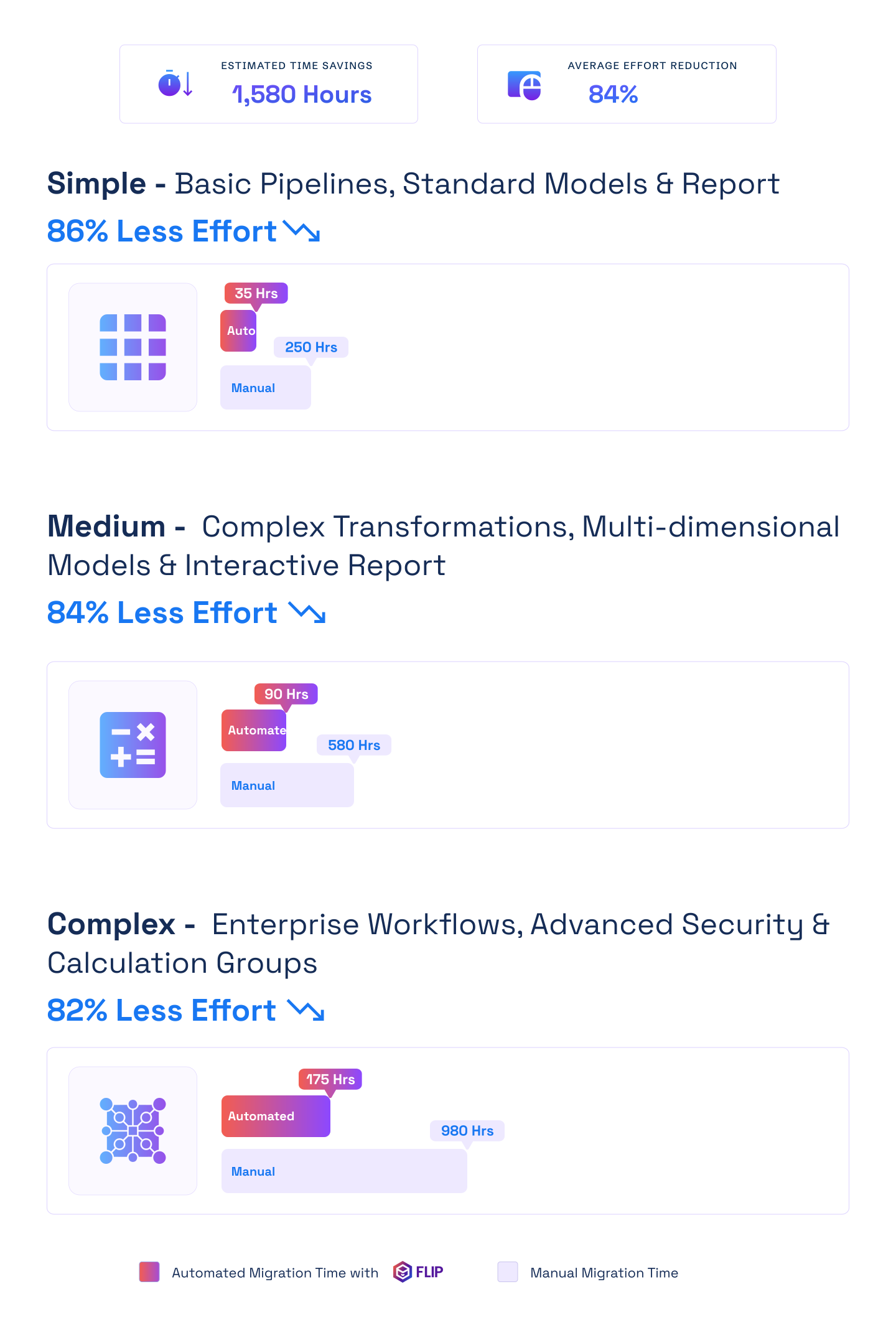

ESTIMATED TIME SAVINGS

Average effort reduction
Simple - Basic Pipelines, Standard Models & Report
Less Effort

Medium - Complex Transformations, Multi-dimensional Models & Interactive Report
Less Effort
Complex - Enterprise Workflows, Advanced Security & Calculation Groups
Less Effort

Case studies
Delivering Analytics Excellence with Automated Migrations
Migration
Transforming Retail Reporting and Analytics with SQL to Microsoft Fabric Migration
Impact:
- 74% Faster Reporting Cycles
- 65% Increase in Reporting Stability
- 72% Faster Access to Current Metrics
Migration
Migration of Data Pipelines from SQL Server Integration Services (SSIS) to Microsoft Fabric
Impact:
- 30% Improvement in Data Processing Speeds
- 40% Reduction in Operational Costs
- 25% Decrease in Manual Maintenance Efforts
Migration
Migrating Semantic Models from SSAS to Microsoft Fabric for Improved Efficiency
Impact:
- 25% Increase in real-time analytics capabilities
- 40% Reduction in manual maintenance efforts
- 20% Improvement in data integration efficiency
Frequently Asked Questions (FAQs)
Microsoft Fabric is a unified analytics platform combining data integration, warehousing, and business intelligence capabilities. Unlike legacy SQL Server services (SSIS, SSAS, SSRS), Fabric offers serverless cloud architecture, automatic scaling, real-time data processing, and consolidated analytics workflows. This modern infrastructure eliminates fragmented tools while reducing maintenance overhead and enabling seamless collaboration across data engineering and analytics teams.
Organizations migrate to Microsoft Fabric to eliminate technical debt, reduce infrastructure costs, and enable digital transformation. Legacy SQL Server services consume 80% of IT budgets on maintenance, limit scalability, and hinder innovation. Fabric’s unified platform transforms fixed infrastructure costs into flexible consumption pricing while delivering enhanced performance, real-time analytics capabilities, and cloud-native architecture for modern data workloads.
Kanerika’s migration accelerator supports flexible migration strategies based on your business priorities. You can migrate all three SQL Server services together for complete platform modernization, or select individual components—SSIS data integration pipelines, SSAS semantic models, or SSRS reporting solutions—independently. This phased migration approach minimizes business disruption while allowing organizations to prioritize critical workloads and manage change effectively.
Migration timelines vary based on complexity, ranging from weeks for simple pipelines and standard reports to several months for enterprise-grade implementations with
advanced security and calculation groups. Kanerika’s FLIP accelerator significantly reduces migration effort through automated conversion processes, transforming SSIS packages, SSAS models, and SSRS reports into production-ready Fabric components efficiently while maintaining functionality and business continuity.
Microsoft Fabric provides native connectivity to both cloud-based and on-premises data sources through secure gateway configurations and modern authentication protocols. The platform supports hybrid data integration scenarios, enabling seamless data movement between legacy systems and cloud environments. Fabric’s advanced connectors facilitate real-time data processing, ETL workflows, and semantic layer creation across diverse data landscapes without compromising security or performance.
FLIP is Kanerika’s proprietary migration accelerator that automates the conversion of legacy SQL Server components into Microsoft Fabric equivalents. The tool exports SSIS packages, SSAS models, and SSRS reports, analyzes their structure, and automatically generates Fabric data pipelines, semantic models, and interactive reports. FLIP preserves business logic, relationships, and security configurations while significantly reducing manual migration effort and accelerating time-to-value.
SSIS package migration involves exporting existing integration workflows, analyzing control flow logic and data transformation patterns, then converting them into Fabric data pipelines using modern ETL constructs. Kanerika’s FLIP accelerator automates this conversion, mapping SSIS tasks to equivalent Fabric activities while enhancing capabilities with distributed computing, real-time processing, and cloud-native connectors. The resulting pipelines maintain business logic while leveraging Fabric’s advanced transformation options.
Yes, complex SSIS transformations including custom scripts, conditional logic, loop containers, and advanced data quality operations can be migrated to Microsoft Fabric. Kanerika’s migration methodology evaluates transformation complexity, identifies equivalent Fabric capabilities, and implements enhanced solutions using dataflows, notebooks, or pipeline activities. Some legacy transformations may be optimized during migration to leverage Fabric’s distributed computing power and modern data processing paradigms.
Microsoft Fabric replaces SSAS models through Power BI semantic models (formerly datasets) with enhanced capabilities. Tabular models migrate seamlessly to Fabric semantic models with preserved relationships, calculations, and hierarchies. Multidimensional models require analysis and conversion to tabular architecture, which Kanerika facilitates through automated assessment and redesign. Fabric semantic models offer improved performance, web-based development, and integrated version control for enterprise analytics.
SSRS reports are converted to Power BI reports within Microsoft Fabric, maintaining visual elements, data connections, and report parameters while gaining interactive capabilities. Kanerika’s FLIP accelerator analyzes SSRS report definitions (RDL files), extracts layout specifications and data queries, then generates equivalent Power BI reports with enhanced visualizations. Paginated reports functionality is preserved through Power BI Premium capacity, ensuring operational reporting requirements are met.
Organizations typically realize significant ROI through reduced infrastructure maintenance costs, improved developer productivity, accelerated time-to-insight, and enhanced analytics capabilities. Kanerika’s migration approach reduces manual effort by 60-80% depending on complexity. Businesses eliminate server refresh cycles, transform fixed IT costs into consumption-based pricing, and unlock new revenue opportunities through real-time analytics and data-driven decision making enabled by Fabric’s modern platform.
Microsoft Fabric eliminates technical debt by replacing aging SQL Server infrastructure with cloud-native, continuously updated analytics platform. Organizations reduce the 80% of IT budgets spent maintaining legacy systems, overcome growth barriers cited by 44% of CIOs, and improve developer productivity lost to outdated tools. Fabric’s unified architecture removes fragmented data management approaches, provides automatic updates, and enables modern development practices including version control and CI/CD deployment.
Serverless architecture delivers substantial cost savings by eliminating hardware procurement, data center operations, and infrastructure maintenance expenses. Organizations transform fixed capital expenditure into flexible operational
costs based on actual consumption. Microsoft Fabric automatically scales resources matching business demand, preventing over-provisioning and reducing idle capacity costs. Kanerika helps optimize Fabric capacity utilization and workspace configurations, maximizing cost efficiency while maintaining performance for data integration, modeling, and reporting workloads.
Microsoft Fabric enables seamless collaboration through integrated workspace environments, version control integration, and unified data access. Unlike fragmented SQL Server services requiring separate tools for SSIS development, SSAS modeling, and SSRS reporting, Fabric provides web-based interfaces accessible across teams. Data engineers, analysts, and business users work within shared semantic layers, collaborate on pipelines and reports in real-time, and leverage Git integration for development lifecycle management.
Microsoft Fabric enhances business continuity through built-in disaster recovery, automated backups, geographic redundancy, and high availability configurations. Unlike legacy SQL Server infrastructure requiring manual failover planning and redundant hardware investments, Fabric’s cloud-native architecture provides enterprise-grade resilience automatically. Organizations eliminate single points of failure, reduce recovery time objectives, and ensure analytics availability without complex infrastructure management, enabling uninterrupted business intelligence and data integration operations.
Microsoft Fabric maintains enterprise-grade security through row-level security, column-level security, data encryption at rest and in transit, and comprehensive identity management. Kanerika’s migration process preserves existing security configurations from SSAS models and SSRS reports, translating permissions into equivalent Fabric security roles. The platform provides enhanced audit logging, threat detection, and compliance certifications including SOC 2, ISO 27001, HIPAA, and GDPR, ensuring regulatory requirements are met.
Yes, row-level security (RLS) and role-based access controls from SSAS models are preserved and enhanced during Microsoft Fabric migration. Kanerika’s FLIP accelerator analyzes existing security configurations, extracts role definitions and DAX security filters, then implements equivalent security measures in Fabric semantic
models. The migration process may enhance security implementations leveraging Fabric’s advanced capabilities including dynamic security, object-level permissions, and integrated Azure Active Directory authentication for centralized access management.
Microsoft Fabric maintains comprehensive compliance certifications including SOC 1/2/3, ISO 27001/27018/27017, HIPAA/HITECH, PCI DSS, FedRAMP, GDPR, and industry-specific standards. The platform provides compliance documentation, audit reports, and automated compliance monitoring capabilities. Organizations migrating from legacy SQL Server services benefit from cloud-native compliance frameworks, continuous security updates, and enhanced data governance tools that simplify regulatory adherence across healthcare, financial services, government, and retail sectors.
Microsoft Fabric implements multi-layered encryption protecting data at rest using AES 256-bit encryption and data in transit using TLS 1.2+ protocols. The platform provides customer-managed encryption keys, private endpoints for network isolation, and comprehensive data loss prevention policies. Fabric’s privacy controls support data residency requirements, sensitive data discovery, classification labeling, and usage tracking, ensuring organizations maintain data sovereignty and regulatory compliance throughout analytics workflows.
Yes, existing data governance policies can be maintained and enhanced through Microsoft Fabric’s integrated governance capabilities within Microsoft Purview. Kanerika helps organizations translate legacy governance frameworks into modern data management practices including data cataloging, lineage tracking, quality monitoring, and stewardship workflows. Fabric provides unified governance across data integration, warehousing, and analytics workloads, enabling comprehensive metadata management, impact analysis, and regulatory compliance documentation throughout the data lifecycle.
Yes, Microsoft Fabric provides advanced real-time data integration through Event Streams, Real-Time Analytics, and streaming dataflows. Unlike legacy SSIS batch processing limitations, Fabric enables continuous data ingestion from IoT devices, applications, and streaming sources using Apache Kafka, Event Hubs, and change data capture. Real-time pipelines support low-latency transformations, immediate analytics
processing, and millisecond-level reporting, empowering organizations with instant insights for operational decision-making and customer experience optimization.
Microsoft Fabric provides extensive connectivity to enterprise applications including Dynamics 365, Salesforce, SAP, Oracle, Snowflake, and hundreds of data sources through native connectors and REST APIs. The platform supports traditional databases (SQL Server, PostgreSQL, MySQL), cloud data platforms (Azure Data Lake, AWS S3), and SaaS applications. Kanerika’s migration approach includes comprehensive data source assessment, connection migration planning, and implementation of secure authentication mechanisms for seamless enterprise integration.
Custom code and scripts from SSIS packages are analyzed and converted to equivalent Microsoft Fabric capabilities during migration. C# scripts may be reimplemented using Python or Scala in Fabric notebooks, while SQL procedures can leverage Fabric’s SQL analytics engine or data warehouse. Kanerika’s migration experts evaluate custom logic complexity, recommend optimal conversion approaches, and implement enhanced solutions using Fabric’s distributed computing, ensuring business logic preservation while improving performance and maintainability.
SSIS connection managers are transformed into Microsoft Fabric linked services and connections during migration. Connection strings, authentication methods, and configuration parameters are extracted from SSIS packages and recreated in Fabric’s connection management framework. Kanerika’s FLIP accelerator automates this conversion, mapping OLEDB, ODBC, file system, and other connection types to equivalent Fabric connectors while implementing enhanced security through Azure Key Vault integration and managed identities for passwordless authentication.
Yes, Microsoft Fabric provides comprehensive scheduling and orchestration capabilities through pipeline triggers, time-based schedules, event-driven execution, and dependency management. Migrated SSIS packages maintain their scheduling logic while gaining enhanced orchestration features including conditional execution, parallel processing, and monitoring dashboards. Organizations can implement complex workflow dependencies, automated retry logic, and integration with external orchestration tools like Azure Data Factory, ensuring robust data integration operations aligned with business requirements.
Microsoft Fabric delivers superior performance through distributed computing architecture, automatic query optimization, and serverless resource scaling. Unlike legacy SQL Server services limited by hardware constraints, Fabric processes large datasets using parallel execution engines, columnar storage optimization, and intelligent caching. Data integration pipelines execute faster through distributed transformations, semantic models leverage VertiPaq compression for sub-second query responses, and reports render dynamically with enhanced visualization performance across desktop and mobile devices.
Yes, Microsoft Fabric is designed for enterprise-scale analytics supporting petabyte-level data volumes through distributed storage and compute separation. The platform automatically partitions large datasets, implements intelligent data tiering between hot and cold storage, and optimizes query execution across distributed compute nodes. Kanerika’s migration approach includes capacity planning, performance tuning, and architecture optimization ensuring semantic models, data warehouses, and lakehouses handle growing data volumes efficiently without manual infrastructure scaling.
Microsoft Fabric implements automatic scaling through dynamic resource allocation based on workload demands. The platform monitors query complexity, concurrent user requests, and data processing requirements, then adjusts compute resources automatically without manual intervention. Unlike legacy SQL Server requiring hardware upgrades, Fabric scales capacity units seamlessly, ensuring consistent performance during peak usage. Organizations pay only for consumed resources, eliminating over-provisioning costs while maintaining enterprise-grade performance for data integration, analytics, and reporting operations.
Microsoft Fabric provides comprehensive optimization including automatic query tuning, aggregation recommendations, materialized views, result caching, and performance monitoring dashboards. The platform analyzes usage patterns, identifies bottlenecks, and suggests optimization strategies through built-in advisor services. Kanerika’s migration methodology includes performance baseline establishment, optimization implementation, and continuous monitoring setup, ensuring migrated SSIS pipelines, SSAS models, and SSRS reports exceed legacy system performance while leveraging Fabric’s intelligent optimization capabilities for sustained efficiency.
Microsoft Fabric handles concurrent users through distributed query processing, intelligent caching, and capacity isolation mechanisms. The platform separates interactive analytics from batch processing workloads, prevents resource contention, and maintains consistent query response times under heavy load. Semantic models leverage DirectQuery, import mode, and composite model patterns optimizing data retrieval. Fabric’s elastic capacity automatically accommodates user growth and query complexity increases without performance degradation, supporting thousands of concurrent users across enterprise analytics environments.
Kanerika provides comprehensive training programs covering Microsoft Fabric fundamentals, data engineering best practices, semantic modeling techniques, and report development. Training includes role-based curriculum for data engineers, analysts, and administrators; hands-on workshops using migrated workloads; and documentation of organizational patterns and standards. Kanerika’s enablement approach combines instructor-led sessions, self-paced learning modules, and mentoring support ensuring teams develop proficiency with Fabric’s unified platform, accelerating adoption and maximizing platform investment value.
Kanerika provides ongoing support through managed services, optimization consulting, platform monitoring, and enhancement implementation. Post-migration support includes performance tuning, capacity planning assistance, troubleshooting escalation, and quarterly business reviews assessing Fabric utilization and ROI. Organizations access Kanerika’s Microsoft Fabric expertise for new use case development, architecture evolution guidance, and platform feature adoption as Microsoft releases capabilities, ensuring continuous value realization and long-term success with the unified analytics platform.
Kanerika’s FLIP migration accelerator generates comprehensive documentation including migration impact assessment reports, component conversion logs, architecture diagrams, data lineage maps, and configuration specifications. Documentation covers migrated pipeline logic, semantic model relationships, security role mappings, and operational procedures for ongoing management. Technical runbooks detail deployment processes, troubleshooting guides, and optimization recommendations. This documentation ensures knowledge transfer, supports organizational change management, and provides reference materials for future platform enhancements and team onboarding.
Yes, Microsoft Fabric management best practices include capacity planning based on usage patterns, workspace organization aligned with business domains, semantic model optimization for performance, and automated deployment pipelines using DevOps integration. Organizations should implement governance frameworks covering data access policies, naming conventions, and development standards. Kanerika establishes these practices during migration, configuring monitoring dashboards, backup procedures, and capacity autoscaling, creating sustainable operating models that maximize Fabric platform value while minimizing administrative overhead and operational risks.
Organizations can access extensive Microsoft Fabric resources including official documentation, Microsoft Learn training modules, community forums, and YouTube tutorial channels. Microsoft provides virtual instructor-led training, certification paths for data engineers and analysts, and hands-on labs with sample datasets. Kanerika complements these resources with customized training aligned to migrated workloads, organizational use cases, and industry-specific analytics patterns, accelerating team proficiency and ensuring successful adoption of Fabric’s unified analytics platform across data engineering and business intelligence functions.
Microsoft Fabric operates on capacity-based licensing through Power BI Premium or Fabric capacity units, fundamentally different from SQL Server’s per-core or CAL-based licensing. Organizations purchase capacity units (CUs) providing compute and storage resources consumed across all Fabric workloads. This unified licensing eliminates separate SSIS, SSAS, and SSRS licenses, simplifies procurement, and provides cost predictability. Kanerika helps organizations assess capacity requirements, optimize consumption patterns, and design cost-effective licensing strategies aligned with business analytics demands.
Migration costs depend on workload complexity, component volume (SSIS packages, SSAS models, SSRS reports), customization requirements, data source diversity, and organizational change management needs. Simple migrations with standard transformations require less effort than complex enterprise implementations with advanced security and
calculation groups. Kanerika’s FLIP accelerator significantly reduces migration costs through automation while providing transparent effort estimates based on comprehensive workload assessment, enabling accurate budgeting and predictable return on investment for analytics modernization initiatives.
Yes, capacity planning involves analyzing current SQL Server workload characteristics including data volumes, user concurrency, query complexity, and refresh frequencies. Kanerika conducts comprehensive assessment capturing performance baselines, growth projections, and usage patterns to model Fabric capacity requirements. This analysis informs capacity unit sizing, autoscaling configurations, and cost projections. Organizations receive detailed consumption models, monitoring dashboards for tracking actual usage, and optimization recommendations ensuring Fabric capacity aligns with business needs while controlling costs throughout the analytics lifecycle.
Successful Microsoft Fabric migration requires consideration beyond licensing and migration services including training investments, change management, potential application modifications for API integration changes, and temporary dual-system operation during transition. However, Kanerika’s methodology minimizes hidden costs through comprehensive planning, automated conversion reducing manual effort, and accelerated deployment minimizing parallel system operation. Organizations should budget for ongoing capacity management, monitoring tools, and continuous optimization while recognizing long-term savings from eliminated infrastructure maintenance, reduced technical debt, and enhanced productivity.
ROI realization timelines vary based on organizational size, workload complexity, and baseline infrastructure costs, typically ranging from 12-24 months. Organizations immediately reduce infrastructure maintenance expenses, eliminate server refresh cycles, and improve developer productivity post-migration. Kanerika’s accelerated migration approach shortens time-to-value through automated conversion and rapid deployment. Long-term ROI compounds through enhanced analytics capabilities enabling better business decisions, improved operational efficiency, reduced technical debt, and competitive advantages from real-time insights unavailable in legacy SQL Server environments.


