

Migrate from ADF/Synapse to Microsoft Fabric with Kanerika
Modern data demands require unified analytics and AI capabilities. Kanerika's migration accelerator effortlessly transforms your Azure Data Factory (ADF) and synapse pipelines into Fabric Data Factory (FDF) workflows, delivering integrated governance and enhanced performance for next-generation data operations.
Get Started with Azure to Fabric Migration
The Tech Debt
The Cost of Not Modernizing Your Data Platforms

80%
IT budgets are spent on legacy system maintenance.

44%
CIOs see legacy systems as growth barriers.

50%
Developer productivity is lost due to outdated tools

70%
Digital transformation efforts fail due to legacy systems
Migrate from

with Our Accelerator
Use Your Azure Committed Spend (MACC)

Experience Our
Azure to Fabric Migration
The Azure to Fabric Advantage
Transform Isolated Pipelines into Unified Analytics

Accelerate Data Processing with Native Integration
- Transform isolated pipelines into unified analytics workflows
- Enable seamless connectivity across Fabric workloads
- Replace complex integrations with native platform capabilities

Optimize Costs Through Intelligent Resource Management
- Eliminate separate compute provisioning overhead
- Handle dynamic workloads through automatic scaling
- Reduce infrastructure expenses with shared resources

Enhance Collaboration with Unified Workspace Environment
- Replace siloed development with integrated workspaces
- Access unified governance and security across operations
- Utilize shared resources and streamlined development processes

Modernize Operations with Advanced Monitoring Capabilities
- Reduce troubleshooting time through comprehensive pipeline observability
- Enable intelligent alerting with automated notification systems
- Replace reactive maintenance with proactive optimization
The Migration Process
Transition to FDF Effortlessly with Our Accelerator
Pipeline Architecture Assessment & Discovery
Our migration accelerator analyzes your existing ADF/Synapse pipelines, activities, and dependencies, mapping the complete data orchestration architecture to ensure comprehensive migration planning.


Activity Conversion & Fabric Optimization
The accelerator converts ADF and Synapse activities to their Fabric equivalents, optimizing for native Fabric capabilities while preserving business logic and maintaining data flow integrity.

Integration Mapping & Workspace Configuration
This automated process ensures functionality through comprehensive testing, validates data lineage accuracy, and optimizes performance settings for enhanced Fabric Data Factory execution.

Validation Testing & Performance Optimization
This automated process ensures functionality through comprehensive testing, validates data lineage accuracy, and optimizes performance settings for enhanced Fabric Data Factory execution.

ROI YOU CAN EXPECT
Unlock Microsoft Fabric's Potential with a Cost-Effective Transition
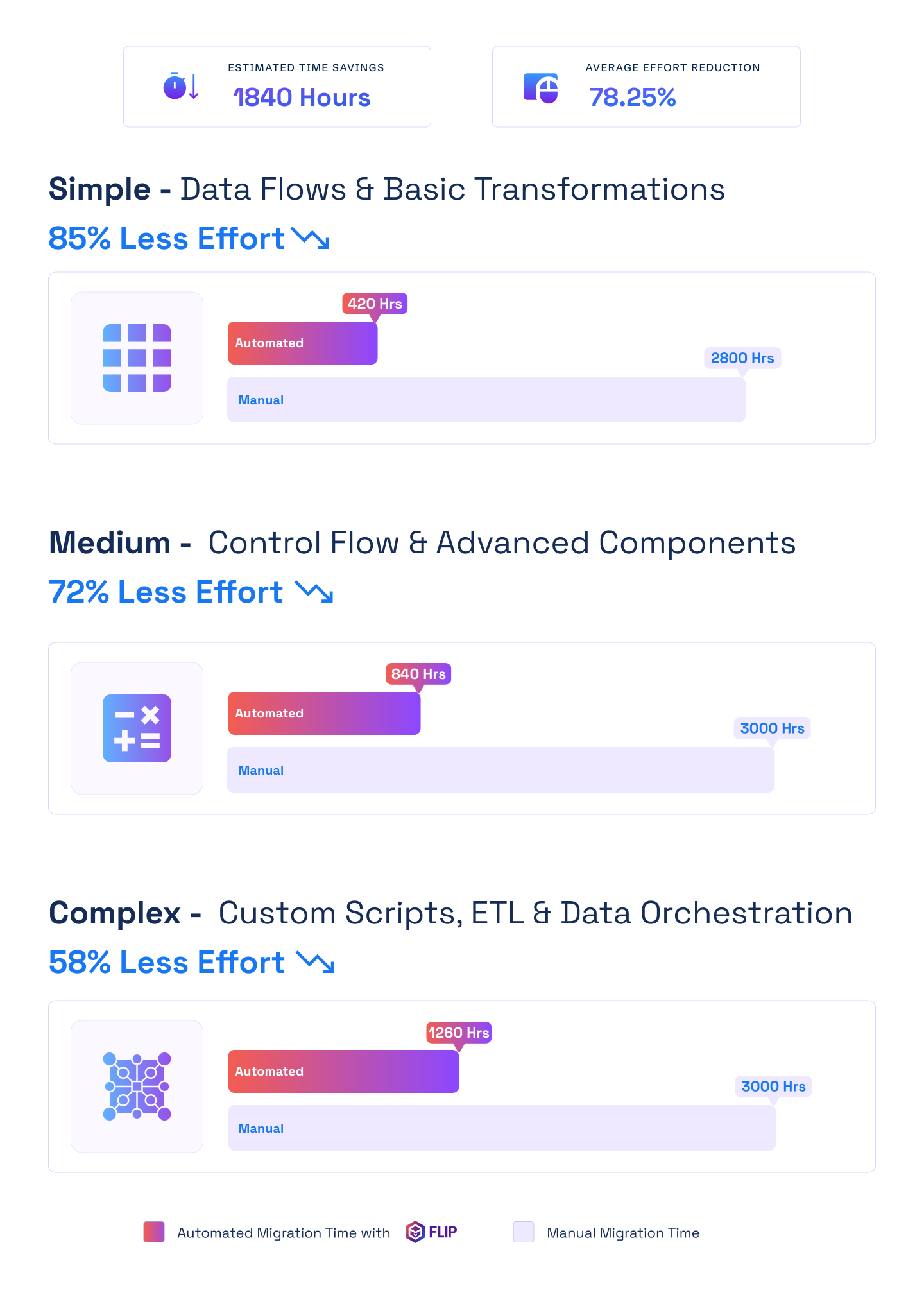

ESTIMATED TIME SAVINGS

Average effort reduction
Simple - Data Flows & Basic Transformations
Less Effort

Medium - Control Flow & Advanced Components
Less Effort
Complex - Custom Scripts, ETL & Data Orchestration
Less Effort

Case studies
Delivering Measurable Outcomes with Automated Migrations
Migration
Modernizing Enterprise Reporting with Crystal Reports to Power BI Migration
Impact:
- 60% Faster Migration
- 10x Data Scale
- 99.5% Refresh Success Rate
Migration
Modernizing Financial Analytics with Informatica to Alteryx Migration
Impact:
- 45% Faster Reporting Cycles
- 38% Reduction in Maintenance Costs
- 60% Improved Analytics Turnaround
Migration
Transforming Retail Reporting and Analytics with SQL to Microsoft Fabric Migration
Impact:
- 74% Faster Reporting Cycles
- 65% Increase in Reporting Stability
- 72% Faster Access to Current Metrics
Frequently Asked Questions (FAQs)
The migration time varies based on your pipeline complexity and Synapse workspace configurations, but with Kanerika’s automated migration solutions, the process is significantly faster than manual migration methods, ensuring minimal downtime and rapid value realization.
Fabric Data Factory maintains familiar ADF and Synapse concepts while adding enhanced capabilities. Teams experienced with ADF pipelines and Synapse analytics can quickly adapt, and our approach ensures smooth transition with minimal additional training requirements.
Fabric Data Factory offers more cost-efficient pricing models by consolidating ADF and Synapse functionalities into a unified platform. Migrating reduces infrastructure complexity, eliminates duplicate services, and provides better resource utilization while delivering advanced unified analytics capabilities.
No. Our automated migration process ensures continuous operation of both ADF pipelines and Synapse workloads through parallel deployment strategies, maintaining business continuity while securely transferring all configurations and maintaining execution consistency across data integration and analytics operations.
Once migration is complete, Fabric Data Factory unlocks unified analytics capabilities that previously required separate ADF and Synapse services, enhanced collaboration features, improved performance monitoring, and integrated data lakehouse architecture, providing greater operational efficiency and deeper insights from your consolidated data operations.
ADF and Synapse require managing separate services for data integration, warehousing, and analytics. Microsoft Fabric unifies everything in one platform, eliminating complex integrations. Microsoft is prioritizing investment in Microsoft Fabric while ADF receives maintenance updates. Organizations staying on legacy Azure services risk falling behind as Microsoft Fabric capabilities expand. Kanerika’s proprietary migration accelerator, powered by FLIP, automates the transition, converting complex pipelines in days instead of months of manual work.
Microsoft Fabric eliminates infrastructure management with cloud-native SaaS architecture that scales automatically. Built-in CI/CD features remove the need for external Git integration. OneLake provides centralized storage, reducing data duplication costs. Native Office 365 and Teams integration improves collaboration. Real-time analytics capabilities exceed ADF’s batch-focused approach. Kanerika’s proprietary migration accelerator, powered by FLIP, ensures you realize these benefits immediately without lengthy manual pipeline recreation.
Not directly. Microsoft Fabric’s JSON structure differs from ADF, so pipelines require conversion. However, Kanerika’s proprietary migration accelerator, powered by FLIP, automates this completely. The tool connects to your ADF environment, discovers all pipelines automatically, and rebuilds them using Microsoft Fabric’s native architecture. Business logic, parameters, and configurations transfer completely. You avoid months of manual recreation through intelligent automation.
Kanerika’s proprietary migration accelerator, powered by FLIP, converts ADF triggers to Microsoft Fabric equivalents automatically. Schedule triggers, tumbling window triggers, and event-based triggers all migrate with proper timing configurations. The accelerator preserves trigger dependencies and execution sequences. We validate all scheduling post-migration to ensure pipelines run at correct intervals. Teams see identical execution patterns after migration.
Yes. Microsoft Fabric supports dataflows through Power Query and notebooks using PySpark and Spark SQL. Kanerika’s proprietary migration accelerator, powered by FLIP, intelligently converts ADF mapping dataflows to Microsoft Fabric dataflows or PySpark notebooks based on complexity. The tool analyzes each dataflow and selects the optimal transformation method. Notebook activities from Synapse migrate to Microsoft Fabric notebooks with code preservation.
With Kanerika’s proprietary migration accelerator, powered by FLIP, migrations complete in 2-8 weeks depending on pipeline complexity. Simple environments with 50-100 pipelines finish in 2-3 weeks. Large deployments with 500+ pipelines complete in 6-8 weeks including validation. Manual migration without automation extends timelines to 6-12 months with high error risk. Our accelerator reduces migration effort by 75% through intelligent automation.
Yes. Microsoft Fabric excels at both batch ETL and real-time streaming through Real-Time Intelligence capabilities. You can ingest, process, and analyze streaming data with lower latency than ADF. Microsoft Fabric’s Eventstreams handle Kafka, Event Hubs, and IoT data natively. Kanerika’s proprietary migration accelerator, powered by FLIP, converts batch pipelines while enabling teams to add real-time capabilities post-migration.
Kanerika’s proprietary migration accelerator, powered by FLIP, preserves all lineage information during migration. Microsoft Fabric enhances this with end-to-end lineage tracking across the entire platform. You see how data flows from sources through pipelines to semantic models and reports. Microsoft Purview integration provides centralized governance. Our accelerator maintains your existing governance controls and maps them to Microsoft Fabric’s enhanced capabilities.
OneLake eliminates data duplication and movement between services. All Microsoft Fabric workloads access the same centralized data without copies. This reduces storage costs and improves query performance. Microsoft Fabric’s distributed architecture is less sensitive to load spikes and handles high concurrency better than ADF. Kanerika’s proprietary migration accelerator, powered by FLIP, optimizes pipelines to leverage OneLake’s performance advantages immediately.
Yes. Microsoft Fabric and Power BI are deeply integrated. Semantic models refresh through Microsoft Fabric pipeline activities without complex configurations. Power BI reports embed directly into Microsoft Fabric workspaces. Teams build pipelines, transform data, and create visualizations in one platform. Kanerika’s proprietary migration accelerator, powered by FLIP, ensures your migrated pipelines connect seamlessly to existing Power BI reports and dashboards.
Yes. Kanerika’s proprietary migration accelerator, powered by FLIP, handles both dedicated SQL pools and Spark pools. We begin with a comprehensive pre-migration assessment to analyze schema compatibility, identify unsupported features, and plan refactoring needs. Dedicated SQL pools convert to Microsoft Fabric data warehouse or lakehouse based on your architecture. Tables, views, and stored procedures migrate with proper syntax conversion.
Microsoft Fabric consolidates licensing from multiple Azure services into unified consumption-based pricing. You eliminate infrastructure maintenance costs since Microsoft Fabric handles compute automatically. OneLake reduces storage costs by eliminating duplicate data copies. Organizations typically reduce total data platform costs by 30-50% after migration. Kanerika’s proprietary migration accelerator, powered by FLIP, cuts migration costs another 75% through automation.
Kanerika’s proprietary migration accelerator, powered by FLIP, maintains parallel systems during transition. Your ADF pipelines continue running while we build Microsoft Fabric versions. Both environments operate simultaneously during testing and validation. Cutover happens gradually, pipeline by pipeline, with rollback capabilities at every stage. Users experience zero disruption to data processing throughout the entire migration.
Yes. While Kanerika’s proprietary migration accelerator, powered by FLIP, preserves all business logic, we identify modernization opportunities. This includes optimizing for OneLake architecture, implementing incremental refresh patterns, and refactoring complex transformations. Our accelerator flags these opportunities during assessment. We can implement improvements during migration or as post-go-live enhancements based on your priorities.
Teams familiar with ADF adapt quickly since Microsoft Fabric maintains similar pipeline concepts. The drag-and-drop interface is more intuitive than ADF Studio. Power Query knowledge helps with dataflow development. We provide training on Microsoft Fabric-specific features like OneLake integration and deployment pipelines. Most developers become productive within 2-3 weeks. Kanerika’s proprietary migration accelerator, powered by FLIP, generates well-structured pipelines that serve as learning examples.
Kanerika’s proprietary migration accelerator, powered by FLIP, preserves all security configurations during migration. ADF role-based access controls map to Microsoft Fabric workspace roles. Connection credentials transfer securely to Microsoft Fabric connections. Compliance standards like GDPR, HIPAA, and SOC 2 remain intact. Microsoft Purview integration enhances governance beyond ADF capabilities. We validate security settings post-migration to ensure proper access controls.
Yes. Kanerika’s proprietary migration accelerator, powered by FLIP, handles comprehensive migrations including pipelines, dataflows, and semantic models. We coordinate migration across ADF, Synapse SQL pools, and Power BI to Microsoft Fabric in unified projects. This approach ensures data flows work end-to-end from ingestion through analytics. Integrated migrations often deliver better results than piecemeal platform transitions.
Yes. We configure Microsoft Fabric workspaces, capacity settings, and monitoring dashboards as part of migration. Post-migration optimization includes performance tuning based on actual usage patterns, implementing best practices, and configuring advanced features. We provide 30-90 day support periods after go-live. Our team helps you leverage Microsoft Fabric capabilities beyond what existed in ADF to maximize platform value.
Microsoft Fabric connects to on-premises data sources through on-premises data gateways and Virtual Network data gateways. You can maintain hybrid architectures during migration. However, Microsoft Fabric is optimized for Azure cloud deployment. For truly multi-cloud scenarios across AWS and GCP, complementary tools may be needed. Kanerika’s proprietary migration accelerator, powered by FLIP, assesses your specific hybrid requirements during pre-migration assessment.
Yes. We offer 30-90 day support periods after go-live to address any issues with pipelines migrated through Kanerika’s proprietary migration accelerator, powered by FLIP. Our team monitors Microsoft Fabric capacity usage, pipeline performance, and error rates. We provide optimization recommendations based on actual workload patterns. Training sessions help your team understand Microsoft Fabric’s monitoring hub and troubleshooting tools.
No. Microsoft Fabric is a unified SaaS analytics platform built on Azure infrastructure. It consolidates multiple Azure services like ADF, Synapse, Power BI, and Data Lake into one integrated experience. Microsoft Fabric doesn’t replace Azure but rather provides a modern layer on top of Azure for data and analytics workloads. Kanerika’s proprietary migration accelerator, powered by FLIP, helps you transition from individual Azure services to Microsoft Fabric’s unified platform.
Azure provides individual services like ADF, Synapse, and Data Lake that require integration. Microsoft Fabric unifies these into one SaaS platform with shared storage through OneLake. Microsoft Fabric eliminates infrastructure management and provides built-in CI/CD without external Git. The platform uses capacity-based pricing instead of per-service billing. Kanerika’s proprietary migration accelerator, powered by FLIP, bridges the architectural differences during migration.
Microsoft Fabric eliminates linked services and datasets, defining connections inline within activities. Integration runtimes are replaced by cloud-based compute and data gateways. Microsoft Fabric pipelines have built-in CI/CD through deployment pipelines without Azure DevOps. The JSON structure differs slightly, preventing direct import. Kanerika’s proprietary migration accelerator, powered by FLIP, handles these architectural differences automatically during conversion.
Yes. Kanerika’s proprietary migration accelerator, powered by FLIP, automates ADF and Synapse migrations to Microsoft Fabric. The tool discovers pipelines automatically, converts them to Microsoft Fabric’s native format, and deploys through API-driven automation. Microsoft provides some migration guidance and tools, but Kanerika’s accelerator delivers complete end-to-end automation. We handle 90-95% of typical migrations automatically, significantly reducing manual effort.
Main challenges include rebuilding pipelines due to JSON differences, converting integration runtimes to data gateways, and rewriting dataflows in Power Query. Testing scope expands since every pipeline needs validation. Teams must learn Microsoft Fabric’s unified interface. Kanerika’s proprietary migration accelerator, powered by FLIP, eliminates most challenges through automation. We begin with pre-migration assessment to identify specific issues in your environment.
Yes. Kanerika’s proprietary migration accelerator, powered by FLIP, supports parallel deployment strategies. You can mount ADF factories directly in Microsoft Fabric workspaces as read-only items. Both systems access the same data sources during transition. This approach eliminates downtime and allows thorough validation before final cutover. We gradually shift workloads pipeline by pipeline rather than forcing immediate complete migration.
Microsoft Fabric provides centralized governance through Microsoft Purview integration. Workspace-level security replaces individual service permissions. Row-level security and object-level security work across all Microsoft Fabric components. OneLake provides unified data access control. Kanerika’s proprietary migration accelerator, powered by FLIP, maps your existing Azure security models to Microsoft Fabric’s enhanced governance framework during migration.
Kanerika’s proprietary migration accelerator, powered by FLIP, includes comprehensive validation comparing ADF and Microsoft Fabric outputs. We run parallel pipelines with identical data and verify results match exactly. Performance monitoring tracks execution times, resource utilization, and bottlenecks. Our team optimizes for Microsoft Fabric’s distributed architecture through proper partitioning, incremental refresh, and OneLake integration. Most pipelines run faster in Microsoft Fabric after optimization.
Microsoft Fabric enhances compliance through unified audit logging across all workloads. Microsoft Purview integration provides comprehensive data cataloging and sensitivity labeling. Workspace lineage shows complete data flow from source to consumption. Compliance standards like GDPR, HIPAA, and SOC 2 have better enforcement mechanisms. Kanerika’s proprietary migration accelerator, powered by FLIP, maintains your existing compliance controls and leverages Microsoft Fabric’s improved capabilities.
Microsoft Fabric’s Copilot helps developers write DAX expressions, build pipelines faster, and troubleshoot issues through natural language. AI-powered insights detect anomalies and performance issues automatically. Intelligent monitoring suggests optimizations based on usage patterns. After migration through Kanerika’s proprietary accelerator powered by FLIP, teams leverage these AI features to accelerate development and improve pipeline reliability beyond what was possible in ADF.
Synapse dedicated SQL pools use traditional data warehouse architecture. Microsoft Fabric Lakehouse combines data lake and warehouse capabilities with Delta Lake format. Tables in Microsoft Fabric don’t require index management since the engine optimizes automatically. Distribution strategies differ significantly. Kanerika’s proprietary migration accelerator, powered by FLIP, analyzes your SQL pool design and recommends optimal Microsoft Fabric architecture during pre-migration assessment.
Kanerika’s proprietary migration accelerator, powered by FLIP, converts Synapse stored procedures to Microsoft Fabric-compatible T-SQL syntax. Unsupported features are flagged during pre-migration assessment. Complex transformations may convert to notebooks for better performance. We validate all business logic post-migration to ensure identical outputs. Some procedures benefit from refactoring to leverage Microsoft Fabric’s improved query engine.
Kanerika’s proprietary migration accelerator, powered by FLIP, converts ADF incremental load patterns to Microsoft Fabric’s optimized approaches. CDC workflows migrate to Microsoft Fabric’s native change tracking capabilities. We implement watermark tables, timestamp-based filtering, and partitioning strategies. Microsoft Fabric’s improved performance often allows full loads where incremental was previously necessary. Our accelerator recommends the optimal approach during assessment.
Microsoft Fabric provides built-in deployment pipelines without Azure DevOps dependency. Git integration works with Azure DevOps or GitHub through Microsoft Fabric’s native features. You promote changes across dev, test, and production environments through simple interface clicks. No ARM templates are needed. Kanerika’s proprietary migration accelerator, powered by FLIP, establishes proper CI/CD practices during migration, often improving upon ADF workflows.
Kanerika’s proprietary migration accelerator, powered by FLIP, begins with comprehensive pre-migration assessment of your Synapse workspace. We analyze SQL pools, Spark pools, pipelines, and notebooks. Dedicated SQL pools convert to Microsoft Fabric warehouse or lakehouse. Spark notebooks migrate with code preservation. Pipelines convert to Microsoft Fabric Data Factory. We optimize for OneLake integration and performance tuning throughout migration.
Yes. Microsoft Fabric’s workspace isolation and capacity management provide better multi-tenant architectures. Row-level security scales across tenants more efficiently. OneLake shortcuts enable secure data sharing without duplication. Workspace-level permissions simplify tenant access control. Kanerika’s proprietary migration accelerator, powered by FLIP, helps design multi-tenant architectures during migration, often improving upon Synapse patterns.
Kanerika’s proprietary migration accelerator, powered by FLIP, preserves all metadata during migration. Microsoft Purview integration provides enhanced data catalog capabilities. We map existing metadata to Microsoft Fabric’s unified catalog structure. Data lineage transfers and improves with Microsoft Fabric’s comprehensive tracking. Business glossaries, technical definitions, and classifications all migrate to the modern governance framework.
Existing ADLS Gen2 connections work with Microsoft Fabric through shortcuts, avoiding data duplication. You can gradually migrate data to OneLake or maintain hybrid architecture. Kanerika’s proprietary migration accelerator, powered by FLIP, assesses your ADLS usage and recommends optimal OneLake migration strategy. Most organizations benefit from consolidating to OneLake for better performance and reduced costs.
Microsoft Fabric’s monitoring hub provides AI-powered insights into pipeline failures and performance bottlenecks. Copilot suggests fixes for common errors automatically. Anomaly detection identifies unusual patterns in data processing. Cross-workspace analytics give complete visibility across all Microsoft Fabric workloads. After migration through Kanerika’s proprietary accelerator powered by FLIP, teams troubleshoot issues faster than was possible in ADF.
Start with proper workspace organization based on security boundaries and business domains. Implement consistent naming conventions and tagging strategies. Configure Microsoft Purview integration early for comprehensive governance. Use sensitivity labels and row-level security appropriately. Kanerika’s proprietary migration accelerator, powered by FLIP, establishes these best practices during migration. Our pre-migration assessment identifies governance gaps and designs scalable security architecture for your Microsoft Fabric environment.


