
TL;DR
Responsible AI practices should match the risk: light checks for internal assistants, and full testing for credit, hiring, claims and agents. Each principle turns into a control you build, a test you run and a record you keep. Fairness means checking error rates for each customer group before launch. Transparency means plain explanations, and accountability means a named person who can overrule the model. AI agents also need tight limits, approval before any action that cannot be undone and a log of every step. The rules now have dates: the EU AI Act applies generally from August 2, 2026, and Colorado’s duties start January 1, 2027.
Key Takeaways
- Responsible AI practices turn principles such as fairness and transparency into controls, tests and evidence that an auditor can check.
- The six principles most enterprises adopt are fairness, reliability and safety, privacy and security, inclusiveness, transparency and accountability.
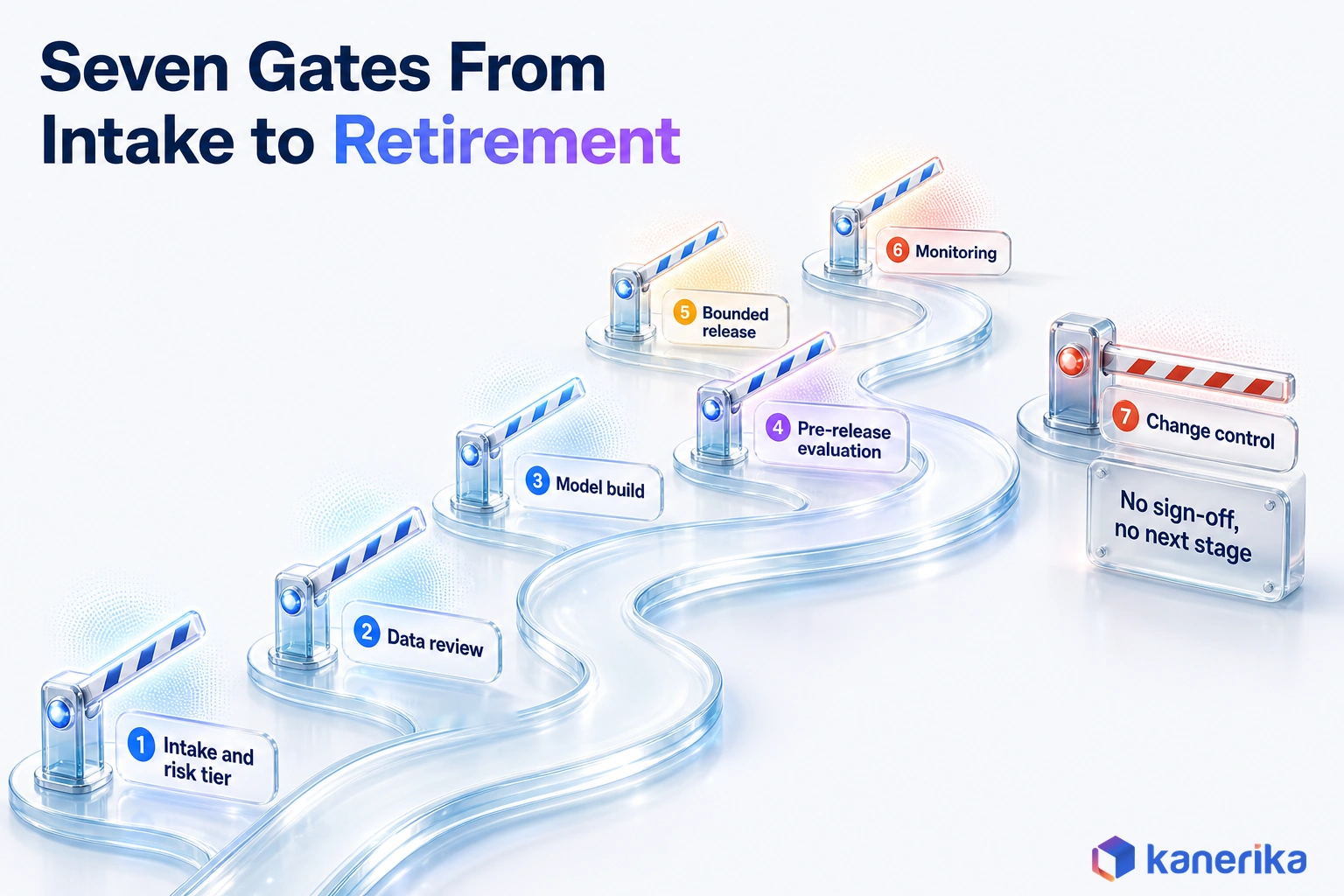
- Controls belong at seven lifecycle gates, from use-case intake and risk tiering through monitoring, change control and retirement.
- Generative AI and agents need extra controls for grounding, prompt injection, data leakage, action scope and reversibility.
- The level of control should follow the risk tier, so a credit model or an autonomous agent gets far more than an internal writing assistant.
- EU AI Act high-risk rules for Annex III areas apply from December 2, 2027, which leaves little time to build the evidence trail.
The Launch That Stalled on Three Questions
Picture a claims-triage model at a mid-sized insurer. It scores well on every accuracy test the data science team runs, and the business wants it live before quarter end.
Two weeks before launch, the risk team sends three questions. What are the error rates for each customer age band and region? Where did the training data come from, and did customers consent to that use? Who can override the model when it routes a claim the wrong way?
Nobody has the answers written down. The data scientists know the model works on average, but no one measured it by subgroup. The data also came from three systems with no lineage record, while the override process exists only as a line in a slide deck.
So the launch slips by a quarter while the team rebuilds evidence it could have produced along the way. That gap, between a model that works and a model you can prove is safe and fair, is what responsible AI practices close. This guide shows the controls, tests and records that close it, stage by stage.
What Responsible AI Means in Practice
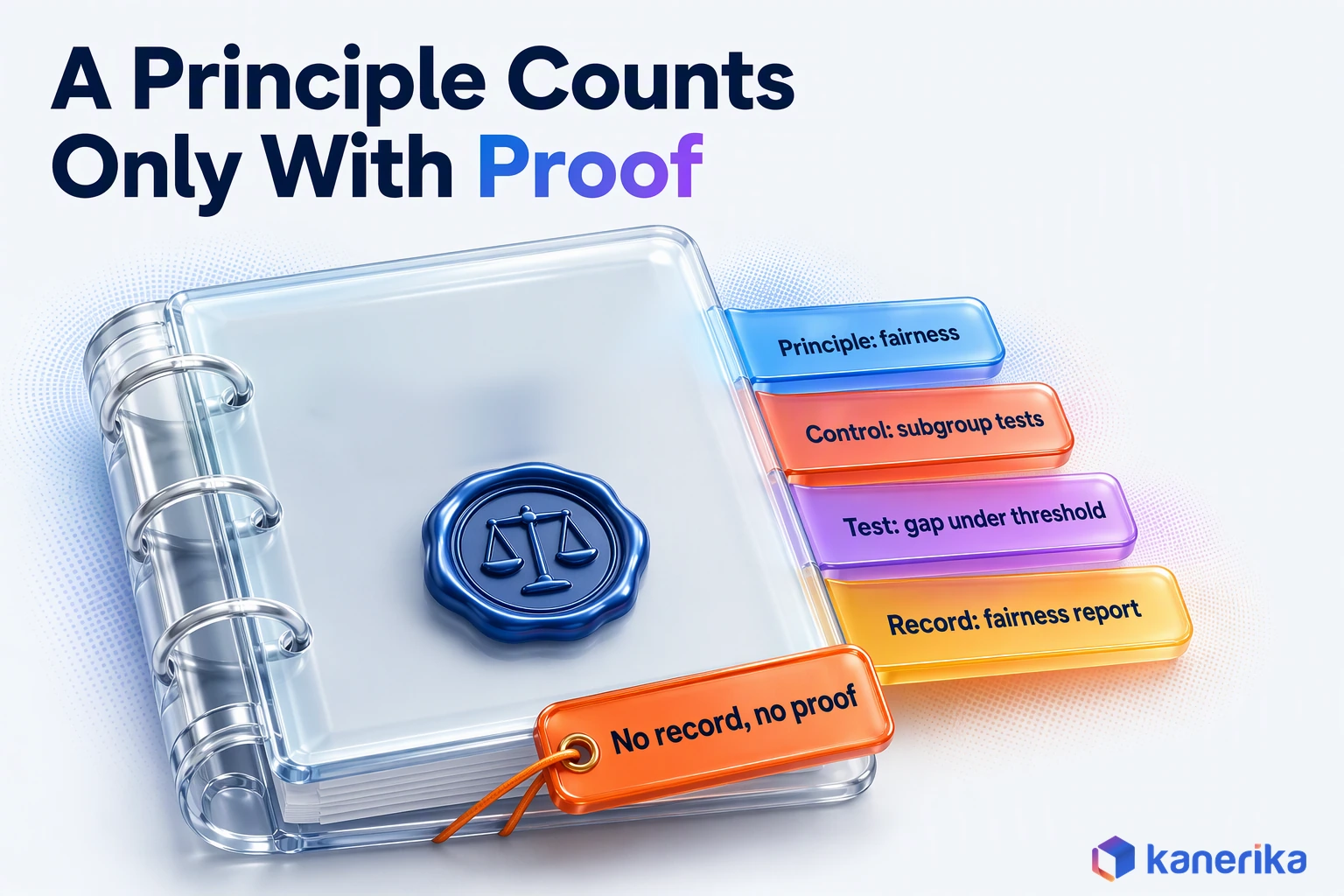
Responsible AI means building and running AI systems so that their fairness, safety, privacy, transparency and accountability can be shown with evidence. The working test is simple. For every principle you sign up to, you should be able to point to a control, a test result and a stored record.
Take fairness, for example. A policy that says “our models are fair” proves nothing on its own, because nobody can test it. A fairness practice, by contrast, names the metric (the gap in false-negative rates between groups, say) and sets an agreed threshold. It runs the test before every release and saves the report with the model version, so anyone can check it later.
The same logic applies to the other principles. Transparency becomes a model card and a chosen explanation method. Accountability, in the same way, becomes a named owner, an escalation path and a log of human overrides, which turns an ethics statement into engineering work that fits into sprints and release gates.
This shift also changes who does the work. Data scientists run the tests, while engineers build the logging and access controls and risk or compliance teams review the evidence. Responsible AI practices succeed when each of those groups knows its part before the first line of code is written.
Responsible AI vs AI Ethics vs AI Governance
These three terms overlap, so teams often use them as if they meant the same thing. They answer different questions, though, and each one has a different owner and output.
| Term | Question it answers | Who usually owns it | Typical output |
|---|---|---|---|
| AI ethics | What should we value, and what should we never build? | Leadership, ethics board, legal | Principles, red lines, acceptable-use policy |
| AI governance | Who decides, who approves and how is policy enforced? | Risk, compliance, an AI council | Operating model, approval workflow, inventory of AI systems |
| Responsible AI | How do we build and run each system so the principles hold? | Product, data science and engineering teams | Controls, test results, model cards, monitoring logs |
Ethics sets the values, and you can read more about where they get tested in our piece on ethical concerns in AI. Governance sets the decision rights, which our guide to AI governance best practices covers in depth, along with the wider AI governance framework. This article, in contrast, stays with the third layer, the practices that make both of them real inside each system.
The Six Principles of Responsible AI and the Practice Behind Each
Published frameworks use a similar set of principles. So the useful question is what each principle requires you to do. Microsoft’s widely cited version, for example, names six on its responsible AI principles page: fairness, reliability and safety, privacy and security, inclusiveness, transparency and accountability.
Large vendors also publish standards and reports on how they apply these ideas internally. Microsoft, for instance, maintains a Responsible AI Standard and released its 2026 Responsible AI Transparency Report.
Still, you do not need a vendor’s scale to copy the pattern. Map each principle to a practice, a test and a record.
| Principle | Practice | Test or metric | Evidence artifact |
|---|---|---|---|
| Fairness | Check training data balance; add fairness constraints where gaps appear | Error-rate and selection-rate gaps across groups, against an agreed threshold | Fairness report stored with each model version |
| Reliability and safety | Stress-test edge cases; set fallbacks for low-confidence outputs | Robustness tests, red-team findings, failure rate on edge-case sets | Evaluation report and red-team log |
| Privacy and security | Minimize personal data; control access to training data and endpoints | Data-access reviews, leakage tests, penetration tests | Data protection impact assessment, access logs |
| Inclusiveness | Involve affected users in design; test with diverse user groups | Usability and accessibility results by user group | User research notes, accessibility checks |
| Transparency | Choose an explanation method before build; disclose AI use to users | Explanation coverage and stability; disclosure present in the interface | Model card, data sheet, user notice |
| Accountability | Name an owner per system; define override and escalation paths | Overrides logged; incidents closed within target time | Owner register, override log, incident records |
Where Teams Struggle: Transparency and Privacy
Transparency is the principle teams most often leave until the end, and it is the hardest to retrofit. Picking the explanation method up front, in fact, shapes the model choice itself, a point our guide to explainable AI methods walks through. A credit model that must give reasons for each decline, for example, may need a simpler model family than a product-recommendation engine.
Privacy and security, in turn, lean on the same controls your data team already runs. For example, access reviews, encryption and retention rules from your data security best practices carry straight over to training data and model endpoints. What changes is the scope, because prompts, embeddings and model outputs now count as data too.
Why Responsible AI Practices Matter in 2026
The short reason is that the rules now have dates attached, and those dates also sit inside most enterprise planning cycles. A practice that was optional in pilots becomes a launch requirement once a regulator, an auditor or a large customer asks for proof.
The business case comes first, though, and the insurer from the opening shows it. Its model scored well on accuracy, yet the launch slipped a quarter because the evidence the risk team asked for did not exist. Teams that test for bias and failure before launch avoid that delay and ship fewer incidents. Approval also moves faster when the risk team receives a standard evidence pack instead of a fresh set of questions for every model. Eventually that builds trust with customers and staff, which decides whether people actually use the systems you deploy.
Kanerika Service
AI Governance Services
Kanerika runs bias and fairness audits, model validation and LLMOps governance with prompt-injection protection, so each AI system ships with the evidence your risk team needs.
Explore AI GovernanceEU AI Act: The Dates That Changed in 2026
The EU AI Act applies to providers and deployers whose AI systems are used in the EU, so it covers many US companies too. Its timeline shifted in 2026 when the AI Omnibus moved the high-risk dates, so older summaries now give the wrong deadlines. The current sequence, per the European Commission’s AI Act page, is below.
- August 1, 2024: the Act entered into force.
- February 2, 2025: prohibited practices and AI literacy obligations began to apply.
- August 2, 2025: obligations for general-purpose AI models and the governance rules took effect.
- November 19, 2025: the Commission adopted the AI Omnibus proposal.
- May 7, 2026: lawmakers reached political agreement on the Omnibus, which entered into force on July 27, 2026.
- August 2, 2026: the Act became generally applicable, with the AI Office and national authorities enforcing it.
- December 2, 2027: high-risk rules apply to the Annex III areas.
- August 2, 2028: high-risk rules apply to AI embedded in products regulated under Annex I.
The extra time for high-risk systems is still not a reason to wait, because the evidence has to exist before the deadline, not after it. Subgroup monitoring and data lineage need several release cycles of history before they show a trend. A Tier 3 system, as a result, has to start collecting that evidence well before December 2, 2027.
Our guide to EU AI Act compliance steps covers the obligations in detail.
The US Picture: NIST AI RMF and State Laws
The United States has no single federal AI law, so most enterprises anchor on the voluntary NIST AI Risk Management Framework. NIST released AI RMF 1.0 on January 26, 2023, and added the Generative AI Profile, NIST AI 600-1, on July 26, 2024. On April 7, 2026, NIST also published a concept note for a profile aimed at critical infrastructure, according to its AI RMF program page.
State laws, by comparison, are where binding duties appear first. Colorado first enacted SB 24-205 in 2024, and then on May 14, 2026, the governor signed SB 26-189. That bill repeals and reenacts the law around automated decision-making technology, with developer duties starting January 1, 2027, per the Colorado General Assembly bill page.
Readiness still trails adoption by a wide margin. Deloitte surveyed 3,235 leaders across 24 countries, as described in its April 24, 2026 article on AI agents. Only 21% reported mature governance for agentic AI. Agents are being deployed faster than the controls around them, which is why the agent section later in this guide matters.
Responsible AI Practices Across the AI Lifecycle
A lifecycle view answers the most practical question a team has: which control happens when, and who signs it off. Principles stay abstract until they are tied to a stage with a clear exit gate. That gate is the point where work cannot move forward without a named approval.
Think of it like a release pipeline for software, with quality gates that block a deploy when tests fail. Responsible AI adds gates for fairness, explainability and oversight alongside the usual accuracy and performance checks. The seven stages below cover a model from the first idea to the day it is switched off.
Before Release: Stages 1 to 4
- Use-case intake and risk tiering. The control is a short intake form that records purpose, affected people and the decisions the system will touch. The product owner and the risk lead sign off. Exit gate: a risk tier is assigned and recorded.
- Data review. The control checks provenance, consent and representativeness of every training source, following your rules on data privacy. The data owner signs off. Exit gate: a data sheet lists sources, known gaps and permitted uses.
- Model build. The control applies fairness constraints where the data review found gaps, and fixes the explanation method before training starts. The lead data scientist signs off. Exit gate: the model card draft names the method and the metrics to be tested.
- Pre-release evaluation. The control runs subgroup metrics, robustness tests and red teaming for language models. An independent reviewer signs off. Exit gate: every metric is under its agreed threshold, or a documented exception is approved.
After Release: Stages 5 to 7
- Bounded release with human oversight. The control limits who sees the system and where a person reviews outputs, an approach we cover in AI augmentation with human review. The business owner signs off. Exit gate: override paths are tested and staff are trained.
- Monitoring. The control tracks data drift, accuracy drift and fairness drift, with an incident runbook. The operations owner signs off on alert thresholds. Exit gate: dashboards and on-call ownership are live.
- Change control and retirement. The control re-runs evaluation after any retraining, prompt change or vendor model update, and records why a system is retired. The model owner signs off. Exit gate: the inventory and model card show the current version or the retirement date.
Where Lifecycle Programs Usually Break
Stage two, in particular, is where many programs quietly fail. A model trained on data that underrepresents a region or age group carries that gap into every prediction. After that, no amount of tuning fully fixes it.
Checking representativeness early costs a few days, while discovering the gap after launch can cost the whole model.
Stage five deserves equal care, since human oversight only works when it is designed in. For instance, a reviewer who clears hundreds of cases an hour cannot exercise real judgment. Good oversight sets a manageable review volume, shows the reviewer why the model decided, and makes overriding as easy as accepting. Our note on ML model deployment covers the release mechanics that sit underneath this stage.
Responsible AI Practices for Generative AI and AI Agents
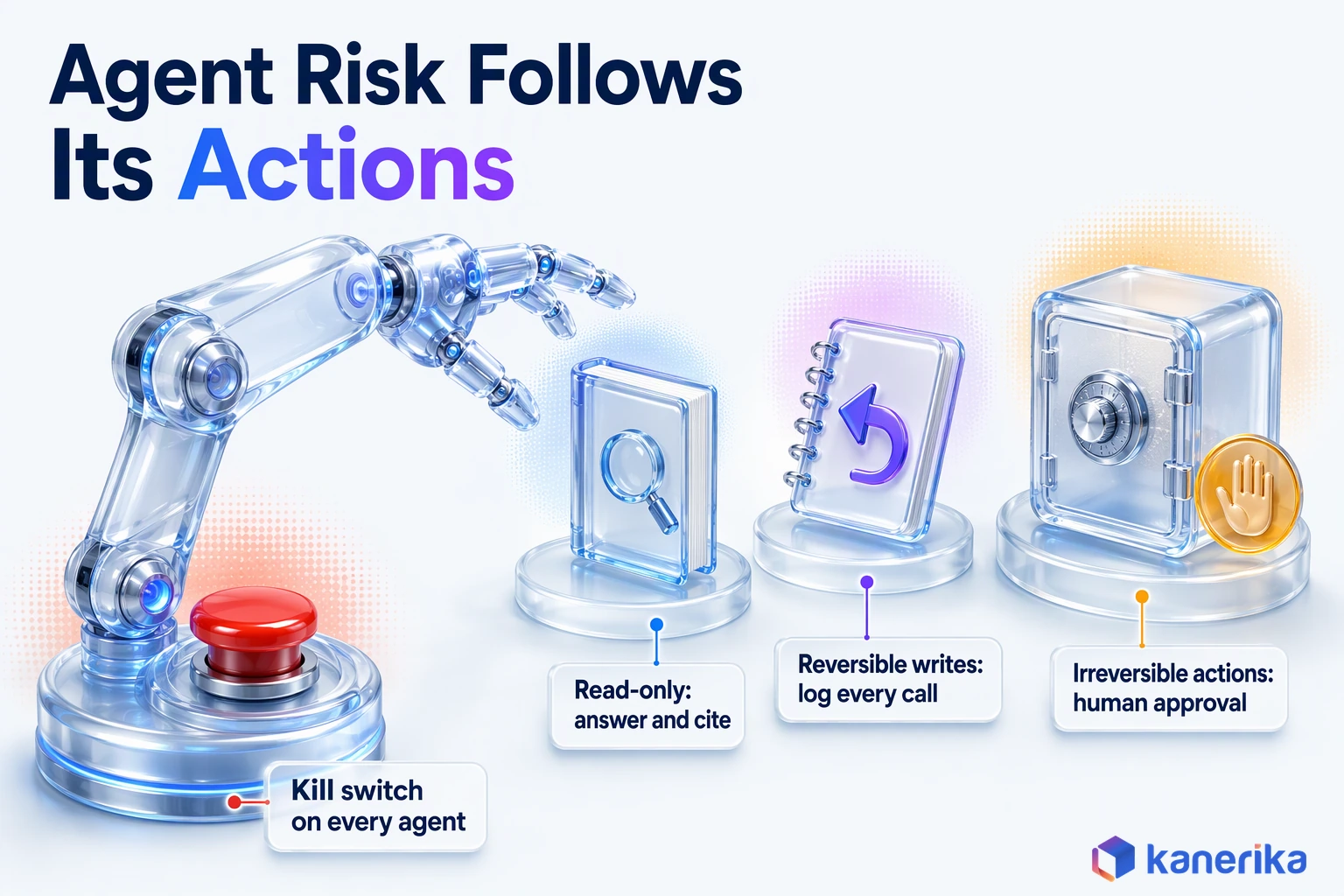
Generative AI and agents keep every risk of a classic model and add new ones, because their outputs are open-ended and agents can take actions. A credit model returns a score. An agent with tool access, however, can send an email, change a record or issue a refund, so one mistake reaches a customer directly.
The controls therefore shift toward limiting what the system can see and do. Grounding answers in approved sources, often through retrieval-augmented generation, cuts the room for made-up answers because the model must cite what it used. Permission tiers then decide which actions an agent may take alone, which need a person to approve and which are off limits.
| Risk | Control | How to test it |
|---|---|---|
| Hallucination and weak grounding | Answer only from retrieved, approved sources; cite the source in the answer | Groundedness checks on a fixed question set; sample review of citations |
| Prompt injection | Separate system instructions from user and document content; filter inputs and outputs | Injection attack suites run before each release and after prompt changes |
| Data leakage through prompts | Mask personal data; respect source permissions at retrieval time | Leakage tests with seeded sensitive records; access-control reviews |
| Agent action scope | Allow-list of tools and actions per agent; no default write access | Attempted out-of-scope actions in a test environment must be blocked |
| Permission tiers | Read-only, act with approval, act alone, mapped to the risk of each action | Review that every tool is assigned a tier; spot-check approvals |
| Reversibility | Prefer actions that can be undone; hold irreversible ones for human approval | Rollback drills for each action type the agent can take |
| Missing audit trail | Log every prompt, retrieved source, tool call and result with a trace ID | Replay a sample of sessions end to end from the logs alone |
Leakage and Multi-Agent Hand-Offs
Leakage deserves a closer look, since assistants inherit whatever access the user has. If a SharePoint folder is shared too widely, an assistant will summarize it for the wrong person. Our review of Microsoft Copilot security concerns covers this pattern in detail. Fixing permissions at the source is a responsible AI control, even though it looks like routine data hygiene.
Agents raise the stakes again, because one agent often calls another. So each hand-off in multi-agent workflows is a point where scope can widen without anyone noticing. In addition, our guides on governance for AI agents and AI guardrails go deeper on the policy side.
The podcast episode below takes up the same question from a leadership angle: how to stop an agent before it causes damage.
Responsible AI Tools by Control Function
Tools help, but each one covers a single function, and none of them makes a system responsible by itself. So the clearest way to choose is to start from the control you need and then pick a tool for it.
Fairness, in particular, has the most mature open-source options. Fairlearn is a community-driven Python toolkit for assessing and mitigating fairness issues. AI Fairness 360 (AIF360) is an Apache-2.0 library of fairness metrics and bias-mitigation algorithms.
For data lineage and access, enterprises usually rely on their existing catalog, so our roundup of data governance tools compares the options.
| Control function | Open-source example | Platform example | What it does not do |
|---|---|---|---|
| Fairness testing and mitigation | Fairlearn, AIF360 | Fairness reports inside your ML platform | Decide which groups and thresholds matter for your use case |
| Explainability | Feature-attribution libraries | Built-in explanation views in ML platforms | Make a complex model simple enough for a regulator |
| Privacy and data access | Data masking and anonymization libraries | Microsoft Purview, Databricks Unity Catalog | Fix permissions that were already too broad at the source |
| Monitoring and drift | Drift detection libraries | Model monitoring in your MLOps stack | Tell you whether a drift alert should stop the model |
| Documentation | Model card and data sheet templates | Model registries with metadata fields | Write the content or keep it current after retraining |
| GenAI safety | Prompt-injection and evaluation test suites | Content filters in your model provider | Limit what an agent is allowed to do with its tools |
The last column is the one buyers skip. A fairness library can report the gap in approval rates between two groups. However, it cannot tell you whether that gap is acceptable for your lending policy. That judgment stays with the model owner and the risk team, while the tool simply makes the evidence faster to produce.
Kanerika Service
Data Governance Services
Kanerika combines KANGovern, KANGuard and KANComply on Microsoft Purview and Databricks Unity Catalog to give AI teams lineage, access control and compliance checks.
Explore Data GovernanceDecision Framework: How Much Control Each AI Use Case Needs
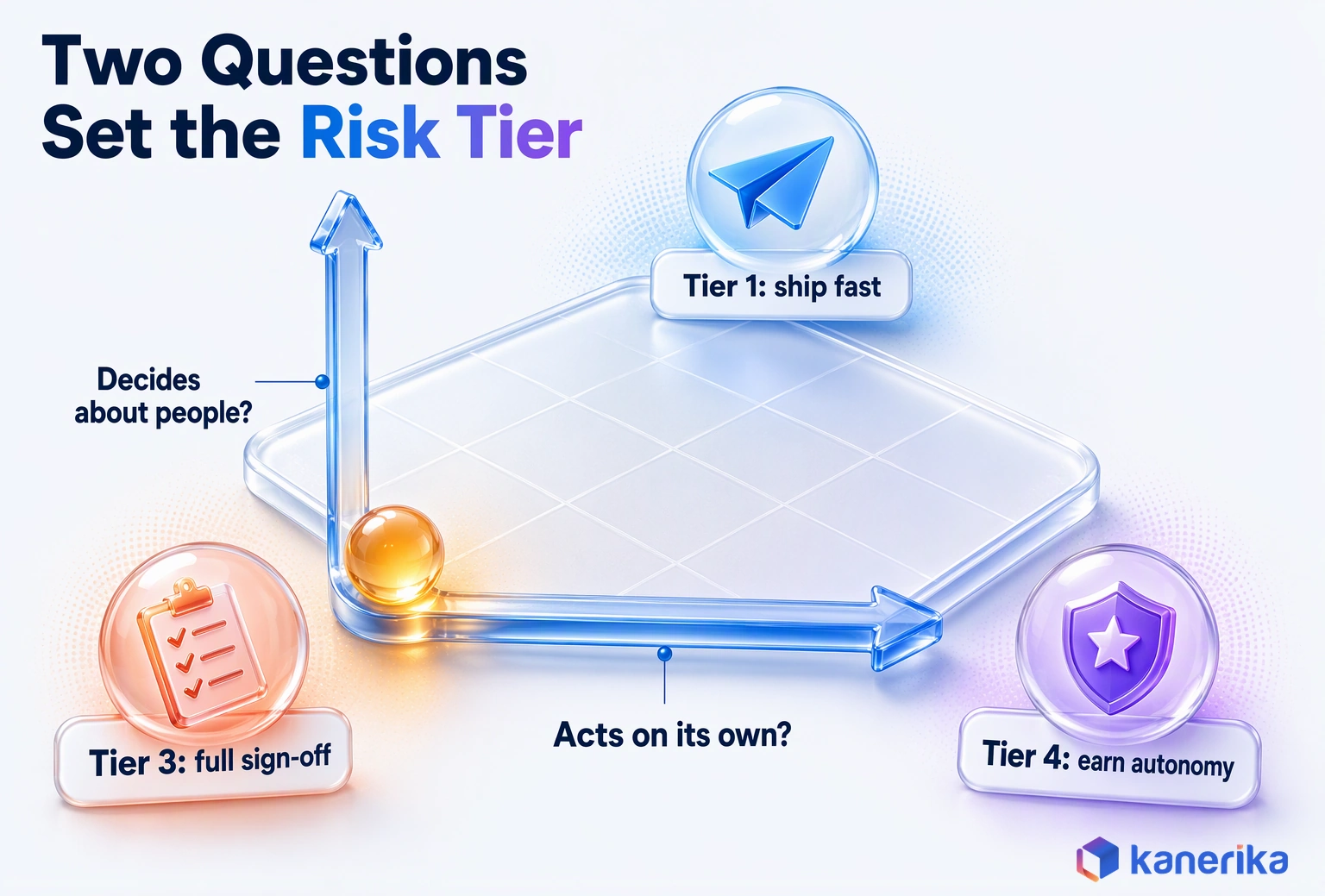
Not every AI system needs the same depth of control, since treating them all alike either slows low-risk work or under-protects high-risk work. The fix, therefore, is a tiered framework where the risk of the use case sets the minimum controls and the level of human oversight.
Two questions decide the tier. Does the system make or shape a decision about a person, such as credit, hiring, insurance or medical care? Can it act on its own, or does it only produce text and suggestions for a person to use? The answers then move a use case up or down the table below.
| Risk tier | Typical examples | Minimum controls | Human oversight | Our pick |
|---|---|---|---|---|
| Tier 1: internal productivity | Drafting, summarizing, internal search | Acceptable-use policy, data access review, usage logging | User reviews own output | Ship fast with light controls |
| Tier 2: customer-facing GenAI | Support chat, marketing content, retail product Q&A | Grounding, injection tests, content filters, AI disclosure | Sampled review and escalation path | Ship with grounding and sampled review |
| Tier 3: consequential decisions | Credit limits, hiring screens, claims triage, patient prioritization | Full lifecycle gates, subgroup metrics, explanations, impact assessment | Person approves or can override every decision | Full testing and sign-off before launch |
| Tier 4: autonomous agents | Agents that issue refunds, change records or place orders | Tier 3 controls plus action allow-lists, permission tiers, rollback, full trace logs | Approval for irreversible actions; kill switch | Start read-only, earn autonomy in steps |
Sector, in other words, matters mostly through these two questions. Banking, insurance and healthcare land in Tier 3 more often, because their models touch decisions about people. Manufacturing and logistics usually sit in Tiers 1 and 2, unless an agent controls physical operations. Our AI governance practices guide explains how the approval workflow attaches to each tier.
Worked Example: An Internal Assistant That Starts Taking Actions
Consider an internal IT help assistant that begins life answering questions about the VPN and password resets. At this point it is Tier 1. The controls are an acceptable-use policy, a check that it only reads approved help articles, and usage logs.
Six months later, the team connects it to the ticketing system so it can file tickets on the user’s behalf.
Filing a ticket is a write action, but it is low impact and easy to reverse. The team then adds an allow-list with one tool and logs every call with a trace ID. It also runs injection tests so that a pasted email cannot trigger a flood of tickets.
Next, finance asks whether the same assistant could approve small software refunds. Now it moves money, so it becomes a different kind of agent among the types of AI agents a company runs. As a result, the assistant moves to Tier 4.
Refunds now go through an approval step, and a rollback procedure is tested first. Finally, the agent gets a spending cap and a kill switch owned by a named finance lead.
In the end, nothing about the underlying model changed across those three steps. The risk changed because the actions changed, and the controls followed the risk. That is the habit worth building: re-tier a system every time it gains a new tool.
Responsible AI Standards and Frameworks to Anchor On
A standard gives your controls a shared vocabulary that auditors, regulators and customers already recognize. Instead of inventing your own structure, you map each practice to a framework clause or function, and the evidence then answers several frameworks at once.
In practice, four references cover what most US enterprises need. The NIST AI RMF and its Generative AI Profile give a risk process. ISO/IEC 42001:2023 is the AI management system standard. The OECD AI Principles, adopted in 2019 and updated in May 2024, now have 47 adherents.
| Framework | Type | Certifiable? | Use it for |
|---|---|---|---|
| NIST AI RMF 1.0 and NIST AI 600-1 | Voluntary US framework and GenAI profile | No | Structuring risk work into govern, map, measure and manage |
| ISO/IEC 42001:2023 | International management system standard | Yes | A formal, auditable AI management system |
| EU AI Act | Binding regulation | No, but high-risk systems need conformity assessment | Legal obligations for systems used in the EU |
| OECD AI Principles | Intergovernmental principles | No | Policy language that matches what governments expect |
For a clause-by-clause comparison, see how NIST AI RMF and ISO 42001 map to each other. Teams that also track AI trust, risk and security management as one program can read our explainer on AI TRiSM.
AI Assessment
Where Does Your AI Program Stand?
Score your data, processes and governance with Kanerika’s AI maturity assessment and see which controls to build before the next deadline.
Start Your AI Assessment →Common Responsible AI Mistakes and How to Fix Them
The same handful of mistakes shows up across industries. Most of them come from treating responsible AI as a one-time review instead of a habit. Each one is cheap to fix early and expensive to fix after an incident.
| Mistake | What it causes | Fix |
|---|---|---|
| Testing accuracy only | A model that works on average but fails one group badly | Add subgroup metrics to every evaluation run |
| Checking fairness once | Fairness drift goes unseen as the population changes | Monitor fairness metrics in production with alerts |
| Adding explainability after launch | Explanations that do not match how the model decides | Choose the explanation method at the build stage |
| No owner for model incidents | Slow, confused response when something goes wrong | Name an owner and an on-call path per system |
| Agent given write access by default | Unintended actions that are hard to undo | Start read-only; grant actions one tool at a time |
| Trusting vendor models without checks | Inherited bias or safety gaps you cannot see | Re-run your own evaluations on any vendor model or update |
The vendor row is growing fastest. Many enterprises now build on foundation models they did not train, so the provider’s documentation becomes one input, not the final word. Running your own test set against each new model version is therefore the only way to know how it behaves on your data. For real programs that handle these trade-offs well, see these real AI governance examples.
A quieter mistake, though, is skipping the data foundation. Fairness and privacy controls depend on knowing where data came from and who may use it, which is a data governance question first. So teams with weak catalogs and lineage tend to stall at the data review gate.
How to Measure Responsible AI: KPIs and Audit Evidence
Measurement turns responsible AI from a stated intent into something leadership can track and an auditor can verify. A useful KPI has two parts: a number that moves, and a record that proves the number is real.
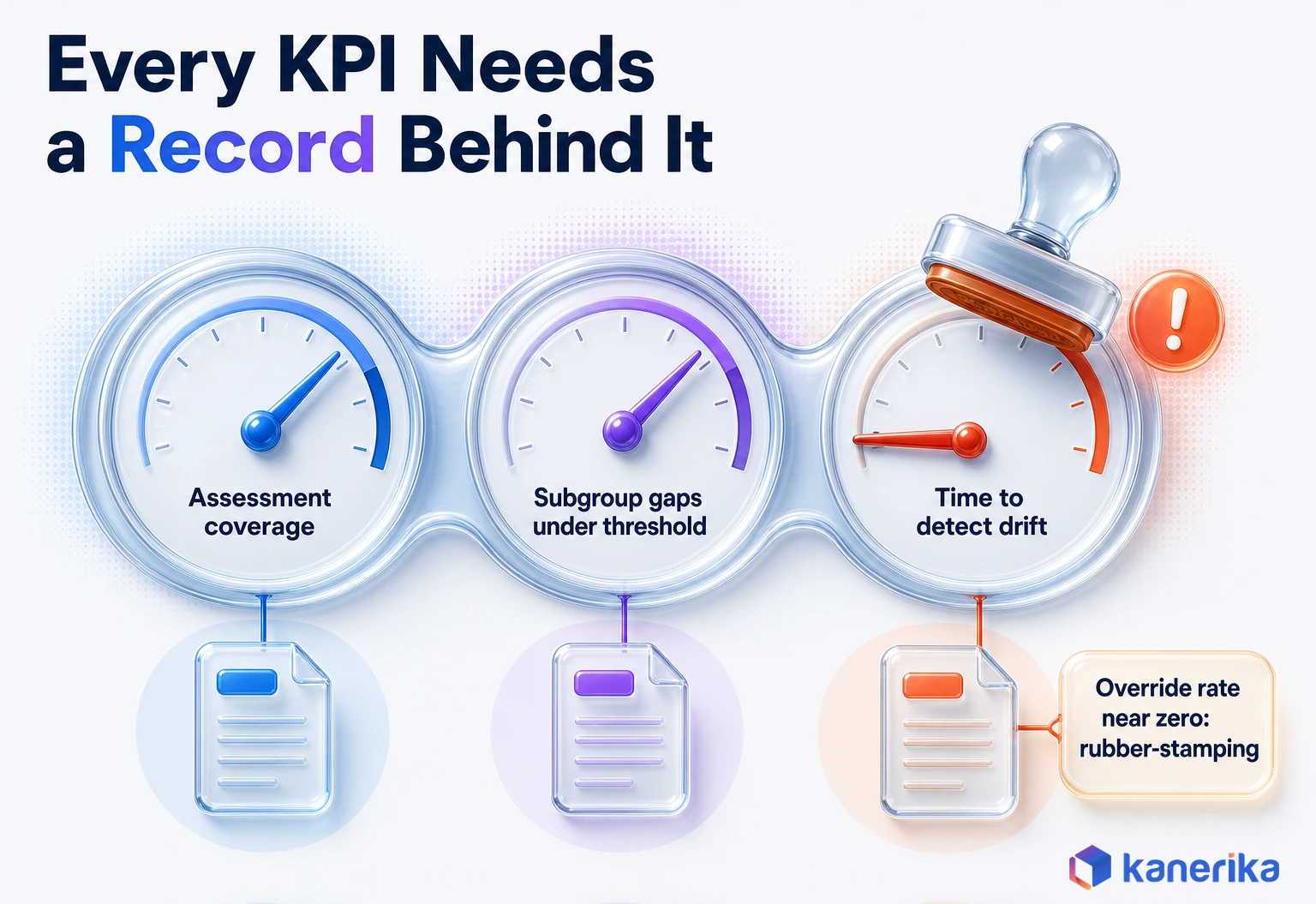
Start with coverage, then quality, then speed. First, coverage tells you whether controls exist for every system. Then quality tells you whether the systems pass. Speed tells you how fast the team spots and fixes problems once they appear.
- Impact assessment coverage: the share of production models with a completed assessment. Evidence: the AI inventory, with a link to each assessment.
- Subgroup metric gaps: the share of Tier 3 and Tier 4 models whose subgroup gaps sit under the agreed threshold. Evidence: fairness reports tied to model versions.
- Time to detect drift: the hours between a drift event and an alert reaching the owner. Evidence: monitoring logs and alert timestamps.
- Overrides logged: the count and rate of human overrides, reviewed for patterns. Evidence: the override log with reasons.
- Incidents closed: AI incidents opened and closed within the target time. Evidence: incident tickets with root cause and fix.
- Documentation freshness: the share of model cards updated after the last retraining or prompt change. Evidence: registry version history.
Reading the Signals
Of these signals, the override rate is the most telling, because it reflects human judgment. A rate near zero can mean reviewers are rubber-stamping, while a rising rate can mean the model is drifting. Either way, it tells you where to look next. Programs that already track data quality maturity can also extend the same scorecard, as in our data governance maturity model.
Set the thresholds before the first report goes to leadership. Otherwise, a gap limit agreed after the numbers arrive tends to drift toward whatever the model already achieves. Write each threshold into the model card, review it once a year, and record who approved any change.
How Kanerika Builds Responsible AI Into Delivery
At Kanerika, responsible AI is part of how we deliver AI work rather than a separate review at the end. The approach follows the lifecycle above in five stages, so each stage leaves its own evidence.
We start by assessing and tiering each use case, so the depth of control matches the risk from day one. That assessment lists every AI system in scope, the people each one affects and the decisions it touches.
Next comes the data foundation. Our data governance services run KANGovern, KANGuard and KANComply on Microsoft Purview, Databricks Unity Catalog and Concentric AI. For your AI system, that means lineage records that fill in the sources on the stage 2 data sheet. Access control and compliance checks cover the training data in the same pass.
The video below shows how that work comes together on a real compliance platform built to run across jurisdictions.
During build, the AI governance practice runs bias and fairness audits and model validation. For LLM systems it also adds LLMOps governance, including prompt-injection protection with output filtering. Release then happens with human oversight designed in, followed by monitoring that tracks drift and incidents.
Each stage hands a record to the next one. The tier decides which tests run, the test results feed the release decision, and the monitoring logs feed the next review. Clients end up with an evidence pack per system. Their risk team, auditors and regulators can read it without a data scientist in the room. Kanerika itself holds ISO/IEC 27001 and 27701, SOC 2, GDPR compliance and CMMI Level 3, so client data in this work is handled under audited controls.
Case Study: Traceability for a Compliance Provider
One engagement, for instance, shows why traceability is what makes responsible AI provable. A leading AI-powered regulatory compliance solutions provider serving financial institutions across multiple jurisdictions struggled with fragmented workflows. Its teams interpreted regulations and mapped controls by hand, so audit readiness had gaps.
Kanerika built a centralized AI compliance platform with automated requirement mapping, controls monitoring, audit traceability and dashboards. The results, as reported in the compliance oversight case study, were 60% less manual compliance work, 40% faster regulatory response and 5X better audit traceability. In short, every requirement now links to a control and a record, which is the same chain this guide recommends for every AI system.
Case Study
60% Less Manual Compliance Work with AI
A regulatory compliance solutions provider serving financial institutions moved to a centralized AI compliance platform, gaining 40% faster regulatory response and 5X better audit traceability.
Read the Case Study →A Responsible AI Deployment Checklist
Use this checklist before any AI system goes live, and again after any major change. Each item should also produce a record you could hand to an auditor tomorrow.
- The use case is in the AI inventory with a named owner and a risk tier.
- Training data has a data sheet covering sources, consent and known gaps.
- Fairness metrics and thresholds are agreed and documented before training.
- The explanation method is chosen and tested on real cases.
- Subgroup, robustness and red-team results are stored with the model version.
- For GenAI, grounding and prompt-injection tests pass on a fixed test set.
- For agents, every tool has a permission tier and irreversible actions need approval.
- Human override paths work, reviewers are trained and overrides are logged.
- Drift and fairness monitoring are live, with alert owners and an incident runbook.
- The model card is current, and a re-review date is set.
Run the list as a release gate rather than a form. If an item has no record behind it, the system waits until it does. For Tier 1 tools, items six to eight may not apply, so mark them as not relevant with a reason rather than leaving them blank.
Repeat the review on a fixed cadence as well as after changes. Tier 3 and Tier 4 systems deserve a check every quarter, because user populations and upstream data shift even when nobody touches the model. Lower tiers can follow an annual cycle, with an extra review whenever a system gains a new data source or tool.
For a longer roadmap that also covers policy and culture, our white paper on ethical AI implementation for enterprises is a useful companion.
Checklist
AI Governance Checklist
Kanerika’s AI governance checklist turns owners, risk tiers, testing and monitoring into steps you can tick off before each AI system goes live.
Get the Checklist →The Bottom Line
Principles, tools and standards each play a part, but none of them works alone. The principles tell you what to protect, while the tools produce the evidence. Standards such as the NIST AI RMF and ISO/IEC 42001 then give that evidence a shape auditors accept.
So which responsible AI practices should you adopt first? Start with an AI inventory that gives every system a risk tier. From there, Tier 1 tools need only light controls, while Tier 3 and Tier 4 systems pass full lifecycle gates for testing, explanations and human sign-off. Whatever the tier, re-tier whenever a system gains a new tool.
Frequently Asked Questions
What is responsible AI?
Responsible AI is the practice of building and running AI systems so their fairness, safety, privacy, transparency and accountability can be proven. Each principle becomes a control you build, a test you run and a record you keep. A fairness commitment, for example, turns into subgroup error-rate tests before every release. The aim is evidence that holds up under audit.
Why is responsible AI important for organizations?
Responsible AI lowers the chance of biased, unsafe or unexplained decisions reaching customers. It also speeds up approvals, because risk teams receive a standard evidence pack for each model. Regulation adds urgency, since the EU AI Act became generally applicable on August 2, 2026. Trust follows too, and staff and customers use systems they believe are fair.
How do you measure whether an AI model is fair?
Pick the groups that matter for the use case, such as age bands or regions. Then compare metrics like error rates, false-negative rates and selection rates across those groups. Agree a threshold for the largest acceptable gap before testing starts. Open-source tools such as Fairlearn and AIF360 calculate these metrics and suggest mitigation methods.
What does meaningful human oversight of AI look like?
Meaningful oversight gives a trained person the information, time and authority to change the outcome. The reviewer sees why the model decided, handles a manageable volume of cases and can override as easily as accept. Every override is logged with a reason. For agents, oversight means approval before irreversible actions and a working kill switch.
Which responsible AI standards should US enterprises follow?
Most US enterprises anchor on the NIST AI Risk Management Framework and its Generative AI Profile, NIST AI 600-1. Companies that want a certifiable management system add ISO/IEC 42001:2023. Firms with EU users also follow the EU AI Act. State laws matter too, and Colorado’s developer duties for automated decision systems start January 1, 2027.
How much does it cost to implement responsible AI?
Cost depends on the number of AI systems, their risk tiers and the state of your data governance. Tier 1 internal tools need little beyond policy and logging. Consequential decision models and autonomous agents need testing, monitoring and review time. Companies with good data catalogs and lineage spend less, because the data review gate moves faster.
What tools help implement responsible AI?
Tools map to control functions. Fairlearn and AIF360 cover fairness testing and mitigation. Feature-attribution libraries support explainability. Data catalogs such as Microsoft Purview and Databricks Unity Catalog handle lineage and access. Drift monitors, model registries and prompt-injection test suites cover the rest. No single tool makes a system responsible, so start from the control you need.
What are the main principles of responsible AI?
Most frameworks share six principles. These are fairness, reliability and safety, privacy and security, inclusiveness, transparency and accountability. Microsoft publishes this exact list, and other frameworks such as the OECD AI Principles cover similar ground. The principles matter only when each one maps to a practice, a test or metric, and an evidence artifact stored with the model.
How does responsible AI help reduce bias in AI systems?
Bias control starts with the data review, which checks whether every group is fairly represented in the training data. During build, teams can add fairness constraints where gaps appear. Before release, they compare error rates and selection rates across groups against an agreed threshold. After launch, fairness monitoring catches drift as the user population changes over time.
What are the risks of ignoring responsible AI?
Ignoring responsible AI exposes a company to biased decisions, privacy breaches and agents that take harmful actions. Each can lead to regulatory penalties, lawsuits and lost customer trust. Launches also slip, because risk teams ask for evidence nobody collected. Rebuilding that evidence after the fact usually costs far more than producing it during the build.
How does responsible AI apply to generative AI and AI agents?
Generative AI keeps every classic model risk and adds hallucination, prompt injection and data leakage through prompts. Agents add the risk of real actions such as refunds or record changes. Controls include grounding answers in approved sources, injection testing, permission tiers per tool, approval for irreversible actions and a full log of every tool call.
How can organizations implement responsible AI at scale?
Scale comes from a repeatable process rather than one-off reviews. Start with an inventory of AI systems and a risk tier for each one. Attach controls to seven lifecycle gates, from intake to retirement. Standardize the evidence pack so every model produces the same records. Then automate tests and monitoring inside the existing MLOps pipeline wherever possible.
How do organizations measure the success of responsible AI initiatives?
Useful measures cover coverage, quality and speed. Track the share of models with completed impact assessments and the share whose subgroup gaps sit under threshold. Measure time to detect drift, the human override rate and incidents closed within target time. Each number should link to a record, such as a fairness report or an incident ticket.
What is the difference between responsible AI and AI governance?
AI governance decides who approves AI systems, which policies apply and how they are enforced across the company. Responsible AI is the practical work inside each system that makes those policies true. Governance produces an operating model and an approval workflow. Responsible AI produces fairness reports, model cards, monitoring logs and the other evidence governance reviews.
Who is responsible for responsible AI in a company?
Ownership is shared, and each system needs one named owner. Data scientists run fairness and robustness tests. Engineers build logging, access controls and agent permissions. Risk and compliance teams review the evidence and approve high-risk launches. Leadership sets the principles and funds the work. The named model owner answers for incidents and decides when to override.